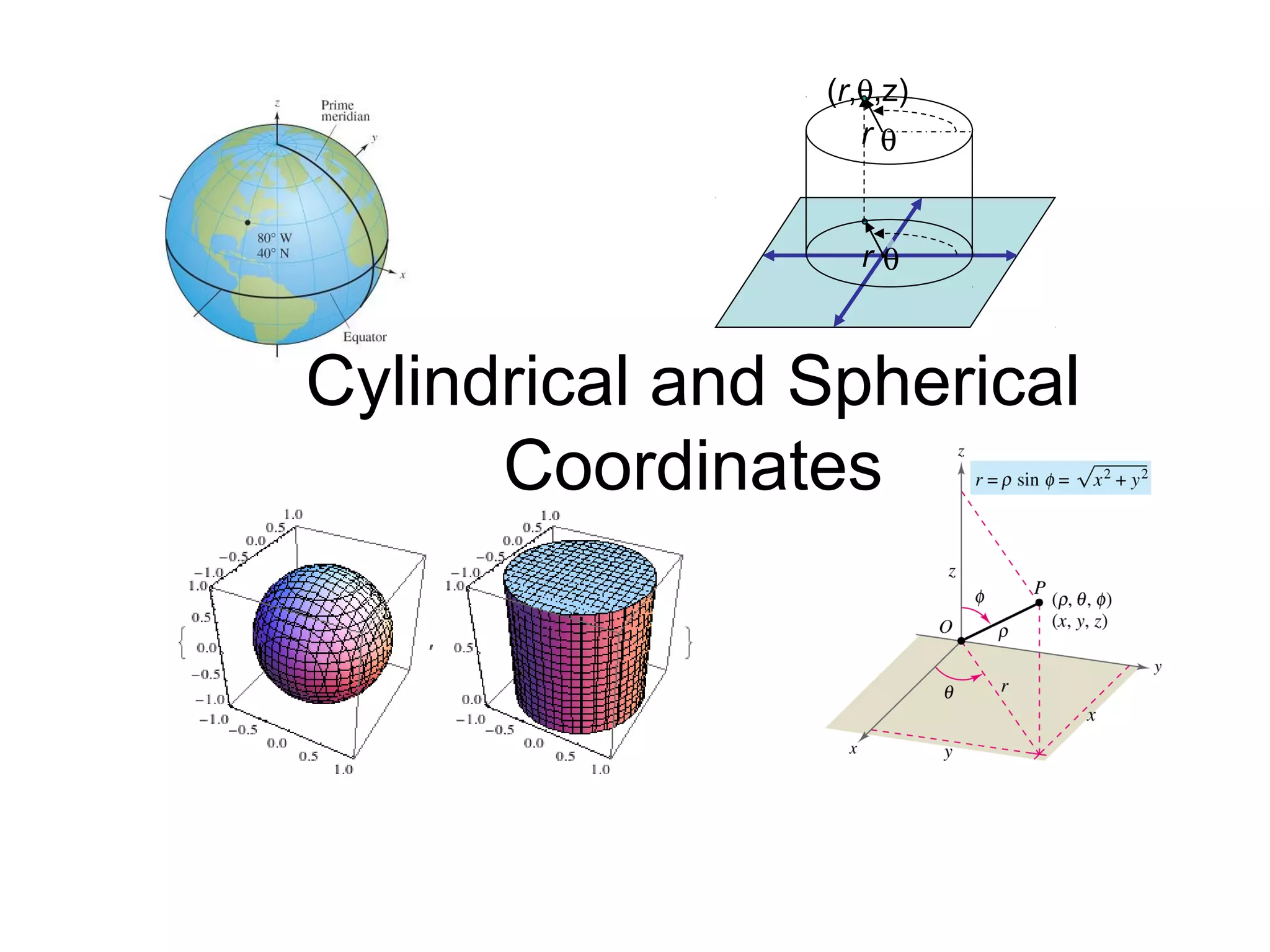
Cylindrical and Spherical
Coordinates
θr
θr
(r,θ,z)
2
 Discuss the cylindrical and spherical coordinates;
 Solve the cylindrical and spherical coordinates in
Cartesian coordinates and vice versa;
 Develop patience and teamwork with their partners in
answering different problems of cylindrical and spherical
coordinates.
Objectives
3
4
5
6
7
8
9
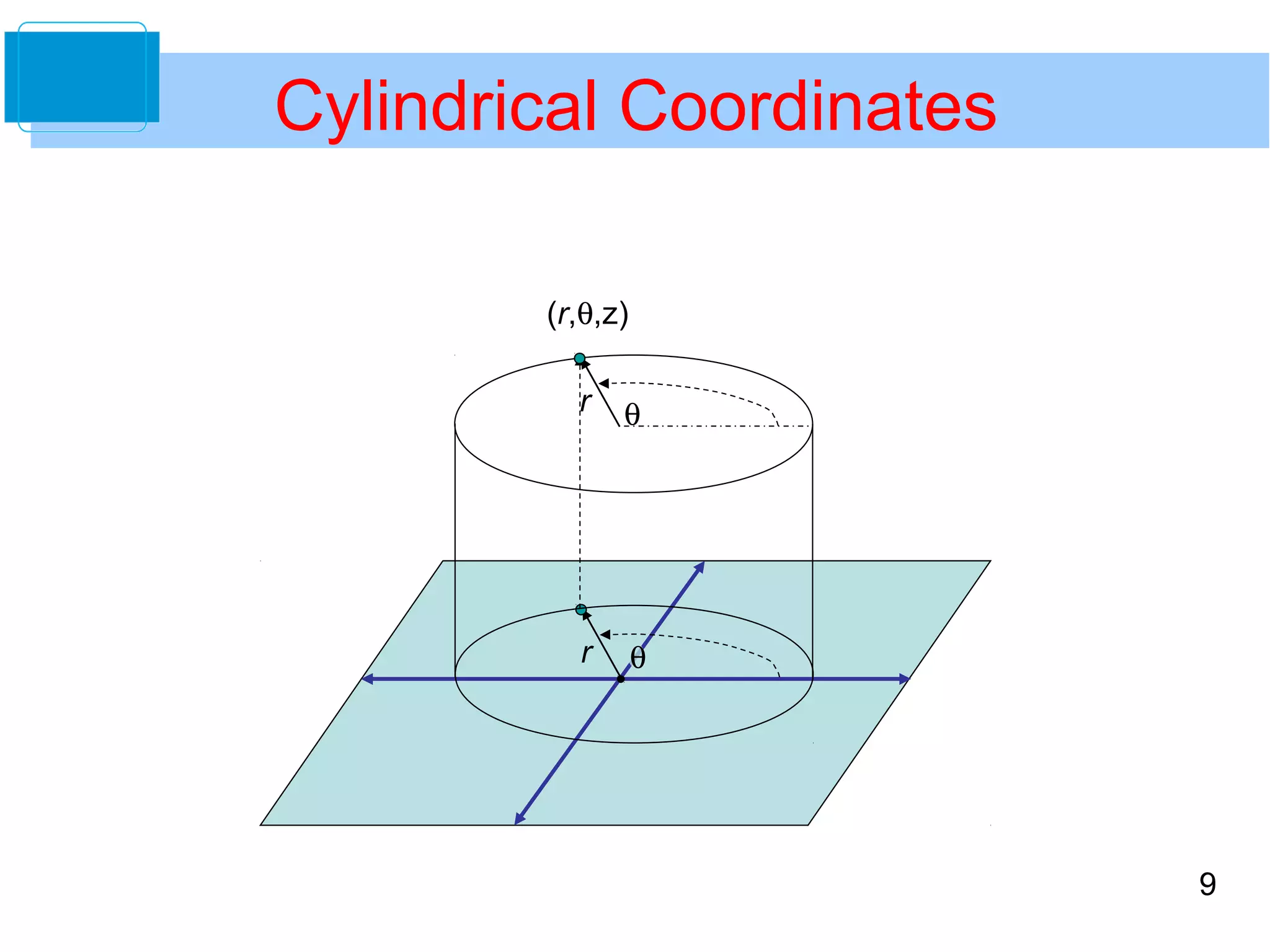
Cylindrical Coordinates
θr
θr
(r,θ,z)
10
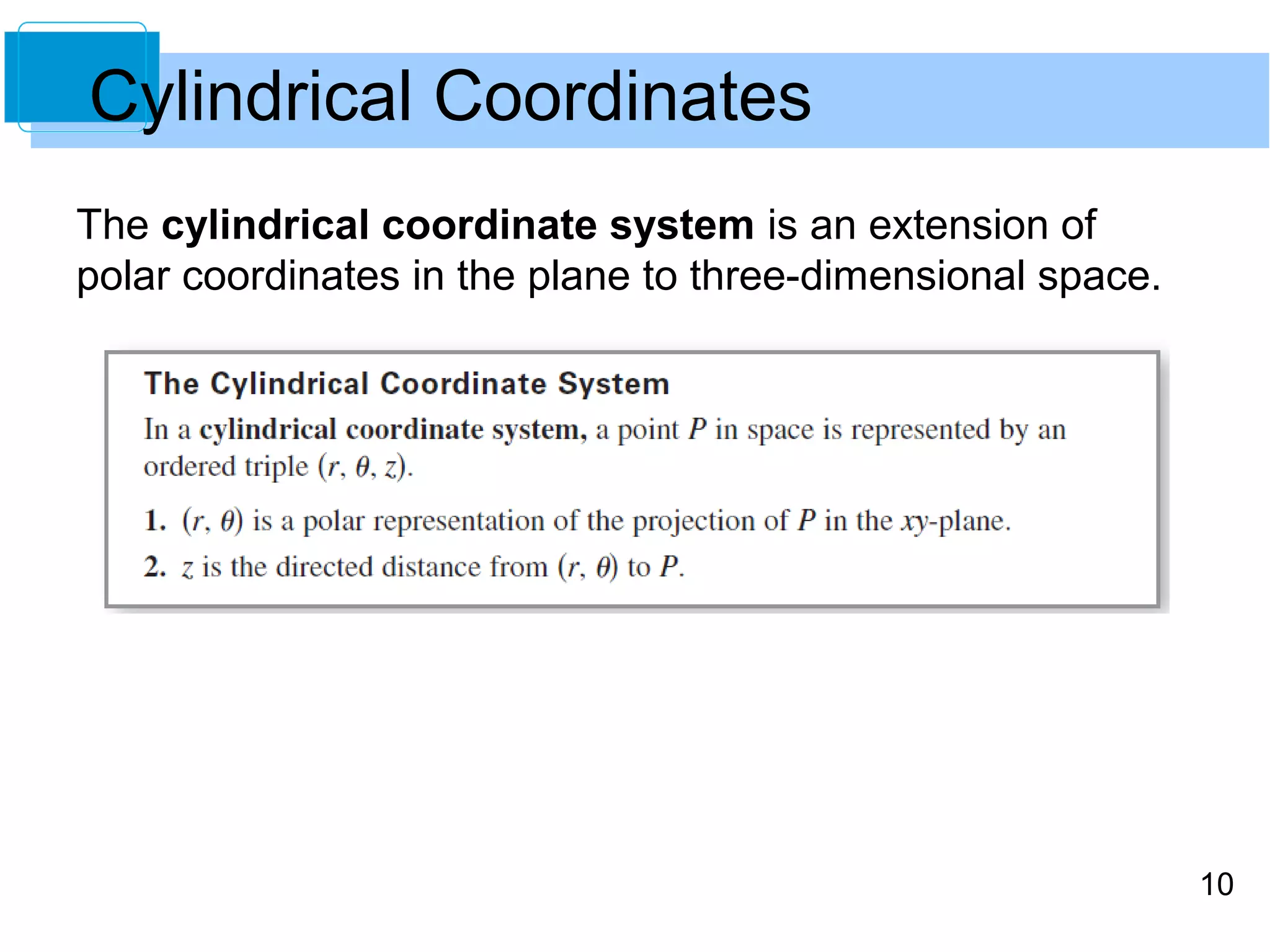
The cylindrical coordinate system is an extension of
polar coordinates in the plane to three-dimensional space.
Cylindrical Coordinates
11
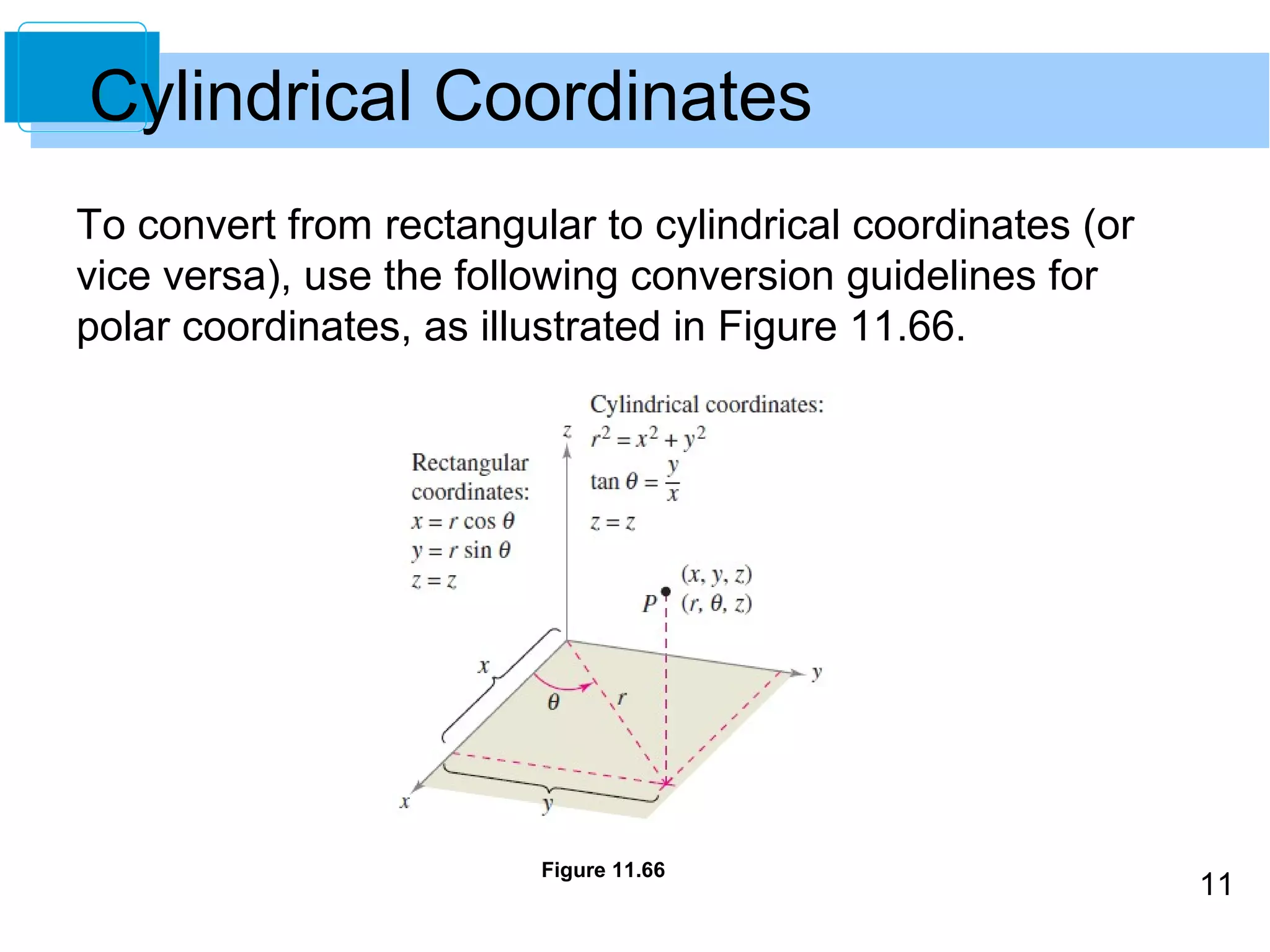
To convert from rectangular to cylindrical coordinates (or
vice versa), use the following conversion guidelines for
polar coordinates, as illustrated in Figure 11.66.
Figure 11.66
Cylindrical Coordinates
12
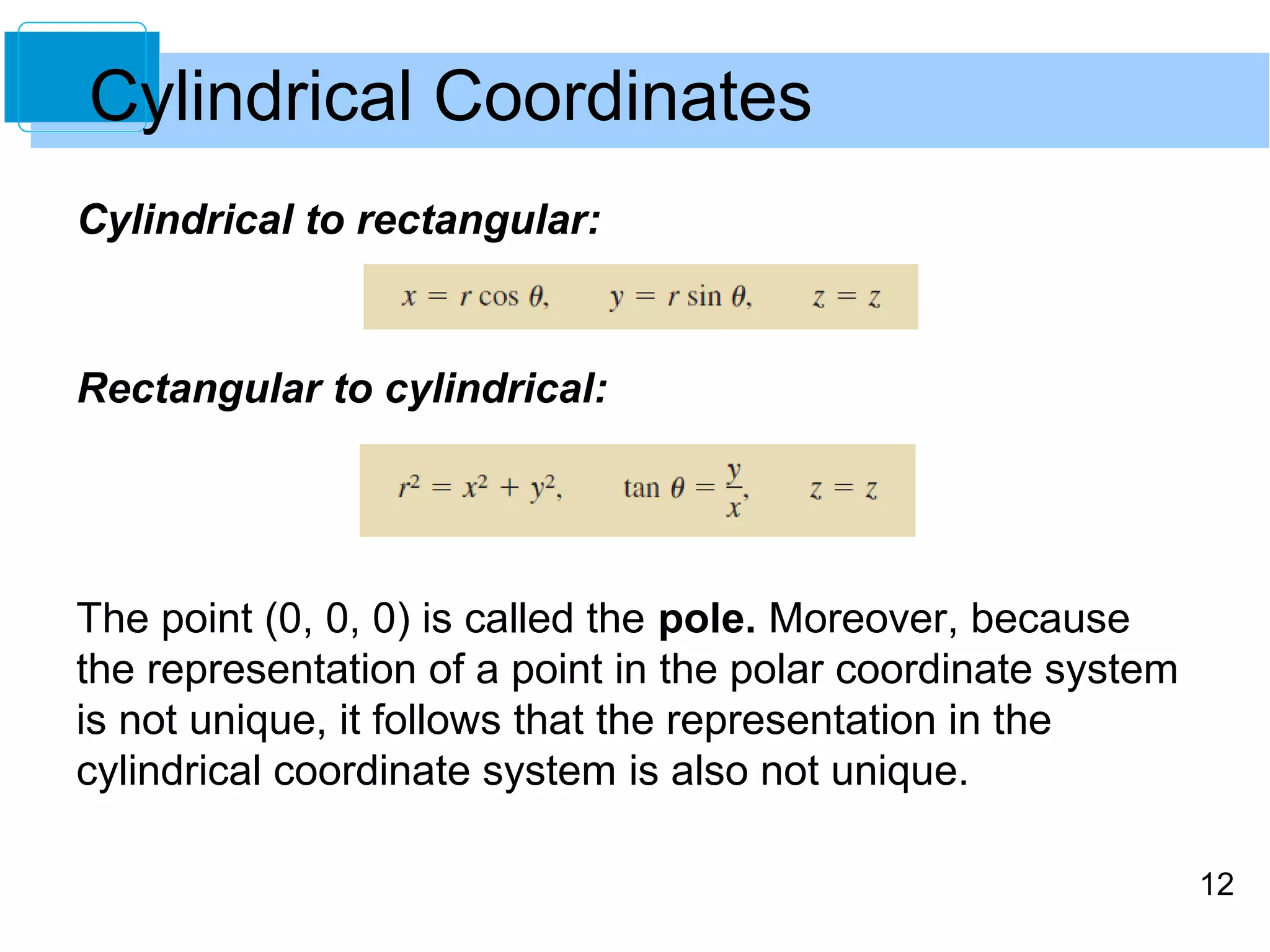
Cylindrical to rectangular:
Rectangular to cylindrical:
The point (0, 0, 0) is called the pole. Moreover, because
the representation of a point in the polar coordinate system
is not unique, it follows that the representation in the
cylindrical coordinate system is also not unique.
Cylindrical Coordinates
13
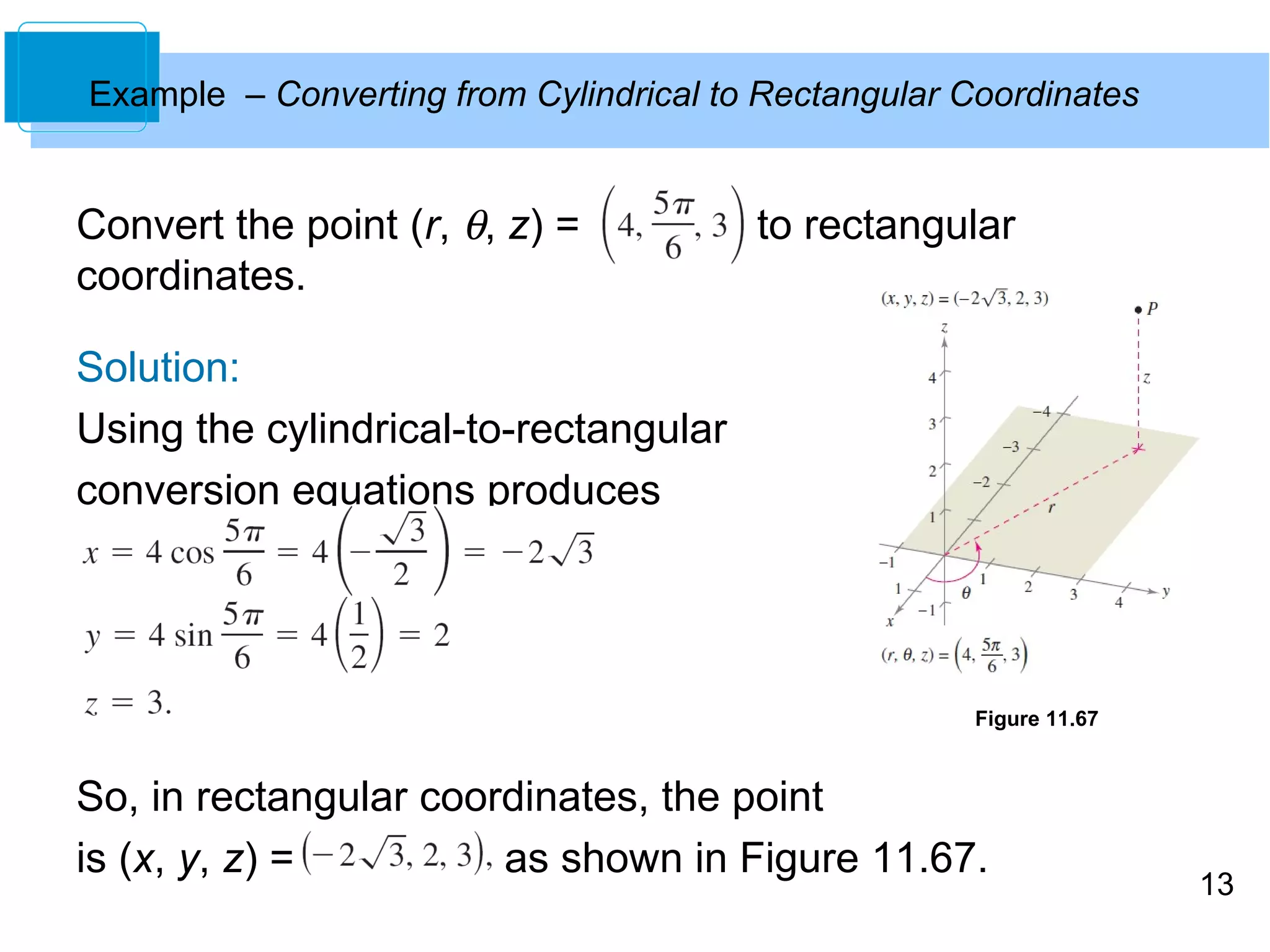
Convert the point (r, θ, z) = to rectangular
coordinates.
Solution:
Using the cylindrical-to-rectangular
conversion equations produces
So, in rectangular coordinates, the point
is (x, y, z) = as shown in Figure 11.67.
Example – Converting from Cylindrical to Rectangular Coordinates
Figure 11.67
14
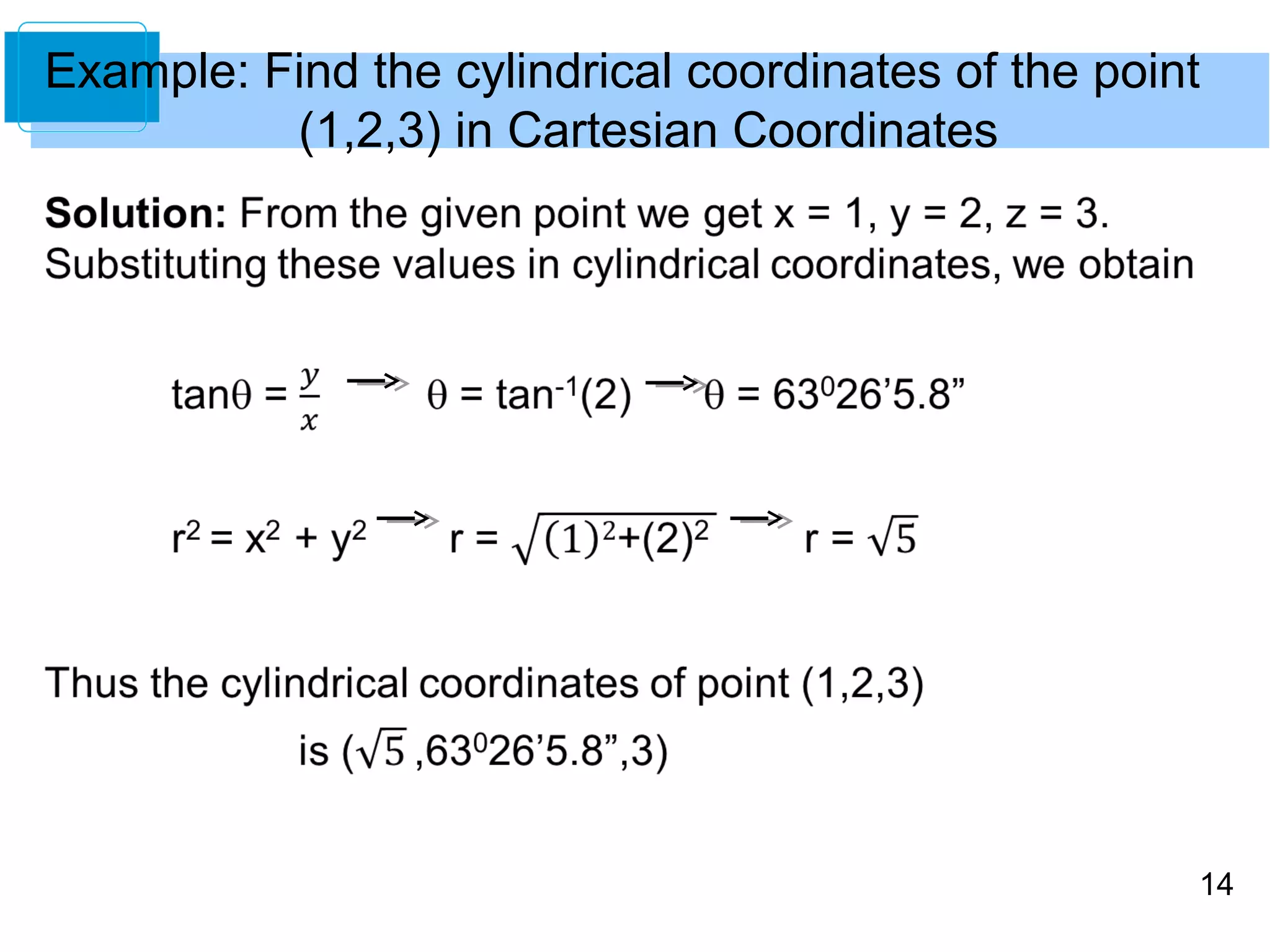
Example: Find the cylindrical coordinates of the point
(1,2,3) in Cartesian Coordinates
15
Cylindrical Coordinates
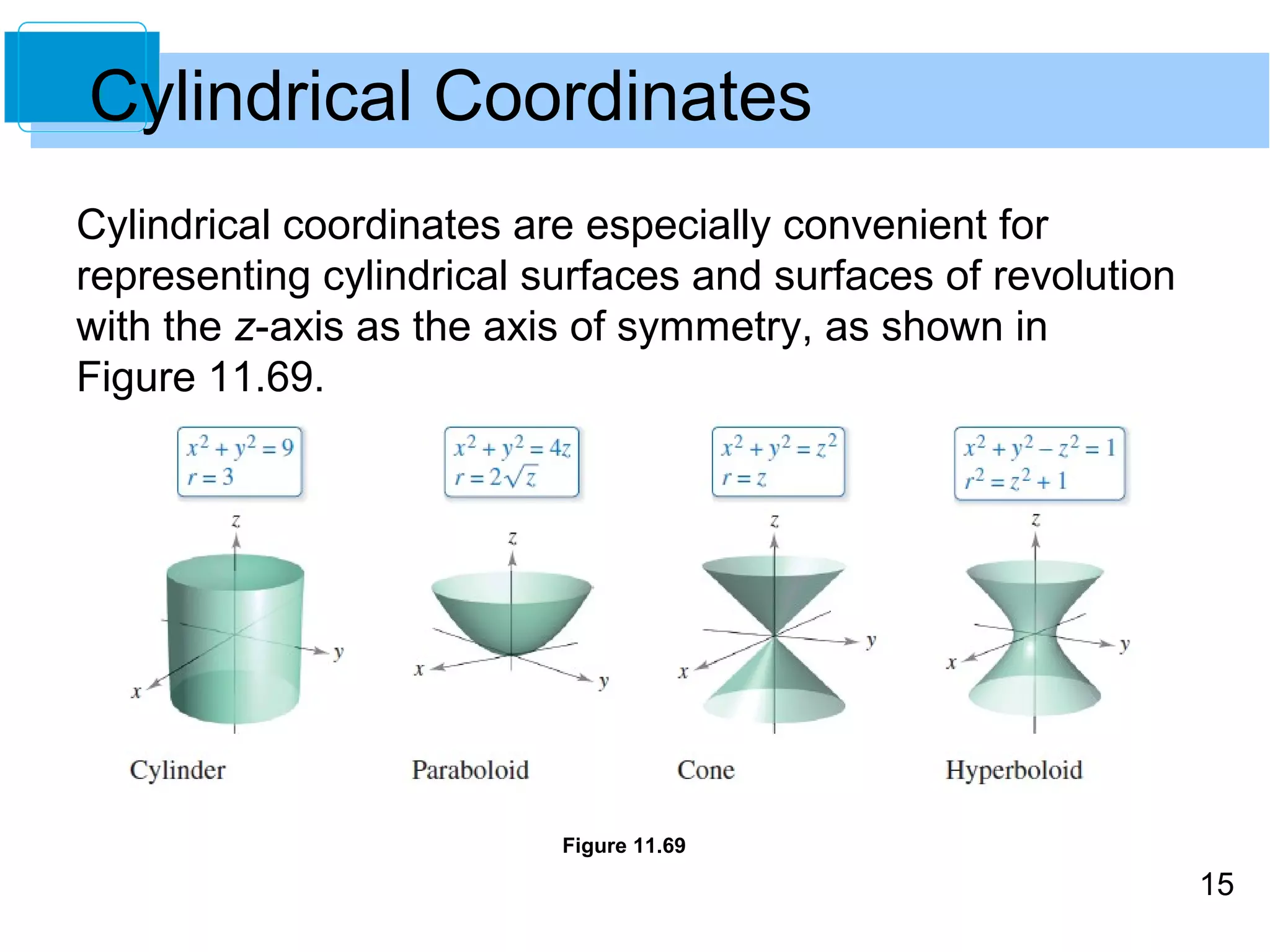
Cylindrical coordinates are especially convenient for
representing cylindrical surfaces and surfaces of revolution
with the z-axis as the axis of symmetry, as shown in
Figure 11.69.
Figure 11.69
16
Cylindrical Coordinates
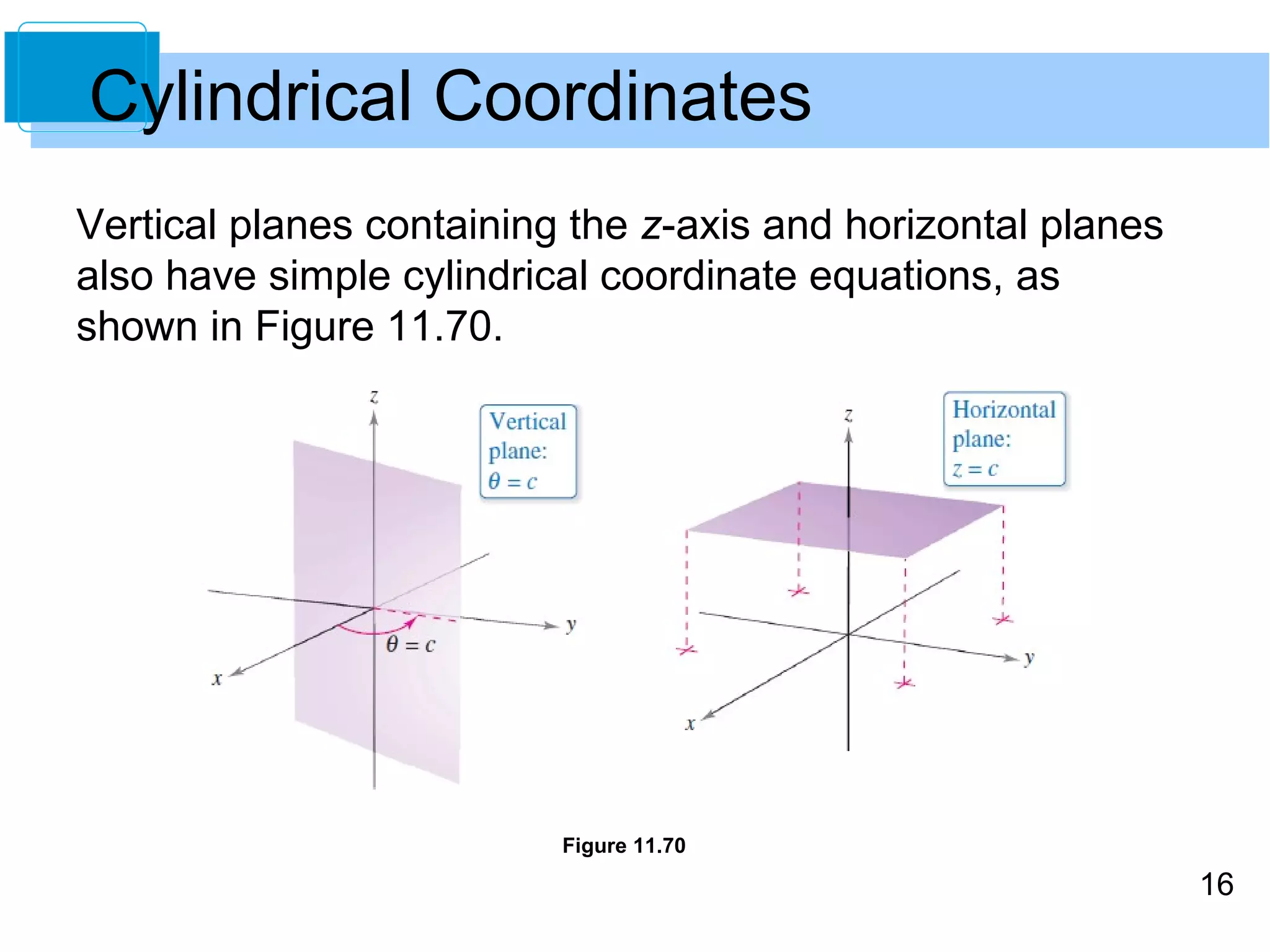
Vertical planes containing the z-axis and horizontal planes
also have simple cylindrical coordinate equations, as
shown in Figure 11.70.
Figure 11.70
17
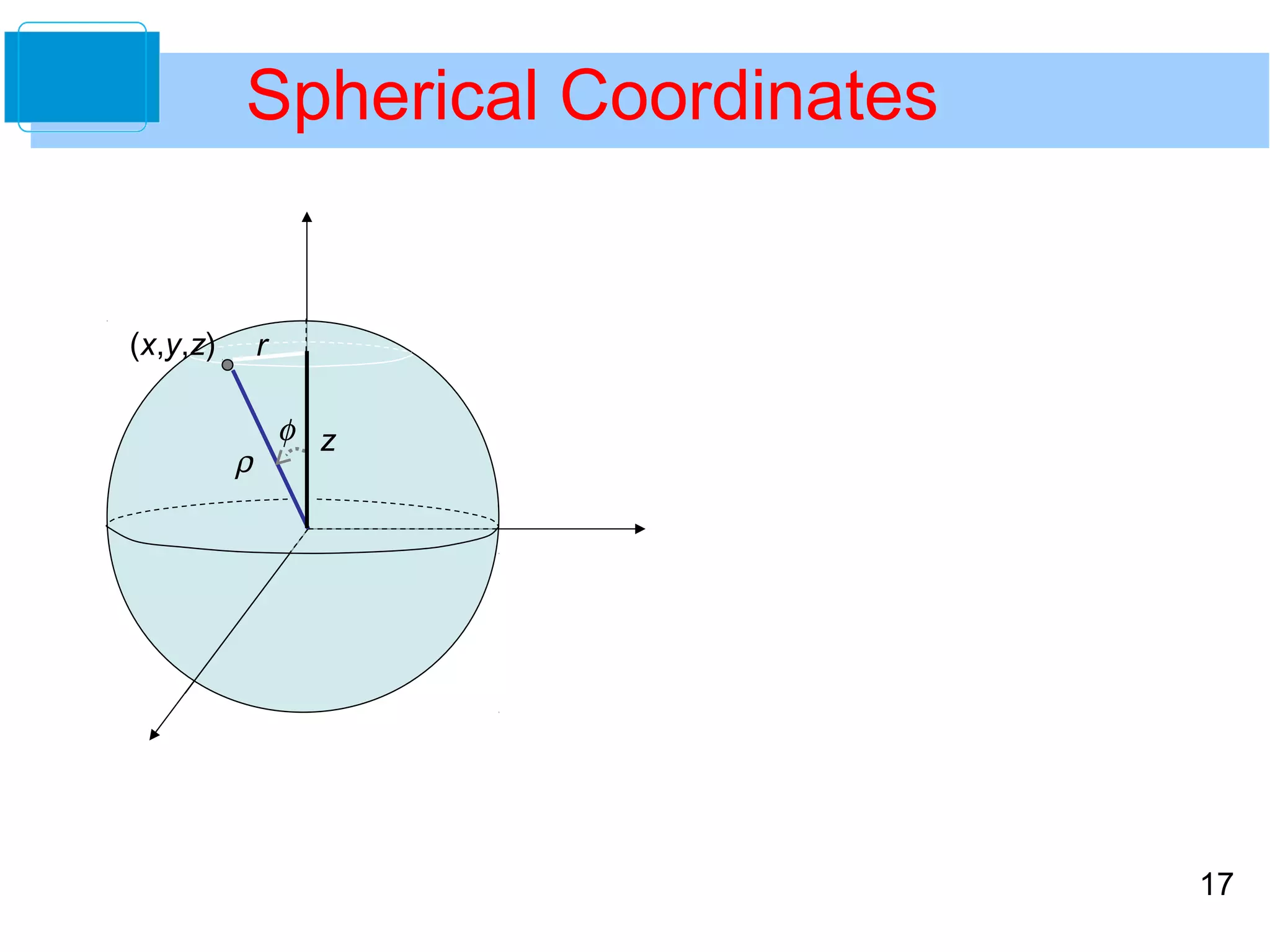
Spherical Coordinates
φ
(x,y,z)
z
ρ
r
18
Spherical Coordinates
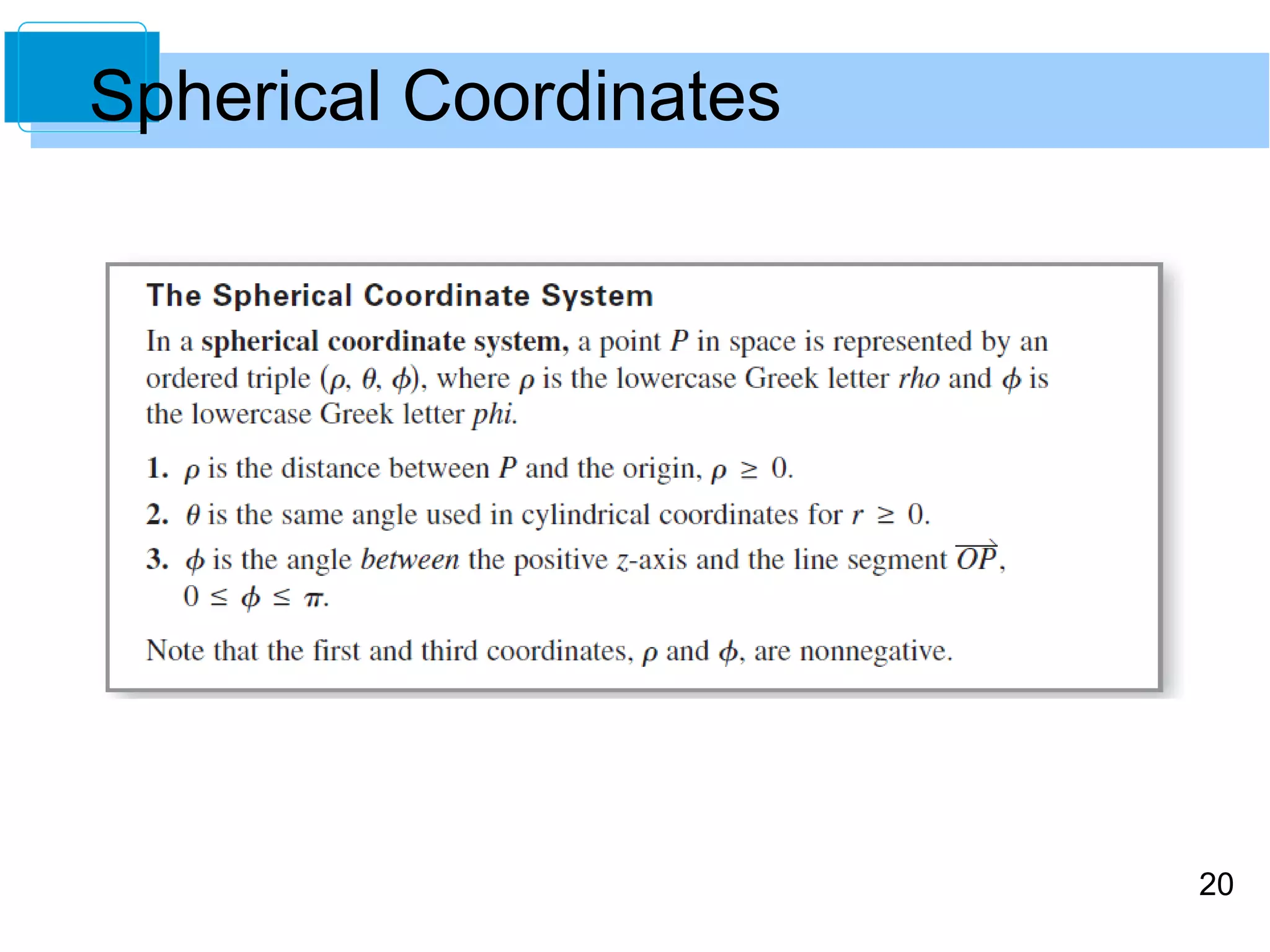
In the spherical coordinate system, each point is
represented by an ordered triple: the first coordinate is a
distance, and the second and third coordinates are angles.
This system is similar to the latitude-longitude system used
to identify points on the surface of Earth.
19
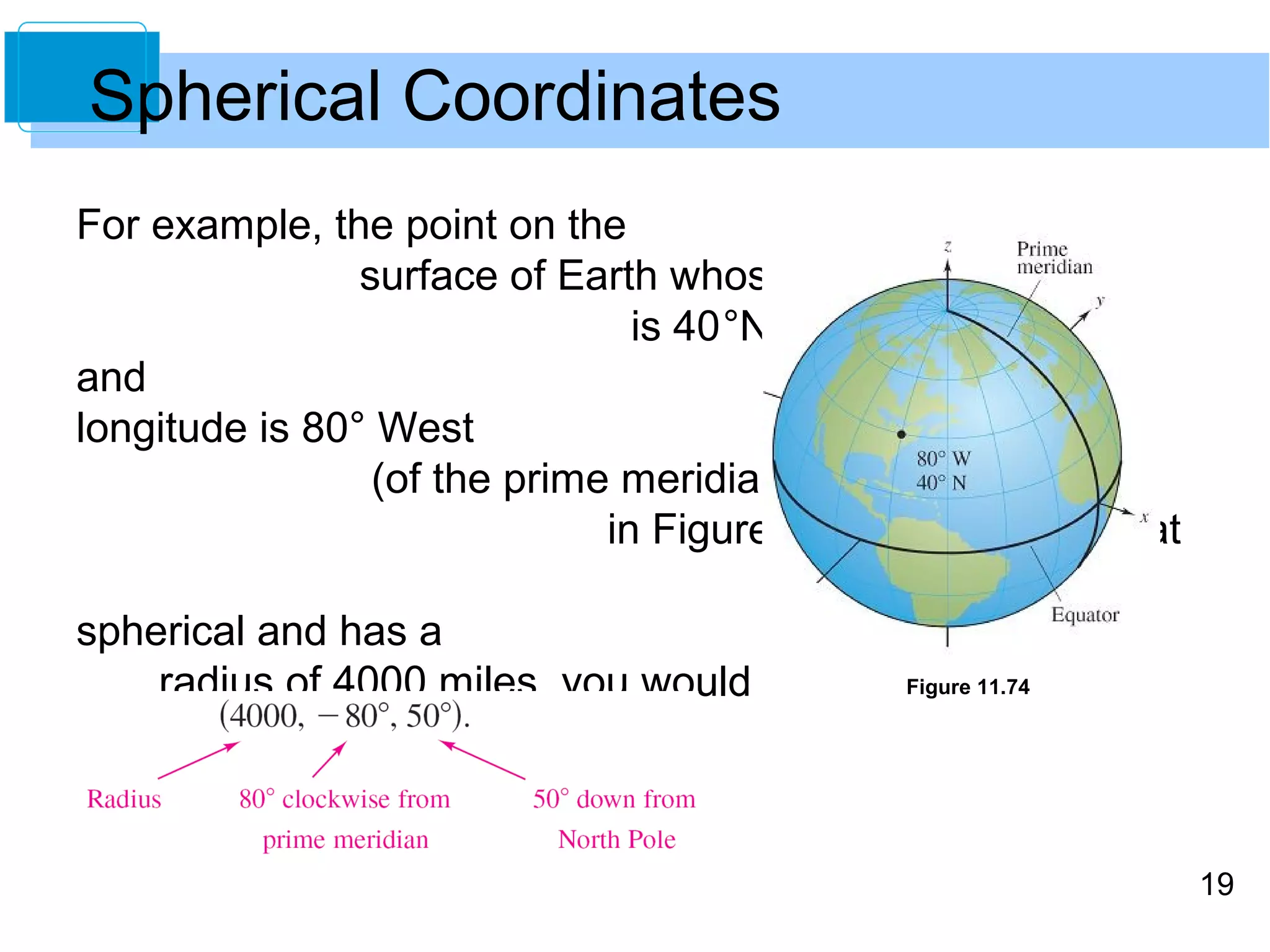
For example, the point on the
surface of Earth whose latitude
is 40°North (of the equator)
and whose
longitude is 80° West
(of the prime meridian) is shown
in Figure 11.74. Assuming that
the Earth is
spherical and has a
radius of 4000 miles, you would
label this point as
Figure 11.74
Spherical Coordinates
20
Spherical Coordinates
21
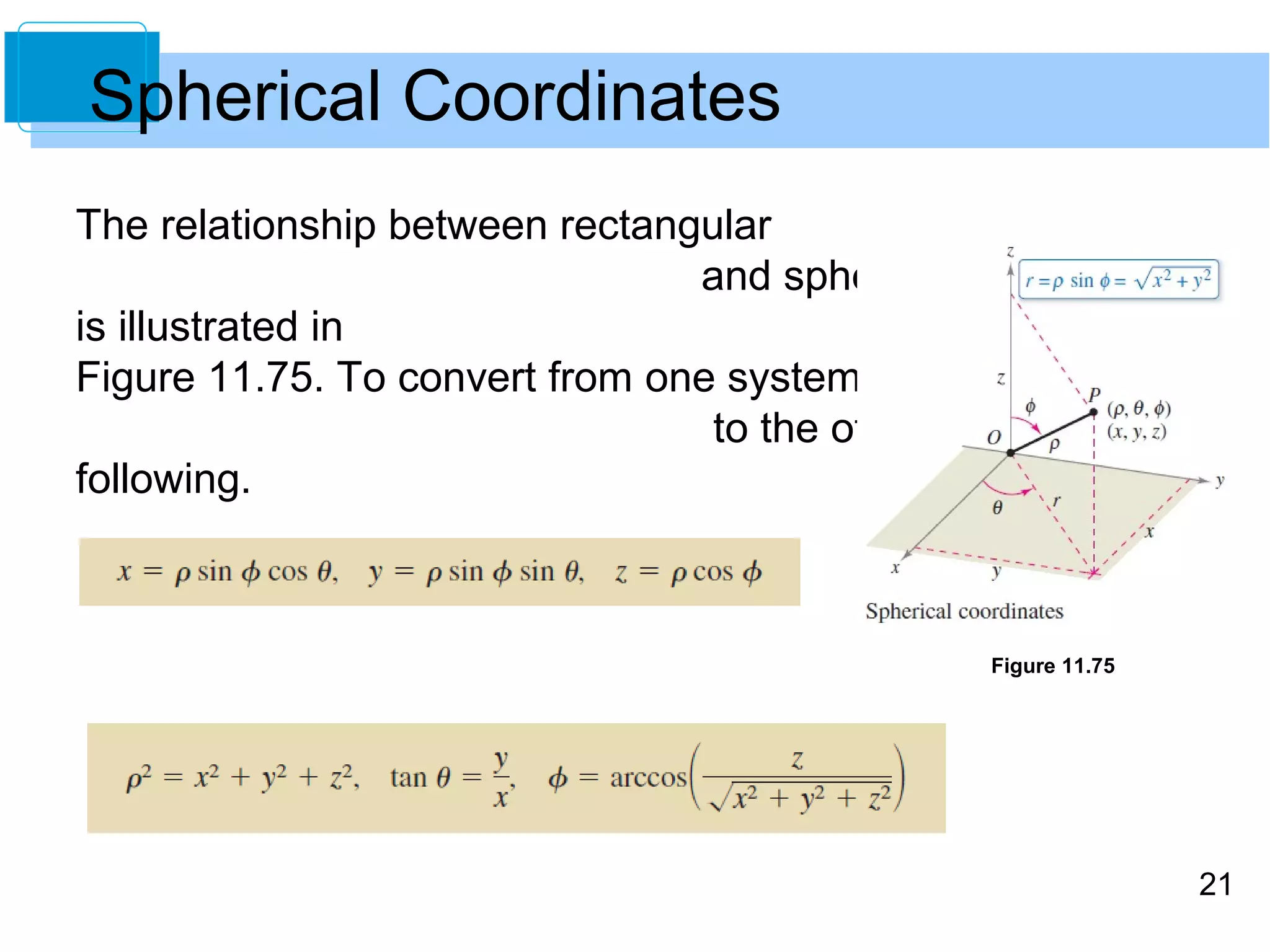
The relationship between rectangular
and spherical coordinates
is illustrated in
Figure 11.75. To convert from one system
to the other, use the
following.
Spherical to rectangular:
Rectangular to spherical:
Figure 11.75
Spherical Coordinates
22
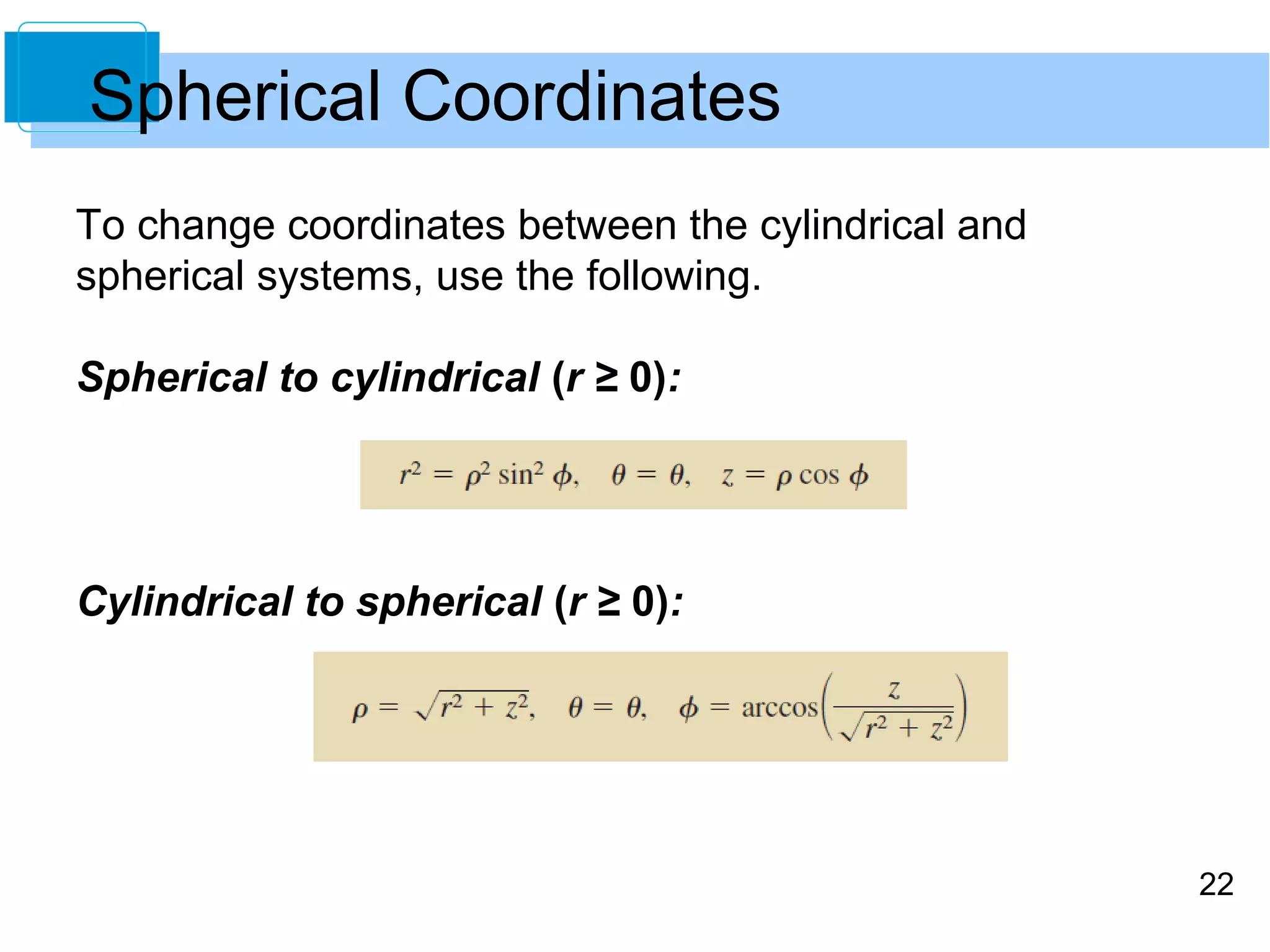
To change coordinates between the cylindrical and
spherical systems, use the following.
Spherical to cylindrical (r ≥ 0):
Cylindrical to spherical (r ≥ 0):
Spherical Coordinates
23
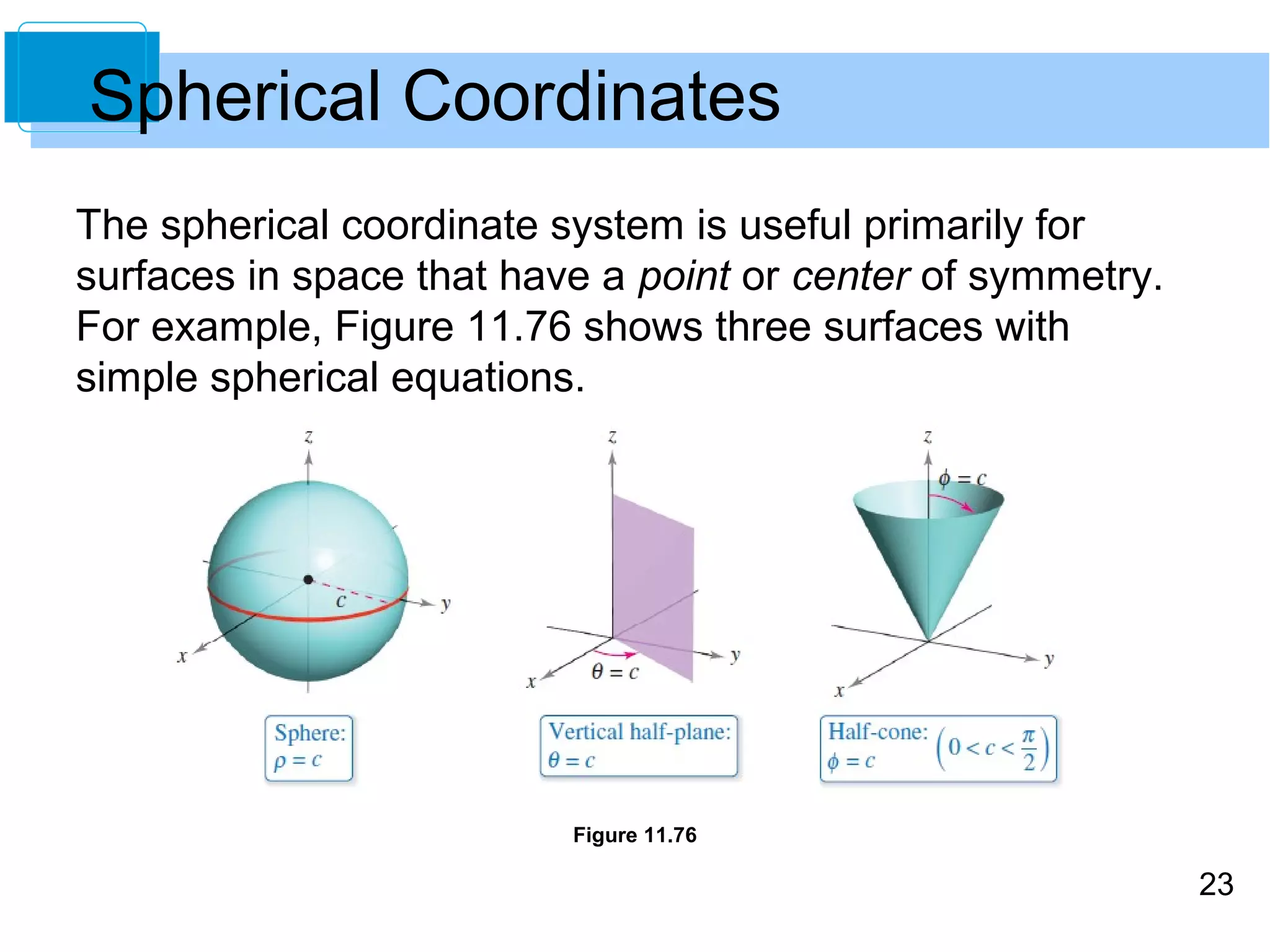
The spherical coordinate system is useful primarily for
surfaces in space that have a point or center of symmetry.
For example, Figure 11.76 shows three surfaces with
simple spherical equations.
Figure 11.76
Spherical Coordinates
24
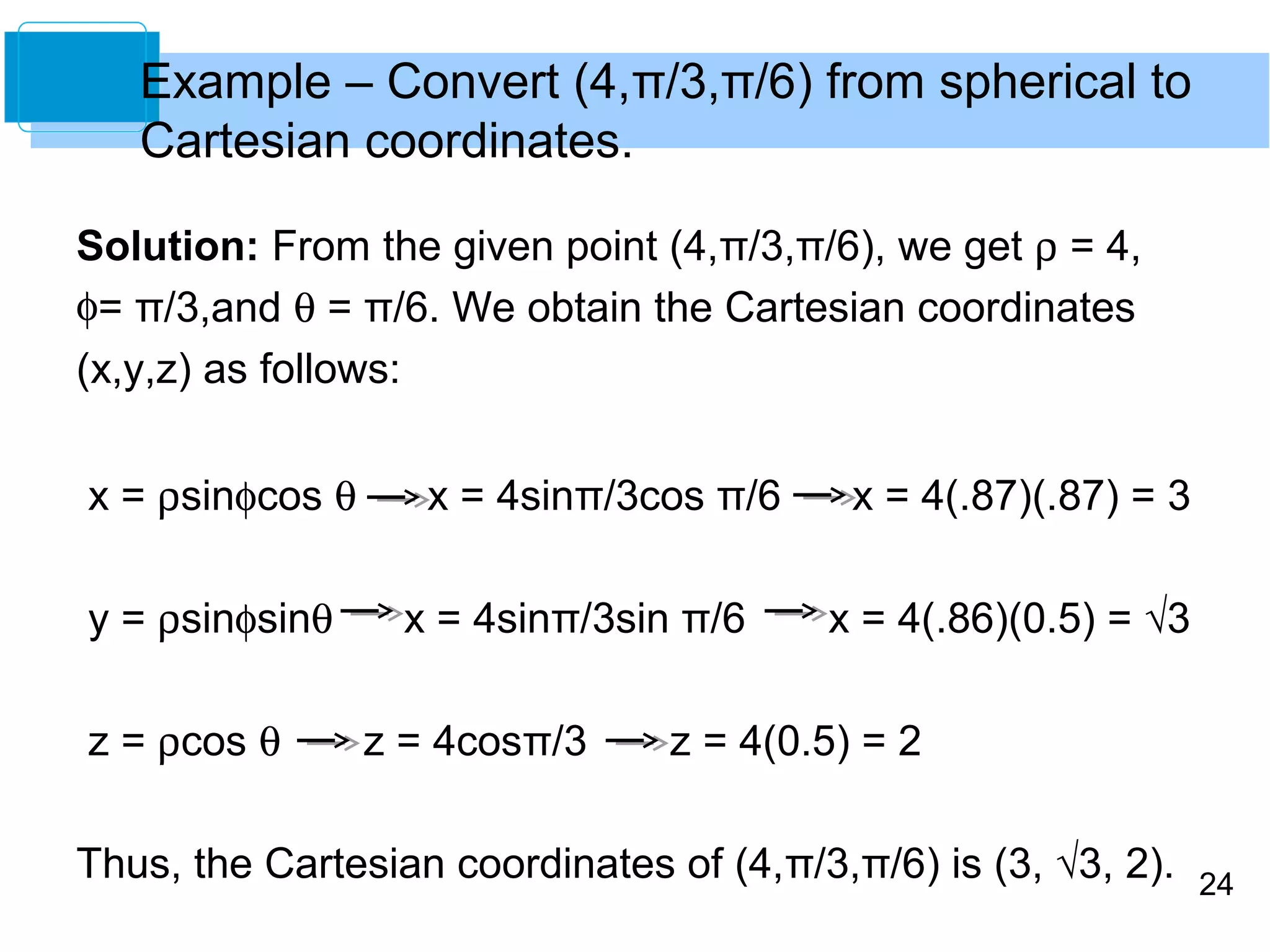
Example – Convert (4,π/3,π/6) from spherical to
Cartesian coordinates.
Solution: From the given point (4,π/3,π/6), we get ρ = 4,
φ= π/3,and θ = π/6. We obtain the Cartesian coordinates
(x,y,z) as follows:
x = ρsinφcos θ x = 4sinπ/3cos π/6 x = 4(.87)(.87) = 3
y = ρsinφsinθ x = 4sinπ/3sin π/6 x = 4(.86)(0.5) = √3
z = ρcos θ z = 4cosπ/3 z = 4(0.5) = 2
Thus, the Cartesian coordinates of (4,π/3,π/6) is (3, √3, 2).
25
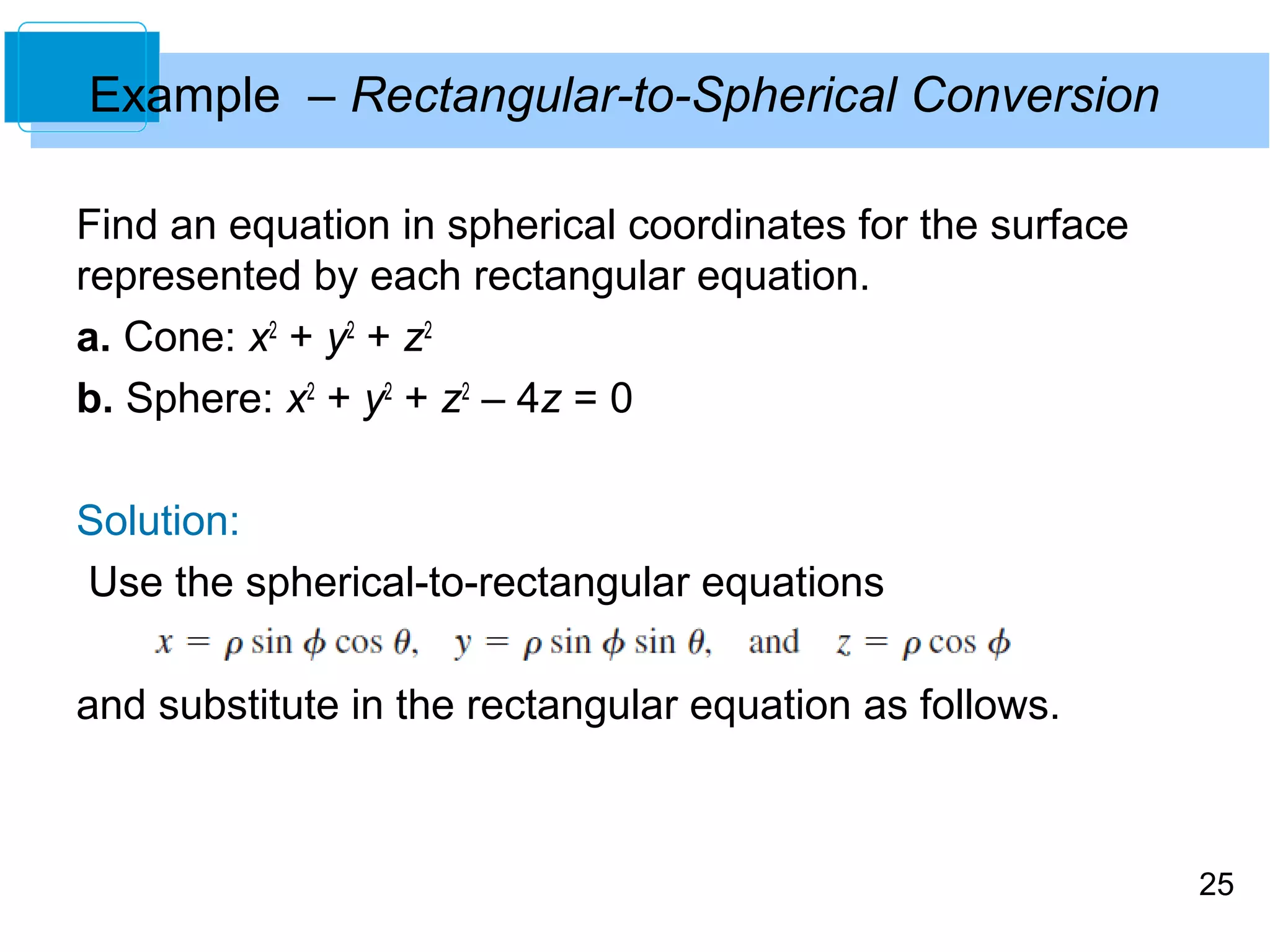
Example – Rectangular-to-Spherical Conversion
Find an equation in spherical coordinates for the surface
represented by each rectangular equation.
a. Cone: x2
+ y2
+ z2
b. Sphere: x2
+ y2
+ z2
– 4z = 0
Solution:
Use the spherical-to-rectangular equations
and substitute in the rectangular equation as follows.
26
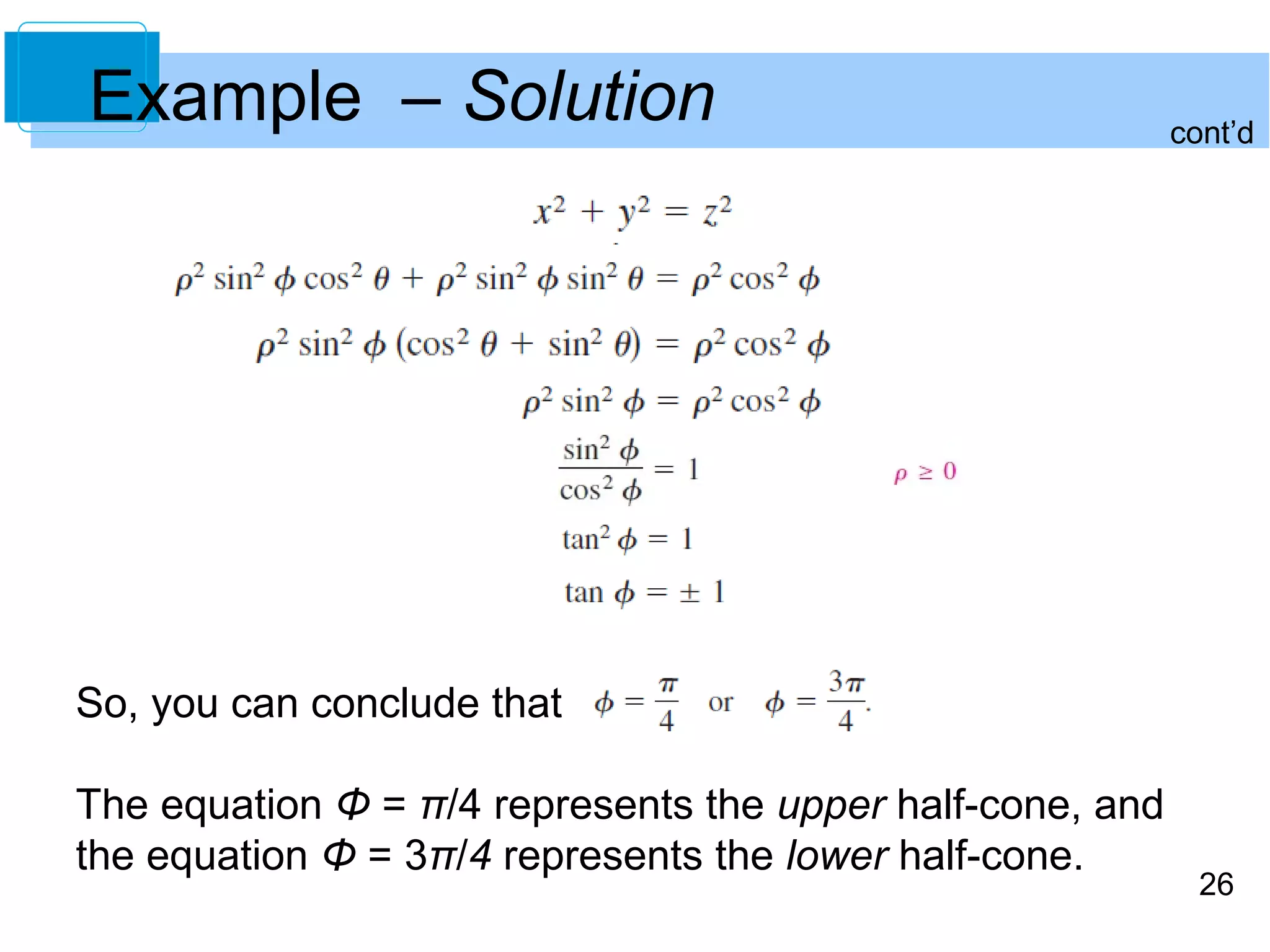
So, you can conclude that
The equation Φ = π/4 represents the upper half-cone, and
the equation Φ = 3π/4 represents the lower half-cone.
Example – Solution cont’d
27
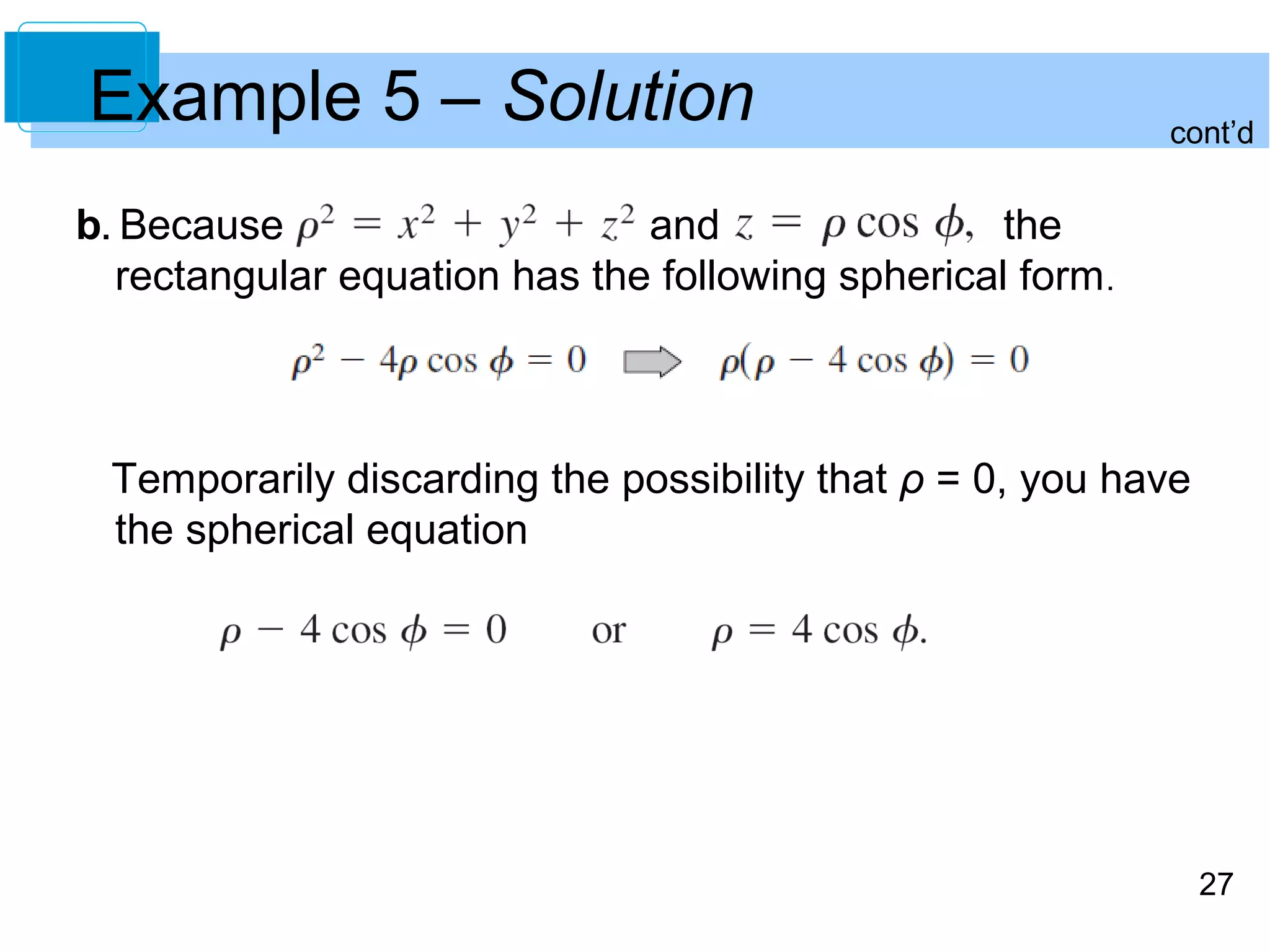
Example 5 – Solution
b. Because and the
rectangular equation has the following spherical form.
Temporarily discarding the possibility that ρ = 0, you have
the spherical equation
cont’d
28
Example 5 – Solution
Note that the solution set for this equation includes a point
for which ρ = 0, so nothing is lost by discarding the factor ρ.
The sphere represented by the equation ρ = 4cos Φ
is shown in Figure 11.77.
Figure 11.77
cont’d

Cylindrical and Spherical Coordinates System

  • 1.
  • 2.
    2  Discuss thecylindrical and spherical coordinates;  Solve the cylindrical and spherical coordinates in Cartesian coordinates and vice versa;  Develop patience and teamwork with their partners in answering different problems of cylindrical and spherical coordinates. Objectives
  • 3.
  • 4.
  • 5.
  • 6.
  • 7.
  • 8.
  • 9.
  • 10.
    10 The cylindrical coordinatesystem is an extension of polar coordinates in the plane to three-dimensional space. Cylindrical Coordinates
  • 11.
    11 To convert fromrectangular to cylindrical coordinates (or vice versa), use the following conversion guidelines for polar coordinates, as illustrated in Figure 11.66. Figure 11.66 Cylindrical Coordinates
  • 12.
    12 Cylindrical to rectangular: Rectangularto cylindrical: The point (0, 0, 0) is called the pole. Moreover, because the representation of a point in the polar coordinate system is not unique, it follows that the representation in the cylindrical coordinate system is also not unique. Cylindrical Coordinates
  • 13.
    13 Convert the point(r, θ, z) = to rectangular coordinates. Solution: Using the cylindrical-to-rectangular conversion equations produces So, in rectangular coordinates, the point is (x, y, z) = as shown in Figure 11.67. Example – Converting from Cylindrical to Rectangular Coordinates Figure 11.67
  • 14.
    14 Example: Find thecylindrical coordinates of the point (1,2,3) in Cartesian Coordinates
  • 15.
    15 Cylindrical Coordinates Cylindrical coordinatesare especially convenient for representing cylindrical surfaces and surfaces of revolution with the z-axis as the axis of symmetry, as shown in Figure 11.69. Figure 11.69
  • 16.
    16 Cylindrical Coordinates Vertical planescontaining the z-axis and horizontal planes also have simple cylindrical coordinate equations, as shown in Figure 11.70. Figure 11.70
  • 17.
  • 18.
    18 Spherical Coordinates In thespherical coordinate system, each point is represented by an ordered triple: the first coordinate is a distance, and the second and third coordinates are angles. This system is similar to the latitude-longitude system used to identify points on the surface of Earth.
  • 19.
    19 For example, thepoint on the surface of Earth whose latitude is 40°North (of the equator) and whose longitude is 80° West (of the prime meridian) is shown in Figure 11.74. Assuming that the Earth is spherical and has a radius of 4000 miles, you would label this point as Figure 11.74 Spherical Coordinates
  • 20.
  • 21.
    21 The relationship betweenrectangular and spherical coordinates is illustrated in Figure 11.75. To convert from one system to the other, use the following. Spherical to rectangular: Rectangular to spherical: Figure 11.75 Spherical Coordinates
  • 22.
    22 To change coordinatesbetween the cylindrical and spherical systems, use the following. Spherical to cylindrical (r ≥ 0): Cylindrical to spherical (r ≥ 0): Spherical Coordinates
  • 23.
    23 The spherical coordinatesystem is useful primarily for surfaces in space that have a point or center of symmetry. For example, Figure 11.76 shows three surfaces with simple spherical equations. Figure 11.76 Spherical Coordinates
  • 24.
    24 Example – Convert(4,π/3,π/6) from spherical to Cartesian coordinates. Solution: From the given point (4,π/3,π/6), we get ρ = 4, φ= π/3,and θ = π/6. We obtain the Cartesian coordinates (x,y,z) as follows: x = ρsinφcos θ x = 4sinπ/3cos π/6 x = 4(.87)(.87) = 3 y = ρsinφsinθ x = 4sinπ/3sin π/6 x = 4(.86)(0.5) = √3 z = ρcos θ z = 4cosπ/3 z = 4(0.5) = 2 Thus, the Cartesian coordinates of (4,π/3,π/6) is (3, √3, 2).
  • 25.
    25 Example – Rectangular-to-SphericalConversion Find an equation in spherical coordinates for the surface represented by each rectangular equation. a. Cone: x2 + y2 + z2 b. Sphere: x2 + y2 + z2 – 4z = 0 Solution: Use the spherical-to-rectangular equations and substitute in the rectangular equation as follows.
  • 26.
    26 So, you canconclude that The equation Φ = π/4 represents the upper half-cone, and the equation Φ = 3π/4 represents the lower half-cone. Example – Solution cont’d
  • 27.
    27 Example 5 –Solution b. Because and the rectangular equation has the following spherical form. Temporarily discarding the possibility that ρ = 0, you have the spherical equation cont’d
  • 28.
    28 Example 5 –Solution Note that the solution set for this equation includes a point for which ρ = 0, so nothing is lost by discarding the factor ρ. The sphere represented by the equation ρ = 4cos Φ is shown in Figure 11.77. Figure 11.77 cont’d