1
Chapter 15 Multiple Integrals I
15.1 Double Integrals over Rectangles
33
Review of the Definite Integrals
44
Review of the Definite Integrals
First let’s recall the basic facts concerning definite integrals
of functions of a single variable.
If f(x) is defined for a  x  b, we start by dividing the
interval [a, b] into n subintervals [xi–1, xi] of equal width
x = (b – a)/n and we choose sample points in these
subintervals. Then we form the Riemann sum
and take the limit of such sums as n → to obtain the
definite integral of f from a to b:
55
Review of the Definite Integrals
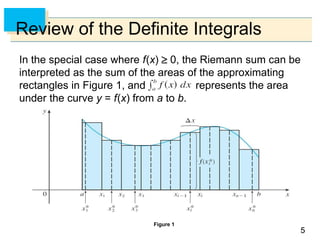
In the special case where f(x)  0, the Riemann sum can be
interpreted as the sum of the areas of the approximating
rectangles in Figure 1, and represents the area
under the curve y = f(x) from a to b.
Figure 1
66
Volumes and Double Integrals
77
In a similar manner we consider a function f of two
variables defined on a closed rectangle
R = [a, b]  [c, d] = {(x, y)  |a  x  b, c  y  d}
and we first suppose that f(x, y)  0.
The graph of f is a surface
with equation z = f(x, y).
Let S be the solid that lies
above R and under the
graph of f, that is,
S = {(x, y, z)  |0  z  f(x, y), (x, y)  R}
(See Figure 2.)
Volumes and Double Integrals
Figure 2
88
Volumes and Double Integrals
Our goal is to find the volume of S.
The first step is to divide the rectangle R into
subrectangles.
We accomplish this by dividing the interval [a, b] into m
subintervals [xi – 1, xi] of equal width x = (b – a)/m and
dividing [c, d ] into n subintervals [yj – 1, yj] of equal width
y = (d – c)/n.
99
Volumes and Double Integrals
By drawing lines parallel to the coordinate axes through the
endpoints of these subintervals, as in Figure 3, we form the
subrectangles
Rij = [xi–1, xi]  [yj–1, yj] = {(x, y) | xi–1  x  xi, yj–1  y  yj}
each with area A = x y.
Figure 3
Dividing R into subrectangles
1010
Volumes and Double Integrals
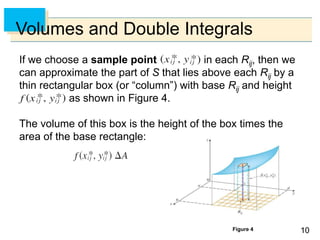
If we choose a sample point in each Rij, then we
can approximate the part of S that lies above each Rij by a
thin rectangular box (or “column”) with base Rij and height
as shown in Figure 4.
The volume of this box is the height of the box times the
area of the base rectangle:
Figure 4
1111
Volumes and Double Integrals
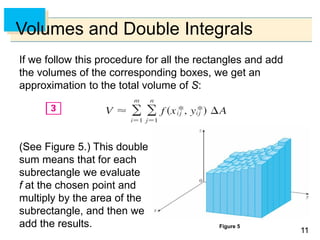
If we follow this procedure for all the rectangles and add
the volumes of the corresponding boxes, we get an
approximation to the total volume of S:
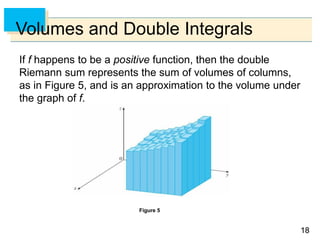
(See Figure 5.) This double
sum means that for each
subrectangle we evaluate
f at the chosen point and
multiply by the area of the
subrectangle, and then we
add the results. Figure 5
1212
Volumes and Double Integrals
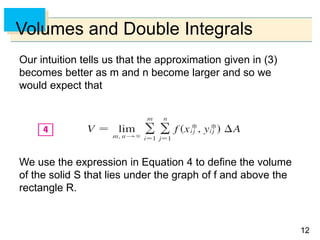
Our intuition tells us that the approximation given in (3)
becomes better as m and n become larger and so we
would expect that
We use the expression in Equation 4 to define the volume
of the solid S that lies under the graph of f and above the
rectangle R.
1313
Volumes and Double Integrals
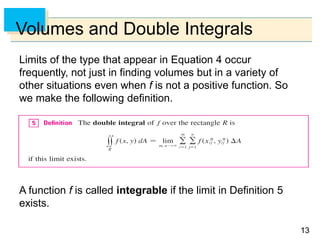
Limits of the type that appear in Equation 4 occur
frequently, not just in finding volumes but in a variety of
other situations even when f is not a positive function. So
we make the following definition.
A function f is called integrable if the limit in Definition 5
exists.
1414
Volumes and Double Integrals
It is shown in courses on advanced calculus that all
continuous functions are integrable. In fact, the double
integral of f exists provided that f is “not too discontinuous.”
In particular, if f is bounded [that is, there is a constant M
such that |f(x, y)|  M for all (x, y) in R], and f is continuous
there, except on a finite number of smooth curves, then f is
integrable over R.
1515
Volumes and Double Integrals
The sample point can be chosen to be any point
in the subrectangle Rij, but if we choose it to be the upper
right-hand corner of Rij [namely (xi, yj), see Figure 3], then
the expression for the double integral looks simpler:
Figure 3
Dividing R into subrectangles
1616
Volumes and Double Integrals
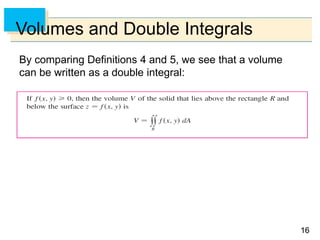
By comparing Definitions 4 and 5, we see that a volume
can be written as a double integral:
1717
Volumes and Double Integrals
The sum in Definition 5,
is called a double Riemann sum and is used as an
approximation to the value of the double integral. [Notice
how similar it is to the Riemann sum in for a function of
a single variable.]
1818
Volumes and Double Integrals
If f happens to be a positive function, then the double
Riemann sum represents the sum of volumes of columns,
as in Figure 5, and is an approximation to the volume under
the graph of f.
Figure 5
1919
Example 1
Estimate the volume of the solid that lies above the square
R = [0, 2]  [0, 2] and below the elliptic paraboloid
z = 16 – x2 – 2y2.
Divide R into four equal squares and choose the sample
point to be the upper right corner of each square Rij.
Sketch the solid and the approximating
rectangular boxes.
2020
Example 1 – Solution
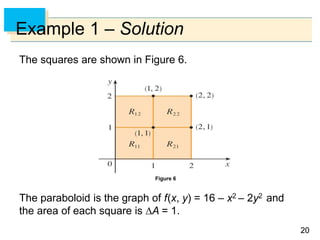
The squares are shown in Figure 6.
The paraboloid is the graph of f(x, y) = 16 – x2 – 2y2 and
the area of each square is A = 1.
Figure 6
2121
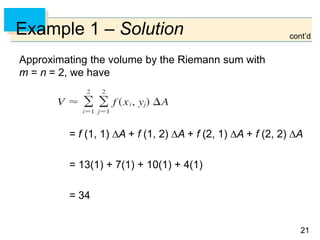
Approximating the volume by the Riemann sum with
m = n = 2, we have
= f (1, 1) A + f (1, 2) A + f (2, 1) A + f (2, 2) A
= 13(1) + 7(1) + 10(1) + 4(1)
= 34
Example 1 – Solution cont’d
2222
Example 1 – Solution
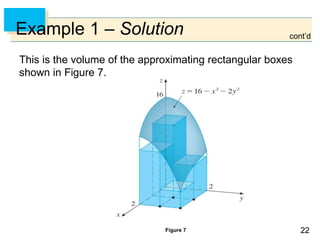
Figure 7
cont’d
This is the volume of the approximating rectangular boxes
shown in Figure 7.
2323
The Midpoint Rule
2424
The Midpoint Rule
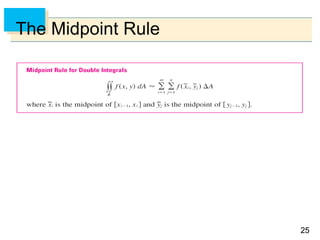
The methods that we used for approximating single
integrals (the Midpoint Rule, the Trapezoidal Rule,
Simpson’s Rule) all have counterparts for double integrals.
Here we consider only the Midpoint Rule for double
integrals.
This means that we use a double Riemann sum to
approximate the double integral, where the sample point
in Rij is chosen to be the center of Rij. In
other words, is the midpoint of [xi–1, xi] and is the
midpoint of [yj–1, yj].
2525
The Midpoint Rule
2626
Example 3
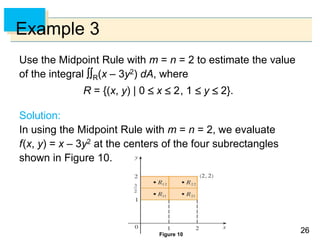
Use the Midpoint Rule with m = n = 2 to estimate the value
of the integral R(x – 3y2) dA, where
R = {(x, y) | 0  x  2, 1  y  2}.
Solution:
In using the Midpoint Rule with m = n = 2, we evaluate
f(x, y) = x – 3y2 at the centers of the four subrectangles
shown in Figure 10.
Figure 10
2727
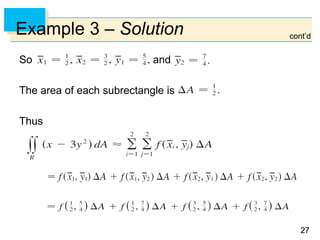
Example 3 – Solution
So and
The area of each subrectangle is
Thus
cont’d
2828
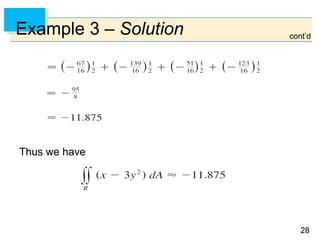
Example 3 – Solution
Thus we have
cont’d
2929
Average Values
3030
Average Values
Recall that the average value of a function f of one variable
defined on an interval [a, b] is
In a similar fashion we define the average value of a
function f of two variables defined on a rectangle R to be
where A(R) is the area of R.
3131
Average Values
If f(x, y)  0, the equation
A(R)  fave = f(x, y) dA
says that the box with base R and height fave has the same
volume as the solid that lies under the graph of f.
[If z = f(x, y) describes a
mountainous region and you
chop off the tops of the
mountains at height fave, then
you can use them to fill in the
valleys so that the region
becomes completely flat.
See Figure 11.] Figure 11
3232
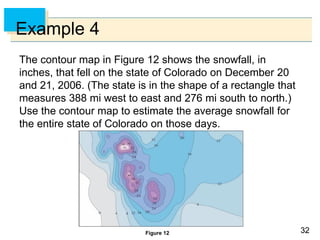
Example 4
The contour map in Figure 12 shows the snowfall, in
inches, that fell on the state of Colorado on December 20
and 21, 2006. (The state is in the shape of a rectangle that
measures 388 mi west to east and 276 mi south to north.)
Use the contour map to estimate the average snowfall for
the entire state of Colorado on those days.
Figure 12
3333
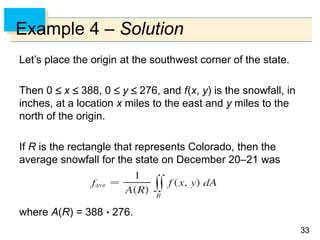
Example 4 – Solution
Let’s place the origin at the southwest corner of the state.
Then 0  x  388, 0  y  276, and f(x, y) is the snowfall, in
inches, at a location x miles to the east and y miles to the
north of the origin.
If R is the rectangle that represents Colorado, then the
average snowfall for the state on December 20–21 was
where A(R) = 388  276.
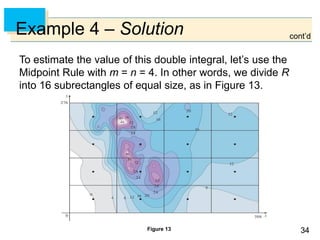
3434
Example 4 – Solution
To estimate the value of this double integral, let’s use the
Midpoint Rule with m = n = 4. In other words, we divide R
into 16 subrectangles of equal size, as in Figure 13.
Figure 13
cont’d
3535
Example 4 – Solution
The area of each subrectangle is
Using the contour map to estimate the value of f at the
center of each subrectangle, we get
≈ A[0 + 15 + 8 + 7 + 2 + 25 + 18.5
+ 11 + 4.5 + 28 + 17 + 13.5 + 12
+ 15 + 17.5 + 13]
= (6693)(207)
= 6693 mi2
cont’d
3636
Example 4 – Solution cont’d
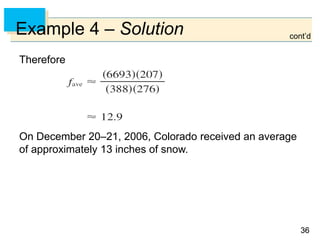
Therefore
On December 20–21, 2006, Colorado received an average
of approximately 13 inches of snow.
3737
Properties of Double Integrals
3838
Properties of Double Integrals
We list here three properties of double integrals. We
assume that all of the integrals exist. Properties 7 and 8 are
referred to as the linearity of the integral.
[f(x, y) + g(x, y)] dA = f(x, y) dA + g(x, y) dA
c f(x, y) dA = c f(x, y) dA where c is a constant
If f(x, y)  g(x, y) for all (x, y) in R, then
f(x, y) dA  g(x, y) dA
3939
15.2 Double Integrals over General Regions
For single integrals, the region over which we integrate is
always an interval.
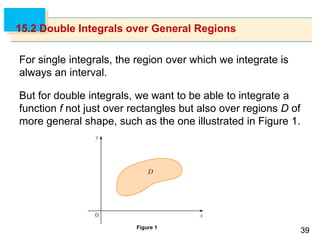
But for double integrals, we want to be able to integrate a
function f not just over rectangles but also over regions D of
more general shape, such as the one illustrated in Figure 1.
Figure 1
4040
Double Integrals over General Regions
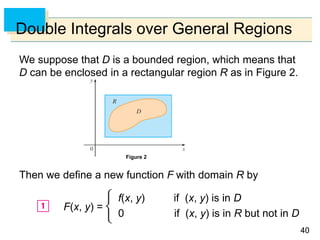
We suppose that D is a bounded region, which means that
D can be enclosed in a rectangular region R as in Figure 2.
Then we define a new function F with domain R by
f(x, y) if (x, y) is in D
0 if (x, y) is in R but not in D
Figure 2
F(x, y) =
4141
Double Integrals over General Regions
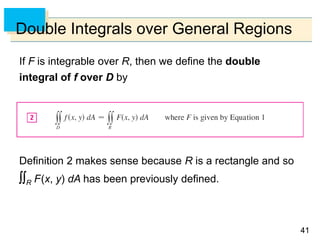
If F is integrable over R, then we define the double
integral of f over D by
Definition 2 makes sense because R is a rectangle and so
R F(x, y) dA has been previously defined.
4242
Double Integrals over General Regions
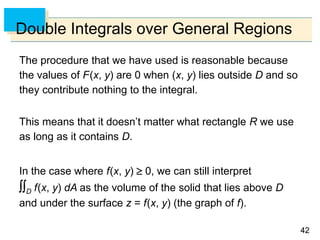
The procedure that we have used is reasonable because
the values of F(x, y) are 0 when (x, y) lies outside D and so
they contribute nothing to the integral.
This means that it doesn’t matter what rectangle R we use
as long as it contains D.
In the case where f(x, y)  0, we can still interpret
D f(x, y) dA as the volume of the solid that lies above D
and under the surface z = f(x, y) (the graph of f).
4343
Double Integrals over General Regions
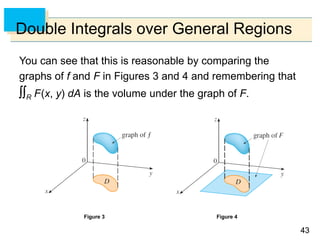
You can see that this is reasonable by comparing the
graphs of f and F in Figures 3 and 4 and remembering that
R F(x, y) dA is the volume under the graph of F.
Figure 3 Figure 4
4444
Double Integrals over General Regions
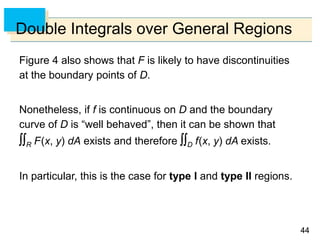
Figure 4 also shows that F is likely to have discontinuities
at the boundary points of D.
Nonetheless, if f is continuous on D and the boundary
curve of D is “well behaved”, then it can be shown that
R F(x, y) dA exists and therefore D f(x, y) dA exists.
In particular, this is the case for type I and type II regions.
4545
Double Integrals over General Regions
A plane region D is said to be of type I if it lies between the
graphs of two continuous functions of x, that is,
D = {(x, y) | a  x  b, g1(x)  y  g2(x)}
where g1 and g2 are continuous on [a, b]. Some examples
of type I regions are shown in Figure 5.
Some type I regions
Figure 5
4646
Double Integrals over General Regions
In order to evaluate D f(x, y) dA when D is a region of
type I, we choose a rectangle R = [a, b]  [c, d] that
contains D, as in Figure 6, and we let F be the function
given by Equation 1; that is, F agrees with f on D and F is 0
outside D.
Figure 6
4747
Double Integrals over General Regions
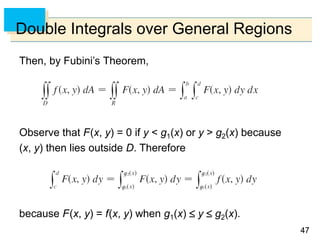
Then, by Fubini’s Theorem,
Observe that F(x, y) = 0 if y < g1(x) or y > g2(x) because
(x, y) then lies outside D. Therefore
because F(x, y) = f(x, y) when g1(x)  y  g2(x).
4848
Double Integrals over General Regions
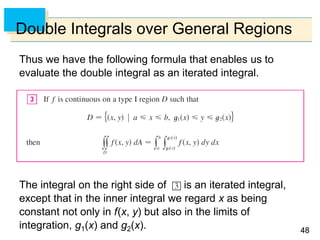
Thus we have the following formula that enables us to
evaluate the double integral as an iterated integral.
The integral on the right side of is an iterated integral,
except that in the inner integral we regard x as being
constant not only in f(x, y) but also in the limits of
integration, g1(x) and g2(x).
4949
Double Integrals over General Regions
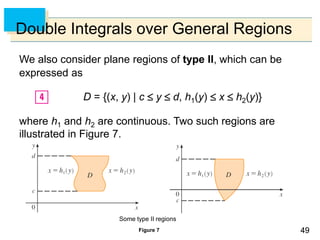
We also consider plane regions of type II, which can be
expressed as
D = {(x, y) | c  y  d, h1(y)  x  h2(y)}
where h1 and h2 are continuous. Two such regions are
illustrated in Figure 7.
Some type II regions
Figure 7
5050
Double Integrals over General Regions
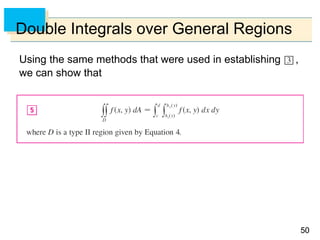
Using the same methods that were used in establishing ,
we can show that
5151
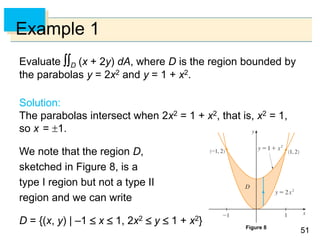
Example 1
Evaluate D (x + 2y) dA, where D is the region bounded by
the parabolas y = 2x2 and y = 1 + x2.
Solution:
The parabolas intersect when 2x2 = 1 + x2, that is, x2 = 1,
so x = 1.
We note that the region D,
sketched in Figure 8, is a
type I region but not a type II
region and we can write
D = {(x, y) | –1  x  1, 2x2  y  1 + x2} Figure 8
5252
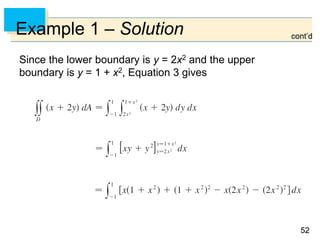
Example 1 – Solution
Since the lower boundary is y = 2x2 and the upper
boundary is y = 1 + x2, Equation 3 gives
cont’d
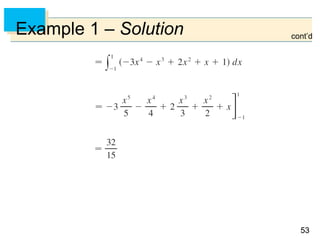
5353
Example 1 – Solution cont’d
5454
Properties of Double Integrals
5555
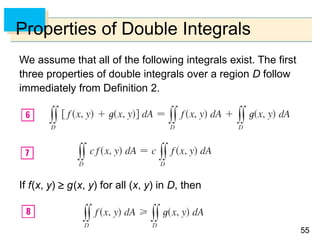
Properties of Double Integrals
We assume that all of the following integrals exist. The first
three properties of double integrals over a region D follow
immediately from Definition 2.
If f(x, y)  g(x, y) for all (x, y) in D, then
5656
Properties of Double Integrals
The next property of double integrals is similar to the
property of single integrals given by the equation
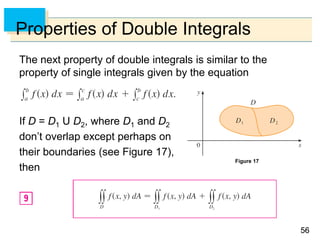
If D = D1 U D2, where D1 and D2
don’t overlap except perhaps on
their boundaries (see Figure 17),
then
Figure 17
5757
Properties of Double Integrals
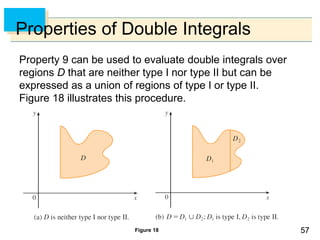
Property 9 can be used to evaluate double integrals over
regions D that are neither type I nor type II but can be
expressed as a union of regions of type I or type II.
Figure 18 illustrates this procedure.
Figure 18
5858
Properties of Double Integrals
The next property of integrals says that if we integrate the
constant function f(x, y) = 1 over a region D, we get the
area of D:
5959
Properties of Double Integrals
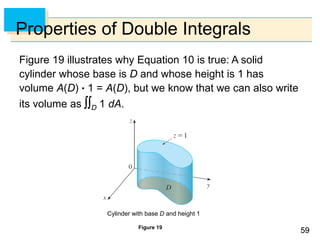
Figure 19 illustrates why Equation 10 is true: A solid
cylinder whose base is D and whose height is 1 has
volume A(D)  1 = A(D), but we know that we can also write
its volume as D 1 dA.
Cylinder with base D and height 1
Figure 19
6060
Properties of Double Integrals
Finally, we can combine Properties 7, 8, and 10 to prove
the following property.
6161
Example 6
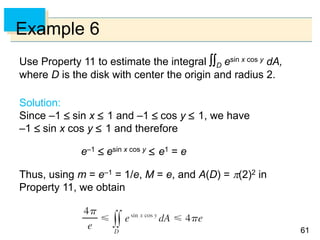
Use Property 11 to estimate the integral D esin x cos y dA,
where D is the disk with center the origin and radius 2.
Solution:
Since –1  sin x  1 and –1  cos y  1, we have
–1  sin x cos y  1 and therefore
e–1  esin x cos y  e1 = e
Thus, using m = e–1 = 1/e, M = e, and A(D) = (2)2 in
Property 11, we obtain
6262
15.3 Double Integrals in Polar Coordinates
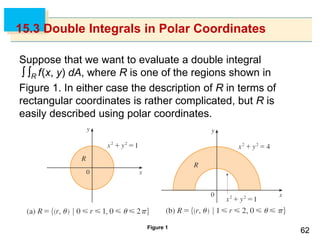
Suppose that we want to evaluate a double integral
 R f(x, y) dA, where R is one of the regions shown in
Figure 1. In either case the description of R in terms of
rectangular coordinates is rather complicated, but R is
easily described using polar coordinates.
Figure 1
6363
Double Integrals in Polar Coordinates
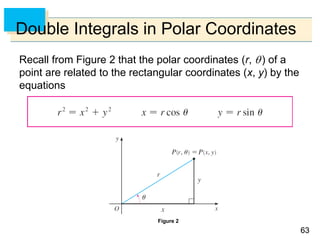
Recall from Figure 2 that the polar coordinates (r, ) of a
point are related to the rectangular coordinates (x, y) by the
equations
Figure 2
6464
Double Integrals in Polar Coordinates
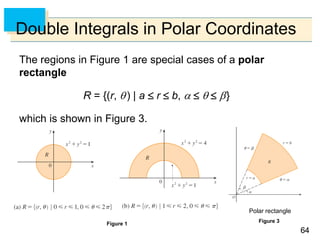
The regions in Figure 1 are special cases of a polar
rectangle
R = {(r, ) | a  r  b,     }
which is shown in Figure 3.
Figure 1
Polar rectangle
Figure 3
6565
Double Integrals in Polar Coordinates
In order to compute the double integral  R f(x, y) dA, where
R is a polar rectangle, we divide the interval [a, b] into m
subintervals [ri–1, ri] of equal width r = (b – a)/m and we
divide the interval [, ] into n subintervals [j–1, j] of
equal width  = ( – )/n.
Then the circles r = ri and the
rays  = j divide the polar
rectangle R into the small polar
rectangles Rij shown in Figure 4.
Figure 4
Dividing R into polar subrectangles
6666
Double Integrals in Polar Coordinates
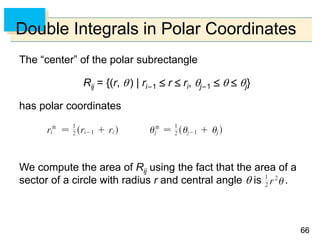
The “center” of the polar subrectangle
Rij = {(r, ) | ri–1  r  ri, j–1    j}
has polar coordinates
We compute the area of Rij using the fact that the area of a
sector of a circle with radius r and central angle  is .
6767
Double Integrals in Polar Coordinates
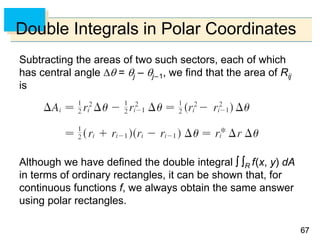
Subtracting the areas of two such sectors, each of which
has central angle  = j – j–1, we find that the area of Rij
is
Although we have defined the double integral  R f(x, y) dA
in terms of ordinary rectangles, it can be shown that, for
continuous functions f, we always obtain the same answer
using polar rectangles.
6868
Double Integrals in Polar Coordinates
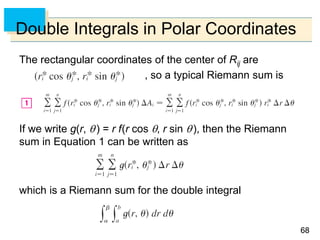
The rectangular coordinates of the center of Rij are
, so a typical Riemann sum is
If we write g(r, ) = r f(r cos , r sin ), then the Riemann
sum in Equation 1 can be written as
which is a Riemann sum for the double integral
6969
Double Integrals in Polar Coordinates
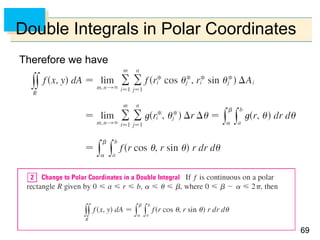
Therefore we have
7070
Double Integrals in Polar Coordinates
The formula in (2) says that we convert from rectangular to
polar coordinates in a double integral by writing
x = r cos  and y = r sin , using the appropriate limits of
integration for r and , and replacing dA by r dr d.
Be careful not to forget the additional factor r on the right
side of Formula 2.
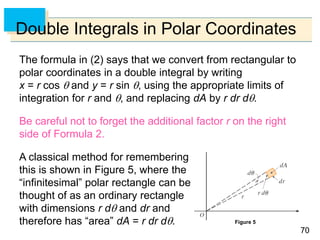
A classical method for remembering
this is shown in Figure 5, where the
“infinitesimal” polar rectangle can be
thought of as an ordinary rectangle
with dimensions r d and dr and
therefore has “area” dA = r dr d. Figure 5
7171
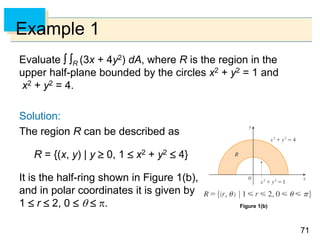
Example 1
Evaluate  R (3x + 4y2) dA, where R is the region in the
upper half-plane bounded by the circles x2 + y2 = 1 and
x2 + y2 = 4.
Solution:
The region R can be described as
R = {(x, y) | y  0, 1  x2 + y2  4}
It is the half-ring shown in Figure 1(b),
and in polar coordinates it is given by
1  r  2, 0    . Figure 1(b)
7272
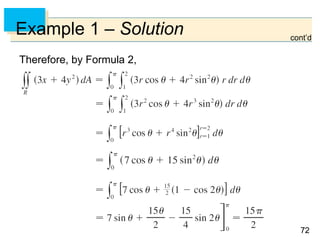
Example 1 – Solution cont’d
Therefore, by Formula 2,
7373
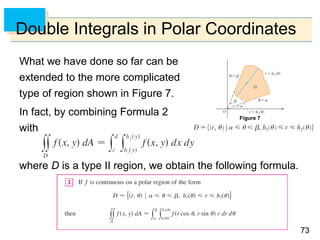
Double Integrals in Polar Coordinates
What we have done so far can be
extended to the more complicated
type of region shown in Figure 7.
In fact, by combining Formula 2
with
where D is a type II region, we obtain the following formula.
Figure 7
7474
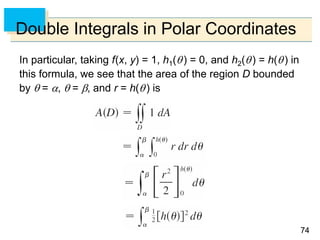
Double Integrals in Polar Coordinates
In particular, taking f(x, y) = 1, h1() = 0, and h2() = h() in
this formula, we see that the area of the region D bounded
by  = ,  = , and r = h() is
7575
END OF CHAPTER

Chatper 15

  • 1.
  • 2.
    15.1 Double Integralsover Rectangles
  • 3.
    33 Review of theDefinite Integrals
  • 4.
    44 Review of theDefinite Integrals First let’s recall the basic facts concerning definite integrals of functions of a single variable. If f(x) is defined for a  x  b, we start by dividing the interval [a, b] into n subintervals [xi–1, xi] of equal width x = (b – a)/n and we choose sample points in these subintervals. Then we form the Riemann sum and take the limit of such sums as n → to obtain the definite integral of f from a to b:
  • 5.
    55 Review of theDefinite Integrals In the special case where f(x)  0, the Riemann sum can be interpreted as the sum of the areas of the approximating rectangles in Figure 1, and represents the area under the curve y = f(x) from a to b. Figure 1
  • 6.
  • 7.
    77 In a similarmanner we consider a function f of two variables defined on a closed rectangle R = [a, b]  [c, d] = {(x, y)  |a  x  b, c  y  d} and we first suppose that f(x, y)  0. The graph of f is a surface with equation z = f(x, y). Let S be the solid that lies above R and under the graph of f, that is, S = {(x, y, z)  |0  z  f(x, y), (x, y)  R} (See Figure 2.) Volumes and Double Integrals Figure 2
  • 8.
    88 Volumes and DoubleIntegrals Our goal is to find the volume of S. The first step is to divide the rectangle R into subrectangles. We accomplish this by dividing the interval [a, b] into m subintervals [xi – 1, xi] of equal width x = (b – a)/m and dividing [c, d ] into n subintervals [yj – 1, yj] of equal width y = (d – c)/n.
  • 9.
    99 Volumes and DoubleIntegrals By drawing lines parallel to the coordinate axes through the endpoints of these subintervals, as in Figure 3, we form the subrectangles Rij = [xi–1, xi]  [yj–1, yj] = {(x, y) | xi–1  x  xi, yj–1  y  yj} each with area A = x y. Figure 3 Dividing R into subrectangles
  • 10.
    1010 Volumes and DoubleIntegrals If we choose a sample point in each Rij, then we can approximate the part of S that lies above each Rij by a thin rectangular box (or “column”) with base Rij and height as shown in Figure 4. The volume of this box is the height of the box times the area of the base rectangle: Figure 4
  • 11.
    1111 Volumes and DoubleIntegrals If we follow this procedure for all the rectangles and add the volumes of the corresponding boxes, we get an approximation to the total volume of S: (See Figure 5.) This double sum means that for each subrectangle we evaluate f at the chosen point and multiply by the area of the subrectangle, and then we add the results. Figure 5
  • 12.
    1212 Volumes and DoubleIntegrals Our intuition tells us that the approximation given in (3) becomes better as m and n become larger and so we would expect that We use the expression in Equation 4 to define the volume of the solid S that lies under the graph of f and above the rectangle R.
  • 13.
    1313 Volumes and DoubleIntegrals Limits of the type that appear in Equation 4 occur frequently, not just in finding volumes but in a variety of other situations even when f is not a positive function. So we make the following definition. A function f is called integrable if the limit in Definition 5 exists.
  • 14.
    1414 Volumes and DoubleIntegrals It is shown in courses on advanced calculus that all continuous functions are integrable. In fact, the double integral of f exists provided that f is “not too discontinuous.” In particular, if f is bounded [that is, there is a constant M such that |f(x, y)|  M for all (x, y) in R], and f is continuous there, except on a finite number of smooth curves, then f is integrable over R.
  • 15.
    1515 Volumes and DoubleIntegrals The sample point can be chosen to be any point in the subrectangle Rij, but if we choose it to be the upper right-hand corner of Rij [namely (xi, yj), see Figure 3], then the expression for the double integral looks simpler: Figure 3 Dividing R into subrectangles
  • 16.
    1616 Volumes and DoubleIntegrals By comparing Definitions 4 and 5, we see that a volume can be written as a double integral:
  • 17.
    1717 Volumes and DoubleIntegrals The sum in Definition 5, is called a double Riemann sum and is used as an approximation to the value of the double integral. [Notice how similar it is to the Riemann sum in for a function of a single variable.]
  • 18.
    1818 Volumes and DoubleIntegrals If f happens to be a positive function, then the double Riemann sum represents the sum of volumes of columns, as in Figure 5, and is an approximation to the volume under the graph of f. Figure 5
  • 19.
    1919 Example 1 Estimate thevolume of the solid that lies above the square R = [0, 2]  [0, 2] and below the elliptic paraboloid z = 16 – x2 – 2y2. Divide R into four equal squares and choose the sample point to be the upper right corner of each square Rij. Sketch the solid and the approximating rectangular boxes.
  • 20.
    2020 Example 1 –Solution The squares are shown in Figure 6. The paraboloid is the graph of f(x, y) = 16 – x2 – 2y2 and the area of each square is A = 1. Figure 6
  • 21.
    2121 Approximating the volumeby the Riemann sum with m = n = 2, we have = f (1, 1) A + f (1, 2) A + f (2, 1) A + f (2, 2) A = 13(1) + 7(1) + 10(1) + 4(1) = 34 Example 1 – Solution cont’d
  • 22.
    2222 Example 1 –Solution Figure 7 cont’d This is the volume of the approximating rectangular boxes shown in Figure 7.
  • 23.
  • 24.
    2424 The Midpoint Rule Themethods that we used for approximating single integrals (the Midpoint Rule, the Trapezoidal Rule, Simpson’s Rule) all have counterparts for double integrals. Here we consider only the Midpoint Rule for double integrals. This means that we use a double Riemann sum to approximate the double integral, where the sample point in Rij is chosen to be the center of Rij. In other words, is the midpoint of [xi–1, xi] and is the midpoint of [yj–1, yj].
  • 25.
  • 26.
    2626 Example 3 Use theMidpoint Rule with m = n = 2 to estimate the value of the integral R(x – 3y2) dA, where R = {(x, y) | 0  x  2, 1  y  2}. Solution: In using the Midpoint Rule with m = n = 2, we evaluate f(x, y) = x – 3y2 at the centers of the four subrectangles shown in Figure 10. Figure 10
  • 27.
    2727 Example 3 –Solution So and The area of each subrectangle is Thus cont’d
  • 28.
    2828 Example 3 –Solution Thus we have cont’d
  • 29.
  • 30.
    3030 Average Values Recall thatthe average value of a function f of one variable defined on an interval [a, b] is In a similar fashion we define the average value of a function f of two variables defined on a rectangle R to be where A(R) is the area of R.
  • 31.
    3131 Average Values If f(x,y)  0, the equation A(R)  fave = f(x, y) dA says that the box with base R and height fave has the same volume as the solid that lies under the graph of f. [If z = f(x, y) describes a mountainous region and you chop off the tops of the mountains at height fave, then you can use them to fill in the valleys so that the region becomes completely flat. See Figure 11.] Figure 11
  • 32.
    3232 Example 4 The contourmap in Figure 12 shows the snowfall, in inches, that fell on the state of Colorado on December 20 and 21, 2006. (The state is in the shape of a rectangle that measures 388 mi west to east and 276 mi south to north.) Use the contour map to estimate the average snowfall for the entire state of Colorado on those days. Figure 12
  • 33.
    3333 Example 4 –Solution Let’s place the origin at the southwest corner of the state. Then 0  x  388, 0  y  276, and f(x, y) is the snowfall, in inches, at a location x miles to the east and y miles to the north of the origin. If R is the rectangle that represents Colorado, then the average snowfall for the state on December 20–21 was where A(R) = 388  276.
  • 34.
    3434 Example 4 –Solution To estimate the value of this double integral, let’s use the Midpoint Rule with m = n = 4. In other words, we divide R into 16 subrectangles of equal size, as in Figure 13. Figure 13 cont’d
  • 35.
    3535 Example 4 –Solution The area of each subrectangle is Using the contour map to estimate the value of f at the center of each subrectangle, we get ≈ A[0 + 15 + 8 + 7 + 2 + 25 + 18.5 + 11 + 4.5 + 28 + 17 + 13.5 + 12 + 15 + 17.5 + 13] = (6693)(207) = 6693 mi2 cont’d
  • 36.
    3636 Example 4 –Solution cont’d Therefore On December 20–21, 2006, Colorado received an average of approximately 13 inches of snow.
  • 37.
  • 38.
    3838 Properties of DoubleIntegrals We list here three properties of double integrals. We assume that all of the integrals exist. Properties 7 and 8 are referred to as the linearity of the integral. [f(x, y) + g(x, y)] dA = f(x, y) dA + g(x, y) dA c f(x, y) dA = c f(x, y) dA where c is a constant If f(x, y)  g(x, y) for all (x, y) in R, then f(x, y) dA  g(x, y) dA
  • 39.
    3939 15.2 Double Integralsover General Regions For single integrals, the region over which we integrate is always an interval. But for double integrals, we want to be able to integrate a function f not just over rectangles but also over regions D of more general shape, such as the one illustrated in Figure 1. Figure 1
  • 40.
    4040 Double Integrals overGeneral Regions We suppose that D is a bounded region, which means that D can be enclosed in a rectangular region R as in Figure 2. Then we define a new function F with domain R by f(x, y) if (x, y) is in D 0 if (x, y) is in R but not in D Figure 2 F(x, y) =
  • 41.
    4141 Double Integrals overGeneral Regions If F is integrable over R, then we define the double integral of f over D by Definition 2 makes sense because R is a rectangle and so R F(x, y) dA has been previously defined.
  • 42.
    4242 Double Integrals overGeneral Regions The procedure that we have used is reasonable because the values of F(x, y) are 0 when (x, y) lies outside D and so they contribute nothing to the integral. This means that it doesn’t matter what rectangle R we use as long as it contains D. In the case where f(x, y)  0, we can still interpret D f(x, y) dA as the volume of the solid that lies above D and under the surface z = f(x, y) (the graph of f).
  • 43.
    4343 Double Integrals overGeneral Regions You can see that this is reasonable by comparing the graphs of f and F in Figures 3 and 4 and remembering that R F(x, y) dA is the volume under the graph of F. Figure 3 Figure 4
  • 44.
    4444 Double Integrals overGeneral Regions Figure 4 also shows that F is likely to have discontinuities at the boundary points of D. Nonetheless, if f is continuous on D and the boundary curve of D is “well behaved”, then it can be shown that R F(x, y) dA exists and therefore D f(x, y) dA exists. In particular, this is the case for type I and type II regions.
  • 45.
    4545 Double Integrals overGeneral Regions A plane region D is said to be of type I if it lies between the graphs of two continuous functions of x, that is, D = {(x, y) | a  x  b, g1(x)  y  g2(x)} where g1 and g2 are continuous on [a, b]. Some examples of type I regions are shown in Figure 5. Some type I regions Figure 5
  • 46.
    4646 Double Integrals overGeneral Regions In order to evaluate D f(x, y) dA when D is a region of type I, we choose a rectangle R = [a, b]  [c, d] that contains D, as in Figure 6, and we let F be the function given by Equation 1; that is, F agrees with f on D and F is 0 outside D. Figure 6
  • 47.
    4747 Double Integrals overGeneral Regions Then, by Fubini’s Theorem, Observe that F(x, y) = 0 if y < g1(x) or y > g2(x) because (x, y) then lies outside D. Therefore because F(x, y) = f(x, y) when g1(x)  y  g2(x).
  • 48.
    4848 Double Integrals overGeneral Regions Thus we have the following formula that enables us to evaluate the double integral as an iterated integral. The integral on the right side of is an iterated integral, except that in the inner integral we regard x as being constant not only in f(x, y) but also in the limits of integration, g1(x) and g2(x).
  • 49.
    4949 Double Integrals overGeneral Regions We also consider plane regions of type II, which can be expressed as D = {(x, y) | c  y  d, h1(y)  x  h2(y)} where h1 and h2 are continuous. Two such regions are illustrated in Figure 7. Some type II regions Figure 7
  • 50.
    5050 Double Integrals overGeneral Regions Using the same methods that were used in establishing , we can show that
  • 51.
    5151 Example 1 Evaluate D(x + 2y) dA, where D is the region bounded by the parabolas y = 2x2 and y = 1 + x2. Solution: The parabolas intersect when 2x2 = 1 + x2, that is, x2 = 1, so x = 1. We note that the region D, sketched in Figure 8, is a type I region but not a type II region and we can write D = {(x, y) | –1  x  1, 2x2  y  1 + x2} Figure 8
  • 52.
    5252 Example 1 –Solution Since the lower boundary is y = 2x2 and the upper boundary is y = 1 + x2, Equation 3 gives cont’d
  • 53.
    5353 Example 1 –Solution cont’d
  • 54.
  • 55.
    5555 Properties of DoubleIntegrals We assume that all of the following integrals exist. The first three properties of double integrals over a region D follow immediately from Definition 2. If f(x, y)  g(x, y) for all (x, y) in D, then
  • 56.
    5656 Properties of DoubleIntegrals The next property of double integrals is similar to the property of single integrals given by the equation If D = D1 U D2, where D1 and D2 don’t overlap except perhaps on their boundaries (see Figure 17), then Figure 17
  • 57.
    5757 Properties of DoubleIntegrals Property 9 can be used to evaluate double integrals over regions D that are neither type I nor type II but can be expressed as a union of regions of type I or type II. Figure 18 illustrates this procedure. Figure 18
  • 58.
    5858 Properties of DoubleIntegrals The next property of integrals says that if we integrate the constant function f(x, y) = 1 over a region D, we get the area of D:
  • 59.
    5959 Properties of DoubleIntegrals Figure 19 illustrates why Equation 10 is true: A solid cylinder whose base is D and whose height is 1 has volume A(D)  1 = A(D), but we know that we can also write its volume as D 1 dA. Cylinder with base D and height 1 Figure 19
  • 60.
    6060 Properties of DoubleIntegrals Finally, we can combine Properties 7, 8, and 10 to prove the following property.
  • 61.
    6161 Example 6 Use Property11 to estimate the integral D esin x cos y dA, where D is the disk with center the origin and radius 2. Solution: Since –1  sin x  1 and –1  cos y  1, we have –1  sin x cos y  1 and therefore e–1  esin x cos y  e1 = e Thus, using m = e–1 = 1/e, M = e, and A(D) = (2)2 in Property 11, we obtain
  • 62.
    6262 15.3 Double Integralsin Polar Coordinates Suppose that we want to evaluate a double integral  R f(x, y) dA, where R is one of the regions shown in Figure 1. In either case the description of R in terms of rectangular coordinates is rather complicated, but R is easily described using polar coordinates. Figure 1
  • 63.
    6363 Double Integrals inPolar Coordinates Recall from Figure 2 that the polar coordinates (r, ) of a point are related to the rectangular coordinates (x, y) by the equations Figure 2
  • 64.
    6464 Double Integrals inPolar Coordinates The regions in Figure 1 are special cases of a polar rectangle R = {(r, ) | a  r  b,     } which is shown in Figure 3. Figure 1 Polar rectangle Figure 3
  • 65.
    6565 Double Integrals inPolar Coordinates In order to compute the double integral  R f(x, y) dA, where R is a polar rectangle, we divide the interval [a, b] into m subintervals [ri–1, ri] of equal width r = (b – a)/m and we divide the interval [, ] into n subintervals [j–1, j] of equal width  = ( – )/n. Then the circles r = ri and the rays  = j divide the polar rectangle R into the small polar rectangles Rij shown in Figure 4. Figure 4 Dividing R into polar subrectangles
  • 66.
    6666 Double Integrals inPolar Coordinates The “center” of the polar subrectangle Rij = {(r, ) | ri–1  r  ri, j–1    j} has polar coordinates We compute the area of Rij using the fact that the area of a sector of a circle with radius r and central angle  is .
  • 67.
    6767 Double Integrals inPolar Coordinates Subtracting the areas of two such sectors, each of which has central angle  = j – j–1, we find that the area of Rij is Although we have defined the double integral  R f(x, y) dA in terms of ordinary rectangles, it can be shown that, for continuous functions f, we always obtain the same answer using polar rectangles.
  • 68.
    6868 Double Integrals inPolar Coordinates The rectangular coordinates of the center of Rij are , so a typical Riemann sum is If we write g(r, ) = r f(r cos , r sin ), then the Riemann sum in Equation 1 can be written as which is a Riemann sum for the double integral
  • 69.
    6969 Double Integrals inPolar Coordinates Therefore we have
  • 70.
    7070 Double Integrals inPolar Coordinates The formula in (2) says that we convert from rectangular to polar coordinates in a double integral by writing x = r cos  and y = r sin , using the appropriate limits of integration for r and , and replacing dA by r dr d. Be careful not to forget the additional factor r on the right side of Formula 2. A classical method for remembering this is shown in Figure 5, where the “infinitesimal” polar rectangle can be thought of as an ordinary rectangle with dimensions r d and dr and therefore has “area” dA = r dr d. Figure 5
  • 71.
    7171 Example 1 Evaluate R (3x + 4y2) dA, where R is the region in the upper half-plane bounded by the circles x2 + y2 = 1 and x2 + y2 = 4. Solution: The region R can be described as R = {(x, y) | y  0, 1  x2 + y2  4} It is the half-ring shown in Figure 1(b), and in polar coordinates it is given by 1  r  2, 0    . Figure 1(b)
  • 72.
    7272 Example 1 –Solution cont’d Therefore, by Formula 2,
  • 73.
    7373 Double Integrals inPolar Coordinates What we have done so far can be extended to the more complicated type of region shown in Figure 7. In fact, by combining Formula 2 with where D is a type II region, we obtain the following formula. Figure 7
  • 74.
    7474 Double Integrals inPolar Coordinates In particular, taking f(x, y) = 1, h1() = 0, and h2() = h() in this formula, we see that the area of the region D bounded by  = ,  = , and r = h() is
  • 75.