PRESENTED BY: Pawan
Nagar
Reg. no.: 04-2690-2015
M.Sc.(Fruit Science)
Marker assisted selection
Plant breeding—in combination with developments in agricultural technology such as
agrochemicals—has made remarkable progress in increasing crop yields for over a
century.
However, plant breeders must constantly respond to many changes. First, agricultural
practices change, which creates the need for developing genotypes with specific
agronomic
characteristics. Second, target environments and the organisms within them are
constantly
changing. For example, fungal and insect pests continually evolve and overcome host–
plant
resistance. New land areas are regularly being used for farming, exposing plants to
altered
growing conditions. Finally, consumer preferences and requirements change. Plant
breeders
therefore face the endless task of continually developing new crop varieties.
To overcome the demand of food for the world crop improvement in lesser time
duration
is needed, for that DNA markers are very useful to detect the presence of allelic
variation in the genes underlying these traits. By using DNA markers to assist in
plant
breeding, efficiency an d precision could be greatly increased. The use of DNA
markers
in plant breeding is called marker-assisted selection (MAS) and is a component of
the
new discipline of ‘molecular breeding’.

Marker assisted selection (MAS)
refers to the use of DNA markers that are
tightly-linked to target loci as a substitute
for or to assist phenotypic screening
 Reliability. Markers should be tightly linked to target loci, preferably less
than 5 cM genetic distance. The use of flanking markers or intragenic
markers will
greatly increase the reliability of the markers to predict phenotype
 DNA quantity and quality. Some marker techniques require large
amounts and high quality of DNA, which may sometimes be difficult to
obtain in practice, and this adds to the cost of the procedures.
 
 Technical procedure. The level of simplicity and the time
required for the technique are critical considerations. Highly simple
and quick methods are highly desirable.
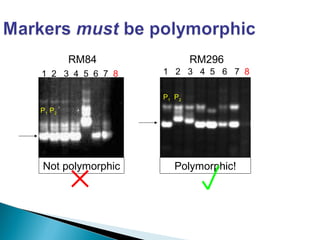
 Level of polymorphism. Ideally, the marker should be highly
polymorphic in breeding material (i.e. it should discriminate between
different genotypes), especially in core breeding material.
 Cost. The marker assay must be cost-effective in order for MAS to
be feasible.
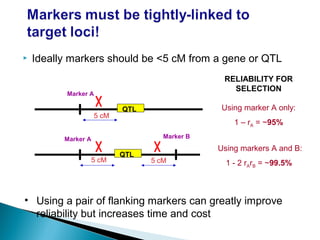
 Ideally markers should be <5 cM from a gene or QTL
• Using a pair of flanking markers can greatly improve
reliability but increases time and cost
Marker A
QTL
5 cM
RELIABILITY FOR
SELECTION
Using marker A only:
1 – rA = ~95%
Marker A
QTL
Marker B
5 cM 5 cM
Using markers A and B:
1 - 2 rArB = ~99.5%
1 2 3 4 5 6 7 8 1 2 3 4 5 6 7 8
RM84 RM296
P1 P2
P1 P2
Not polymorphic Polymorphic!
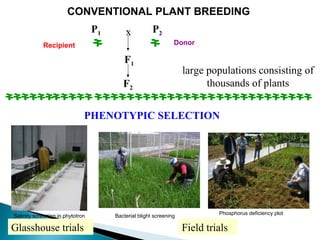
F2
P2
F1
P1 x
large populations consisting of
thousands of plants
PHENOTYPIC SELECTION
Field trialsGlasshouse trials
DonorRecipient
CONVENTIONAL PLANT BREEDING
Salinity screening in phytotron Bacterial blight screening
Phosphorus deficiency plot
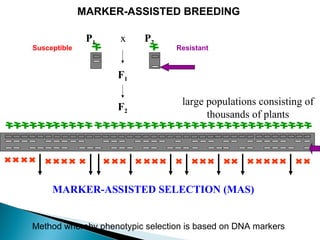
F2
P2
F1
P1 x
large populations consisting of
thousands of plants
ResistantSusceptible
MARKER-ASSISTED SELECTION (MAS)
MARKER-ASSISTED BREEDING
Method whereby phenotypic selection is based on DNA markers
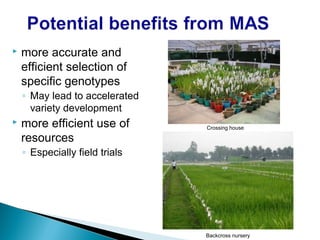
 more accurate and
efficient selection of
specific genotypes
◦ May lead to accelerated
variety development
 more efficient use of
resources
◦ Especially field trials
Crossing house
Backcross nursery
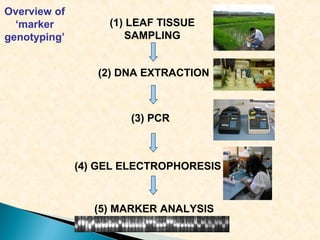
(1) LEAF TISSUE
SAMPLING
(2) DNA EXTRACTION
(3) PCR
(4) GEL ELECTROPHORESIS
(5) MARKER ANALYSIS
Overview of
‘marker
genotyping’
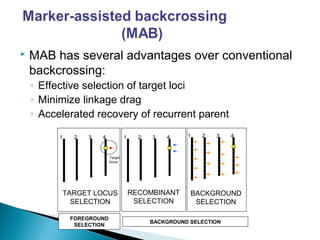
 MAB has several advantages over conventional
backcrossing:
◦ Effective selection of target loci
◦ Minimize linkage drag
◦ Accelerated recovery of recurrent parent
1 2 3 4
Target
locus
1 2 3 4
RECOMBINANT
SELECTION
1 2 3 4
BACKGROUND
SELECTION
TARGET LOCUS
SELECTION
FOREGROUND
SELECTION
BACKGROUND SELECTION
 Widely used for combining multiple disease
resistance genes for specific races of a
pathogen
 Pyramiding is extremely difficult to achieve using
conventional methods
 Important to develop ‘durable’ disease
resistance against different races
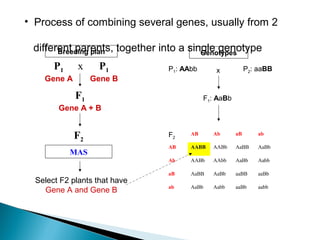
F2
F1
Gene A + B
P1
Gene A
x P1
Gene B
MAS
Select F2 plants that have
Gene A and Gene B
Genotypes
P1: AAbb P2: aaBB
F1: AaBb
F2
AB Ab aB ab
AB AABB AABb AaBB AaBb
Ab AABb AAbb AaBb Aabb
aB AaBB AaBb aaBB aaBb
ab AaBb Aabb aaBb aabb
• Process of combining several genes, usually from 2
different parents, together into a single genotype
x
Breeding plan
 MAS conducted at F2 or F3 stage
 Plants with desirable genes/QTLs are
selected and alleles can be ‘fixed’ in the
homozygous state
◦ plants with undesirable gene combinations can be
discarded
 Advantage for later stages of breeding
program because resources can be used to
focus on fewer lines
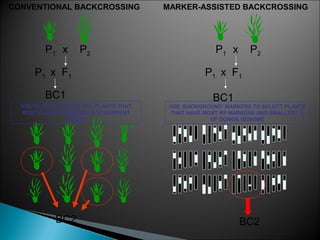
P1 x F1
P1 x P2
CONVENTIONAL BACKCROSSING
BC1
VISUAL SELECTION OF BC1 PLANTS THAT
MOST CLOSELY RESEMBLE RECURRENT
PARENT
BC2
MARKER-ASSISTED BACKCROSSING
P1 x F1
P1 x P2
BC1
USE ‘BACKGROUND’ MARKERS TO SELECT PLANTS
THAT HAVE MOST RP MARKERS AND SMALLEST %
OF DONOR GENOME
BC2
 Simpler method compared to phenotypic
screening
◦ Especially for traits with laborious screening
◦ May save time and resources
 Selection at seedling stage
◦ Important for traits such as grain quality
◦ Can select before transplanting
 Increased reliability
◦ No environmental effects
◦ Can discriminate between homozygotes and
heterozygotes and select single plants
 A literature review
indicates thousands of
QTL mapping studies but
not many actual reports of
the application of MAS in
breeding
 Resources (equipment) not available
 Markers may not be cost-effective
 Accuracy of QTL mapping studies
 QTL effects may depend on genetic background
or be influenced by environmental conditions
 Lack of suitable marker for polymorphism in
particular breeding material
 Poor integration of molecular genetics and
conventional breeding
 Cost-efficiency has rarely been
calculated but MAS is more expensive
for most traits
◦ Exceptions include quality traits
 Determined by:
◦ Trait and method for phenotypic screening
◦ Cost of glasshouse/field trials
◦ Labour costs
◦ Type of markers used
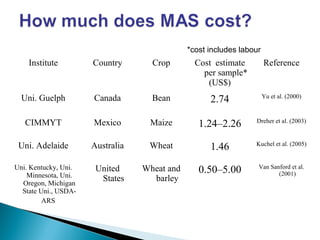
Institute Country Crop Cost estimate
per sample*
(US$)
Reference
Uni. Guelph Canada Bean 2.74 Yu et al. (2000)
CIMMYT Mexico Maize 1.24–2.26 Dreher et al. (2003)
Uni. Adelaide Australia Wheat 1.46 Kuchel et al. (2005)
Uni. Kentucky, Uni.
Minnesota, Uni.
Oregon, Michigan
State Uni., USDA-
ARS
United
States
Wheat and
barley
0.50–5.00 Van Sanford et al.
(2001)
*cost includes labour
 Large ‘gaps’ remain between marker
development and plant breeding
◦ QTL mapping/marker development have been
separated from breeding
◦ Effective transfer of data or information between
research institute and breeding station may not
occur
 Essential concepts in may not be understood
by molecular biologists and breeders (and
other disciplines)
 Improved cost-efficiency
◦ Optimization, simplification of
methods and future innovation
 Design of efficient and
effective MAS strategies
 Greater integration between
molecular genetics and plant
breeding
 Data management
 MAS has great
scope, because MAS
saves time and
labour. And these are
the most important
benefits in the
competetive field of
PLANT
BREEDING from
research point of view
and ultimately to give
food security to the
people of the world.
Marker assistant selection

Marker assistant selection

  • 1.
    PRESENTED BY: Pawan Nagar Reg.no.: 04-2690-2015 M.Sc.(Fruit Science) Marker assisted selection
  • 2.
    Plant breeding—in combinationwith developments in agricultural technology such as agrochemicals—has made remarkable progress in increasing crop yields for over a century. However, plant breeders must constantly respond to many changes. First, agricultural practices change, which creates the need for developing genotypes with specific agronomic characteristics. Second, target environments and the organisms within them are constantly changing. For example, fungal and insect pests continually evolve and overcome host– plant resistance. New land areas are regularly being used for farming, exposing plants to altered growing conditions. Finally, consumer preferences and requirements change. Plant breeders therefore face the endless task of continually developing new crop varieties.
  • 3.
    To overcome thedemand of food for the world crop improvement in lesser time duration is needed, for that DNA markers are very useful to detect the presence of allelic variation in the genes underlying these traits. By using DNA markers to assist in plant breeding, efficiency an d precision could be greatly increased. The use of DNA markers in plant breeding is called marker-assisted selection (MAS) and is a component of the new discipline of ‘molecular breeding’. 
  • 4.
    Marker assisted selection(MAS) refers to the use of DNA markers that are tightly-linked to target loci as a substitute for or to assist phenotypic screening
  • 5.
     Reliability. Markersshould be tightly linked to target loci, preferably less than 5 cM genetic distance. The use of flanking markers or intragenic markers will greatly increase the reliability of the markers to predict phenotype  DNA quantity and quality. Some marker techniques require large amounts and high quality of DNA, which may sometimes be difficult to obtain in practice, and this adds to the cost of the procedures.  
  • 6.
     Technical procedure.The level of simplicity and the time required for the technique are critical considerations. Highly simple and quick methods are highly desirable.  Level of polymorphism. Ideally, the marker should be highly polymorphic in breeding material (i.e. it should discriminate between different genotypes), especially in core breeding material.  Cost. The marker assay must be cost-effective in order for MAS to be feasible.
  • 7.
     Ideally markersshould be <5 cM from a gene or QTL • Using a pair of flanking markers can greatly improve reliability but increases time and cost Marker A QTL 5 cM RELIABILITY FOR SELECTION Using marker A only: 1 – rA = ~95% Marker A QTL Marker B 5 cM 5 cM Using markers A and B: 1 - 2 rArB = ~99.5%
  • 8.
    1 2 34 5 6 7 8 1 2 3 4 5 6 7 8 RM84 RM296 P1 P2 P1 P2 Not polymorphic Polymorphic!
  • 9.
    F2 P2 F1 P1 x large populationsconsisting of thousands of plants PHENOTYPIC SELECTION Field trialsGlasshouse trials DonorRecipient CONVENTIONAL PLANT BREEDING Salinity screening in phytotron Bacterial blight screening Phosphorus deficiency plot
  • 10.
    F2 P2 F1 P1 x large populationsconsisting of thousands of plants ResistantSusceptible MARKER-ASSISTED SELECTION (MAS) MARKER-ASSISTED BREEDING Method whereby phenotypic selection is based on DNA markers
  • 11.
     more accurateand efficient selection of specific genotypes ◦ May lead to accelerated variety development  more efficient use of resources ◦ Especially field trials Crossing house Backcross nursery
  • 12.
    (1) LEAF TISSUE SAMPLING (2)DNA EXTRACTION (3) PCR (4) GEL ELECTROPHORESIS (5) MARKER ANALYSIS Overview of ‘marker genotyping’
  • 13.
     MAB hasseveral advantages over conventional backcrossing: ◦ Effective selection of target loci ◦ Minimize linkage drag ◦ Accelerated recovery of recurrent parent 1 2 3 4 Target locus 1 2 3 4 RECOMBINANT SELECTION 1 2 3 4 BACKGROUND SELECTION TARGET LOCUS SELECTION FOREGROUND SELECTION BACKGROUND SELECTION
  • 14.
     Widely usedfor combining multiple disease resistance genes for specific races of a pathogen  Pyramiding is extremely difficult to achieve using conventional methods  Important to develop ‘durable’ disease resistance against different races
  • 15.
    F2 F1 Gene A +B P1 Gene A x P1 Gene B MAS Select F2 plants that have Gene A and Gene B Genotypes P1: AAbb P2: aaBB F1: AaBb F2 AB Ab aB ab AB AABB AABb AaBB AaBb Ab AABb AAbb AaBb Aabb aB AaBB AaBb aaBB aaBb ab AaBb Aabb aaBb aabb • Process of combining several genes, usually from 2 different parents, together into a single genotype x Breeding plan
  • 16.
     MAS conductedat F2 or F3 stage  Plants with desirable genes/QTLs are selected and alleles can be ‘fixed’ in the homozygous state ◦ plants with undesirable gene combinations can be discarded  Advantage for later stages of breeding program because resources can be used to focus on fewer lines
  • 17.
    P1 x F1 P1x P2 CONVENTIONAL BACKCROSSING BC1 VISUAL SELECTION OF BC1 PLANTS THAT MOST CLOSELY RESEMBLE RECURRENT PARENT BC2 MARKER-ASSISTED BACKCROSSING P1 x F1 P1 x P2 BC1 USE ‘BACKGROUND’ MARKERS TO SELECT PLANTS THAT HAVE MOST RP MARKERS AND SMALLEST % OF DONOR GENOME BC2
  • 18.
     Simpler methodcompared to phenotypic screening ◦ Especially for traits with laborious screening ◦ May save time and resources  Selection at seedling stage ◦ Important for traits such as grain quality ◦ Can select before transplanting  Increased reliability ◦ No environmental effects ◦ Can discriminate between homozygotes and heterozygotes and select single plants
  • 19.
     A literaturereview indicates thousands of QTL mapping studies but not many actual reports of the application of MAS in breeding
  • 20.
     Resources (equipment)not available  Markers may not be cost-effective  Accuracy of QTL mapping studies  QTL effects may depend on genetic background or be influenced by environmental conditions  Lack of suitable marker for polymorphism in particular breeding material  Poor integration of molecular genetics and conventional breeding
  • 21.
     Cost-efficiency hasrarely been calculated but MAS is more expensive for most traits ◦ Exceptions include quality traits  Determined by: ◦ Trait and method for phenotypic screening ◦ Cost of glasshouse/field trials ◦ Labour costs ◦ Type of markers used
  • 22.
    Institute Country CropCost estimate per sample* (US$) Reference Uni. Guelph Canada Bean 2.74 Yu et al. (2000) CIMMYT Mexico Maize 1.24–2.26 Dreher et al. (2003) Uni. Adelaide Australia Wheat 1.46 Kuchel et al. (2005) Uni. Kentucky, Uni. Minnesota, Uni. Oregon, Michigan State Uni., USDA- ARS United States Wheat and barley 0.50–5.00 Van Sanford et al. (2001) *cost includes labour
  • 23.
     Large ‘gaps’remain between marker development and plant breeding ◦ QTL mapping/marker development have been separated from breeding ◦ Effective transfer of data or information between research institute and breeding station may not occur  Essential concepts in may not be understood by molecular biologists and breeders (and other disciplines)
  • 24.
     Improved cost-efficiency ◦Optimization, simplification of methods and future innovation  Design of efficient and effective MAS strategies  Greater integration between molecular genetics and plant breeding  Data management
  • 25.
     MAS hasgreat scope, because MAS saves time and labour. And these are the most important benefits in the competetive field of PLANT BREEDING from research point of view and ultimately to give food security to the people of the world.