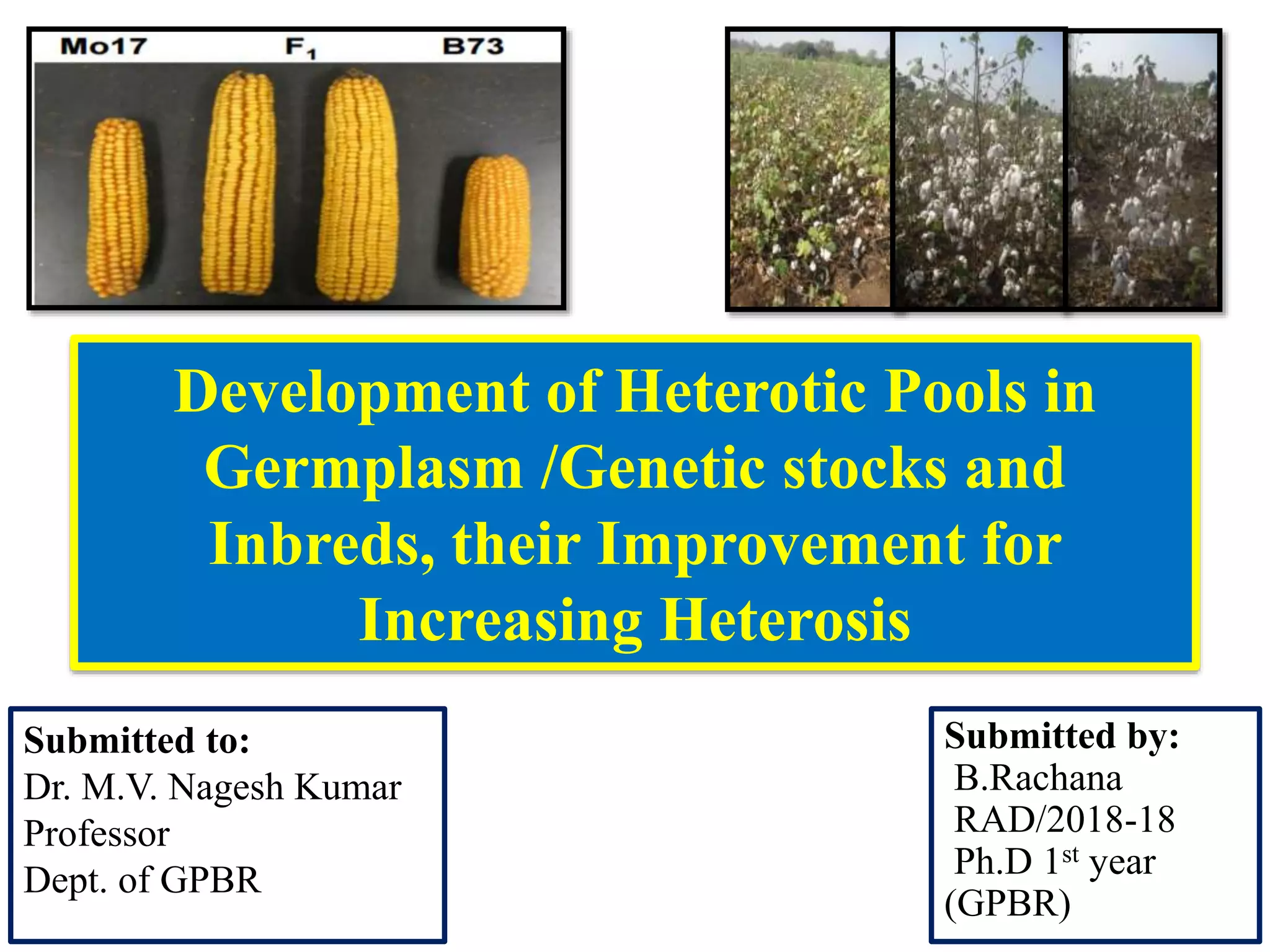
Development of Heterotic Pools in
Germplasm /Genetic stocks and
Inbreds, their Improvement for
Increasing Heterosis
Submitted by:
B.Rachana
RAD/2018-18
Ph.D 1st year
(GPBR)
Submitted to:
Dr. M.V. Nagesh Kumar
Professor
Dept. of GPBR
Contents
• Introduction
• Heterotic groups and
patterns
• History
• Method of developing
• Research findings
• Conclusion
• The application of heterosis is one of the most important
contributions of plant genetics to the development of agricultural
technology in terms of productivity of maize, cotton and many
other crops.
• An increase in genetic diversity doesn’t increase the heterosis, the
combining ability of the lines has to be routinely checked.
• So development of hybrid oriented heterotic populations
(genetically diverse populations) and application of schemes for
improving combining ability is an integral part of hybrid breeding.
• In this regard the concept of heterotic grouping includes the
subdivision of the germplasm available into divergent populations.
Introduction
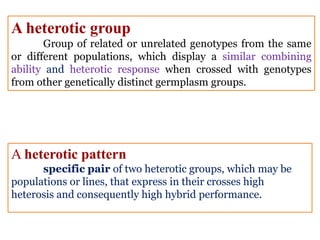
A heterotic group
Group of related or unrelated genotypes from the same
or different populations, which display a similar combining
ability and heterotic response when crossed with genotypes
from other genetically distinct germplasm groups.
A heterotic pattern
specific pair of two heterotic groups, which may be
populations or lines, that express in their crosses high
heterosis and consequently high hybrid performance.
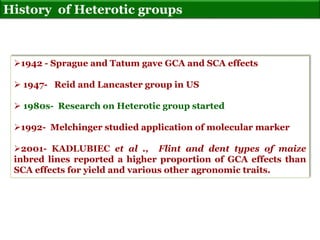
1942 - Sprague and Tatum gave GCA and SCA effects
 1947- Reid and Lancaster group in US
 1980s- Research on Heterotic group started
1992- Melchinger studied application of molecular marker
2001- KADLUBIEC et al ., Flint and dent types of maize
inbred lines reported a higher proportion of GCA effects than
SCA effects for yield and various other agronomic traits.
History of Heterotic groups
Why HETEROTIC GROUPS…???
(i) a higher mean heterosis and hybrid performance and
(ii) a reduced specific combining ability (SCA) variance and a lower ratio of
SCA to general combining ability (GCA) variance.
Assigning lines to heterotic groups would avoid the development and
evaluation of crosses that should be discarded, allowing maximum
heterosis to be exploited by crossing inbred lines belonging to different
heterotic groups.
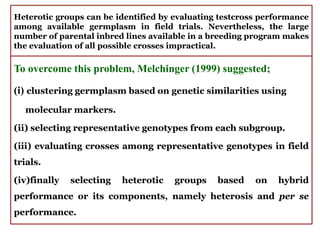
Heterotic groups can be identified by evaluating testcross performance
among available germplasm in field trials. Nevertheless, the large
number of parental inbred lines available in a breeding program makes
the evaluation of all possible crosses impractical.
To overcome this problem, Melchinger (1999) suggested;
(i) clustering germplasm based on genetic similarities using
molecular markers.
(ii) selecting representative genotypes from each subgroup.
(iii) evaluating crosses among representative genotypes in field
trials.
(iv)finally selecting heterotic groups based on hybrid
performance or its components, namely heterosis and per se
performance.
Maintaining genetically distinct heterotic pools leads
to:
• Developing parent lines that are unrelated by descent
• Increased allelic diversity among the heterotic pools
• Increased degree of heterozygosity in the resulting
hybrids.
• Sustainable hybrid breeding
Importance of maintaining Heterotic pools
 Pedigree analysis
Ex- Wu (1983) attempted to classify inbred lines of maize into 4 or 5 groups based on
pedigree analysis and to predict heterotic patterns used in China
Methods for developing heterotic groups
Geographical isolation inference
Ex- Hybrid rice development in China- two heterotic groups that is early season indica from
southern China and mid or late-season indica from Southeast Asia were identified for
three-line hybrid rice based on wild abortive (WA) male sterile cytoplasm (Yuan 1977).
Measurement of heterosis, combining ability
analysis and GY information
Ex- 14 maize inbred lines in Iran, were crossed in a diallel mating design for investigation of
combining ability of genotypes for grain yield and to determine heterotic patterns among
germplasm sources, using both, the Griffing‘s method and the biplot approach for diallel
analysis (Bidhendi et al., 2012).
Molecular markers
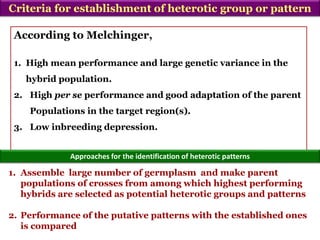
According to Melchinger,
1. High mean performance and large genetic variance in the
hybrid population.
2. High per se performance and good adaptation of the parent
Populations in the target region(s).
3. Low inbreeding depression.
Criteria for establishment of heterotic group or pattern
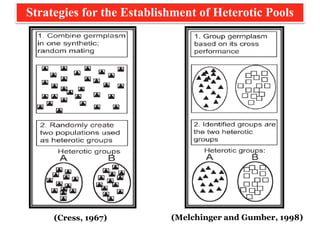
Approaches for the identification of heterotic patterns
1. Assemble large number of germplasm and make parent
populations of crosses from among which highest performing
hybrids are selected as potential heterotic groups and patterns
2. Performance of the putative patterns with the established ones
is compared
(Cress, 1967) (Melchinger and Gumber, 1998)
Strategies for the Establishment of Heterotic Pools
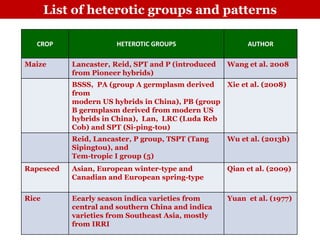
List of heterotic groups and patterns
CROP HETEROTIC GROUPS AUTHOR
Maize Lancaster, Reid, SPT and P (introduced
from Pioneer hybrids)
Wang et al. 2008
BSSS, PA (group A germplasm derived
from
modern US hybrids in China), PB (group
B germplasm derived from modern US
hybrids in China), Lan, LRC (Luda Reb
Cob) and SPT (Si-ping-tou)
Xie et al. (2008)
Reid, Lancaster, P group, TSPT (Tang
Sipingtou), and
Tem-tropic I group (5)
Wu et al. (2013b)
Rapeseed Asian, European winter-type and
Canadian and European spring-type
Qian et al. (2009)
Rice Eearly season indica varieties from
central and southern China and indica
varieties from Southeast Asia, mostly
from IRRI
Yuan et al. (1977)
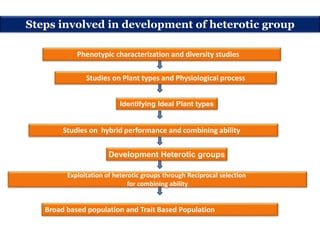
Phenotypic characterization and diversity studies
Studies on Plant types and Physiological process
Identifying Ideal Plant types
Studies on hybrid performance and combining ability
Development Heterotic groups
Exploitation of heterotic groups through Reciprocal selection
for combining ability
Broad based population and Trait Based Population
Steps involved in development of heterotic group
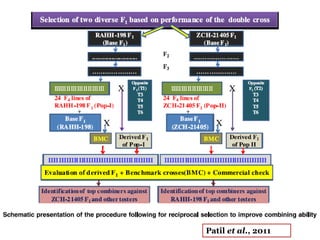
• In often cross pollinated or self pollinated crops, diverse F1s as base
populations advanced through pedigree method and then reciprocal
selection for combining ability is done.
• Diverse F1s were identified based on actual performance of DCH or
based on predicted DCH performane (Somashekhar, 2006).
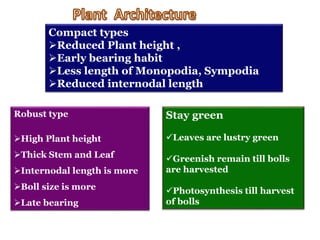
Compact types
Reduced Plant height ,
Early bearing habit
Less length of Monopodia, Sympodia
Reduced internodal length
Robust type
High Plant height
Thick Stem and Leaf
Internodal length is more
Boll size is more
Late bearing
Stay green
Leaves are lustry green
Greenish remain till bolls
are harvested
Photosynthesis till harvest
of bolls
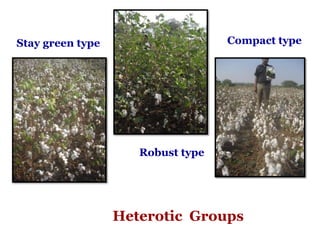
Robust type
Stay green type Compact type
Heterotic Groups
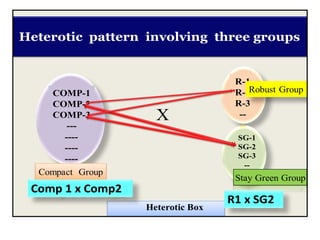
COMP-1
COMP-2
COMP-3
---
----
----
----
R-1
R-2
R-3
--
--
SG-1
SG-2
SG-3
--
--
X
Stay Green Group
Compact Group
Robust Group
Heterotic Box
Comp 1 x Comp2
R1 x SG2
Heterotic pattern involving three groups
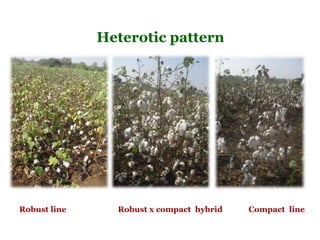
Robust line Compact lineRobust x compact hybrid
Heterotic pattern
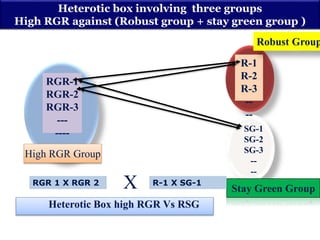
Heterotic box involving three groups
High RGR against (Robust group + stay green group )
RGR-1
RGR-2
RGR-3
---
----
----
----
R-1
R-2
R-3
--
--
SG-1
SG-2
SG-3
--
--
X Stay Green Group
High RGR Group
Robust Group
Heterotic Box high RGR Vs RSG
RGR 1 X RGR 2 R-1 X SG-1
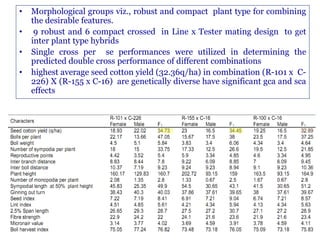
• Morphological groups viz., robust and compact plant type for combining
the desirable features.
• 9 robust and 6 compact crossed in Line x Tester mating design to get
inter plant type hybrids
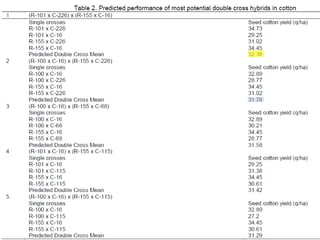
• Single cross per se performances were utilized in determining the
predicted double cross performance of different combinations
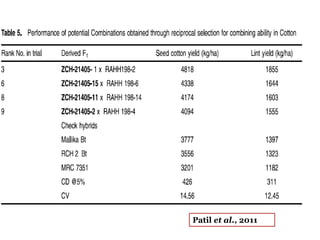
• highest average seed cotton yield (32.36q/ha) in combination (R-101 x C-
226) X (R-155 x C-16) are genetically diverse have significant gca and sca
effects
20
21
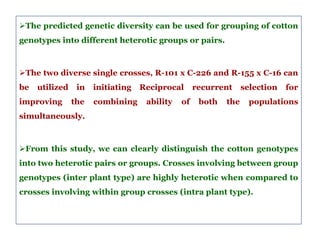
The predicted genetic diversity can be used for grouping of cotton
genotypes into different heterotic groups or pairs.
The two diverse single crosses, R-101 x C-226 and R-155 x C-16 can
be utilized in initiating Reciprocal recurrent selection for
improving the combining ability of both the populations
simultaneously.
From this study, we can clearly distinguish the cotton genotypes
into two heterotic pairs or groups. Crosses involving between group
genotypes (inter plant type) are highly heterotic when compared to
crosses involving within group crosses (intra plant type).
Patil et al., 2011
Patil et al., 2011
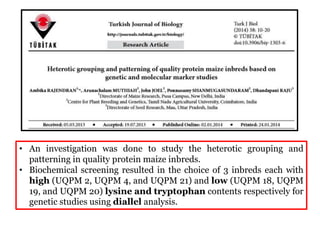
• An investigation was done to study the heterotic grouping and
patterning in quality protein maize inbreds.
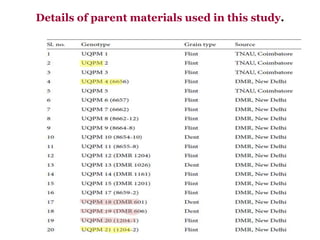
• Biochemical screening resulted in the choice of 3 inbreds each with
high (UQPM 2, UQPM 4, and UQPM 21) and low (UQPM 18, UQPM
19, and UQPM 20) lysine and tryptophan contents respectively for
genetic studies using diallel analysis.
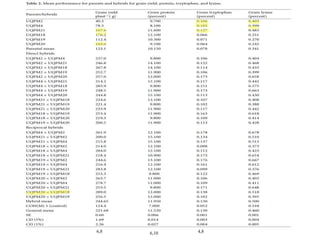
Details of parent materials used in this study.
6,8 6,10 4,8
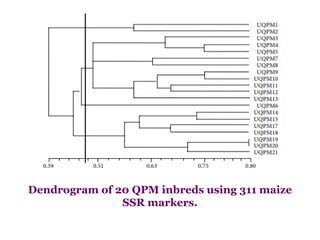
Dendrogram of 20 QPM inbreds using 311 maize
SSR markers.
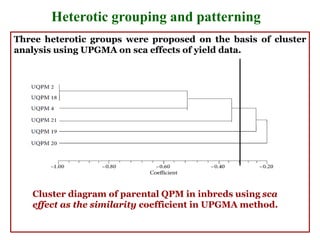
Heterotic grouping and patterning
Three heterotic groups were proposed on the basis of cluster
analysis using UPGMA on sca effects of yield data.
Cluster diagram of parental QPM in inbreds using sca
effect as the similarity coefficient in UPGMA method.
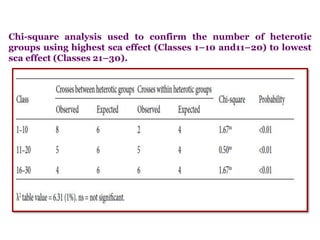
Chi-square analysis used to confirm the number of heterotic
groups using highest sca effect (Classes 1–10 and11–20) to lowest
sca effect (Classes 21–30).
The best hybrid, UQPM 20 × UQPM 18, was an intracluster
hybrid based on genetic diversity at the molecular level.
Thus, prediction of hybrid performance to exclude inferior
crosses before field testing was not feasible with the aid of the
set of molecular markers, irrespective of the marker system or
genetic distance estimate used.
The result of this study showed that genetic distance, in
general, correlated poorly with heterosis.
Future research into heterotic patterns and groups
• To enrich the germplasm pool
• To develop a simple, more efficient method of identifying
heterotic groups and patterns
• to define the genetic interactions and molecular mechanisms
involved in heterotic patterns
“The single most important element of a breeding program is the
recognition and utilization of heterotic pattern. This recognition
both simplifies and increases the efficiency of all subsequent
operations”
(Sprague, 1984)
Conclusion
• Information on genetic diversity and heterotic groups helps
breeders to utilize their germplasm in a more efficient and consistent
manner.
• If once heterotic groups and their pattern are identified then large
number of hybrid combination can be developed, within short period
of time because grouping of lines in different heterotic groups would
avoid the development and evaluation of unnecessary hybrids from
these heterotic groups.
• Heterotic patterns have a strong impact in crop improvement because
they predetermine to a large extent the type of germplasm used in a
hybrid breeding program over a long period of time.
Heterotic pools

Heterotic pools

  • 1.
    Development of HeteroticPools in Germplasm /Genetic stocks and Inbreds, their Improvement for Increasing Heterosis Submitted by: B.Rachana RAD/2018-18 Ph.D 1st year (GPBR) Submitted to: Dr. M.V. Nagesh Kumar Professor Dept. of GPBR
  • 2.
    Contents • Introduction • Heteroticgroups and patterns • History • Method of developing • Research findings • Conclusion
  • 3.
    • The applicationof heterosis is one of the most important contributions of plant genetics to the development of agricultural technology in terms of productivity of maize, cotton and many other crops. • An increase in genetic diversity doesn’t increase the heterosis, the combining ability of the lines has to be routinely checked. • So development of hybrid oriented heterotic populations (genetically diverse populations) and application of schemes for improving combining ability is an integral part of hybrid breeding. • In this regard the concept of heterotic grouping includes the subdivision of the germplasm available into divergent populations. Introduction
  • 4.
    A heterotic group Groupof related or unrelated genotypes from the same or different populations, which display a similar combining ability and heterotic response when crossed with genotypes from other genetically distinct germplasm groups. A heterotic pattern specific pair of two heterotic groups, which may be populations or lines, that express in their crosses high heterosis and consequently high hybrid performance.
  • 5.
    1942 - Spragueand Tatum gave GCA and SCA effects  1947- Reid and Lancaster group in US  1980s- Research on Heterotic group started 1992- Melchinger studied application of molecular marker 2001- KADLUBIEC et al ., Flint and dent types of maize inbred lines reported a higher proportion of GCA effects than SCA effects for yield and various other agronomic traits. History of Heterotic groups
  • 6.
    Why HETEROTIC GROUPS…??? (i)a higher mean heterosis and hybrid performance and (ii) a reduced specific combining ability (SCA) variance and a lower ratio of SCA to general combining ability (GCA) variance. Assigning lines to heterotic groups would avoid the development and evaluation of crosses that should be discarded, allowing maximum heterosis to be exploited by crossing inbred lines belonging to different heterotic groups.
  • 7.
    Heterotic groups canbe identified by evaluating testcross performance among available germplasm in field trials. Nevertheless, the large number of parental inbred lines available in a breeding program makes the evaluation of all possible crosses impractical. To overcome this problem, Melchinger (1999) suggested; (i) clustering germplasm based on genetic similarities using molecular markers. (ii) selecting representative genotypes from each subgroup. (iii) evaluating crosses among representative genotypes in field trials. (iv)finally selecting heterotic groups based on hybrid performance or its components, namely heterosis and per se performance.
  • 8.
    Maintaining genetically distinctheterotic pools leads to: • Developing parent lines that are unrelated by descent • Increased allelic diversity among the heterotic pools • Increased degree of heterozygosity in the resulting hybrids. • Sustainable hybrid breeding Importance of maintaining Heterotic pools
  • 9.
     Pedigree analysis Ex-Wu (1983) attempted to classify inbred lines of maize into 4 or 5 groups based on pedigree analysis and to predict heterotic patterns used in China Methods for developing heterotic groups Geographical isolation inference Ex- Hybrid rice development in China- two heterotic groups that is early season indica from southern China and mid or late-season indica from Southeast Asia were identified for three-line hybrid rice based on wild abortive (WA) male sterile cytoplasm (Yuan 1977). Measurement of heterosis, combining ability analysis and GY information Ex- 14 maize inbred lines in Iran, were crossed in a diallel mating design for investigation of combining ability of genotypes for grain yield and to determine heterotic patterns among germplasm sources, using both, the Griffing‘s method and the biplot approach for diallel analysis (Bidhendi et al., 2012). Molecular markers
  • 10.
    According to Melchinger, 1.High mean performance and large genetic variance in the hybrid population. 2. High per se performance and good adaptation of the parent Populations in the target region(s). 3. Low inbreeding depression. Criteria for establishment of heterotic group or pattern Approaches for the identification of heterotic patterns 1. Assemble large number of germplasm and make parent populations of crosses from among which highest performing hybrids are selected as potential heterotic groups and patterns 2. Performance of the putative patterns with the established ones is compared
  • 11.
    (Cress, 1967) (Melchingerand Gumber, 1998) Strategies for the Establishment of Heterotic Pools
  • 12.
    List of heteroticgroups and patterns CROP HETEROTIC GROUPS AUTHOR Maize Lancaster, Reid, SPT and P (introduced from Pioneer hybrids) Wang et al. 2008 BSSS, PA (group A germplasm derived from modern US hybrids in China), PB (group B germplasm derived from modern US hybrids in China), Lan, LRC (Luda Reb Cob) and SPT (Si-ping-tou) Xie et al. (2008) Reid, Lancaster, P group, TSPT (Tang Sipingtou), and Tem-tropic I group (5) Wu et al. (2013b) Rapeseed Asian, European winter-type and Canadian and European spring-type Qian et al. (2009) Rice Eearly season indica varieties from central and southern China and indica varieties from Southeast Asia, mostly from IRRI Yuan et al. (1977)
  • 13.
    Phenotypic characterization anddiversity studies Studies on Plant types and Physiological process Identifying Ideal Plant types Studies on hybrid performance and combining ability Development Heterotic groups Exploitation of heterotic groups through Reciprocal selection for combining ability Broad based population and Trait Based Population Steps involved in development of heterotic group
  • 14.
    • In oftencross pollinated or self pollinated crops, diverse F1s as base populations advanced through pedigree method and then reciprocal selection for combining ability is done. • Diverse F1s were identified based on actual performance of DCH or based on predicted DCH performane (Somashekhar, 2006).
  • 15.
    Compact types Reduced Plantheight , Early bearing habit Less length of Monopodia, Sympodia Reduced internodal length Robust type High Plant height Thick Stem and Leaf Internodal length is more Boll size is more Late bearing Stay green Leaves are lustry green Greenish remain till bolls are harvested Photosynthesis till harvest of bolls
  • 16.
    Robust type Stay greentype Compact type Heterotic Groups
  • 17.
    COMP-1 COMP-2 COMP-3 --- ---- ---- ---- R-1 R-2 R-3 -- -- SG-1 SG-2 SG-3 -- -- X Stay Green Group CompactGroup Robust Group Heterotic Box Comp 1 x Comp2 R1 x SG2 Heterotic pattern involving three groups
  • 18.
    Robust line CompactlineRobust x compact hybrid Heterotic pattern
  • 19.
    Heterotic box involvingthree groups High RGR against (Robust group + stay green group ) RGR-1 RGR-2 RGR-3 --- ---- ---- ---- R-1 R-2 R-3 -- -- SG-1 SG-2 SG-3 -- -- X Stay Green Group High RGR Group Robust Group Heterotic Box high RGR Vs RSG RGR 1 X RGR 2 R-1 X SG-1
  • 20.
    • Morphological groupsviz., robust and compact plant type for combining the desirable features. • 9 robust and 6 compact crossed in Line x Tester mating design to get inter plant type hybrids • Single cross per se performances were utilized in determining the predicted double cross performance of different combinations • highest average seed cotton yield (32.36q/ha) in combination (R-101 x C- 226) X (R-155 x C-16) are genetically diverse have significant gca and sca effects 20
  • 21.
  • 22.
    The predicted geneticdiversity can be used for grouping of cotton genotypes into different heterotic groups or pairs. The two diverse single crosses, R-101 x C-226 and R-155 x C-16 can be utilized in initiating Reciprocal recurrent selection for improving the combining ability of both the populations simultaneously. From this study, we can clearly distinguish the cotton genotypes into two heterotic pairs or groups. Crosses involving between group genotypes (inter plant type) are highly heterotic when compared to crosses involving within group crosses (intra plant type).
  • 23.
  • 24.
  • 25.
    • An investigationwas done to study the heterotic grouping and patterning in quality protein maize inbreds. • Biochemical screening resulted in the choice of 3 inbreds each with high (UQPM 2, UQPM 4, and UQPM 21) and low (UQPM 18, UQPM 19, and UQPM 20) lysine and tryptophan contents respectively for genetic studies using diallel analysis.
  • 26.
    Details of parentmaterials used in this study.
  • 27.
  • 28.
    Dendrogram of 20QPM inbreds using 311 maize SSR markers.
  • 29.
    Heterotic grouping andpatterning Three heterotic groups were proposed on the basis of cluster analysis using UPGMA on sca effects of yield data. Cluster diagram of parental QPM in inbreds using sca effect as the similarity coefficient in UPGMA method.
  • 30.
    Chi-square analysis usedto confirm the number of heterotic groups using highest sca effect (Classes 1–10 and11–20) to lowest sca effect (Classes 21–30).
  • 31.
    The best hybrid,UQPM 20 × UQPM 18, was an intracluster hybrid based on genetic diversity at the molecular level. Thus, prediction of hybrid performance to exclude inferior crosses before field testing was not feasible with the aid of the set of molecular markers, irrespective of the marker system or genetic distance estimate used. The result of this study showed that genetic distance, in general, correlated poorly with heterosis.
  • 32.
    Future research intoheterotic patterns and groups • To enrich the germplasm pool • To develop a simple, more efficient method of identifying heterotic groups and patterns • to define the genetic interactions and molecular mechanisms involved in heterotic patterns “The single most important element of a breeding program is the recognition and utilization of heterotic pattern. This recognition both simplifies and increases the efficiency of all subsequent operations” (Sprague, 1984)
  • 33.
    Conclusion • Information ongenetic diversity and heterotic groups helps breeders to utilize their germplasm in a more efficient and consistent manner. • If once heterotic groups and their pattern are identified then large number of hybrid combination can be developed, within short period of time because grouping of lines in different heterotic groups would avoid the development and evaluation of unnecessary hybrids from these heterotic groups. • Heterotic patterns have a strong impact in crop improvement because they predetermine to a large extent the type of germplasm used in a hybrid breeding program over a long period of time.