MAGIC population
A new resource for plant genetics
Presented by –
Thorat Balaji Shivaji
Sr. MS.c.(Agri) (2418)
Department of Agril. Botany
Genetics and Plant Breeding
 Introduction
 Objectives
 Procedure
Genetic analysis of MAGIC population
 Use of MAGIC line in breeding programs
Case studies
 Advantages
 Institutes involved in development of magic populations
 Limitation
 Conclusion
 MAGIC stands for “Multi-parent Advanced Generation Inter-Cross”.
 It is a simple extension of the advanced intercross (Darvasi and soller,
1995).
 The method was first proposed and applied in mice by Mott et al. (2000)
 Magic coined by Mackay and Powell (2008) and advocated by them.
 MAGIC population were first developed and described in Arabidopsis
(Kover et al, 2009)
 MAGIC described as “heterogeneous stock”
 MAGIC allows the identification of genes controlling quantitative traits,
by crossing different combinations of multiple parents.
 MAGIC – combines high diversity (from multiple parents) with
high recombination.
 The increased recombination and diversity of MAGIC gives
greater precision in QTL location and greater opportunity to detect
more QTL.
 Lines derived from early generation can be used for QTL
detection and coarse mapping
 Intercrossed mapping population is created from multiple founder
lines.
Each generation reduces the extent of linkage disequilibrium
(LD), thus allowing QTL to be mapped more accurately.
OBJECTIVE OF MAGIC POPULATION
 MAGIC has the potential to increase the speed and efficiency of
breeding.
 MAGIC will direct impact on the production of farms as well as
the ability to change the way of scientists to identify the genes that
control the quality and disease resistance.
 MAGIC populations served as source material for extraction and
development of breeding lines and varieties.
 Development of variety with several agronomically benefitial
traits.
Variety which can be adopt to several diverse region of the world
and suitable for diverse climatic conditions.
 MAGIC populations are bring model shift toward QTL analysis,
gene mapping, variety development etc. in plant species.
 This work is also providing Australian wheat breeders with more
accurate DNA markers for the genes responsible for wheat quality.
Cont……..
PROCEDURE OF MAGIC POPULATION
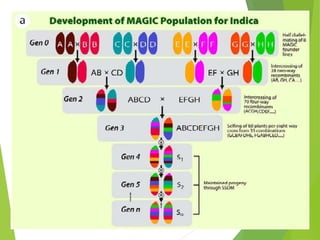
Steps in development of MAGIC population
 Founder selection
 Mixing of parents
 Advanced intercrossing
 Inbreeding
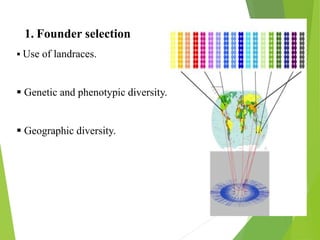
1. Founder selection
 Use of landraces.
 Genetic and phenotypic diversity.
 Geographic diversity.
2. Mixing of parents
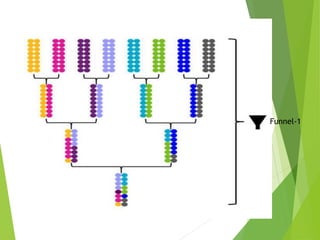
Multiple parents are intercrossed to form a broad genetic base.
 Mixing of parents together in predefined patterns and
intermated.
 The inbred founders are paired and inter-mated known as
funnel.
 The result of this stage is a set of lines whose genomes

comprised contribute from each of founder.
Funnel-1
•
3. Advanced intercross lines
 Proposed by Darvasi and Soller (1995).
Cross between two inbred lines.
 Each generation intercross sequentially and randomly.
 Selection is phenotypic to further reduce the frequency of
deleterious allele from the donor.
Mixed lines from different funnels are randomly and sequentially
intercrossed as in the advanced intercross.
The main goal is to increased the number of recombination's in a
population.
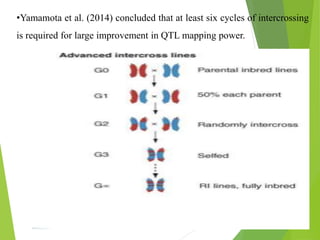
•Yamamota et al. (2014) concluded that at least six cycles of intercrossing
is required for large improvement in QTL mapping power.
4. Inbreeding
• Development of homozygous individuals.
• Selfing of individuals either directly from funnels or
after advanced intercrossing to form inbred lines.
•RILs in plants can be created via single seed descent or
doubled haploid production
•Doubled haploid production is often faster
• The multiple generations of selfing will introduce
additional recombination
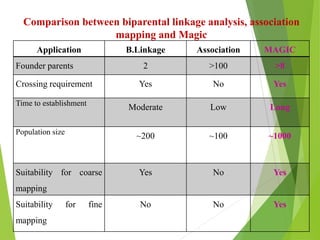
Comparison between biparental linkage analysis, association
mapping and Magic
Application B.Linkage Association MAGIC
Founder parents 2 >100 >8
Crossing requirement Yes No Yes
Time to establishment
Moderate Low Long
Population size
~200 ~100 ~1000
Suitability for coarse
mapping
Yes No Yes
Suitability for fine
mapping
No No Yes
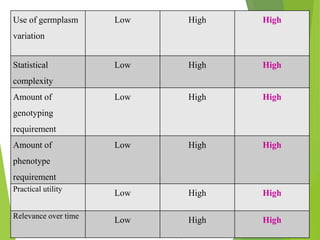
Use of germplasm
variation
Low High High
Statistical
complexity
Low High High
Amount of
genotyping
requirement
Low High High
Amount of
phenotype
requirement
Low High High
Practical utility
Low High High
Relevance over time
Low High High
Genetic analysis of MAGIC population:
1. Linkage map construction
•The large number of polymorphic markers across all founders and
accumulation of recombination events through many generations
•This MAGIC pedigree can be used to achieve dense and high-
resolution mapping of the genome
•MAGIC population can be seen most clearly in the region around
centromeres
•The first linkage map from a MAGIC population was constructed
in wheat (Huang et al., 2012 )
2 . QTL mapping approaches
•The use of heterogeneous stocks (HS) improves the power to
detect and localize QTL
•The large number of parental accessions increases the allelic and
phenotypic diversity
• The larger number of accumulated recombination events increase
the mapping accuracy of the detected QTL compared to an F 2
cross
“Thus , MAGIC lines occupy an intermediate
position between naturally occurring accessions and existing
synthetic populations.”
Use of MAGIC lines in breeding programs :
 MAGIC populations may be used directly as source materials for the
extraction and development of breeding lines and varieties.
Development of variety with several agronomically beneficial traits .
Variety which can adopt to several diverse regions of the world and
suitable for diverse climatic conditions.
Can provide solutions to a range of production constraints (particularly
stress tolerance)
An assessment and understanding of the potential of enhanced
recombination in generating novel diversity .
CASE STUDY - 1
Multiparent advanced generation intercross (MAGIC) populations
in rice progress and potential for genetics research and breeding
 Bandilo et al. (2013) developed two initial MAGIC population by
inter-crossing eight elite lines.
 From the Asia indica group – indica MAGIC.
 The japonica group – japonica MAGIC.
 Each population comprised of eight founder lines.
 Modern varieties exhibit high yield potential, good grain quality,
resistance to biotic and abiotic stress.
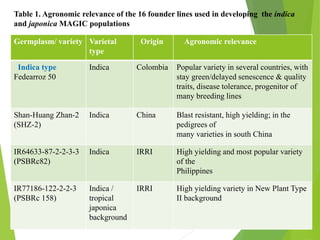
Table 1. Agronomic relevance of the 16 founder lines used in developing the indica
and japonica MAGIC populations
Germplasm/ variety Varietal
type
Origin Agronomic relevance
Indica type
Fedearroz 50
Indica Colombia Popular variety in several countries, with
stay green/delayed senescence & quality
traits, disease tolerance, progenitor of
many breeding lines
Shan-Huang Zhan-2
(SHZ-2)
Indica China Blast resistant, high yielding; in the
pedigrees of
many varieties in south China
IR64633-87-2-2-3-3
(PSBRc82)
Indica IRRI High yielding and most popular variety
of the
Philippines
IR77186-122-2-2-3
(PSBRc 158)
Indica /
tropical
japonica
background
IRRI High yielding variety in New Plant Type
II background
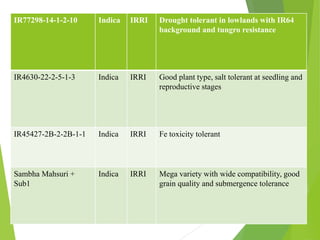
IR77298-14-1-2-10 Indica IRRI Drought tolerant in lowlands with IR64
background and tungro resistance
IR4630-22-2-5-1-3 Indica IRRI Good plant type, salt tolerant at seedling and
reproductive stages
IR45427-2B-2-2B-1-1 Indica IRRI Fe toxicity tolerant
Sambha Mahsuri +
Sub1
Indica IRRI Mega variety with wide compatibility, good
grain quality and submergence tolerance
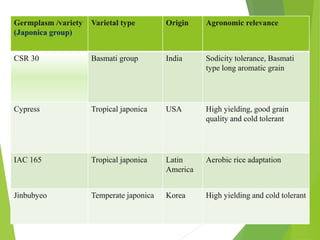
Germplasm /variety
(Japonica group)
Varietal type Origin Agronomic relevance
CSR 30 Basmati group India Sodicity tolerance, Basmati
type long aromatic grain
Cypress Tropical japonica USA High yielding, good grain
quality and cold tolerant
IAC 165 Tropical japonica Latin
America
Aerobic rice adaptation
Jinbubyeo Temperate japonica Korea High yielding and cold tolerant
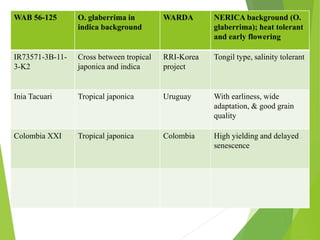
WAB 56-125 O. glaberrima in
indica background
WARDA NERICA background (O.
glaberrima); heat tolerant
and early flowering
IR73571-3B-11-
3-K2
Cross between tropical
japonica and indica
RRI-Korea
project
Tongil type, salinity tolerant
Inia Tacuari Tropical japonica Uruguay With earliness, wide
adaptation, & good grain
quality
Colombia XXI Tropical japonica Colombia High yielding and delayed
senescence
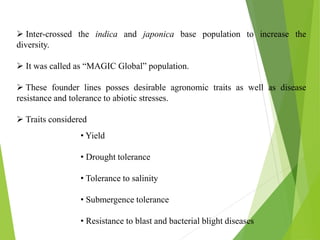
 Inter-crossed the indica and japonica base population to increase the
diversity.
 It was called as “MAGIC Global” population.
 These founder lines posses desirable agronomic traits as well as disease
resistance and tolerance to abiotic stresses.
 Traits considered
• Yield
• Drought tolerance
• Tolerance to salinity
• Submergence tolerance
• Resistance to blast and bacterial blight diseases
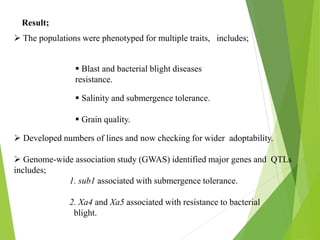
 The populations were phenotyped for multiple traits, includes;
 Blast and bacterial blight diseases
resistance.
 Salinity and submergence tolerance.
 Grain quality.
 Developed numbers of lines and now checking for wider adoptability.
 Genome-wide association study (GWAS) identified major genes and QTLs
includes;
1. sub1 associated with submergence tolerance.
2. Xa4 and Xa5 associated with resistance to bacterial
blight.
Result;
CASE STUDY - 2
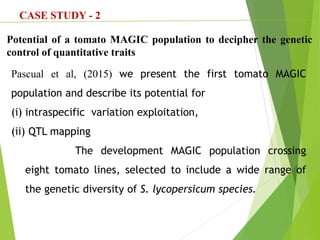
Potential of a tomato MAGIC population to decipher the genetic
control of quantitative traits
Pascual et al, (2015) we present the first tomato MAGIC
population and describe its potential for
(i) intraspecific variation exploitation,
(ii) QTL mapping
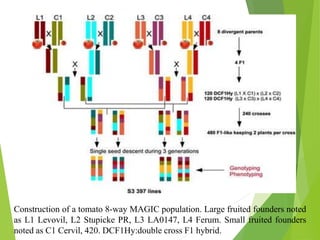
The development MAGIC population crossing
eight tomato lines, selected to include a wide range of
the genetic diversity of S. lycopersicum species.
Construction of a tomato 8-way MAGIC population. Large fruited founders noted
as L1 Levovil, L2 Stupicke PR, L3 LA0147, L4 Ferum. Small fruited founders
noted as C1 Cervil, 420. DCF1Hy:double cross F1 hybrid.
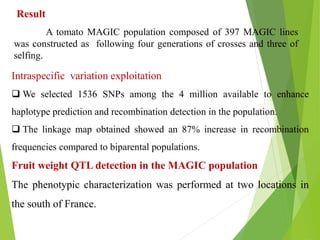
Intraspecific variation exploitation
 We selected 1536 SNPs among the 4 million available to enhance
haplotype prediction and recombination detection in the population.
 The linkage map obtained showed an 87% increase in recombination
frequencies compared to biparental populations.
Fruit weight QTL detection in the MAGIC population
The phenotypic characterization was performed at two locations in
the south of France.
A tomato MAGIC population composed of 397 MAGIC lines
was constructed as following four generations of crosses and three of
selfing.
Result
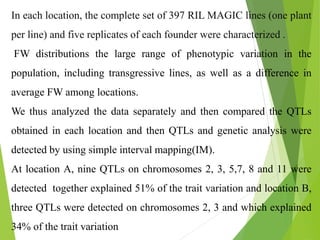
In each location, the complete set of 397 RIL MAGIC lines (one plant
per line) and five replicates of each founder were characterized .
FW distributions the large range of phenotypic variation in the
population, including transgressive lines, as well as a difference in
average FW among locations.
We thus analyzed the data separately and then compared the QTLs
obtained in each location and then QTLs and genetic analysis were
detected by using simple interval mapping(IM).
At location A, nine QTLs on chromosomes 2, 3, 5,7, 8 and 11 were
detected together explained 51% of the trait variation and location B,
three QTLs were detected on chromosomes 2, 3 and which explained
34% of the trait variation
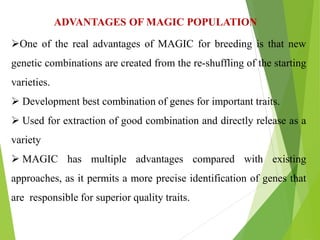
One of the real advantages of MAGIC for breeding is that new
genetic combinations are created from the re-shuffling of the starting
varieties.
 Development best combination of genes for important traits.
 Used for extraction of good combination and directly release as a
variety
 MAGIC has multiple advantages compared with existing
approaches, as it permits a more precise identification of genes that
are responsible for superior quality traits.
ADVANTAGES OF MAGIC POPULATION
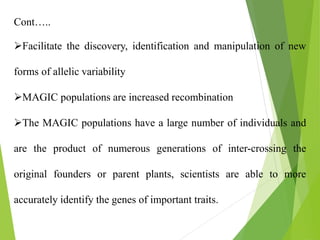
Cont…..
Facilitate the discovery, identification and manipulation of new
forms of allelic variability
MAGIC populations are increased recombination
The MAGIC populations have a large number of individuals and
are the product of numerous generations of inter-crossing the
original founders or parent plants, scientists are able to more
accurately identify the genes of important traits.
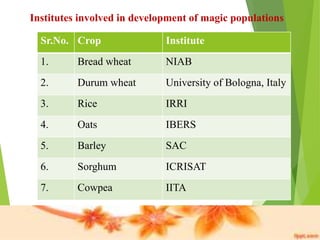
33
Sr.No. Crop Institute
1. Bread wheat NIAB
2. Durum wheat University of Bologna, Italy
3. Rice IRRI
4. Oats IBERS
5. Barley SAC
6. Sorghum ICRISAT
7. Cowpea IITA
Institutes involved in development of magic populations
LIMITATION
1. More time
2. Large scale phenotyping
3. Incompatibility between the parents
4. Require more inputs
5. Better marker system is necessary to identify QTLs
6. Extensive segregation
• Used for development of variability.
• Detection of QTLs which responsible for stress resistance, yield
and other important traits.
• Development of varieties with novel combination.
•It is a powerful method to increase the precision of genetic
markers linked to the QTLs.
• MAGIC populations are likely to bring model shift towards QTL
analysis, gene mapping, variety development etc. in plant species.
Magic population

Magic population

  • 1.
    MAGIC population A newresource for plant genetics Presented by – Thorat Balaji Shivaji Sr. MS.c.(Agri) (2418) Department of Agril. Botany Genetics and Plant Breeding
  • 2.
     Introduction  Objectives Procedure Genetic analysis of MAGIC population  Use of MAGIC line in breeding programs Case studies  Advantages  Institutes involved in development of magic populations  Limitation  Conclusion
  • 3.
     MAGIC standsfor “Multi-parent Advanced Generation Inter-Cross”.  It is a simple extension of the advanced intercross (Darvasi and soller, 1995).  The method was first proposed and applied in mice by Mott et al. (2000)  Magic coined by Mackay and Powell (2008) and advocated by them.  MAGIC population were first developed and described in Arabidopsis (Kover et al, 2009)  MAGIC described as “heterogeneous stock”  MAGIC allows the identification of genes controlling quantitative traits, by crossing different combinations of multiple parents.
  • 4.
     MAGIC –combines high diversity (from multiple parents) with high recombination.  The increased recombination and diversity of MAGIC gives greater precision in QTL location and greater opportunity to detect more QTL.  Lines derived from early generation can be used for QTL detection and coarse mapping  Intercrossed mapping population is created from multiple founder lines. Each generation reduces the extent of linkage disequilibrium (LD), thus allowing QTL to be mapped more accurately.
  • 5.
    OBJECTIVE OF MAGICPOPULATION  MAGIC has the potential to increase the speed and efficiency of breeding.  MAGIC will direct impact on the production of farms as well as the ability to change the way of scientists to identify the genes that control the quality and disease resistance.  MAGIC populations served as source material for extraction and development of breeding lines and varieties.  Development of variety with several agronomically benefitial traits.
  • 6.
    Variety which canbe adopt to several diverse region of the world and suitable for diverse climatic conditions.  MAGIC populations are bring model shift toward QTL analysis, gene mapping, variety development etc. in plant species.  This work is also providing Australian wheat breeders with more accurate DNA markers for the genes responsible for wheat quality. Cont……..
  • 7.
    PROCEDURE OF MAGICPOPULATION Steps in development of MAGIC population  Founder selection  Mixing of parents  Advanced intercrossing  Inbreeding
  • 8.
    1. Founder selection Use of landraces.  Genetic and phenotypic diversity.  Geographic diversity.
  • 9.
    2. Mixing ofparents Multiple parents are intercrossed to form a broad genetic base.  Mixing of parents together in predefined patterns and intermated.  The inbred founders are paired and inter-mated known as funnel.  The result of this stage is a set of lines whose genomes comprised contribute from each of founder.
  • 10.
  • 11.
    • 3. Advanced intercrosslines  Proposed by Darvasi and Soller (1995). Cross between two inbred lines.  Each generation intercross sequentially and randomly.  Selection is phenotypic to further reduce the frequency of deleterious allele from the donor. Mixed lines from different funnels are randomly and sequentially intercrossed as in the advanced intercross. The main goal is to increased the number of recombination's in a population.
  • 12.
    •Yamamota et al.(2014) concluded that at least six cycles of intercrossing is required for large improvement in QTL mapping power.
  • 13.
    4. Inbreeding • Developmentof homozygous individuals. • Selfing of individuals either directly from funnels or after advanced intercrossing to form inbred lines. •RILs in plants can be created via single seed descent or doubled haploid production •Doubled haploid production is often faster • The multiple generations of selfing will introduce additional recombination
  • 14.
    Comparison between biparentallinkage analysis, association mapping and Magic Application B.Linkage Association MAGIC Founder parents 2 >100 >8 Crossing requirement Yes No Yes Time to establishment Moderate Low Long Population size ~200 ~100 ~1000 Suitability for coarse mapping Yes No Yes Suitability for fine mapping No No Yes
  • 15.
    Use of germplasm variation LowHigh High Statistical complexity Low High High Amount of genotyping requirement Low High High Amount of phenotype requirement Low High High Practical utility Low High High Relevance over time Low High High
  • 16.
    Genetic analysis ofMAGIC population: 1. Linkage map construction •The large number of polymorphic markers across all founders and accumulation of recombination events through many generations •This MAGIC pedigree can be used to achieve dense and high- resolution mapping of the genome •MAGIC population can be seen most clearly in the region around centromeres •The first linkage map from a MAGIC population was constructed in wheat (Huang et al., 2012 )
  • 17.
    2 . QTLmapping approaches •The use of heterogeneous stocks (HS) improves the power to detect and localize QTL •The large number of parental accessions increases the allelic and phenotypic diversity • The larger number of accumulated recombination events increase the mapping accuracy of the detected QTL compared to an F 2 cross “Thus , MAGIC lines occupy an intermediate position between naturally occurring accessions and existing synthetic populations.”
  • 18.
    Use of MAGIClines in breeding programs :  MAGIC populations may be used directly as source materials for the extraction and development of breeding lines and varieties. Development of variety with several agronomically beneficial traits . Variety which can adopt to several diverse regions of the world and suitable for diverse climatic conditions. Can provide solutions to a range of production constraints (particularly stress tolerance) An assessment and understanding of the potential of enhanced recombination in generating novel diversity .
  • 19.
    CASE STUDY -1 Multiparent advanced generation intercross (MAGIC) populations in rice progress and potential for genetics research and breeding  Bandilo et al. (2013) developed two initial MAGIC population by inter-crossing eight elite lines.  From the Asia indica group – indica MAGIC.  The japonica group – japonica MAGIC.  Each population comprised of eight founder lines.  Modern varieties exhibit high yield potential, good grain quality, resistance to biotic and abiotic stress.
  • 20.
    Table 1. Agronomicrelevance of the 16 founder lines used in developing the indica and japonica MAGIC populations Germplasm/ variety Varietal type Origin Agronomic relevance Indica type Fedearroz 50 Indica Colombia Popular variety in several countries, with stay green/delayed senescence & quality traits, disease tolerance, progenitor of many breeding lines Shan-Huang Zhan-2 (SHZ-2) Indica China Blast resistant, high yielding; in the pedigrees of many varieties in south China IR64633-87-2-2-3-3 (PSBRc82) Indica IRRI High yielding and most popular variety of the Philippines IR77186-122-2-2-3 (PSBRc 158) Indica / tropical japonica background IRRI High yielding variety in New Plant Type II background
  • 21.
    IR77298-14-1-2-10 Indica IRRIDrought tolerant in lowlands with IR64 background and tungro resistance IR4630-22-2-5-1-3 Indica IRRI Good plant type, salt tolerant at seedling and reproductive stages IR45427-2B-2-2B-1-1 Indica IRRI Fe toxicity tolerant Sambha Mahsuri + Sub1 Indica IRRI Mega variety with wide compatibility, good grain quality and submergence tolerance
  • 22.
    Germplasm /variety (Japonica group) Varietaltype Origin Agronomic relevance CSR 30 Basmati group India Sodicity tolerance, Basmati type long aromatic grain Cypress Tropical japonica USA High yielding, good grain quality and cold tolerant IAC 165 Tropical japonica Latin America Aerobic rice adaptation Jinbubyeo Temperate japonica Korea High yielding and cold tolerant
  • 23.
    WAB 56-125 O.glaberrima in indica background WARDA NERICA background (O. glaberrima); heat tolerant and early flowering IR73571-3B-11- 3-K2 Cross between tropical japonica and indica RRI-Korea project Tongil type, salinity tolerant Inia Tacuari Tropical japonica Uruguay With earliness, wide adaptation, & good grain quality Colombia XXI Tropical japonica Colombia High yielding and delayed senescence
  • 24.
     Inter-crossed theindica and japonica base population to increase the diversity.  It was called as “MAGIC Global” population.  These founder lines posses desirable agronomic traits as well as disease resistance and tolerance to abiotic stresses.  Traits considered • Yield • Drought tolerance • Tolerance to salinity • Submergence tolerance • Resistance to blast and bacterial blight diseases
  • 26.
     The populationswere phenotyped for multiple traits, includes;  Blast and bacterial blight diseases resistance.  Salinity and submergence tolerance.  Grain quality.  Developed numbers of lines and now checking for wider adoptability.  Genome-wide association study (GWAS) identified major genes and QTLs includes; 1. sub1 associated with submergence tolerance. 2. Xa4 and Xa5 associated with resistance to bacterial blight. Result;
  • 27.
    CASE STUDY -2 Potential of a tomato MAGIC population to decipher the genetic control of quantitative traits Pascual et al, (2015) we present the first tomato MAGIC population and describe its potential for (i) intraspecific variation exploitation, (ii) QTL mapping The development MAGIC population crossing eight tomato lines, selected to include a wide range of the genetic diversity of S. lycopersicum species.
  • 28.
    Construction of atomato 8-way MAGIC population. Large fruited founders noted as L1 Levovil, L2 Stupicke PR, L3 LA0147, L4 Ferum. Small fruited founders noted as C1 Cervil, 420. DCF1Hy:double cross F1 hybrid.
  • 29.
    Intraspecific variation exploitation We selected 1536 SNPs among the 4 million available to enhance haplotype prediction and recombination detection in the population.  The linkage map obtained showed an 87% increase in recombination frequencies compared to biparental populations. Fruit weight QTL detection in the MAGIC population The phenotypic characterization was performed at two locations in the south of France. A tomato MAGIC population composed of 397 MAGIC lines was constructed as following four generations of crosses and three of selfing. Result
  • 30.
    In each location,the complete set of 397 RIL MAGIC lines (one plant per line) and five replicates of each founder were characterized . FW distributions the large range of phenotypic variation in the population, including transgressive lines, as well as a difference in average FW among locations. We thus analyzed the data separately and then compared the QTLs obtained in each location and then QTLs and genetic analysis were detected by using simple interval mapping(IM). At location A, nine QTLs on chromosomes 2, 3, 5,7, 8 and 11 were detected together explained 51% of the trait variation and location B, three QTLs were detected on chromosomes 2, 3 and which explained 34% of the trait variation
  • 31.
    One of thereal advantages of MAGIC for breeding is that new genetic combinations are created from the re-shuffling of the starting varieties.  Development best combination of genes for important traits.  Used for extraction of good combination and directly release as a variety  MAGIC has multiple advantages compared with existing approaches, as it permits a more precise identification of genes that are responsible for superior quality traits. ADVANTAGES OF MAGIC POPULATION
  • 32.
    Cont….. Facilitate the discovery,identification and manipulation of new forms of allelic variability MAGIC populations are increased recombination The MAGIC populations have a large number of individuals and are the product of numerous generations of inter-crossing the original founders or parent plants, scientists are able to more accurately identify the genes of important traits.
  • 33.
    33 Sr.No. Crop Institute 1.Bread wheat NIAB 2. Durum wheat University of Bologna, Italy 3. Rice IRRI 4. Oats IBERS 5. Barley SAC 6. Sorghum ICRISAT 7. Cowpea IITA Institutes involved in development of magic populations
  • 34.
    LIMITATION 1. More time 2.Large scale phenotyping 3. Incompatibility between the parents 4. Require more inputs 5. Better marker system is necessary to identify QTLs 6. Extensive segregation
  • 35.
    • Used fordevelopment of variability. • Detection of QTLs which responsible for stress resistance, yield and other important traits. • Development of varieties with novel combination. •It is a powerful method to increase the precision of genetic markers linked to the QTLs. • MAGIC populations are likely to bring model shift towards QTL analysis, gene mapping, variety development etc. in plant species.