Department of Agricultural Biotechnology, OUAT,
BBSR
Presented by,
Arjun S. Pimple
07ABT/13
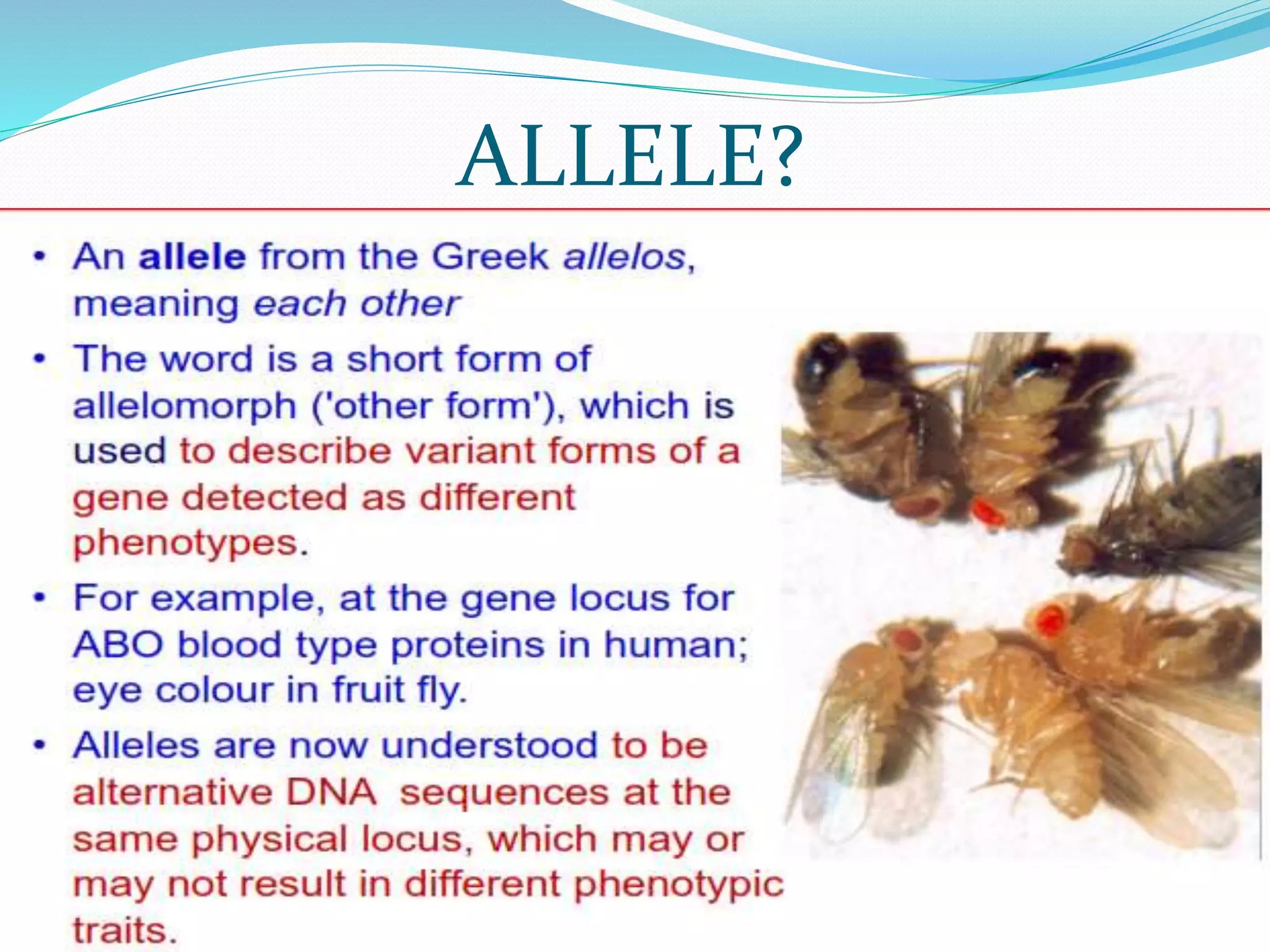
ALLELE?
Allele mining
Allele mining
is a research field
aimed at identifying allelic variation
of relevant traits
within genetic resources collections
Some Facts
• In human beings, 99.9 percent bases are same.
• Remaining 0.1 percent makes a person unique.
– Different attributes / characteristics / traits
• how a person looks,
• diseases he or she develops.
• These variations can be:
– Harmless (change in phenotype)
– Harmful (diabetes, cancer, heart disease, Huntington's disease, and
hemophilia )
– Latent (variations found in coding and regulatory regions, are not
harmful on their own, and the change in each gene only becomes
apparent under certain conditions e.g. susceptibility to lung cancer)
WHAT IS THE ALLELE MINING?
 Identification and access to allelic variation that affects
the plant phenotype is of the utmost importance for
the utilization of genetic resources, such as in plant
variety development.
 Considering the huge numbers of accessions that are
held collectively by gene banks, genetic resources
collections are deemed to harbour a wealth of
undisclosed allelic variants.
 The challenge is how to unlock this variation. Allele
mining is a research field aimed at identifying allelic
variation of relevant traits within genetic resources
collections.
IMPORTANCE
 It helps in tracing the evolution of alleles
 Identification of new haplotypes and development of
allele-specific markers for use in marker-assisted
selection.
 This capability will be important for giving rice breeders
direct access to key alleles conferring
 (1) resistance to biotic stresses,
(2) tolerance of abiotic stresses,
(3) greater nutrient use efficiency,
(4) enhanced yield, and
(5) improved quality, including human nutrition
Continue…
 It can also provide insight into molecular basis of novel
trait variations and identify the nucleotide sequence
changes associated with superior alleles. In addition,
the rate of evolution of alleles.
STEPS IN ALLELE MINING
Methods of Allele Priming
Eco TILLING
PCR Based Allele Priming
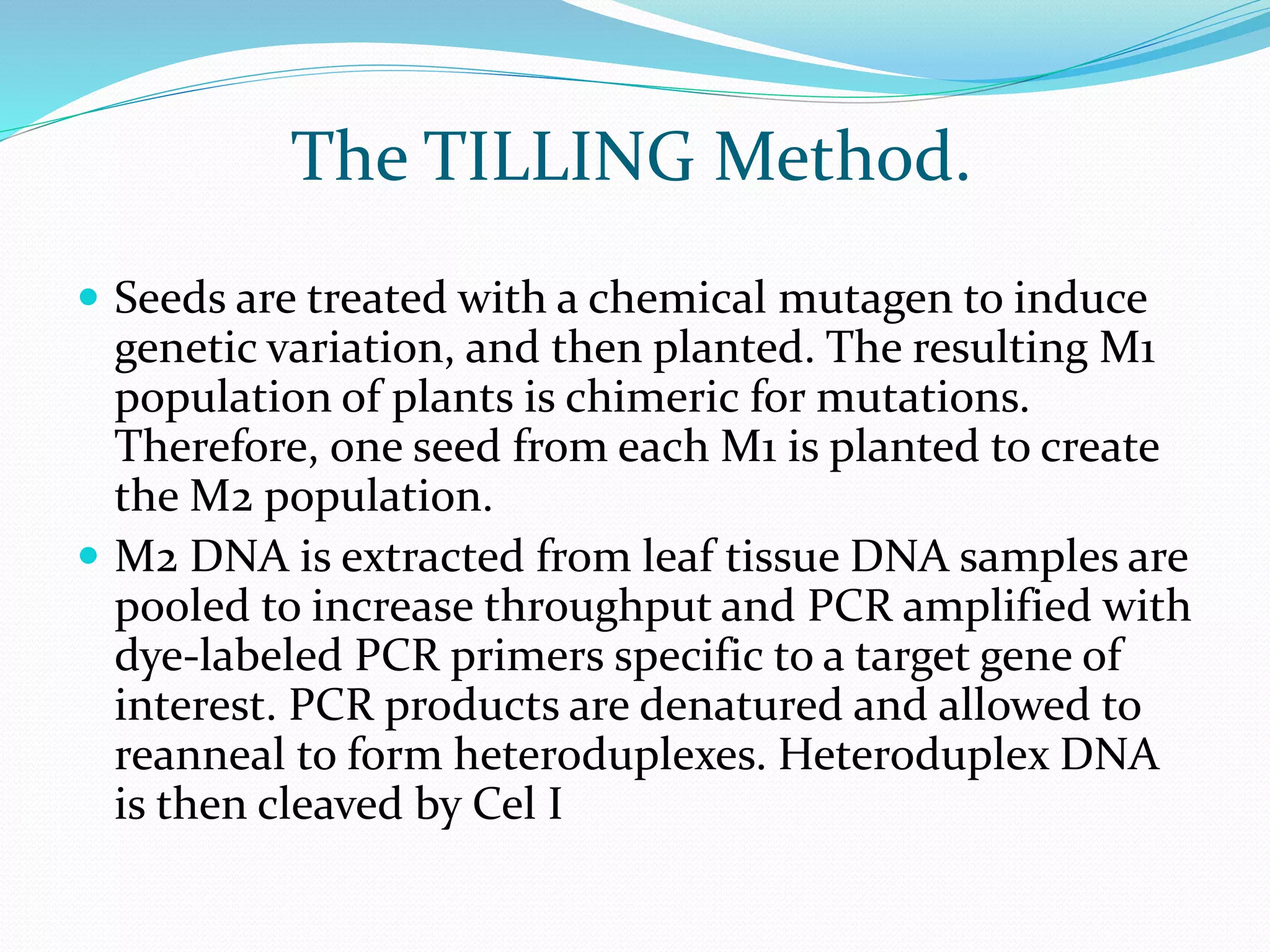
The TILLING Method.
 Seeds are treated with a chemical mutagen to induce
genetic variation, and then planted. The resulting M1
population of plants is chimeric for mutations.
Therefore, one seed from each M1 is planted to create
the M2 population.
 M2 DNA is extracted from leaf tissue DNA samples are
pooled to increase throughput and PCR amplified with
dye-labeled PCR primers specific to a target gene of
interest. PCR products are denatured and allowed to
reanneal to form heteroduplexes. Heteroduplex DNA
is then cleaved by Cel I
ECO-TILLING
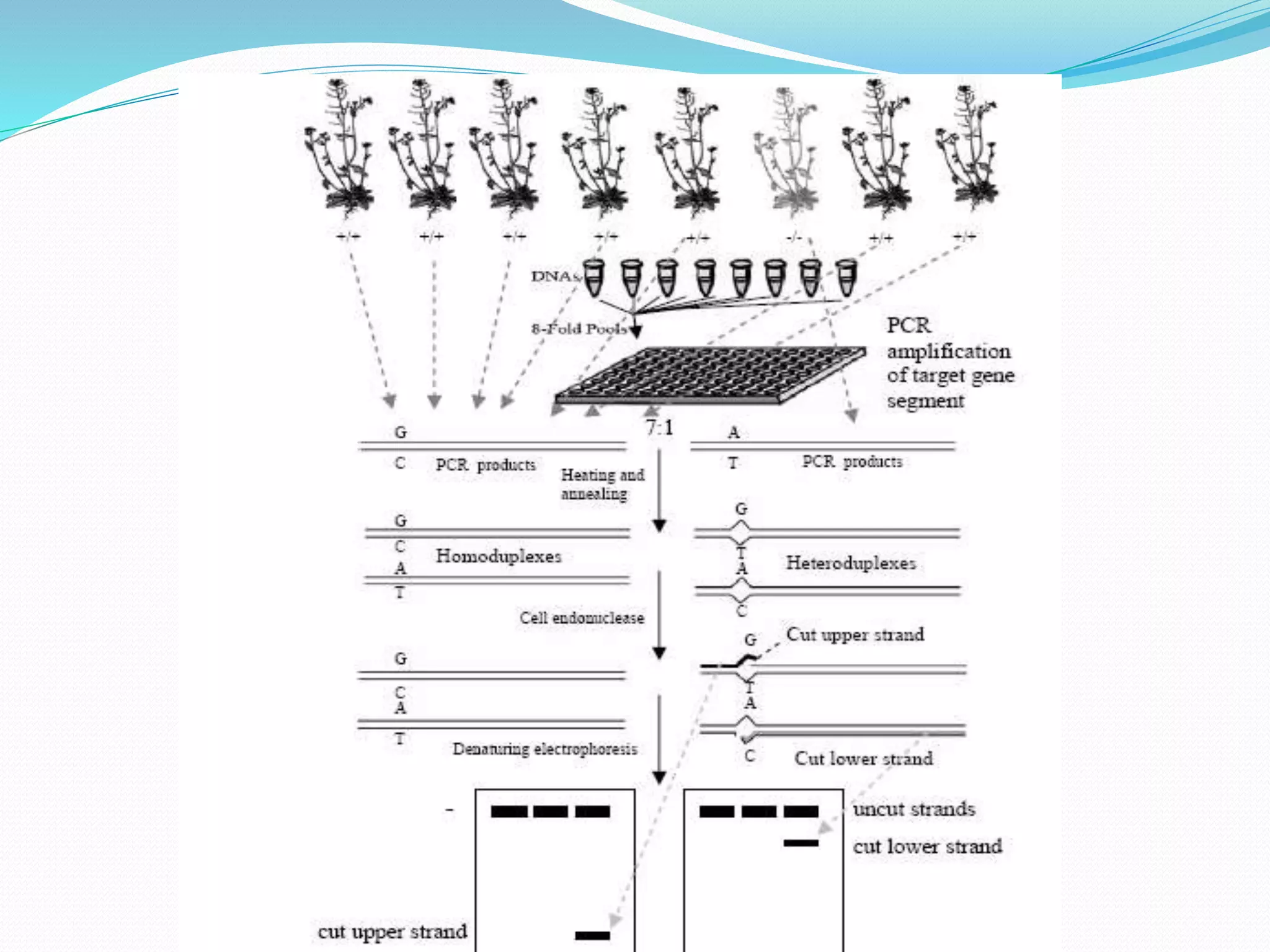
 DNA from many (eight) plants are pooled, The
amplified products are denaturated by heating and
cooling slowly for randomly
 Re-annealing and forming homo- and
heteroduplexes, double-stranded products are
digested by CEL-I endonuclease, Gel
Electrophoresis
SNPs
(A SNP is defined as a single base change in a DNA sequence)
 SNPs are found in coding and (mostly) noncoding
regions.
 Occur with a very high frequency
-about 1 in 1000 bases to 1 in 100 to 300 bases.
 The abundance of SNPs and the ease with which they
can be measured make these genetic variations
significant.
 SNPs close to particular gene acts as a marker for that
gene.
 SNPs in coding regions may alter the protein structure
made by that coding region.
SNPs may / may not alter protein structure
APPLICATION
WHY IT IS IMPORTANT?
 Vaughan (1994) describes the genus Oryza and related
grasses (subfamily Oryzoideae), while Kellogg (1999)
summarizes the evolutionary relationships among the
grasses in general, including the cereals.
The feasibility of PCR-based allele
mining for stress tolerance genes in rice and related germplasm.
(CASE STUDY)
 Nipponbare is a japonica cultivar and therefore
belongs to isozyme group VI of O. sativa (Glaszmann
1987). For each gene, the Nipponbare allele will be
most closely related to the alleles of other japonica
cultivars and then progressively less closely related to
alleles.
 1) the isozyme groups I-V of O. sativa, (2) the other AA
genome species, (3) the non-AA genome species of
genus Oryza, (4) related grass genera such as
Porteresia, and (5) the other cereals.
MATERIAL USED
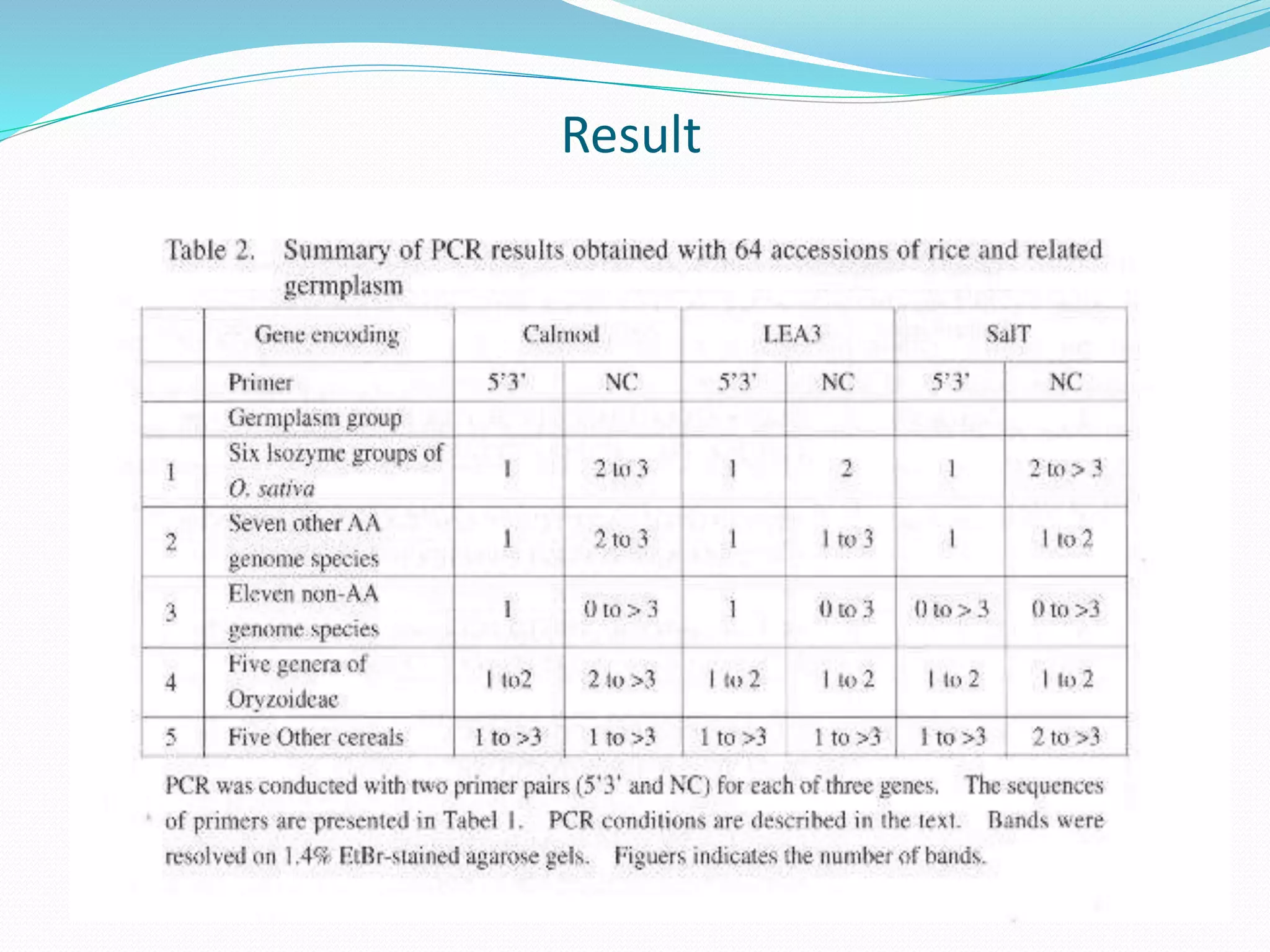
 The germplasm used in this study of allele mining
comprised 64 accessions, including at least two
representatives of each of the six isozyme groups of O.
sativa, two accessions of each of the seven other AA
genome wild species, 1 or 2 accessions of each of eleven
non-AA genome wild species, one accession of each of
five closely related grass genera, and 1-3 accessions of
each of five other cereals.
Three gene
 They evaluated their protocols for allele mining by focusing
on three genes important in abiotic stress tolerance. These
genes encoded (1) calmodulin (Calmod, Z12828), (2) a late
embryogenesis abundant protein 3 (LEA3, AF046884), and
(3) SalT (Z25811).
 Calmodulin is a part of the network of signal transduction
pathways centered on calcium ions as second messenger in
stress tolerance (Epstein 1998). LEA3 accumulates in cells
to protect them against ionic changes accompanying
various stresses (Skriver and Mundy 1991).
 SalT accumulates in rice leaf sheaths and roots in response
to salt and drought but its role is not clear (Claes et al.
1990). Both LEA3 and SalT are induced by ABA treatment
(Moons eta!. 1995).
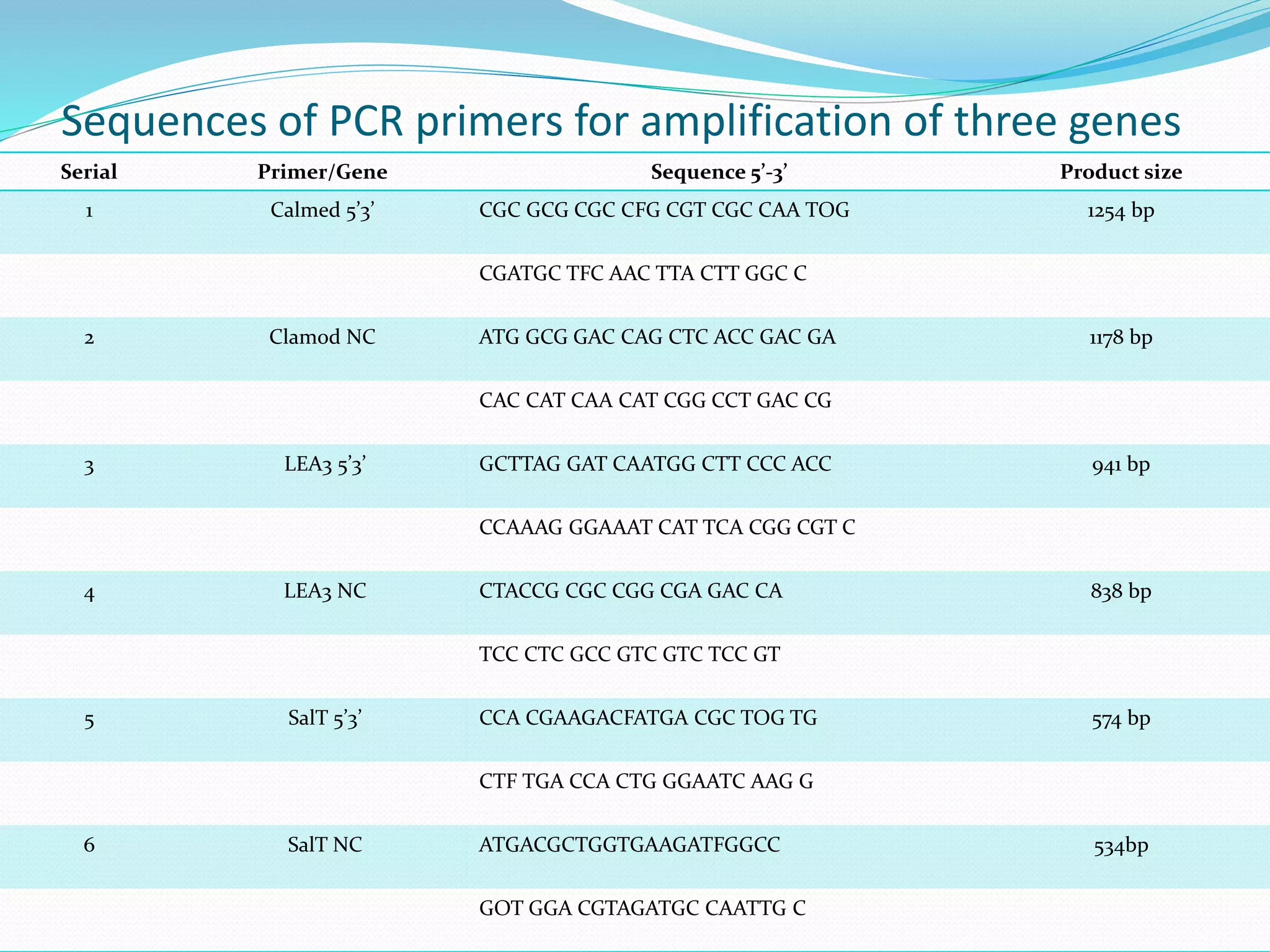
Sequences of PCR primers for amplification of three genes
Serial Primer/Gene Sequence 5’-3’ Product size
1 Calmed 5’3’ CGC GCG CGC CFG CGT CGC CAA TOG 1254 bp
CGATGC TFC AAC TTA CTT GGC C
2 Clamod NC ATG GCG GAC CAG CTC ACC GAC GA 1178 bp
CAC CAT CAA CAT CGG CCT GAC CG
3 LEA3 5’3’ GCTTAG GAT CAATGG CTT CCC ACC 941 bp
CCAAAG GGAAAT CAT TCA CGG CGT C
4 LEA3 NC CTACCG CGC CGG CGA GAC CA 838 bp
TCC CTC GCC GTC GTC TCC GT
5 SalT 5’3’ CCA CGAAGACFATGA CGC TOG TG 574 bp
CTF TGA CCA CTG GGAATC AAG G
6 SalT NC ATGACGCTGGTGAAGATFGGCC 534bp
GOT GGA CGTAGATGC CAATTG C
Result
Allele mining

Allele mining

  • 1.
    Department of AgriculturalBiotechnology, OUAT, BBSR Presented by, Arjun S. Pimple 07ABT/13
  • 2.
  • 3.
    Allele mining Allele mining isa research field aimed at identifying allelic variation of relevant traits within genetic resources collections
  • 4.
    Some Facts • Inhuman beings, 99.9 percent bases are same. • Remaining 0.1 percent makes a person unique. – Different attributes / characteristics / traits • how a person looks, • diseases he or she develops. • These variations can be: – Harmless (change in phenotype) – Harmful (diabetes, cancer, heart disease, Huntington's disease, and hemophilia ) – Latent (variations found in coding and regulatory regions, are not harmful on their own, and the change in each gene only becomes apparent under certain conditions e.g. susceptibility to lung cancer)
  • 5.
    WHAT IS THEALLELE MINING?  Identification and access to allelic variation that affects the plant phenotype is of the utmost importance for the utilization of genetic resources, such as in plant variety development.  Considering the huge numbers of accessions that are held collectively by gene banks, genetic resources collections are deemed to harbour a wealth of undisclosed allelic variants.  The challenge is how to unlock this variation. Allele mining is a research field aimed at identifying allelic variation of relevant traits within genetic resources collections.
  • 6.
    IMPORTANCE  It helpsin tracing the evolution of alleles  Identification of new haplotypes and development of allele-specific markers for use in marker-assisted selection.  This capability will be important for giving rice breeders direct access to key alleles conferring  (1) resistance to biotic stresses, (2) tolerance of abiotic stresses, (3) greater nutrient use efficiency, (4) enhanced yield, and (5) improved quality, including human nutrition
  • 7.
    Continue…  It canalso provide insight into molecular basis of novel trait variations and identify the nucleotide sequence changes associated with superior alleles. In addition, the rate of evolution of alleles.
  • 8.
  • 9.
    Methods of AllelePriming Eco TILLING PCR Based Allele Priming
  • 10.
    The TILLING Method. Seeds are treated with a chemical mutagen to induce genetic variation, and then planted. The resulting M1 population of plants is chimeric for mutations. Therefore, one seed from each M1 is planted to create the M2 population.  M2 DNA is extracted from leaf tissue DNA samples are pooled to increase throughput and PCR amplified with dye-labeled PCR primers specific to a target gene of interest. PCR products are denatured and allowed to reanneal to form heteroduplexes. Heteroduplex DNA is then cleaved by Cel I
  • 12.
    ECO-TILLING  DNA frommany (eight) plants are pooled, The amplified products are denaturated by heating and cooling slowly for randomly  Re-annealing and forming homo- and heteroduplexes, double-stranded products are digested by CEL-I endonuclease, Gel Electrophoresis
  • 14.
    SNPs (A SNP isdefined as a single base change in a DNA sequence)  SNPs are found in coding and (mostly) noncoding regions.  Occur with a very high frequency -about 1 in 1000 bases to 1 in 100 to 300 bases.  The abundance of SNPs and the ease with which they can be measured make these genetic variations significant.  SNPs close to particular gene acts as a marker for that gene.  SNPs in coding regions may alter the protein structure made by that coding region.
  • 15.
    SNPs may /may not alter protein structure
  • 16.
  • 17.
    WHY IT ISIMPORTANT?  Vaughan (1994) describes the genus Oryza and related grasses (subfamily Oryzoideae), while Kellogg (1999) summarizes the evolutionary relationships among the grasses in general, including the cereals.
  • 18.
    The feasibility ofPCR-based allele mining for stress tolerance genes in rice and related germplasm. (CASE STUDY)  Nipponbare is a japonica cultivar and therefore belongs to isozyme group VI of O. sativa (Glaszmann 1987). For each gene, the Nipponbare allele will be most closely related to the alleles of other japonica cultivars and then progressively less closely related to alleles.  1) the isozyme groups I-V of O. sativa, (2) the other AA genome species, (3) the non-AA genome species of genus Oryza, (4) related grass genera such as Porteresia, and (5) the other cereals.
  • 19.
    MATERIAL USED  Thegermplasm used in this study of allele mining comprised 64 accessions, including at least two representatives of each of the six isozyme groups of O. sativa, two accessions of each of the seven other AA genome wild species, 1 or 2 accessions of each of eleven non-AA genome wild species, one accession of each of five closely related grass genera, and 1-3 accessions of each of five other cereals.
  • 20.
    Three gene  Theyevaluated their protocols for allele mining by focusing on three genes important in abiotic stress tolerance. These genes encoded (1) calmodulin (Calmod, Z12828), (2) a late embryogenesis abundant protein 3 (LEA3, AF046884), and (3) SalT (Z25811).  Calmodulin is a part of the network of signal transduction pathways centered on calcium ions as second messenger in stress tolerance (Epstein 1998). LEA3 accumulates in cells to protect them against ionic changes accompanying various stresses (Skriver and Mundy 1991).  SalT accumulates in rice leaf sheaths and roots in response to salt and drought but its role is not clear (Claes et al. 1990). Both LEA3 and SalT are induced by ABA treatment (Moons eta!. 1995).
  • 21.
    Sequences of PCRprimers for amplification of three genes Serial Primer/Gene Sequence 5’-3’ Product size 1 Calmed 5’3’ CGC GCG CGC CFG CGT CGC CAA TOG 1254 bp CGATGC TFC AAC TTA CTT GGC C 2 Clamod NC ATG GCG GAC CAG CTC ACC GAC GA 1178 bp CAC CAT CAA CAT CGG CCT GAC CG 3 LEA3 5’3’ GCTTAG GAT CAATGG CTT CCC ACC 941 bp CCAAAG GGAAAT CAT TCA CGG CGT C 4 LEA3 NC CTACCG CGC CGG CGA GAC CA 838 bp TCC CTC GCC GTC GTC TCC GT 5 SalT 5’3’ CCA CGAAGACFATGA CGC TOG TG 574 bp CTF TGA CCA CTG GGAATC AAG G 6 SalT NC ATGACGCTGGTGAAGATFGGCC 534bp GOT GGA CGTAGATGC CAATTG C
  • 22.