Qsn:
Marker assisted selection in
breeding for nematode
resistance.
MADHANZI BOTHWELL
MAS
Marker assisted selection (MAS) is an indirect selection process where a trait of
interest is selected, not based on the trait itself, but on a marker linked to it.
 MAS refers to the use of DNA markers that are tightly-linked to target loci as a
substitute for or to assist phenotypic screening.
 The development of DNA (or molecular) markers has irreversibly changed the
disciplines of plant genetics and plant breeding.
 determining the allele of a DNA marker, plants that possess particular genes or
quantitative trait loci (QTLs) may be identified based on their genotype rather than
their phenotype.
As a shortcut, plant breeders now use marker-assisted selection (MAS).
To help identify specific genes, scientists use what are called molecular or genetic
markers.
The markers are a string or sequence of nucleic acid which makes up a segment of
DNA.
 The markers are located near the DNA sequence of the desired gene and are
transmitted by the standard laws of inheritance from one generation to the next .
Since the markers and the genes are close together on the same chromosome, they
tend to stay together as each generation of plants is produced.
TYPES OF MARKERS
Morphological markers:
These are the traditional morphological mutant traits which are mapped and linked
to a desirable or undesirable trait in a population which can be used in indirect
selection.
 The major limitations with these markers are; high dependency on environmental
factors, undesirable features such as dwarfism or albinism, time consuming,
labour intensive and requirement of large plant population.
Molecular markers (DNA - based Markers):
Molecular markers have become important tools for genetic analysis and crop
improvement.
DNA-Markers, being phenotypically neutral and literally unlimited in number,
have allowed scanning of the whole genome and assigning landmarks in high
density on every chromosome in many plant species, which makes them fit for
indirect selection.
 MAS IN BREEDING FOR NEMATODE RESSISTANCE
Root-knot nematodes, Meloidogyne spp., are obligate, sedentary endoparasites of
many plant species.
Their potential host range encompasses more than 3000 plant species
 In Zim , the most important and widely spread in the root knot nematodes which
affect Tobacco
 Host-plant resistant to root-knot nematodes is a powerful tool for crop protection,
and it is destined to play a more important role than ever before in managing
nematode problems in sustainable agriculture.
THE Mi GENE IN TOMATO
The Mi gene was discovered 50 years ago in an accession (P.I. 128657) of
Lycopersicon peruvianum (Mill.), a wild relative of the edible tomato
(Lycopersicon esculentum Mill.) that was grown in the western coastal region of
South America
Many commercial tomato varieties carry a single, dominant gene called Mi which
confers resistance to 3 of the most damaging species of root-knot nematodes
(Meloidogyne incognita, M. javanica and M. arenaria).
This resistance is associated with the localized death of host tissue near the
invading nematode in the root tips.
Cont……
The Mi gene is located on the short arm of chromosome 6, this chromosome has
been mapped in considerable detail, and multiple markers for other traits linked to
Mi gene have been identified
DNA isolation
DNA was extraction using the method by Doyle and Doyle (1987)
 Freeze fresh leaf tissue in liquid nitrogen and ground using an Eppendorf tube
and glass bar.
Place the homogenate of the leaf tissue in a tube together with 500 μl of DNA
extraction buffer [2% (w/v) CTAB (hexadecyltrimethylammoniumbromide), 1.4
M NaCl, 0.2% (v/v) 2-mercaptoethanol, 20 mM EDTA, and 100 mM Tris-HCl,
pH 8.0], and incubated in a water bath at 600 C for 30 min with occasional
swirling.
After incubation, extract the lysate once with chloroform: phenol (1:1, v/v). Mix
the aqueous phase with a two-thirds volume of cold isopropanol.
 Resuspended the precipitated DNA was in TE (10 mM Tris pH 8.0, and 0.1 mM
EDTA)
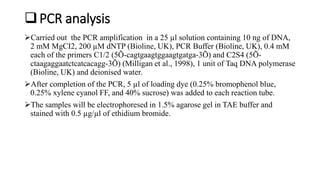
PCR analysis
Carried out the PCR amplification in a 25 µl solution containing 10 ng of DNA,
2 mM MgCI2, 200 µM dNTP (Bioline, UK), PCR Buffer (Bioline, UK), 0.4 mM
each of the primers C1/2 (5Õ-cagtgaagtggaagtgatga-3Õ) and C2S4 (5Õ-
ctaagaggaatctcatcacagg-3Õ) (Milligan et al., 1998), 1 unit of Taq DNA polymerase
(Bioline, UK) and deionised water.
After completion of the PCR, 5 µl of loading dye (0.25% bromophenol blue,
0.25% xylene cyanol FF, and 40% sucrose) was added to each reaction tube.
The samples will be electrophoresed in 1.5% agarose gel in TAE buffer and
stained with 0.5 µg/µl of ethidium bromide.
THE END
INNOVATE OR DIE

marker assisted selection in breeding for nematode resistance

  • 1.
    Qsn: Marker assisted selectionin breeding for nematode resistance. MADHANZI BOTHWELL
  • 2.
    MAS Marker assisted selection(MAS) is an indirect selection process where a trait of interest is selected, not based on the trait itself, but on a marker linked to it.  MAS refers to the use of DNA markers that are tightly-linked to target loci as a substitute for or to assist phenotypic screening.  The development of DNA (or molecular) markers has irreversibly changed the disciplines of plant genetics and plant breeding.  determining the allele of a DNA marker, plants that possess particular genes or quantitative trait loci (QTLs) may be identified based on their genotype rather than their phenotype.
  • 3.
    As a shortcut,plant breeders now use marker-assisted selection (MAS). To help identify specific genes, scientists use what are called molecular or genetic markers. The markers are a string or sequence of nucleic acid which makes up a segment of DNA.  The markers are located near the DNA sequence of the desired gene and are transmitted by the standard laws of inheritance from one generation to the next . Since the markers and the genes are close together on the same chromosome, they tend to stay together as each generation of plants is produced.
  • 4.
    TYPES OF MARKERS Morphologicalmarkers: These are the traditional morphological mutant traits which are mapped and linked to a desirable or undesirable trait in a population which can be used in indirect selection.  The major limitations with these markers are; high dependency on environmental factors, undesirable features such as dwarfism or albinism, time consuming, labour intensive and requirement of large plant population.
  • 5.
    Molecular markers (DNA- based Markers): Molecular markers have become important tools for genetic analysis and crop improvement. DNA-Markers, being phenotypically neutral and literally unlimited in number, have allowed scanning of the whole genome and assigning landmarks in high density on every chromosome in many plant species, which makes them fit for indirect selection.
  • 6.
     MAS INBREEDING FOR NEMATODE RESSISTANCE Root-knot nematodes, Meloidogyne spp., are obligate, sedentary endoparasites of many plant species. Their potential host range encompasses more than 3000 plant species  In Zim , the most important and widely spread in the root knot nematodes which affect Tobacco  Host-plant resistant to root-knot nematodes is a powerful tool for crop protection, and it is destined to play a more important role than ever before in managing nematode problems in sustainable agriculture.
  • 7.
    THE Mi GENEIN TOMATO The Mi gene was discovered 50 years ago in an accession (P.I. 128657) of Lycopersicon peruvianum (Mill.), a wild relative of the edible tomato (Lycopersicon esculentum Mill.) that was grown in the western coastal region of South America Many commercial tomato varieties carry a single, dominant gene called Mi which confers resistance to 3 of the most damaging species of root-knot nematodes (Meloidogyne incognita, M. javanica and M. arenaria). This resistance is associated with the localized death of host tissue near the invading nematode in the root tips.
  • 8.
    Cont…… The Mi geneis located on the short arm of chromosome 6, this chromosome has been mapped in considerable detail, and multiple markers for other traits linked to Mi gene have been identified
  • 9.
    DNA isolation DNA wasextraction using the method by Doyle and Doyle (1987)  Freeze fresh leaf tissue in liquid nitrogen and ground using an Eppendorf tube and glass bar. Place the homogenate of the leaf tissue in a tube together with 500 μl of DNA extraction buffer [2% (w/v) CTAB (hexadecyltrimethylammoniumbromide), 1.4 M NaCl, 0.2% (v/v) 2-mercaptoethanol, 20 mM EDTA, and 100 mM Tris-HCl, pH 8.0], and incubated in a water bath at 600 C for 30 min with occasional swirling. After incubation, extract the lysate once with chloroform: phenol (1:1, v/v). Mix the aqueous phase with a two-thirds volume of cold isopropanol.  Resuspended the precipitated DNA was in TE (10 mM Tris pH 8.0, and 0.1 mM EDTA)
  • 10.
    PCR analysis Carried outthe PCR amplification in a 25 µl solution containing 10 ng of DNA, 2 mM MgCI2, 200 µM dNTP (Bioline, UK), PCR Buffer (Bioline, UK), 0.4 mM each of the primers C1/2 (5Õ-cagtgaagtggaagtgatga-3Õ) and C2S4 (5Õ- ctaagaggaatctcatcacagg-3Õ) (Milligan et al., 1998), 1 unit of Taq DNA polymerase (Bioline, UK) and deionised water. After completion of the PCR, 5 µl of loading dye (0.25% bromophenol blue, 0.25% xylene cyanol FF, and 40% sucrose) was added to each reaction tube. The samples will be electrophoresed in 1.5% agarose gel in TAE buffer and stained with 0.5 µg/µl of ethidium bromide.
  • 11.