TILLING & Eco-TILLING
Speaker:
B.Rachana
RAD/2018-18
Ph.D 1st year
(GPBR)
GP-603
Genomics for Crop Improvement
CONTENTS
• What is TILLING
• Why TILLING
• Discovery of TILLING
• TILLING Procedure
• Application in plant species
• Merits and Demerits
• Eco-TILLING
TILLING
TARGETING INDUCED LOCAL LESIONS IN
GENOME
INTRODUCTION
• One of the most direct ways of establishing gene function is to
identify a mutation in the specific gene and to link this mutation to
the phenotypic change in the mutated organism.
• In the forward genetics approach (“from mutation through
phenotype to the gene”), large mutated populations have been
created and screened for alterations in the trait but this approach is
both time-consuming and labour-intensive.
• The reverse genetics strategy (“from gene sequence to phenotype”)
has widely replaced the forward approach in studies involved in
detecting gene function.
• Several reverse genetics technologies, such as insertional
mutagenesis with T-DNA, transposon/retrotransposon tagging or
gene silencing using RNA interference, have been proposed for
plant functional genomics .
• However, the majority of these methods are fully applicable only
for model plants with small genomes, such as Arabidopsis or rice,
and even in these species, there are some drawbacks that limit their
utilisation.
What is TILLING ?
TILLING is a general reverse genetic technique that combines
chemical mutagenesis with PCR based screening to identify
point mutations in regions of interest. (McCallum et.al, 2000)
TILLING is a powerful technology that employed
heteroduplex analysis to detect which organism in a population
carry single nucleotide mutation in specific genes.
TILLING can also be used to detect naturally occurring SNP
in genes among the accession, variety or cultivar. To study the
gene function, or to detect genetic marker in population.
Reverse genetics is-
DNAsequence Protein Phenotypes
AGCTCAATCAGATAATC
TCGAGTTAGTCTATTAG
WHY TILLING ??
 Tool for functional genomics that can help decipher the
functions of the thousands of newly identified genes.
 To identify SNPs and/or INDELS in a gene of interest
from population.
 Genetic mutation is a powerful tool that establishes a
direct link between the biochemical function of a gene
product and its role in vivo.
Discovery of TILLING
TILLING first began in the late 1990’s by McCallum who
worked on characterizing the function of 2-chromomethylase
(CMT2) gene in Arabidopsis.
Claire McCallum utilized reverse genetic approaches such as
T-DNA lines and antisense RNA, but was unable to successfully
apply these approaches to characterize CMT2.
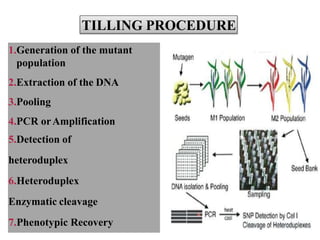
TILLING PROCEDURE
1.Generation of the mutant
population
2.Extraction of the DNA
3.Pooling
4.PCR orAmplification
5.Detection of
heteroduplex
6.Heteroduplex
Enzymatic cleavage
7.Phenotypic Recovery
GENERATION OF MUTANT POPULATION
Mutagenizing seed with EMS done by soaking seeds in an
EMS solution (14-18 h in a 30-100 mM (0.3%-1%) EMS
solution.)
Planting the seeds in field
Mutagenized population (M1generation) is grown to maturity
allowed to self-fertilize to produce M2 seeds.
M2 seeds can be maintained as lines or bulked
If the M2 seed is bulked then lines need to be established using M3
seed. In either case, when sampling M2 plants to establish population.
DNAEXTRACTION
POOLING
DNAAMPLIFICATION BY USING
PCR
DETECTION OF HETERODUPLEX
• Gene specific primers are available to find the sequence of gene of
interest.
• Software are also use to identify the point mutation in a gene such
as CODDLE
• Codons Optimized to Detect Deleterious LEsions
• Once a genomic sequence and the corresponding coding sequence is
available, CODDLE identifies regions where point mutations are
most likely to cause deleterious effects on gene function.
• Screening the mutant the population compare with wild type at a
single nucleotide level.
• Detection of the cleavage fragment was based on a Denaturing
High Pressure Liquid Chromatography (DHPLC).
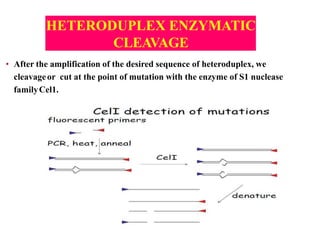
HETERODUPLEX ENZYMATIC
CLEAVAGE
• After the amplification of the desired sequence of heteroduplex, we
cleavageor cut at the point of mutation with the enzyme of S1 nuclease
familyCel1.
Cleaved products are detected on polyacrylamide
denaturing gels.
PHENOTYPE
RECOVERY
• When allelic series of mutation
discovered through TILLING
• Phenotypic analysis is required to verify
the effect of mutation.
Scheme depicting TILLING strategy applied to Arabidopsis
APPLICATIONS OF TILLING
Major areas of applications are
Functional genomics:
• The identification of numerous mutations in target region of genome.
Construction of TILLING library is useful for scientists to search for
mutations in gene of interest. TILLING offers a way to investigate target
GOI in any crop of interest without first having knowledge of gene product.
Genetic engineering:
• Agricultural interest in producing phenotypic variants without introducing
foreign DNA of any type into plants genome. T-DNA/ Transposon
insertions are used to obtain specific gene knockouts but practically limited
to some crops only. TILLING is in front of transgene, as consists of
identification of numerous mutations within a targeted region of whole
genome.
Evaluation of genetic diversity of natural populations:
• Alternative to wild relatives, TILLING is used to introduce useful genetic
variation of elite germplasm. Also applicable in a population which has
several pre-existing polymorphism for developing SNPs.
Source: Muhammad Rashid et al, 2011
MERITS AND DEMERITS
OFTILLING
MERITS
• Cheap and rapid reverse
genetic approach
• Firstly use to detect a chemical
mutagenesis at single
nucleotide level
• It is independent of
genome size, reproductive
system or generation time.
• Valuable for essential gene
DEMERITS
• Skilled labour is
required
• Depend upon primary
design
• Lower rate of
induction of mutation
• The first publication of the EcoTILLING method in which TILLING
was modified to mine for natural polymorphisms was in 2004 from
work in Arabidopsis thaliana.
• EcoTILLING is similar to TILLING, except that its objective is to
identify natural genetic variation as opposed to induced mutations.
• Many species are not amenable to chemical mutagenesis; therefore,
EcoTILLING can aid in the discovery of natural variants and their
putative gene function
•This approach allows one to rapidly screen through many samples
with a gene of interest to identify naturally occurring SNPs and / or
small INs/DELS.
EcoTILLING
TILLING and EcoTILLING
• A study based on applying TILLING to elucidate gene function in a chemically
induced sorghum mutant population showed that total of five mutants were
detected for four gene targets.
• A total of 768 mutant lines were assayed for mutation induction in the target
genes.
• Four gene targets were selected based on their potential contribution to
bioenergy, nutrition and agronomic performance for high throughput
TILLING.
• Eight-fold pools of genomic DNA from leaf tissues of M2 plants were used for
TILLING.
• Mutagenesis sorghum inbred line BT*623 was used to generate the mutant
populations using EMS (0.1 to 0.6% mutagenesis).
• A subset of 768 mutant lines was analyzed by TILLING using four target
genes.
• A total of five mutations were identified resulting in a calculated mutation
density of 1/526 kb.
A gallery of selected mutant phenotypes
TILLING & ECO-TILLING

TILLING & ECO-TILLING

  • 1.
    TILLING & Eco-TILLING Speaker: B.Rachana RAD/2018-18 Ph.D1st year (GPBR) GP-603 Genomics for Crop Improvement
  • 2.
    CONTENTS • What isTILLING • Why TILLING • Discovery of TILLING • TILLING Procedure • Application in plant species • Merits and Demerits • Eco-TILLING
  • 3.
  • 4.
    INTRODUCTION • One ofthe most direct ways of establishing gene function is to identify a mutation in the specific gene and to link this mutation to the phenotypic change in the mutated organism. • In the forward genetics approach (“from mutation through phenotype to the gene”), large mutated populations have been created and screened for alterations in the trait but this approach is both time-consuming and labour-intensive. • The reverse genetics strategy (“from gene sequence to phenotype”) has widely replaced the forward approach in studies involved in detecting gene function. • Several reverse genetics technologies, such as insertional mutagenesis with T-DNA, transposon/retrotransposon tagging or gene silencing using RNA interference, have been proposed for plant functional genomics . • However, the majority of these methods are fully applicable only for model plants with small genomes, such as Arabidopsis or rice, and even in these species, there are some drawbacks that limit their utilisation.
  • 5.
    What is TILLING? TILLING is a general reverse genetic technique that combines chemical mutagenesis with PCR based screening to identify point mutations in regions of interest. (McCallum et.al, 2000) TILLING is a powerful technology that employed heteroduplex analysis to detect which organism in a population carry single nucleotide mutation in specific genes. TILLING can also be used to detect naturally occurring SNP in genes among the accession, variety or cultivar. To study the gene function, or to detect genetic marker in population. Reverse genetics is- DNAsequence Protein Phenotypes AGCTCAATCAGATAATC TCGAGTTAGTCTATTAG
  • 6.
    WHY TILLING ?? Tool for functional genomics that can help decipher the functions of the thousands of newly identified genes.  To identify SNPs and/or INDELS in a gene of interest from population.  Genetic mutation is a powerful tool that establishes a direct link between the biochemical function of a gene product and its role in vivo.
  • 7.
    Discovery of TILLING TILLINGfirst began in the late 1990’s by McCallum who worked on characterizing the function of 2-chromomethylase (CMT2) gene in Arabidopsis. Claire McCallum utilized reverse genetic approaches such as T-DNA lines and antisense RNA, but was unable to successfully apply these approaches to characterize CMT2.
  • 8.
    TILLING PROCEDURE 1.Generation ofthe mutant population 2.Extraction of the DNA 3.Pooling 4.PCR orAmplification 5.Detection of heteroduplex 6.Heteroduplex Enzymatic cleavage 7.Phenotypic Recovery
  • 9.
    GENERATION OF MUTANTPOPULATION Mutagenizing seed with EMS done by soaking seeds in an EMS solution (14-18 h in a 30-100 mM (0.3%-1%) EMS solution.) Planting the seeds in field Mutagenized population (M1generation) is grown to maturity allowed to self-fertilize to produce M2 seeds. M2 seeds can be maintained as lines or bulked If the M2 seed is bulked then lines need to be established using M3 seed. In either case, when sampling M2 plants to establish population.
  • 10.
  • 11.
  • 12.
  • 13.
    DETECTION OF HETERODUPLEX •Gene specific primers are available to find the sequence of gene of interest. • Software are also use to identify the point mutation in a gene such as CODDLE • Codons Optimized to Detect Deleterious LEsions • Once a genomic sequence and the corresponding coding sequence is available, CODDLE identifies regions where point mutations are most likely to cause deleterious effects on gene function. • Screening the mutant the population compare with wild type at a single nucleotide level. • Detection of the cleavage fragment was based on a Denaturing High Pressure Liquid Chromatography (DHPLC).
  • 15.
    HETERODUPLEX ENZYMATIC CLEAVAGE • Afterthe amplification of the desired sequence of heteroduplex, we cleavageor cut at the point of mutation with the enzyme of S1 nuclease familyCel1.
  • 16.
    Cleaved products aredetected on polyacrylamide denaturing gels.
  • 18.
    PHENOTYPE RECOVERY • When allelicseries of mutation discovered through TILLING • Phenotypic analysis is required to verify the effect of mutation.
  • 19.
    Scheme depicting TILLINGstrategy applied to Arabidopsis
  • 20.
    APPLICATIONS OF TILLING Majorareas of applications are Functional genomics: • The identification of numerous mutations in target region of genome. Construction of TILLING library is useful for scientists to search for mutations in gene of interest. TILLING offers a way to investigate target GOI in any crop of interest without first having knowledge of gene product. Genetic engineering: • Agricultural interest in producing phenotypic variants without introducing foreign DNA of any type into plants genome. T-DNA/ Transposon insertions are used to obtain specific gene knockouts but practically limited to some crops only. TILLING is in front of transgene, as consists of identification of numerous mutations within a targeted region of whole genome. Evaluation of genetic diversity of natural populations: • Alternative to wild relatives, TILLING is used to introduce useful genetic variation of elite germplasm. Also applicable in a population which has several pre-existing polymorphism for developing SNPs.
  • 21.
  • 22.
    MERITS AND DEMERITS OFTILLING MERITS •Cheap and rapid reverse genetic approach • Firstly use to detect a chemical mutagenesis at single nucleotide level • It is independent of genome size, reproductive system or generation time. • Valuable for essential gene DEMERITS • Skilled labour is required • Depend upon primary design • Lower rate of induction of mutation
  • 23.
    • The firstpublication of the EcoTILLING method in which TILLING was modified to mine for natural polymorphisms was in 2004 from work in Arabidopsis thaliana. • EcoTILLING is similar to TILLING, except that its objective is to identify natural genetic variation as opposed to induced mutations. • Many species are not amenable to chemical mutagenesis; therefore, EcoTILLING can aid in the discovery of natural variants and their putative gene function •This approach allows one to rapidly screen through many samples with a gene of interest to identify naturally occurring SNPs and / or small INs/DELS. EcoTILLING
  • 24.
  • 26.
    • A studybased on applying TILLING to elucidate gene function in a chemically induced sorghum mutant population showed that total of five mutants were detected for four gene targets. • A total of 768 mutant lines were assayed for mutation induction in the target genes. • Four gene targets were selected based on their potential contribution to bioenergy, nutrition and agronomic performance for high throughput TILLING. • Eight-fold pools of genomic DNA from leaf tissues of M2 plants were used for TILLING. • Mutagenesis sorghum inbred line BT*623 was used to generate the mutant populations using EMS (0.1 to 0.6% mutagenesis). • A subset of 768 mutant lines was analyzed by TILLING using four target genes. • A total of five mutations were identified resulting in a calculated mutation density of 1/526 kb.
  • 27.
    A gallery ofselected mutant phenotypes