MARKER-ASSISTED SELECTION
Contents
1.Marker assisted selection:-
a.Introduction & features.
b.General Steps in MAS.
c.MAS Breeding Scheme(Marker assisted
backcrossing,Pyramiding in Rice,…..).
d. Current status of molecular breeding.
e. Future challenges.
f. Future of MAS in rice etc?
Introduction
Marker assisted selection (MAS) refers
to the use of DNA markers that are
tightly-linked to target loci as a
substitute for or to assist phenotypic
screening or
The use of genetic markers with the
phenotypes in a process called
Marker assisted selection.
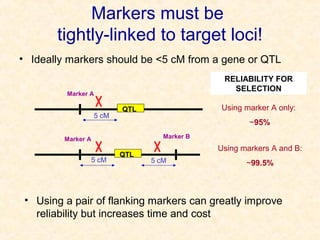
Markers must be
tightly-linked to target loci!
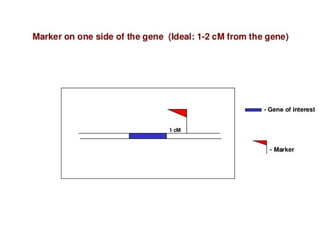
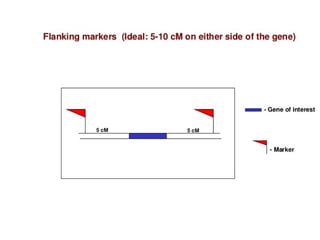
• Ideally markers should be <5 cM from a gene or QTL
• Using a pair of flanking markers can greatly improve
reliability but increases time and cost
Marker A
QTL
5 cM
RELIABILITY FOR
SELECTION
Using marker A only:
~95%
Marker A
QTL
Marker B
5 cM 5 cM
Using markers A and B:
~99.5%
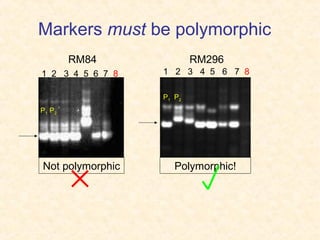
Markers must be polymorphic
1 2 3 4 5 6 7 8 1 2 3 4 5 6 7 8
RM84 RM296
P1 P2
P1 P2
Not polymorphic Polymorphic!
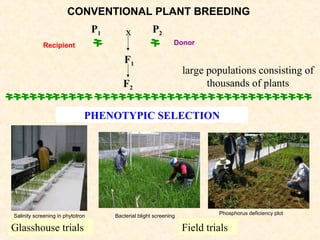
F2
P2
F1
P1 x
large populations consisting of
thousands of plants
PHENOTYPIC SELECTION
Field trialsGlasshouse trials
DonorRecipient
CONVENTIONAL PLANT BREEDING
Salinity screening in phytotron Bacterial blight screening
Phosphorus deficiency plot
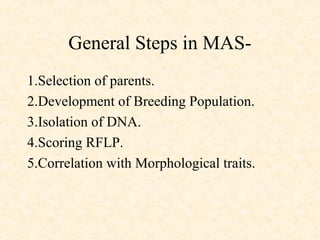
General Steps in MAS-
1.Selection of parents.
2.Development of Breeding Population.
3.Isolation of DNA.
4.Scoring RFLP.
5.Correlation with Morphological traits.
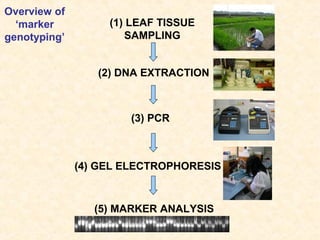
(1) LEAF TISSUE
SAMPLING
(2) DNA EXTRACTION
(3) PCR
(4) GEL ELECTROPHORESIS
(5) MARKER ANALYSIS
Overview of
‘marker
genotyping’
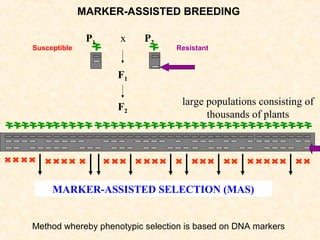
F2
P2
F1
P1 x
large populations consisting of
thousands of plants
ResistantSusceptible
MARKER-ASSISTED SELECTION (MAS)
MARKER-ASSISTED BREEDING
Method whereby phenotypic selection is based on DNA markers
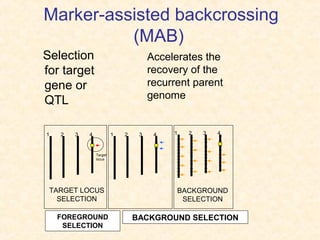
Marker-assisted backcrossing
(MAB)
Selection
for target
gene or
QTL
1 2 3 4
Target
locus
1 2 3 41 2 3 4
BACKGROUND
SELECTION
TARGET LOCUS
SELECTION
FOREGROUND
SELECTION
BACKGROUND SELECTION
Accelerates the
recovery of the
recurrent parent
genome
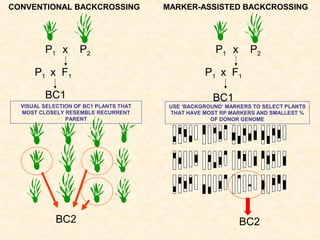
P1 x F1
P1 x P2
CONVENTIONAL BACKCROSSING
BC1
VISUAL SELECTION OF BC1 PLANTS THAT
MOST CLOSELY RESEMBLE RECURRENT
PARENT
BC2
MARKER-ASSISTED BACKCROSSING
P1 x F1
P1 x P2
BC1
USE ‘BACKGROUND’ MARKERS TO SELECT PLANTS
THAT HAVE MOST RP MARKERS AND SMALLEST %
OF DONOR GENOME
BC2
Application of MAS
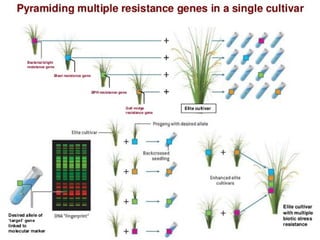
1.It is useful in gene pyramiding for disease
and insect resistance.
2.Uses in backcrossing programme.
3.It is being used for transfer of male sterility
into cultivated genotypes from different
sources.
4.MAS is being used for improvement of
quality characters in different crops such as
for protein quality in maize, etc…
Advantage of MAS
1. Accuracy,
2. Rapid Method,
3. Non-transgenic Product,
4. Identification of Recessive Alleles,
5. Early Detection of Traits,
6. Screening of Difficult Traits,
7. Highly Reproducible,
8. Small Sample for Testing,etc…
Achievements of MAS
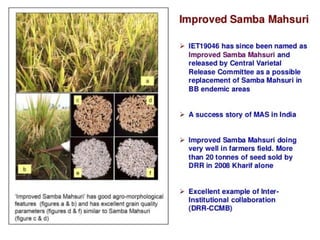
1.Rice-a.(PB1 x JRBB55)Improved Pusa
Basmati 1, b.Improved Sambha
Mahsuri(BPT5204),
2.Maize-Improved QPM-9,
3.Pearlmillet-HHB67-2,
4.Wheat-Patwin,etc
Current status of molecular breeding
• A literature review
indicates thousands
of QTL mapping
studies but not many
actual reports of the
application of MAS in
breeding
• Why is this the case?
Some possible reasons to explain the
low impact of MAS in crop
improvement
• Resources (equipment) not available
• Markers may not be cost-effective
• Accuracy of QTL mapping studies
• QTL effects may depend on genetic background
or be influenced by environmental conditions
• Lack of marker polymorphism in breeding
material
• Poor integration of molecular genetics and
conventional breeding
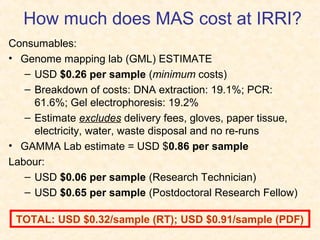
How much does MAS cost at IRRI?
Consumables:
• Genome mapping lab (GML) ESTIMATE
– USD $0.26 per sample (minimum costs)
– Breakdown of costs: DNA extraction: 19.1%; PCR:
61.6%; Gel electrophoresis: 19.2%
– Estimate excludes delivery fees, gloves, paper tissue,
electricity, water, waste disposal and no re-runs
• GAMMA Lab estimate = USD $0.86 per sample
Labour:
– USD $0.06 per sample (Research Technician)
– USD $0.65 per sample (Postdoctoral Research Fellow)
TOTAL: USD $0.32/sample (RT); USD $0.91/sample (PDF)
Future challenges
• Improved cost-efficiency
– Optimization, simplification
of methods and future
innovation
• Design of efficient and effective
MAS strategies
• Greater integration between
molecular genetics and plant
breeding
• Data management
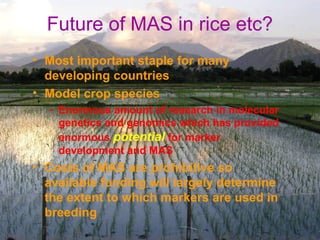
Future of MAS in rice etc?
• Most important staple for many
developing countries
• Model crop species
– Enormous amount of research in molecular
genetics and genomics which has provided
enormous potential for marker
development and MAS
• Costs of MAS are prohibitive so
available funding will largely determine
the extent to which markers are used in
breeding
2.Barnase-Barstar System
Contents:-
1.Major system & Introduction,
2.Mechanism of Barnase-Barstar system,
3.Fertility Restoration System,
4.Production of 100% male sterile,
5. Features of this dominant genetic male
sterility system regarding commercial
value,
6.Achievements.
Major Systems of Genetic Male
Sterility
1.Dominant Nuclear Male Sterility,
2.Male Sterility by Silencing fertility Gene Bcp1,
3.Male Sterility through Hormone Engineering,
4.Pollen self destruction engineered Male Sterility,
5.Male Sterility through modification of
Biochemical Pathway,
6.Male Sterility using Pathogenesis related Protein
Genes.
Introduction
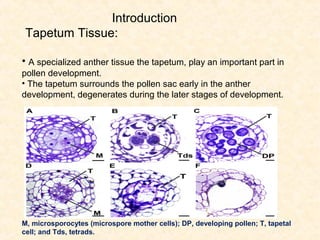
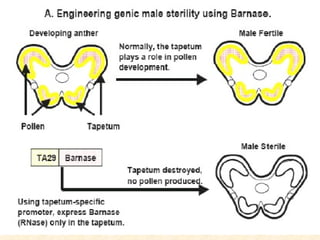
Tapetum Tissue:
• A specialized anther tissue the tapetum, play an important part in
pollen development.
• The tapetum surrounds the pollen sac early in the anther
development, degenerates during the later stages of development.
M, microsporocytes (microspore mother cells); DP, developing pollen; T, tapetal
cell; and Tds, tetrads.
Barnase
In 1990, C.Mariani et al. Successfully used a
chimeric dominant gene construct having an
anther specific promoter(from TA29gene of
tobacco) and bacterial coding sequence for
a ribonuclease (barnase gene from Bacillus
amyloliquefaciens) for production of
transgenic plant in B.napus. The product of
barnase(110 amino acid) gene is cytotoxic
killing the tapetul cells, thus preventing
pollen development result transgenic male
sterility.
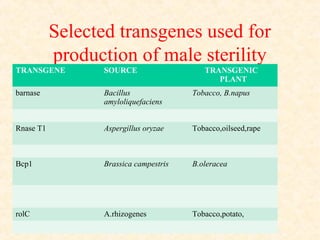
Selected transgenes used for
production of male sterility
TRANSGENE SOURCE TRANSGENIC
PLANT
barnase Bacillus
amyloliquefaciens
Tobacco, B.napus
Rnase T1 Aspergillus oryzae Tobacco,oilseed,rape
Bcp1 Brassica campestris B.oleracea
rolC A.rhizogenes Tobacco,potato,
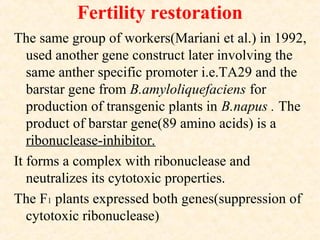
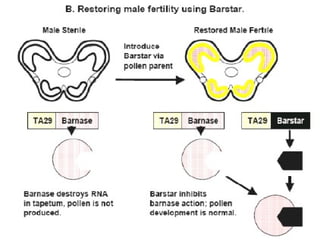
Fertility restoration
The same group of workers(Mariani et al.) in 1992,
used another gene construct later involving the
same anther specific promoter i.e.TA29 and the
barstar gene from B.amyloliquefaciens for
production of transgenic plants in B.napus . The
product of barstar gene(89 amino acids) is a
ribonuclease-inhibitor.
It forms a complex with ribonuclease and
neutralizes its cytotoxic properties.
The F1 plants expressed both genes(suppression of
cytotoxic ribonuclease)
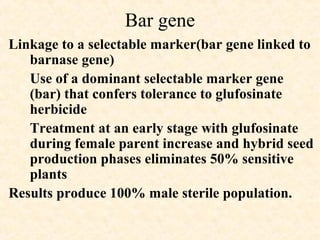
Bar gene
Linkage to a selectable marker(bar gene linked to
barnase gene)
Use of a dominant selectable marker gene
(bar) that confers tolerance to glufosinate
herbicide
Treatment at an early stage with glufosinate
during female parent increase and hybrid seed
production phases eliminates 50% sensitive
plants
Results produce 100% male sterile population.
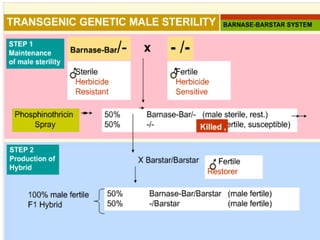
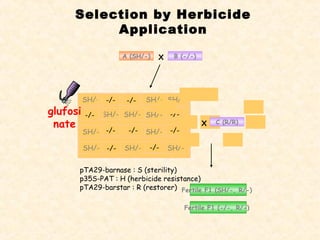
Selection by Herbicide
Application
pTA29-barnase : S (sterility)
p35S-PAT : H (herbicide resistance)
pTA29-barstar : R (restorer)
SH/-
SH/-
-/- SH/-
SH/-
-/- SH/-
-/-
SH/-
-/-
-/- SH/-
-/- SH/-SH/-
-/- -/-
-/-SH/-SH/-
-/- -/-
-/- -/-
-/--/--/-
-/- -/-
A (SH/-) X B (-/-)
glufosi
nate X C (R/R)
Fertile F1 (SH/-, R/-)
Fertile F1 (-/-, R/-)
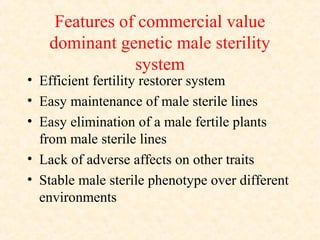
Features of commercial value
dominant genetic male sterility
system
• Efficient fertility restorer system
• Easy maintenance of male sterile lines
• Easy elimination of a male fertile plants
from male sterile lines
• Lack of adverse affects on other traits
• Stable male sterile phenotype over different
environments
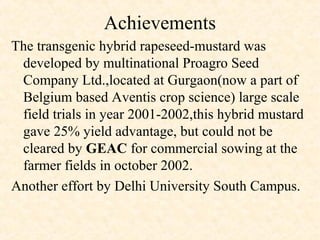
Achievements
The transgenic hybrid rapeseed-mustard was
developed by multinational Proagro Seed
Company Ltd.,located at Gurgaon(now a part of
Belgium based Aventis crop science) large scale
field trials in year 2001-2002,this hybrid mustard
gave 25% yield advantage, but could not be
cleared by GEAC for commercial sowing at the
farmer fields in october 2002.
Another effort by Delhi University South Campus.
References:-
1. Gupta P.K., Langridge P, Mir R.R.(2010)Marker assisted
wheat Breeding:present status and future possibilities,
2.Article shared by Sudhadip Mondal MAS meaning
application step achievements,
3.Journal of Drug Metabolism&Toxicology(review),
4.Singh,B.D. Plant Breeding Principles and Methods,
5.Marker-assisted selection:an approach for precision plant
breeding in the twenty-first century-Bertrand C.Y Collard
and David J Mackill,
6.Singhal.N.C,Hybrid Seed Production,
7.Internet&SlideShare etc

marker assisted selection

  • 2.
  • 3.
    Contents 1.Marker assisted selection:- a.Introduction& features. b.General Steps in MAS. c.MAS Breeding Scheme(Marker assisted backcrossing,Pyramiding in Rice,…..). d. Current status of molecular breeding. e. Future challenges. f. Future of MAS in rice etc?
  • 4.
    Introduction Marker assisted selection(MAS) refers to the use of DNA markers that are tightly-linked to target loci as a substitute for or to assist phenotypic screening or The use of genetic markers with the phenotypes in a process called Marker assisted selection.
  • 8.
    Markers must be tightly-linkedto target loci! • Ideally markers should be <5 cM from a gene or QTL • Using a pair of flanking markers can greatly improve reliability but increases time and cost Marker A QTL 5 cM RELIABILITY FOR SELECTION Using marker A only: ~95% Marker A QTL Marker B 5 cM 5 cM Using markers A and B: ~99.5%
  • 9.
    Markers must bepolymorphic 1 2 3 4 5 6 7 8 1 2 3 4 5 6 7 8 RM84 RM296 P1 P2 P1 P2 Not polymorphic Polymorphic!
  • 10.
    F2 P2 F1 P1 x large populationsconsisting of thousands of plants PHENOTYPIC SELECTION Field trialsGlasshouse trials DonorRecipient CONVENTIONAL PLANT BREEDING Salinity screening in phytotron Bacterial blight screening Phosphorus deficiency plot
  • 11.
    General Steps inMAS- 1.Selection of parents. 2.Development of Breeding Population. 3.Isolation of DNA. 4.Scoring RFLP. 5.Correlation with Morphological traits.
  • 12.
    (1) LEAF TISSUE SAMPLING (2)DNA EXTRACTION (3) PCR (4) GEL ELECTROPHORESIS (5) MARKER ANALYSIS Overview of ‘marker genotyping’
  • 13.
    F2 P2 F1 P1 x large populationsconsisting of thousands of plants ResistantSusceptible MARKER-ASSISTED SELECTION (MAS) MARKER-ASSISTED BREEDING Method whereby phenotypic selection is based on DNA markers
  • 14.
    Marker-assisted backcrossing (MAB) Selection for target geneor QTL 1 2 3 4 Target locus 1 2 3 41 2 3 4 BACKGROUND SELECTION TARGET LOCUS SELECTION FOREGROUND SELECTION BACKGROUND SELECTION Accelerates the recovery of the recurrent parent genome
  • 15.
    P1 x F1 P1x P2 CONVENTIONAL BACKCROSSING BC1 VISUAL SELECTION OF BC1 PLANTS THAT MOST CLOSELY RESEMBLE RECURRENT PARENT BC2 MARKER-ASSISTED BACKCROSSING P1 x F1 P1 x P2 BC1 USE ‘BACKGROUND’ MARKERS TO SELECT PLANTS THAT HAVE MOST RP MARKERS AND SMALLEST % OF DONOR GENOME BC2
  • 22.
    Application of MAS 1.Itis useful in gene pyramiding for disease and insect resistance. 2.Uses in backcrossing programme. 3.It is being used for transfer of male sterility into cultivated genotypes from different sources. 4.MAS is being used for improvement of quality characters in different crops such as for protein quality in maize, etc…
  • 23.
    Advantage of MAS 1.Accuracy, 2. Rapid Method, 3. Non-transgenic Product, 4. Identification of Recessive Alleles, 5. Early Detection of Traits, 6. Screening of Difficult Traits, 7. Highly Reproducible, 8. Small Sample for Testing,etc…
  • 24.
    Achievements of MAS 1.Rice-a.(PB1x JRBB55)Improved Pusa Basmati 1, b.Improved Sambha Mahsuri(BPT5204), 2.Maize-Improved QPM-9, 3.Pearlmillet-HHB67-2, 4.Wheat-Patwin,etc
  • 25.
    Current status ofmolecular breeding • A literature review indicates thousands of QTL mapping studies but not many actual reports of the application of MAS in breeding • Why is this the case?
  • 26.
    Some possible reasonsto explain the low impact of MAS in crop improvement • Resources (equipment) not available • Markers may not be cost-effective • Accuracy of QTL mapping studies • QTL effects may depend on genetic background or be influenced by environmental conditions • Lack of marker polymorphism in breeding material • Poor integration of molecular genetics and conventional breeding
  • 27.
    How much doesMAS cost at IRRI? Consumables: • Genome mapping lab (GML) ESTIMATE – USD $0.26 per sample (minimum costs) – Breakdown of costs: DNA extraction: 19.1%; PCR: 61.6%; Gel electrophoresis: 19.2% – Estimate excludes delivery fees, gloves, paper tissue, electricity, water, waste disposal and no re-runs • GAMMA Lab estimate = USD $0.86 per sample Labour: – USD $0.06 per sample (Research Technician) – USD $0.65 per sample (Postdoctoral Research Fellow) TOTAL: USD $0.32/sample (RT); USD $0.91/sample (PDF)
  • 28.
    Future challenges • Improvedcost-efficiency – Optimization, simplification of methods and future innovation • Design of efficient and effective MAS strategies • Greater integration between molecular genetics and plant breeding • Data management
  • 29.
    Future of MASin rice etc? • Most important staple for many developing countries • Model crop species – Enormous amount of research in molecular genetics and genomics which has provided enormous potential for marker development and MAS • Costs of MAS are prohibitive so available funding will largely determine the extent to which markers are used in breeding
  • 30.
    2.Barnase-Barstar System Contents:- 1.Major system& Introduction, 2.Mechanism of Barnase-Barstar system, 3.Fertility Restoration System, 4.Production of 100% male sterile, 5. Features of this dominant genetic male sterility system regarding commercial value, 6.Achievements.
  • 31.
    Major Systems ofGenetic Male Sterility 1.Dominant Nuclear Male Sterility, 2.Male Sterility by Silencing fertility Gene Bcp1, 3.Male Sterility through Hormone Engineering, 4.Pollen self destruction engineered Male Sterility, 5.Male Sterility through modification of Biochemical Pathway, 6.Male Sterility using Pathogenesis related Protein Genes.
  • 32.
    Introduction Tapetum Tissue: • Aspecialized anther tissue the tapetum, play an important part in pollen development. • The tapetum surrounds the pollen sac early in the anther development, degenerates during the later stages of development. M, microsporocytes (microspore mother cells); DP, developing pollen; T, tapetal cell; and Tds, tetrads.
  • 33.
    Barnase In 1990, C.Marianiet al. Successfully used a chimeric dominant gene construct having an anther specific promoter(from TA29gene of tobacco) and bacterial coding sequence for a ribonuclease (barnase gene from Bacillus amyloliquefaciens) for production of transgenic plant in B.napus. The product of barnase(110 amino acid) gene is cytotoxic killing the tapetul cells, thus preventing pollen development result transgenic male sterility.
  • 35.
    Selected transgenes usedfor production of male sterility TRANSGENE SOURCE TRANSGENIC PLANT barnase Bacillus amyloliquefaciens Tobacco, B.napus Rnase T1 Aspergillus oryzae Tobacco,oilseed,rape Bcp1 Brassica campestris B.oleracea rolC A.rhizogenes Tobacco,potato,
  • 36.
    Fertility restoration The samegroup of workers(Mariani et al.) in 1992, used another gene construct later involving the same anther specific promoter i.e.TA29 and the barstar gene from B.amyloliquefaciens for production of transgenic plants in B.napus . The product of barstar gene(89 amino acids) is a ribonuclease-inhibitor. It forms a complex with ribonuclease and neutralizes its cytotoxic properties. The F1 plants expressed both genes(suppression of cytotoxic ribonuclease)
  • 38.
    Bar gene Linkage toa selectable marker(bar gene linked to barnase gene) Use of a dominant selectable marker gene (bar) that confers tolerance to glufosinate herbicide Treatment at an early stage with glufosinate during female parent increase and hybrid seed production phases eliminates 50% sensitive plants Results produce 100% male sterile population.
  • 39.
    Selection by Herbicide Application pTA29-barnase: S (sterility) p35S-PAT : H (herbicide resistance) pTA29-barstar : R (restorer) SH/- SH/- -/- SH/- SH/- -/- SH/- -/- SH/- -/- -/- SH/- -/- SH/-SH/- -/- -/- -/-SH/-SH/- -/- -/- -/- -/- -/--/--/- -/- -/- A (SH/-) X B (-/-) glufosi nate X C (R/R) Fertile F1 (SH/-, R/-) Fertile F1 (-/-, R/-)
  • 41.
    Features of commercialvalue dominant genetic male sterility system • Efficient fertility restorer system • Easy maintenance of male sterile lines • Easy elimination of a male fertile plants from male sterile lines • Lack of adverse affects on other traits • Stable male sterile phenotype over different environments
  • 42.
    Achievements The transgenic hybridrapeseed-mustard was developed by multinational Proagro Seed Company Ltd.,located at Gurgaon(now a part of Belgium based Aventis crop science) large scale field trials in year 2001-2002,this hybrid mustard gave 25% yield advantage, but could not be cleared by GEAC for commercial sowing at the farmer fields in october 2002. Another effort by Delhi University South Campus.
  • 43.
    References:- 1. Gupta P.K.,Langridge P, Mir R.R.(2010)Marker assisted wheat Breeding:present status and future possibilities, 2.Article shared by Sudhadip Mondal MAS meaning application step achievements, 3.Journal of Drug Metabolism&Toxicology(review), 4.Singh,B.D. Plant Breeding Principles and Methods, 5.Marker-assisted selection:an approach for precision plant breeding in the twenty-first century-Bertrand C.Y Collard and David J Mackill, 6.Singhal.N.C,Hybrid Seed Production, 7.Internet&SlideShare etc