Marker Assisted Selection
By
Kartikey Sootrakar
Ph.D. IIIrd semester
Enroll. 170234001
College of Agriculture, Rewa
J.N.K.V.V., Jabalpur (M.P.)
Doctoral Seminar
on
Marker-Assisted Selection
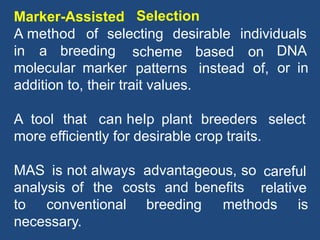
A method of selecting desirable individuals
in a breeding scheme
patterns
based
instead
on
of,
DNA
molecular marker or in
addition to, their trait values.
A tool that can help plant breeders select
more efficiently for desirable crop traits.
MAS is not always advantageous, so careful
relativeanalysis of the costs and benefits
to conventional breeding methods is
necessary.
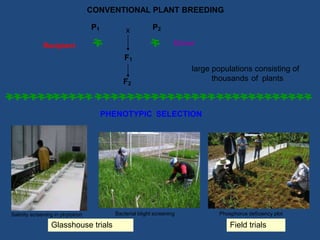
CONVENTIONAL PLANT BREEDING
P1 P2x
DonorRecipient
F1
large populations consisting of
thousands of plantsF2
PHENOTYPIC SELECTION
Bacterial blight screening Phosphorus deficiency plotSalinity screening in phytotron
Field trialsGlasshouse trials
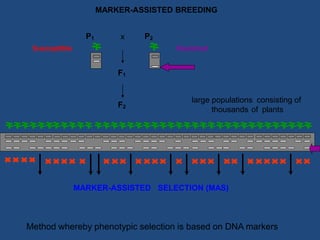
MARKER-ASSISTED BREEDING
P1 x P2
Susceptible Resistant
F1
large populations consisting of
F2
thousands of plants
MARKER-ASSISTED SELECTION (MAS)
Method whereby phenotypic selection is based on DNA markers
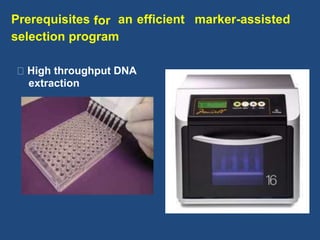
Prerequisites for an efficient marker-assisted
selection program
High throughput DNA
extraction
Markers
Markers (morphological, protein, cytological)
also be used in MAS programs.
can
RFLP, SSR, RAPD, AFLP,and SNP
For efficient
 Ease of use
Small amount
Low cost
Repeatability
MAS:
of DNA required
of results
 High rate of polymorphism
Occurrence throughout the genome
Codominance
gene.
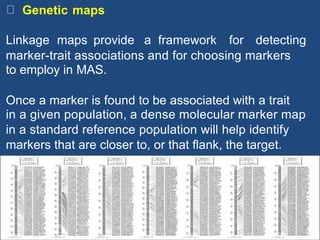
Genetic maps
Linkage maps provide a framework for detecting
marker-trait associations and for choosing markers
to employ in MAS.
Once a marker is found to be associated with a trait
in a given population, a dense molecular marker map
in a standard reference population will help identify
markers that are closer to, or that flank, the target.
Data managementsystem
Large numbers of samples are handled
sample
multiple
in a MAS program, with each
potentially
markers.
evaluated for
This situation requires an efficient
retrieving,system for labeling, storing,
and analyzing large data
useful
sets,
to
and
theproducing
breeder.
reports
Potential advantages of MAS
It can be performed on seedling material
Thus reducing the time required before a plant’s
genotype is known.
In contrast, many important plant traits are
observable only when the plant has reached
flowering or harvest maturity.
Knowing a plant’s genotype before
order
flowering can
thebe particularly useful in to plan
appropriate crosses between selected individuals.
MAS is not affected by environmental
conditions
Some crop production constraints (such as
disease, insect pests, temperature and moisture
stress) occur sporadically or non-uniformly.
Therefore, evaluating resistance to those
constraints may not be possible in a given year or
location.
MAS offers the chance to determine a plant’s
resistance level independent of environment.
When recessive alleles determine traits of
interest
They cannot be detected through phenotypic
evaluation of heterozygous plants, because their
presence is masked by the dominant allele.
In a traditional backcross program, plants with
recessive alleles are identified by progeny
evaluation after self-pollination or testcrossing
recessive tester.
to a
This time-consuming step can be eliminated in a
MAS program, because recessive alleles are
identified by linked markers.
When multiple resistance genes are
pyramided together
line,
in the same variety
or breeding
The presence of each individual gene is
difficult to verify phenotypically.
The presence of one resistance gene may
conceal the effect of additional genes.
This problem can
for
be overcome if markers
are available each of the resistance
genes.
A consideration that
MAS
may
is
affect cost
effectiveness of
be
that multiple
markers can evaluated using the same
DNA sample.
Once DNA is extracted and purified, it may
same
be
orused for multiple
traits,
markers, for the
different thus reducing the time and
cost per marker.
MAS may be cheaper and faster than
conventional phenotypic assays, depending on
the trait.
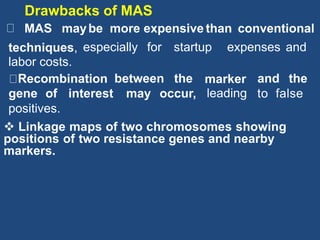
MAS maybe more expensive than conventional
techniques,
labor costs.
especially for startup expenses and
Recombination between the marker
leading
and the
gene of interest may occur, to false
positives.
 Linkage maps of two chromosomes showing
positions of two resistance genes and nearby
markers.
Drawbacks of MAS
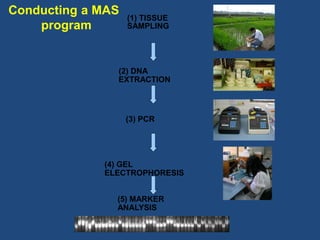
Conducting a MAS
(1) TISSUE
SAMPLINGprogram
(2) DNA
EXTRACTION
(3) PCR
(4) GEL
ELECTROPHORESIS
(5) MARKER
ANALYSIS
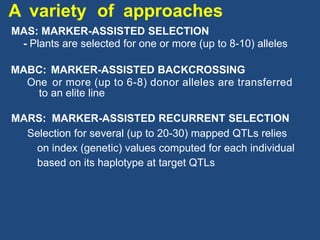
A variety of approaches
MAS: MARKER-ASSISTED SELECTION
- Plants are selected for one or more (up to 8-10) alleles
MABC:
One
to
MARKER-ASSISTED BACKCROSSING
or more (up to 6-8) donor alleles are transferred
an elite line
MARS: MARKER-ASSISTED RECURRENT SELECTION
Selection for several (up to 20-30) mapped QTLs relies
on index (genetic) values computed for each individual
based on its haplotype at target QTLs
Conclusion
MAS is a methodology that has already
proved its value.
It is likely to become more valuable as a
larger number of genes are identified and
their functions and interactions elucidated.
Reduced costs and optimized strategies for
integrating MAS with phenotypic selection
are needed before the technology can reach
its full potential.
MAS ( Marker Assisted Selection)

MAS ( Marker Assisted Selection)

  • 1.
    Marker Assisted Selection By KartikeySootrakar Ph.D. IIIrd semester Enroll. 170234001 College of Agriculture, Rewa J.N.K.V.V., Jabalpur (M.P.) Doctoral Seminar on
  • 2.
    Marker-Assisted Selection A methodof selecting desirable individuals in a breeding scheme patterns based instead on of, DNA molecular marker or in addition to, their trait values. A tool that can help plant breeders select more efficiently for desirable crop traits. MAS is not always advantageous, so careful relativeanalysis of the costs and benefits to conventional breeding methods is necessary.
  • 3.
    CONVENTIONAL PLANT BREEDING P1P2x DonorRecipient F1 large populations consisting of thousands of plantsF2 PHENOTYPIC SELECTION Bacterial blight screening Phosphorus deficiency plotSalinity screening in phytotron Field trialsGlasshouse trials
  • 4.
    MARKER-ASSISTED BREEDING P1 xP2 Susceptible Resistant F1 large populations consisting of F2 thousands of plants MARKER-ASSISTED SELECTION (MAS) Method whereby phenotypic selection is based on DNA markers
  • 5.
    Prerequisites for anefficient marker-assisted selection program High throughput DNA extraction
  • 6.
    Markers Markers (morphological, protein,cytological) also be used in MAS programs. can RFLP, SSR, RAPD, AFLP,and SNP For efficient  Ease of use Small amount Low cost Repeatability MAS: of DNA required of results  High rate of polymorphism Occurrence throughout the genome Codominance
  • 7.
    gene. Genetic maps Linkage mapsprovide a framework for detecting marker-trait associations and for choosing markers to employ in MAS. Once a marker is found to be associated with a trait in a given population, a dense molecular marker map in a standard reference population will help identify markers that are closer to, or that flank, the target.
  • 8.
    Data managementsystem Large numbersof samples are handled sample multiple in a MAS program, with each potentially markers. evaluated for This situation requires an efficient retrieving,system for labeling, storing, and analyzing large data useful sets, to and theproducing breeder. reports
  • 9.
    Potential advantages ofMAS It can be performed on seedling material Thus reducing the time required before a plant’s genotype is known. In contrast, many important plant traits are observable only when the plant has reached flowering or harvest maturity. Knowing a plant’s genotype before order flowering can thebe particularly useful in to plan appropriate crosses between selected individuals.
  • 10.
    MAS is notaffected by environmental conditions Some crop production constraints (such as disease, insect pests, temperature and moisture stress) occur sporadically or non-uniformly. Therefore, evaluating resistance to those constraints may not be possible in a given year or location. MAS offers the chance to determine a plant’s resistance level independent of environment.
  • 11.
    When recessive allelesdetermine traits of interest They cannot be detected through phenotypic evaluation of heterozygous plants, because their presence is masked by the dominant allele. In a traditional backcross program, plants with recessive alleles are identified by progeny evaluation after self-pollination or testcrossing recessive tester. to a This time-consuming step can be eliminated in a MAS program, because recessive alleles are identified by linked markers.
  • 12.
    When multiple resistancegenes are pyramided together line, in the same variety or breeding The presence of each individual gene is difficult to verify phenotypically. The presence of one resistance gene may conceal the effect of additional genes. This problem can for be overcome if markers are available each of the resistance genes.
  • 13.
    A consideration that MAS may is affectcost effectiveness of be that multiple markers can evaluated using the same DNA sample. Once DNA is extracted and purified, it may same be orused for multiple traits, markers, for the different thus reducing the time and cost per marker. MAS may be cheaper and faster than conventional phenotypic assays, depending on the trait.
  • 14.
    MAS maybe moreexpensive than conventional techniques, labor costs. especially for startup expenses and Recombination between the marker leading and the gene of interest may occur, to false positives.  Linkage maps of two chromosomes showing positions of two resistance genes and nearby markers. Drawbacks of MAS
  • 15.
    Conducting a MAS (1)TISSUE SAMPLINGprogram (2) DNA EXTRACTION (3) PCR (4) GEL ELECTROPHORESIS (5) MARKER ANALYSIS
  • 16.
    A variety ofapproaches MAS: MARKER-ASSISTED SELECTION - Plants are selected for one or more (up to 8-10) alleles MABC: One to MARKER-ASSISTED BACKCROSSING or more (up to 6-8) donor alleles are transferred an elite line MARS: MARKER-ASSISTED RECURRENT SELECTION Selection for several (up to 20-30) mapped QTLs relies on index (genetic) values computed for each individual based on its haplotype at target QTLs
  • 17.
    Conclusion MAS is amethodology that has already proved its value. It is likely to become more valuable as a larger number of genes are identified and their functions and interactions elucidated. Reduced costs and optimized strategies for integrating MAS with phenotypic selection are needed before the technology can reach its full potential.