2
Speaker
Pawan Kumar Nagar
Reg. no : 04-2690-2015
III sem. M.Sc. (Fruit scince)
Submitted to
Dr. A. V. Kotecha
Assistant Professor
Department of Horticulture
It is one of the popular fruit of India, according to
burton, in the early years of seventeenth century it was
found growing in India.
It is richest and cheapest source of vitamin – C (299
mg/100 g)
The ideal canopy shape should be such that it may meet
out as many as possible principles.
The perfect ideotype of guava is the canopy should be
dwarf, spreading, larger trunk, and open.
3
4
 Canopy management is one of the most important fruit plant
management practice.
 This forms the basis of precociousness and longevity of the
fruit trees in an orchard.
 The strong scaffold system help the trees to produce heavy crop
loads of quality fruits without any major limb breakage.
 Regular annual priming is essential for the induction of good
amount of new growth.
 which will provide the tree maximum fruit bearing area
uniformly over the whole tree.
 Unpruned trees grow beyond limits provided for each tree in an
orchard.
5
The tree size can be controlled by use of dwarfing
rootstock like Psidium friedrichsthalianum and aneuploid
– 82.
While as triploid guava was found to increase the
vigour of Allahabad Safeda cultivar.
High density planting in guava has attracting attention
of many workers by using growth controlling root stock
and other canopy management practices like training and
pruning.
Accommodation of the maximum possible number of the
plants per unit area to get the maximum possible profit per unit of
the tree volume without impairing the soil fertility status is called
high density planting.
 The Meadow Orchard is a modern method of fruit
cultivation.
 There is a shift in farmers' perception from production to
productivity and profitability.
 Achieved through high density planting.
 Recently, there is a trend to plant fruit trees at closer
spacing leading to high density or meadow orchard.
 Higher and quality production is achieved from densely planted
orchards through judicious canopy management and adoption of
suitable tree training systems.
 The Meadow Orchard is a modern method of fruit cultivation
using small or dwarf tree with modified canopy.
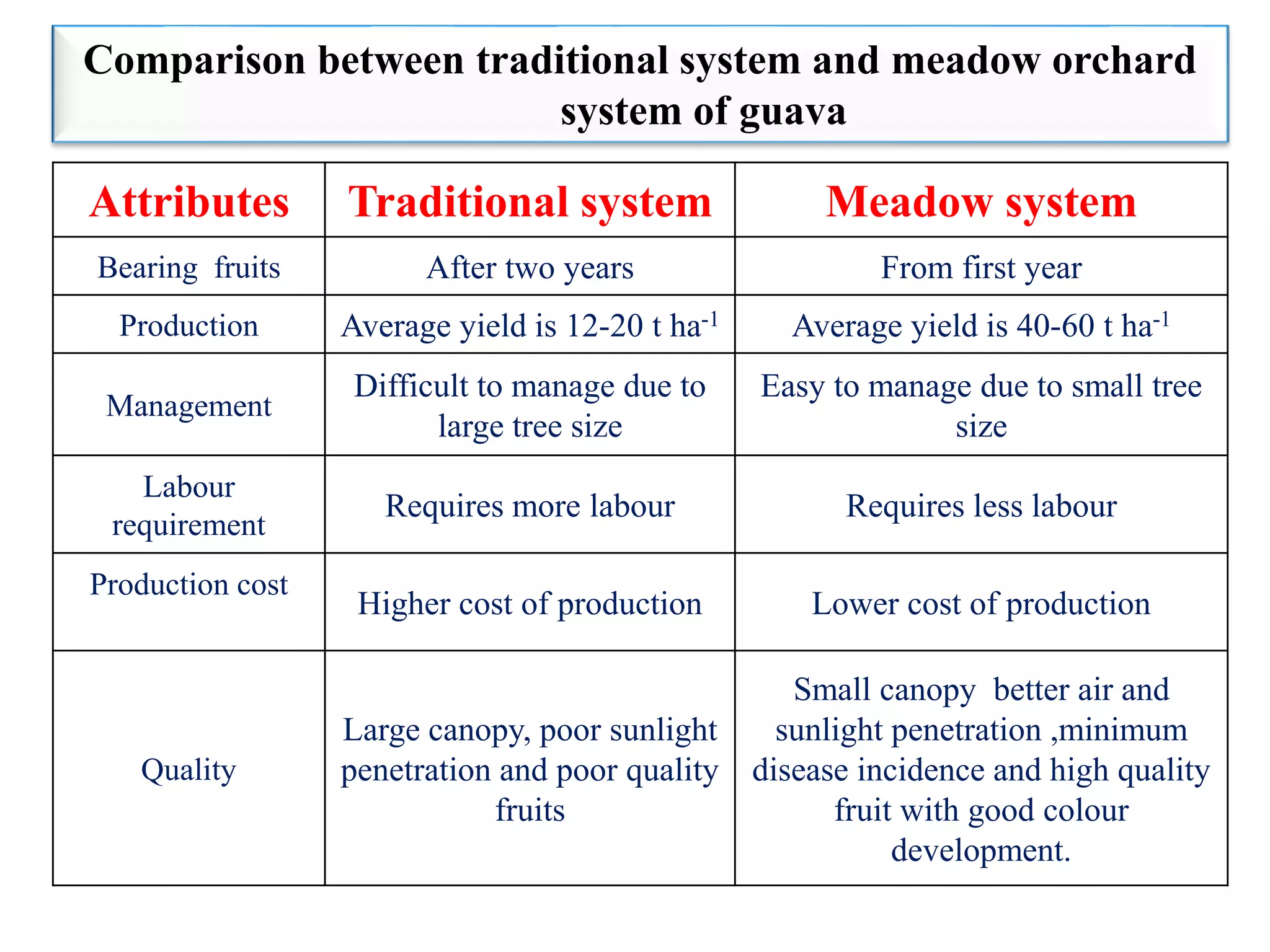
 A comparison between meadow orchard system and the
traditional system of fruit growing is necessary to evaluate the
potentiality of this technique.
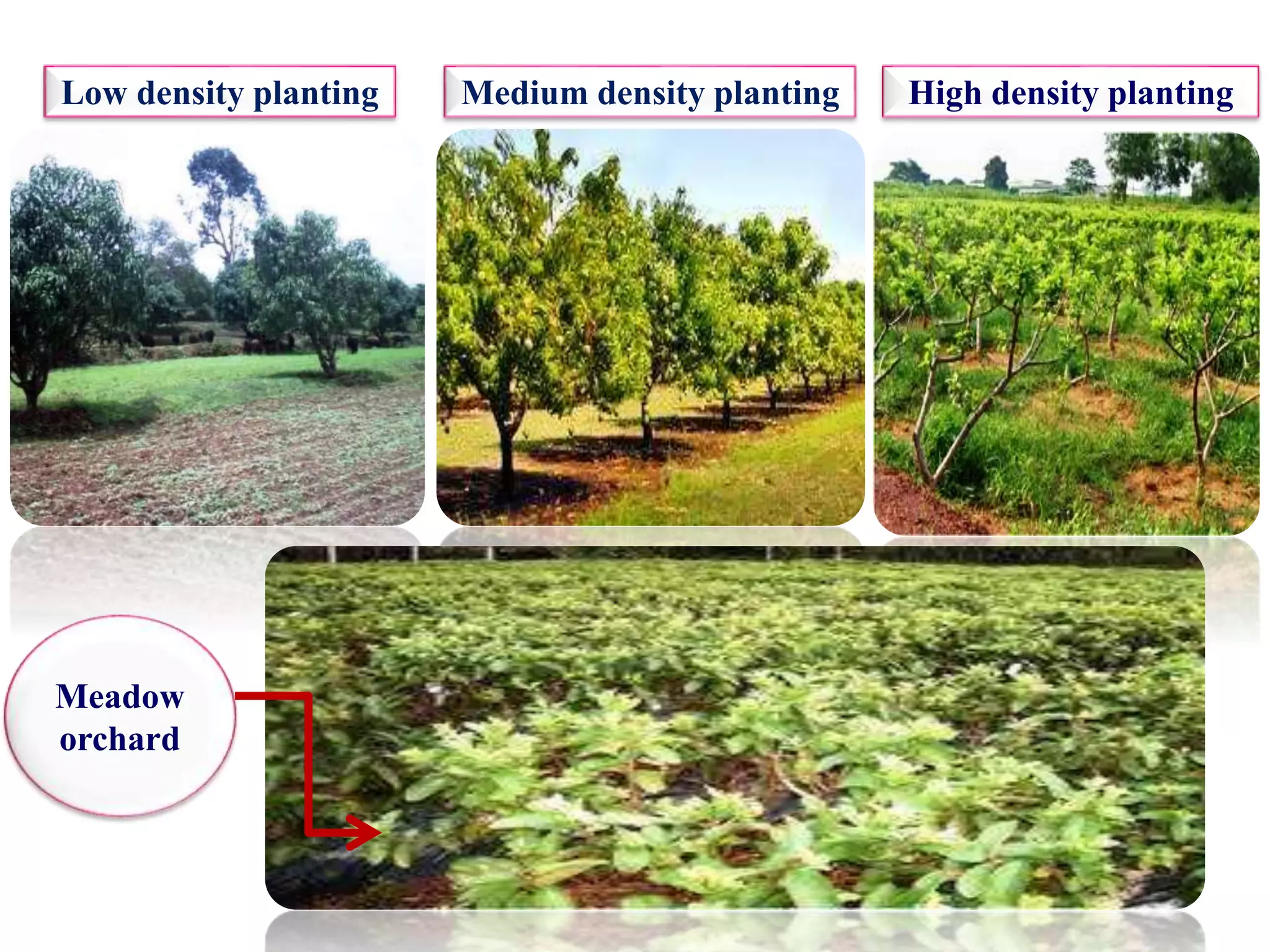
Low density planting Medium density planting High density planting
Meadow
orchard
Attributes Traditional system Meadow system
Bearing fruits After two years From first year
Production Average yield is 12-20 t ha-1 Average yield is 40-60 t ha-1
Management
Difficult to manage due to
large tree size
Easy to manage due to small tree
size
Labour
requirement
Requires more labour Requires less labour
Production cost
Higher cost of production Lower cost of production
Quality
Large canopy, poor sunlight
penetration and poor quality
fruits
Small canopy better air and
sunlight penetration ,minimum
disease incidence and high quality
fruit with good colour
development.
Comparison between traditional system and meadow orchard
system of guava
Planting system Spacing (m) Density of plant /ha
Low density 8 × 8 156
Medium density
6 × 6 277
High density 3 × 3 1111
Ultra-High density
3 × 1.5 2222
Meadow Orcharding 2 × 1 5000
Different spacing and density of plants/ha of guava
Training:- It refers to the practice of giving shape to the tree in
the initial year of planting to bear the load of crop in subsequent
years.
Pruning:- “Pruning is the art of removal of parts of a tree,
especially shoots, roots, limbs, buds or nipping away of the
terminal parts.”
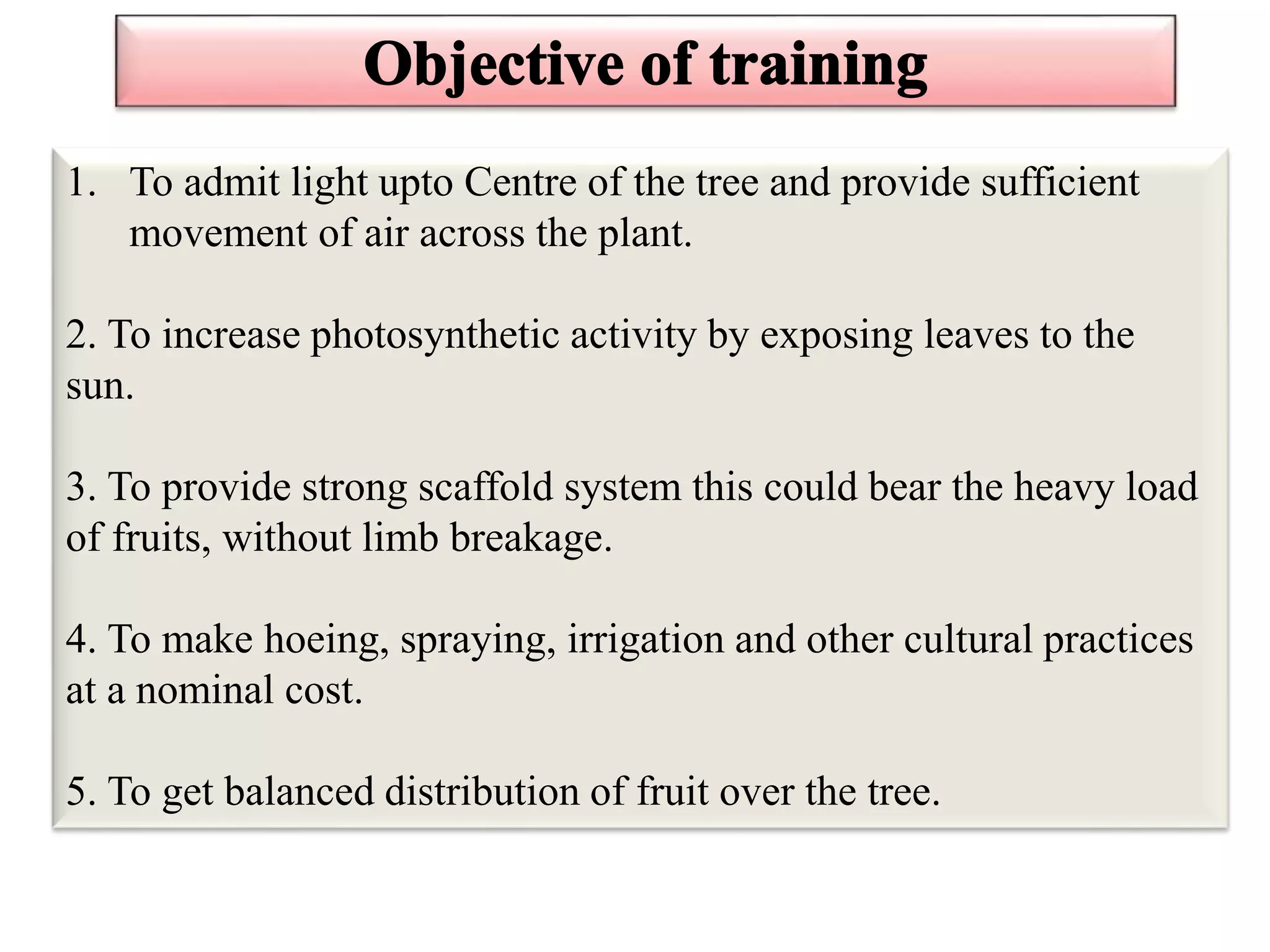
1. To admit light upto Centre of the tree and provide sufficient
movement of air across the plant.
2. To increase photosynthetic activity by exposing leaves to the
sun.
3. To provide strong scaffold system this could bear the heavy load
of fruits, without limb breakage.
4. To make hoeing, spraying, irrigation and other cultural practices
at a nominal cost.
5. To get balanced distribution of fruit over the tree.
14
Thinning out: When a shoot is removed entirely from the
inception so that, no new shoot arises from that place, it is referred
as thinning out.
Heading back: When a branch is cut almost to the base, leaving a
few inches of stump, carrying few buds, it is referred as heading
back.
Restrains the vigorous vegetative growth of guava to manageable
sizes and forms thereby to achieve optimum production.
Increase productivity of orchards.
Stimulate precocious flowering of new plantings.
Extend the productive life of the orchard.
Increase air circulation in the orchard, which lowers losses
associated with diseases.
16
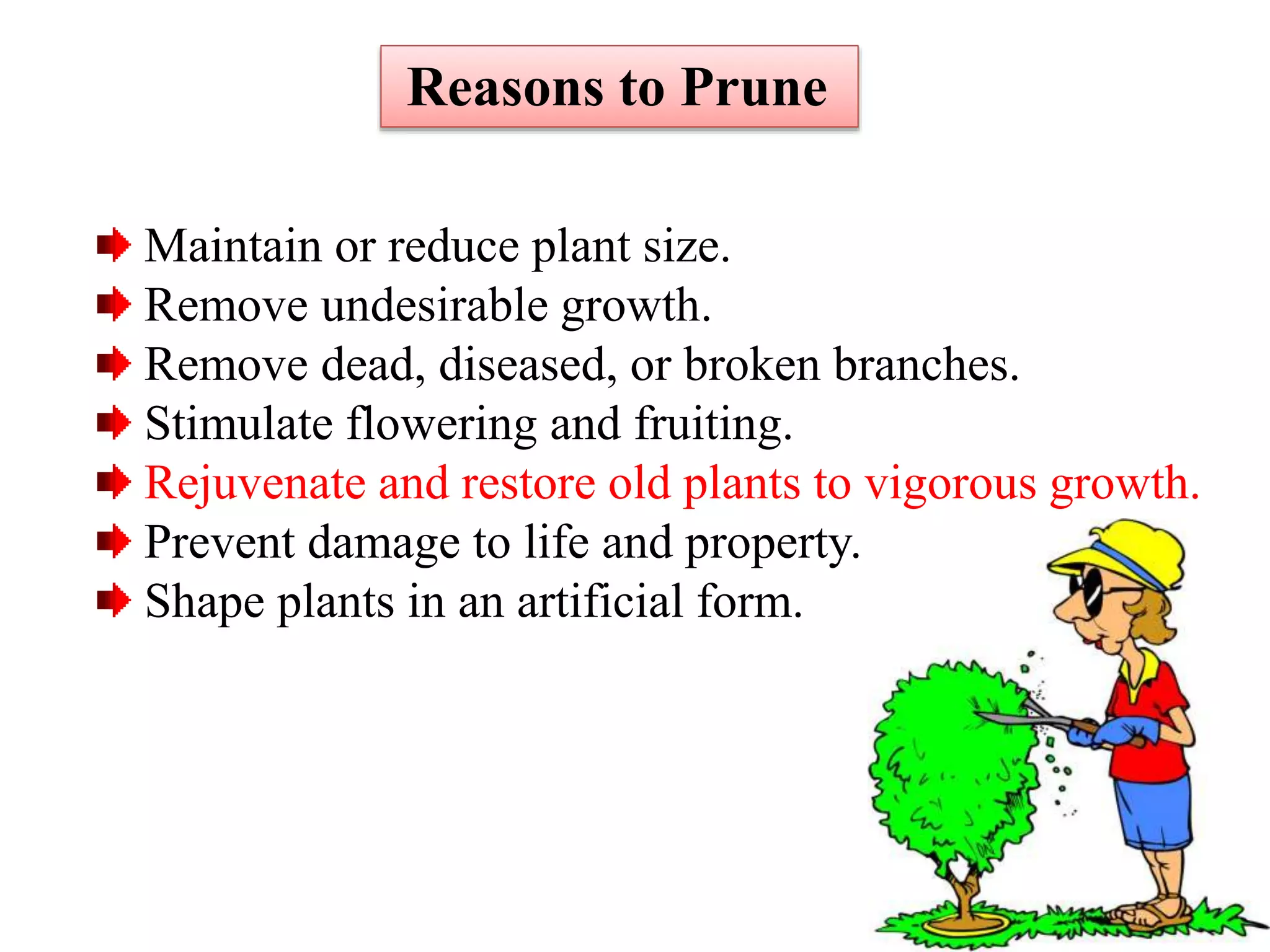
Maintain or reduce plant size.
Remove undesirable growth.
Remove dead, diseased, or broken branches.
Stimulate flowering and fruiting.
Rejuvenate and restore old plants to vigorous growth.
Prevent damage to life and property.
Shape plants in an artificial form.
Reasons to Prune
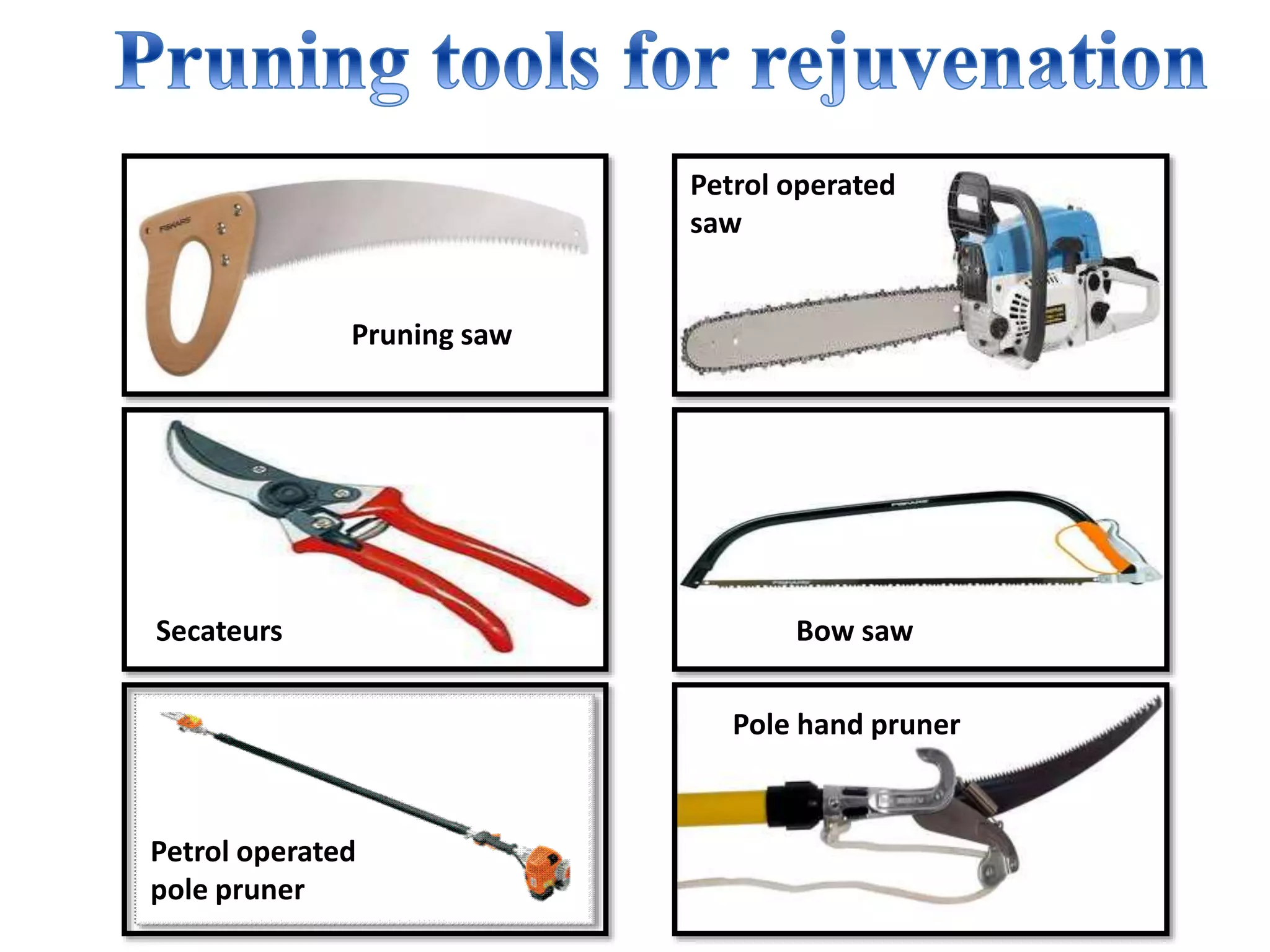
Pruning saw
Petrol operated
saw
Secateurs Bow saw
Pole hand pruner
Petrol operated
pole pruner
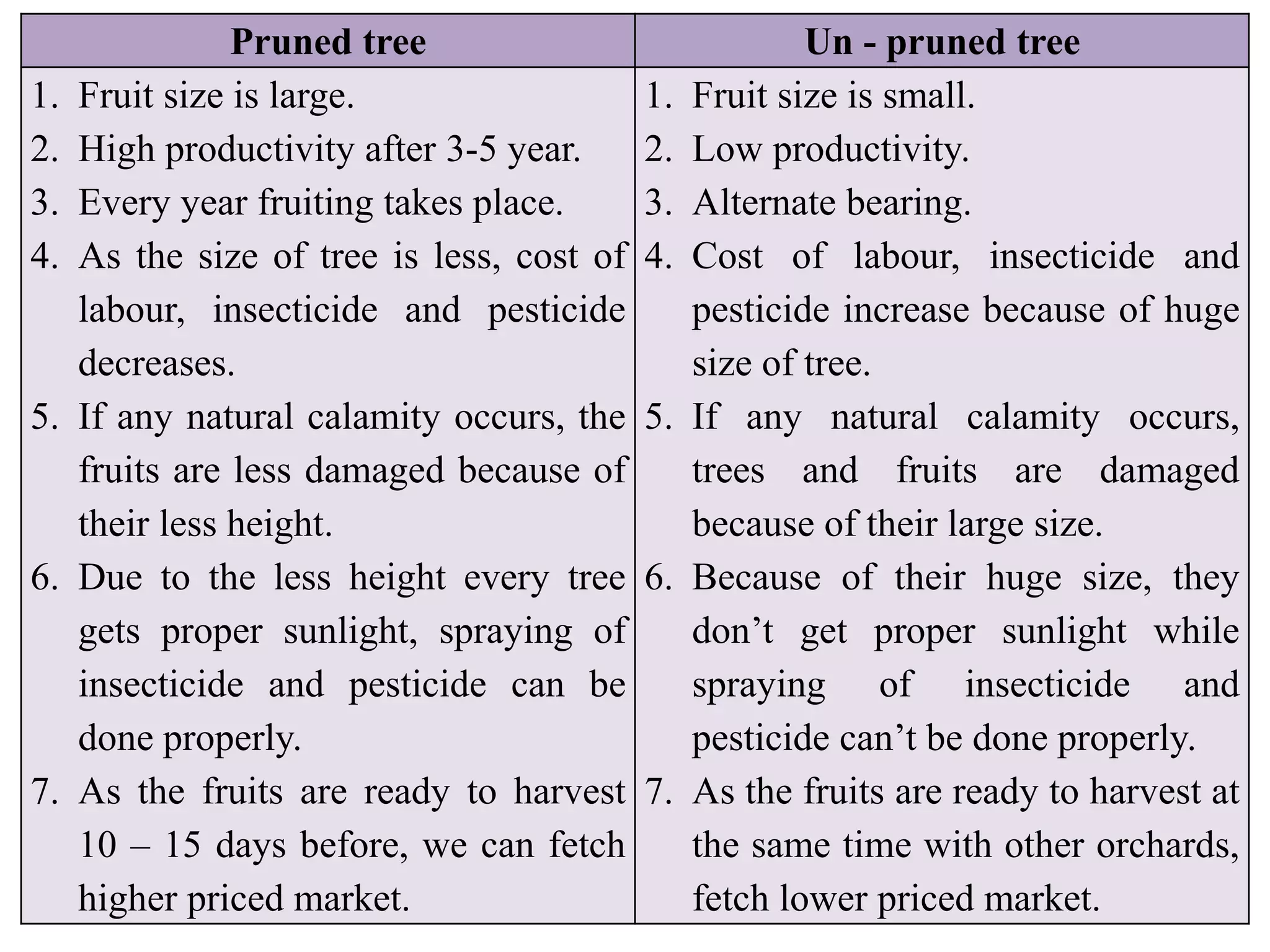
Pruned tree Un - pruned tree
1. Fruit size is large.
2. High productivity after 3-5 year.
3. Every year fruiting takes place.
4. As the size of tree is less, cost of
labour, insecticide and pesticide
decreases.
5. If any natural calamity occurs, the
fruits are less damaged because of
their less height.
6. Due to the less height every tree
gets proper sunlight, spraying of
insecticide and pesticide can be
done properly.
7. As the fruits are ready to harvest
10 – 15 days before, we can fetch
higher priced market.
1. Fruit size is small.
2. Low productivity.
3. Alternate bearing.
4. Cost of labour, insecticide and
pesticide increase because of huge
size of tree.
5. If any natural calamity occurs,
trees and fruits are damaged
because of their large size.
6. Because of their huge size, they
don’t get proper sunlight while
spraying of insecticide and
pesticide can’t be done properly.
7. As the fruits are ready to harvest at
the same time with other orchards,
fetch lower priced market.
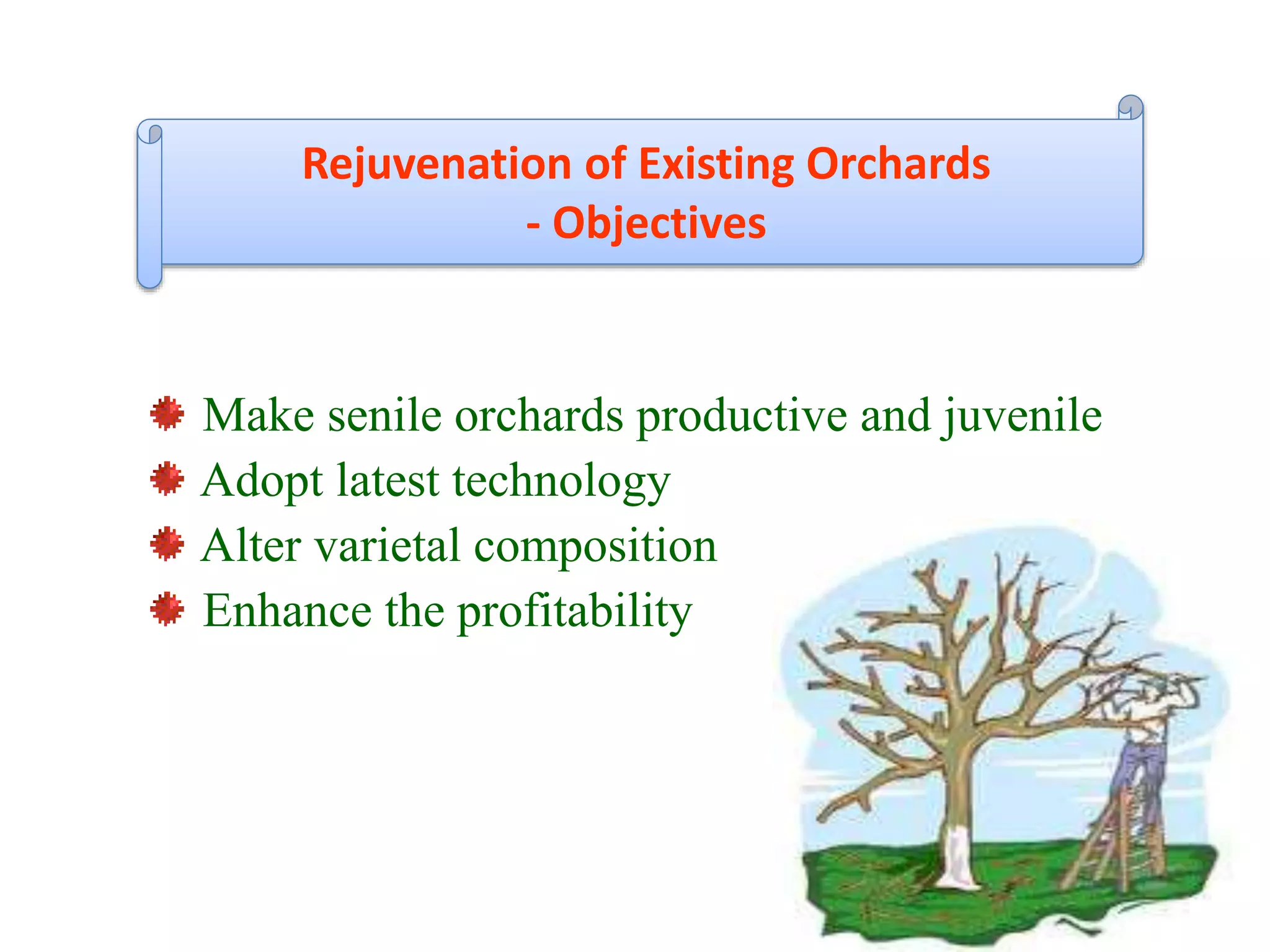
Make senile orchards productive and juvenile
Adopt latest technology
Alter varietal composition
Enhance the profitability
Rejuvenation of Existing Orchards
- Objectives
Reduction in the photosynthetic surface area.
Non availability of productive shoots.
Increased incidence of insect pest and diseases.
Less penetration of sunlight.
20
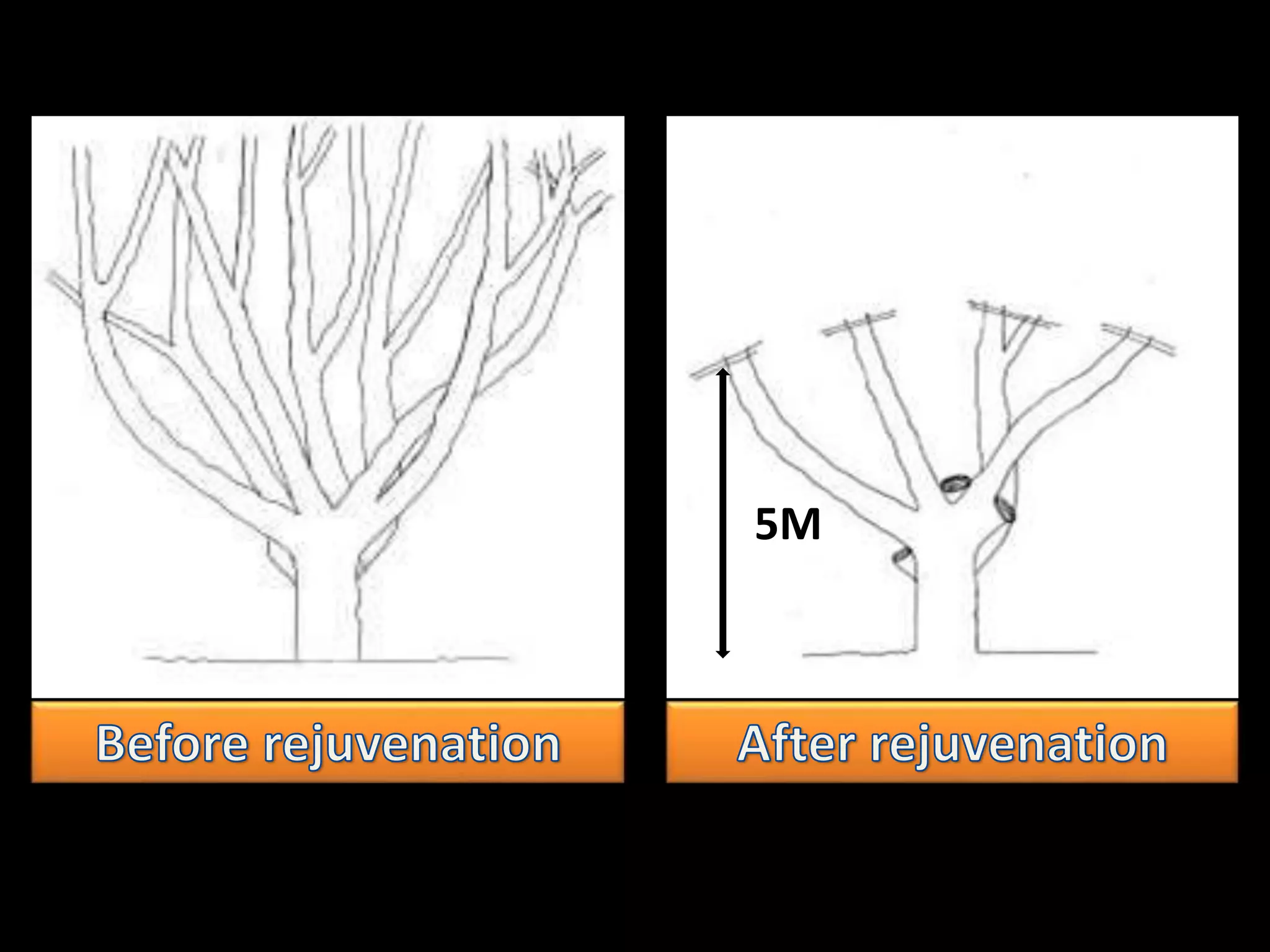
5M
22
Cutting should be done from lower
surface of the branch and later from
upper surface to avoid cracking as
well as bark splitting.
Large upright branches and trunks
should be cut on a slight angle.
Large branches and main trunks
should be cut off in sections.
Pruning tips for Rejuvenation
23

Canopy

  • 2.
    2 Speaker Pawan Kumar Nagar Reg.no : 04-2690-2015 III sem. M.Sc. (Fruit scince) Submitted to Dr. A. V. Kotecha Assistant Professor Department of Horticulture
  • 3.
    It is oneof the popular fruit of India, according to burton, in the early years of seventeenth century it was found growing in India. It is richest and cheapest source of vitamin – C (299 mg/100 g) The ideal canopy shape should be such that it may meet out as many as possible principles. The perfect ideotype of guava is the canopy should be dwarf, spreading, larger trunk, and open. 3
  • 4.
    4  Canopy managementis one of the most important fruit plant management practice.  This forms the basis of precociousness and longevity of the fruit trees in an orchard.  The strong scaffold system help the trees to produce heavy crop loads of quality fruits without any major limb breakage.  Regular annual priming is essential for the induction of good amount of new growth.  which will provide the tree maximum fruit bearing area uniformly over the whole tree.  Unpruned trees grow beyond limits provided for each tree in an orchard.
  • 5.
    5 The tree sizecan be controlled by use of dwarfing rootstock like Psidium friedrichsthalianum and aneuploid – 82. While as triploid guava was found to increase the vigour of Allahabad Safeda cultivar. High density planting in guava has attracting attention of many workers by using growth controlling root stock and other canopy management practices like training and pruning.
  • 6.
    Accommodation of themaximum possible number of the plants per unit area to get the maximum possible profit per unit of the tree volume without impairing the soil fertility status is called high density planting.
  • 7.
     The MeadowOrchard is a modern method of fruit cultivation.  There is a shift in farmers' perception from production to productivity and profitability.  Achieved through high density planting.  Recently, there is a trend to plant fruit trees at closer spacing leading to high density or meadow orchard.
  • 8.
     Higher andquality production is achieved from densely planted orchards through judicious canopy management and adoption of suitable tree training systems.  The Meadow Orchard is a modern method of fruit cultivation using small or dwarf tree with modified canopy.  A comparison between meadow orchard system and the traditional system of fruit growing is necessary to evaluate the potentiality of this technique.
  • 9.
    Low density plantingMedium density planting High density planting Meadow orchard
  • 10.
    Attributes Traditional systemMeadow system Bearing fruits After two years From first year Production Average yield is 12-20 t ha-1 Average yield is 40-60 t ha-1 Management Difficult to manage due to large tree size Easy to manage due to small tree size Labour requirement Requires more labour Requires less labour Production cost Higher cost of production Lower cost of production Quality Large canopy, poor sunlight penetration and poor quality fruits Small canopy better air and sunlight penetration ,minimum disease incidence and high quality fruit with good colour development. Comparison between traditional system and meadow orchard system of guava
  • 11.
    Planting system Spacing(m) Density of plant /ha Low density 8 × 8 156 Medium density 6 × 6 277 High density 3 × 3 1111 Ultra-High density 3 × 1.5 2222 Meadow Orcharding 2 × 1 5000 Different spacing and density of plants/ha of guava
  • 12.
    Training:- It refersto the practice of giving shape to the tree in the initial year of planting to bear the load of crop in subsequent years. Pruning:- “Pruning is the art of removal of parts of a tree, especially shoots, roots, limbs, buds or nipping away of the terminal parts.”
  • 13.
    1. To admitlight upto Centre of the tree and provide sufficient movement of air across the plant. 2. To increase photosynthetic activity by exposing leaves to the sun. 3. To provide strong scaffold system this could bear the heavy load of fruits, without limb breakage. 4. To make hoeing, spraying, irrigation and other cultural practices at a nominal cost. 5. To get balanced distribution of fruit over the tree.
  • 14.
    14 Thinning out: Whena shoot is removed entirely from the inception so that, no new shoot arises from that place, it is referred as thinning out. Heading back: When a branch is cut almost to the base, leaving a few inches of stump, carrying few buds, it is referred as heading back.
  • 15.
    Restrains the vigorousvegetative growth of guava to manageable sizes and forms thereby to achieve optimum production. Increase productivity of orchards. Stimulate precocious flowering of new plantings. Extend the productive life of the orchard. Increase air circulation in the orchard, which lowers losses associated with diseases.
  • 16.
    16 Maintain or reduceplant size. Remove undesirable growth. Remove dead, diseased, or broken branches. Stimulate flowering and fruiting. Rejuvenate and restore old plants to vigorous growth. Prevent damage to life and property. Shape plants in an artificial form. Reasons to Prune
  • 17.
    Pruning saw Petrol operated saw SecateursBow saw Pole hand pruner Petrol operated pole pruner
  • 18.
    Pruned tree Un- pruned tree 1. Fruit size is large. 2. High productivity after 3-5 year. 3. Every year fruiting takes place. 4. As the size of tree is less, cost of labour, insecticide and pesticide decreases. 5. If any natural calamity occurs, the fruits are less damaged because of their less height. 6. Due to the less height every tree gets proper sunlight, spraying of insecticide and pesticide can be done properly. 7. As the fruits are ready to harvest 10 – 15 days before, we can fetch higher priced market. 1. Fruit size is small. 2. Low productivity. 3. Alternate bearing. 4. Cost of labour, insecticide and pesticide increase because of huge size of tree. 5. If any natural calamity occurs, trees and fruits are damaged because of their large size. 6. Because of their huge size, they don’t get proper sunlight while spraying of insecticide and pesticide can’t be done properly. 7. As the fruits are ready to harvest at the same time with other orchards, fetch lower priced market.
  • 19.
    Make senile orchardsproductive and juvenile Adopt latest technology Alter varietal composition Enhance the profitability Rejuvenation of Existing Orchards - Objectives
  • 20.
    Reduction in thephotosynthetic surface area. Non availability of productive shoots. Increased incidence of insect pest and diseases. Less penetration of sunlight. 20
  • 21.
  • 22.
    22 Cutting should bedone from lower surface of the branch and later from upper surface to avoid cracking as well as bark splitting. Large upright branches and trunks should be cut on a slight angle. Large branches and main trunks should be cut off in sections. Pruning tips for Rejuvenation
  • 23.

Editor's Notes