PRESENTED
BY
GANESH H S
PG17AGR9116
DEPARTMENT OF PLANT PATHOLOGY
PRESENTATION
ON
“MARKER ASSISTED SELECTION”
(M.A.S)
AREAS OF PRESENTATION
•INTRODUCTION
•MARKER ASSISTED SELECTION
•TYPES OF MARKERS
•FEATURES OF M.A.S.
•STEPS IN M.A.S.
•MERITS AND DEMERITS
•CASE STUDY
INTRODUCTION
•Any property of an individual showing heritable
variation is referred to as CHARACTER
•QUALITATIVE and QUANTITATIVE
•MARKER CHARACTERS
WHAT IS M.A.S.?
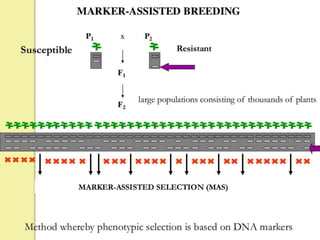
“Marker assisted selection or Marker aided
selection (MAS) is an indirect selection process where
a trait of interest is selected based on a marker
(morphological, biochemical or DNA/RNA variation)
linked to a trait of interest (e.g. productivity, disease
resistance, abiotic stress tolerance, and quality),
rather than on the trait itself.”
TYPES OF
MARKERS
MORPHOLOGICAL
CYTOLOGICAL
BIOCHEMICAL
DNA MARKER
TYPES OF MARKERS
•Morphological Markers:- these are releated to size, shape,
colour and surface of various plant parts
•Cytological Markers:- such markers are releated to variations
in chromosomes morphology
•Biochemical Markers:- such markers are releated to
variations in protein and amino acid banding patterns.
•DNA markers:- they are related to variation in DNA
fragments genrated by restriction end nuclease enzyme
DNA MARKERS
•RFLP - Restriction fragment length polymorphism
•SSLP - Simple sequence length polymorphism
•AFLP - Amplified fragment length polymorphism
•RAPD- Random amplification of polymorphic DNA
•VNTR -Variable number tandem repeat
•SNP - Single nucleotide polymorphism
•STR - Short tandem repeat
•SFP -Single feature polymorphism
DNA MARKERS IN CROP IMPROMENT
•Germplasm characterization
•Varietal identification
•Tracing genetic origin of crop plants
•Gene tagging
•Genome mapping
•MAS
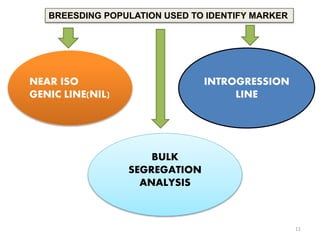
BREESDING POPULATION USED TO IDENTIFY MARKER
NEAR ISO
GENIC LINE(NIL)
INTROGRESSION
LINE
BULK
SEGREGATION
ANALYSIS
11
PROPERTIES OF IDEAL MARKERS
•Easy recognition of all possible phenotypes from all
different alleles
•Abundant in number
•Low or null interaction among the markers allowing
the use of many at the same time in a segregating
population
•Testing for the marker does not have variable success
depending on the allele at the marker locus or the
allele at the target locus
•Polymorphic
FEATURES OF M.A.S.
APPLICATION
HIGH ACCURACY
RAPID METHOD
ENVIRONMENTAL EFFECT
PERMITS QTL TAGGING
LABORATORY
PROCEDURE FOR MAS
SELECTION OF
PARENTS
DEVELOPMENT
OF BREEDING
POPULATION
ISOLATION OF
DNA FROM
EACH PLANT
Scoring RFLPs
COORELATION WITH
MORPHOLOGICAL TRAITS
SELECTION OF PARENTS
•Contrasting characters OR Divergent origin
•HOMOZYGOUS
•Self pollinated (homozygous)
•Cross pollinated (inbreed lines)
DEVELOPMENT OF BREEDING POPULATION
•The selected parents are
crossed to obtain F1
•50-100 F2 Plants are
sufficient for the study of
segregation of RFLP
markers.
ISOLATION OF DNA
GEL
ELECTROPHOROSIS
METHOD
Scoring RFLPs
EXAMPLES OF M.A.S.
CROP CHARACTER Gene/QTL MAS
Barley BYDV resistance
Leaf rust resistance
Yd2
Rphq6
STS
AFLP
Maize Corn borer resistance QTLs on 2HL RFLPs
Rice BLB resistance
BLAST resistance
Xa21, xa5
Pi1
STS, SSR
SSR
Wheat Powdry mildew resistance 22 Pm genes AFLP
DEMERITS
•LABORATORY
•EXPENSIVE
•TECHNICAL WORK
•COMBURSOME JOB
•HEALTH HAZARDS
CASE STUDY
• Ribaut, J.-M. et al., Genetic basis of physiological
traits. In Application of Physiology in Wheat Breeding,
CIMMYT, Mexico, 2001.
• Ribaut, J.-M. and Hoisington, D. A., Marker assisted
selection: new tools and strategies. Trends Plant Sci.,
1998, 3, 236–239.
•Rosyara, U.R. 2006. REQUIREMENT OF ROBUST
MOLECULAR MARKER TECHNOLOGY FOR PLANT
BREEDING APPLICATIONS.Journal of Plant Breed. Gr.
1: 67 – 72.
THANK YOU

MARKER ASSISTED SELECTION

  • 2.
  • 3.
  • 4.
    AREAS OF PRESENTATION •INTRODUCTION •MARKERASSISTED SELECTION •TYPES OF MARKERS •FEATURES OF M.A.S. •STEPS IN M.A.S. •MERITS AND DEMERITS •CASE STUDY
  • 5.
    INTRODUCTION •Any property ofan individual showing heritable variation is referred to as CHARACTER •QUALITATIVE and QUANTITATIVE •MARKER CHARACTERS
  • 6.
    WHAT IS M.A.S.? “Markerassisted selection or Marker aided selection (MAS) is an indirect selection process where a trait of interest is selected based on a marker (morphological, biochemical or DNA/RNA variation) linked to a trait of interest (e.g. productivity, disease resistance, abiotic stress tolerance, and quality), rather than on the trait itself.”
  • 7.
  • 8.
    TYPES OF MARKERS •MorphologicalMarkers:- these are releated to size, shape, colour and surface of various plant parts •Cytological Markers:- such markers are releated to variations in chromosomes morphology •Biochemical Markers:- such markers are releated to variations in protein and amino acid banding patterns. •DNA markers:- they are related to variation in DNA fragments genrated by restriction end nuclease enzyme
  • 9.
    DNA MARKERS •RFLP -Restriction fragment length polymorphism •SSLP - Simple sequence length polymorphism •AFLP - Amplified fragment length polymorphism •RAPD- Random amplification of polymorphic DNA •VNTR -Variable number tandem repeat •SNP - Single nucleotide polymorphism •STR - Short tandem repeat •SFP -Single feature polymorphism
  • 10.
    DNA MARKERS INCROP IMPROMENT •Germplasm characterization •Varietal identification •Tracing genetic origin of crop plants •Gene tagging •Genome mapping •MAS
  • 11.
    BREESDING POPULATION USEDTO IDENTIFY MARKER NEAR ISO GENIC LINE(NIL) INTROGRESSION LINE BULK SEGREGATION ANALYSIS 11
  • 13.
    PROPERTIES OF IDEALMARKERS •Easy recognition of all possible phenotypes from all different alleles •Abundant in number •Low or null interaction among the markers allowing the use of many at the same time in a segregating population •Testing for the marker does not have variable success depending on the allele at the marker locus or the allele at the target locus •Polymorphic
  • 15.
    FEATURES OF M.A.S. APPLICATION HIGHACCURACY RAPID METHOD ENVIRONMENTAL EFFECT PERMITS QTL TAGGING LABORATORY
  • 19.
    PROCEDURE FOR MAS SELECTIONOF PARENTS DEVELOPMENT OF BREEDING POPULATION ISOLATION OF DNA FROM EACH PLANT Scoring RFLPs COORELATION WITH MORPHOLOGICAL TRAITS
  • 20.
    SELECTION OF PARENTS •Contrastingcharacters OR Divergent origin •HOMOZYGOUS •Self pollinated (homozygous) •Cross pollinated (inbreed lines)
  • 21.
    DEVELOPMENT OF BREEDINGPOPULATION •The selected parents are crossed to obtain F1 •50-100 F2 Plants are sufficient for the study of segregation of RFLP markers.
  • 22.
  • 23.
  • 24.
  • 26.
    EXAMPLES OF M.A.S. CROPCHARACTER Gene/QTL MAS Barley BYDV resistance Leaf rust resistance Yd2 Rphq6 STS AFLP Maize Corn borer resistance QTLs on 2HL RFLPs Rice BLB resistance BLAST resistance Xa21, xa5 Pi1 STS, SSR SSR Wheat Powdry mildew resistance 22 Pm genes AFLP
  • 28.
  • 29.
  • 33.
    • Ribaut, J.-M.et al., Genetic basis of physiological traits. In Application of Physiology in Wheat Breeding, CIMMYT, Mexico, 2001. • Ribaut, J.-M. and Hoisington, D. A., Marker assisted selection: new tools and strategies. Trends Plant Sci., 1998, 3, 236–239. •Rosyara, U.R. 2006. REQUIREMENT OF ROBUST MOLECULAR MARKER TECHNOLOGY FOR PLANT BREEDING APPLICATIONS.Journal of Plant Breed. Gr. 1: 67 – 72.
  • 35.