GPB 621 Principles of Quantitative Genetics (2+1)
MARKER ASSISTED SELECTION
Introduction
 Easily detectable traits are referred to as markers or marker traits.
 The markers are of three types
I. Morphological markers (shape, size, colour)
II. Bio chemical Markers (variation in protein structure)
III. Molecular Markers or DNA Markers (variation in DNA fragments)
DNA markers: A molecular markers or DNA markers refers to as unique
sequence of nucleotides found on a strand of DNA. The DNA
markers are also known as genetic markers.
MARKER ASSISTED SELECTION
 Marker assisted selection (MAS) refers to indirect selection for a desired
plant phenotype based on the banding pattern of linked molecular DNA
markers. MAS is based on the concept that it is possible to infer the
presence of a gene from the presence of a marker which is tightly linked to
the gene of interest. The main features of MAS are briefly presented below.
 Other Terms used.
MAS is also termed as marker aided selection and marker assisted
breeding (MAB). It differs from gene assisted selection (GAS) which
refers to selection which is based on QTLs (Quantitative trait locus or
loci).
 Pre-requisites
There are two pre-requisites for marker assisted selection. These are: 1. a
tight linkage between molecular marker and gene of interest, and 2 high
heritability of the gene of interest.
 Application
MAS is applicable for genetic improvement of crop plants. It is equally
applicable for both self and cross pollinated species.
 Markers Used
The most commonly used molecular markers include Amplified fragment
length polymorphisms (AFLP), Restriction fragment length polymorphisms
(RFLP), Random amplified polymorphic DNA (RAPD), Simple sequence
repeats (SSR), Simple nucleotide polymorphism (SNP), etc.
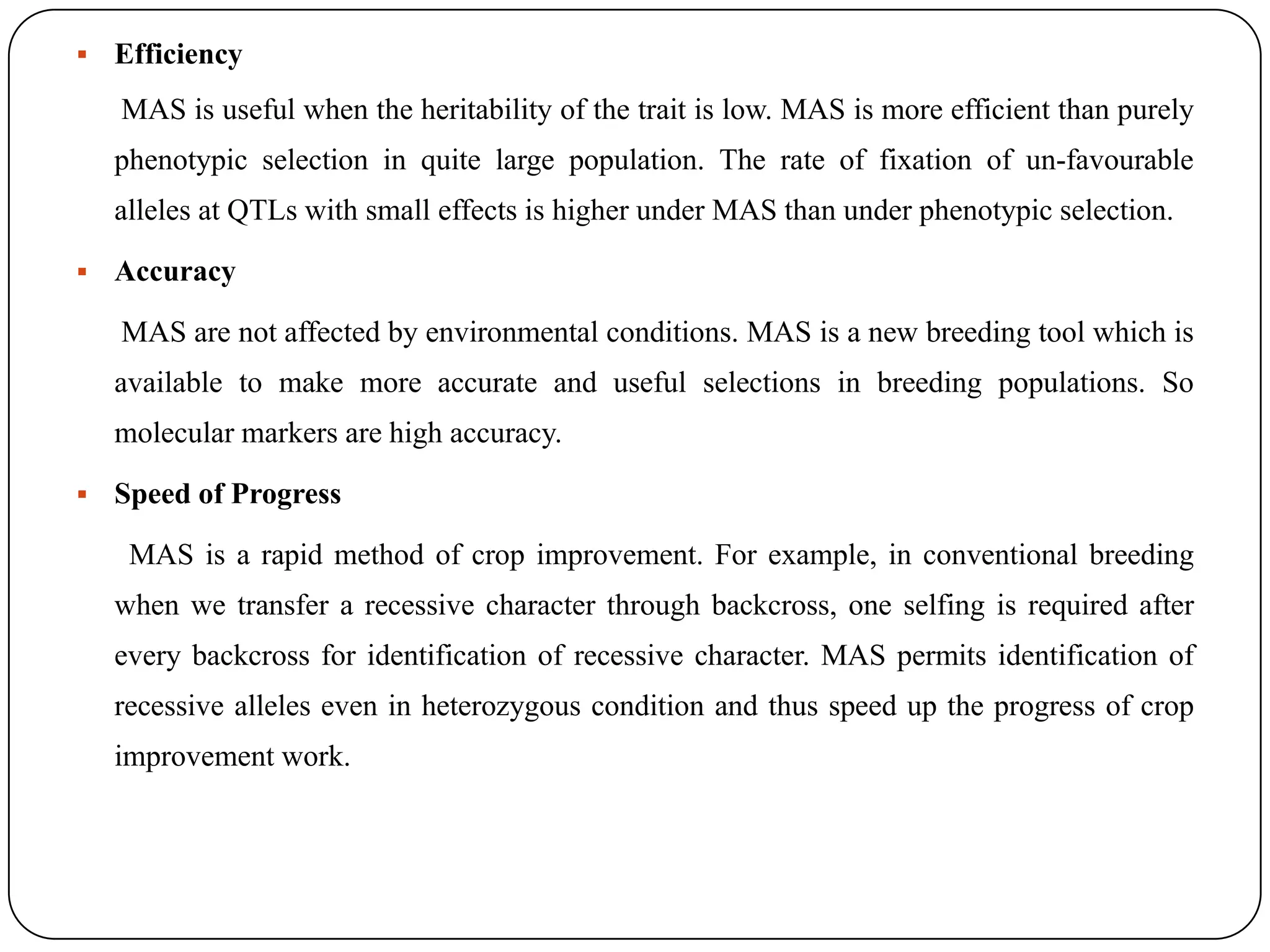
 Efficiency
MAS is useful when the heritability of the trait is low. MAS is more efficient than purely
phenotypic selection in quite large population. The rate of fixation of un-favourable
alleles at QTLs with small effects is higher under MAS than under phenotypic selection.
 Accuracy
MAS are not affected by environmental conditions. MAS is a new breeding tool which is
available to make more accurate and useful selections in breeding populations. So
molecular markers are high accuracy.
 Speed of Progress
MAS is a rapid method of crop improvement. For example, in conventional breeding
when we transfer a recessive character through backcross, one selfing is required after
every backcross for identification of recessive character. MAS permits identification of
recessive alleles even in heterozygous condition and thus speed up the progress of crop
improvement work.
 Traits Improved.
MAS can be used for improvement of both oligogenic and polygenic traits.
 Materials Developed
MAS leads to development of non-transgenic genotypes or cultivars. In other
words, MAS is used for development non-transgenic cultivars. Cultivars
developed by MAS are acceptable by consumers.
 Cost
MAS is very costly as compared to phenotypic selection. In MAS, the costly
item include equipment, consumables, labour, and DNA extraction process.
MAS requires sophisticated and well equipped Lab.
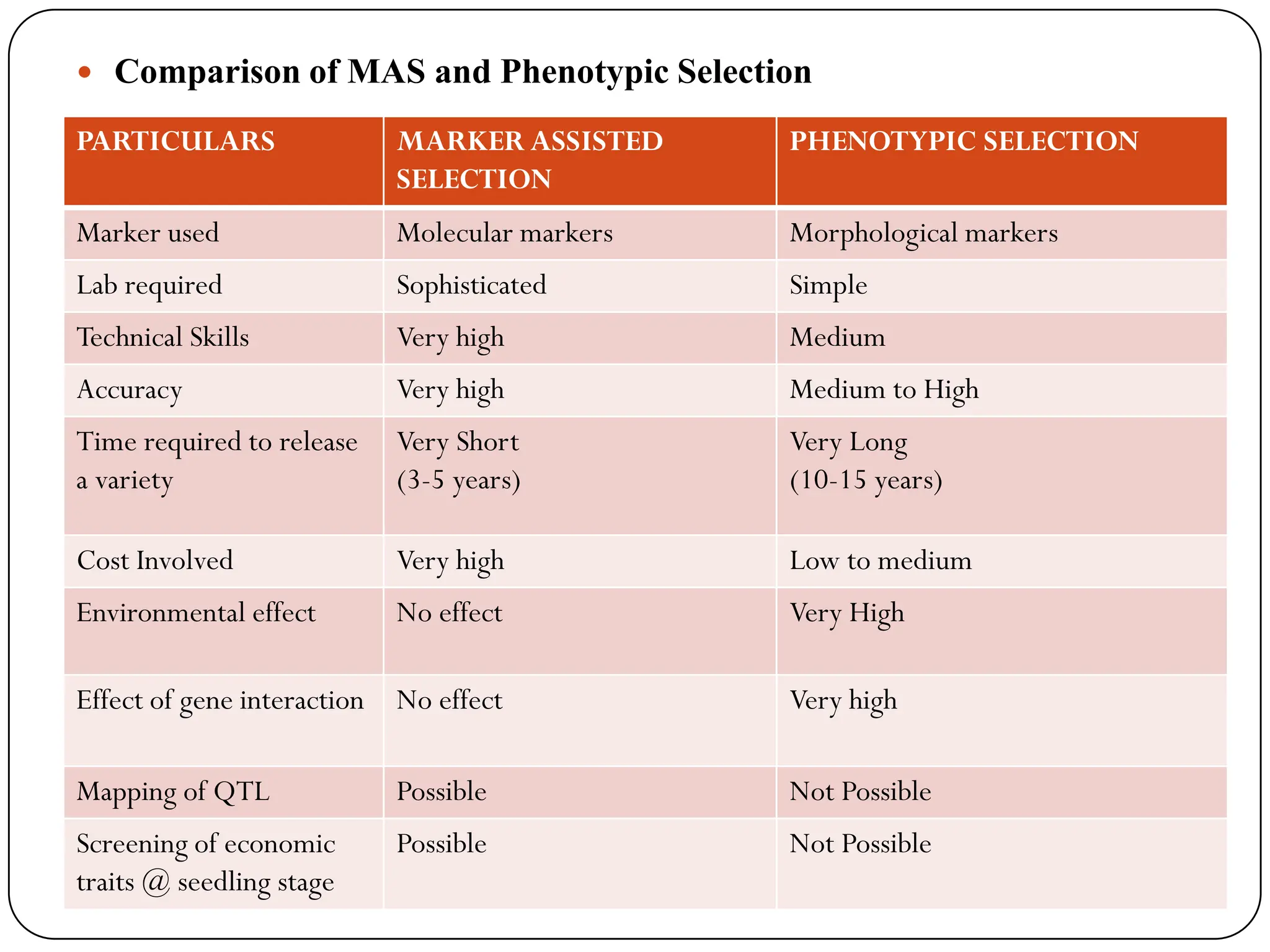
 Comparison of MAS and Phenotypic Selection
PARTICULARS MARKER ASSISTED
SELECTION
PHENOTYPIC SELECTION
Marker used Molecular markers Morphological markers
Lab required Sophisticated Simple
Technical Skills Very high Medium
Accuracy Very high Medium to High
Time required to release
a variety
Very Short
(3-5 years)
Very Long
(10-15 years)
Cost Involved Very high Low to medium
Environmental effect No effect Very High
Effect of gene interaction No effect Very high
Mapping of QTL Possible Not Possible
Screening of economic
traits @ seedling stage
Possible Not Possible
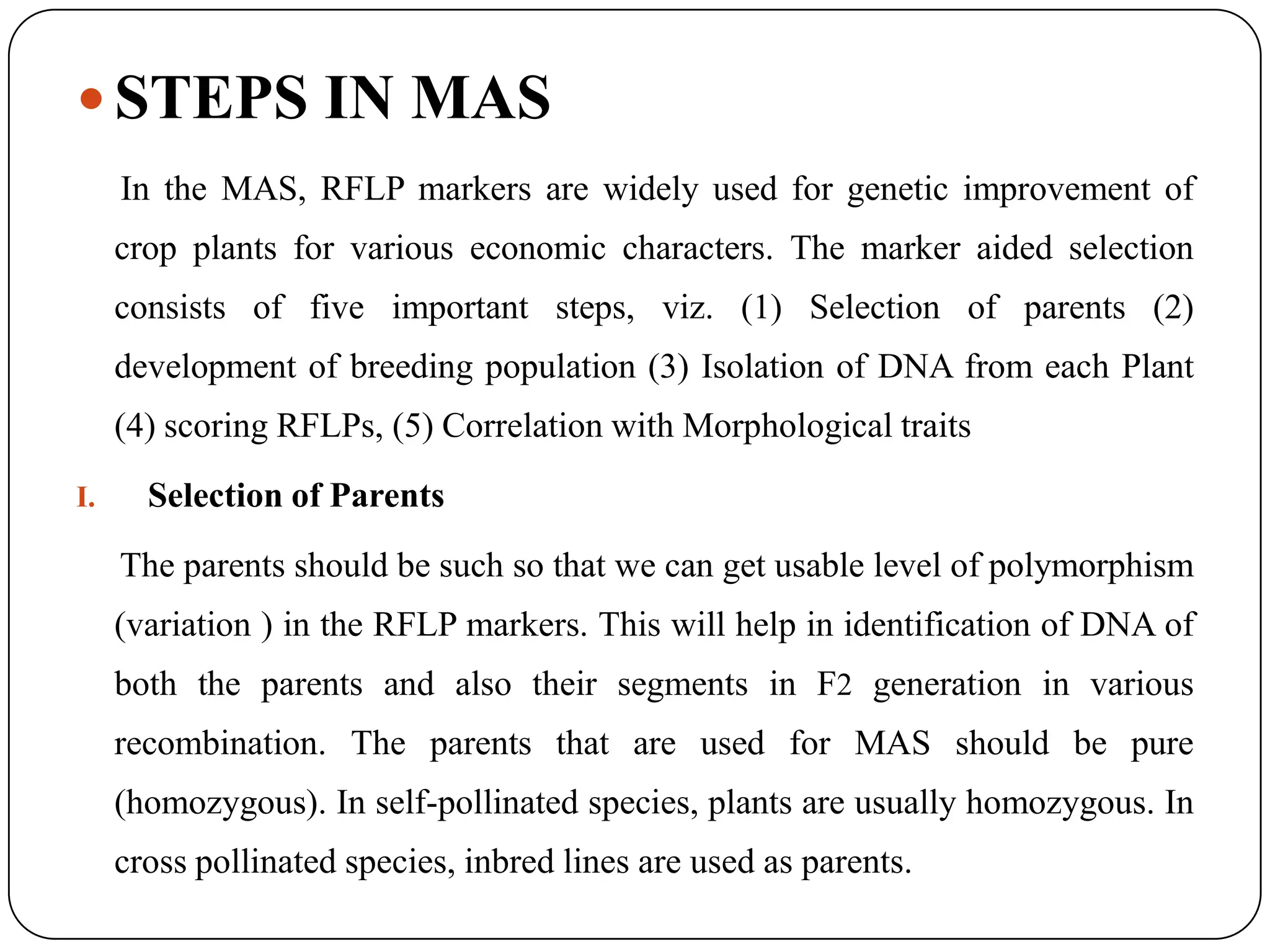
 STEPS IN MAS
In the MAS, RFLP markers are widely used for genetic improvement of
crop plants for various economic characters. The marker aided selection
consists of five important steps, viz. (1) Selection of parents (2)
development of breeding population (3) Isolation of DNA from each Plant
(4) scoring RFLPs, (5) Correlation with Morphological traits
I. Selection of Parents
The parents should be such so that we can get usable level of polymorphism
(variation ) in the RFLP markers. This will help in identification of DNA of
both the parents and also their segments in F2 generation in various
recombination. The parents that are used for MAS should be pure
(homozygous). In self-pollinated species, plants are usually homozygous. In
cross pollinated species, inbred lines are used as parents.
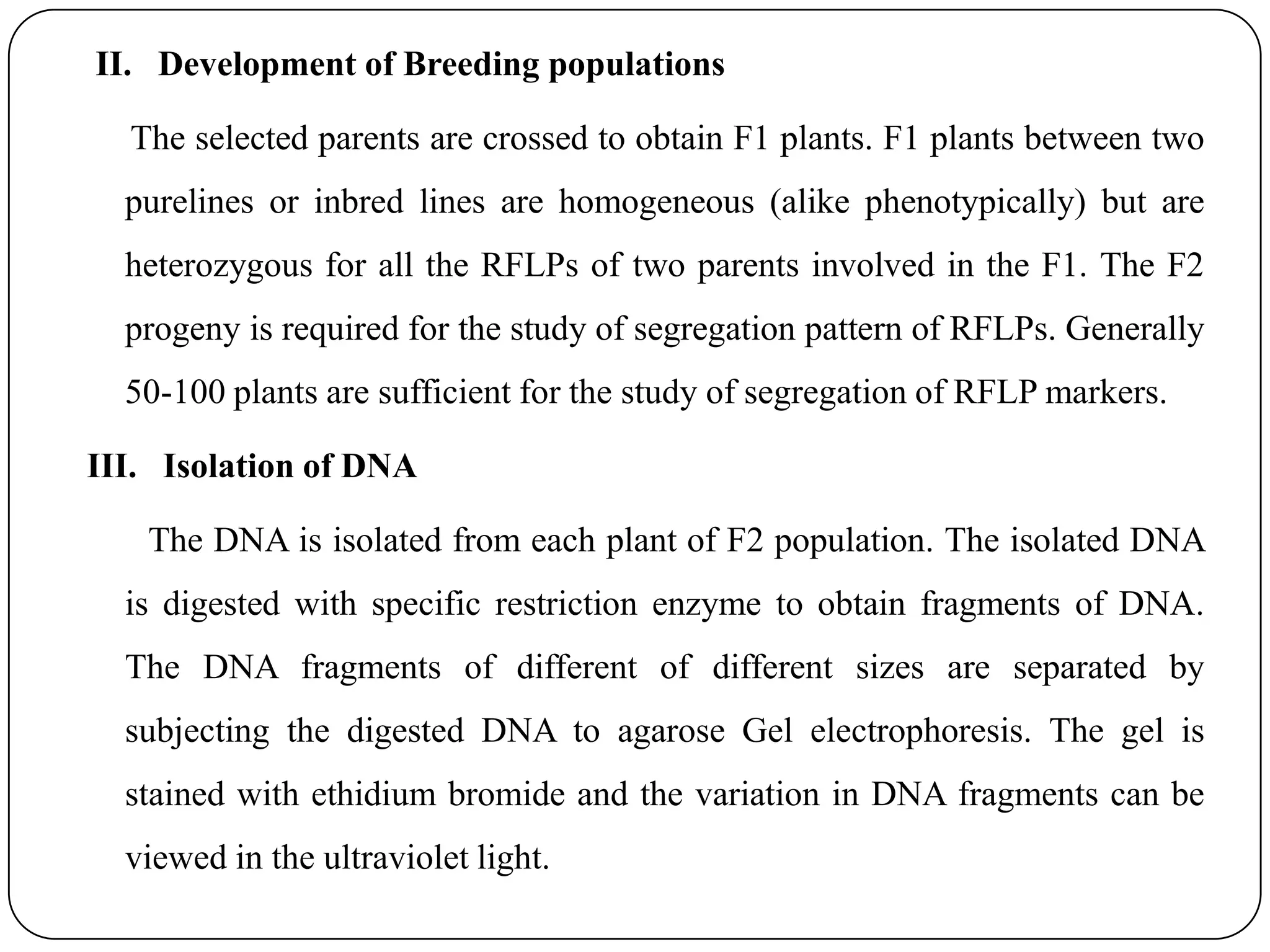
II. Development of Breeding populations
The selected parents are crossed to obtain F1 plants. F1 plants between two
purelines or inbred lines are homogeneous (alike phenotypically) but are
heterozygous for all the RFLPs of two parents involved in the F1. The F2
progeny is required for the study of segregation pattern of RFLPs. Generally
50-100 plants are sufficient for the study of segregation of RFLP markers.
III. Isolation of DNA
The DNA is isolated from each plant of F2 population. The isolated DNA
is digested with specific restriction enzyme to obtain fragments of DNA.
The DNA fragments of different of different sizes are separated by
subjecting the digested DNA to agarose Gel electrophoresis. The gel is
stained with ethidium bromide and the variation in DNA fragments can be
viewed in the ultraviolet light.
IV. Scoring of RFLPs
The polymorphism in RFLPs between the parents and their involvement in
the recombinants in F2 population is determined using DNA Probes. The
labelled probes are used to find out the fragments having similarity. The
probe will hybridize only with those segments which are complementary in
nature. Generally 32P is used for radioactive labelling of DNA probe. Now
non-radioactive probe labelling techniques are also available. In this way
RFLPs are determined.
V. Correlation with Morphological Traits
The DNA markers ( say RFLPs) are correlated with morphological
markers and the indirect selection through molecular markers is
confirmed. Once the correlation of molecular markers is established with
morphological markers, MAS can be effectively used for genetic
improvement of various economic traits.
 Application of MAS
1. MAS is effective, rapid method of transferring resistance to biotic and abiotic
stresses in crop plants.
2. Useful in gene pyramiding for disease insect resistance.
3. Used to transfer Male sterility and photoperiod insensitivity into cultivated
genotypes.
4. Used for improvement of quality characters in different crops such as quality
in maize, fatty acid content in soybean and storage quality in vegetables and
fruits.
5. Effective in introgression of desirable genes from wild into cultivated species.
6. Has wide application for genetic improvement of oligogenic traits as
compared to polygenic traits.
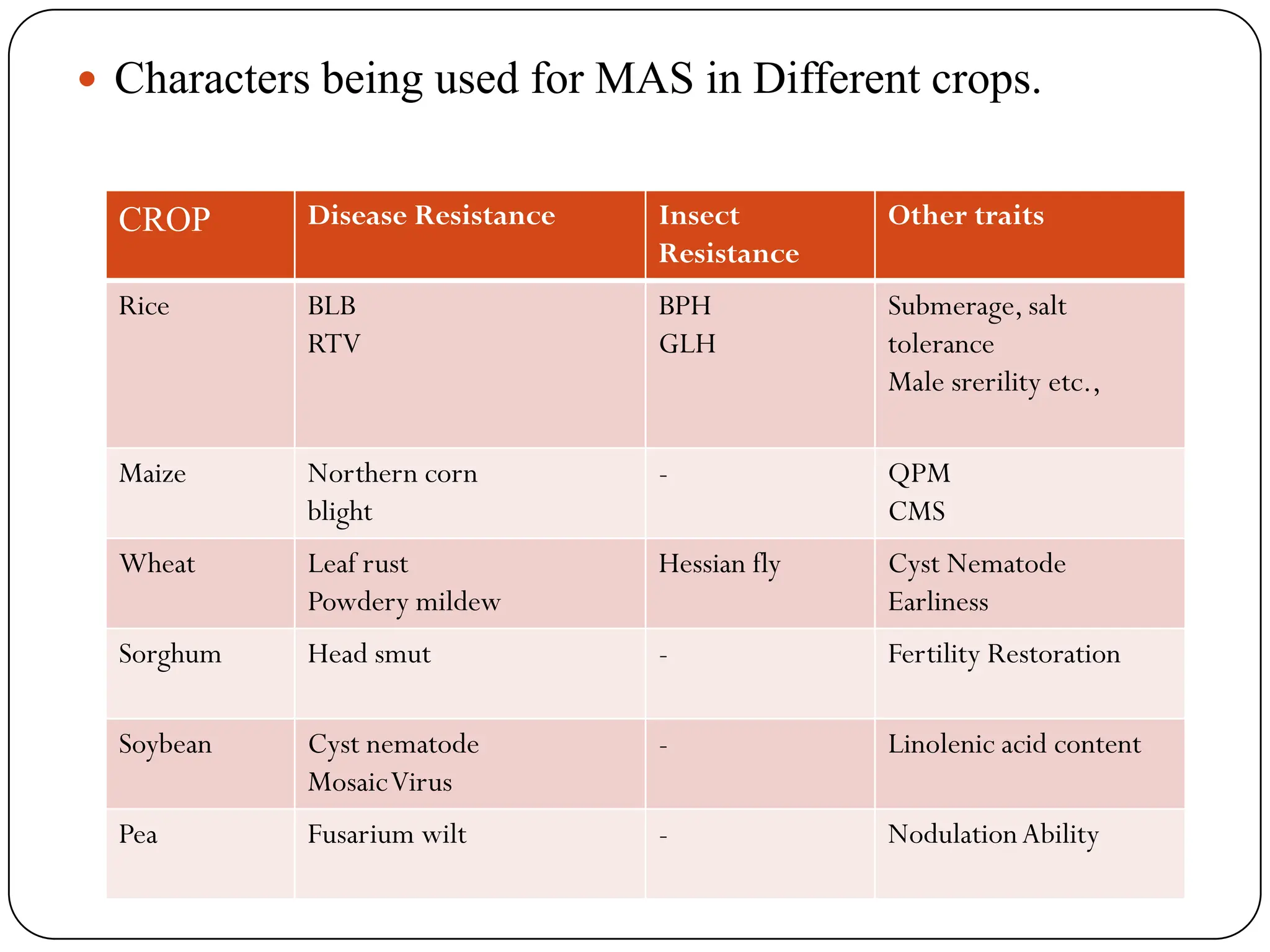
 Characters being used for MAS in Different crops.
CROP Disease Resistance Insect
Resistance
Other traits
Rice BLB
RTV
BPH
GLH
Submerage, salt
tolerance
Male srerility etc.,
Maize Northern corn
blight
- QPM
CMS
Wheat Leaf rust
Powdery mildew
Hessian fly Cyst Nematode
Earliness
Sorghum Head smut - Fertility Restoration
Soybean Cyst nematode
MosaicVirus
- Linolenic acid content
Pea Fusarium wilt - NodulationAbility
Advantages of MAS
 Accuracy
 Rapid method
 Non-transgenic Product
 Identification of recessive Alleles
 Early Detection of Traits
 Screening of Difficult Traits
 Gene Pyramiding
 Small sample for testing
 Permits QTL mapping
 Highly Reproducible
Limitation of MAS
 Costly method
 Requires well trained man power
 Detection of various linked markers is difficult
 MAS some times involves radioactive isotopes in labelling of DNA, which
may lead to serious health hazards.
 It has been reported that MAS become less efficient than phenotypic
selection in the long term
 The use of MAS is more difficult for QTL because they have minor
cumulative effects and are greatly influenced by environmental conditions
and genetic background.
References:
 Introduction to Biotechnology by Dr. Phundan Singh
Submitted by:
J.R.JERISH
Reg NO: 197040008
I M.Sc. (Agri) Genetics and Plant Breeding
Department of Genetics and Plant Breeding
Faculty of Agriculture
Annamalai University

MARKER ASSISTED SELECTION IN CROP IMPROVEMENT

  • 1.
    GPB 621 Principlesof Quantitative Genetics (2+1) MARKER ASSISTED SELECTION
  • 2.
    Introduction  Easily detectabletraits are referred to as markers or marker traits.  The markers are of three types I. Morphological markers (shape, size, colour) II. Bio chemical Markers (variation in protein structure) III. Molecular Markers or DNA Markers (variation in DNA fragments) DNA markers: A molecular markers or DNA markers refers to as unique sequence of nucleotides found on a strand of DNA. The DNA markers are also known as genetic markers.
  • 3.
    MARKER ASSISTED SELECTION Marker assisted selection (MAS) refers to indirect selection for a desired plant phenotype based on the banding pattern of linked molecular DNA markers. MAS is based on the concept that it is possible to infer the presence of a gene from the presence of a marker which is tightly linked to the gene of interest. The main features of MAS are briefly presented below.  Other Terms used. MAS is also termed as marker aided selection and marker assisted breeding (MAB). It differs from gene assisted selection (GAS) which refers to selection which is based on QTLs (Quantitative trait locus or loci).
  • 4.
     Pre-requisites There aretwo pre-requisites for marker assisted selection. These are: 1. a tight linkage between molecular marker and gene of interest, and 2 high heritability of the gene of interest.  Application MAS is applicable for genetic improvement of crop plants. It is equally applicable for both self and cross pollinated species.  Markers Used The most commonly used molecular markers include Amplified fragment length polymorphisms (AFLP), Restriction fragment length polymorphisms (RFLP), Random amplified polymorphic DNA (RAPD), Simple sequence repeats (SSR), Simple nucleotide polymorphism (SNP), etc.
  • 5.
     Efficiency MAS isuseful when the heritability of the trait is low. MAS is more efficient than purely phenotypic selection in quite large population. The rate of fixation of un-favourable alleles at QTLs with small effects is higher under MAS than under phenotypic selection.  Accuracy MAS are not affected by environmental conditions. MAS is a new breeding tool which is available to make more accurate and useful selections in breeding populations. So molecular markers are high accuracy.  Speed of Progress MAS is a rapid method of crop improvement. For example, in conventional breeding when we transfer a recessive character through backcross, one selfing is required after every backcross for identification of recessive character. MAS permits identification of recessive alleles even in heterozygous condition and thus speed up the progress of crop improvement work.
  • 6.
     Traits Improved. MAScan be used for improvement of both oligogenic and polygenic traits.  Materials Developed MAS leads to development of non-transgenic genotypes or cultivars. In other words, MAS is used for development non-transgenic cultivars. Cultivars developed by MAS are acceptable by consumers.  Cost MAS is very costly as compared to phenotypic selection. In MAS, the costly item include equipment, consumables, labour, and DNA extraction process. MAS requires sophisticated and well equipped Lab.
  • 7.
     Comparison ofMAS and Phenotypic Selection PARTICULARS MARKER ASSISTED SELECTION PHENOTYPIC SELECTION Marker used Molecular markers Morphological markers Lab required Sophisticated Simple Technical Skills Very high Medium Accuracy Very high Medium to High Time required to release a variety Very Short (3-5 years) Very Long (10-15 years) Cost Involved Very high Low to medium Environmental effect No effect Very High Effect of gene interaction No effect Very high Mapping of QTL Possible Not Possible Screening of economic traits @ seedling stage Possible Not Possible
  • 8.
     STEPS INMAS In the MAS, RFLP markers are widely used for genetic improvement of crop plants for various economic characters. The marker aided selection consists of five important steps, viz. (1) Selection of parents (2) development of breeding population (3) Isolation of DNA from each Plant (4) scoring RFLPs, (5) Correlation with Morphological traits I. Selection of Parents The parents should be such so that we can get usable level of polymorphism (variation ) in the RFLP markers. This will help in identification of DNA of both the parents and also their segments in F2 generation in various recombination. The parents that are used for MAS should be pure (homozygous). In self-pollinated species, plants are usually homozygous. In cross pollinated species, inbred lines are used as parents.
  • 9.
    II. Development ofBreeding populations The selected parents are crossed to obtain F1 plants. F1 plants between two purelines or inbred lines are homogeneous (alike phenotypically) but are heterozygous for all the RFLPs of two parents involved in the F1. The F2 progeny is required for the study of segregation pattern of RFLPs. Generally 50-100 plants are sufficient for the study of segregation of RFLP markers. III. Isolation of DNA The DNA is isolated from each plant of F2 population. The isolated DNA is digested with specific restriction enzyme to obtain fragments of DNA. The DNA fragments of different of different sizes are separated by subjecting the digested DNA to agarose Gel electrophoresis. The gel is stained with ethidium bromide and the variation in DNA fragments can be viewed in the ultraviolet light.
  • 10.
    IV. Scoring ofRFLPs The polymorphism in RFLPs between the parents and their involvement in the recombinants in F2 population is determined using DNA Probes. The labelled probes are used to find out the fragments having similarity. The probe will hybridize only with those segments which are complementary in nature. Generally 32P is used for radioactive labelling of DNA probe. Now non-radioactive probe labelling techniques are also available. In this way RFLPs are determined. V. Correlation with Morphological Traits The DNA markers ( say RFLPs) are correlated with morphological markers and the indirect selection through molecular markers is confirmed. Once the correlation of molecular markers is established with morphological markers, MAS can be effectively used for genetic improvement of various economic traits.
  • 11.
     Application ofMAS 1. MAS is effective, rapid method of transferring resistance to biotic and abiotic stresses in crop plants. 2. Useful in gene pyramiding for disease insect resistance. 3. Used to transfer Male sterility and photoperiod insensitivity into cultivated genotypes. 4. Used for improvement of quality characters in different crops such as quality in maize, fatty acid content in soybean and storage quality in vegetables and fruits. 5. Effective in introgression of desirable genes from wild into cultivated species. 6. Has wide application for genetic improvement of oligogenic traits as compared to polygenic traits.
  • 12.
     Characters beingused for MAS in Different crops. CROP Disease Resistance Insect Resistance Other traits Rice BLB RTV BPH GLH Submerage, salt tolerance Male srerility etc., Maize Northern corn blight - QPM CMS Wheat Leaf rust Powdery mildew Hessian fly Cyst Nematode Earliness Sorghum Head smut - Fertility Restoration Soybean Cyst nematode MosaicVirus - Linolenic acid content Pea Fusarium wilt - NodulationAbility
  • 13.
    Advantages of MAS Accuracy  Rapid method  Non-transgenic Product  Identification of recessive Alleles  Early Detection of Traits  Screening of Difficult Traits  Gene Pyramiding  Small sample for testing  Permits QTL mapping  Highly Reproducible
  • 14.
    Limitation of MAS Costly method  Requires well trained man power  Detection of various linked markers is difficult  MAS some times involves radioactive isotopes in labelling of DNA, which may lead to serious health hazards.  It has been reported that MAS become less efficient than phenotypic selection in the long term  The use of MAS is more difficult for QTL because they have minor cumulative effects and are greatly influenced by environmental conditions and genetic background.
  • 15.
    References:  Introduction toBiotechnology by Dr. Phundan Singh Submitted by: J.R.JERISH Reg NO: 197040008 I M.Sc. (Agri) Genetics and Plant Breeding Department of Genetics and Plant Breeding Faculty of Agriculture Annamalai University