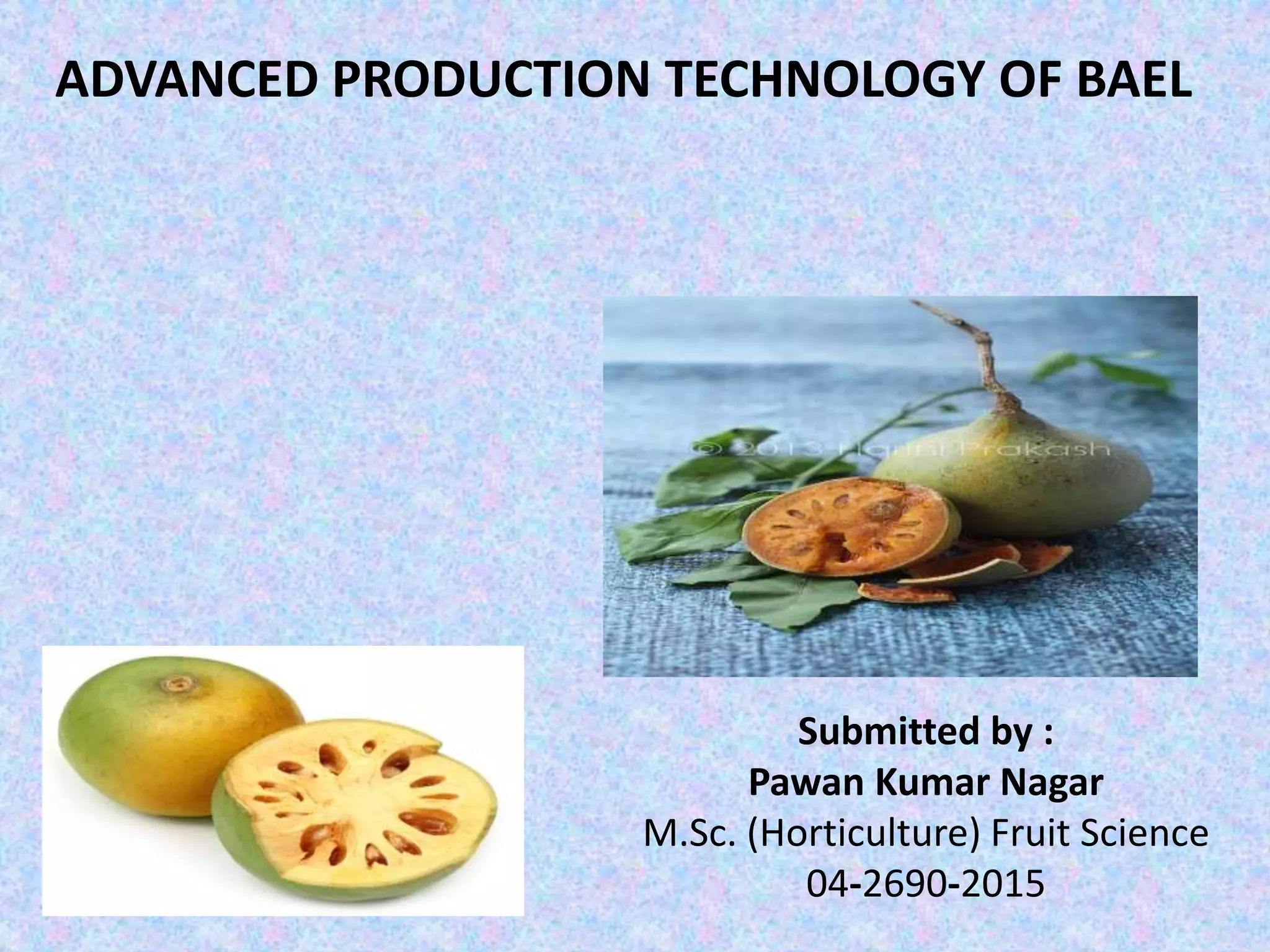
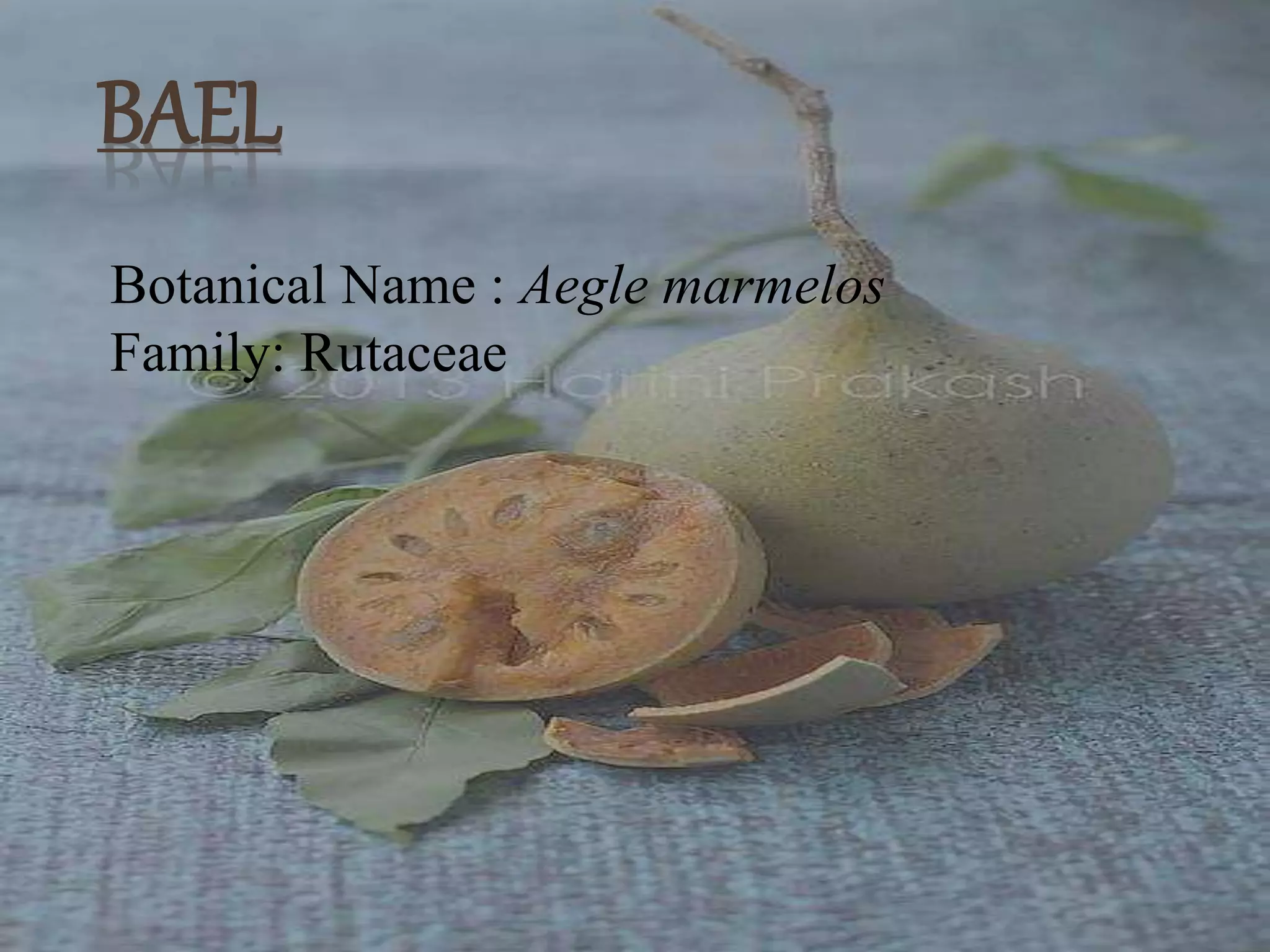
ADVANCED PRODUCTION TECHNOLOGY OF BAEL
Submitted by :
Pawan Kumar Nagar
M.Sc. (Horticulture) Fruit Science
04-2690-2015
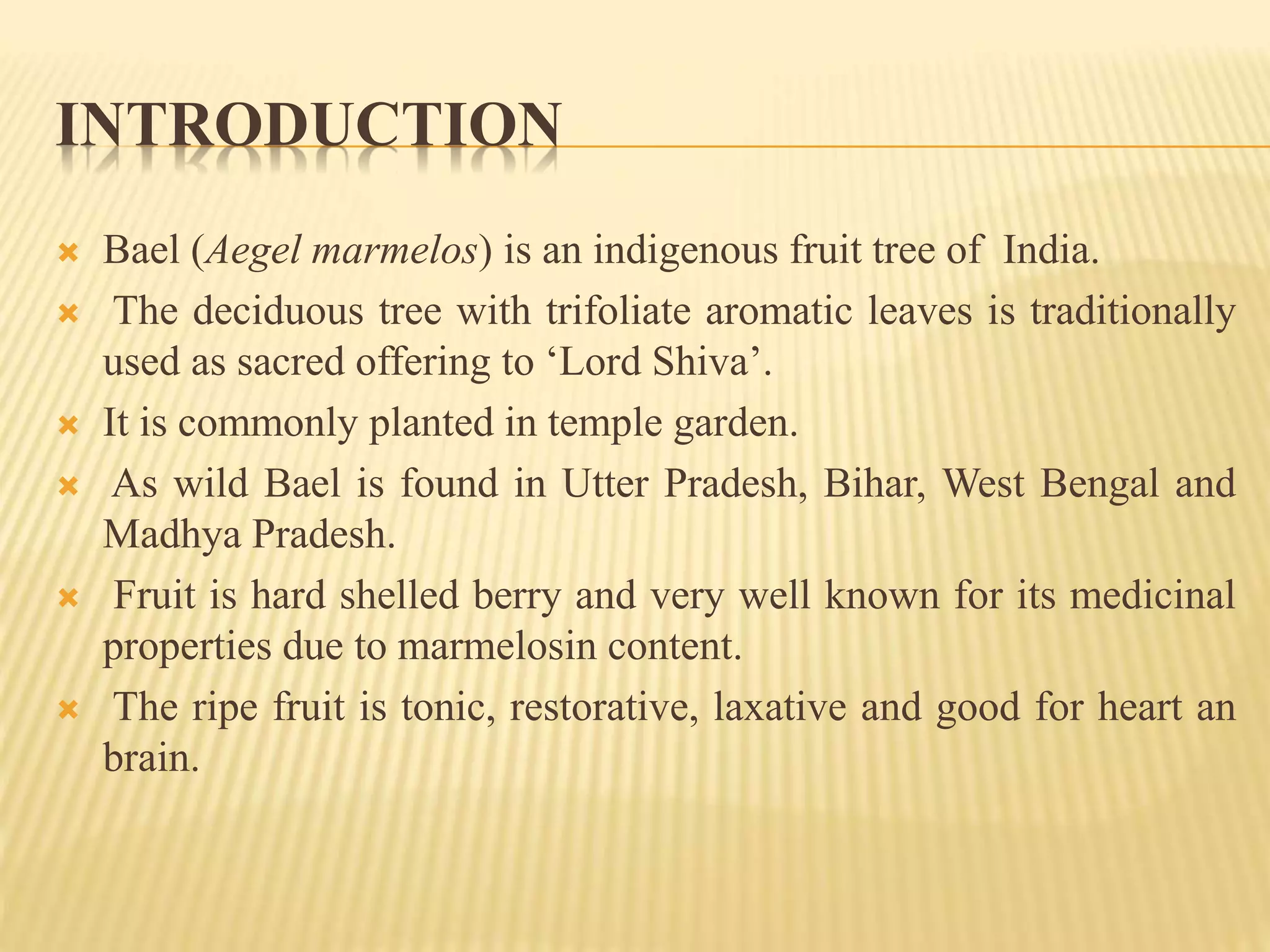
BAEL
Botanical Name : Aegle marmelos
Family: Rutaceae
INTRODUCTION
 Bael (Aegel marmelos) is an indigenous fruit tree of India.
 The deciduous tree with trifoliate aromatic leaves is traditionally
used as sacred offering to ‘Lord Shiva’.
 It is commonly planted in temple garden.
 As wild Bael is found in Utter Pradesh, Bihar, West Bengal and
Madhya Pradesh.
 Fruit is hard shelled berry and very well known for its medicinal
properties due to marmelosin content.
 The ripe fruit is tonic, restorative, laxative and good for heart an
brain.
CLIMATE
 Owing to hardy nature, bael tree has a wide adaptability
to adverse soil and climatic condition.
 It require subtropical climate where summer is hot and
dry, and winter is mild.
 Plants can grow even up to an elevation of 1,200m.
 They are not damaged by temperature as low as -7⁰C.
SOIL
 A well drained, sandy loam soil is ideal.
 It can thrive even on poor and clay soil.
 It can stand sodicity up to 30 ESP and salinity up to
9ds/m EC.
VARIETIES
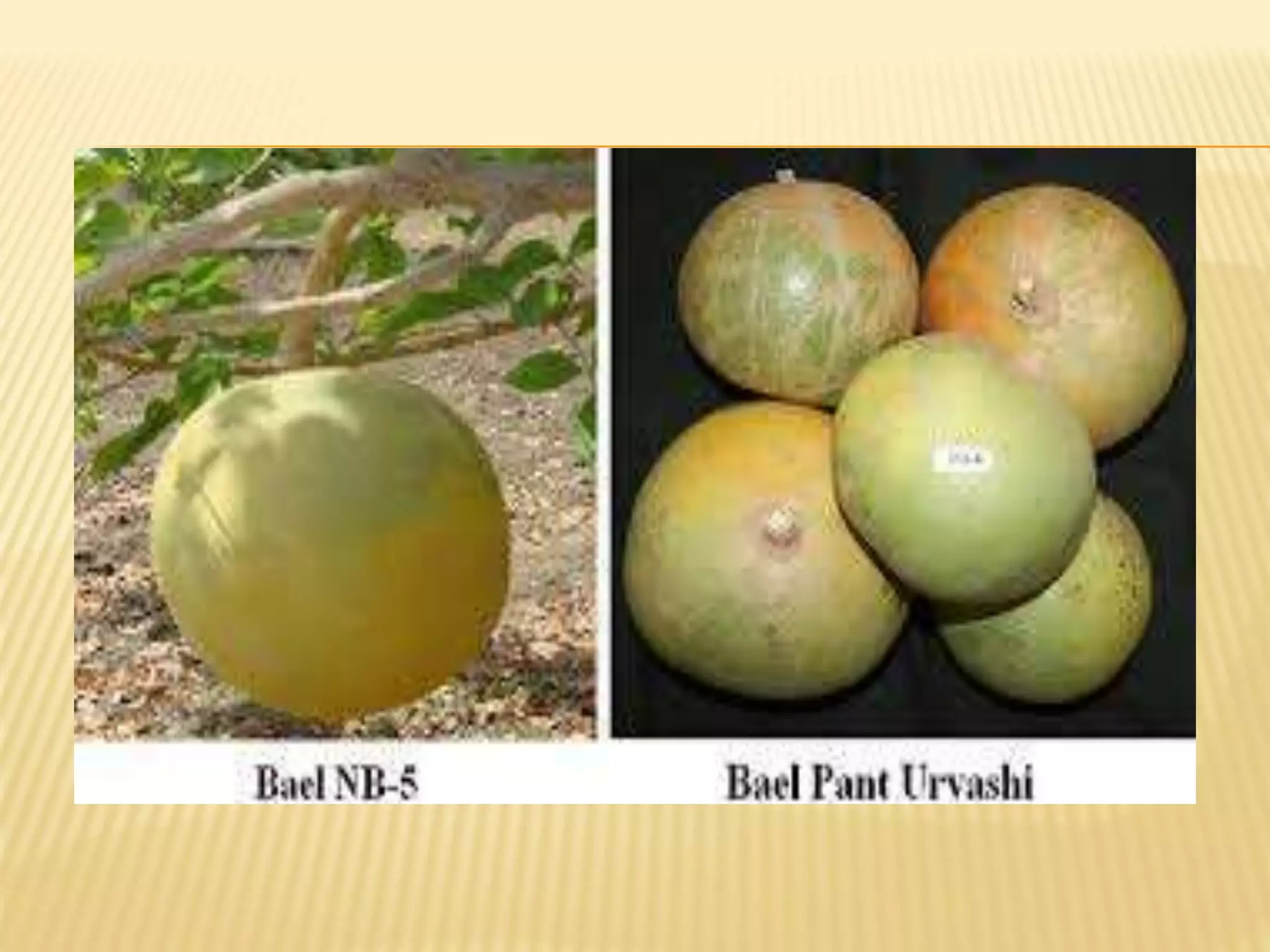
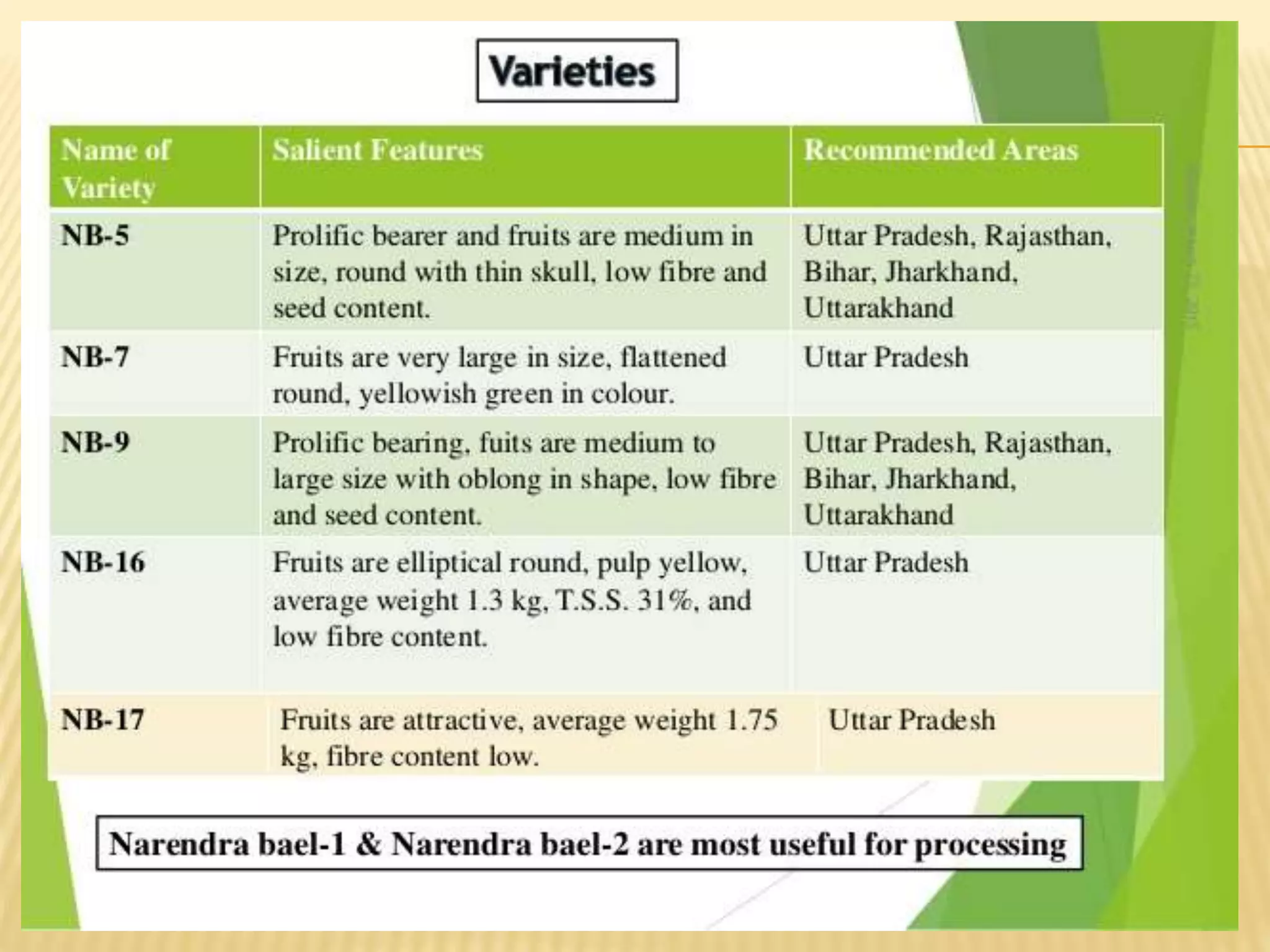
 Narendra bael - 5 :
 The plants are small and semi spreading growth habit,
precocious and prolific in bearing.
 The budded plants start fruiting in the 4th year, the
average fruit yield of six year old plant is 28.78 kg.
 fruits are medium in size, round, with smooth surface
and very thin rind, straw yellow at maturity, low in
mucilage, moderately fibrous.
 Release from N D university Agriculture and technology,
Faizabad,UP.
 Pant Shivani :
 It is a early mid season variety.
 Trees are tall, vigorous, dense, upright growing,
precocious and heavy bearer.
 Fruit shape is ovoid, oblong and the size being 18.50
cm × 15.00 cm. fruit weight ranges from 2 to 2.4kg.
 colour of fruit is lemon yellow and its storage quality
is good.
 Release from G B Pant university of Agriculture and
technology, Pant Nagar, Uttarakhand.
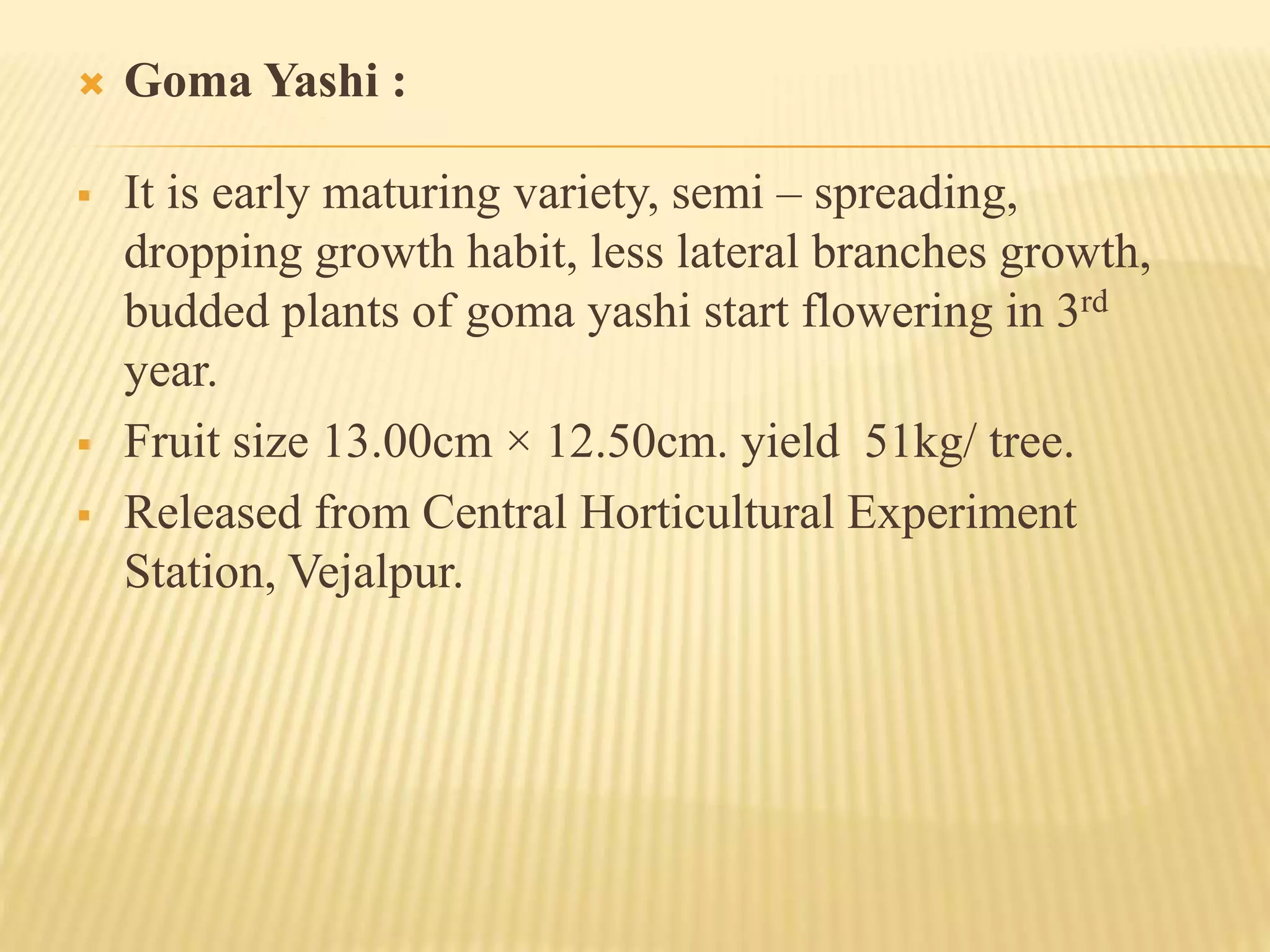
 Goma Yashi :
 It is early maturing variety, semi – spreading,
dropping growth habit, less lateral branches growth,
budded plants of goma yashi start flowering in 3rd
year.
 Fruit size 13.00cm × 12.50cm. yield 51kg/ tree.
 Released from Central Horticultural Experiment
Station, Vejalpur.
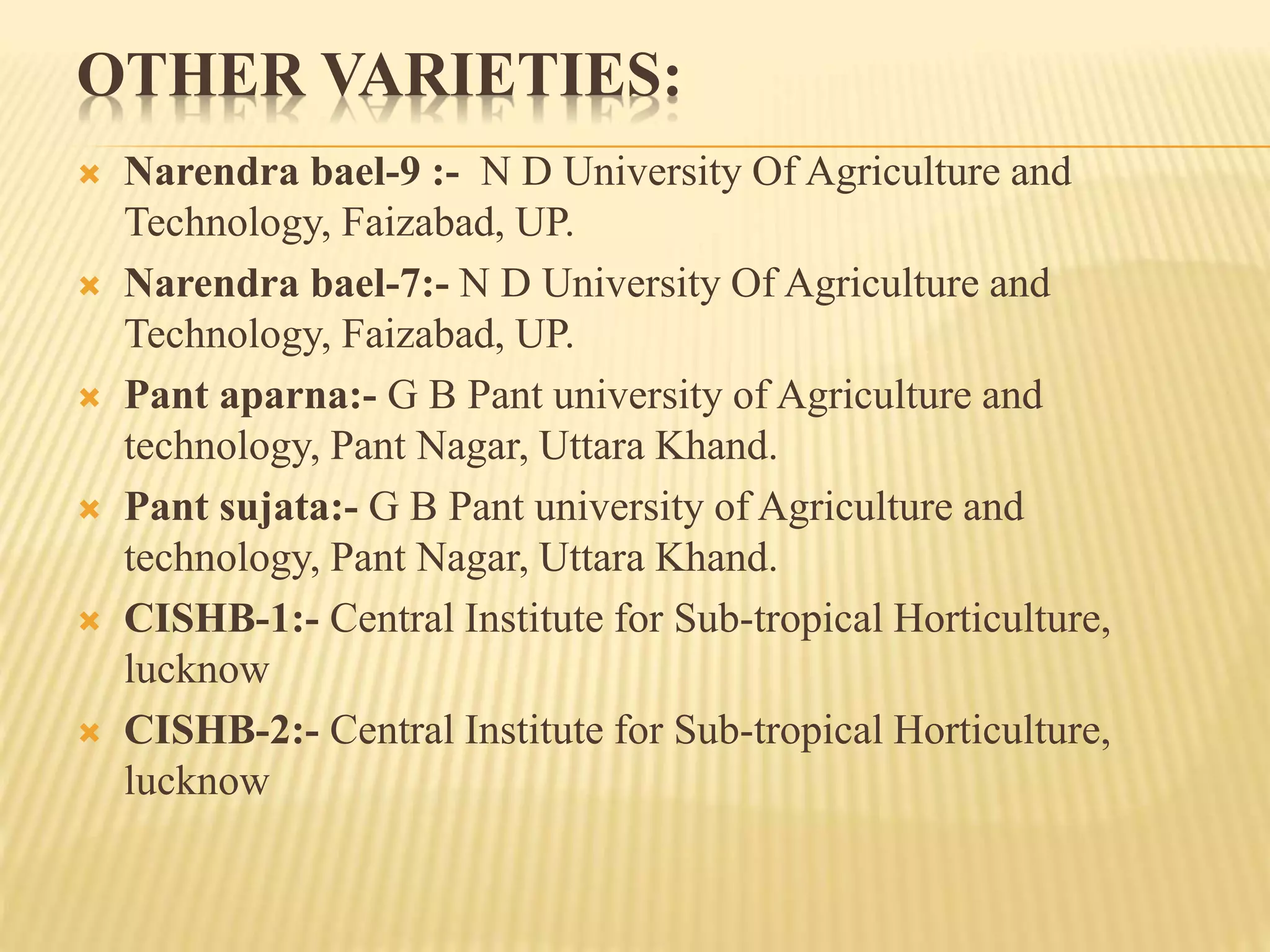
OTHER VARIETIES:
 Narendra bael-9 :- N D University Of Agriculture and
Technology, Faizabad, UP.
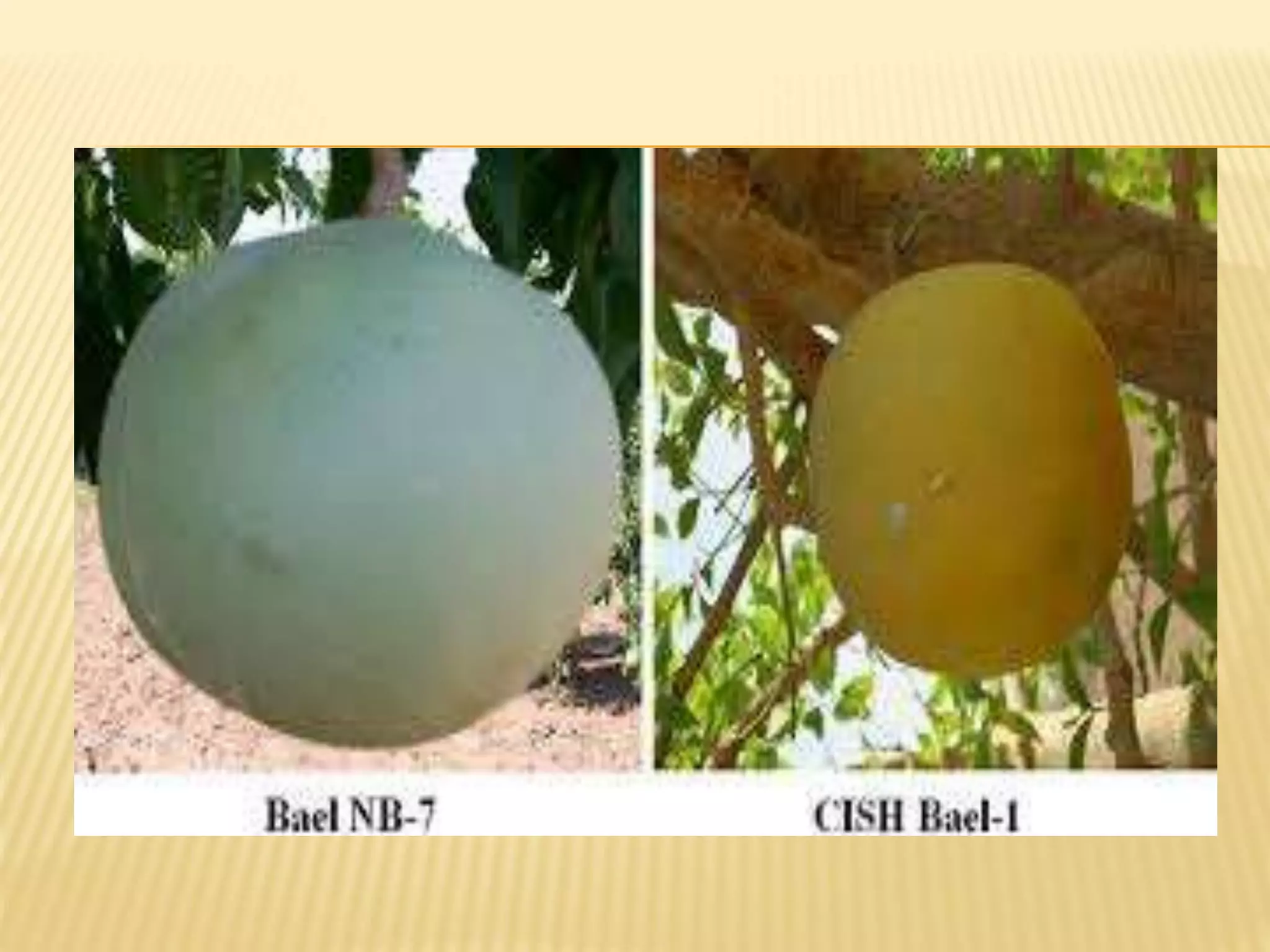
 Narendra bael-7:- N D University Of Agriculture and
Technology, Faizabad, UP.
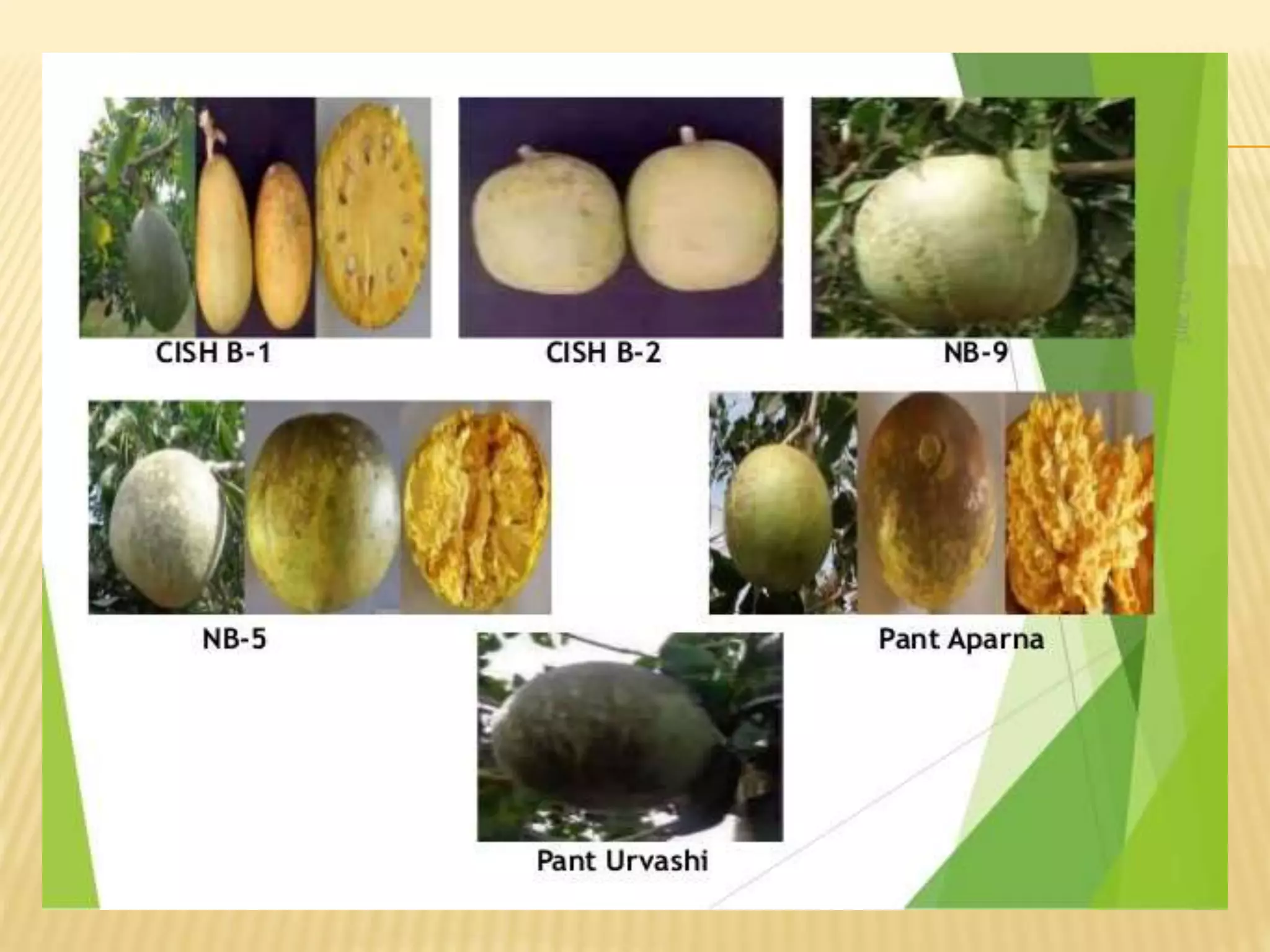
 Pant aparna:- G B Pant university of Agriculture and
technology, Pant Nagar, Uttara Khand.
 Pant sujata:- G B Pant university of Agriculture and
technology, Pant Nagar, Uttara Khand.
 CISHB-1:- Central Institute for Sub-tropical Horticulture,
lucknow
 CISHB-2:- Central Institute for Sub-tropical Horticulture,
lucknow
PLANTING
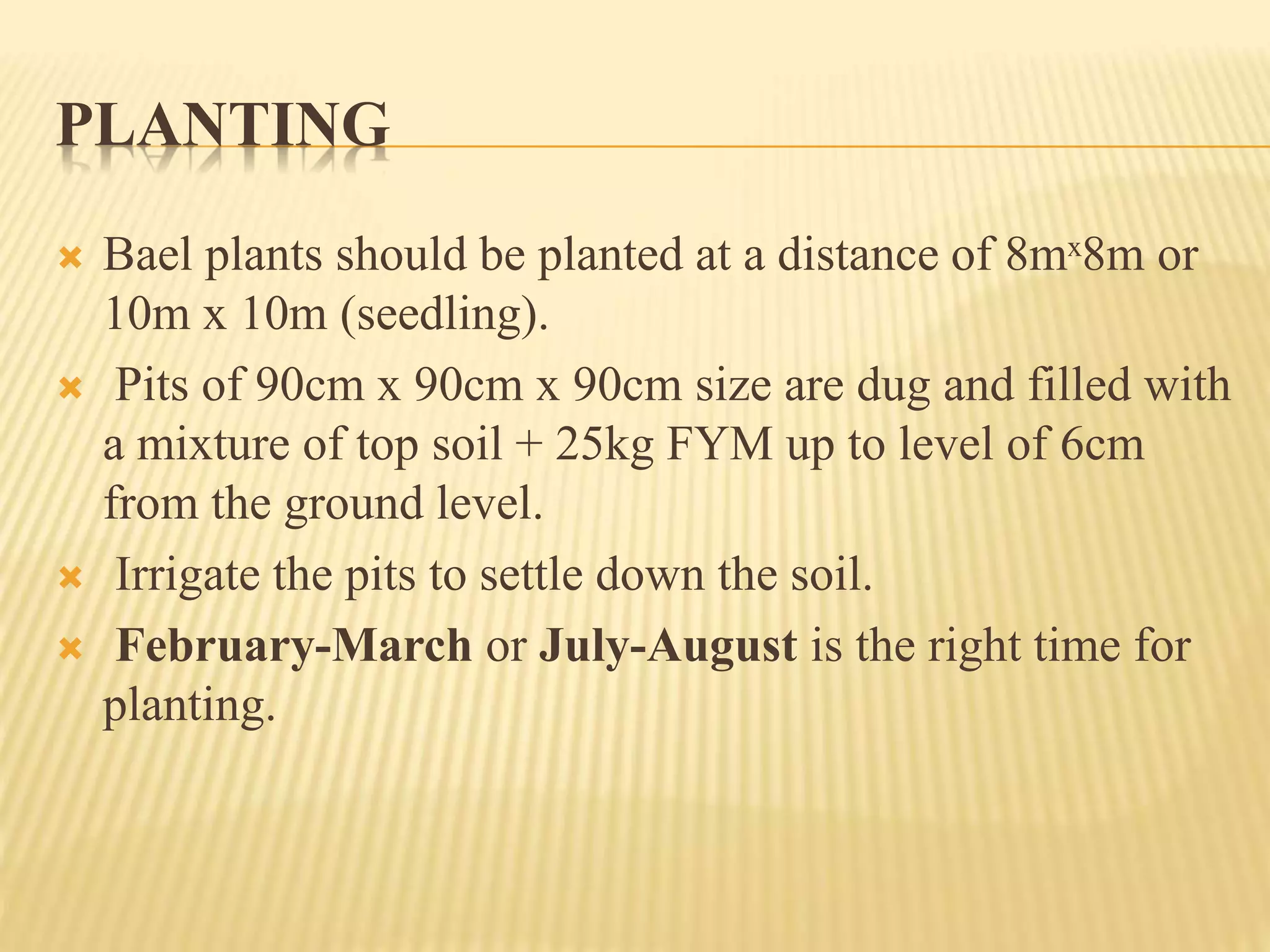
 Bael plants should be planted at a distance of 8mˣ8m or
10m x 10m (seedling).
 Pits of 90cm x 90cm x 90cm size are dug and filled with
a mixture of top soil + 25kg FYM up to level of 6cm
from the ground level.
 Irrigate the pits to settle down the soil.
 February-March or July-August is the right time for
planting.
TRAINING AND PRUNING
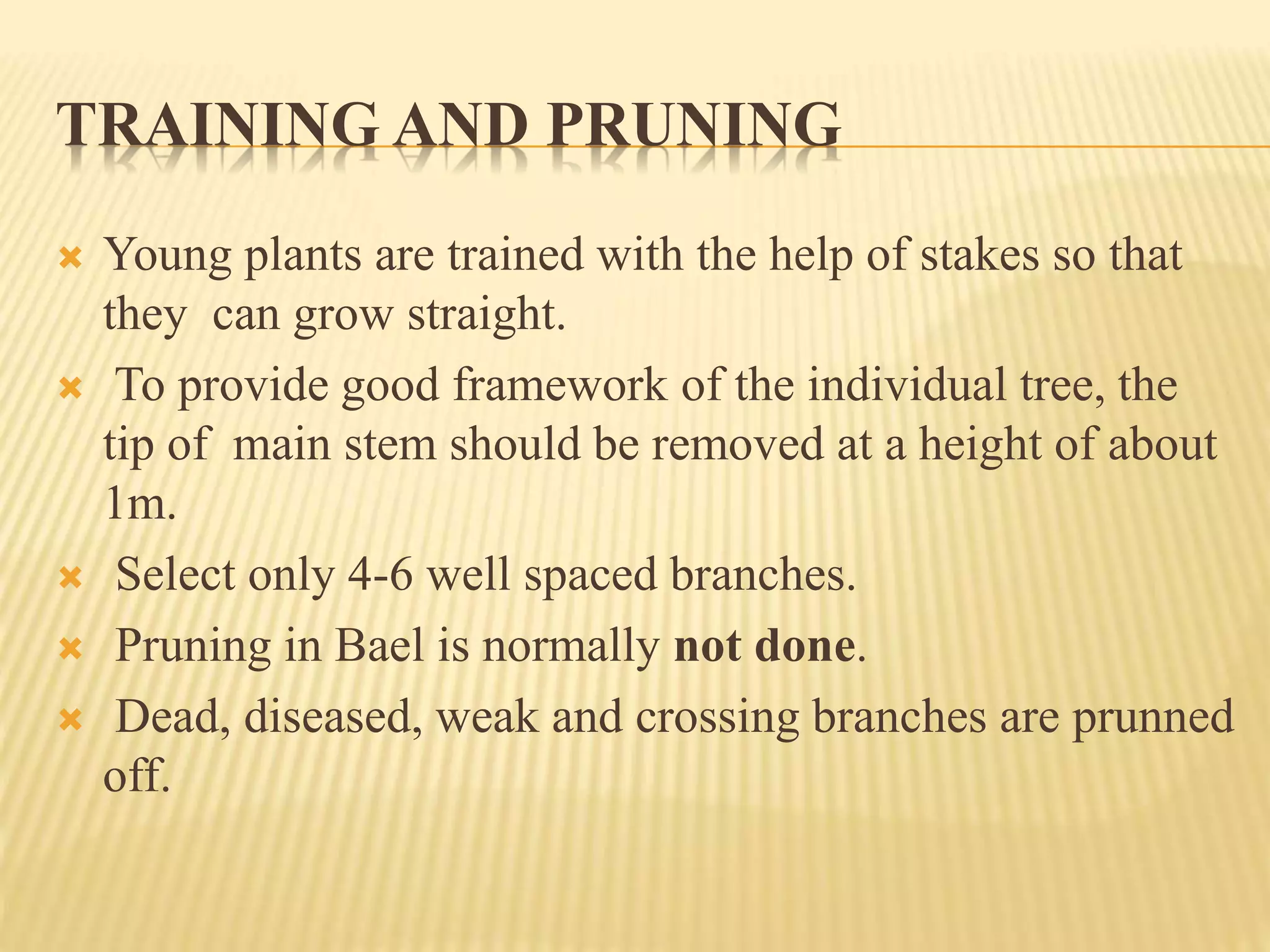
 Young plants are trained with the help of stakes so that
they can grow straight.
 To provide good framework of the individual tree, the
tip of main stem should be removed at a height of about
1m.
 Select only 4-6 well spaced branches.
 Pruning in Bael is normally not done.
 Dead, diseased, weak and crossing branches are prunned
off.
MANURES AND FERTILIZATION
 Little or no systematic work has been done on its nutritional
requirements.
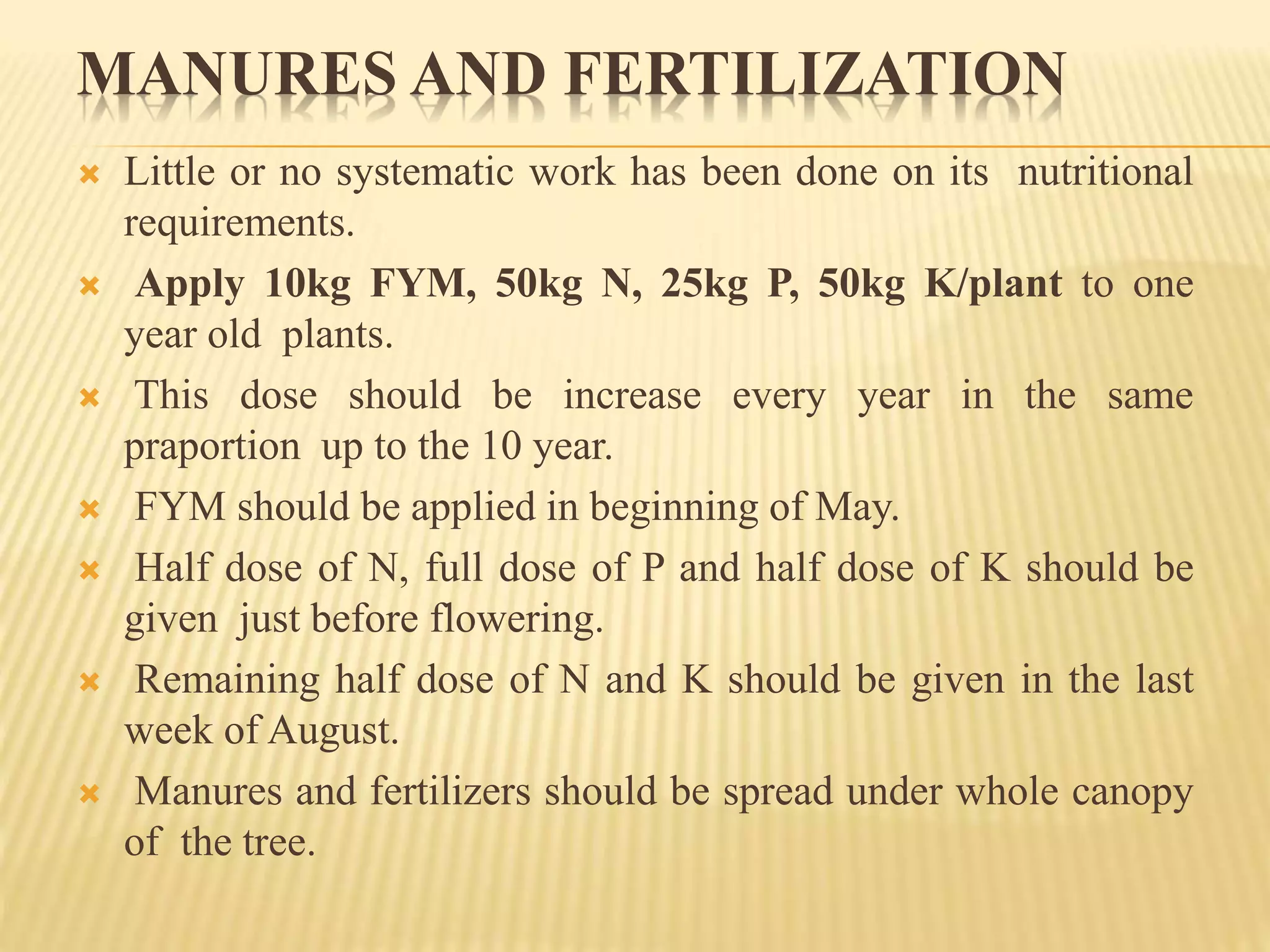
 Apply 10kg FYM, 50kg N, 25kg P, 50kg K/plant to one
year old plants.
 This dose should be increase every year in the same
praportion up to the 10 year.
 FYM should be applied in beginning of May.
 Half dose of N, full dose of P and half dose of K should be
given just before flowering.
 Remaining half dose of N and K should be given in the last
week of August.
 Manures and fertilizers should be spread under whole canopy
of the tree.
IRRIGATION
 Plants need to be cared for watering.
 Basin system providing more uniform distribution of
water should be used for irrigation of young plants.
 Irrigation to young plantation should be given at 20 days
interval in summer.
 In bearing orchard, first irrigation should be given after
manuring and fertilization.
 Irrigation at monthly intervals should be given after the
rainy season (October-April)
HARVESTING AND POSTHARVEST
MANAGEMENT
 Bael is used for preserve making, hence mature green fruits
are ideal for harvesting.
 Fruits become fully mature 8 months after fruit set.
 At this stage shell (peel) changes from deep green to light
green and flesh (pulp) from light yellow to deep yellow.
 Fruits take about 11 months after fruit set to ripen on the tree.
 Its ripening can be advance by 45bdays with pre-harvest
treatment of Ethephon (1000ppm) during 1st week of Feb.
or 9 months after fruit set.
 There is no standard grading of bael fruits. Fruits are mostly
packed in gunny bags and some times in basket for
transportation and marketing.
YIELD
 The number of fruits per tree may vary from 30 – 45 at
the age of 6 – 7 years. depending on genotype, soil and
climatic condition. However, a seedling tree at the 30-40
years age can yield 500-800 fruit.
USE
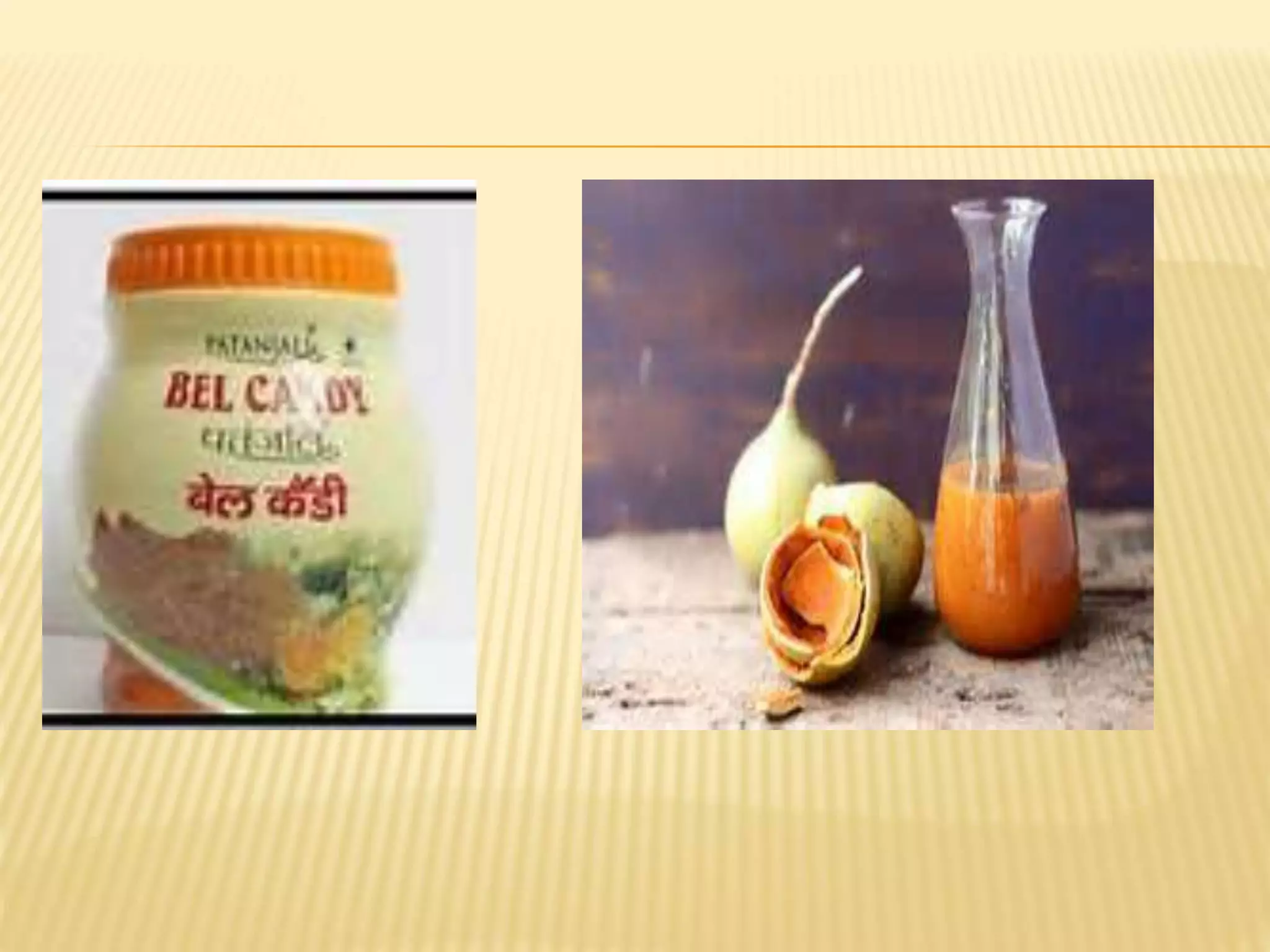
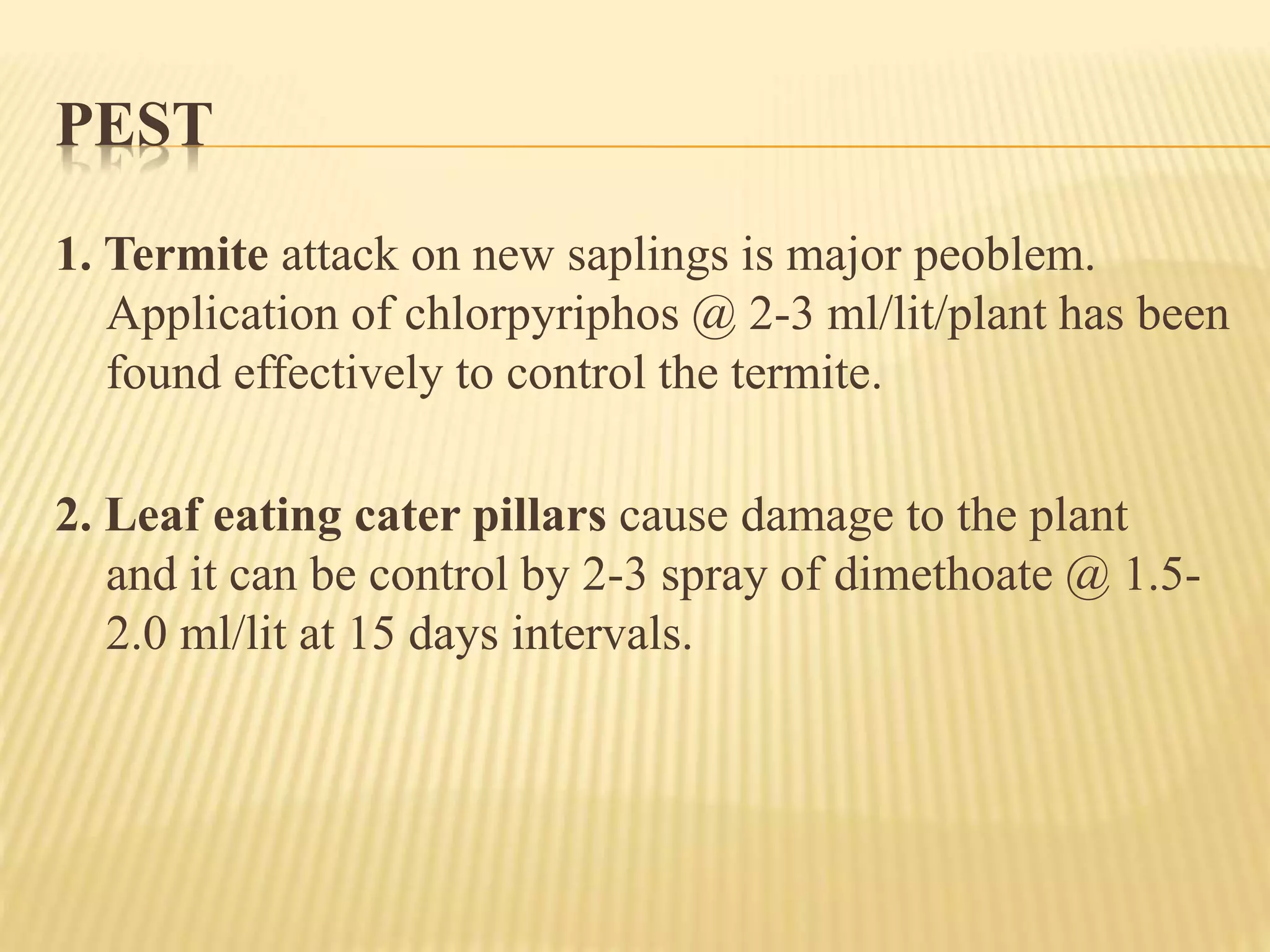
 Toffee
 Squash
 Powder
 Jam
 Slab
 Ready to serve
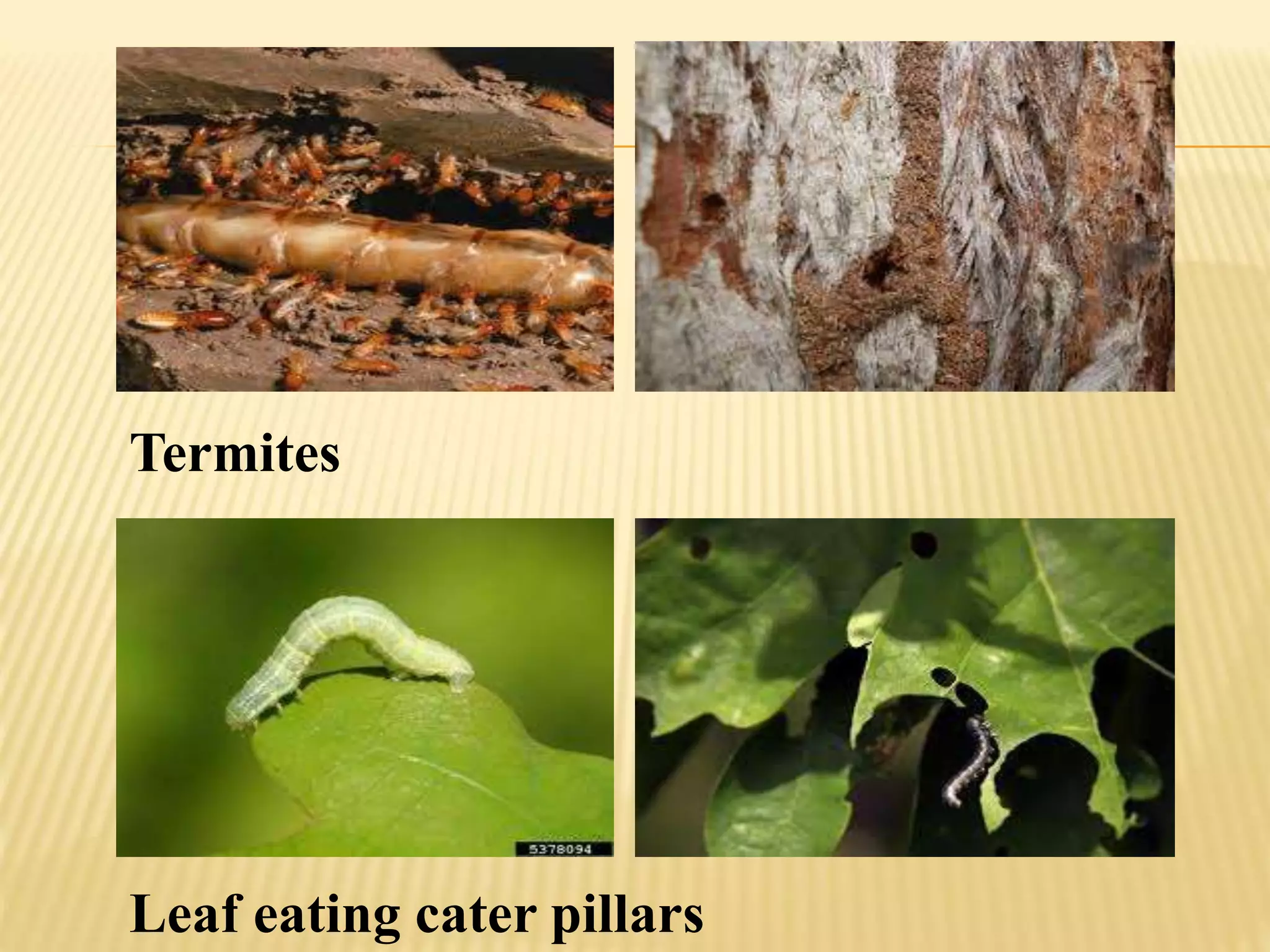
PEST
1. Termite attack on new saplings is major peoblem.
Application of chlorpyriphos @ 2-3 ml/lit/plant has been
found effectively to control the termite.
2. Leaf eating cater pillars cause damage to the plant
and it can be control by 2-3 spray of dimethoate @ 1.5-
2.0 ml/lit at 15 days intervals.
Termites
Leaf eating cater pillars
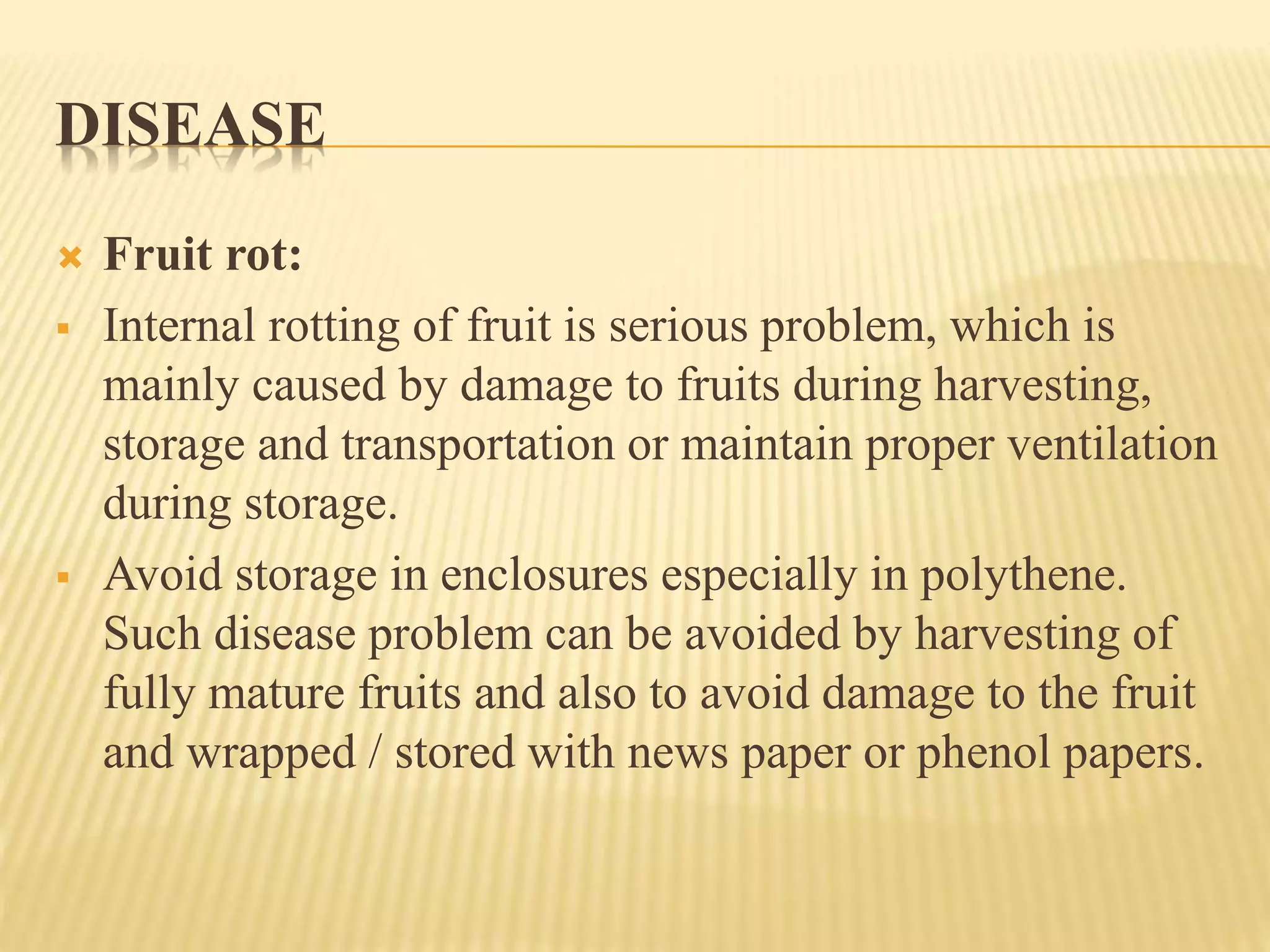
DISEASE
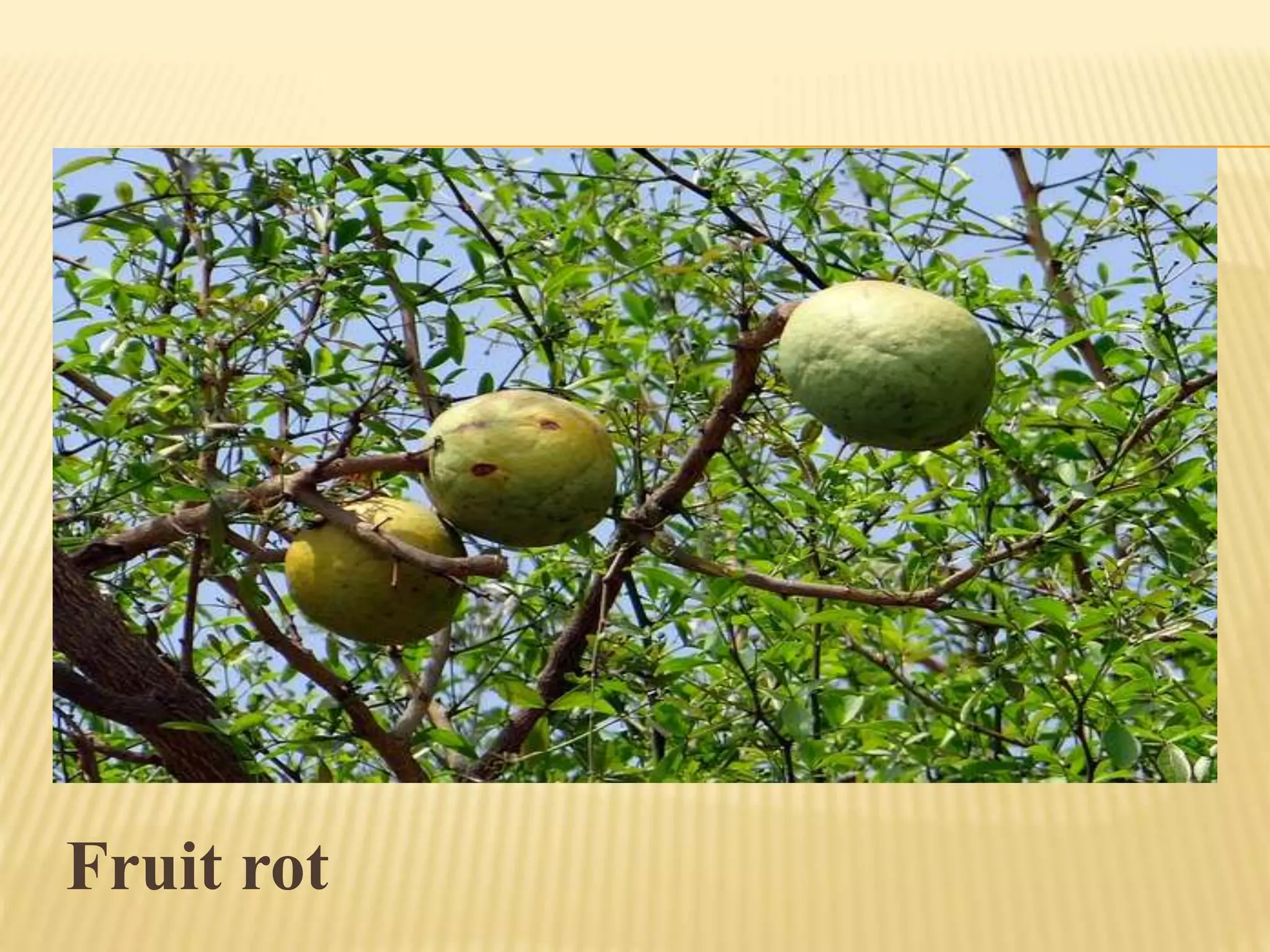
 Fruit rot:
 Internal rotting of fruit is serious problem, which is
mainly caused by damage to fruits during harvesting,
storage and transportation or maintain proper ventilation
during storage.
 Avoid storage in enclosures especially in polythene.
Such disease problem can be avoided by harvesting of
fully mature fruits and also to avoid damage to the fruit
and wrapped / stored with news paper or phenol papers.
Fruit rot
PHYSIOLOGICAL DISORDER
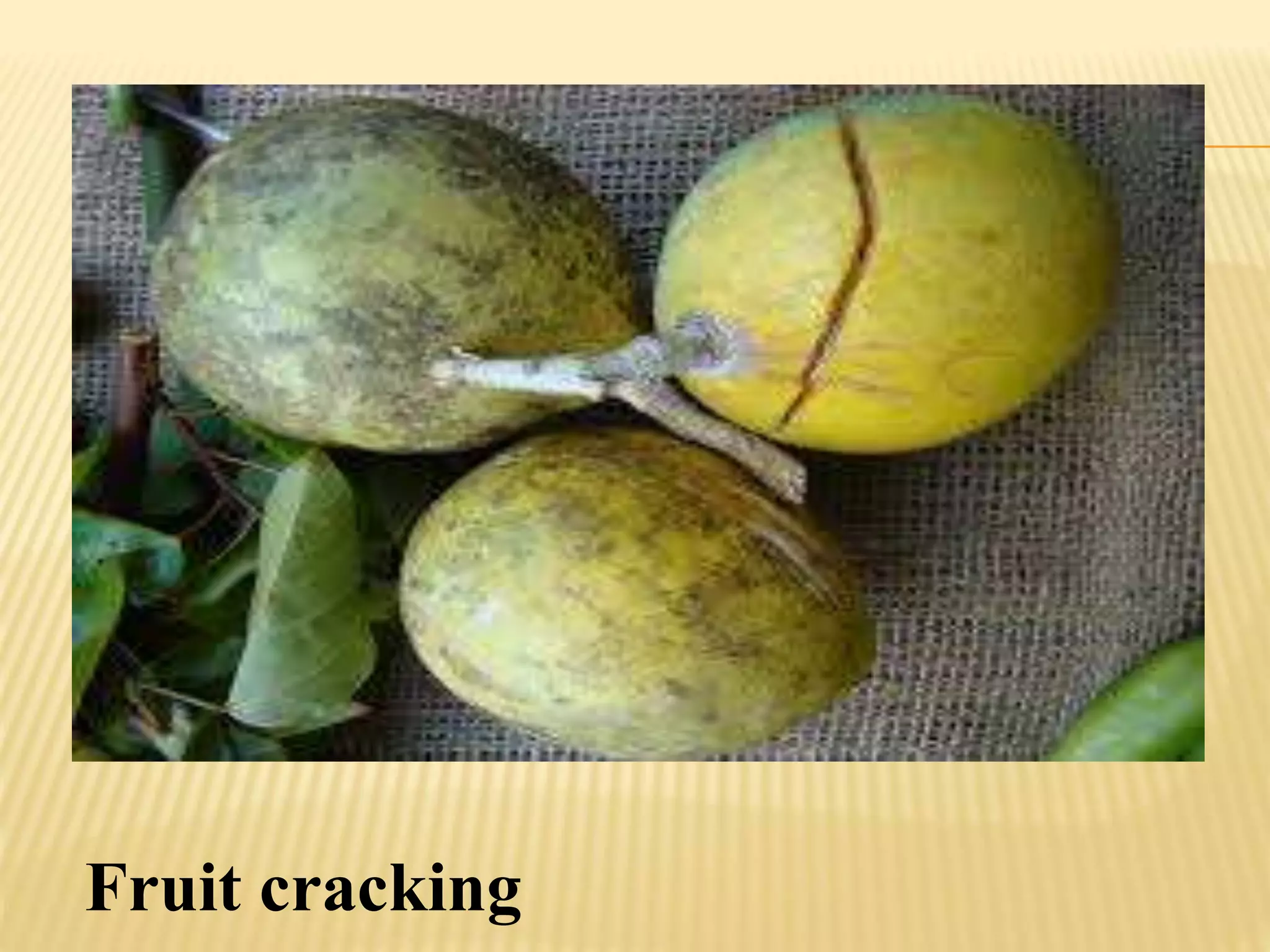
 Fruit cracking:
 Fruit cracking has been observed as a major
physiological disorder and its degree of damage depends
according to genotypes / varieties and locality.
 The cracking can be minimized by maintaining optimum
soil moisture regime and by provision of winds breaks
against hot desiccating wind side of orchard.
Fruit cracking
REFERENCES
 Handbook of horticulture by K. L. Chadha.
 Management of horticultural crops (Part-1) by T.
Pradeep kumar, B. Suma, Jyothibhaskar and K.
N. Satheesan.
 A handbook of fruit production by S. Prasad and
U. Kumar.
 www. fruitemedia.com

Advanced production technology of bael

  • 2.
    ADVANCED PRODUCTION TECHNOLOGYOF BAEL Submitted by : Pawan Kumar Nagar M.Sc. (Horticulture) Fruit Science 04-2690-2015
  • 3.
    BAEL Botanical Name :Aegle marmelos Family: Rutaceae
  • 4.
    INTRODUCTION  Bael (Aegelmarmelos) is an indigenous fruit tree of India.  The deciduous tree with trifoliate aromatic leaves is traditionally used as sacred offering to ‘Lord Shiva’.  It is commonly planted in temple garden.  As wild Bael is found in Utter Pradesh, Bihar, West Bengal and Madhya Pradesh.  Fruit is hard shelled berry and very well known for its medicinal properties due to marmelosin content.  The ripe fruit is tonic, restorative, laxative and good for heart an brain.
  • 5.
    CLIMATE  Owing tohardy nature, bael tree has a wide adaptability to adverse soil and climatic condition.  It require subtropical climate where summer is hot and dry, and winter is mild.  Plants can grow even up to an elevation of 1,200m.  They are not damaged by temperature as low as -7⁰C.
  • 6.
    SOIL  A welldrained, sandy loam soil is ideal.  It can thrive even on poor and clay soil.  It can stand sodicity up to 30 ESP and salinity up to 9ds/m EC.
  • 7.
    VARIETIES  Narendra bael- 5 :  The plants are small and semi spreading growth habit, precocious and prolific in bearing.  The budded plants start fruiting in the 4th year, the average fruit yield of six year old plant is 28.78 kg.  fruits are medium in size, round, with smooth surface and very thin rind, straw yellow at maturity, low in mucilage, moderately fibrous.  Release from N D university Agriculture and technology, Faizabad,UP.
  • 9.
     Pant Shivani:  It is a early mid season variety.  Trees are tall, vigorous, dense, upright growing, precocious and heavy bearer.  Fruit shape is ovoid, oblong and the size being 18.50 cm × 15.00 cm. fruit weight ranges from 2 to 2.4kg.  colour of fruit is lemon yellow and its storage quality is good.  Release from G B Pant university of Agriculture and technology, Pant Nagar, Uttarakhand.
  • 10.
     Goma Yashi:  It is early maturing variety, semi – spreading, dropping growth habit, less lateral branches growth, budded plants of goma yashi start flowering in 3rd year.  Fruit size 13.00cm × 12.50cm. yield 51kg/ tree.  Released from Central Horticultural Experiment Station, Vejalpur.
  • 11.
    OTHER VARIETIES:  Narendrabael-9 :- N D University Of Agriculture and Technology, Faizabad, UP.  Narendra bael-7:- N D University Of Agriculture and Technology, Faizabad, UP.  Pant aparna:- G B Pant university of Agriculture and technology, Pant Nagar, Uttara Khand.  Pant sujata:- G B Pant university of Agriculture and technology, Pant Nagar, Uttara Khand.  CISHB-1:- Central Institute for Sub-tropical Horticulture, lucknow  CISHB-2:- Central Institute for Sub-tropical Horticulture, lucknow
  • 15.
    PLANTING  Bael plantsshould be planted at a distance of 8mˣ8m or 10m x 10m (seedling).  Pits of 90cm x 90cm x 90cm size are dug and filled with a mixture of top soil + 25kg FYM up to level of 6cm from the ground level.  Irrigate the pits to settle down the soil.  February-March or July-August is the right time for planting.
  • 16.
    TRAINING AND PRUNING Young plants are trained with the help of stakes so that they can grow straight.  To provide good framework of the individual tree, the tip of main stem should be removed at a height of about 1m.  Select only 4-6 well spaced branches.  Pruning in Bael is normally not done.  Dead, diseased, weak and crossing branches are prunned off.
  • 17.
    MANURES AND FERTILIZATION Little or no systematic work has been done on its nutritional requirements.  Apply 10kg FYM, 50kg N, 25kg P, 50kg K/plant to one year old plants.  This dose should be increase every year in the same praportion up to the 10 year.  FYM should be applied in beginning of May.  Half dose of N, full dose of P and half dose of K should be given just before flowering.  Remaining half dose of N and K should be given in the last week of August.  Manures and fertilizers should be spread under whole canopy of the tree.
  • 18.
    IRRIGATION  Plants needto be cared for watering.  Basin system providing more uniform distribution of water should be used for irrigation of young plants.  Irrigation to young plantation should be given at 20 days interval in summer.  In bearing orchard, first irrigation should be given after manuring and fertilization.  Irrigation at monthly intervals should be given after the rainy season (October-April)
  • 19.
    HARVESTING AND POSTHARVEST MANAGEMENT Bael is used for preserve making, hence mature green fruits are ideal for harvesting.  Fruits become fully mature 8 months after fruit set.  At this stage shell (peel) changes from deep green to light green and flesh (pulp) from light yellow to deep yellow.  Fruits take about 11 months after fruit set to ripen on the tree.  Its ripening can be advance by 45bdays with pre-harvest treatment of Ethephon (1000ppm) during 1st week of Feb. or 9 months after fruit set.  There is no standard grading of bael fruits. Fruits are mostly packed in gunny bags and some times in basket for transportation and marketing.
  • 20.
    YIELD  The numberof fruits per tree may vary from 30 – 45 at the age of 6 – 7 years. depending on genotype, soil and climatic condition. However, a seedling tree at the 30-40 years age can yield 500-800 fruit.
  • 21.
    USE  Toffee  Squash Powder  Jam  Slab  Ready to serve
  • 23.
    PEST 1. Termite attackon new saplings is major peoblem. Application of chlorpyriphos @ 2-3 ml/lit/plant has been found effectively to control the termite. 2. Leaf eating cater pillars cause damage to the plant and it can be control by 2-3 spray of dimethoate @ 1.5- 2.0 ml/lit at 15 days intervals.
  • 24.
  • 25.
    DISEASE  Fruit rot: Internal rotting of fruit is serious problem, which is mainly caused by damage to fruits during harvesting, storage and transportation or maintain proper ventilation during storage.  Avoid storage in enclosures especially in polythene. Such disease problem can be avoided by harvesting of fully mature fruits and also to avoid damage to the fruit and wrapped / stored with news paper or phenol papers.
  • 26.
  • 27.
    PHYSIOLOGICAL DISORDER  Fruitcracking:  Fruit cracking has been observed as a major physiological disorder and its degree of damage depends according to genotypes / varieties and locality.  The cracking can be minimized by maintaining optimum soil moisture regime and by provision of winds breaks against hot desiccating wind side of orchard.
  • 28.
  • 29.
    REFERENCES  Handbook ofhorticulture by K. L. Chadha.  Management of horticultural crops (Part-1) by T. Pradeep kumar, B. Suma, Jyothibhaskar and K. N. Satheesan.  A handbook of fruit production by S. Prasad and U. Kumar.  www. fruitemedia.com