Dr. SWATI V. RAMTEKE
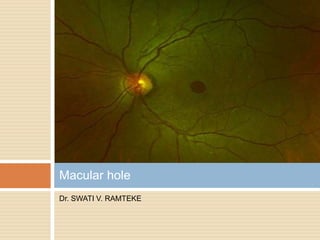
Macular hole
 Macular hole (MH) is a round full-thickness
opening in the foveal center.
 HISTORY:
 MH was first described in 1869 by Knapp in a
traumatic case.
 Gass - proposed a staging system - on the
basis of his biomicroscopic observations.
 Hee et al. were the first to describe the stages
of MH on OCT scans.
 Prevalence of MH reported in the literature
varies greatly.
 1.7per 1000 in a study in Southern India.
 Female-to-male ratio of 3.3.to 1. Bilateral in
5% to 16 % of patients.
 Risk factors – age 65 or older and females.
Introduction
 Idiopathic
 Myopia
 CME
 Retinal vascular
diseases
 Retinal detachment
 Trauma
 Lightening strike
 Hypertensive
retinopathy
 Most of the macular
holes occur as age
related idiopathic
condition not
related to specific
preceding events or
ocular problems
PATHOGENESIS
 HYPOTHESIS :
 Vitreomacular Traction (VMT) - anteroposterior
traction of vitreous fibers on the fovea.
 FOVEAL CYSTS - foveal cyst formation due to
vitreous traction was the first step in MH
formation. It was considered to be a prehole
condition.
 Contraction of Premacular Vitreous Cortex - Gass
postulated that the tangential contraction of the
prefoveal “posterior hyaloid membrane” resulted
in detachment of the central photoreceptors
and then in the opening of the fovea.
 PVD - attachments of the posterior hyaloid to
the foveal center and optic disc are the last to
be released. It leads to the creation of oblique
tractional forces on the foveal floor.
 SYMPTOMS – decrease in visual
acuity,metamorphosia,central scotoma
 Amslers grid test and/or Watzke Allens test
 DIAGNOSIS – slit lamp biomicroscopy,an
indirect peripheral examination,OCT.
 OCT – diagnosis,staging,prognosis and fellow
eye screening.
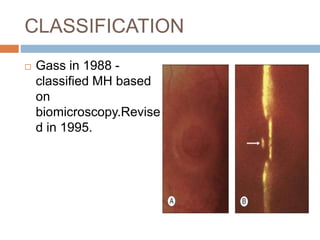
CLASSIFICATION
 Gass in 1988 -
classified MH based
on
biomicroscopy.Revise
d in 1995.
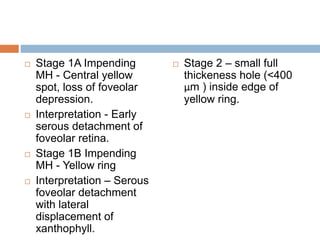
 Stage 1A Impending
MH - Central yellow
spot, loss of foveolar
depression.
 Interpretation - Early
serous detachment of
foveolar retina.
 Stage 1B Impending
MH - Yellow ring
 Interpretation – Serous
foveolar detachment
with lateral
displacement of
xanthophyll.
 Stage 2 – small full
thickeness hole (<400
μm ) inside edge of
yellow ring.
 Stage 3 Macular
hole
 Full thickeness MH
≥400 μm, partial
vitreous seperation.
 Stage 4-Macular
hole
 Full thickeness MH
≥400 μm, complete
vitreous seperation.
 OCT - replaced biomicroscopy for the
diagnosis of MH.
 A new classification has been proposed based
on both the MH diameter and the status of the
vitreous attachment at the hole edge on OCT.
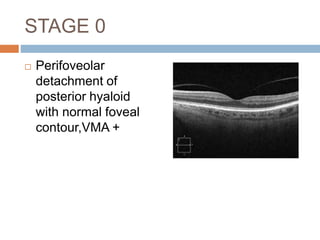
STAGE 0
 Perifoveolar
detachment of
posterior hyaloid
with normal foveal
contour,VMA +
STAGE 1A MH
 Perifoveolar
detachment of
posterior hyaloid.
Foveal cyst in the
inner foveola, and/or
foveolar detachment
of the cone outer
segment tip line.
 VMT +
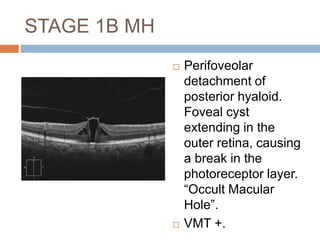
STAGE 1B MH
 Perifoveolar
detachment of
posterior hyaloid.
Foveal cyst
extending in the
outer retina, causing
a break in the
photoreceptor layer.
“Occult Macular
Hole”.
 VMT +.
STAGE 2 MH
 Hole of various size.
Partial opening of the
roof of the cyst ,the
operculum staying still
attached to the edge of
the hole. Partial
detachment of the
posterior hyaloid, which
is still attached at the
operculum. The
operculum contains
retinal tissue. Small or
STAGE 3 MH
 Hole of various size.
Posterior hyaloid
detached from the
macular surface, but
still attached to the
optic disc, most
often containing an
operculum.
 Medium or large
FTMH with VMT
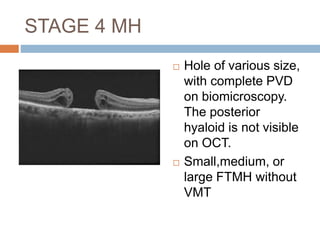
STAGE 4 MH
 Hole of various size,
with complete PVD
on biomicroscopy.
The posterior
hyaloid is not visible
on OCT.
 Small,medium, or
large FTMH without
VMT
 Stage 1A ,B –
Foveal
pseudocyst,Impendi
ng MH
 Stage 2 –lamellar
macular hole
 Stage 3 – FTMH
without PVD
 Stage 4 – FTMH
with PVD
DD’s of MH
 Lamellar macular
hole (LMH) was
coined by Gass in
1975.
 Results from
opening of central
cyst of CME.
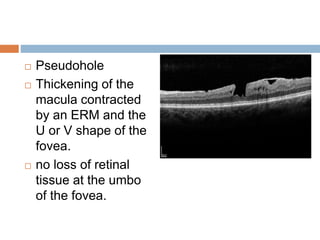
 Pseudohole
 Thickening of the
macula contracted
by an ERM and the
U or V shape of the
fovea.
 no loss of retinal
tissue at the umbo
of the fovea.
SECONDARY MH
 ORBITAL TRAUMA
 In children and young male
adults.
 Due to sudden axial
compression of the eye
resulting in equatorial
expansion and retinal
rupture of the fovea.
 Combined with other
fundus lesions such as
choroidal or Bruch's
membrane disruption,
commotio retinae,
sclopetaria, or peripheral
breaks.
SECONDARY MH
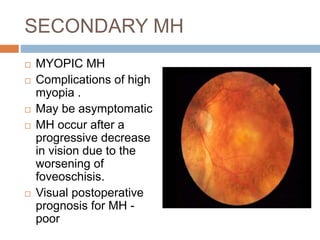
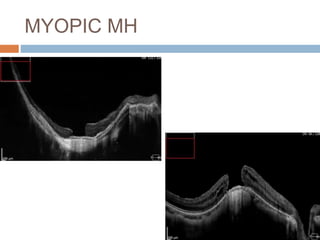
 MYOPIC MH
 Complications of high
myopia .
 May be asymptomatic
 MH occur after a
progressive decrease
in vision due to the
worsening of
foveoschisis.
 Visual postoperative
prognosis for MH -
poor
MYOPIC MH
TREATMENT
 Stage 1A ,1B MH – Observation
Spontaneous closure in 50% or progress to
stage 2 MH.
Stage 2,3,4 MH – requires surgery – vitrectomy.
MACULAR HOLE SURGERY
 Kelly and Wendel first initiated successful surgery
for MH and reported their results for 52 cases in
1990 with a success rate 58%.
 Pars Plana Vitrectomy (PPV) - to separate the
posterior cortical hyaloid from the retinal surface
of the macula.
 Internal limiting membrane peeling (ILM) – using
brilliant blue(BB), indocyanine green (ICG) or
tryphan blue (TP) dyes or triamcinolone (TA).
 ICG dye – RPE toxicity, visual field defects noted.
 Inverted ILM flap – large MH, myopic MH.
 Tamponade - by dehydrating hole edge and then
by preventing fluid currents from hampering the
healing process.
 Agents - Air, SF6, C3F8, SILICONE OIL.
 Positioning - to maintain a face-down position for
10 to 14 days postoperatively.
 Anatomical closure - 91% to 98% for FTMHs
 Visual prognosis - better closure rates and better
final visual acuities when the duration of
symptoms is less than 6 months.
 Complications – Cataract in phakic eyes within
1st few years.
 Intraoperative Retinal tears.
 Retinal detachment , visual field defect,
endophthalmitis.
 IOP rise in case of gas tamponade in high
altitudes.
 Late reopening of MH.
VITREOPHARMACOLYSIS
 OCRIPLASMIN - a recombinant
protease,approved by the FDA in 2012 for the
management of symptomatic VMA.
 Lower MH closure rates , electroretinographic
abnormalities, macular detachment, and
dyschromatopsia.
THANK YOU

MACULAR HOLE.pptx

  • 1.
    Dr. SWATI V.RAMTEKE Macular hole
  • 2.
     Macular hole(MH) is a round full-thickness opening in the foveal center.  HISTORY:  MH was first described in 1869 by Knapp in a traumatic case.  Gass - proposed a staging system - on the basis of his biomicroscopic observations.  Hee et al. were the first to describe the stages of MH on OCT scans.
  • 3.
     Prevalence ofMH reported in the literature varies greatly.  1.7per 1000 in a study in Southern India.  Female-to-male ratio of 3.3.to 1. Bilateral in 5% to 16 % of patients.  Risk factors – age 65 or older and females.
  • 4.
    Introduction  Idiopathic  Myopia CME  Retinal vascular diseases  Retinal detachment  Trauma  Lightening strike  Hypertensive retinopathy  Most of the macular holes occur as age related idiopathic condition not related to specific preceding events or ocular problems
  • 5.
    PATHOGENESIS  HYPOTHESIS : Vitreomacular Traction (VMT) - anteroposterior traction of vitreous fibers on the fovea.  FOVEAL CYSTS - foveal cyst formation due to vitreous traction was the first step in MH formation. It was considered to be a prehole condition.  Contraction of Premacular Vitreous Cortex - Gass postulated that the tangential contraction of the prefoveal “posterior hyaloid membrane” resulted in detachment of the central photoreceptors and then in the opening of the fovea.
  • 6.
     PVD -attachments of the posterior hyaloid to the foveal center and optic disc are the last to be released. It leads to the creation of oblique tractional forces on the foveal floor.
  • 7.
     SYMPTOMS –decrease in visual acuity,metamorphosia,central scotoma  Amslers grid test and/or Watzke Allens test  DIAGNOSIS – slit lamp biomicroscopy,an indirect peripheral examination,OCT.  OCT – diagnosis,staging,prognosis and fellow eye screening.
  • 8.
    CLASSIFICATION  Gass in1988 - classified MH based on biomicroscopy.Revise d in 1995.
  • 9.
     Stage 1AImpending MH - Central yellow spot, loss of foveolar depression.  Interpretation - Early serous detachment of foveolar retina.  Stage 1B Impending MH - Yellow ring  Interpretation – Serous foveolar detachment with lateral displacement of xanthophyll.  Stage 2 – small full thickeness hole (<400 μm ) inside edge of yellow ring.
  • 10.
     Stage 3Macular hole  Full thickeness MH ≥400 μm, partial vitreous seperation.  Stage 4-Macular hole  Full thickeness MH ≥400 μm, complete vitreous seperation.
  • 11.
     OCT -replaced biomicroscopy for the diagnosis of MH.  A new classification has been proposed based on both the MH diameter and the status of the vitreous attachment at the hole edge on OCT.
  • 12.
    STAGE 0  Perifoveolar detachmentof posterior hyaloid with normal foveal contour,VMA +
  • 13.
    STAGE 1A MH Perifoveolar detachment of posterior hyaloid. Foveal cyst in the inner foveola, and/or foveolar detachment of the cone outer segment tip line.  VMT +
  • 14.
    STAGE 1B MH Perifoveolar detachment of posterior hyaloid. Foveal cyst extending in the outer retina, causing a break in the photoreceptor layer. “Occult Macular Hole”.  VMT +.
  • 15.
    STAGE 2 MH Hole of various size. Partial opening of the roof of the cyst ,the operculum staying still attached to the edge of the hole. Partial detachment of the posterior hyaloid, which is still attached at the operculum. The operculum contains retinal tissue. Small or
  • 16.
    STAGE 3 MH Hole of various size. Posterior hyaloid detached from the macular surface, but still attached to the optic disc, most often containing an operculum.  Medium or large FTMH with VMT
  • 17.
    STAGE 4 MH Hole of various size, with complete PVD on biomicroscopy. The posterior hyaloid is not visible on OCT.  Small,medium, or large FTMH without VMT
  • 18.
     Stage 1A,B – Foveal pseudocyst,Impendi ng MH  Stage 2 –lamellar macular hole  Stage 3 – FTMH without PVD  Stage 4 – FTMH with PVD
  • 19.
    DD’s of MH Lamellar macular hole (LMH) was coined by Gass in 1975.  Results from opening of central cyst of CME.
  • 20.
     Pseudohole  Thickeningof the macula contracted by an ERM and the U or V shape of the fovea.  no loss of retinal tissue at the umbo of the fovea.
  • 21.
    SECONDARY MH  ORBITALTRAUMA  In children and young male adults.  Due to sudden axial compression of the eye resulting in equatorial expansion and retinal rupture of the fovea.  Combined with other fundus lesions such as choroidal or Bruch's membrane disruption, commotio retinae, sclopetaria, or peripheral breaks.
  • 22.
    SECONDARY MH  MYOPICMH  Complications of high myopia .  May be asymptomatic  MH occur after a progressive decrease in vision due to the worsening of foveoschisis.  Visual postoperative prognosis for MH - poor
  • 23.
  • 24.
    TREATMENT  Stage 1A,1B MH – Observation Spontaneous closure in 50% or progress to stage 2 MH. Stage 2,3,4 MH – requires surgery – vitrectomy.
  • 25.
    MACULAR HOLE SURGERY Kelly and Wendel first initiated successful surgery for MH and reported their results for 52 cases in 1990 with a success rate 58%.  Pars Plana Vitrectomy (PPV) - to separate the posterior cortical hyaloid from the retinal surface of the macula.  Internal limiting membrane peeling (ILM) – using brilliant blue(BB), indocyanine green (ICG) or tryphan blue (TP) dyes or triamcinolone (TA).  ICG dye – RPE toxicity, visual field defects noted.  Inverted ILM flap – large MH, myopic MH.
  • 26.
     Tamponade -by dehydrating hole edge and then by preventing fluid currents from hampering the healing process.  Agents - Air, SF6, C3F8, SILICONE OIL.  Positioning - to maintain a face-down position for 10 to 14 days postoperatively.  Anatomical closure - 91% to 98% for FTMHs  Visual prognosis - better closure rates and better final visual acuities when the duration of symptoms is less than 6 months.
  • 27.
     Complications –Cataract in phakic eyes within 1st few years.  Intraoperative Retinal tears.  Retinal detachment , visual field defect, endophthalmitis.  IOP rise in case of gas tamponade in high altitudes.  Late reopening of MH.
  • 28.
    VITREOPHARMACOLYSIS  OCRIPLASMIN -a recombinant protease,approved by the FDA in 2012 for the management of symptomatic VMA.  Lower MH closure rates , electroretinographic abnormalities, macular detachment, and dyschromatopsia.
  • 29.