MACULAR HOLE

Nawat Watanachai
Orn (จำำนำมสกุลใหม่ไม่ได้)
Ramathibodi Hospital
INTRODUCTION
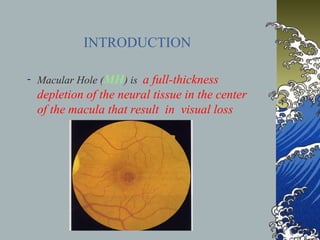
- Macular Hole (MH) is a full-thickness

depletion of the neural tissue in the center
of the macula that result in visual loss
History
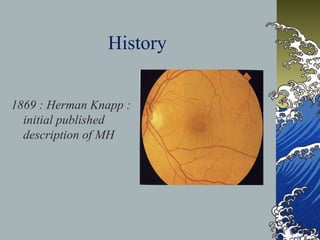
1869 : Herman Knapp :
initial published
description of MH
EPIDEMIOLOGY
 In USA , MH affect about 100,000 people
 1.9 % of visual impaired eyes (20/4020/200)
 Female > male (2:1)
 age 60 – 80 years ( mean 65 years )
 VA 20/20 - 20/400
 Incidence of MH in fellow eye : 5-10%
 not associated with medical dis, refractive
error
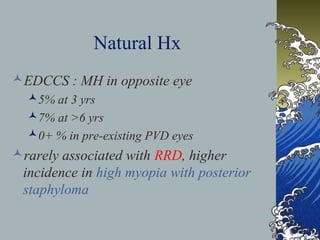
Natural Hx
EDCCS : vision/ progression
45% loss > 2 snellen lines in 4.5 yrs
28% loss > 3 snellen lines in 4.5 yrs
30% increased in size in 4.5 yrs
8% spont. resolution/regression after 6 yrs
only 3% spont. improve vision
Natural Hx
EDCCS : MH in opposite eye
5% at 3 yrs
7% at >6 yrs
0+ % in pre-existing PVD eyes

rarely associated with RRD, higher
incidence in high myopia with posterior
staphyloma
Causes
- most common cause is
- the others
-

non-surgical trauma
surgical trauma
pathologic myopia
vascular disease

idiopathic
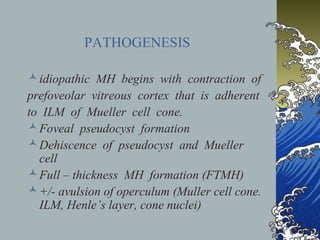
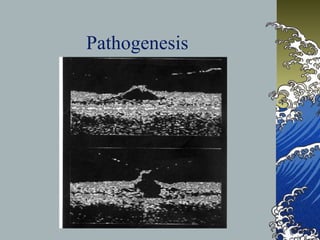
PATHOGENESIS
 idiopathic MH begins with contraction of
prefoveolar vitreous cortex that is adherent
to ILM of Mueller cell cone.
 Foveal pseudocyst formation
 Dehiscence of pseudocyst and Mueller
cell
 Full – thickness MH formation (FTMH)
 +/- avulsion of operculum (Muller cell cone.
ILM, Henle’s layer, cone nuclei)
Pathogenesis
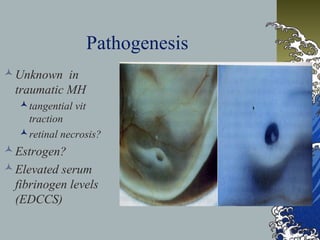
Pathogenesis
 Unknown in
traumatic MH
 tangential vit
traction
 retinal necrosis?

 Estrogen?
 Elevated serum
fibrinogen levels
(EDCCS)
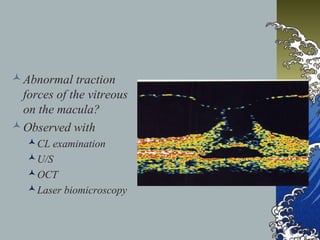
 Abnormal traction
forces of the vitreous
on the macula?
 Observed with
 CL examination
 U/S
 OCT
 Laser biomicroscopy
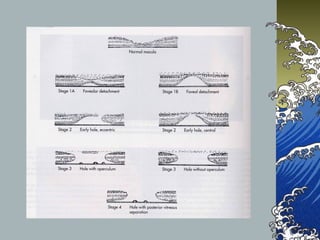
CLASSIFICATION
Gass and Johnson classification
stage 1 - pre – macular hole lesion
1a yellow spot
1b yellow ring
stage 2 - eccentric or concertric FTMH < 400
stage 3 - FTMH > 400
stage 4 - FTMH with PVD
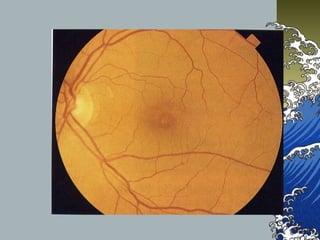
Stage 1
- localized shrinkage of prefoveal cortical
vitreous formed the traction shallow
detachment of foveola
- loss of normal foveola depression and
light reflex
- 1a small yellow spot ( 250 -300 )
- 1b yellow ring ( halo form of foveal
detachment )
-+/-pseudooperculum
- VA < 20/40 , metamorphopsia
- 50 % had spontaneous PVD
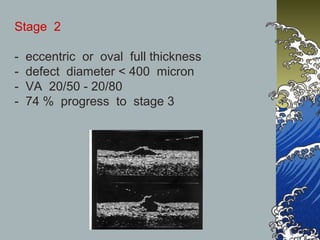
Stage 2
-

eccentric or oval full thickness
defect diameter < 400 micron
VA 20/50 - 20/80
74 % progress to stage 3
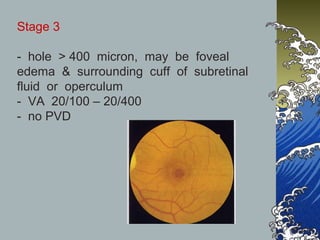
Stage 3
- hole > 400 micron, may be foveal
edema & surrounding cuff of subretinal
fluid or operculum
- VA 20/100 – 20/400
- no PVD
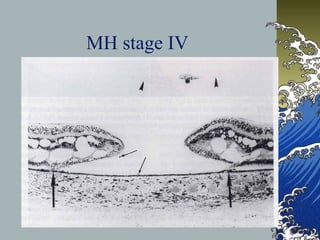
Stage 4
- FTMH with complete PVD
- may be associated to ERM
- FFA in stage 3 , 4 - mottle
hyperfluorescene from RPE thining, RPE
depigment, loss of xanthophyl
MH stage IV
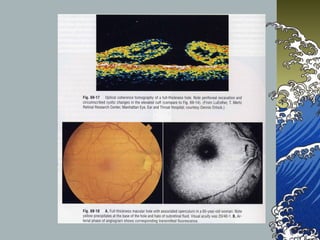
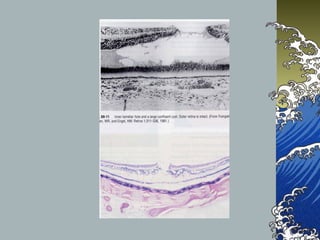
HISTOPATHOLOGY
- MH is the full thickening circular retinal

defect at fovea
- size 100 – 800 micron
- operculum composed of ILM, Mueller
cell cone, superficial inner cone fiber and
cone nuclei.
CLINICAL AND DIAGNOSIS

 VA loss
20/80 – 20/400
mean 20/200

 Central scotoma / Amsler grid
 metamorphopsia
CLINICAL AND DIAGNOSIS
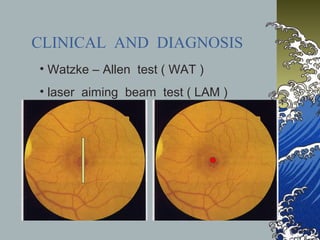
• Watzke – Allen test ( WAT )
• laser aiming beam test ( LAM )
CLINICAL AND DIAGNOSIS
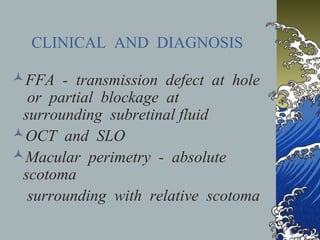
FFA - transmission defect at hole
or partial blockage at
surrounding subretinal fluid
OCT and SLO
Macular perimetry - absolute
scotoma
surrounding with relative scotoma
MH WITH SPECIFIC CAUSE

1. TRAUMA
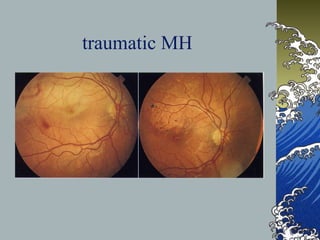
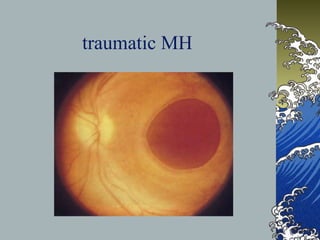
- trauma with cystic macular degeneration
associated with MH formation
- concussion effect & residual macular
traction after incomplete PVD
traumatic MH
traumatic MH
2.PATHOLOGIC MYOPIA
- progressive thining and streching
of posterior pole, loss of choriocapillaris
lead to cystic formation and macular
atrophy
- FFA - abnormal slow choroidal
and retinal blood flow
3.

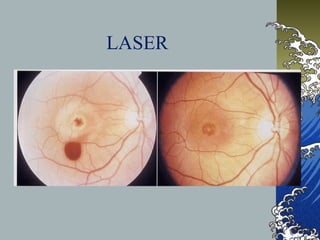
LASER
- LASER eg. Argon, dye laser, Xenon,
Krypton, YAG
- Thermal pigment absorption
LASER
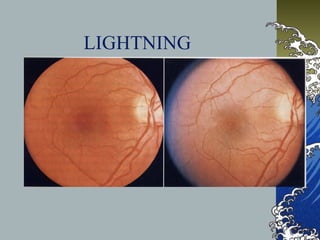
LIGHTNING
4. ELECTRIC CURRENT
- electric current can cause of
cataract by current pass to the eye
- study ; 2 from 159 electric burn
patient develop MH
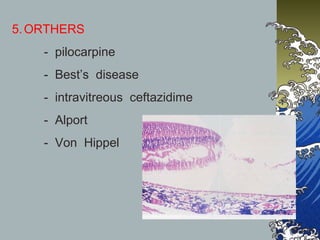
5. ORTHERS
- pilocarpine
- Best’s disease
- intravitreous ceftazidime
- Alport
- Von Hippel
NATURAL COURSE
Different between stage 1 – 4
stage 1 - MH s PVD progress to FTMH
33-52 %
- MH c PVD not turn to FTMH
stage 2 - most turn to stage 3, 4
stage 3,4 – almost always stable or slowly
progress
Chance of FTMH in fellow eye
1. if no PVD in both eyes - high risk
2. if PVD in FTMH eye but no PVD
in fellow eye - intermediate risk
3. if PVD in fellow eye
- no/very low
risk
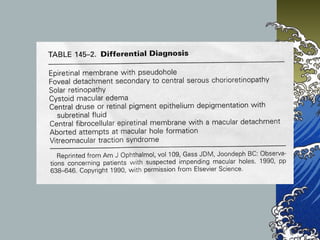
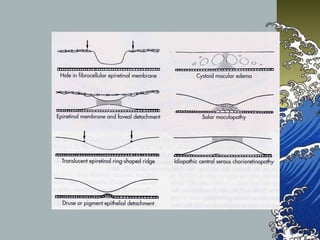
DIFFERENTIAL DIAGNOSIS
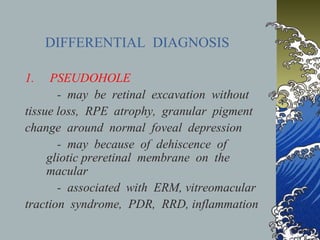
1.

PSEUDOHOLE
- may be retinal excavation without
tissue loss, RPE atrophy, granular pigment
change around normal foveal depression
- may because of dehiscence of
gliotic preretinal membrane on the
macular
- associated with ERM, vitreomacular
traction syndrome, PDR, RRD, inflammation
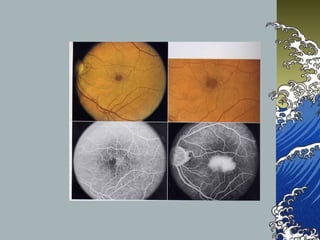
pseudohole
- VA normal or slightly reduce or
distortion
- FFA normal
- good prognosis
- no evidence of leser therapy
- vitrectomy surgery or membrane
peeling when VA < 20/80 or distortion
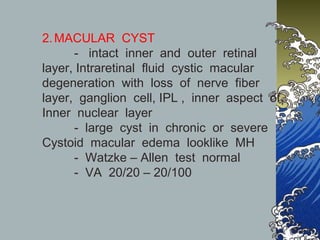
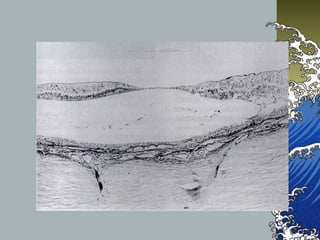
2. MACULAR CYST
- intact inner and outer retinal
layer, Intraretinal fluid cystic macular
degeneration with loss of nerve fiber
layer, ganglion cell, IPL , inner aspect of
Inner nuclear layer
- large cyst in chronic or severe
Cystoid macular edema looklike MH
- Watzke – Allen test normal
- VA 20/20 – 20/100
- FFA - pooling in cystic space in
late venous phase
- CME associated with intraocular
Gas, trauma, inflammation, exudate
macular degeneration, DM
- fluid accumulated between inner
nuclear and outer plexiform layer
- prognosis depend on underlying
Cause, size, chronicity of cytoid edema
- no treatment
3. PARTIAL THICKNESS HOLE
- outer lamella hole (OLH )
- inner lamella hole ( ILH )
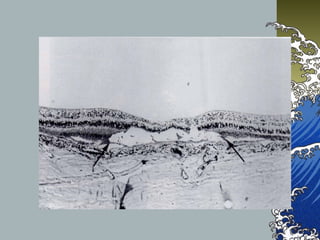
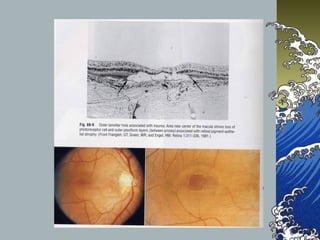
• outer lamella hole ( OLH )
- collapse of outer wall of Cyst
follow break down of outer BRB at RPE

- associated with Berlin’ s edema,
macular schisis, LASER
- slightly irregular deep round or oval
Excavation with intact inner retinal tissue
- VA 20/20 – 20/400
- FFA - window defect
• Inner lamella hole ( ILH )
- common, may be intermediate stage
to develop FTMH
- rarely develop from chronic CME,
spontaneous rupture at inner wall of cyst
result in round oval excavation in retina
size < 500 micron
- may develop from radiation, gas
C3F8, telangiectasia
- VA 20/20 – 20/80
- FFA - no transmitted fluorescene,
minimal window defect or accumulated in
perifoveal cystoid space
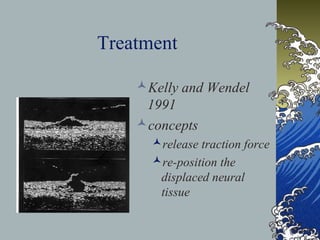
Treatment
Kelly and Wendel
1991
concepts
release traction force
re-position the
displaced neural
tissue
TREATMENT
Basic step of MH surgery
 PPV
 Remove of post. Hyaloid
 ERM dissection
 Check peripheral retinal break
 FAX
 Inject adjunctive agent ( if use )
 Air – gas/SO exchange
 prone position
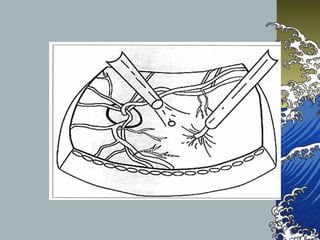
1. PPV and delamination of vitreous cortex
- remove AP, tangential,circumferential
force
- fish – strike or diving rod sign
2. Delamination of ERM
- peeling of visible ERM and / or ILM
- prevalence of ERM
- 80% in Pseudophakic eye
- 63 % in phakic eye
3. Delamination of ILM
- fibroblast like cell
- +/- 0.2 -0.4 cc. Of 0.5% ICG stain
- complication s
- trauma to retina
- Light toxicity – 15 min
- ICG RPE toxicity
4. Adjuvant
- growth factor B2, collagen plug,
thrombin – activated fibrinogen, thrombin
autologous platlet concentration, 
autologous serum
- endolaser
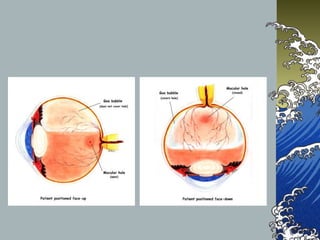
5. Temponade of MH
- gas or silicone oil
- postop. 12 -16 % C3F8 facedown
1-3 wks then 6 hr. per day until no gas
( 4 – 6 wks )
6. Elimination or reducing duration position
- short acting gas ( 4 days )
- SO 6 – 12 wks
7. Orther
- macular scleral buckle may be
Used in high myopia, post. Staphyloma
Or MH with extensive subretinal fluid
8. Repaired reopened MH
- repeat vitrectomy or FGX, FGX
With laser photocoagulation
Other alternatives
macular buckle
minimal vitrectomy (Rick Spaide)
pharmacological vitreolysis eg plasmin,
hyaluronidase, TPA, urokinase,
plasminogen
RPE laser treatment
RESULT OF SURGERY
Stage 1 lesion
- no benefit to PPV
- stage 1
- VA 20/40 30% turn FTMH
- VA 20/50 – 20/80 % turn FTMH
Stage 2 – 4
position of hole - elevate or flat
edges of hole - open or closed
Anatomical outcome
1. elevate/oper - failed surgical
2. flat/open - VA rarely better than
20/50
3. flat/close - VA > 20/30
COMPLICATIONS
 cataract 70% in 2 yrs
 RD 2 – 11%
 ERM
 Periphery iatrogenic retinal break 5.5 %
 VF defect ( temporal wedge)
 Increase IOP
 RPE change
 Endophthalmitis < 1 : 1000
 Ulnar neuropathy
THANK YOU

NW2010 Macular hole

  • 1.
    MACULAR HOLE Nawat Watanachai Orn(จำำนำมสกุลใหม่ไม่ได้) Ramathibodi Hospital
  • 2.
    INTRODUCTION - Macular Hole(MH) is a full-thickness depletion of the neural tissue in the center of the macula that result in visual loss
  • 3.
    History 1869 : HermanKnapp : initial published description of MH
  • 4.
    EPIDEMIOLOGY  In USA, MH affect about 100,000 people  1.9 % of visual impaired eyes (20/4020/200)  Female > male (2:1)  age 60 – 80 years ( mean 65 years )  VA 20/20 - 20/400  Incidence of MH in fellow eye : 5-10%  not associated with medical dis, refractive error
  • 5.
    Natural Hx EDCCS :vision/ progression 45% loss > 2 snellen lines in 4.5 yrs 28% loss > 3 snellen lines in 4.5 yrs 30% increased in size in 4.5 yrs 8% spont. resolution/regression after 6 yrs only 3% spont. improve vision
  • 6.
    Natural Hx EDCCS :MH in opposite eye 5% at 3 yrs 7% at >6 yrs 0+ % in pre-existing PVD eyes rarely associated with RRD, higher incidence in high myopia with posterior staphyloma
  • 7.
    Causes - most commoncause is - the others - non-surgical trauma surgical trauma pathologic myopia vascular disease idiopathic
  • 8.
    PATHOGENESIS  idiopathic MHbegins with contraction of prefoveolar vitreous cortex that is adherent to ILM of Mueller cell cone.  Foveal pseudocyst formation  Dehiscence of pseudocyst and Mueller cell  Full – thickness MH formation (FTMH)  +/- avulsion of operculum (Muller cell cone. ILM, Henle’s layer, cone nuclei)
  • 9.
  • 10.
    Pathogenesis  Unknown in traumaticMH  tangential vit traction  retinal necrosis?  Estrogen?  Elevated serum fibrinogen levels (EDCCS)
  • 11.
     Abnormal traction forcesof the vitreous on the macula?  Observed with  CL examination  U/S  OCT  Laser biomicroscopy
  • 12.
    CLASSIFICATION Gass and Johnsonclassification stage 1 - pre – macular hole lesion 1a yellow spot 1b yellow ring stage 2 - eccentric or concertric FTMH < 400 stage 3 - FTMH > 400 stage 4 - FTMH with PVD
  • 14.
    Stage 1 - localizedshrinkage of prefoveal cortical vitreous formed the traction shallow detachment of foveola - loss of normal foveola depression and light reflex - 1a small yellow spot ( 250 -300 ) - 1b yellow ring ( halo form of foveal detachment ) -+/-pseudooperculum - VA < 20/40 , metamorphopsia - 50 % had spontaneous PVD
  • 15.
    Stage 2 - eccentric oroval full thickness defect diameter < 400 micron VA 20/50 - 20/80 74 % progress to stage 3
  • 16.
    Stage 3 - hole> 400 micron, may be foveal edema & surrounding cuff of subretinal fluid or operculum - VA 20/100 – 20/400 - no PVD
  • 17.
    Stage 4 - FTMHwith complete PVD - may be associated to ERM - FFA in stage 3 , 4 - mottle hyperfluorescene from RPE thining, RPE depigment, loss of xanthophyl
  • 18.
  • 19.
    HISTOPATHOLOGY - MH isthe full thickening circular retinal defect at fovea - size 100 – 800 micron - operculum composed of ILM, Mueller cell cone, superficial inner cone fiber and cone nuclei.
  • 21.
    CLINICAL AND DIAGNOSIS VA loss 20/80 – 20/400 mean 20/200  Central scotoma / Amsler grid  metamorphopsia
  • 22.
    CLINICAL AND DIAGNOSIS •Watzke – Allen test ( WAT ) • laser aiming beam test ( LAM )
  • 23.
    CLINICAL AND DIAGNOSIS FFA- transmission defect at hole or partial blockage at surrounding subretinal fluid OCT and SLO Macular perimetry - absolute scotoma surrounding with relative scotoma
  • 24.
    MH WITH SPECIFICCAUSE 1. TRAUMA - trauma with cystic macular degeneration associated with MH formation - concussion effect & residual macular traction after incomplete PVD
  • 25.
  • 26.
  • 27.
    2.PATHOLOGIC MYOPIA - progressivethining and streching of posterior pole, loss of choriocapillaris lead to cystic formation and macular atrophy - FFA - abnormal slow choroidal and retinal blood flow
  • 28.
    3. LASER - LASER eg.Argon, dye laser, Xenon, Krypton, YAG - Thermal pigment absorption
  • 29.
  • 30.
  • 31.
    4. ELECTRIC CURRENT -electric current can cause of cataract by current pass to the eye - study ; 2 from 159 electric burn patient develop MH
  • 32.
    5. ORTHERS - pilocarpine -Best’s disease - intravitreous ceftazidime - Alport - Von Hippel
  • 33.
    NATURAL COURSE Different betweenstage 1 – 4 stage 1 - MH s PVD progress to FTMH 33-52 % - MH c PVD not turn to FTMH stage 2 - most turn to stage 3, 4 stage 3,4 – almost always stable or slowly progress
  • 34.
    Chance of FTMHin fellow eye 1. if no PVD in both eyes - high risk 2. if PVD in FTMH eye but no PVD in fellow eye - intermediate risk 3. if PVD in fellow eye - no/very low risk
  • 37.
    DIFFERENTIAL DIAGNOSIS 1. PSEUDOHOLE - maybe retinal excavation without tissue loss, RPE atrophy, granular pigment change around normal foveal depression - may because of dehiscence of gliotic preretinal membrane on the macular - associated with ERM, vitreomacular traction syndrome, PDR, RRD, inflammation
  • 38.
    pseudohole - VA normalor slightly reduce or distortion - FFA normal - good prognosis - no evidence of leser therapy - vitrectomy surgery or membrane peeling when VA < 20/80 or distortion
  • 40.
    2. MACULAR CYST -intact inner and outer retinal layer, Intraretinal fluid cystic macular degeneration with loss of nerve fiber layer, ganglion cell, IPL , inner aspect of Inner nuclear layer - large cyst in chronic or severe Cystoid macular edema looklike MH - Watzke – Allen test normal - VA 20/20 – 20/100
  • 41.
    - FFA -pooling in cystic space in late venous phase - CME associated with intraocular Gas, trauma, inflammation, exudate macular degeneration, DM - fluid accumulated between inner nuclear and outer plexiform layer - prognosis depend on underlying Cause, size, chronicity of cytoid edema - no treatment
  • 43.
    3. PARTIAL THICKNESSHOLE - outer lamella hole (OLH ) - inner lamella hole ( ILH )
  • 44.
    • outer lamellahole ( OLH ) - collapse of outer wall of Cyst follow break down of outer BRB at RPE - associated with Berlin’ s edema, macular schisis, LASER - slightly irregular deep round or oval Excavation with intact inner retinal tissue - VA 20/20 – 20/400 - FFA - window defect
  • 47.
    • Inner lamellahole ( ILH ) - common, may be intermediate stage to develop FTMH - rarely develop from chronic CME, spontaneous rupture at inner wall of cyst result in round oval excavation in retina size < 500 micron - may develop from radiation, gas C3F8, telangiectasia - VA 20/20 – 20/80
  • 48.
    - FFA -no transmitted fluorescene, minimal window defect or accumulated in perifoveal cystoid space
  • 51.
    Treatment Kelly and Wendel 1991 concepts releasetraction force re-position the displaced neural tissue
  • 52.
    TREATMENT Basic step ofMH surgery  PPV  Remove of post. Hyaloid  ERM dissection  Check peripheral retinal break  FAX  Inject adjunctive agent ( if use )  Air – gas/SO exchange  prone position
  • 53.
    1. PPV anddelamination of vitreous cortex - remove AP, tangential,circumferential force - fish – strike or diving rod sign 2. Delamination of ERM - peeling of visible ERM and / or ILM - prevalence of ERM - 80% in Pseudophakic eye - 63 % in phakic eye
  • 55.
    3. Delamination ofILM - fibroblast like cell - +/- 0.2 -0.4 cc. Of 0.5% ICG stain - complication s - trauma to retina - Light toxicity – 15 min - ICG RPE toxicity
  • 56.
    4. Adjuvant - growthfactor B2, collagen plug, thrombin – activated fibrinogen, thrombin autologous platlet concentration, autologous serum - endolaser
  • 57.
    5. Temponade ofMH - gas or silicone oil - postop. 12 -16 % C3F8 facedown 1-3 wks then 6 hr. per day until no gas ( 4 – 6 wks ) 6. Elimination or reducing duration position - short acting gas ( 4 days ) - SO 6 – 12 wks
  • 59.
    7. Orther - macularscleral buckle may be Used in high myopia, post. Staphyloma Or MH with extensive subretinal fluid 8. Repaired reopened MH - repeat vitrectomy or FGX, FGX With laser photocoagulation
  • 60.
    Other alternatives macular buckle minimalvitrectomy (Rick Spaide) pharmacological vitreolysis eg plasmin, hyaluronidase, TPA, urokinase, plasminogen RPE laser treatment
  • 61.
    RESULT OF SURGERY Stage1 lesion - no benefit to PPV - stage 1 - VA 20/40 30% turn FTMH - VA 20/50 – 20/80 % turn FTMH Stage 2 – 4 position of hole - elevate or flat edges of hole - open or closed
  • 62.
    Anatomical outcome 1. elevate/oper- failed surgical 2. flat/open - VA rarely better than 20/50 3. flat/close - VA > 20/30
  • 65.
    COMPLICATIONS  cataract 70%in 2 yrs  RD 2 – 11%  ERM  Periphery iatrogenic retinal break 5.5 %  VF defect ( temporal wedge)  Increase IOP  RPE change  Endophthalmitis < 1 : 1000  Ulnar neuropathy
  • 66.