Dr Samarth Mishra
 Clear, colorless, watery solution, continuously circulated
from the posterior chamber of the eye throughout the
anterior chamber.
 Volume of the aqueous is about 0.31 ml (0.25ml in anterior
chamber and about 0.06 ml in the posterior chamber).
 Refractive index of the aqueous is 1.336
 Osmotic pressure: Aqueous is slightly hyper osmotic to
plasma by 3 to 5 mOsm/l.
 pH of the aqueous is acidic with a pH in the anterior
chamber of 7.2.
 RATE OF FORMATION: The normal aqueous production
rate is 2.6-2.8 µl/min during day time.
 ANTERIOR CHAMBER
 bounded anteriorly by the back of cornea and posteriorly by the
anterior surface of iris and part of ciliary body.
 3mm deep in the centre in normal adults.
 contains about 0.25 ml of the aqueous humour.
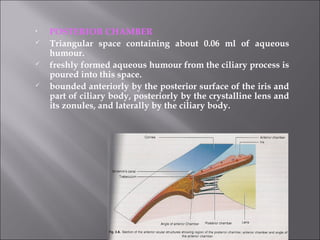
• POSTERIOR CHAMBER
 Triangular space containing about 0.06 ml of aqueous
humour.
 freshly formed aqueous humour from the ciliary process is
poured into this space.
 bounded anteriorly by the posterior surface of the iris and
part of ciliary body, posteriorly by the crystalline lens and
its zonules, and laterally by the ciliary body.
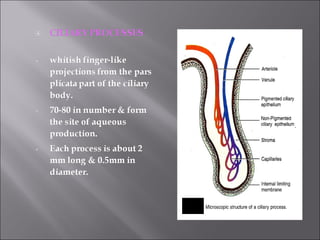
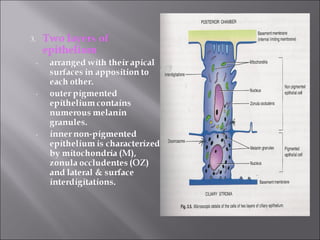
1. The network of capillaries
 occupies the centre of each process.
 Each capillary consists of a very thin endothelium with
fenestrae or false pores which is lined by (the site of
increased permeability) a basement membrane.
1. Stroma of ciliary process
 is very thin & separates the capillary network from the
epithelial layers.
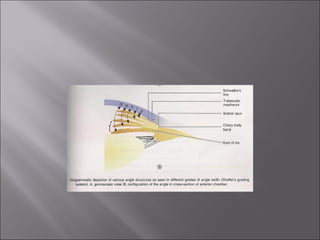
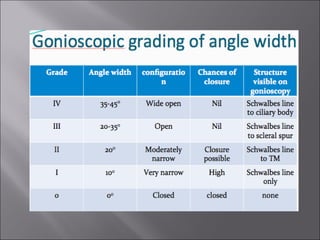
ANGLE OF ANTERIOR CHAMBER
 Formed by the following structure
1 The ciliary band
2 Scleral spur
3 Trabecular meshwork
4 Schwalbe’s line
 Ciliary processes are the site of aqueous
formation which is primarily derived from the
plasma within capillaries of cilliary processes.
1.Diffusion (10%)-
Mol. of gas/solution distribute themselves uniformly
throughout the space in which they are contained, by net
flux of particles from area of higher conc. to area of lower
conc.
 Fick’s law of diffusion
Rate of movement=k( c1-c2)
K is constant which depends on nature and
permeability of membrane, nature of solute and
solvent and temp.
C1- conc. of substance on side with higher conc.
C2-conc. of substance on side with lower conc.
2. Ultrafiltration (20%)- depends on hydrostatic
pressure and solute conc. of plasma in capillaries
of cilliary processes
3. Secretion (70%)- active process against conc.
gradient. water soluble substances of large mol.
size and greater charge are actively transported.
A. Formation of stromal pool:
 First step in the formation of aqueous.
 by ultra filtration of plasma, most substances pass easily from
the capillaries of the ciliary processes
 this ultra filtrate accumulates behind the tight junctions of the
NPE
 due to fenestrations in ciliary capillaries, proteins are also
present in the stromal pool
A. Active transport of stromal filtrates
 filtrates from the plasma accumulated behind tight junction of
NPE & transport actively across NPE.
 Evidence of active transport occurring across NPE, comes from
presence of the following
 Abundant Na+ - K+ - active ATPase
 Presence of more mitochondria
 Higher adenyl cyclase activity
 Higher specific activity for glycolytic enzymes
 Passive transport across non-pigmented ciliary
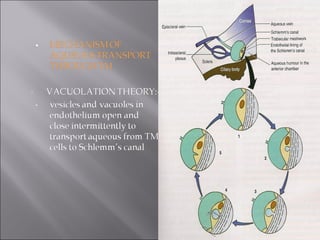
epitheliam
 Active transport of the substances across the NPE results
in an osmotic and electrical gradient.
 To maintain the balance of osmotic and electrical forces,
water, chloride & other small plasma constituents then
move into the posterior chamber by ultrafiltration &
diffusion.
 Sodium is primarily responsible for movement of water
into the posterior chamber and its secretion is a major
factor in the formation of aqueous.
C. FLUID TRANSFER THROUGH GAP
JUNCTIONS
 Gap junctions between PE and NPE formed by
connexins Cx43 and Cx40
 But functionally less significant
 Aqueous is thus formed by parallel couplets of
PE-NPE cell gap junctions.
D. FLUID TRANSFER INTO AQUEOUS HUMOUR
 final step in aqueous secretion.
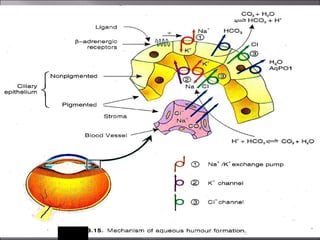
 Solutes and water are transported across the basolateral
membrane of NPE.
 Na+
- K+
ATPase releases(70%) Na+
against electrochemical
gradient into aqueous, remaining (30%/) transported
passively or by ultra filtration.
 Cl-
is released along its electrochemical gradient through Cl-
channels.
 Water released along osmotic gradient established by solute
transfer into aqueous through AQP1 and AQP4.
 Bicarbonate exits through HCO3
-
/Cl-
exchangers as well as
Cl-
channels.
 K+
transported by secretion and diffusion
 Ascorbic acid secreted against a conc gradient
 Amino acids are secreted by 3 diff carrier proteins each for
acidic , basic and neutral molecules.
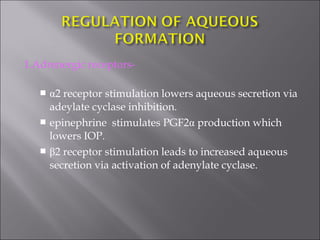
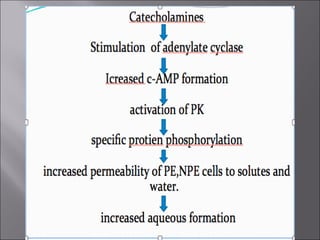
1.Adrenergic receptors-
 α2 receptor stimulation lowers aqueous secretion via
adeylate cyclase inhibition.
 epinephrine stimulates PGF2α production which
lowers IOP.
 β2 receptor stimulation leads to increased aqueous
secretion via activation of adenylate cyclase.
2. Ultrafiltration and diffusion
 these passive mechanisms depend on blood
pressure in cilliary capillaries , plasma oncotic
pressure,and IOP.
3. Vasopressin
 vasopressin stimulates NaCl transport through
PE ,NPE and thus aqueous formation.
 vasopressin levels in turn are indirectly proportional
to plasma osmolarity.
Class 1 methods: measure rate of appearance
and disappearance of a substance from
aqueous
1. Fluorescein techniques
2. Radioactive labelled isotopes
3. Intravenous PAH technique
Class 2 methods: flow= C(Po-Pv)
• C= facility of aqueous outflow
• Po= IOP
• Pv=episcleral venous pressure
1. Perfusion of eyes at a constant pressure
2. Tonography
3. Perilimbal suction cup method
 Water: constitutes about 99.9% of aqueous
 Proteins: about 5-16 mg/dl, whereas in plasma protein
content 6-7g/dl
A:G ratio is same as that of plasma
IgG and IgM are present
plasminogen and its proactivators are present
FGF,TGFβ,IGF1
 Amino acids:- conc varies with aqueous/plasma conc (0.08-
3.14)
 Non colloidal constituents:- similar to that of plasma
 ascorbate, lactate, pyruvate is higher than that in
plasma.
 conc. of glucose and urea is higher than that of plasma.
 bicarbonate, ascorbate levels in post chamber is higher
than in ant chamber
 chloride conc in post chamber is lower than in ant
chamber
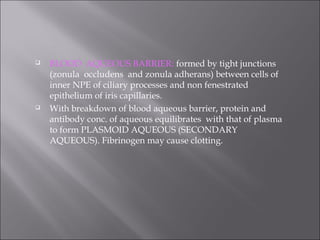
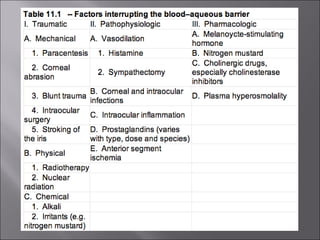
 BLOOD AQUEOUS BARRIER: formed by tight junctions
(zonula occludens and zonula adherans) between cells of
inner NPE of ciliary processes and non fenestrated
epithelium of iris capillaries.
 With breakdown of blood aqueous barrier, protein and
antibody conc. of aqueous equilibrates with that of plasma
to form PLASMOID AQUEOUS (SECONDARY
AQUEOUS). Fibrinogen may cause clotting.
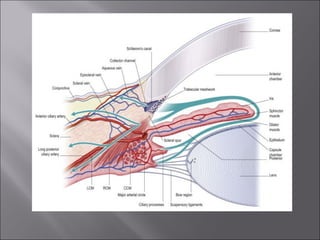
It includes
1. Trabecular meshwork
2. Schlemm’s canal
3. Collector channels
4. Aqueous veins and the Episcleral veins
1. Trabecular meshwork
 Sieve-like structure through which aqueous humour leaves
eye.
 It bridges the scleral sulcus & converts it into tube, which
accommodates the Schlemm’s canal.
 Trabecular meshwork consists of three portions
A. Uveal meshowk
B. Corneoscleral meshwork
C. Juxtacanalicular (endothelial) meshwork
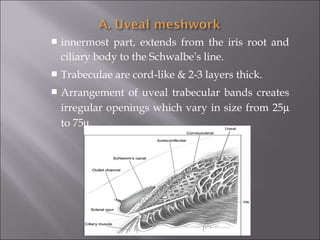
 innermost part, extends from the iris root and
ciliary body to the Schwalbe’s line.
 Trabeculae are cord-like & 2-3 layers thick.
 Arrangement of uveal trabecular bands creates
irregular openings which vary in size from 25µ
to 75µ.
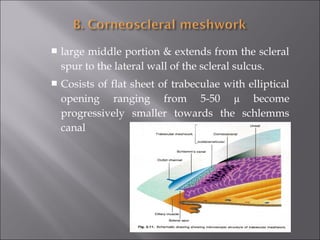
 large middle portion & extends from the scleral
spur to the lateral wall of the scleral sulcus.
 Cosists of flat sheet of trabeculae with elliptical
opening ranging from 5-50 μ become
progressively smaller towards the schlemms
canal
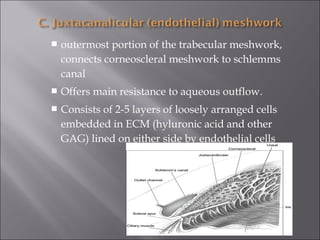
 outermost portion of the trabecular meshwork,
connects corneoscleral meshwork to schlemms
canal
 Offers main resistance to aqueous outflow.
 Consists of 2-5 layers of loosely arranged cells
embedded in ECM (hyluronic acid and other
GAG) lined on either side by endothelial cells
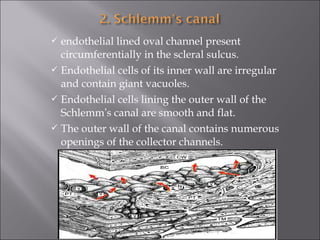
 endothelial lined oval channel present
circumferentially in the scleral sulcus.
 Endothelial cells of its inner wall are irregular
and contain giant vacuoles.
 Endothelial cells lining the outer wall of the
Schlemm’s canal are smooth and flat.
 The outer wall of the canal contains numerous
openings of the collector channels.
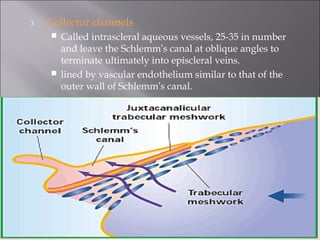
3. Collector channels
 Called intrascleral aqueous vessels, 25-35 in number
and leave the Schlemm’s canal at oblique angles to
terminate ultimately into episcleral veins.
 lined by vascular endothelium similar to that of the
outer wall of Schlemm’s canal.
4. Episcleral veins
 Most of the aqueous vessels drain into the
episcleral veins. Episcleral veins ultimately
drain into the cavernous sinus via the anterior
ciliary and superior ophthalmic veins.
 Aqueous flows from post to ant chamber
through pupil and in AC flows along
conventional current set up due to temp
difference in ant part and post part of AC.
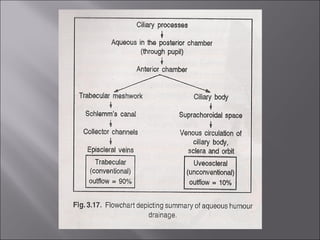
 From AC aqueous is drained by
1. Trabecular(conventional) outflow
2. Uveoscleral( unconventional) outflow
 Drains 75 to 90% aqueous
 Free flow occurs through TM till the juxtacanalicular tissue which
offer some resistance to the outflow.
 SPECIAL CHARACTERISTICS OF TM CELLS:
I. High levels of cytoskeletal actin and lower levels of microtubules
II. Presence of cellular vimentin and desmin
III. AQP1 PROTIENS
IV. High levels of surface tPA
V. GAG degrading enzymes and acid phosphatases
VI. Β2 adrenergic receptors and TIGR
VII. Specialized endocytic / phagocytic properties
2. LEAKY ENDOTHELIAL CELLS
3. SONDERMAN’S CHANNELS : microtubules in TM cells help
aqueous flow from corneoscleral trabecular meshwork into lumen
of Schlemm’s canal .
4. CONTRACTILE MICROFILAMENTS : present in the inner wall
endothelium of Schlemm’s canal & also in the endothelial lining of
trabeculae.
5. PORES IN ENDOTHELIAL CELLS : (3μm ) about 20,000
Transport across collector channels and episcleral
veins
 From the Schlemm’s canal the aqueous is
transported via 25-35 external collector channels
into the episcleral veins by direct and indirect
systems.
 A pressure gradient between intraocular pressure
& intrascleral venous pressure is responsible for
unidirectional flow of aqueous.
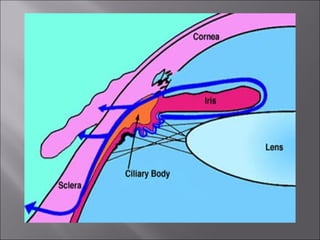
 Aqueous passes across the ciliary body into the
suprachoroidal space and is drained by the venous
circulation in the ciliary body, choroid, sclera and into
the orbital tissue.
 Drains 0.3μl/min
 Drains 10 to 25% of aqueous
 Independent of IOP
 PG increase uveoscleral flow to lower the IOP
 Pressure gradient of 10mm of Hg between IOP
and episcleral venous plexus helps in drainage
 C- value expressed as aq. Outflow in
μl/min/mm of Hg
 It represents quantitative approximation of
state of aq. Drainage system
1. Perfusion method
 C= flow rate / Pi – Po
 Independent of ocular rigidity and corneal curvature
 C=0.28 μl/min/mm of Hg
2. Tonography
 Most commonly used non invasive method
3. Suction cup method
 97.5% population has C value >0.18
 Most glaucoma pt. has C value <0.17
 Significance of C value
1. As adjuncting diagnosis of glaucoma
2. C value < 0.10 or less in angle closure glaucoma after
an acute attack suggest that peripheral iridectomy
may not be sufficient
3. Evaluation of drug mechanism and experimentally
to study abnormality of various influences on aq.
Dynamics
A. Maintenance of IOP
B. Metabolism of avascular stuctures of eye
C. Optical function
D. Clearing function
THANK YOU

Aqueous humour

  • 1.
  • 2.
     Clear, colorless,watery solution, continuously circulated from the posterior chamber of the eye throughout the anterior chamber.  Volume of the aqueous is about 0.31 ml (0.25ml in anterior chamber and about 0.06 ml in the posterior chamber).  Refractive index of the aqueous is 1.336  Osmotic pressure: Aqueous is slightly hyper osmotic to plasma by 3 to 5 mOsm/l.  pH of the aqueous is acidic with a pH in the anterior chamber of 7.2.  RATE OF FORMATION: The normal aqueous production rate is 2.6-2.8 µl/min during day time.
  • 3.
     ANTERIOR CHAMBER bounded anteriorly by the back of cornea and posteriorly by the anterior surface of iris and part of ciliary body.  3mm deep in the centre in normal adults.  contains about 0.25 ml of the aqueous humour.
  • 4.
    • POSTERIOR CHAMBER Triangular space containing about 0.06 ml of aqueous humour.  freshly formed aqueous humour from the ciliary process is poured into this space.  bounded anteriorly by the posterior surface of the iris and part of ciliary body, posteriorly by the crystalline lens and its zonules, and laterally by the ciliary body.
  • 6.
    1. The networkof capillaries  occupies the centre of each process.  Each capillary consists of a very thin endothelium with fenestrae or false pores which is lined by (the site of increased permeability) a basement membrane. 1. Stroma of ciliary process  is very thin & separates the capillary network from the epithelial layers.
  • 8.
    ANGLE OF ANTERIORCHAMBER  Formed by the following structure 1 The ciliary band 2 Scleral spur 3 Trabecular meshwork 4 Schwalbe’s line
  • 11.
     Ciliary processesare the site of aqueous formation which is primarily derived from the plasma within capillaries of cilliary processes. 1.Diffusion (10%)- Mol. of gas/solution distribute themselves uniformly throughout the space in which they are contained, by net flux of particles from area of higher conc. to area of lower conc.
  • 12.
     Fick’s lawof diffusion Rate of movement=k( c1-c2) K is constant which depends on nature and permeability of membrane, nature of solute and solvent and temp. C1- conc. of substance on side with higher conc. C2-conc. of substance on side with lower conc. 2. Ultrafiltration (20%)- depends on hydrostatic pressure and solute conc. of plasma in capillaries of cilliary processes 3. Secretion (70%)- active process against conc. gradient. water soluble substances of large mol. size and greater charge are actively transported.
  • 13.
    A. Formation ofstromal pool:  First step in the formation of aqueous.  by ultra filtration of plasma, most substances pass easily from the capillaries of the ciliary processes  this ultra filtrate accumulates behind the tight junctions of the NPE  due to fenestrations in ciliary capillaries, proteins are also present in the stromal pool A. Active transport of stromal filtrates  filtrates from the plasma accumulated behind tight junction of NPE & transport actively across NPE.  Evidence of active transport occurring across NPE, comes from presence of the following  Abundant Na+ - K+ - active ATPase  Presence of more mitochondria  Higher adenyl cyclase activity  Higher specific activity for glycolytic enzymes
  • 14.
     Passive transportacross non-pigmented ciliary epitheliam  Active transport of the substances across the NPE results in an osmotic and electrical gradient.  To maintain the balance of osmotic and electrical forces, water, chloride & other small plasma constituents then move into the posterior chamber by ultrafiltration & diffusion.  Sodium is primarily responsible for movement of water into the posterior chamber and its secretion is a major factor in the formation of aqueous.
  • 15.
    C. FLUID TRANSFERTHROUGH GAP JUNCTIONS  Gap junctions between PE and NPE formed by connexins Cx43 and Cx40  But functionally less significant  Aqueous is thus formed by parallel couplets of PE-NPE cell gap junctions. D. FLUID TRANSFER INTO AQUEOUS HUMOUR  final step in aqueous secretion.  Solutes and water are transported across the basolateral membrane of NPE.
  • 16.
     Na+ - K+ ATPasereleases(70%) Na+ against electrochemical gradient into aqueous, remaining (30%/) transported passively or by ultra filtration.  Cl- is released along its electrochemical gradient through Cl- channels.  Water released along osmotic gradient established by solute transfer into aqueous through AQP1 and AQP4.  Bicarbonate exits through HCO3 - /Cl- exchangers as well as Cl- channels.  K+ transported by secretion and diffusion  Ascorbic acid secreted against a conc gradient  Amino acids are secreted by 3 diff carrier proteins each for acidic , basic and neutral molecules.
  • 18.
    1.Adrenergic receptors-  α2receptor stimulation lowers aqueous secretion via adeylate cyclase inhibition.  epinephrine stimulates PGF2α production which lowers IOP.  β2 receptor stimulation leads to increased aqueous secretion via activation of adenylate cyclase.
  • 20.
    2. Ultrafiltration anddiffusion  these passive mechanisms depend on blood pressure in cilliary capillaries , plasma oncotic pressure,and IOP. 3. Vasopressin  vasopressin stimulates NaCl transport through PE ,NPE and thus aqueous formation.  vasopressin levels in turn are indirectly proportional to plasma osmolarity.
  • 21.
    Class 1 methods:measure rate of appearance and disappearance of a substance from aqueous 1. Fluorescein techniques 2. Radioactive labelled isotopes 3. Intravenous PAH technique
  • 22.
    Class 2 methods:flow= C(Po-Pv) • C= facility of aqueous outflow • Po= IOP • Pv=episcleral venous pressure 1. Perfusion of eyes at a constant pressure 2. Tonography 3. Perilimbal suction cup method
  • 23.
     Water: constitutesabout 99.9% of aqueous  Proteins: about 5-16 mg/dl, whereas in plasma protein content 6-7g/dl A:G ratio is same as that of plasma IgG and IgM are present plasminogen and its proactivators are present FGF,TGFβ,IGF1  Amino acids:- conc varies with aqueous/plasma conc (0.08- 3.14)
  • 24.
     Non colloidalconstituents:- similar to that of plasma  ascorbate, lactate, pyruvate is higher than that in plasma.  conc. of glucose and urea is higher than that of plasma.  bicarbonate, ascorbate levels in post chamber is higher than in ant chamber  chloride conc in post chamber is lower than in ant chamber
  • 25.
     BLOOD AQUEOUSBARRIER: formed by tight junctions (zonula occludens and zonula adherans) between cells of inner NPE of ciliary processes and non fenestrated epithelium of iris capillaries.  With breakdown of blood aqueous barrier, protein and antibody conc. of aqueous equilibrates with that of plasma to form PLASMOID AQUEOUS (SECONDARY AQUEOUS). Fibrinogen may cause clotting.
  • 27.
    It includes 1. Trabecularmeshwork 2. Schlemm’s canal 3. Collector channels 4. Aqueous veins and the Episcleral veins
  • 29.
    1. Trabecular meshwork Sieve-like structure through which aqueous humour leaves eye.  It bridges the scleral sulcus & converts it into tube, which accommodates the Schlemm’s canal.  Trabecular meshwork consists of three portions A. Uveal meshowk B. Corneoscleral meshwork C. Juxtacanalicular (endothelial) meshwork
  • 30.
     innermost part,extends from the iris root and ciliary body to the Schwalbe’s line.  Trabeculae are cord-like & 2-3 layers thick.  Arrangement of uveal trabecular bands creates irregular openings which vary in size from 25µ to 75µ.
  • 31.
     large middleportion & extends from the scleral spur to the lateral wall of the scleral sulcus.  Cosists of flat sheet of trabeculae with elliptical opening ranging from 5-50 μ become progressively smaller towards the schlemms canal
  • 32.
     outermost portionof the trabecular meshwork, connects corneoscleral meshwork to schlemms canal  Offers main resistance to aqueous outflow.  Consists of 2-5 layers of loosely arranged cells embedded in ECM (hyluronic acid and other GAG) lined on either side by endothelial cells
  • 33.
     endothelial linedoval channel present circumferentially in the scleral sulcus.  Endothelial cells of its inner wall are irregular and contain giant vacuoles.  Endothelial cells lining the outer wall of the Schlemm’s canal are smooth and flat.  The outer wall of the canal contains numerous openings of the collector channels.
  • 34.
    3. Collector channels Called intrascleral aqueous vessels, 25-35 in number and leave the Schlemm’s canal at oblique angles to terminate ultimately into episcleral veins.  lined by vascular endothelium similar to that of the outer wall of Schlemm’s canal.
  • 35.
    4. Episcleral veins Most of the aqueous vessels drain into the episcleral veins. Episcleral veins ultimately drain into the cavernous sinus via the anterior ciliary and superior ophthalmic veins.
  • 36.
     Aqueous flowsfrom post to ant chamber through pupil and in AC flows along conventional current set up due to temp difference in ant part and post part of AC.  From AC aqueous is drained by 1. Trabecular(conventional) outflow 2. Uveoscleral( unconventional) outflow
  • 38.
     Drains 75to 90% aqueous  Free flow occurs through TM till the juxtacanalicular tissue which offer some resistance to the outflow.  SPECIAL CHARACTERISTICS OF TM CELLS: I. High levels of cytoskeletal actin and lower levels of microtubules II. Presence of cellular vimentin and desmin III. AQP1 PROTIENS IV. High levels of surface tPA V. GAG degrading enzymes and acid phosphatases VI. Β2 adrenergic receptors and TIGR VII. Specialized endocytic / phagocytic properties
  • 40.
    2. LEAKY ENDOTHELIALCELLS 3. SONDERMAN’S CHANNELS : microtubules in TM cells help aqueous flow from corneoscleral trabecular meshwork into lumen of Schlemm’s canal . 4. CONTRACTILE MICROFILAMENTS : present in the inner wall endothelium of Schlemm’s canal & also in the endothelial lining of trabeculae. 5. PORES IN ENDOTHELIAL CELLS : (3μm ) about 20,000
  • 41.
    Transport across collectorchannels and episcleral veins  From the Schlemm’s canal the aqueous is transported via 25-35 external collector channels into the episcleral veins by direct and indirect systems.  A pressure gradient between intraocular pressure & intrascleral venous pressure is responsible for unidirectional flow of aqueous.
  • 42.
     Aqueous passesacross the ciliary body into the suprachoroidal space and is drained by the venous circulation in the ciliary body, choroid, sclera and into the orbital tissue.  Drains 0.3μl/min  Drains 10 to 25% of aqueous  Independent of IOP  PG increase uveoscleral flow to lower the IOP
  • 44.
     Pressure gradientof 10mm of Hg between IOP and episcleral venous plexus helps in drainage  C- value expressed as aq. Outflow in μl/min/mm of Hg  It represents quantitative approximation of state of aq. Drainage system
  • 45.
    1. Perfusion method C= flow rate / Pi – Po  Independent of ocular rigidity and corneal curvature  C=0.28 μl/min/mm of Hg 2. Tonography  Most commonly used non invasive method 3. Suction cup method
  • 46.
     97.5% populationhas C value >0.18  Most glaucoma pt. has C value <0.17  Significance of C value 1. As adjuncting diagnosis of glaucoma 2. C value < 0.10 or less in angle closure glaucoma after an acute attack suggest that peripheral iridectomy may not be sufficient 3. Evaluation of drug mechanism and experimentally to study abnormality of various influences on aq. Dynamics
  • 47.
    A. Maintenance ofIOP B. Metabolism of avascular stuctures of eye C. Optical function D. Clearing function
  • 48.