Macrolide antibiotics
Dr. S. Parasuraman
Associate Professor, Unit of Pharmacology,
Faculty of Pharmacy, AIMST University, Malaysia.
Macrolide antibiotics
• The macrolides are a group of antibiotics with a
macrocyclic lactone structure to which one or more deoxy
sugars are attached.
• Erythromycin is the first member discovered in the 1950s,
Roxithromycin, Clarithromycin, Telithromycin and
Azithromycin are the later additions.
• Telithromycin, a semisynthetic derivative of erythromycin,
is the first “ketolide [Ketolides are derived from
erythromycin by substituting the cladinose sugar with a
keto-group]” antimicrobial agent.
Mechanism of action of macrolides
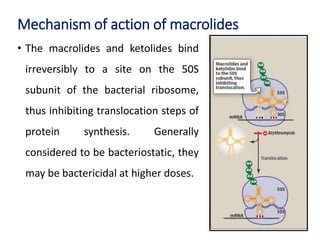
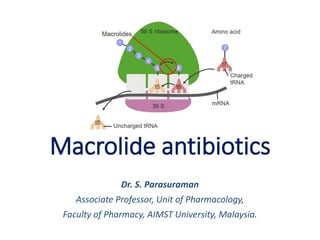
• The macrolides and ketolides bind
irreversibly to a site on the 50S
subunit of the bacterial ribosome,
thus inhibiting translocation steps of
protein synthesis. Generally
considered to be bacteriostatic, they
may be bactericidal at higher doses.
Antibacterial spectrum of macrolides
• Erythromycin: This drug is effective against many of the
same organisms as penicillin G (active against gram-
positive bacteria such as Staphylococcus, Streptococcus,
and Pneumococci); therefore, it may be considered as an
alternative in patients with penicillin allergy.
• Clarithromycin: Clarithromycin has activity similar to
erythromycin, but it is also effective against Haemophilus
influenzae and has greater activity against intracellular
pathogens such as Chlamydia, Legionella, Moraxella,
Ureaplasma species, and Helicobacter pylori.
Antibacterial spectrum of macrolides
• Roxithromycin: Roxithromycin is a long-acting acid stable
semisynthetic derivative of erythromycin with an N-oxime
side chain on the lactone ring having antibacterial and
antimalarial activities. It shows potent activity against
Gardnerella vaginalis, Moraxella catarrhalis (Branhamella
catarrhalis), Haemophilus ducreyi, etc.
Antibacterial spectrum of macrolides
• Azithromycin: It is less active than erythromycin against
streptococci and staphylococci. Azithromycin is far more
active against respiratory pathogens such as H. influenzae
and Moraxella catarrhalis. Extensive use of azithromycin
has resulted in growing Streptococcus pneumoniae
resistance.
• Telithromycin: Telithromycin has an antimicrobial
spectrum similar to that of azithromycin.
Resistance to macrolides
• Resistance to macrolides is associated with:
• the inability of the organism to take up the antibiotic,
• the presence of efflux pumps,
• a decreased affinity of the 50S ribosomal subunit for the
antibiotic due to methylation of an adenine in the 23S
bacterial ribosomal RNA in gram-positive organisms,
• the presence of plasmid-associated erythromycin esterases
in gram-negative organisms such as the Enterobacteriaceae.
Pharmacokinetics properties of macrolides
• Absorption: Erythromycin like drug is administered as enteric-coated
tablets or esterified forms of the antibiotic, orally. Telithromycin is
administered orally without regard to meals. Erythromycin and
azithromycin are available in IV formulations.
• Distribution: Erythromycin distributes well to all body fluids except
the CSF. It is one of the few antibiotics that diffuse into prostatic fluid.
• Elimination: Macrolides are extensively metabolized in the liver by
the CYP450 system. Interference with the metabolism of drugs such
as theophylline, statins, and numerous antiepileptics. Azithromycin is
primarily concentrated and excreted in the bile as active drug.
Erythromycin and its metabolites are also excreted in the bile.
Adverse effects of macrolides
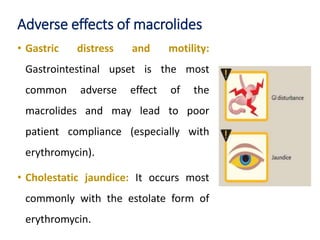
• Gastric distress and motility:
Gastrointestinal upset is the most
common adverse effect of the
macrolides and may lead to poor
patient compliance (especially with
erythromycin).
• Cholestatic jaundice: It occurs most
commonly with the estolate form of
erythromycin.
Adverse effects of macrolides
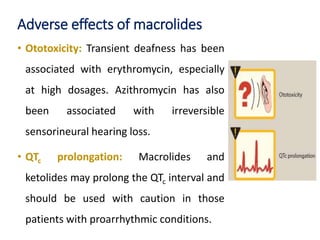
• Ototoxicity: Transient deafness has been
associated with erythromycin, especially
at high dosages. Azithromycin has also
been associated with irreversible
sensorineural hearing loss.
• QTc prolongation: Macrolides and
ketolides may prolong the QTc interval and
should be used with caution in those
patients with proarrhythmic conditions.
Drug interactions of macrolides
• Erythromycin, telithromycin,
roxithromycin, and
clarithromycin inhibit the
hepatic metabolism of a
number of drugs, which can
lead to toxic accumulation of
these compounds.
Contraindications of macrolides
• Patients with hepatic dysfunction should be treated
cautiously with erythromycin, telithromycin, or
azithromycin, because these drugs accumulate in the liver.
Reference: Macrolides. Available in https://tmedweb.tulane.edu/pharmwiki/doku.php/macrolides [Last assessed on 24 Apr. 2022]

Macrolide antibiotics.pptx

  • 1.
    Macrolide antibiotics Dr. S.Parasuraman Associate Professor, Unit of Pharmacology, Faculty of Pharmacy, AIMST University, Malaysia.
  • 2.
    Macrolide antibiotics • Themacrolides are a group of antibiotics with a macrocyclic lactone structure to which one or more deoxy sugars are attached. • Erythromycin is the first member discovered in the 1950s, Roxithromycin, Clarithromycin, Telithromycin and Azithromycin are the later additions. • Telithromycin, a semisynthetic derivative of erythromycin, is the first “ketolide [Ketolides are derived from erythromycin by substituting the cladinose sugar with a keto-group]” antimicrobial agent.
  • 3.
    Mechanism of actionof macrolides • The macrolides and ketolides bind irreversibly to a site on the 50S subunit of the bacterial ribosome, thus inhibiting translocation steps of protein synthesis. Generally considered to be bacteriostatic, they may be bactericidal at higher doses.
  • 4.
    Antibacterial spectrum ofmacrolides • Erythromycin: This drug is effective against many of the same organisms as penicillin G (active against gram- positive bacteria such as Staphylococcus, Streptococcus, and Pneumococci); therefore, it may be considered as an alternative in patients with penicillin allergy. • Clarithromycin: Clarithromycin has activity similar to erythromycin, but it is also effective against Haemophilus influenzae and has greater activity against intracellular pathogens such as Chlamydia, Legionella, Moraxella, Ureaplasma species, and Helicobacter pylori.
  • 5.
    Antibacterial spectrum ofmacrolides • Roxithromycin: Roxithromycin is a long-acting acid stable semisynthetic derivative of erythromycin with an N-oxime side chain on the lactone ring having antibacterial and antimalarial activities. It shows potent activity against Gardnerella vaginalis, Moraxella catarrhalis (Branhamella catarrhalis), Haemophilus ducreyi, etc.
  • 6.
    Antibacterial spectrum ofmacrolides • Azithromycin: It is less active than erythromycin against streptococci and staphylococci. Azithromycin is far more active against respiratory pathogens such as H. influenzae and Moraxella catarrhalis. Extensive use of azithromycin has resulted in growing Streptococcus pneumoniae resistance. • Telithromycin: Telithromycin has an antimicrobial spectrum similar to that of azithromycin.
  • 7.
    Resistance to macrolides •Resistance to macrolides is associated with: • the inability of the organism to take up the antibiotic, • the presence of efflux pumps, • a decreased affinity of the 50S ribosomal subunit for the antibiotic due to methylation of an adenine in the 23S bacterial ribosomal RNA in gram-positive organisms, • the presence of plasmid-associated erythromycin esterases in gram-negative organisms such as the Enterobacteriaceae.
  • 8.
    Pharmacokinetics properties ofmacrolides • Absorption: Erythromycin like drug is administered as enteric-coated tablets or esterified forms of the antibiotic, orally. Telithromycin is administered orally without regard to meals. Erythromycin and azithromycin are available in IV formulations. • Distribution: Erythromycin distributes well to all body fluids except the CSF. It is one of the few antibiotics that diffuse into prostatic fluid. • Elimination: Macrolides are extensively metabolized in the liver by the CYP450 system. Interference with the metabolism of drugs such as theophylline, statins, and numerous antiepileptics. Azithromycin is primarily concentrated and excreted in the bile as active drug. Erythromycin and its metabolites are also excreted in the bile.
  • 9.
    Adverse effects ofmacrolides • Gastric distress and motility: Gastrointestinal upset is the most common adverse effect of the macrolides and may lead to poor patient compliance (especially with erythromycin). • Cholestatic jaundice: It occurs most commonly with the estolate form of erythromycin.
  • 10.
    Adverse effects ofmacrolides • Ototoxicity: Transient deafness has been associated with erythromycin, especially at high dosages. Azithromycin has also been associated with irreversible sensorineural hearing loss. • QTc prolongation: Macrolides and ketolides may prolong the QTc interval and should be used with caution in those patients with proarrhythmic conditions.
  • 11.
    Drug interactions ofmacrolides • Erythromycin, telithromycin, roxithromycin, and clarithromycin inhibit the hepatic metabolism of a number of drugs, which can lead to toxic accumulation of these compounds.
  • 12.
    Contraindications of macrolides •Patients with hepatic dysfunction should be treated cautiously with erythromycin, telithromycin, or azithromycin, because these drugs accumulate in the liver.
  • 13.
    Reference: Macrolides. Availablein https://tmedweb.tulane.edu/pharmwiki/doku.php/macrolides [Last assessed on 24 Apr. 2022]

Editor's Notes

  • #10 Cholestasis is a condition where bile cannot flow from the liver to the duodenum. It is classified into intrahepatic or extrahepatic cholestasis.
  • #11 Cholestasis is a condition where bile cannot flow from the liver to the duodenum. It is classified into intrahepatic or extrahepatic cholestasis.