Downloaded 41 times
- 1 / 34
- 2 / 34
 Most read
- 3 / 34
- 4 / 34
 Most read
- 5 / 34
 Most read
- 6 / 34
- 7 / 34
- 8 / 34
- 9 / 34
- 10 / 34
- 11 / 34
- 12 / 34
- 13 / 34
- 14 / 34
- 15 / 34
- 16 / 34
- 17 / 34
- 18 / 34
- 19 / 34
- 20 / 34


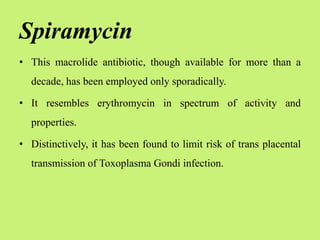
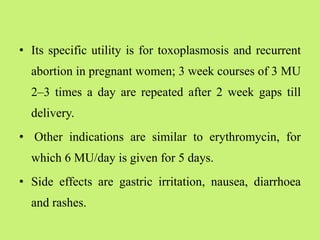


This document provides information about macrolide antibiotics, including erythromycin, newer macrolides, and spiramycin. It discusses their mechanisms of action, spectra of activity, pharmacokinetics, uses, resistance, and side effects. Some of the key points include: - Erythromycin was the first macrolide discovered and is bacteriostatic at low concentrations but bactericidal at high concentrations. It acts by inhibiting bacterial protein synthesis. - Newer macrolides like roxithromycin, clarithromycin, and azithromycin were developed to overcome limitations of erythromycin like acid instability and interactions. They have expanded spectra and better pharmacok


