S. Parasuraman M.Pharm., Ph.D.,
Faculty of Pharmacy, AIMST University.
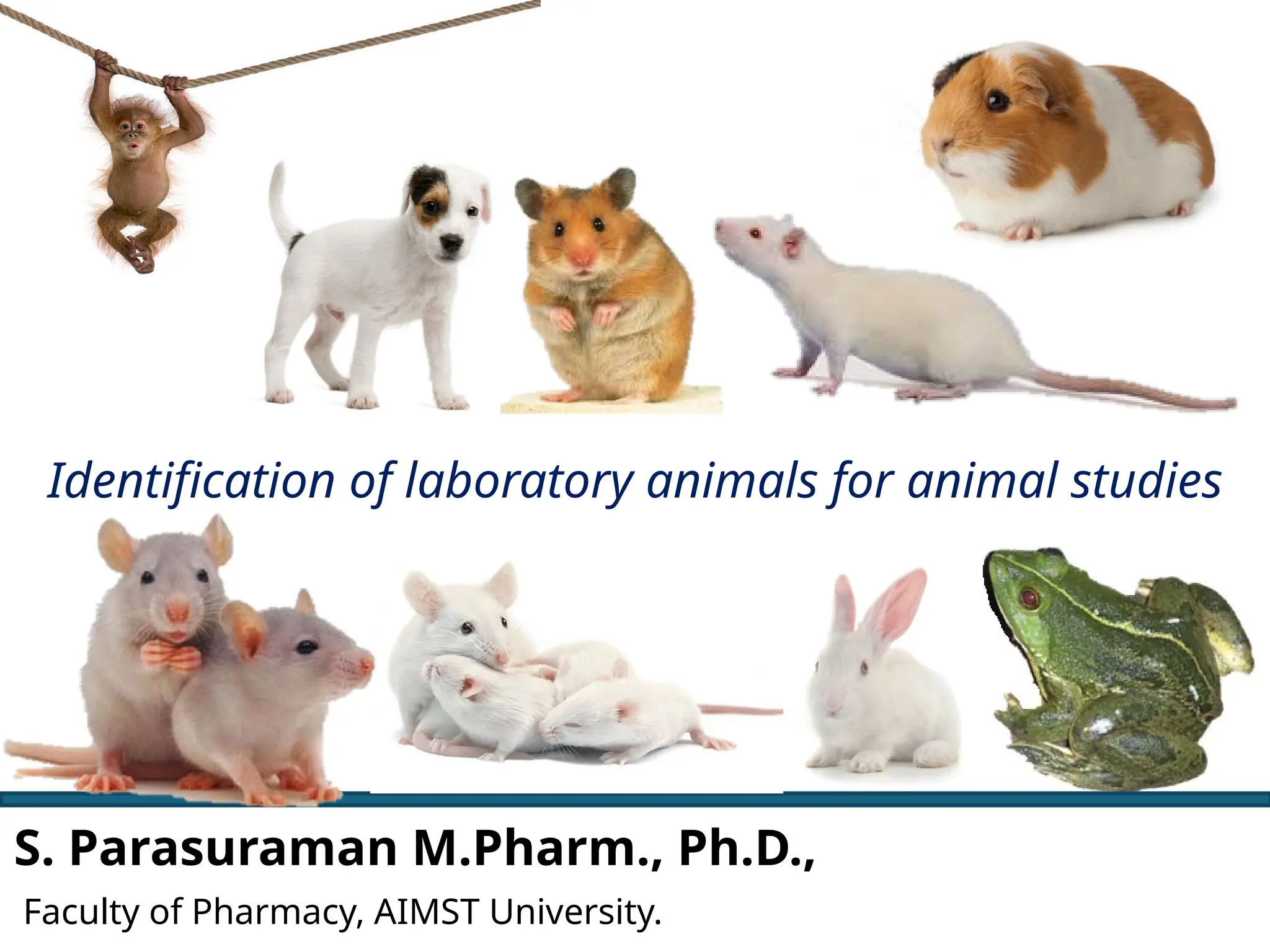
Identification of laboratory animals for animal studies
Laboratory animal identification tools
• Identification of laboratory animals is a critical
component of animal studies, ensuring accurate
tracking, data collection, and compliance with ethical
and scientific standards.
• Animal identification systems also assist with breeding
record keeping.
• The identification of an animal may be link to essential
data, such as sex, genotype, study parameters, and
results.
• Different methods are used depending on the species,
study requirements, and the need for permanent or
temporary identification.
Permanent identification methods
• Ear notching
• Branding / Tattooing
• Radio frequency identification technology (Microchips)
• Toe clipping
Temporary identification methods
• Marker pens or dyes
• Cage cards
• Ear tagging
Importance of lab animal identification
• Tracking and Record-Keeping: Identifying animals
allows for the accurate tracking of data related to each
individual, such as their health, genetics, and
treatments. This helps researchers to monitor the
progress and outcomes of the experiments.
• Compliance with Ethical Standards and
Regulations: The regulations required proper
identification of lab animals to ensure humane
treatment and adequate care.
• Health and Welfare Monitoring: Identification allows
for monitoring of health status and any treatments
given. If an animal becomes ill, its medical history can
be reviewed quickly, improving the chances of early
diagnosis and effective treatments.
Importance of lab animal identification
• Inventory Management: Animal identification
systems help with inventory control, ensuring that the
right animals are available for specific experiments.
• Facilitating Long-Term Studies: In long-term studies,
animals may be tracked throughout the experiment.
Sometimes, the study involves multiple phases of
research. Proper identification ensures continuity and
allows for the correct animal to be followed
throughout the study’s duration.
• Ethical Review: Proof of animal identification as part
of the ethical review process to ensure that the
animal’s participation in research is justified.
Permanent
identification methods
Ear notching
• Ear notching is a very traditional method of identification in
swine.
• Ear notching - cut part of ear using an agreed code.
• Used to identify mice, rats, and other small rodents.
• Advantages:
• Permanent
• Visible
• Inexpensive way to identify individual animal
• Low cost
• provides unique identifiers
• Disadvantages
• Requires skill
• Large area of the ear shell could be removed
• May cause minor distress
• Increased chance of errors (mismarking and misreading)
• It is not legally acceptable
Branding / Tattooing
• Tattooing is the best permanent method of identification for
registered animals.
• Tattooing is made by applying ink to the skin using a needle
or tattoo machine. Appropriate tattoo sites include: tail –all
rodents, ears –guinea pigs.
• Used to identify mice, rats, rabbits, and larger animals.
• Advantages:
• Permanent
• Visible
• Disadvantages
• Requires anesthesia for small animals
• Potential fading over time
• Potential for infection
• May be difficult to read in pigmented animals
• Identification mark cannot be read easily from a distance and may
require a secondary method of identification, such as an ear tag
Radio frequency identification (RFID)
technology (Microchips)
• Pet microchips are a simple and safe technology.
• Microchips provide a reliable, convenient, and permanent
solution for the positive identification of laboratory animals.
microchip transponders are implanted via subcutaneous
injection.
• Used to identify mice, rats, rabbits, and larger animals.
• Advantages:
• No anesthesia required
• Easy to read
• Quick placement of chips
• Some chips can be linked to computer system that records other data
about the animal
• Disadvantages
• Initial cost of equipment
• Chips can fall out
• Requires special equipment to read identification
• Potential for infection
Radio frequency identification (RFID)
technology (Microchips)
• Benefits of RFID microchips for lab animal
identification
• PERMANENT - Confidence that animals will never lose their
identification.
• UNIQUE - Each microchip contains a unique, non-repeating
identification code.
• ACCURATE - Eliminate misreading and data entry errors inherent
in other methods.
• CONVENIENT - Animal ID and data collected within seconds with
a simple scan.
• EFFICIENT - Provides an effective system for unique
identification of individual animals in a group.
• EASY TO USE - Quick and simple insertion with a pre-assembled
cannula.
• SIMPLE DATA COLLECTION - Retrieve ID and data within seconds
without disturbing the animals.
Radio frequency identification (RFID)
technology (Microchips)
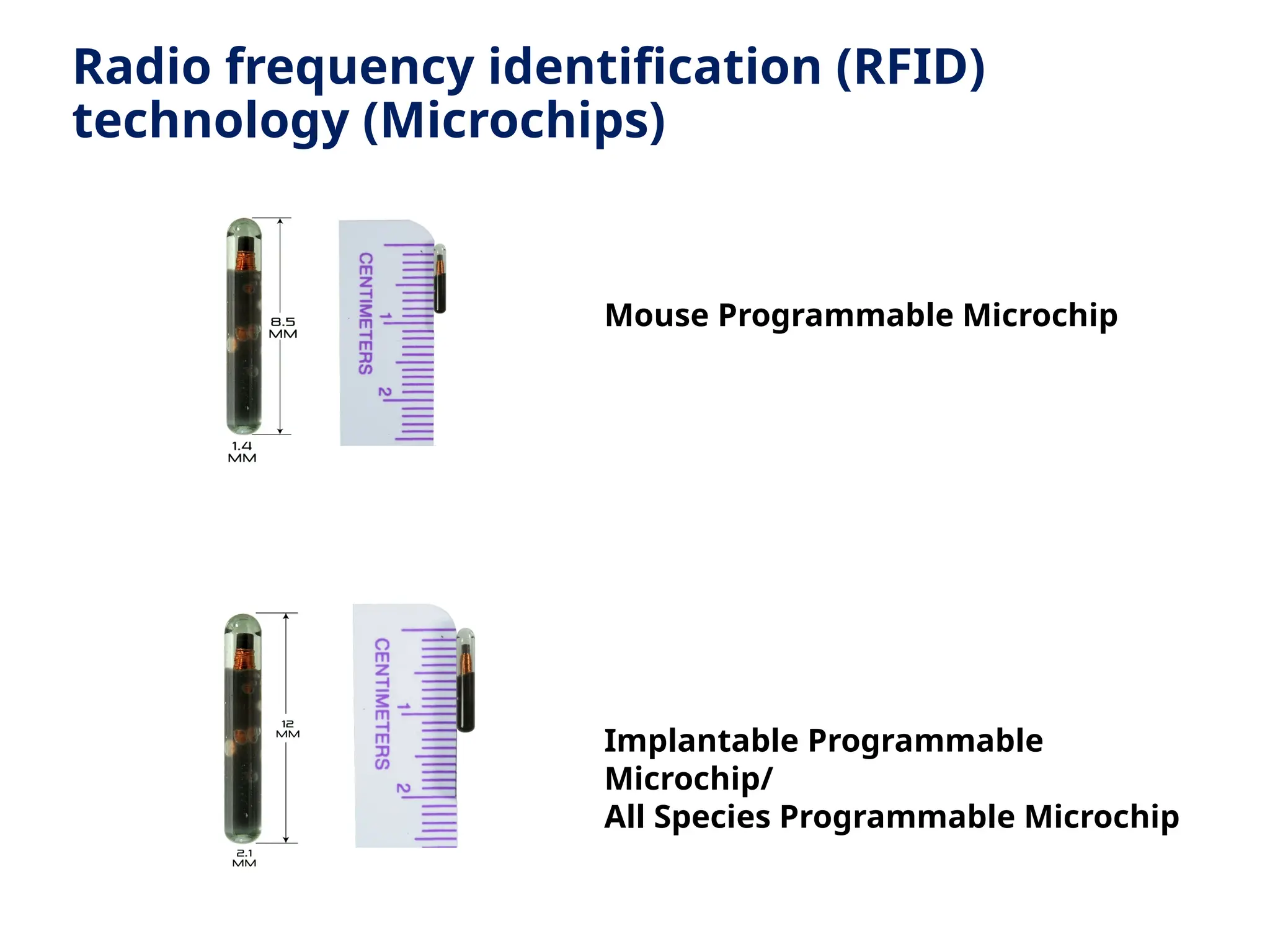
Mouse Programmable Microchip
Implantable Programmable
Microchip/
All Species Programmable Microchip
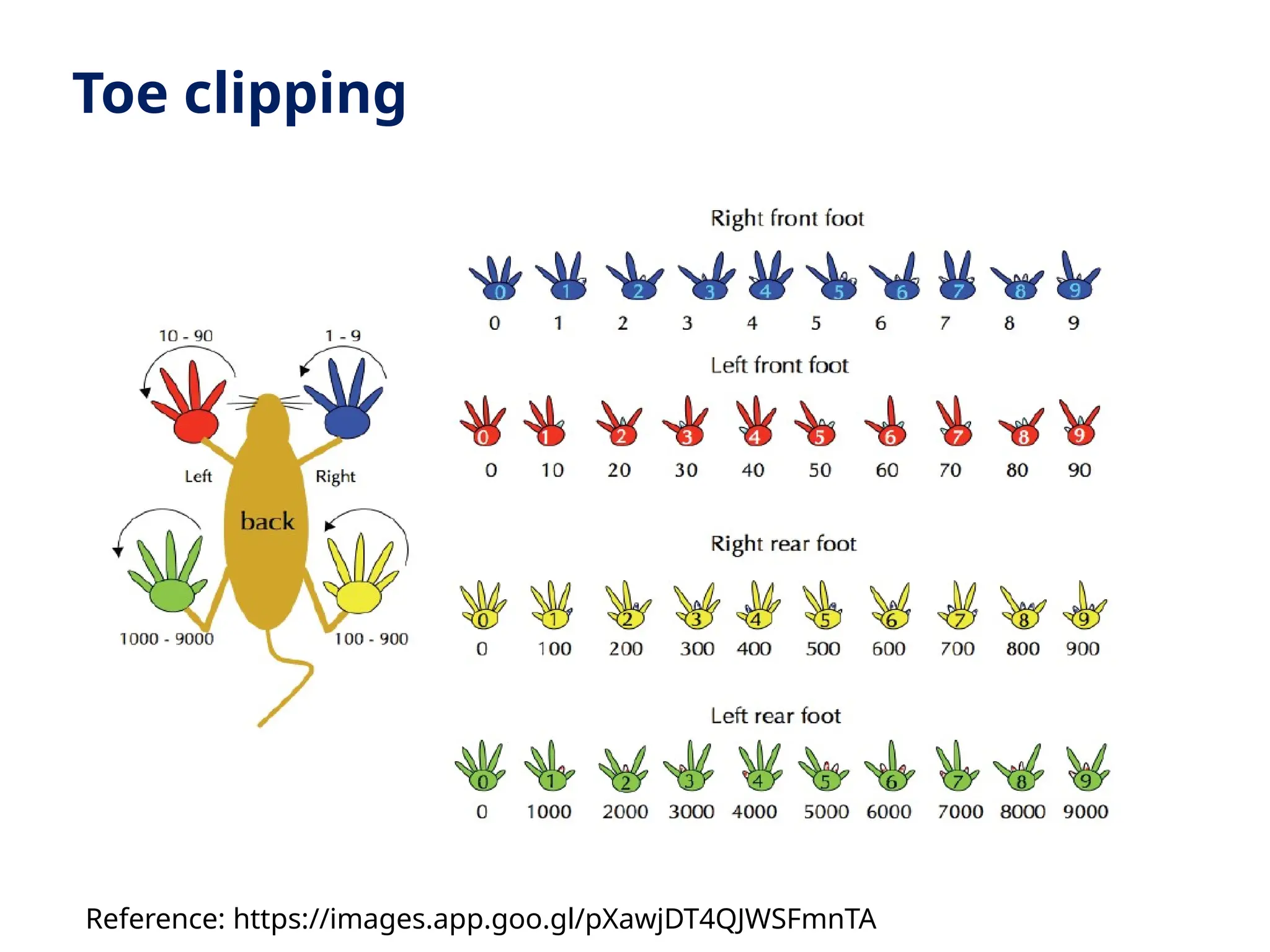
Toe clipping
• Toe-clipping is removal of a small part of a toe.
• Toe-clipping should be used only when no other individual
identification method is feasible. It may be the preferred
method for neonatal mice up to 7 days of age as it appears to
have few adverse effects on behavior and well-being at this
age. Under all circumstances aseptic practices should be
followed. Use of anesthesia or analgesia should be adequate
with the age of the animals.
• Used to identify mice, under strict ethical conditions.
• Advantages:
• Easy to read
• Inexpensive
• Successfully employed in neonates
• Clipped tissue can be used for DNA (PCR) screening
• Disadvantages:
• Potentially painful procedure
• Lameness
• Infection
• Decreased grasping ability
• Significant ethical concerns; often avoided
Toe clipping
Reference: https://images.app.goo.gl/pXawjDT4QJWSFmnTA
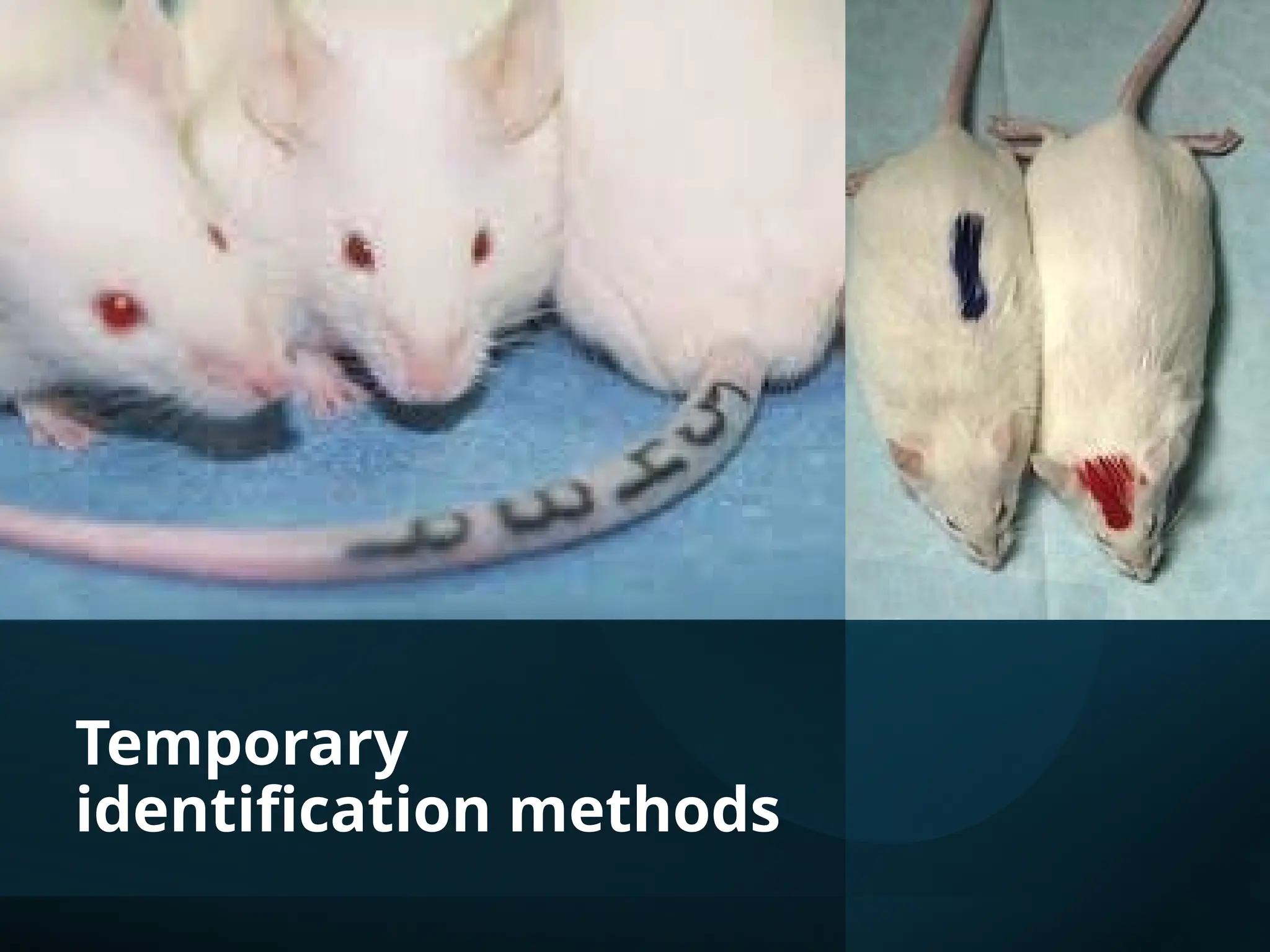
Temporary
identification methods
Marker pens or dyes
• Non-toxic ink or dyes applied to fur or skin to identify the
animals.
• Used to identify mice, rats, and other small animals.
• Advantages:
• Non-invasive, easy to apply.
• Painless and easy procedure.
• May be used on rodents of all ages.
• Both fur and tail may be stained
• Large marks and patterns are clearly visible and allow easy identification
by staff
• Disadvantages
• Temporary
• Dyes may fade over time or due to grooming.
• Need to conduct daily monitoring to assess the condition of the mark.
• Need to renew the mark as it fades, especially in long-term experiments.
• Predominantly may be used on white-furred rodents.
Reference: Klabukov et al. Animals (Basel). 2023;13(22):3452.
Cage cards
• Cards with identification information attached to
cages. Cage cards are the methods of identifying
animals, and are used in conjunction with other
methods to ensure the correct animal is in the right
place and receiving the right treatment.
• Rodent and rabbit cages must have cage cards labeled
with the following information: source of the animal,
the strain or stock, principal investigator (PI), arrival
date and /or date of birth, protocol number, duration
of explement (if applicable), the sex and number of
animals in the cage.
• Rodents can also be individually identified to ensure
accurate records by ear notching, ear tags, micro-
chipping, tattooing and toe clipping. Refer to Rodent
Husbandry Care policy for species specific information.
Cage cards or tags
• Used to identify group housing of small animals.
• Advantages: Simple and cost-effective.
• Disadvantages: Does not uniquely identify individual
animals.
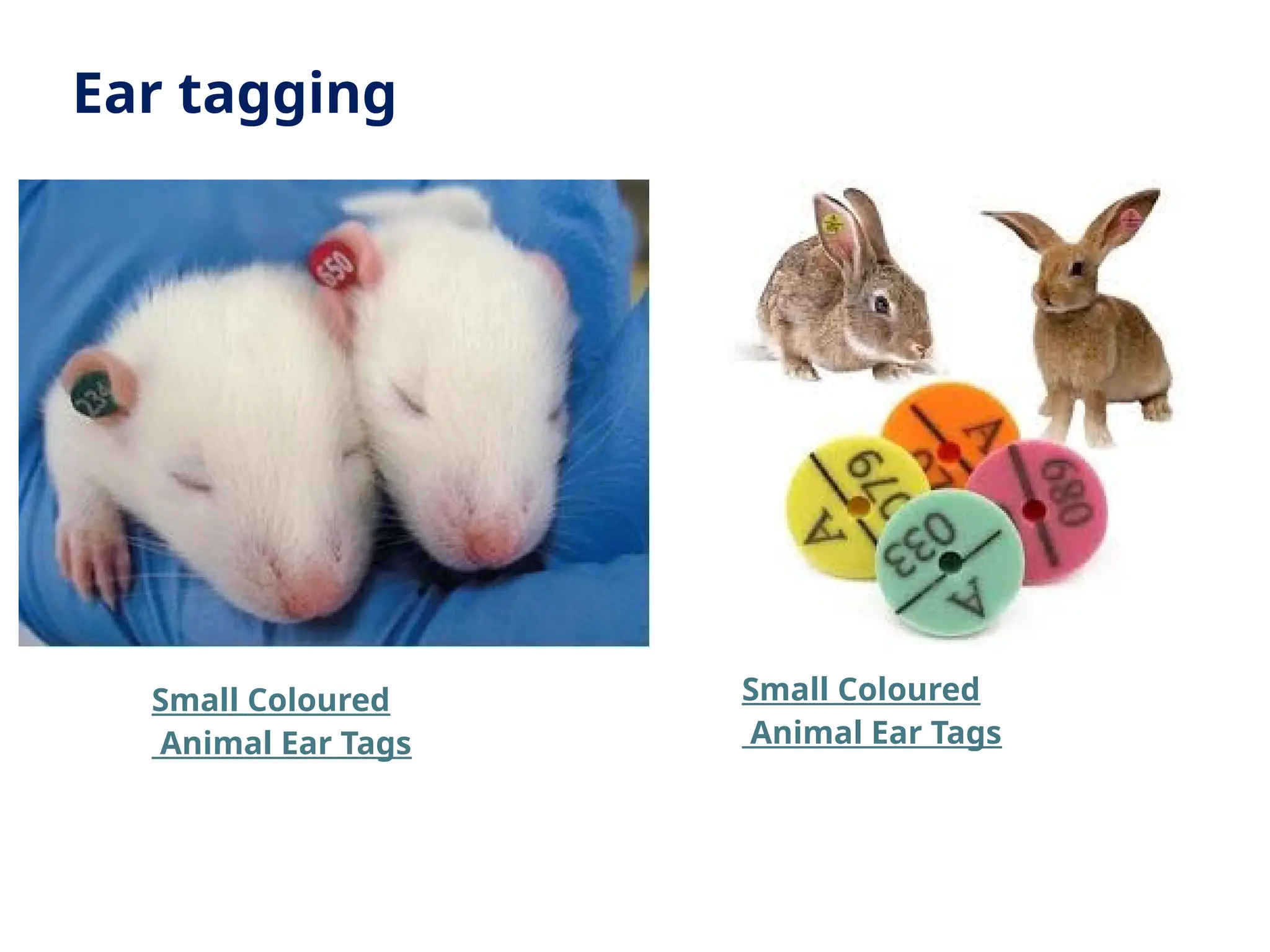
Ear tagging
• Ear tagging is a common method of identifying livestock
that involves attaching a unique tag to an animal's ear.
• Ear tagging is perceived as less painful or stressful than
tattooing and therefore is generally considered less
harmful. Ear tags are available for most livestock
including cattle, sheep, goats, and pigs.
• Used to identify mice, rats, rabbits, and other species.
• Advantages: Visible and semi-permanent.
• Disadvantages:
• Can cause irritation or be lost.
• Wrongly applied ear tags can result in tissue problems,
infections, or severe pain.
• Tags are considered a semi-permanent identification method
because they can break.
• Metallic ear tags are associated with infections
Ear tagging
Small Coloured
Animal Ear Tags
Small Coloured
Animal Ear Tags
Ethical Considerations
• Animal Welfare: Ensure methods minimize pain,
stress, and long-term effects.
• Regulatory Compliance: Follow guidelines from
governing bodies.
• Training: Identification methods must be performed
by trained personnel to ensure accuracy and humane
handling.
Thank you

Identification of laboratory animals for animal studies.pptx

  • 1.
    S. Parasuraman M.Pharm.,Ph.D., Faculty of Pharmacy, AIMST University. Identification of laboratory animals for animal studies
  • 2.
    Laboratory animal identificationtools • Identification of laboratory animals is a critical component of animal studies, ensuring accurate tracking, data collection, and compliance with ethical and scientific standards. • Animal identification systems also assist with breeding record keeping. • The identification of an animal may be link to essential data, such as sex, genotype, study parameters, and results. • Different methods are used depending on the species, study requirements, and the need for permanent or temporary identification.
  • 3.
    Permanent identification methods •Ear notching • Branding / Tattooing • Radio frequency identification technology (Microchips) • Toe clipping
  • 4.
    Temporary identification methods •Marker pens or dyes • Cage cards • Ear tagging
  • 5.
    Importance of labanimal identification • Tracking and Record-Keeping: Identifying animals allows for the accurate tracking of data related to each individual, such as their health, genetics, and treatments. This helps researchers to monitor the progress and outcomes of the experiments. • Compliance with Ethical Standards and Regulations: The regulations required proper identification of lab animals to ensure humane treatment and adequate care. • Health and Welfare Monitoring: Identification allows for monitoring of health status and any treatments given. If an animal becomes ill, its medical history can be reviewed quickly, improving the chances of early diagnosis and effective treatments.
  • 6.
    Importance of labanimal identification • Inventory Management: Animal identification systems help with inventory control, ensuring that the right animals are available for specific experiments. • Facilitating Long-Term Studies: In long-term studies, animals may be tracked throughout the experiment. Sometimes, the study involves multiple phases of research. Proper identification ensures continuity and allows for the correct animal to be followed throughout the study’s duration. • Ethical Review: Proof of animal identification as part of the ethical review process to ensure that the animal’s participation in research is justified.
  • 7.
  • 8.
    Ear notching • Earnotching is a very traditional method of identification in swine. • Ear notching - cut part of ear using an agreed code. • Used to identify mice, rats, and other small rodents. • Advantages: • Permanent • Visible • Inexpensive way to identify individual animal • Low cost • provides unique identifiers • Disadvantages • Requires skill • Large area of the ear shell could be removed • May cause minor distress • Increased chance of errors (mismarking and misreading) • It is not legally acceptable
  • 9.
    Branding / Tattooing •Tattooing is the best permanent method of identification for registered animals. • Tattooing is made by applying ink to the skin using a needle or tattoo machine. Appropriate tattoo sites include: tail –all rodents, ears –guinea pigs. • Used to identify mice, rats, rabbits, and larger animals. • Advantages: • Permanent • Visible • Disadvantages • Requires anesthesia for small animals • Potential fading over time • Potential for infection • May be difficult to read in pigmented animals • Identification mark cannot be read easily from a distance and may require a secondary method of identification, such as an ear tag
  • 10.
    Radio frequency identification(RFID) technology (Microchips) • Pet microchips are a simple and safe technology. • Microchips provide a reliable, convenient, and permanent solution for the positive identification of laboratory animals. microchip transponders are implanted via subcutaneous injection. • Used to identify mice, rats, rabbits, and larger animals. • Advantages: • No anesthesia required • Easy to read • Quick placement of chips • Some chips can be linked to computer system that records other data about the animal • Disadvantages • Initial cost of equipment • Chips can fall out • Requires special equipment to read identification • Potential for infection
  • 11.
    Radio frequency identification(RFID) technology (Microchips) • Benefits of RFID microchips for lab animal identification • PERMANENT - Confidence that animals will never lose their identification. • UNIQUE - Each microchip contains a unique, non-repeating identification code. • ACCURATE - Eliminate misreading and data entry errors inherent in other methods. • CONVENIENT - Animal ID and data collected within seconds with a simple scan. • EFFICIENT - Provides an effective system for unique identification of individual animals in a group. • EASY TO USE - Quick and simple insertion with a pre-assembled cannula. • SIMPLE DATA COLLECTION - Retrieve ID and data within seconds without disturbing the animals.
  • 12.
    Radio frequency identification(RFID) technology (Microchips) Mouse Programmable Microchip Implantable Programmable Microchip/ All Species Programmable Microchip
  • 13.
    Toe clipping • Toe-clippingis removal of a small part of a toe. • Toe-clipping should be used only when no other individual identification method is feasible. It may be the preferred method for neonatal mice up to 7 days of age as it appears to have few adverse effects on behavior and well-being at this age. Under all circumstances aseptic practices should be followed. Use of anesthesia or analgesia should be adequate with the age of the animals. • Used to identify mice, under strict ethical conditions. • Advantages: • Easy to read • Inexpensive • Successfully employed in neonates • Clipped tissue can be used for DNA (PCR) screening • Disadvantages: • Potentially painful procedure • Lameness • Infection • Decreased grasping ability • Significant ethical concerns; often avoided
  • 14.
  • 15.
  • 16.
    Marker pens ordyes • Non-toxic ink or dyes applied to fur or skin to identify the animals. • Used to identify mice, rats, and other small animals. • Advantages: • Non-invasive, easy to apply. • Painless and easy procedure. • May be used on rodents of all ages. • Both fur and tail may be stained • Large marks and patterns are clearly visible and allow easy identification by staff • Disadvantages • Temporary • Dyes may fade over time or due to grooming. • Need to conduct daily monitoring to assess the condition of the mark. • Need to renew the mark as it fades, especially in long-term experiments. • Predominantly may be used on white-furred rodents. Reference: Klabukov et al. Animals (Basel). 2023;13(22):3452.
  • 17.
    Cage cards • Cardswith identification information attached to cages. Cage cards are the methods of identifying animals, and are used in conjunction with other methods to ensure the correct animal is in the right place and receiving the right treatment. • Rodent and rabbit cages must have cage cards labeled with the following information: source of the animal, the strain or stock, principal investigator (PI), arrival date and /or date of birth, protocol number, duration of explement (if applicable), the sex and number of animals in the cage. • Rodents can also be individually identified to ensure accurate records by ear notching, ear tags, micro- chipping, tattooing and toe clipping. Refer to Rodent Husbandry Care policy for species specific information.
  • 18.
    Cage cards ortags • Used to identify group housing of small animals. • Advantages: Simple and cost-effective. • Disadvantages: Does not uniquely identify individual animals.
  • 19.
    Ear tagging • Eartagging is a common method of identifying livestock that involves attaching a unique tag to an animal's ear. • Ear tagging is perceived as less painful or stressful than tattooing and therefore is generally considered less harmful. Ear tags are available for most livestock including cattle, sheep, goats, and pigs. • Used to identify mice, rats, rabbits, and other species. • Advantages: Visible and semi-permanent. • Disadvantages: • Can cause irritation or be lost. • Wrongly applied ear tags can result in tissue problems, infections, or severe pain. • Tags are considered a semi-permanent identification method because they can break. • Metallic ear tags are associated with infections
  • 20.
    Ear tagging Small Coloured AnimalEar Tags Small Coloured Animal Ear Tags
  • 21.
    Ethical Considerations • AnimalWelfare: Ensure methods minimize pain, stress, and long-term effects. • Regulatory Compliance: Follow guidelines from governing bodies. • Training: Identification methods must be performed by trained personnel to ensure accuracy and humane handling.
  • 22.

Editor's Notes

  • #2 https://www.somarkinnovations.com/lab-animal-identification/
  • #5 https://www.somarkinnovations.com/lab-animal-identification/
  • #6 https://www.somarkinnovations.com/lab-animal-identification/
  • #10 https://www.uidevices.com/laboratory-animal-identification/
  • #11 https://www.uidevices.com/laboratory-animal-identification/
  • #12 https://www.uidevices.com/laboratory-animal-identification/
  • #16 https://pmc.ncbi.nlm.nih.gov/articles/PMC10668729/