Hypolipidaemic Drugs
• Antihyperlipidemicdrugs, also called hypolipidemic
drugs, are often taken indefinitely to reduce the risk of
Atherosclerotic Cardiovascular Disease (ASCVD) in
select patients and to control plasma lipid levels.
• Normal lipid profile
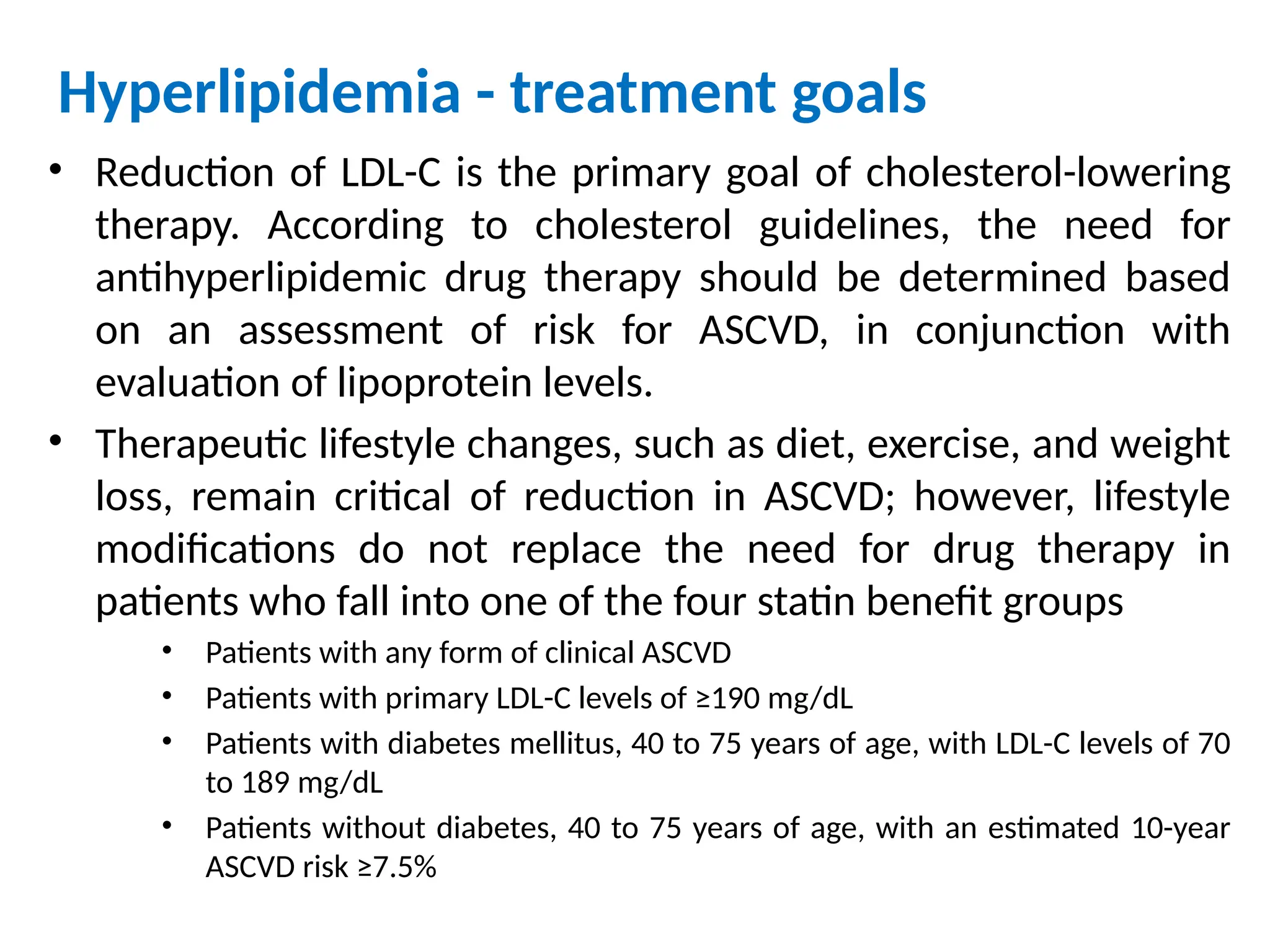
Hyperlipidemia - treatmentgoals
• Reduction of LDL-C is the primary goal of cholesterol-lowering
therapy. According to cholesterol guidelines, the need for
antihyperlipidemic drug therapy should be determined based
on an assessment of risk for ASCVD, in conjunction with
evaluation of lipoprotein levels.
• Therapeutic lifestyle changes, such as diet, exercise, and weight
loss, remain critical of reduction in ASCVD; however, lifestyle
modifications do not replace the need for drug therapy in
patients who fall into one of the four statin benefit groups
• Patients with any form of clinical ASCVD
• Patients with primary LDL-C levels of ≥190 mg/dL
• Patients with diabetes mellitus, 40 to 75 years of age, with LDL-C levels of 70
to 189 mg/dL
• Patients without diabetes, 40 to 75 years of age, with an estimated 10-year
ASCVD risk ≥7.5%
Hypolipidaemic Drugs
Mechanism ofaction of lipid-lowering drugs.
Abbreviations: ACLY = ATP citrate lyase, ASCVD = atherosclerotic cardiovascular disease, HMGR = HMG-CoA
reductase, LDL = low density lipoprotein, LDLR = low density lipoprotein receptor, mAb = monoclonal
antibodies, NPC1L1 = Niemann-Pick C1-Like 1, PCSK9 = proprotein convertase subtilisin/kexin type 9, siRNA
= small interfering RNA, SREBP-2 = sterol regulatory element binding protein 2.
Reference: Bosco G, et al. Management of Statin Intolerant Patients in the Era of Novel Lipid Lowering Therapies: A Critical Approach in Clinical
Practice. J Clin Med. 2023;12(6):2444.
7.
HMG-CoA reductase inhibitors(Statins)
• This class of compounds are the most efficacious, most
commonly used and best tolerated hypolipidaemic drugs.
• MoA: They competitively inhibit conversion of 3-Hydroxy-3-
methyl glutaryl coenzyme A (HMG-CoA) to mevalonate (rate
limiting step in CH synthesis) by the enzyme HMG-CoA
reductase.
• Therapeutic doses reduce CH synthesis by 20–50%. HMG-CoA
reductase activity is maximum at midnight, all statins are
administered at bed time to obtain maximum effectiveness.
• Adverse effects: Elevated liver enzymes may occur with statin
therapy. Therefore, liver function should be evaluated prior to
starting therapy. Myopathy, rhabdomyolysis, renal insufficiency,
vitamin D deficiency and hypothyroidism are reported ADRs.
8.
Bile acid sequestrants(Resins)
• Bile acid sequestrants (resins) have significant LDL-C
lowering effects.
• MoA: Bile acid sequestrants lower LDL cholesterol by
binding to bile acids in the intestines, preventing their
reabsorption.
• Therapeutic uses: The bile acid sequestrants are
useful (often in combination with diet or niacin) for
treating type IIA and type IIB hyperlipidemias.
• ADR: GI disturbances such as constipation, nausea,
and flatulence.
9.
Lipoprotein lipase activators(PPARα activators, Fibrates)
• Fenofibrate and gemfibrozil are derivatives of fibric
acid that lower serum triglycerides and increase HDL-
C.
• MoA: Fibrates are agonists of peroxisome proliferator-
activated receptor alpha (PPARα) that reduce TG and
increase HDL-C levels. PPARα also inhibits
apolipoprotein C-III.
• Therapeutic uses: The fibrates are used in the
treatment of hypertriglyceridemias and type III
hyperlipidemia (dysbetalipoproteinemia).
• ADR: GI upset, myalgia, rashes
10.
Lipolysis and triglyceridesynthesis inhibitor
• Niacin (nicotinic acid) reduces LDL-C by 10% to 20% and is the
most effective agent for increasing HDL-C. It also lowers
triglycerides by 20% to 35% at typical doses of 1.5 to 3 g/day.
Niacin can be used in combination with statins, and fixed-dose
combinations of long-acting niacin with lovastatin and
simvastatin.
• MoA: Niacin strongly inhibits lipolysis in adipose tissue, thereby
reducing production of free fatty acids.
• Therapeutic uses: Because niacin lowers plasma levels of both
cholesterol and triglycerides, it is useful in the treatment of
familial hyperlipidemias.
• ADR: Dyspepsia, vomiting and diarrhoea, Dryness and
hyperpigmentation of skin, liver dysfunction and jaundice and
Hyperglycaemia.
11.
Sterol absorption inhibitor
•Ezetimibe is a novel drug, selectively inhibits
absorption of dietary and biliary cholesterol in the
small intestine, leading to a decrease in the delivery of
intestinal cholesterol to the liver.
• ADR: No specific adverse effect, except reversible
hepatic dysfunction and rarely myositis has been
noted with ezetimibe.