Prepared by :- Ruchita V Bhavsar
1st sem M.Pharm
Guided by :- Mr. Samaresh Pal Roy
HOD of Pharmacology,
SDPC, Kim
 Introduction
 History
 Classification
 Mechanism of Action
 Resistance
 Pharmacokinetics
 Use
 Adverse Effects
 Interaction
2
 The quinolones are a family of synthetic,
broad-spectrum antibiotic with bactericidal
activity.
 The term quinolone refers to potent
synthetic chemotherapeutic antibacterial
agent.
3
 The 1st generation of the quinolones begins with
Nalidixic acid in 1962 for the treatment of
Urinary Tract Infections in humans.
 Nalidixic acid was discovered by George Lesher
and co-workers in a distillate during an attempt
at chloroquine synthesis.
4
 Quinolones (1st generation)
 Highly protein bound
 Mostly used in UTI
 Fluoroquinolones (2nd, 3rd, 4th generation)
 Modified 1st generation quinolones
 Not highly protein bound
 Wide distribution to urine and other tissues
 Limited CSF penetration
5
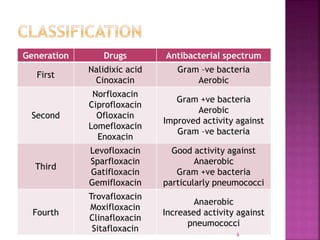
Generation Drugs Antibacterial spectrum
First
Nalidixic acid
Cinoxacin
Gram –ve bacteria
Aerobic
Second
Norfloxacin
Ciprofloxacin
Ofloxacin
Lomefloxacin
Enoxacin
Gram +ve bacteria
Aerobic
Improved activity against
Gram –ve bacteria
Third
Levofloxacin
Sparfloxacin
Gatifloxacin
Gemifloxacin
Good activity against
Anaerobic
Gram +ve bacteria
particularly pneumococci
Fourth
Trovafloxacin
Moxifloxacin
Clinafloxacin
Sitafloxacin
Anaerobic
Increased activity against
pneumococci
6
 The first-generation agents include cinoxacin
and nalidixic acid, which are the oldest and least
often used quinolones.
 Because minimal serum levels are achieved, use
of these drugs has been restricted to the
treatment of uncomplicated urinary tract
infections.
 They are more susceptible to the development
of bacterial resistance.
 These agents are not recommended for use in
patients with poor renal function because of
significantly decreased urine concentrations.
7
 The second-generation quinolones have increased
gram-negative activity, as well as some gram-
positive and atypical pathogen coverage.
 Compared with first-generation drugs, these agents
have broader clinical applications in the treatment
of complicated urinary tract infections and
pyelonephritis, sexually transmitted diseases,
selected pneumonias and skin infections.
 They include ciprofloxacin, lomefloxacin,
norfloxacin, ofloxacin and enoxacin.
 Ciprofloxacin and ofloxacin are the most widely
used because of their availability in oral and
intravenous formulations.
8
 The third-generation quinolones currently include
levofloxacin, gatifloxacin, moxifloxacin and
sparfloxacin.
 These agents are separated into a third class
because of their expanded activity against gram-
positive organisms, particularly penicillin-sensitive
and penicillin-resistant S. pneumoniae, and
atypical pathogens such as Mycoplasma
pneumoniae and Chlamydia pneumoniae.
 Although the third-generation quinolones retain
broad gram-negative coverage, they are less active
than ciprofloxacin against Pseudomonas species.
9
10
 Because of their expanded antimicrobial spectrum,
they are useful in the treatment of community-
acquired pneumonia, acute sinusitis and acute
exacerbations of chronic bronchitis.
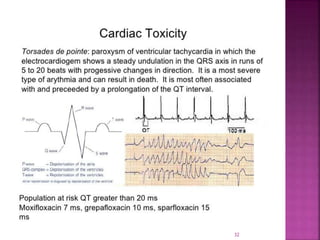
 The FDA recommends that all of these drugs should
be avoided in patients who are taking drugs that
are known to prolong the QT interval, such as
tricyclic antidepressants, phenothiazines and class
I antiarrhythmics. In contrast, levofloxacin does
not affect the QT interval.
 Trovafloxacin, the current member of the fourth-
generation class, adds significant antimicrobial
activity against anaerobes while maintaining the
gram-positive and gram-negative activity of the
third-generation quinolones. It also retains activity
against Pseudomonas species comparable to that of
ciprofloxacin.
 Because of concern about hepatotoxicity,
trovafloxacin therapy should be reserved for life-
or limb-threatening infections requiring inpatient
treatment and the drug should be taken for no
longer than 14 days.
11
 Delafloxacin (developmental code name RX-
3341) is a fluoroquinolone antibiotic being
developed.
 It is more active than other quinolones
against Gram-Positive bacteria.
 Phase II clinical trials have been completed and
Phase III trial for ACUTE BACTERIAL SKIN AND
SKIN STRUCTURE INFECTIONS (ABSSSI) is due to
begin.
12
13
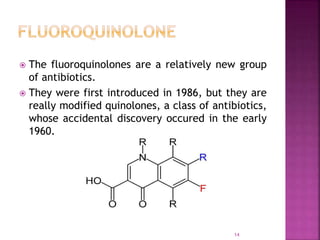
 The fluoroquinolones are a relatively new group
of antibiotics.
 They were first introduced in 1986, but they are
really modified quinolones, a class of antibiotics,
whose accidental discovery occured in the early
1960.
14
15
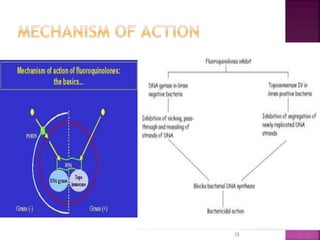
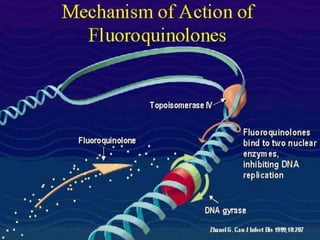
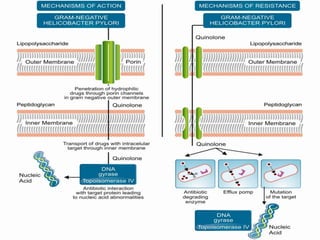
 It blocks bacterial DNA synthesis by
 Inhibition of bacterial Topoisomerase II (DNA
Gyrase)
 Inhibition of Topoisomerase IV
 Inhibition of ATP dependent DNA gyrase; which
nicks doule stranded DNA, introduces negative
supercoils and then reseals the nicked ends. This
is required to prevent excessive positive
supercoiling of DNA strands when they seperate
to permit replication or transcription.
16
17
 Inhibition of DNA gyrase also prevents the
relaxation of positively supercoiled DNA.
 Inhibition of DNA nicking–closing enzyme
responsible for DNA elongation, which leads to
break in double stranded DNA.
 Inhibition of topoisomerase IV interferes with the
separation of replicated chromosomal DNA into
respective daughter cells during cell division.
18
 The critical imbalance in cellular metabolism
resulting from the inhibition of enzymes
precipitates a sequence of cellular events which
may lead to :
1. Premature cell division
2. Delayed cell division
3. Total failure of cell division leading to lysis of
the cell
19
20
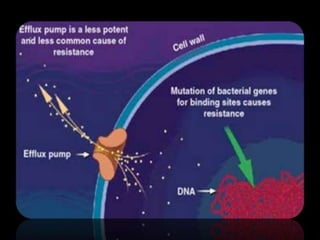
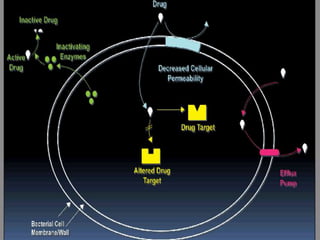
 Resistance appears to be the result of :
 Alteration in the quinolone enzymatic targets
(DNA gyrase), decreased outer membrane
permeability or the development of efflux
mechanisms.
 One or more point mutations in the quinolone
binding region of the target enzyme
(Topoisomerase) or from a change in the
permeability of the organism.
21
22
23
24
 Absorption : Well absorbed orally with
bioavailability 80-95% Oral absorption is impaired
by divalent cations
 Distribution : Widely distributed in body fluids
and tissues but limited CSF penetration. It can
pass the placenta reaching to the foetus
 Half life : 3-8 hours in serum
 Elimination : 30-50% from urine by tubular
secretion or glomerular filtration and some
amount in bile – faeces.
25
26
1. RTI (Respiratory Tract Infection) :
 EMPYEMA : The collection of pus in a cavity of
the body, especially in the pleural cavity (the
area between the lungs and the inner surface of
the chest wall)
 PNEUMONIA : Infection of the lungs that caused
by bacteria, viruses, fungi or parasites
 LUNG ABSCESS : Bacterial infection that occurs
in the lung tissue causing tissue to die and pus to
collect in that space
2. MENINGITIS : Inflammation of the lining of the
brain and spinal cord
27
3. UTI (Urinary Tract Infection) :
 PYELONEPHRITIS : A type of urinary tract
infection (UTI) that affects one or both kidneys
caused by a bacterium mainly Escherichia coli or
virus infection. It causes the kidneys to swell
and may permanently damage them.
 EPIDIDYMITIS : Inflammation of the epididymis, a
tube near the testicles that stores and carries
sperm in men
 PROSTATITIS : Inflammation of
the prostate gland due to a
urine infection in men
 CYSTITIS : Inflammation of the
bladder usually caused by a
urine infection in women
28
4. GIT (Gastro Intestinal Tract) infection :
 ENTERIC FEVER : A potentially fatal
multisystemic illness caused primarily by
Salmonella species
 BACTERIAL DIARRHOEA : Caused by
Campylobacter, salmonellae, and shigella
organisms
5. Skin & soft tissue infections :
 INFECTED ULCERS : Shallow wound that
develops on the skin
 INFECTED BURNS : Red coloured and warm to
touch due to an infection
29
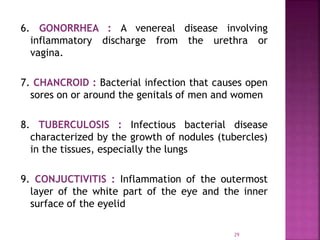
6. GONORRHEA : A venereal disease involving
inflammatory discharge from the urethra or
vagina.
7. CHANCROID : Bacterial infection that causes open
sores on or around the genitals of men and women
8. TUBERCULOSIS : Infectious bacterial disease
characterized by the growth of nodules (tubercles)
in the tissues, especially the lungs
9. CONJUCTIVITIS : Inflammation of the outermost
layer of the white part of the eye and the inner
surface of the eyelid
30
CNS (Central Nervous System)
 Quinolones may displace the neuroinhibitor GABA,
resulting in CNS stimulation
 Dizziness
 Headache
 Insomnia
 Restlessness
Phototoxicity
 Skin damage after exposure to UV light due to
toxic reactions.
 These included second-degree burns, discoloration
and sometimes permanent discoloration and
scarring of the skin. 31
32
33
Gastrointestinal
 Depletion of magnesium and disruption of cellular
enzyme function
 Disruption of mitochondrial function and energy
production
 Other common side effects are :
 Nausea
 Vomiting
 Anorexia
 Diarrhea
1. NSAIDs :
 Enhance the CNS toxicity of quinolones
2. Theophylline, Caffeine or Warfirine
 Plasma concentration is increased by
Ciprofloxacin
3. Antacid or Iron salts
 Reduce the absorption of quinolones
34
 2nd generation fluoroquinolone
 Most potent fluoroquinolone against P.
aeruginosa
 Not effective against Gram +ve and anaerobes
 Mainly effective against Gram –ve bacteria :
Enterobacteriacae H. Influenzae
Campylobacter M. Catarrhalis
Pseudomonas N. Gonorrhea
 Intracellular Pathogen :
M. Tuberculosis Mycoplasma
Chlamydia Legionella
Brucella
35
36
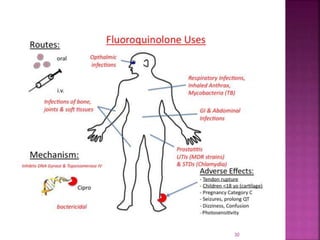
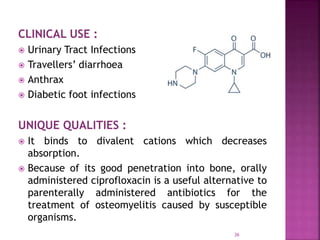
CLINICAL USE :
 Urinary Tract Infections
 Travellers’ diarrhoea
 Anthrax
 Diabetic foot infections
UNIQUE QUALITIES :
 It binds to divalent cations which decreases
absorption.
 Because of its good penetration into bone, orally
administered ciprofloxacin is a useful alternative to
parenterally administered antibiotics for the
treatment of osteomyelitis caused by susceptible
organisms.
37
MARKETED PREPARATIONS :
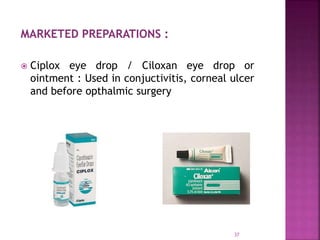
 Ciplox eye drop / Ciloxan eye drop or
ointment : Used in conjuctivitis, corneal ulcer
and before opthalmic surgery
38
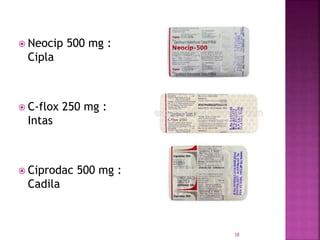
 Neocip 500 mg :
Cipla
 C-flox 250 mg :
Intas
 Ciprodac 500 mg :
Cadila
 3rd generation fluoroquinolone
 Levo-isomer
 100% oral bioavailability
 Effective against Gram +ve and Gram –ve
bacteria
 Also effective against Pathogen :
Legionella pneumophila
Atypical respiratory pathogens
Mycobacterium tuberculosis
39
40
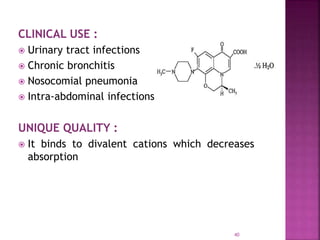
CLINICAL USE :
 Urinary tract infections
 Chronic bronchitis
 Nosocomial pneumonia
 Intra-abdominal infections
UNIQUE QUALITY :
 It binds to divalent cations which decreases
absorption
41
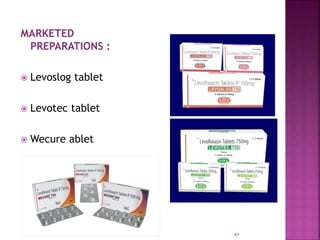
MARKETED
PREPARATIONS :
 Levoslog tablet
 Levotec tablet
 Wecure ablet
42

Quinolones

  • 1.
    Prepared by :-Ruchita V Bhavsar 1st sem M.Pharm Guided by :- Mr. Samaresh Pal Roy HOD of Pharmacology, SDPC, Kim
  • 2.
     Introduction  History Classification  Mechanism of Action  Resistance  Pharmacokinetics  Use  Adverse Effects  Interaction 2
  • 3.
     The quinolonesare a family of synthetic, broad-spectrum antibiotic with bactericidal activity.  The term quinolone refers to potent synthetic chemotherapeutic antibacterial agent. 3
  • 4.
     The 1stgeneration of the quinolones begins with Nalidixic acid in 1962 for the treatment of Urinary Tract Infections in humans.  Nalidixic acid was discovered by George Lesher and co-workers in a distillate during an attempt at chloroquine synthesis. 4
  • 5.
     Quinolones (1stgeneration)  Highly protein bound  Mostly used in UTI  Fluoroquinolones (2nd, 3rd, 4th generation)  Modified 1st generation quinolones  Not highly protein bound  Wide distribution to urine and other tissues  Limited CSF penetration 5
  • 6.
    Generation Drugs Antibacterialspectrum First Nalidixic acid Cinoxacin Gram –ve bacteria Aerobic Second Norfloxacin Ciprofloxacin Ofloxacin Lomefloxacin Enoxacin Gram +ve bacteria Aerobic Improved activity against Gram –ve bacteria Third Levofloxacin Sparfloxacin Gatifloxacin Gemifloxacin Good activity against Anaerobic Gram +ve bacteria particularly pneumococci Fourth Trovafloxacin Moxifloxacin Clinafloxacin Sitafloxacin Anaerobic Increased activity against pneumococci 6
  • 7.
     The first-generationagents include cinoxacin and nalidixic acid, which are the oldest and least often used quinolones.  Because minimal serum levels are achieved, use of these drugs has been restricted to the treatment of uncomplicated urinary tract infections.  They are more susceptible to the development of bacterial resistance.  These agents are not recommended for use in patients with poor renal function because of significantly decreased urine concentrations. 7
  • 8.
     The second-generationquinolones have increased gram-negative activity, as well as some gram- positive and atypical pathogen coverage.  Compared with first-generation drugs, these agents have broader clinical applications in the treatment of complicated urinary tract infections and pyelonephritis, sexually transmitted diseases, selected pneumonias and skin infections.  They include ciprofloxacin, lomefloxacin, norfloxacin, ofloxacin and enoxacin.  Ciprofloxacin and ofloxacin are the most widely used because of their availability in oral and intravenous formulations. 8
  • 9.
     The third-generationquinolones currently include levofloxacin, gatifloxacin, moxifloxacin and sparfloxacin.  These agents are separated into a third class because of their expanded activity against gram- positive organisms, particularly penicillin-sensitive and penicillin-resistant S. pneumoniae, and atypical pathogens such as Mycoplasma pneumoniae and Chlamydia pneumoniae.  Although the third-generation quinolones retain broad gram-negative coverage, they are less active than ciprofloxacin against Pseudomonas species. 9
  • 10.
    10  Because oftheir expanded antimicrobial spectrum, they are useful in the treatment of community- acquired pneumonia, acute sinusitis and acute exacerbations of chronic bronchitis.  The FDA recommends that all of these drugs should be avoided in patients who are taking drugs that are known to prolong the QT interval, such as tricyclic antidepressants, phenothiazines and class I antiarrhythmics. In contrast, levofloxacin does not affect the QT interval.
  • 11.
     Trovafloxacin, thecurrent member of the fourth- generation class, adds significant antimicrobial activity against anaerobes while maintaining the gram-positive and gram-negative activity of the third-generation quinolones. It also retains activity against Pseudomonas species comparable to that of ciprofloxacin.  Because of concern about hepatotoxicity, trovafloxacin therapy should be reserved for life- or limb-threatening infections requiring inpatient treatment and the drug should be taken for no longer than 14 days. 11
  • 12.
     Delafloxacin (developmentalcode name RX- 3341) is a fluoroquinolone antibiotic being developed.  It is more active than other quinolones against Gram-Positive bacteria.  Phase II clinical trials have been completed and Phase III trial for ACUTE BACTERIAL SKIN AND SKIN STRUCTURE INFECTIONS (ABSSSI) is due to begin. 12
  • 13.
  • 14.
     The fluoroquinolonesare a relatively new group of antibiotics.  They were first introduced in 1986, but they are really modified quinolones, a class of antibiotics, whose accidental discovery occured in the early 1960. 14
  • 15.
  • 16.
     It blocksbacterial DNA synthesis by  Inhibition of bacterial Topoisomerase II (DNA Gyrase)  Inhibition of Topoisomerase IV  Inhibition of ATP dependent DNA gyrase; which nicks doule stranded DNA, introduces negative supercoils and then reseals the nicked ends. This is required to prevent excessive positive supercoiling of DNA strands when they seperate to permit replication or transcription. 16
  • 17.
    17  Inhibition ofDNA gyrase also prevents the relaxation of positively supercoiled DNA.  Inhibition of DNA nicking–closing enzyme responsible for DNA elongation, which leads to break in double stranded DNA.  Inhibition of topoisomerase IV interferes with the separation of replicated chromosomal DNA into respective daughter cells during cell division.
  • 18.
    18  The criticalimbalance in cellular metabolism resulting from the inhibition of enzymes precipitates a sequence of cellular events which may lead to : 1. Premature cell division 2. Delayed cell division 3. Total failure of cell division leading to lysis of the cell
  • 19.
  • 20.
  • 21.
     Resistance appearsto be the result of :  Alteration in the quinolone enzymatic targets (DNA gyrase), decreased outer membrane permeability or the development of efflux mechanisms.  One or more point mutations in the quinolone binding region of the target enzyme (Topoisomerase) or from a change in the permeability of the organism. 21
  • 22.
  • 23.
  • 24.
  • 25.
     Absorption :Well absorbed orally with bioavailability 80-95% Oral absorption is impaired by divalent cations  Distribution : Widely distributed in body fluids and tissues but limited CSF penetration. It can pass the placenta reaching to the foetus  Half life : 3-8 hours in serum  Elimination : 30-50% from urine by tubular secretion or glomerular filtration and some amount in bile – faeces. 25
  • 26.
    26 1. RTI (RespiratoryTract Infection) :  EMPYEMA : The collection of pus in a cavity of the body, especially in the pleural cavity (the area between the lungs and the inner surface of the chest wall)  PNEUMONIA : Infection of the lungs that caused by bacteria, viruses, fungi or parasites  LUNG ABSCESS : Bacterial infection that occurs in the lung tissue causing tissue to die and pus to collect in that space 2. MENINGITIS : Inflammation of the lining of the brain and spinal cord
  • 27.
    27 3. UTI (UrinaryTract Infection) :  PYELONEPHRITIS : A type of urinary tract infection (UTI) that affects one or both kidneys caused by a bacterium mainly Escherichia coli or virus infection. It causes the kidneys to swell and may permanently damage them.  EPIDIDYMITIS : Inflammation of the epididymis, a tube near the testicles that stores and carries sperm in men  PROSTATITIS : Inflammation of the prostate gland due to a urine infection in men  CYSTITIS : Inflammation of the bladder usually caused by a urine infection in women
  • 28.
    28 4. GIT (GastroIntestinal Tract) infection :  ENTERIC FEVER : A potentially fatal multisystemic illness caused primarily by Salmonella species  BACTERIAL DIARRHOEA : Caused by Campylobacter, salmonellae, and shigella organisms 5. Skin & soft tissue infections :  INFECTED ULCERS : Shallow wound that develops on the skin  INFECTED BURNS : Red coloured and warm to touch due to an infection
  • 29.
    29 6. GONORRHEA :A venereal disease involving inflammatory discharge from the urethra or vagina. 7. CHANCROID : Bacterial infection that causes open sores on or around the genitals of men and women 8. TUBERCULOSIS : Infectious bacterial disease characterized by the growth of nodules (tubercles) in the tissues, especially the lungs 9. CONJUCTIVITIS : Inflammation of the outermost layer of the white part of the eye and the inner surface of the eyelid
  • 30.
  • 31.
    CNS (Central NervousSystem)  Quinolones may displace the neuroinhibitor GABA, resulting in CNS stimulation  Dizziness  Headache  Insomnia  Restlessness Phototoxicity  Skin damage after exposure to UV light due to toxic reactions.  These included second-degree burns, discoloration and sometimes permanent discoloration and scarring of the skin. 31
  • 32.
  • 33.
    33 Gastrointestinal  Depletion ofmagnesium and disruption of cellular enzyme function  Disruption of mitochondrial function and energy production  Other common side effects are :  Nausea  Vomiting  Anorexia  Diarrhea
  • 34.
    1. NSAIDs : Enhance the CNS toxicity of quinolones 2. Theophylline, Caffeine or Warfirine  Plasma concentration is increased by Ciprofloxacin 3. Antacid or Iron salts  Reduce the absorption of quinolones 34
  • 35.
     2nd generationfluoroquinolone  Most potent fluoroquinolone against P. aeruginosa  Not effective against Gram +ve and anaerobes  Mainly effective against Gram –ve bacteria : Enterobacteriacae H. Influenzae Campylobacter M. Catarrhalis Pseudomonas N. Gonorrhea  Intracellular Pathogen : M. Tuberculosis Mycoplasma Chlamydia Legionella Brucella 35
  • 36.
    36 CLINICAL USE : Urinary Tract Infections  Travellers’ diarrhoea  Anthrax  Diabetic foot infections UNIQUE QUALITIES :  It binds to divalent cations which decreases absorption.  Because of its good penetration into bone, orally administered ciprofloxacin is a useful alternative to parenterally administered antibiotics for the treatment of osteomyelitis caused by susceptible organisms.
  • 37.
    37 MARKETED PREPARATIONS : Ciplox eye drop / Ciloxan eye drop or ointment : Used in conjuctivitis, corneal ulcer and before opthalmic surgery
  • 38.
    38  Neocip 500mg : Cipla  C-flox 250 mg : Intas  Ciprodac 500 mg : Cadila
  • 39.
     3rd generationfluoroquinolone  Levo-isomer  100% oral bioavailability  Effective against Gram +ve and Gram –ve bacteria  Also effective against Pathogen : Legionella pneumophila Atypical respiratory pathogens Mycobacterium tuberculosis 39
  • 40.
    40 CLINICAL USE : Urinary tract infections  Chronic bronchitis  Nosocomial pneumonia  Intra-abdominal infections UNIQUE QUALITY :  It binds to divalent cations which decreases absorption
  • 41.
    41 MARKETED PREPARATIONS :  Levoslogtablet  Levotec tablet  Wecure ablet
  • 42.