Quinolones &
Fluoroquinolones
Subramani Parasuraman
Faculty of Pharmacy,
AIMST University, Malaysia
Quinolones
• These are synthetic antimicrobials having a
quinolone structure and are active primarily against
gram-negative bacteria.
• The first member Nalidixic acid introduced in mid-
1960s. Used to treat urinary and G.I. tract infections.
• The usefulness of quinolones is limited because of
low potency.
2
Nalidixic acid
• It is active against gram-negative bacteria, especially
E. coli, Proteus, Klebsiella, Enterobacter, Shigella but
not Pseudomonas.
• It acts by inhibiting bacterial DNA gyrase and is
bactericidal.
• Resistance to nalidixic acid develops rapidly.
• Nalidixic acid is absorbed orally, highly plasma
protein bound and partly metabolized in liver: one of
the metabolites is active. It is excreted in urine with a
plasma t½ ~8 hrs.
• Adverse effects: Relatively infrequent. Individuals with G-
6-PD deficiency may develop haemolysis. Nalidixic acid is
contraindicated in infants.
3
Fluoroquinolones
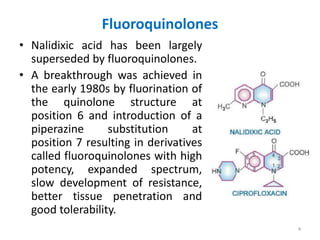
• Nalidixic acid has been largely
superseded by fluoroquinolones.
• A breakthrough was achieved in
the early 1980s by fluorination of
the quinolone structure at
position 6 and introduction of a
piperazine substitution at
position 7 resulting in derivatives
called fluoroquinolones with high
potency, expanded spectrum,
slow development of resistance,
better tissue penetration and
good tolerability.
4
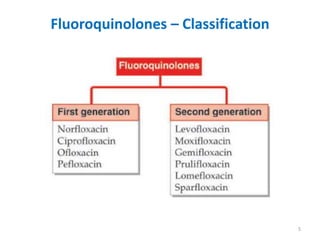
Fluoroquinolones – Classification
5
Fluoroquinolones – Mechanism of action
• Most bacterial species maintain two distinct type II
topoisomerases that assist with DNA replication,
DNA gyrase and topoisomerase IV.
• DNA gyrase is an essential bacterial enzyme that
catalyzes negative supercoiling of plasmid and
chromosomal DNA. Topoisomerase IV assists in
separating daughter chromosomes once replication
is completed. Fluoroquinolones bind to these
enzymes and interfere with DNA ligation.
• Fluoroquinolones have different targets for gram-
negative (DNA gyrase) and gram-positive organisms
(topoisomerase IV), resulting in rapid cell death.
6
Fluoroquinolones – Antimicrobial spectrum
• The fluoroquinolones are potent bactericidal agents
against Proteus, E. coli, Klebsiella, and various species of
Salmonella, Shigella, Enterobacter, and Campylobacter.
Some fluoroquinolones are active against Pseudomonas
spp.,
• Activity against streptococci is significantly greater with
the newer agents, including levofloxacin, gemifloxacin,
and moxifloxacin.
• Ciprofloxacin, ofloxacin, and moxifloxacin are also active
against Mycobacterium fortuitum, M. kansasii and M.
tuberculosis.
• Moxifloxacin also has useful activity against anaerobes.
7
Fluoroquinolones – Bacterial Resistance
• Resistance to quinolones may develop during
therapy via mutations in the bacterial chromosomal
genes encoding DNA gyrase or topoisomerase IV or
by active transport of the drug out of the bacteria.
8
Fluoroquinolones – Pharmacokinetics
• Most quinolones are well absorbed after oral
administration.
• Peak serum levels of the fluoroquinolones are obtained
within 1–3 h of an oral dose. The volume of distribution
of quinolones is high, with concentrations in urine,
kidney, lung, and prostate tissue and stool, bile, and
macrophages and neutrophils higher than serum levels.
• Most fluoroquinolones are excreted renally. Therefore,
dosage adjustments are needed in renal dysfunction.
• Moxifloxacin (metabolized primarily by the liver) should
not be used in patients with hepatic failure.
9
Ciprofloxacin
• It is the most potent first-generation
fluoroquinolones active against a broad range of
bacteria, the most susceptible ones are the aerobic
gram-negative bacilli.
• The MIC of ciprofloxacin against these bacteria is
usually < 0.1 μg/ml, while gram-positive bacteria are
inhibited at relatively higher concentrations.
10
Ciprofloxacin
• Clinical uses:
• Ciprofloxacin is effective in a broad range of infections.
– Urinary tract infections: ciprofloxacin is the most active
against Pseudomonas.
– Chancroid (a bacterial sexually transmitted infection [STI]
caused by infection with Haemophilus ducreyi):
Ciprofloxacin 500 mg BD for 3 days is a second line
alternative drug to ceftriaxone/azithromycin.
– Typhoid: Ciprofloxacin given in a dose of 750 mg BD for 10
days is recommended. Patients unable to take the drug
orally may be treated with 200 mg. i.v. 12 hourly in the
beginning.
11
Ciprofloxacin
• Clinical uses:
• Ciprofloxacin is effective in a broad range of infections.
– Bone, soft tissue, gynaecological and wound infections:
High cure rates have been obtained in osteomyelitis and
joint infections but prolonged treatment (6–8 weeks) with
high doses (750 mg BD) is required.
– Respiratory infections: Ciprofloxacin should not be used as
the primary drug because pneumococci and streptococci
have low and variable susceptibility.
– Anthrax: Ciprofloxacin is considered to be the drug of
choice.
– Tuberculosis: Ciprofloxacin is less active against M.
tuberculosis but is the most active FQ against Mycobact.
avium complex (MAC).
12
Ciprofloxacin
• Clinical uses:
• Ciprofloxacin is effective in a broad range of infections.
– Meningitis: ciprofloxacin used in gram-negative bacterial
meningitis.
– Prophylaxis: of infections in neutropenic/ cancer and other
susceptible patients.
– Conjunctivitis: by gram-negative bacteria: topical therapy
is effective
Typical oral doses are 250–750 mg and intravenous
doses are 200–400 mg twice daily
13
Ciprofloxacin
• Adverse effects:
• Ciprofloxacin has good safety record: side effects occur in
~10% patients but are generally mild; withdrawal is
needed only in 1.5%.
• Gastrointestinal: nausea, vomiting, bad taste, anorexia.
• CNS: dizziness, headache, restlessness, anxiety, insomnia,
impairment of concentration and dexterity (caution while
driving).
• Skin/hypersensitivity: rash, pruritus, photosensitivity,
urticaria and swelling of lips. Serious cutaneous reactions
are rare.
• Erythema multiforme
14
Norfloxacin
• Slightly inferior to ciprofloxacin in terms of MIC values of
gram-negative bacteria. It is primarily used for urinary
tract infections and bacterial diarrhea. It is available in
the form of 200, 400, and 800 mg tablets as well as 100
mg/5ml suspension. Side effect profiles are common to
all fluoroquinolones.
15
Pefloxacin
• Pefloxacin is a fluoroquinolones and having higher lipid
solubility. After oral administration, it is absorbed
completely and attains higher plasma concentrations.
Due to its lipophilicity, its CNS penetration is greater than
other fluoroquinolones. Therefore, it is preferred for
meningeal infections.
• It is available as 200 and 400 mg tablets and
administered twice daily.
16
Ofloxacin
• It is less active than ciprofloxacin against gram-negative
bacteria, but equally or more potent against Strep.
pyogenes and other gram-positive cocci and certain
anaerobes.
• It is the active levo(S) isomer of ofloxacin having
improved activity against Strep. pneumoniae, M.
tuberculosis and some other gram-positive and gram-
negative bacteria. The dosing of levofloxacin ranges from
250 to 750 mg twice daily depending upon the condition.
Levofloxacin
17
Moxifloxacin
• Moxifloxacin has enhanced activity against gram-positive
organisms, gram-negative anaerobes, and
Mycobacterium spp. It is used at a dose of 400 mg once
daily. It is also available as an intravenous infusion.
• Gemifloxacin is indicated for the management of
community-acquired respiratory infections. It is used at a
dose of 320 mg once daily.
Gemifloxacin
18
Prulifloxacin
• Prulifloxacin is a relatively newer generation lipophilic
prodrug of ulifloxacin. It has been considered the most
potent fluoroquinolone against E. coli and P. aeruginosa.
It has a longer half-life, which allows it to be
administered as once daily at a dose of 600 mg.
• Delafloxacin has improved activity against gram-positive
cocci, including MRSA and Enterococcus spp.
Delafloxacin
19
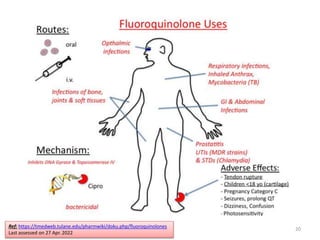
Ref: https://tmedweb.tulane.edu/pharmwiki/doku.php/fluoroquinolones
Last assessed on 27 Apr. 2022
20
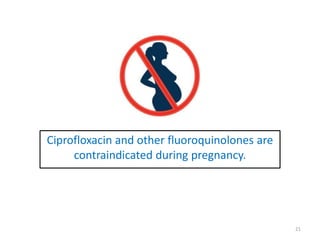
Ciprofloxacin and other fluoroquinolones are
contraindicated during pregnancy.
21