Subramaani Parasuraman
Faculty of Pharmacy
AIMST University
Malaysia
Aminoglycosides
Aminoglycosides
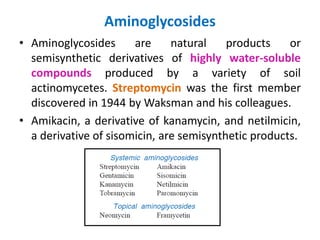
• Aminoglycosides are natural products or
semisynthetic derivatives of highly water-soluble
compounds produced by a variety of soil
actinomycetes. Streptomycin was the first member
discovered in 1944 by Waksman and his colleagues.
• Amikacin, a derivative of kanamycin, and netilmicin,
a derivative of sisomicin, are semisynthetic products.
Aminoglycosides
• Aminoglycosides (gentamicin, tobramycin, amikacin,
netilmicin, kanamycin, streptomycin, paromomycin,
and neomycin) are used primarily to treat infections
caused by aerobic gram-negative bacteria.
• Streptomycin and amikacin are important agents for
the treatment of mycobacterial infections, and
paromomycin is used orally for intestinal amebiasis.
Aminoglycosides are bactericidal inhibitors of protein
synthesis.
Mechanism of action
• The aminoglycoside antibiotics are rapidly bactericidal.
Bacterial killing is concentration dependent: the higher
the concentration, the greater the rate of bacterial
killing.
• Aminoglycosides diffuse through porin channels in the
outer membrane of susceptible organisms. Transport of
aminoglycosides across the cytoplasmic (inner)
membrane depends on a transmembrane electrical
gradient coupled to electron transport to drive
permeation of these antibiotics.
• Once inside the bacterial cell, streptomycin binds to 30S
ribosomes, but other aminoglycosides bind to
additional sites on 50S subunit, as well as to 30S-50S
interface.
Mechanism of action
• Aminoglycosides aminoglycosides bind to polysomes
and interfere with protein synthesis by causing
misreading and premature termination of mRNA
translation.
Aminoglycoside (represented by red circles) binds to the 30S
ribosomal subunit and interferes with initiation of protein
synthesis by fixing the 30S-50S ribosomal complex at the start
codon (AUG) of mRNA.
Antimicrobial Activity
• Aminoglycosides have concentration-dependent
bactericidal activity.
• The antibacterial activity of gentamicin, tobramycin,
and amikacin is directed primarily against aerobic
gram-negative bacilli.
• Aminoglycosides have little activity against
anaerobic microorganisms or facultative bacteria
under anaerobic conditions.
• Their action against most gram-positive bacteria is
limited, and they should not be used as single
agents to treat infections caused by gram-positive
bacteria.
Antimicrobial Activity
Aminoglycosides also exhibit a postantibiotic effect
(PAE), which is continued bacterial suppression after
drug concentrations fall below the MIC.
Susceptibility to aminoglycosides and typical minimal
concentrations that will inhibit 90% (MIC90) of clinical isolates
for several species
Resistance to the Aminoglycosides
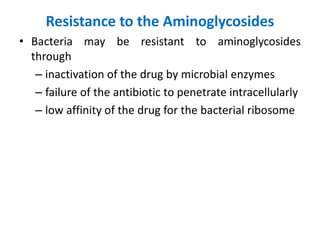
• Bacteria may be resistant to aminoglycosides
through
– inactivation of the drug by microbial enzymes
– failure of the antibiotic to penetrate intracellularly
– low affinity of the drug for the bacterial ribosome
Pharmacokinetics
• Absorption: The highly polar, polycationic structure
of the aminoglycosides prevents adequate
absorption after oral administration. therefore, all
aminoglycosides (except neomycin) must be given
parenterally to achieve adequate serum
concentrations.
• Distribution: Because of their hydrophilicity,
aminoglycoside tissue concentrations may be
subtherapeutic and penetration into most body
fluids is variable. Concentrations achieved in CSF are
inadequate.
Pharmacokinetics
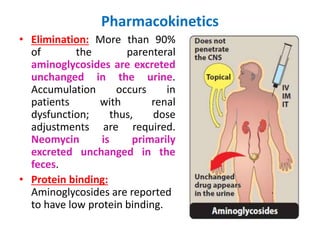
• Elimination: More than 90%
of the parenteral
aminoglycosides are excreted
unchanged in the urine.
Accumulation occurs in
patients with renal
dysfunction; thus, dose
adjustments are required.
Neomycin is primarily
excreted unchanged in the
feces.
• Protein binding:
Aminoglycosides are reported
to have low protein binding.
Therapeutic Uses of Aminoglycosides
• Urinary Tract Infections:
– Aminoglycosides are well-suitable for treatment of
urinary tract infections, less-toxic alternatives are
preferred for uncomplicated infections.
– single intramuscular dose of gentamicin (5 mg/kg)
has been effective in uncomplicated infections of
the lower urinary tract. A 10- to 14-day course of
gentamicin or tobramycin is an alternative for
treatment of pyelonephritis if other agents cannot
be used.
Therapeutic Uses of Aminoglycosides
• Pneumonia:
– Community-acquired pneumonia are susceptible
to broad-spectrum β-lactam antibiotics,
macrolides, or a fluoroquinolone, and usually it is
not necessary to add an aminoglycoside.
Aminoglycosides are ineffective for the treatment
of pneumonia due to anaerobes.
– Aminoglycoside in combination with a β-lactam
antibiotic is recommended as standard empiric
therapy to treat hospital-acquired pneumonia
caused by aerobic multidrug-resistant gram-
negative bacilli.
Therapeutic Uses of Aminoglycosides
• Meningitis:
– Third-generation cephalosporins, especially
cefotaxime and ceftriaxone, has reduced the need
for treatment with aminoglycosides in most cases
of meningitis, except for infections caused by
gram-negative organisms resistant to β-lactam
antibiotics.
– If an aminoglycoside is necessary, direct
instillation into the CNS is likely to achieve
therapeutic levels than intravenous
administration.
Therapeutic Uses of Aminoglycosides
• Peritonitis: Patients who develop peritonitis as a
result of peritoneal dialysis may be treated with
aminoglycoside (gentamicin, netilmicin, or
tobramycin or amikacin).
• Sepsis: An aminoglycoside in an empirical regimen is
commonly recommended for the febrile patient with
neutropenia and for sepsis when P. aeruginosa is a
potential pathogen.
• Tularemia (also known as “rabbit fever”):
Streptomycin (or gentamicin) is the drug of choice for
the treatment of tularemia.
Therapeutic Uses of Aminoglycosides
• Bacterial Endocarditis:
– “Synergistic” or low-dose gentamicin (3 mg/kg/d)
in combination with a penicillin or vancomycin has
been recommended in certain circumstances for
treatment of bacterial endocarditis due to certain
gram-positive organisms. For this indication,
the administration of gentamicin may be
given as a consolidated once-daily dose.
– Penicillin and gentamicin in combination are effective as a
shortcourse (i.e., 2-week) regimen. In cases of
enterococcal endocarditis, concomitant administration of
penicillin (or ampicillin) and gentamicin (given as divided
doses) for 4–6 weeks is recommended as standard therapy.
Therapeutic Uses of Aminoglycosides
• Plague
– A 10-day treatment course of streptomycin or
gentamicin is recommended for severe forms of
plague.
• Mycobacterial Infections
– Streptomycin is a second-line agent for the
treatment of active tuberculosis
– Amikacin is another alternative agent for
infections due to drug-resistant Mycobacterium
tuberculosis
Therapeutic Uses of Aminoglycosides
• Cystic Fibrosis
– Aminoglycosides (tobramycin) are frequently used
as therapy during acute exacerbations of cystic
fibrosis.
• Topical Applications
– Aminoglycosides, especially neomycin and
paromomycin, may be employed as topical agents
in skin and mucous membrane infections.
Therapeutic Uses of Individual Aminoglycosides
Adverse effects
• Therapeutic drug monitoring of gentamicin, tobramycin,
and amikacin plasma concentrations is imperative to
ensure appropriateness of dosing and to minimize dose-
related toxicities. The elderly are particularly susceptible
to nephrotoxicity and ototoxicity.
– Ototoxicity: Ototoxicity (vestibular and auditory) is directly
related to high peak plasma concentrations and the duration of
treatment.
– Nephrotoxicity (kidney damage ranging from mild, reversible
renal impairment to severe, potentially irreversible acute
tubular necrosis)
– Neuromuscular paralysis (associated with a rapid increase in
concentration)
– Allergic reactions (dermatitis is a common reaction to topically
applied neomycin)
Precautions and Interactions
• Avoid aminoglycosides during pregnancy due to risk
of foetal ototoxicity.
• Avoid concurrent use of other nephrotoxic drugs, e.g.
NSAIDs, amphotericin B, vancomycin, cyclosporine
and cisplatin.
• Cautious use of other potentially ototoxic drugs like
vancomycin, minocycline and furosemide.
• Cautious use in patients >60 years age and in those
with kidney damage.
• Do not mix aminoglycoside with any drug in the
same syringe/infusion bottle.
Ref: https://tmedweb.tulane.edu/pharmwiki/doku.php/aminoglycosides; last assessed on 04/05/2022
Aminoglycosides.pptx

Aminoglycosides.pptx

  • 1.
    Subramaani Parasuraman Faculty ofPharmacy AIMST University Malaysia Aminoglycosides
  • 2.
    Aminoglycosides • Aminoglycosides arenatural products or semisynthetic derivatives of highly water-soluble compounds produced by a variety of soil actinomycetes. Streptomycin was the first member discovered in 1944 by Waksman and his colleagues. • Amikacin, a derivative of kanamycin, and netilmicin, a derivative of sisomicin, are semisynthetic products.
  • 3.
    Aminoglycosides • Aminoglycosides (gentamicin,tobramycin, amikacin, netilmicin, kanamycin, streptomycin, paromomycin, and neomycin) are used primarily to treat infections caused by aerobic gram-negative bacteria. • Streptomycin and amikacin are important agents for the treatment of mycobacterial infections, and paromomycin is used orally for intestinal amebiasis. Aminoglycosides are bactericidal inhibitors of protein synthesis.
  • 4.
    Mechanism of action •The aminoglycoside antibiotics are rapidly bactericidal. Bacterial killing is concentration dependent: the higher the concentration, the greater the rate of bacterial killing. • Aminoglycosides diffuse through porin channels in the outer membrane of susceptible organisms. Transport of aminoglycosides across the cytoplasmic (inner) membrane depends on a transmembrane electrical gradient coupled to electron transport to drive permeation of these antibiotics. • Once inside the bacterial cell, streptomycin binds to 30S ribosomes, but other aminoglycosides bind to additional sites on 50S subunit, as well as to 30S-50S interface.
  • 5.
    Mechanism of action •Aminoglycosides aminoglycosides bind to polysomes and interfere with protein synthesis by causing misreading and premature termination of mRNA translation. Aminoglycoside (represented by red circles) binds to the 30S ribosomal subunit and interferes with initiation of protein synthesis by fixing the 30S-50S ribosomal complex at the start codon (AUG) of mRNA.
  • 6.
    Antimicrobial Activity • Aminoglycosideshave concentration-dependent bactericidal activity. • The antibacterial activity of gentamicin, tobramycin, and amikacin is directed primarily against aerobic gram-negative bacilli. • Aminoglycosides have little activity against anaerobic microorganisms or facultative bacteria under anaerobic conditions. • Their action against most gram-positive bacteria is limited, and they should not be used as single agents to treat infections caused by gram-positive bacteria.
  • 7.
    Antimicrobial Activity Aminoglycosides alsoexhibit a postantibiotic effect (PAE), which is continued bacterial suppression after drug concentrations fall below the MIC. Susceptibility to aminoglycosides and typical minimal concentrations that will inhibit 90% (MIC90) of clinical isolates for several species
  • 8.
    Resistance to theAminoglycosides • Bacteria may be resistant to aminoglycosides through – inactivation of the drug by microbial enzymes – failure of the antibiotic to penetrate intracellularly – low affinity of the drug for the bacterial ribosome
  • 9.
    Pharmacokinetics • Absorption: Thehighly polar, polycationic structure of the aminoglycosides prevents adequate absorption after oral administration. therefore, all aminoglycosides (except neomycin) must be given parenterally to achieve adequate serum concentrations. • Distribution: Because of their hydrophilicity, aminoglycoside tissue concentrations may be subtherapeutic and penetration into most body fluids is variable. Concentrations achieved in CSF are inadequate.
  • 10.
    Pharmacokinetics • Elimination: Morethan 90% of the parenteral aminoglycosides are excreted unchanged in the urine. Accumulation occurs in patients with renal dysfunction; thus, dose adjustments are required. Neomycin is primarily excreted unchanged in the feces. • Protein binding: Aminoglycosides are reported to have low protein binding.
  • 11.
    Therapeutic Uses ofAminoglycosides • Urinary Tract Infections: – Aminoglycosides are well-suitable for treatment of urinary tract infections, less-toxic alternatives are preferred for uncomplicated infections. – single intramuscular dose of gentamicin (5 mg/kg) has been effective in uncomplicated infections of the lower urinary tract. A 10- to 14-day course of gentamicin or tobramycin is an alternative for treatment of pyelonephritis if other agents cannot be used.
  • 12.
    Therapeutic Uses ofAminoglycosides • Pneumonia: – Community-acquired pneumonia are susceptible to broad-spectrum β-lactam antibiotics, macrolides, or a fluoroquinolone, and usually it is not necessary to add an aminoglycoside. Aminoglycosides are ineffective for the treatment of pneumonia due to anaerobes. – Aminoglycoside in combination with a β-lactam antibiotic is recommended as standard empiric therapy to treat hospital-acquired pneumonia caused by aerobic multidrug-resistant gram- negative bacilli.
  • 13.
    Therapeutic Uses ofAminoglycosides • Meningitis: – Third-generation cephalosporins, especially cefotaxime and ceftriaxone, has reduced the need for treatment with aminoglycosides in most cases of meningitis, except for infections caused by gram-negative organisms resistant to β-lactam antibiotics. – If an aminoglycoside is necessary, direct instillation into the CNS is likely to achieve therapeutic levels than intravenous administration.
  • 14.
    Therapeutic Uses ofAminoglycosides • Peritonitis: Patients who develop peritonitis as a result of peritoneal dialysis may be treated with aminoglycoside (gentamicin, netilmicin, or tobramycin or amikacin). • Sepsis: An aminoglycoside in an empirical regimen is commonly recommended for the febrile patient with neutropenia and for sepsis when P. aeruginosa is a potential pathogen. • Tularemia (also known as “rabbit fever”): Streptomycin (or gentamicin) is the drug of choice for the treatment of tularemia.
  • 15.
    Therapeutic Uses ofAminoglycosides • Bacterial Endocarditis: – “Synergistic” or low-dose gentamicin (3 mg/kg/d) in combination with a penicillin or vancomycin has been recommended in certain circumstances for treatment of bacterial endocarditis due to certain gram-positive organisms. For this indication, the administration of gentamicin may be given as a consolidated once-daily dose. – Penicillin and gentamicin in combination are effective as a shortcourse (i.e., 2-week) regimen. In cases of enterococcal endocarditis, concomitant administration of penicillin (or ampicillin) and gentamicin (given as divided doses) for 4–6 weeks is recommended as standard therapy.
  • 16.
    Therapeutic Uses ofAminoglycosides • Plague – A 10-day treatment course of streptomycin or gentamicin is recommended for severe forms of plague. • Mycobacterial Infections – Streptomycin is a second-line agent for the treatment of active tuberculosis – Amikacin is another alternative agent for infections due to drug-resistant Mycobacterium tuberculosis
  • 17.
    Therapeutic Uses ofAminoglycosides • Cystic Fibrosis – Aminoglycosides (tobramycin) are frequently used as therapy during acute exacerbations of cystic fibrosis. • Topical Applications – Aminoglycosides, especially neomycin and paromomycin, may be employed as topical agents in skin and mucous membrane infections.
  • 18.
    Therapeutic Uses ofIndividual Aminoglycosides
  • 19.
    Adverse effects • Therapeuticdrug monitoring of gentamicin, tobramycin, and amikacin plasma concentrations is imperative to ensure appropriateness of dosing and to minimize dose- related toxicities. The elderly are particularly susceptible to nephrotoxicity and ototoxicity. – Ototoxicity: Ototoxicity (vestibular and auditory) is directly related to high peak plasma concentrations and the duration of treatment. – Nephrotoxicity (kidney damage ranging from mild, reversible renal impairment to severe, potentially irreversible acute tubular necrosis) – Neuromuscular paralysis (associated with a rapid increase in concentration) – Allergic reactions (dermatitis is a common reaction to topically applied neomycin)
  • 20.
    Precautions and Interactions •Avoid aminoglycosides during pregnancy due to risk of foetal ototoxicity. • Avoid concurrent use of other nephrotoxic drugs, e.g. NSAIDs, amphotericin B, vancomycin, cyclosporine and cisplatin. • Cautious use of other potentially ototoxic drugs like vancomycin, minocycline and furosemide. • Cautious use in patients >60 years age and in those with kidney damage. • Do not mix aminoglycoside with any drug in the same syringe/infusion bottle.
  • 21.

Editor's Notes

  • #5 Macrolides and ketolides bind irreversibly to a site on the 50S subunit of the bacterial ribosome
  • #6 Macrolides and ketolides bind irreversibly to a site on the 50S subunit of the bacterial ribosome
  • #12 Pyelonephritis is a type of urinary tract infection (UTI) that generally begins in your urethra or bladder.
  • #15 Peritonitis is inflammation of the peritoneum Tularemia, also known as “rabbit fever,” is a disease caused by the bacterium Francisella tularensis.