1
Antibiotics-
Protein Synthesis Inhibitors:
Macrolides
Pharmacology L3
PHCL-L3-AntiMicro
Oct 2011
Learning Objectives
 Referring to the therapy of atypical pneumonia, single dose
management of Sexually Transmissible Infections and ,
► choose a drug (generic name) that could be recommended for
► As applicable,
• Cite a commercial name of the drug
• List various dosage forms as available
• Provide essential pharmacokinetic elements of the drug
• Describe the mechanism of action of the drug
• List the adverse effects of the drug
• List drug interaction facts of the drug
• List the contra-indications of the drug
• Describe a potential mechanism of resistance
2
3
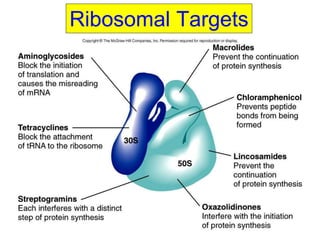
Ribosomal Targets
4
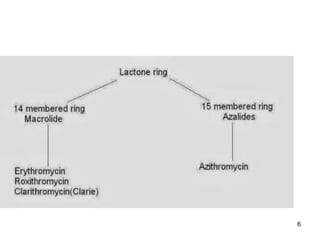
Macrolides
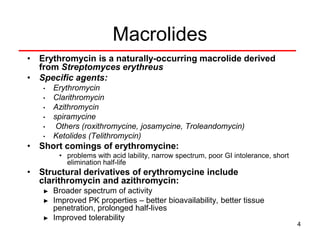
• Erythromycin is a naturally-occurring macrolide derived
from Streptomyces erythreus
• Specific agents:
• Erythromycin
• Clarithromycin
• Azithromycin
• spiramycine
• Others (roxithromycine, josamycine, Troleandomycin)
• Ketolides (Telithromycin)
• Short comings of erythromycine:
• problems with acid lability, narrow spectrum, poor GI intolerance, short
elimination half-life
• Structural derivatives of erythromycine include
clarithromycin and azithromycin:
► Broader spectrum of activity
► Improved PK properties – better bioavailability, better tissue
penetration, prolonged half-lives
► Improved tolerability
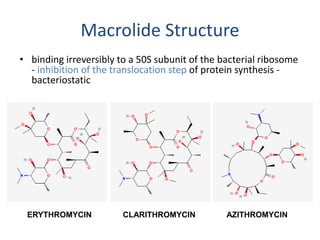
Macrolide Structure
• binding irreversibly to a 50S subunit of the bacterial ribosome
- inhibition of the translocation step of protein synthesis -
bacteriostatic
ERYTHROMYCIN CLARITHROMYCIN AZITHROMYCIN
6
7
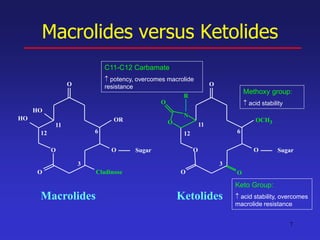
Macrolides versus Ketolides
O
O
OCH3
O
O Sugar
O
R
O
N
O
Ketolides
Cladinose
O
O
OR
O Sugar
O
HO
HO
3
6
11
12
3
6
11
12
Macrolides
C11-C12 Carbamate:
 potency, overcomes macrolide
resistance
Methoxy group:
 acid stability
Keto Group:
 acid stability, overcomes
macrolide resistance
8
Ketolides
Ketolides are derived from
erythromycin by substituting the
cladinose sugar with a keto-group and
attaching a cyclic carbamate group in
the lactone ring.
These modifications give ketolides
much broader spectrum than other
macrolides.
• Telithromycin (the only available ketolide)
9
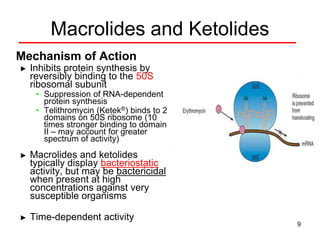
Macrolides and Ketolides
Mechanism of Action
► Inhibits protein synthesis by
reversibly binding to the 50S
ribosomal subunit
• Suppression of RNA-dependent
protein synthesis
• Telithromycin (Ketek®) binds to 2
domains on 50S ribosome (10
times stronger binding to domain
II – may account for greater
spectrum of activity)
► Macrolides and ketolides
typically display bacteriostatic
activity, but may be bactericidal
when present at high
concentrations against very
susceptible organisms
► Time-dependent activity
10
Macrolides and Ketolides
Mechanisms of Resistance
► Altered target sites– encoded by the erm gene
which alters the macrolide binding site on the
ribosome; confers high level resistance to all
macrolides, clindamycin and Synercid, but
telithromycin retains activity
► Active efflux– mef gene encodes for an efflux
pump which pumps the macrolide out of the
cell away from the ribosome;
► Cross-resistance occurs between all
macrolides
11
Macrolide and Ketolide
Spectrum of Activity
Gram-Positive Aerobes
(Telithro>Clarithro>Erythro>Azithro)
• Methicillin-susceptible Staphylococcus aureus
• Streptococcus pneumoniae
• Group and viridans streptococci
• Bacillus sp., Corynebacterium sp.
12
Macrolide and Ketolide
Spectrum of Activity
Gram-Negative Aerobes – newer
macrolides with enhanced activity,
ketolides with poor activity
(Azithro>Clarithro>Erythro> Telithro)
• H. influenzae (not erythro or telithro), M.
catarrhalis, Neisseria sp.
• Do NOT have activity against any
Enterobacteriaceae
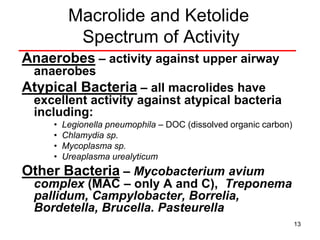
13
Macrolide and Ketolide
Spectrum of Activity
Anaerobes – activity against upper airway
anaerobes
Atypical Bacteria – all macrolides have
excellent activity against atypical bacteria
including:
• Legionella pneumophila – DOC (dissolved organic carbon)
• Chlamydia sp.
• Mycoplasma sp.
• Ureaplasma urealyticum
Other Bacteria – Mycobacterium avium
complex (MAC – only A and C), Treponema
pallidum, Campylobacter, Borrelia,
Bordetella, Brucella. Pasteurella
14
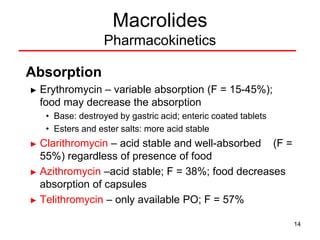
Macrolides
Pharmacokinetics
Absorption
► Erythromycin – variable absorption (F = 15-45%);
food may decrease the absorption
• Base: destroyed by gastric acid; enteric coated tablets
• Esters and ester salts: more acid stable
► Clarithromycin – acid stable and well-absorbed (F =
55%) regardless of presence of food
► Azithromycin –acid stable; F = 38%; food decreases
absorption of capsules
► Telithromycin – only available PO; F = 57%
15
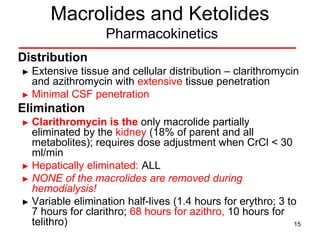
Macrolides and Ketolides
Pharmacokinetics
Distribution
► Extensive tissue and cellular distribution – clarithromycin
and azithromycin with extensive tissue penetration
► Minimal CSF penetration
Elimination
► Clarithromycin is the only macrolide partially
eliminated by the kidney (18% of parent and all
metabolites); requires dose adjustment when CrCl < 30
ml/min
► Hepatically eliminated: ALL
► NONE of the macrolides are removed during
hemodialysis!
► Variable elimination half-lives (1.4 hours for erythro; 3 to
7 hours for clarithro; 68 hours for azithro, 10 hours for
telithro)
16
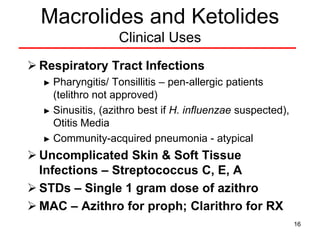
Macrolides and Ketolides
Clinical Uses
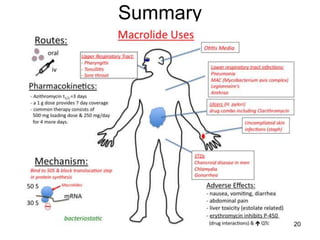
 Respiratory Tract Infections
► Pharyngitis/ Tonsillitis – pen-allergic patients
(telithro not approved)
► Sinusitis, (azithro best if H. influenzae suspected),
Otitis Media
► Community-acquired pneumonia - atypical
 Uncomplicated Skin & Soft Tissue
Infections – Streptococcus C, E, A
 STDs – Single 1 gram dose of azithro
 MAC – Azithro for proph; Clarithro for RX
17
Macrolides
Adverse Effects
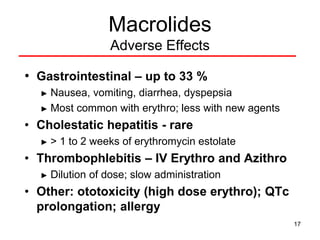
• Gastrointestinal – up to 33 %
► Nausea, vomiting, diarrhea, dyspepsia
► Most common with erythro; less with new agents
• Cholestatic hepatitis - rare
► > 1 to 2 weeks of erythromycin estolate
• Thrombophlebitis – IV Erythro and Azithro
► Dilution of dose; slow administration
• Other: ototoxicity (high dose erythro); QTc
prolongation; allergy
18
Ketolides
Adverse Effects
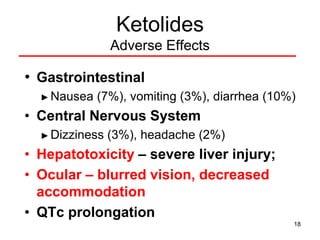
• Gastrointestinal
► Nausea (7%), vomiting (3%), diarrhea (10%)
• Central Nervous System
► Dizziness (3%), headache (2%)
• Hepatotoxicity – severe liver injury;
• Ocular – blurred vision, decreased
accommodation
• QTc prolongation
19
Macrolides and Ketolides
Drug Interactions
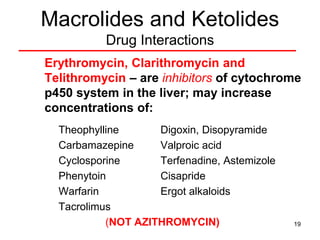
Erythromycin, Clarithromycin and
Telithromycin – are inhibitors of cytochrome
p450 system in the liver; may increase
concentrations of:
Theophylline Digoxin, Disopyramide
Carbamazepine Valproic acid
Cyclosporine Terfenadine, Astemizole
Phenytoin Cisapride
Warfarin Ergot alkaloids
Tacrolimus
(NOT AZITHROMYCIN)
Summary
20
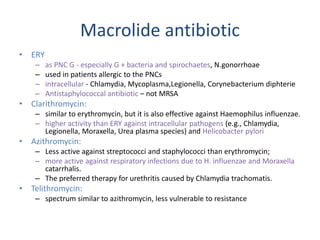
Macrolide antibiotic
• ERY
– as PNC G - especially G + bacteria and spirochaetes, N.gonorrhoae
– used in patients allergic to the PNCs
– intracellular - Chlamydia, Mycoplasma,Legionella, Corynebacterium diphterie
– Antistaphylococcal antibiotic – not MRSA
• Clarithromycin:
– similar to erythromycin, but it is also effective against Haemophilus influenzae.
– higher activity than ERY against intracellular pathogens (e.g., Chlamydia,
Legionella, Moraxella, Urea plasma species) and Helicobacter pylori
• Azithromycin:
– Less active against streptococci and staphylococci than erythromycin;
– more active against respiratory infections due to H. influenzae and Moraxella
catarrhalis.
– The preferred therapy for urethritis caused by Chlamydia trachomatis.
• Telithromycin:
– spectrum similar to azithromycin, less vulnerable to resistance

3-Macrolides.ppt

  • 1.
  • 2.
    Learning Objectives  Referringto the therapy of atypical pneumonia, single dose management of Sexually Transmissible Infections and , ► choose a drug (generic name) that could be recommended for ► As applicable, • Cite a commercial name of the drug • List various dosage forms as available • Provide essential pharmacokinetic elements of the drug • Describe the mechanism of action of the drug • List the adverse effects of the drug • List drug interaction facts of the drug • List the contra-indications of the drug • Describe a potential mechanism of resistance 2
  • 3.
  • 4.
    4 Macrolides • Erythromycin isa naturally-occurring macrolide derived from Streptomyces erythreus • Specific agents: • Erythromycin • Clarithromycin • Azithromycin • spiramycine • Others (roxithromycine, josamycine, Troleandomycin) • Ketolides (Telithromycin) • Short comings of erythromycine: • problems with acid lability, narrow spectrum, poor GI intolerance, short elimination half-life • Structural derivatives of erythromycine include clarithromycin and azithromycin: ► Broader spectrum of activity ► Improved PK properties – better bioavailability, better tissue penetration, prolonged half-lives ► Improved tolerability
  • 5.
    Macrolide Structure • bindingirreversibly to a 50S subunit of the bacterial ribosome - inhibition of the translocation step of protein synthesis - bacteriostatic ERYTHROMYCIN CLARITHROMYCIN AZITHROMYCIN
  • 6.
  • 7.
    7 Macrolides versus Ketolides O O OCH3 O OSugar O R O N O Ketolides Cladinose O O OR O Sugar O HO HO 3 6 11 12 3 6 11 12 Macrolides C11-C12 Carbamate:  potency, overcomes macrolide resistance Methoxy group:  acid stability Keto Group:  acid stability, overcomes macrolide resistance
  • 8.
    8 Ketolides Ketolides are derivedfrom erythromycin by substituting the cladinose sugar with a keto-group and attaching a cyclic carbamate group in the lactone ring. These modifications give ketolides much broader spectrum than other macrolides. • Telithromycin (the only available ketolide)
  • 9.
    9 Macrolides and Ketolides Mechanismof Action ► Inhibits protein synthesis by reversibly binding to the 50S ribosomal subunit • Suppression of RNA-dependent protein synthesis • Telithromycin (Ketek®) binds to 2 domains on 50S ribosome (10 times stronger binding to domain II – may account for greater spectrum of activity) ► Macrolides and ketolides typically display bacteriostatic activity, but may be bactericidal when present at high concentrations against very susceptible organisms ► Time-dependent activity
  • 10.
    10 Macrolides and Ketolides Mechanismsof Resistance ► Altered target sites– encoded by the erm gene which alters the macrolide binding site on the ribosome; confers high level resistance to all macrolides, clindamycin and Synercid, but telithromycin retains activity ► Active efflux– mef gene encodes for an efflux pump which pumps the macrolide out of the cell away from the ribosome; ► Cross-resistance occurs between all macrolides
  • 11.
    11 Macrolide and Ketolide Spectrumof Activity Gram-Positive Aerobes (Telithro>Clarithro>Erythro>Azithro) • Methicillin-susceptible Staphylococcus aureus • Streptococcus pneumoniae • Group and viridans streptococci • Bacillus sp., Corynebacterium sp.
  • 12.
    12 Macrolide and Ketolide Spectrumof Activity Gram-Negative Aerobes – newer macrolides with enhanced activity, ketolides with poor activity (Azithro>Clarithro>Erythro> Telithro) • H. influenzae (not erythro or telithro), M. catarrhalis, Neisseria sp. • Do NOT have activity against any Enterobacteriaceae
  • 13.
    13 Macrolide and Ketolide Spectrumof Activity Anaerobes – activity against upper airway anaerobes Atypical Bacteria – all macrolides have excellent activity against atypical bacteria including: • Legionella pneumophila – DOC (dissolved organic carbon) • Chlamydia sp. • Mycoplasma sp. • Ureaplasma urealyticum Other Bacteria – Mycobacterium avium complex (MAC – only A and C), Treponema pallidum, Campylobacter, Borrelia, Bordetella, Brucella. Pasteurella
  • 14.
    14 Macrolides Pharmacokinetics Absorption ► Erythromycin –variable absorption (F = 15-45%); food may decrease the absorption • Base: destroyed by gastric acid; enteric coated tablets • Esters and ester salts: more acid stable ► Clarithromycin – acid stable and well-absorbed (F = 55%) regardless of presence of food ► Azithromycin –acid stable; F = 38%; food decreases absorption of capsules ► Telithromycin – only available PO; F = 57%
  • 15.
    15 Macrolides and Ketolides Pharmacokinetics Distribution ►Extensive tissue and cellular distribution – clarithromycin and azithromycin with extensive tissue penetration ► Minimal CSF penetration Elimination ► Clarithromycin is the only macrolide partially eliminated by the kidney (18% of parent and all metabolites); requires dose adjustment when CrCl < 30 ml/min ► Hepatically eliminated: ALL ► NONE of the macrolides are removed during hemodialysis! ► Variable elimination half-lives (1.4 hours for erythro; 3 to 7 hours for clarithro; 68 hours for azithro, 10 hours for telithro)
  • 16.
    16 Macrolides and Ketolides ClinicalUses  Respiratory Tract Infections ► Pharyngitis/ Tonsillitis – pen-allergic patients (telithro not approved) ► Sinusitis, (azithro best if H. influenzae suspected), Otitis Media ► Community-acquired pneumonia - atypical  Uncomplicated Skin & Soft Tissue Infections – Streptococcus C, E, A  STDs – Single 1 gram dose of azithro  MAC – Azithro for proph; Clarithro for RX
  • 17.
    17 Macrolides Adverse Effects • Gastrointestinal– up to 33 % ► Nausea, vomiting, diarrhea, dyspepsia ► Most common with erythro; less with new agents • Cholestatic hepatitis - rare ► > 1 to 2 weeks of erythromycin estolate • Thrombophlebitis – IV Erythro and Azithro ► Dilution of dose; slow administration • Other: ototoxicity (high dose erythro); QTc prolongation; allergy
  • 18.
    18 Ketolides Adverse Effects • Gastrointestinal ►Nausea (7%), vomiting (3%), diarrhea (10%) • Central Nervous System ► Dizziness (3%), headache (2%) • Hepatotoxicity – severe liver injury; • Ocular – blurred vision, decreased accommodation • QTc prolongation
  • 19.
    19 Macrolides and Ketolides DrugInteractions Erythromycin, Clarithromycin and Telithromycin – are inhibitors of cytochrome p450 system in the liver; may increase concentrations of: Theophylline Digoxin, Disopyramide Carbamazepine Valproic acid Cyclosporine Terfenadine, Astemizole Phenytoin Cisapride Warfarin Ergot alkaloids Tacrolimus (NOT AZITHROMYCIN)
  • 20.
  • 21.
    Macrolide antibiotic • ERY –as PNC G - especially G + bacteria and spirochaetes, N.gonorrhoae – used in patients allergic to the PNCs – intracellular - Chlamydia, Mycoplasma,Legionella, Corynebacterium diphterie – Antistaphylococcal antibiotic – not MRSA • Clarithromycin: – similar to erythromycin, but it is also effective against Haemophilus influenzae. – higher activity than ERY against intracellular pathogens (e.g., Chlamydia, Legionella, Moraxella, Urea plasma species) and Helicobacter pylori • Azithromycin: – Less active against streptococci and staphylococci than erythromycin; – more active against respiratory infections due to H. influenzae and Moraxella catarrhalis. – The preferred therapy for urethritis caused by Chlamydia trachomatis. • Telithromycin: – spectrum similar to azithromycin, less vulnerable to resistance