MACROLIDE ANTIBIOTICS
Dr. Rupendra K Bharti
Asst. Professor
Late BRKM GMC Jagdalpur
• Macrolide antibiotics contain a many
membered lactone ring known as macrocyclic
ring to which one or more deoxy-sugars are
attached.
• They are:
• Erythromycin
• Clarithromycin
• Roxithromycin
• Azithromycin
• Erythromycin is the first member of this group,
and was isolated from a strain of Streptomyces
erythreus in 1952.
• Clarithromycin, Roxithromycin and
Azithromycin are semi-synthetic derivatives of
erythromycin and these are also called newer
macrolides.
• Some other macrolides are dirithromycin,
oleandomycin and troleandomycin.
Mechanism of action
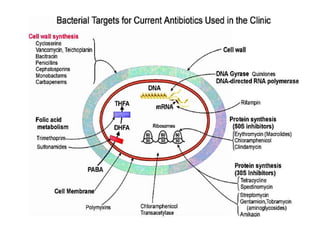
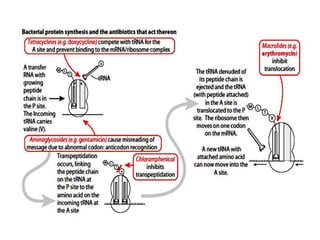
• Macrolide antibiotics are bacteriostatic agents and
inhibit the protein synthesis by binding reversibly to
50s ribosomal subunit of sensitive micro-organism
and interferes with ‘translocation’ step in the protein
synthesis.
• The Gram-positive bacteria accumulate about 100
times more erythromycin than the Gram-negative
bacteria, hence G+ve bacteria are more sensitive
than the G-ve ones.
• Macrolides behave as bactericidal at very high
concentrations.
Bacteriostatic effect at low concentration and
bactericidal at high concentrations
• Antimicrobial spectrum
• These antibiotics are more active against G+ve cocci and
inactive against most of the aerobic and enteric G-ve
bacilli.
• Also chlamydia, mycoplasma, spirochetes and
toxoplasma
Mechanism of ResistancePost-transcriptional methylation of the 23S bacterial
ribosomal RNA.
This acquired resistance can be either plasmid-
mediated or chromosomal.
cross-resistance to macrolides
Due to production of drug-inactivating
enzymes (esterase's or kinases)
production of active ATP-dependent efflux
proteins that transport the drug outside of the
cell.
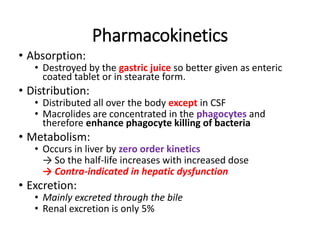
Pharmacokinetics
• Absorption:
• Destroyed by the gastric juice so better given as enteric
coated tablet or in stearate form.
• Distribution:
• Distributed all over the body except in CSF
• Macrolides are concentrated in the phagocytes and
therefore enhance phagocyte killing of bacteria
• Metabolism:
• Occurs in liver by zero order kinetics
→ So the half-life increases with increased dose
→ Contra-indicated in hepatic dysfunction
• Excretion:
• Mainly excreted through the bile
• Renal excretion is only 5%
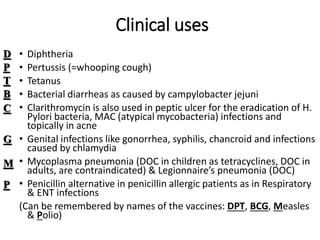
Clinical uses
• Diphtheria
• Pertussis (=whooping cough)
• Tetanus
• Bacterial diarrheas as caused by campylobacter jejuni
• Clarithromycin is also used in peptic ulcer for the eradication of H.
Pylori bacteria, MAC (atypical mycobacteria) infections and
topically in acne
• Genital infections like gonorrhea, syphilis, chancroid and infections
caused by chlamydia
• Mycoplasma pneumonia (DOC in children as tetracyclines, DOC in
adults, are contraindicated) & Legionnaire’s pneumonia (DOC)
• Penicillin alternative in penicillin allergic patients as in Respiratory
& ENT infections
(Can be remembered by names of the vaccines: DPT, BCG, Measles
& Polio)
D
P
T
B
C
G
M
P
Drugs
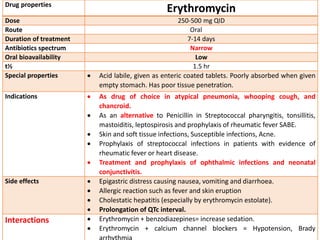
Drug properties
Erythromycin
Dose 250-500 mg QID
Route Oral
Duration of treatment 7-14 days
Antibiotics spectrum Narrow
Oral bioavailability Low
t½ 1.5 hr
Special properties  Acid labile, given as enteric coated tablets. Poorly absorbed when given
empty stomach. Has poor tissue penetration.
Indications  As drug of choice in atypical pneumonia, whooping cough, and
chancroid.
 As an alternative to Penicillin in Streptococcal pharyngitis, tonsillitis,
mastoiditis, leptospirosis and prophylaxis of rheumatic fever SABE.
 Skin and soft tissue infections, Susceptible infections, Acne.
 Prophylaxis of streptococcal infections in patients with evidence of
rheumatic fever or heart disease.
 Treatment and prophylaxis of ophthalmic infections and neonatal
conjunctivitis.
Side effects  Epigastric distress causing nausea, vomiting and diarrhoea.
 Allergic reaction such as fever and skin eruption
 Cholestatic hepatitis (especially by erythromycin estolate).
 Prolongation of QTc interval.
Interactions  Erythromycin + benzodiazepines= increase sedation.
 Erythromycin + calcium channel blockers = Hypotension, Brady
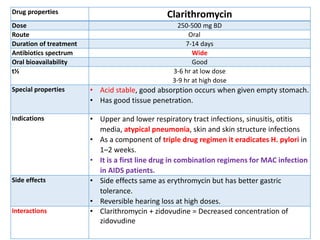
Drug properties Clarithromycin
Dose 250-500 mg BD
Route Oral
Duration of treatment 7-14 days
Antibiotics spectrum Wide
Oral bioavailability Good
t½ 3-6 hr at low dose
3-9 hr at high dose
Special properties • Acid stable, good absorption occurs when given empty stomach.
• Has good tissue penetration.
Indications • Upper and lower respiratory tract infections, sinusitis, otitis
media, atypical pneumonia, skin and skin structure infections
• As a component of triple drug regimen it eradicates H. pylori in
1–2 weeks.
• It is a first line drug in combination regimens for MAC infection
in AIDS patients.
Side effects • Side effects same as erythromycin but has better gastric
tolerance.
• Reversible hearing loss at high doses.
Interactions • Clarithromycin + zidovudine = Decreased concentration of
zidovudine
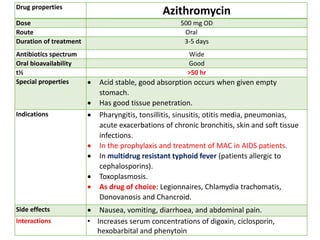
Drug properties
Azithromycin
Dose 500 mg OD
Route Oral
Duration of treatment 3-5 days
Antibiotics spectrum Wide
Oral bioavailability Good
t½ >50 hr
Special properties  Acid stable, good absorption occurs when given empty
stomach.
 Has good tissue penetration.
Indications  Pharyngitis, tonsillitis, sinusitis, otitis media, pneumonias,
acute exacerbations of chronic bronchitis, skin and soft tissue
infections.
 In the prophylaxis and treatment of MAC in AIDS patients.
 In multidrug resistant typhoid fever (patients allergic to
cephalosporins).
 Toxoplasmosis.
 As drug of choice: Legionnaires, Chlamydia trachomatis,
Donovanosis and Chancroid.
Side effects  Nausea, vomiting, diarrhoea, and abdominal pain.
Interactions • Increases serum concentrations of digoxin, ciclosporin,
hexobarbital and phenytoin
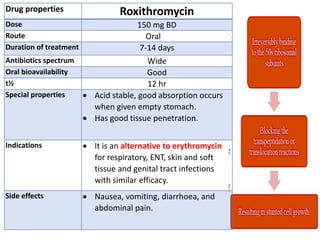
Drug properties Roxithromycin
Dose 150 mg BD
Route Oral
Duration of treatment 7-14 days
Antibiotics spectrum Wide
Oral bioavailability Good
t½ 12 hr
Special properties  Acid stable, good absorption occurs
when given empty stomach.
 Has good tissue penetration.
Indications  It is an alternative to erythromycin
for respiratory, ENT, skin and soft
tissue and genital tract infections
with similar efficacy.
Side effects  Nausea, vomiting, diarrhoea, and
abdominal pain.
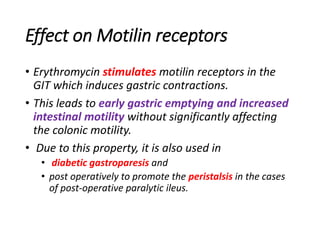
Effect on Motilin receptors
• Erythromycin stimulates motilin receptors in the
GIT which induces gastric contractions.
• This leads to early gastric emptying and increased
intestinal motility without significantly affecting
the colonic motility.
• Due to this property, it is also used in
• diabetic gastroparesis and
• post operatively to promote the peristalsis in the cases
of post-operative paralytic ileus.
Spiramycin
• Spiramycin is also a macrolide antibiotic.
• It resembles erythromycin in spectrum of activity
and properties.
• Its specific utility is for toxoplasmosis and
recurrent abortions in pregnant women.
• It limits risk of transplacental transmission of
Toxoplasma gondii infection.
Cont…
• It is given in a dose of 3 million units (MU) BD/TDS
for 3 weeks. (Three week course is to be repeated
after 2 weeks gaps till delivery).
• Other indications are similar to erythromycin with a
dose of 6 MU per day for 5 days.
• Common side effects are:
• Gastric irritation,
• Nausea,
• Diarrhoea and
• Rashes.
ketolies
Telithromycin, Cethromycin & Solithromycin
Telithromycin
• It is a semi-synthetic derivative of erythromycin and
also called as Ketolide, due to a keto group in its
structure.
• It blocks protein synthesis by binding to domains II
and V of 23S ribosomal RNA of the 50S ribosome
subunit.
• It may also inhibit the assembly of nascent
ribosomal units.
• Due to this changed structure, it is more active
against the Macrolide resistant G+ve micro-
organisms.
Cont..
• It is given orally as once daily dosage
schedule in a dose of 400 mg OD.
• The half-life is 10 hrs.
• Telithromycin is used as treatment of
respiratory tract infections including:
• Acute exacerbation of chronic bronchitis,
• Acute bacterial sinusitis and
• Community acquired pneumonia.
Cont…
• The major side effects are:
• Reversible hepatic dysfunction,
• Prolongation of QTc interval and
• Transient visual disturbances.
• Interactions:
• Additive effect on QT interval prolongation w/ class 1A
(e.g. quinidine, procainamide) or class III (e.g. dofetilide)
antiarrhythmic agents).
Cethromycin
• More potent than telithromycin
• Used against macrolide resistant Streptococci and
Enterococci
• Resistance:
• Ribosomal modification via inducible or constitutive
methylation.
• Ribosomal modification via point mutation- H. pylori
• Drug efflux- S. pyogenes
• Adverse reactions
• Diarrhoea, nausea
• Drug interaction
• Prolonged QT interval (cisapride, terfenadine)
• Increased blood levels of theophylline, midazolam
• Indicated in:
• Community acquired pneumonia
• Prevention of post exposure inhalational anthrax
• It is discovered as orphan drug.
• Now under Phase III clinical trial.
Solithromycin
• MOA:
• Solithromycin inhibits bacterial translation by binding to
the 23S ribosomal RNA, preventing the offending
bacteria from synthesizing proteins.
• Abs spectrum:
• G+ve respiratory tract pathogens, macrolide-resistant
strains.
• Indicated in Community acquired pneumonia.
• M/C ADR: hepatotoxicity.
Other indications of Macrolides
• Diffuse pan-bronchiolitis
• Cystic fibrosis
• Acute bacterial sinusitis
• Asthma
• Chronic obstructive pulmonary disease (COPD)
• Bronchiectasis
• Chronic bronchitis
LINCOSAMIDE ANTIBIOTICS
Clindamycin
• Clindamycin is a Lincosamide antibiotic.
• Its mechanism of action and spectrum of
activity is similar to erythromycin.
• It also inhibits protein synthesis by binding to
50S ribosome.
• Clindamycin inhibits most G+ve cocci and
may anaerobes.
Cont..
• It is well absorbed orally.
• It attains good concentration in neutrophils,
macrophages, skeletal and soft tissues.
• It is metabolised in liver with a t½ of 3 hr
and excreted in urine and bile.
Mechanism of Resistance
• Alteration of 50s ribosomal subunit by adenine
methylation.
• Chromosomal mutation of 50s ribosomal protein.
• Drug inactivation.
Indications
• Anaerobic and mixed infections (abdominal, pelvic
and lung abscess).
• Skin and soft tissue infections.
• Prophylaxis of SABE in penicillin allergic patients,
who undergo dental procedures.
• Alternative to doxycycline for supplementing
quinine/ artesunate in treating multi-drug resistant
malaria.
• Topically for infected acne vulgaris.
Indications
• Acute or chronical suppurative osteomyelitis ,
• Arthritis caused by susceptive organisms especially
Staphylococci aureus
• Aerobic G+ cocci infection
• Combination with pyrimethamine for AIDS-related
toxoplasmosis (600, 75)
• Combination with primaquine for AIDS-related
pneumocystis carinii pneumonia
• Dose:
• Adults: oral dose is 150–300 mg QID, 200–600 mg i.v. 8
hourly
• Children: oral dose is 3–6 mg/kg QID.
ADRs..
• rashes, urticaria, abdominal pain and
diarrhoea.
• Superinfection due to Clostridium
difficile can occur.
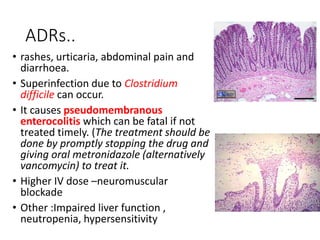
• It causes pseudomembranous
enterocolitis which can be fatal if not
treated timely. (The treatment should be
done by promptly stopping the drug and
giving oral metronidazole (alternatively
vancomycin) to treat it.
• Higher IV dose –neuromuscular
blockade
• Other :Impaired liver function ,
neutropenia, hypersensitivity
Lincomycin
• Lincomycin has similar antibiotic and toxic
properties to clindamycin with higher incidence of
diarrhoea and fatal colitis.
• It was used extensively before the introduction of
clindamycin.
• Rarely used nowadays.

Macrolides antibiotics (with lincosamide)

  • 1.
    MACROLIDE ANTIBIOTICS Dr. RupendraK Bharti Asst. Professor Late BRKM GMC Jagdalpur
  • 2.
    • Macrolide antibioticscontain a many membered lactone ring known as macrocyclic ring to which one or more deoxy-sugars are attached. • They are: • Erythromycin • Clarithromycin • Roxithromycin • Azithromycin
  • 3.
    • Erythromycin isthe first member of this group, and was isolated from a strain of Streptomyces erythreus in 1952. • Clarithromycin, Roxithromycin and Azithromycin are semi-synthetic derivatives of erythromycin and these are also called newer macrolides. • Some other macrolides are dirithromycin, oleandomycin and troleandomycin.
  • 5.
    Mechanism of action •Macrolide antibiotics are bacteriostatic agents and inhibit the protein synthesis by binding reversibly to 50s ribosomal subunit of sensitive micro-organism and interferes with ‘translocation’ step in the protein synthesis. • The Gram-positive bacteria accumulate about 100 times more erythromycin than the Gram-negative bacteria, hence G+ve bacteria are more sensitive than the G-ve ones. • Macrolides behave as bactericidal at very high concentrations.
  • 7.
    Bacteriostatic effect atlow concentration and bactericidal at high concentrations • Antimicrobial spectrum • These antibiotics are more active against G+ve cocci and inactive against most of the aerobic and enteric G-ve bacilli. • Also chlamydia, mycoplasma, spirochetes and toxoplasma
  • 8.
    Mechanism of ResistancePost-transcriptionalmethylation of the 23S bacterial ribosomal RNA. This acquired resistance can be either plasmid- mediated or chromosomal. cross-resistance to macrolides Due to production of drug-inactivating enzymes (esterase's or kinases) production of active ATP-dependent efflux proteins that transport the drug outside of the cell.
  • 9.
    Pharmacokinetics • Absorption: • Destroyedby the gastric juice so better given as enteric coated tablet or in stearate form. • Distribution: • Distributed all over the body except in CSF • Macrolides are concentrated in the phagocytes and therefore enhance phagocyte killing of bacteria • Metabolism: • Occurs in liver by zero order kinetics → So the half-life increases with increased dose → Contra-indicated in hepatic dysfunction • Excretion: • Mainly excreted through the bile • Renal excretion is only 5%
  • 10.
    Clinical uses • Diphtheria •Pertussis (=whooping cough) • Tetanus • Bacterial diarrheas as caused by campylobacter jejuni • Clarithromycin is also used in peptic ulcer for the eradication of H. Pylori bacteria, MAC (atypical mycobacteria) infections and topically in acne • Genital infections like gonorrhea, syphilis, chancroid and infections caused by chlamydia • Mycoplasma pneumonia (DOC in children as tetracyclines, DOC in adults, are contraindicated) & Legionnaire’s pneumonia (DOC) • Penicillin alternative in penicillin allergic patients as in Respiratory & ENT infections (Can be remembered by names of the vaccines: DPT, BCG, Measles & Polio) D P T B C G M P
  • 11.
  • 12.
    Drug properties Erythromycin Dose 250-500mg QID Route Oral Duration of treatment 7-14 days Antibiotics spectrum Narrow Oral bioavailability Low t½ 1.5 hr Special properties  Acid labile, given as enteric coated tablets. Poorly absorbed when given empty stomach. Has poor tissue penetration. Indications  As drug of choice in atypical pneumonia, whooping cough, and chancroid.  As an alternative to Penicillin in Streptococcal pharyngitis, tonsillitis, mastoiditis, leptospirosis and prophylaxis of rheumatic fever SABE.  Skin and soft tissue infections, Susceptible infections, Acne.  Prophylaxis of streptococcal infections in patients with evidence of rheumatic fever or heart disease.  Treatment and prophylaxis of ophthalmic infections and neonatal conjunctivitis. Side effects  Epigastric distress causing nausea, vomiting and diarrhoea.  Allergic reaction such as fever and skin eruption  Cholestatic hepatitis (especially by erythromycin estolate).  Prolongation of QTc interval. Interactions  Erythromycin + benzodiazepines= increase sedation.  Erythromycin + calcium channel blockers = Hypotension, Brady
  • 13.
    Drug properties Clarithromycin Dose250-500 mg BD Route Oral Duration of treatment 7-14 days Antibiotics spectrum Wide Oral bioavailability Good t½ 3-6 hr at low dose 3-9 hr at high dose Special properties • Acid stable, good absorption occurs when given empty stomach. • Has good tissue penetration. Indications • Upper and lower respiratory tract infections, sinusitis, otitis media, atypical pneumonia, skin and skin structure infections • As a component of triple drug regimen it eradicates H. pylori in 1–2 weeks. • It is a first line drug in combination regimens for MAC infection in AIDS patients. Side effects • Side effects same as erythromycin but has better gastric tolerance. • Reversible hearing loss at high doses. Interactions • Clarithromycin + zidovudine = Decreased concentration of zidovudine
  • 14.
    Drug properties Azithromycin Dose 500mg OD Route Oral Duration of treatment 3-5 days Antibiotics spectrum Wide Oral bioavailability Good t½ >50 hr Special properties  Acid stable, good absorption occurs when given empty stomach.  Has good tissue penetration. Indications  Pharyngitis, tonsillitis, sinusitis, otitis media, pneumonias, acute exacerbations of chronic bronchitis, skin and soft tissue infections.  In the prophylaxis and treatment of MAC in AIDS patients.  In multidrug resistant typhoid fever (patients allergic to cephalosporins).  Toxoplasmosis.  As drug of choice: Legionnaires, Chlamydia trachomatis, Donovanosis and Chancroid. Side effects  Nausea, vomiting, diarrhoea, and abdominal pain. Interactions • Increases serum concentrations of digoxin, ciclosporin, hexobarbital and phenytoin
  • 15.
    Drug properties Roxithromycin Dose150 mg BD Route Oral Duration of treatment 7-14 days Antibiotics spectrum Wide Oral bioavailability Good t½ 12 hr Special properties  Acid stable, good absorption occurs when given empty stomach.  Has good tissue penetration. Indications  It is an alternative to erythromycin for respiratory, ENT, skin and soft tissue and genital tract infections with similar efficacy. Side effects  Nausea, vomiting, diarrhoea, and abdominal pain.
  • 16.
    Effect on Motilinreceptors • Erythromycin stimulates motilin receptors in the GIT which induces gastric contractions. • This leads to early gastric emptying and increased intestinal motility without significantly affecting the colonic motility. • Due to this property, it is also used in • diabetic gastroparesis and • post operatively to promote the peristalsis in the cases of post-operative paralytic ileus.
  • 17.
    Spiramycin • Spiramycin isalso a macrolide antibiotic. • It resembles erythromycin in spectrum of activity and properties. • Its specific utility is for toxoplasmosis and recurrent abortions in pregnant women. • It limits risk of transplacental transmission of Toxoplasma gondii infection.
  • 18.
    Cont… • It isgiven in a dose of 3 million units (MU) BD/TDS for 3 weeks. (Three week course is to be repeated after 2 weeks gaps till delivery). • Other indications are similar to erythromycin with a dose of 6 MU per day for 5 days. • Common side effects are: • Gastric irritation, • Nausea, • Diarrhoea and • Rashes.
  • 19.
  • 20.
    Telithromycin • It isa semi-synthetic derivative of erythromycin and also called as Ketolide, due to a keto group in its structure. • It blocks protein synthesis by binding to domains II and V of 23S ribosomal RNA of the 50S ribosome subunit. • It may also inhibit the assembly of nascent ribosomal units. • Due to this changed structure, it is more active against the Macrolide resistant G+ve micro- organisms.
  • 21.
    Cont.. • It isgiven orally as once daily dosage schedule in a dose of 400 mg OD. • The half-life is 10 hrs. • Telithromycin is used as treatment of respiratory tract infections including: • Acute exacerbation of chronic bronchitis, • Acute bacterial sinusitis and • Community acquired pneumonia.
  • 22.
    Cont… • The majorside effects are: • Reversible hepatic dysfunction, • Prolongation of QTc interval and • Transient visual disturbances. • Interactions: • Additive effect on QT interval prolongation w/ class 1A (e.g. quinidine, procainamide) or class III (e.g. dofetilide) antiarrhythmic agents).
  • 23.
    Cethromycin • More potentthan telithromycin • Used against macrolide resistant Streptococci and Enterococci • Resistance: • Ribosomal modification via inducible or constitutive methylation. • Ribosomal modification via point mutation- H. pylori • Drug efflux- S. pyogenes • Adverse reactions • Diarrhoea, nausea • Drug interaction • Prolonged QT interval (cisapride, terfenadine) • Increased blood levels of theophylline, midazolam
  • 24.
    • Indicated in: •Community acquired pneumonia • Prevention of post exposure inhalational anthrax • It is discovered as orphan drug. • Now under Phase III clinical trial.
  • 25.
    Solithromycin • MOA: • Solithromycininhibits bacterial translation by binding to the 23S ribosomal RNA, preventing the offending bacteria from synthesizing proteins. • Abs spectrum: • G+ve respiratory tract pathogens, macrolide-resistant strains. • Indicated in Community acquired pneumonia. • M/C ADR: hepatotoxicity.
  • 26.
    Other indications ofMacrolides • Diffuse pan-bronchiolitis • Cystic fibrosis • Acute bacterial sinusitis • Asthma • Chronic obstructive pulmonary disease (COPD) • Bronchiectasis • Chronic bronchitis
  • 27.
  • 28.
    Clindamycin • Clindamycin isa Lincosamide antibiotic. • Its mechanism of action and spectrum of activity is similar to erythromycin. • It also inhibits protein synthesis by binding to 50S ribosome. • Clindamycin inhibits most G+ve cocci and may anaerobes.
  • 29.
    Cont.. • It iswell absorbed orally. • It attains good concentration in neutrophils, macrophages, skeletal and soft tissues. • It is metabolised in liver with a t½ of 3 hr and excreted in urine and bile.
  • 30.
    Mechanism of Resistance •Alteration of 50s ribosomal subunit by adenine methylation. • Chromosomal mutation of 50s ribosomal protein. • Drug inactivation.
  • 31.
    Indications • Anaerobic andmixed infections (abdominal, pelvic and lung abscess). • Skin and soft tissue infections. • Prophylaxis of SABE in penicillin allergic patients, who undergo dental procedures. • Alternative to doxycycline for supplementing quinine/ artesunate in treating multi-drug resistant malaria. • Topically for infected acne vulgaris.
  • 32.
    Indications • Acute orchronical suppurative osteomyelitis , • Arthritis caused by susceptive organisms especially Staphylococci aureus • Aerobic G+ cocci infection • Combination with pyrimethamine for AIDS-related toxoplasmosis (600, 75) • Combination with primaquine for AIDS-related pneumocystis carinii pneumonia • Dose: • Adults: oral dose is 150–300 mg QID, 200–600 mg i.v. 8 hourly • Children: oral dose is 3–6 mg/kg QID.
  • 33.
    ADRs.. • rashes, urticaria,abdominal pain and diarrhoea. • Superinfection due to Clostridium difficile can occur. • It causes pseudomembranous enterocolitis which can be fatal if not treated timely. (The treatment should be done by promptly stopping the drug and giving oral metronidazole (alternatively vancomycin) to treat it. • Higher IV dose –neuromuscular blockade • Other :Impaired liver function , neutropenia, hypersensitivity
  • 34.
    Lincomycin • Lincomycin hassimilar antibiotic and toxic properties to clindamycin with higher incidence of diarrhoea and fatal colitis. • It was used extensively before the introduction of clindamycin. • Rarely used nowadays.