Anti-fungal drugs
Dr. Karun Kumar
Senior Lecturer
Dept. of Pharmacology
Anti-fungal drugs
• Drugs used for superficial and deep (systemic) fungal
infections
• Fungal infections are mostly associated with the use
of broad-spectrum antibiotics, corticosteroids,
anticancer/immunosuppressant drugs, dentures,
indwelling catheters and implants, and emergence of
AIDS
• As a result of breakdown of host defence
mechanisms by the above agents, saprophytic fungi
easily invade living tissue
• C. albicans is normally resident in the oral cavity
• It invades to cause inf. when host defence is impaired
or the oral flora is disturbed
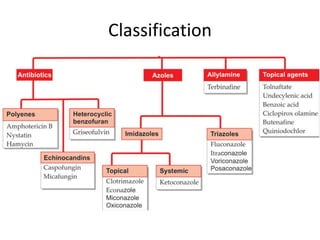
Classification
Polyene antibiotics
• The name polyene is derived from their highly
double-bonded structure
• Amphotericin B (AMB)  Not abs. orally
• Cholesterol, present in host cell membranes, closely
resembles ergosterol; the polyenes bind to it as well,
though with lesser affinity
• Selectivity of action of polyenes is low, and AMB is
one of the most toxic systemically used antibiotics
• Bacteria do not have sterols and are unaffected by
polyenes
• Active against a wide range of yeasts and fungi—
Candida albicans, Histoplasma capsulatum,
Cryptococcus neoformans, Blastomyces dermatitidis,
Coccidioides immitis, Torulopsis, Rhodotorula,
Aspergillus, Sporothrix, etc.
• Dermatophytes are inhibited in vitro, but
concentrations of AMB attained in infected skin are
low and ineffective
• It is fungicidal at high and static at low
concentrations
• Also active on various species of Leishmania, a
protozoa
Uses
1. Topically  Oral, vaginal and cutaneous candidiasis;
otomycosis
• Most effective drug for various types of systemic
mycoses and is the gold standard of antifungal
therapy
• However, because of higher toxicity of AMB, the
azole antifungals are now preferred
2. Leishmaniasis
Adverse effects
1. Acute reaction  Occurs with each infusion and
consists of chills, fever, aches and pain all over,
nausea, vomiting and dyspnoea lasting for 2–5 hour,
probably due to release of cytokines (IL, TNFα).
Thrombophlebitis of the injected vein can occur
2. Long-term toxicity  Nephrotoxicity is the most
important. Most patients develop slowly
progressing anemia (bone marrow depression)
Nystatin
• It is similar to AMB in antifungal action and other
properties
• However, because of higher systemic toxicity, it is
used only locally in superficial candidiasis
• In dentistry, topically applied Nystatin is 2nd choice
drug to Clotrimazole for oral thrush, denture
stomatitis, a.b. assoc. stomatitis, c.s. assoc. oral
candid., mucocut. candid. of lips
• 1 lac U (1 mg = 2000 U) tab is placed in mouth to
dissolve slowly 4 times a day or it can be crushed and
suspended in glycerine for application on the lesions
in mouth.
• S/E  Bitter foul taste and nausea
• Corticosteroid aerosols (e.g. Beclomethasone) can
cause oral candidiasis: nystatin is effective in
preventing as well as treating it
• Nystatin is effective (but less than azoles) in monilial
vaginitis—1 lac U tab inserted twice daily
• Similarly, it is used for corneal, conjunctival and
cutaneous candidiasis in the form of an ointment
• Ineffective in dermatophytosis
• Given orally, not abs. (used in monilial diarrhoea)
Imidazoles and Triazoles
• Most extensively used antifungal drugs
• Fluconazole and Itraconazole have replaced
Ketoconazole for systemic mycosis because of
greater efficacy, longer t½, fewer side effects and
drug interactions
• Posaconazole is a new triazole to be used as a
reserve drug for non- responsive cases
• The Imidazoles and triazoles have broad spectrum
antifungal activity covering dermatophytes, Candida,
other fungi involved in deep mycosis, Nocardia and
Leishmania
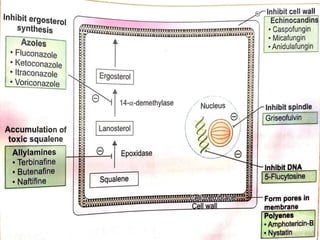
• MOA  Inhibit the fungal cytochrome P450 enzyme
‘lanosterol 14-demethylase’ and impair ergosterol
synthesis leading to a cascade of membrane
abnormalities in the fungus
• The lower host toxicity of triazoles compared to
imidazoles has correlated with their lower affinity for
mammalian CYP450 enzymes and lesser propensity
to inhibit mammalian sterol synthesis
• Development of fungal resistance to azoles has not
so far posed any significant clinical problem
Clotrimazole
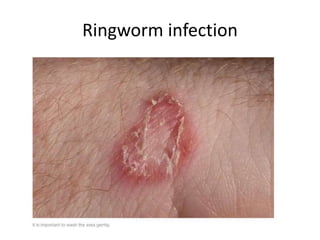
• Effective in the topical t/t of tinea infections like
ringworm, Athletes’ foot and otomycosis
• Oral/cutaneous/vaginal candidiasis have responded
in >80% cases.
• M/c used drug for oropharyngeal candidiasis 10 mg
troche of clotrimazole is allowed to dissolve in the
mouth 3–4 times a day, or the lotion/gel is
applied/swirled in the mouth for as long as possible.
• For denture stomatitis, pts. are advised to apply
Clotrimazole lotion/gel to the fitting surface of the
denture before wearing it
• Also, the denture should be kept overnight in sod.
hypochlorite/Benzalkonium/Cetrimide soln. and it
should be worn only when needed.
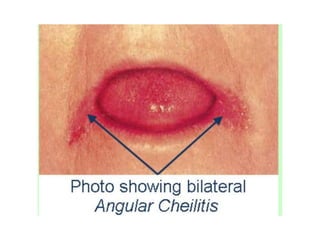
• Topical Clotrimazole can be used to treat angular
cheilitis that often is a mixed candidal, streptococcal,
staph. inf.
• Clotrimazole is well tolerated by most patients
• Local irritation with stinging and burning sensation
occurs in some
• No systemic toxicity is seen after topical use
Ringworm infection
Econazole
• It is similar to Clotrimazole; penetrates superficial
layers of the skin and is highly effective in
dermatophytosis, otomycosis, oral thrush, but is
somewhat inferior to Clotrimazole in vaginitis
• No adverse effects, except local irritation in few is
reported
Miconazole
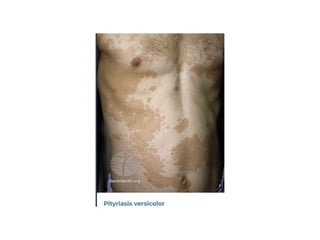
• It is a highly efficacious (>90% cure rate) drug for
tinea, pityriasis versicolor, otomycosis, cutaneous
and vulvovaginal candidiasis
• Single application on skin acts for a few days
• Irritation after cutaneous application is infrequent
• No systemic adverse effects are seen
Oxiconazole
• A newer topical imidazole antifungal effective in
tinea and other dermatophytic infection, as well as
vaginal candidiasis
• Local irritation can occur in some patients
Ketoconazole
• Orally effective broad-spectrum antifungal drug
• Useful in dermatophytosis, superficial candidiasis
and deep mycosis
• Oral absorption facilitated by gastric acidity
• Dose  200 mg OD or BD
• A/E less than with AMB, but more side effects occur
than with Itraconazole or Fluconazole, that have
largely replaced it for systemic use
• M/c S/E Nausea and vomiting (can be reduced by
giving the drug with meals) foll. by loss of appetite,
headache, paresthesia, rashes and hair loss
• Interactions  H2 blockers, PPIs & antacids ↓ oral
abs. of KTZ by reducing gastric acidity. Rifampin,
phenobarbitone, carbamazepine and phenytoin
induce KTZ metabolism and reduce its efficacy
• Use  Rarely used in dental practice
Fluconazole
• Wider range of activity than KTZ; indications include
cryptococcal meningitis, systemic and mucosal
candidiasis in both normal and immunocompromised
patients, coccidioidal meningitis and some tinea
infections
• Fungicidal conc. are achieved in nails, vagina and
saliva; penetration into brain and CSF is good
• A/E  Fluconazole produces fewer side effects:
mostly nausea, vomiting, abdominal pain, rash and
headache. Not recommended in pregnant and
lactating mothers
• Interactions  Same as KTZ
• Use  Fluconazole can be administered orally as
well as i.v. (in severe infections)
• In dentistry 
1. Oral fluconazole (100 mg/day for 2 weeks) is highly
effective in oropharyngeal candidiasis, but is
reserved for cases not responding to topical
antifungals
2. Fluconazole (100 mg/day) for 2–3 weeks is the first
line treatment for Candida esophagitis
Itraconazole
• Broader spectrum of activity than KTZ or
Fluconazole; includes some moulds like Aspergillus
and some fluconazole resistant Candida
• Fungistatic, but effective in immunocompromised
patients
• Oral abs. enh. by food and gastric acid
• Well tolerated in doses below 200 mg/day.
• Gastric intolerance is significant at > 400 mg/day.
Dizziness, pruritus, headache and hypokalaemia are
the other common S/E
• Drug interactions  Oral abs. ↓ by antacids, H2
blockers and PPIs
• Use  Preferred for most systemic mycosis not
associated with meningitis
• Seldom used in dentistry for oral candidiasis
Voriconazole
• 2nd gen. broad spectrum for difficult to treat fungal
infections like invasive aspergillosis, disseminated
infections caused by Fluconazole resistant Candida,
Fusarium infections and febrile neutropenia not
responding to antibacterial therapy
• Serious cases are first treated i.v.
• A/E  Rashes, visual disturbances, QTc prolongation
and an acute reaction on i.v. injection
Terbinafine (Allylamine)
• Fungicidal
• Noncompetitive inhibitor of ‘squalene epoxidase’,
• Accumulation of squalene within fungal cells 
fungicidal action
• High affinity for keratin (conc. in stratum corneum of
skin & nail plates  Effective in tinea inf. Of skin and
nails)
• S/E  Gastric upset, rashes, taste disturbance
• Topical terbinafine can cause erythema, itching,
dryness, irritation, urticaria and rashes
• Use  Terbinafine applied topically as 1% cream
twice daily is indicated in localized tinea pedis/
cruris/corporis and pityriasis versicolor
• 2–4 weeks treatment is required
• Oral treatment with 250 mg OD is reserved for
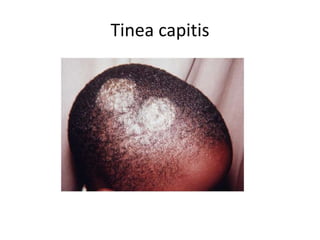
onychomycosis, tinea capitis and wide spread lesions
• Duration of treatment varies from 3–6 months or
more
• Less effective against cutaneous and mucosal
candidiasis: 2–4 weeks oral therapy may be used as
an alternative to fluconazole
Tinea capitis
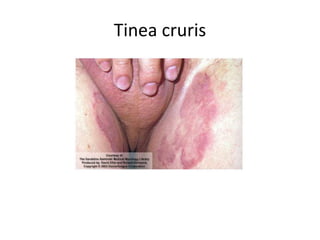
Tinea cruris
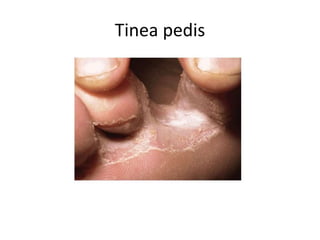
Tinea pedis
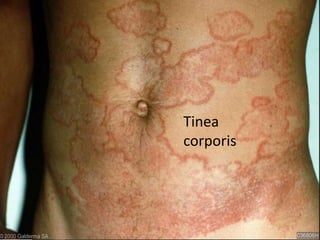
Tinea
corporis