INTRODUCTION
Macrolides are a group of closely related
compounds characterized by a macrocyclic lactone
ring (usually containing 14 or 16 atoms) to
which deoxysugars are attached.
The prototype drug Erythromycin consists of two
sugar moieties attached to a 14-atom lactone ring.
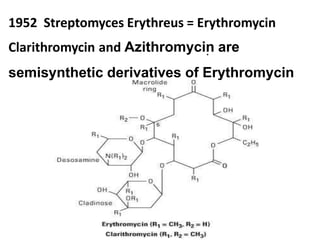
1952 Streptomyces Erythreus = Erythromycin
Clarithromycin and Azithromycin are
semisynthetic derivatives of Erythromycin
.
CLASSIFICATION
MACROLIDES
i. ERYTHROMYCIN
ii. CLARITHROMYCIN
iii. AZITHROMYCIN
iv. ROXITHROMYCIN
v. SPIRAMYCIN
KETOLIDES
i. TELITHROMYCIN
MECHANISM OF ACTION
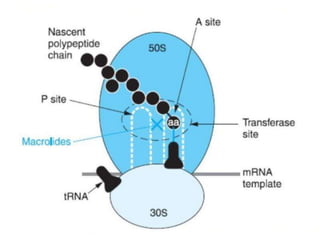
• Inhibits protein synthesis by reversibly binding to
50S ribosomal subunit
• Suppression of RNA- dependent protein synthesis
by inhibition of translocation of mRNA.
• Typically bacteriostatic activity
• Bactericidal at high concentrations against very
susceptible organisms
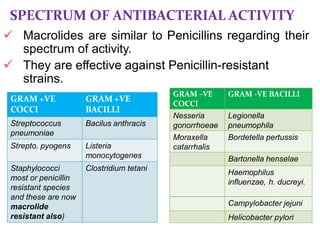
SPECTRUM OF ANTIBACTERIAL ACTIVITY
 Macrolides are similar to Penicillins regarding their
spectrum of activity.
 They are effective against Penicillin-resistant
strains.
GRAM +VE
COCCI
GRAM +VE
BACILLI
Streptococcus
pneumoniae
Bacilus anthracis
Strepto. pyogens Listeria
monocytogenes
Staphylococci
most or penicillin
resistant species
and these are now
macrolide
resistant also)
Clostridium tetani
GRAM –VE
COCCI
GRAM -VE BACILLI
Nesseria
gonorrhoeae
Legionella
pneumophila
Moraxella
catarrhalis
Bordetella pertussis
Bartonella henselae
Haemophilus
influenzae, h. ducreyi.
Campylobacter jejuni
Helicobacter pylori
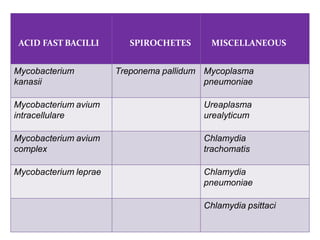
ACID FAST BACILLI SPIROCHETES MISCELLANEOUS
Mycobacterium
kanasii
Treponema pallidum Mycoplasma
pneumoniae
Mycobacterium avium
intracellulare
Ureaplasma
urealyticum
Mycobacterium avium
complex
Chlamydia
trachomatis
Mycobacterium leprae Chlamydia
pneumoniae
Chlamydia psittaci
BACTERIAL RESISTANCE
Methylation of a guanine residue on ribosomal
RNA leads to lower affinity toward
Macrolides
An active efflux system
Presenceof a plasmid associated
Erythromycin esterase.
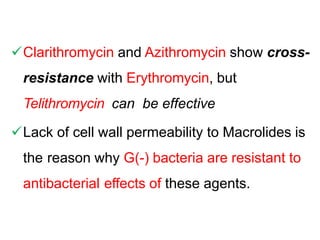
Clarithromycin and Azithromycin show cross-
resistance with Erythromycin, but
Telithromycin can be effective
Lack of cell wall permeability to Macrolides is
the reason why G(-) bacteria are resistant to
antibacterial effects of these agents.
PHARMACOKINETICS
ABSORPTION
ERYTHROMYCIN : variable absorption,
food may decrease absorption.
Base: destroyed by gastric acid
Enteric coated Esters and ester salts: more
acid stable
CLARITHROMYCIN : acid stable and well
absorbed
AZITHROMYCIN : acid stable, food
decreases absorption
DISTRIBUTION:
Extensive tissue and cellular distribution
No BBB and CSF penetration
Erythromycin accumulates in the prostatic
fluid and also in macrophages.
Azithromycin accumulates in Neutrophils
Macrophages, Fibroblasts. Has Large
volume of distribution and longest half life
(greater than 40 hrs
,
ELIMINATION
Clarithromycin is the only Macrolide partially
eliminated by the Kidney(18% of parent and
all metabolites).
Hepatically eliminated: ALL.
NONE of the macrolides are removed during
hemodialysis
Erythromycin and Azithromycin are primarily
concentrated and excreted through bile as
active drugs.
ADVERSE EFFECTS
GASTROINTESTINAL EFFECTS:
 Anorexia, nausea, vomiting, and diarrhoea
occasionally accompany oral administration.
 Gastrointestinal intolerance, which is due to a
direct stimulation of gut motility (motilin agonist)
is the most common reason for discontinuing
Erythromycin and substituting with another
antibiotic.
LIVER TOXICITY:
Erythromycin estolate, can produce acute
,
Cholestatic hepatitis (fever,jaundice,impaired liver
function) probably as a hypersensitivity reaction.
 Most patients recover from this, but hepatitis
reoccurs if the drug is readministered.
 Macrolides get deposited in perilymph and
causes ototoxicity.
 Other allergic reactions include fever,
eosinophilia, and rashes.
 Prolong QT WAVE
DRUG INTERACTIONS
Erythromycin metabolites inhibit cytochrome
P450 enzymes and thus increase the
serum concentrations of numerous drugs
including
• Theophylline
• Oral anticoagulants
• Cyclosporine
• Methylprednisolone,
• Erythromycin increases serum concentrations
of oral Digoxin by increasing its bioavailability.
THERAPEUTIC USES OF ERYTHROMYCIN
It is used to treat
a. upper respiratory tract infections
b. Soft tissue G(+) infections,
c. Urethritis caused by (MRSA,Ureaplasma
Urealyticum)
d. Mycoplasma pneumonia pneumonia
Campylobacter jejuni -- Enteritis,
e. Chlamydia infections
Majorly C. Trachomatis (Urethritis, epididymitis,
cervicitis, pelvic inflammatory disease (PID)
and other conditions)
C. Pneumonia respiratory illness (prolonged
cough, bronchitis, and pneumonia as well as a sore
throat, laryngitis, ear infections, and sinusitis)
f. Gonorrhoea caused by Nesseria gonorrhoea
g. Treatment and prophylaxis of ophthalmic infections
and also neonatal conjuctivitis
h. To treat acne
i. Pelvic inflammatory disease due to susceptible
organisms (e.g., Streptococcus Pneumoniae
,
Streptococcus pyogenes, Haemophilus
influenzae, Chlamydia, Legionella, Mycoplasma,
Nesseria gonorrhoeae, Treponema)
ADVERSE DRUG REACTIONS:
 Ventricular arrhythmias, QT Interval
prolongation
 Pseudomembranous colitis,
 Nausea/Vomiting, abdominal pain, cramping,
diarrhea, hepatitis, rash, pruritis, phlebitis at IV
site, allergic reactions.
THERAPEUTIC USES OF ROXITHROMYCIN
same spectrum as of Erythromycin but
more potent against moraxella catarrhalis and
legionella and less potent against bordetella
pertusis
THERAPEUTIC USES OF SPIRAMYCIN
resembles Erythromycin in its spectrum, though
weaker efficacy. However, highly efficacious
against toxaplasma gondii and cryptosporidium
CLINICAL APPLICATIONS OF CLARITHROMYCIN
 to treat Respiratory tract infections
(pharyngitis/tonsillitis ).
 skin/skin structure infections due to susceptible
organisms (e.g., S. pneumo, S. pyogenes, S. aureus, M.
catarrhalis, Hemophilus influenza, Chlamydia
pneumoniae, Mycoplasma).
 To prevent or treatment disseminated MAC infection
 Eradicate H.pylori associated with peptic ulcer
disease
ADVERSE DRUG REACTIONS :
Hepatic failure, Pseudomembranous colitis,
Stevens-Johnson syndrome, Toxic epidermal
necrolysis,Drug rash (with eosinophilia)
THERAPEUTIC USES OF AZITHROMYCIN
 extended spectrum compared to Erythromycin.
 higher activity against Chlamydia trachomatis,
Mycoplasma pneumoniae, Nesseria gonorrhoeae,
toxoplasma gondii.
 Campylobacter jejuni (It is among the most common
bacterial infections of humans, often a foodborne illness.)
 H. Influenza (Bacteremia,Meningitis,Epiglotittis,Cellulitis,
Infectious arthritis).
Moraxella catarrhalis(can cause infection of the
respiratory system, middle ear, eye,central nervous system
 It is used in acute bacterial infections
 Single dose treatment mild to moderate sinusitis
 Chancroid ( STD; Caused by haemophilus ducreyi)
 T
o treat non gonococcal infections
(urethritis, cervicitis)
 Prevention and treatment ofMAC infection in
patients with advanced HIV.
ADVERSE REACTIONS:
 Pseudomembranous colitis,
 Abdominal pain, Nausea /Vomiting,
 Rash
macrolides.pptx

macrolides.pptx

  • 2.
    INTRODUCTION Macrolides are agroup of closely related compounds characterized by a macrocyclic lactone ring (usually containing 14 or 16 atoms) to which deoxysugars are attached. The prototype drug Erythromycin consists of two sugar moieties attached to a 14-atom lactone ring.
  • 3.
    1952 Streptomyces Erythreus= Erythromycin Clarithromycin and Azithromycin are semisynthetic derivatives of Erythromycin .
  • 4.
    CLASSIFICATION MACROLIDES i. ERYTHROMYCIN ii. CLARITHROMYCIN iii.AZITHROMYCIN iv. ROXITHROMYCIN v. SPIRAMYCIN KETOLIDES i. TELITHROMYCIN
  • 5.
    MECHANISM OF ACTION •Inhibits protein synthesis by reversibly binding to 50S ribosomal subunit • Suppression of RNA- dependent protein synthesis by inhibition of translocation of mRNA. • Typically bacteriostatic activity • Bactericidal at high concentrations against very susceptible organisms
  • 7.
    SPECTRUM OF ANTIBACTERIALACTIVITY  Macrolides are similar to Penicillins regarding their spectrum of activity.  They are effective against Penicillin-resistant strains. GRAM +VE COCCI GRAM +VE BACILLI Streptococcus pneumoniae Bacilus anthracis Strepto. pyogens Listeria monocytogenes Staphylococci most or penicillin resistant species and these are now macrolide resistant also) Clostridium tetani GRAM –VE COCCI GRAM -VE BACILLI Nesseria gonorrhoeae Legionella pneumophila Moraxella catarrhalis Bordetella pertussis Bartonella henselae Haemophilus influenzae, h. ducreyi. Campylobacter jejuni Helicobacter pylori
  • 8.
    ACID FAST BACILLISPIROCHETES MISCELLANEOUS Mycobacterium kanasii Treponema pallidum Mycoplasma pneumoniae Mycobacterium avium intracellulare Ureaplasma urealyticum Mycobacterium avium complex Chlamydia trachomatis Mycobacterium leprae Chlamydia pneumoniae Chlamydia psittaci
  • 9.
    BACTERIAL RESISTANCE Methylation ofa guanine residue on ribosomal RNA leads to lower affinity toward Macrolides An active efflux system Presenceof a plasmid associated Erythromycin esterase.
  • 10.
    Clarithromycin and Azithromycinshow cross- resistance with Erythromycin, but Telithromycin can be effective Lack of cell wall permeability to Macrolides is the reason why G(-) bacteria are resistant to antibacterial effects of these agents.
  • 11.
    PHARMACOKINETICS ABSORPTION ERYTHROMYCIN : variableabsorption, food may decrease absorption. Base: destroyed by gastric acid Enteric coated Esters and ester salts: more acid stable CLARITHROMYCIN : acid stable and well absorbed AZITHROMYCIN : acid stable, food decreases absorption
  • 12.
    DISTRIBUTION: Extensive tissue andcellular distribution No BBB and CSF penetration Erythromycin accumulates in the prostatic fluid and also in macrophages. Azithromycin accumulates in Neutrophils Macrophages, Fibroblasts. Has Large volume of distribution and longest half life (greater than 40 hrs ,
  • 13.
    ELIMINATION Clarithromycin is theonly Macrolide partially eliminated by the Kidney(18% of parent and all metabolites). Hepatically eliminated: ALL. NONE of the macrolides are removed during hemodialysis Erythromycin and Azithromycin are primarily concentrated and excreted through bile as active drugs.
  • 14.
    ADVERSE EFFECTS GASTROINTESTINAL EFFECTS: Anorexia, nausea, vomiting, and diarrhoea occasionally accompany oral administration.  Gastrointestinal intolerance, which is due to a direct stimulation of gut motility (motilin agonist) is the most common reason for discontinuing Erythromycin and substituting with another antibiotic.
  • 15.
    LIVER TOXICITY: Erythromycin estolate,can produce acute , Cholestatic hepatitis (fever,jaundice,impaired liver function) probably as a hypersensitivity reaction.  Most patients recover from this, but hepatitis reoccurs if the drug is readministered.  Macrolides get deposited in perilymph and causes ototoxicity.  Other allergic reactions include fever, eosinophilia, and rashes.  Prolong QT WAVE
  • 16.
    DRUG INTERACTIONS Erythromycin metabolitesinhibit cytochrome P450 enzymes and thus increase the serum concentrations of numerous drugs including • Theophylline • Oral anticoagulants • Cyclosporine • Methylprednisolone, • Erythromycin increases serum concentrations of oral Digoxin by increasing its bioavailability.
  • 18.
    THERAPEUTIC USES OFERYTHROMYCIN It is used to treat a. upper respiratory tract infections b. Soft tissue G(+) infections, c. Urethritis caused by (MRSA,Ureaplasma Urealyticum) d. Mycoplasma pneumonia pneumonia Campylobacter jejuni -- Enteritis,
  • 19.
    e. Chlamydia infections MajorlyC. Trachomatis (Urethritis, epididymitis, cervicitis, pelvic inflammatory disease (PID) and other conditions) C. Pneumonia respiratory illness (prolonged cough, bronchitis, and pneumonia as well as a sore throat, laryngitis, ear infections, and sinusitis) f. Gonorrhoea caused by Nesseria gonorrhoea g. Treatment and prophylaxis of ophthalmic infections and also neonatal conjuctivitis
  • 20.
    h. To treatacne i. Pelvic inflammatory disease due to susceptible organisms (e.g., Streptococcus Pneumoniae , Streptococcus pyogenes, Haemophilus influenzae, Chlamydia, Legionella, Mycoplasma, Nesseria gonorrhoeae, Treponema)
  • 21.
    ADVERSE DRUG REACTIONS: Ventricular arrhythmias, QT Interval prolongation  Pseudomembranous colitis,  Nausea/Vomiting, abdominal pain, cramping, diarrhea, hepatitis, rash, pruritis, phlebitis at IV site, allergic reactions.
  • 22.
    THERAPEUTIC USES OFROXITHROMYCIN same spectrum as of Erythromycin but more potent against moraxella catarrhalis and legionella and less potent against bordetella pertusis THERAPEUTIC USES OF SPIRAMYCIN resembles Erythromycin in its spectrum, though weaker efficacy. However, highly efficacious against toxaplasma gondii and cryptosporidium
  • 23.
    CLINICAL APPLICATIONS OFCLARITHROMYCIN  to treat Respiratory tract infections (pharyngitis/tonsillitis ).  skin/skin structure infections due to susceptible organisms (e.g., S. pneumo, S. pyogenes, S. aureus, M. catarrhalis, Hemophilus influenza, Chlamydia pneumoniae, Mycoplasma).  To prevent or treatment disseminated MAC infection
  • 24.
     Eradicate H.pyloriassociated with peptic ulcer disease ADVERSE DRUG REACTIONS : Hepatic failure, Pseudomembranous colitis, Stevens-Johnson syndrome, Toxic epidermal necrolysis,Drug rash (with eosinophilia)
  • 25.
    THERAPEUTIC USES OFAZITHROMYCIN  extended spectrum compared to Erythromycin.  higher activity against Chlamydia trachomatis, Mycoplasma pneumoniae, Nesseria gonorrhoeae, toxoplasma gondii.  Campylobacter jejuni (It is among the most common bacterial infections of humans, often a foodborne illness.)  H. Influenza (Bacteremia,Meningitis,Epiglotittis,Cellulitis, Infectious arthritis). Moraxella catarrhalis(can cause infection of the respiratory system, middle ear, eye,central nervous system
  • 26.
     It isused in acute bacterial infections  Single dose treatment mild to moderate sinusitis  Chancroid ( STD; Caused by haemophilus ducreyi)  T o treat non gonococcal infections (urethritis, cervicitis)  Prevention and treatment ofMAC infection in patients with advanced HIV. ADVERSE REACTIONS:  Pseudomembranous colitis,  Abdominal pain, Nausea /Vomiting,  Rash