Macrolide AntibioticsMacrolide Antibiotics
VINAY GUPTAVINAY GUPTA
DEPT OF PHARMACOLOGYDEPT OF PHARMACOLOGY
UP UNIVERSITY OF MEDICALUP UNIVERSITY OF MEDICAL
SCIENCES,SCIENCES,
SAIFAI, ETAWAH (UP) INDIASAIFAI, ETAWAH (UP) INDIA
IntroductionIntroduction
O
O O
O
CH3
HO
H3C
CH3
CH3
O
H3C
H3C
O
HO
CH3
N CH3
H3C
Picromycin
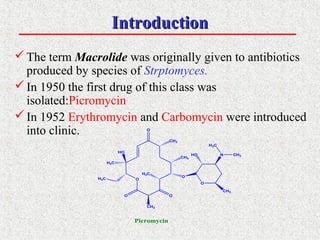
The term Macrolide was originally given to antibiotics
produced by species of Strptomyces.
In 1950 the first drug of this class was
isolated:Picromycin
In 1952 Erythromycin and Carbomycin were introduced
into clinic.
General StructureGeneral Structure
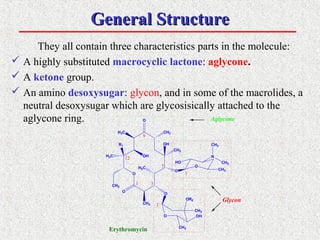
They all contain three characteristics parts in the molecule:
 A highly substituted macrocyclic lactone: aglycone.
 A ketone group.
 An amino desoxysugar: glycon, and in some of the macrolides, a
neutral desoxysugar which are glycosisically attached to the
aglycone ring.
O
O
O
CH3
R1
H3C
CH3
CH3
O
H3C
OH
H3C
CH3
OH
O
O
HO
CH3
N
CH3
CH3
O OH
CH3
CH3
OR2
1 3
5
9
12
1`
1``
Erythromycin
Glycon
Aglycone
The lactone ring usually has 12, 14, or 16 atoms12, 14, or 16 atoms and is
often unsaturated & conjugated with the ketone groupketone group.
Having a dimethyl amino group on the glycon part,
macrolide antibiotics are weak bases and different salts
with pKa range of 6.0-9.0pKa range of 6.0-9.0 can be formed on the amino
group.
Macrolides are water-insolublewater-insoluble molecules.
Macrolides are stable in aqueous solutions at or below
room temperature. They are unstable in acidic or basic
conditions or at high temperatures.
Mechanism of Antimicrobial ActivityMechanism of Antimicrobial Activity
Macrolides attach to the 50s portion of bacterialbacterial
ribosomesribosomes and inhibit the protein synthesisinhibit the protein synthesis
(interferes with Translocation).(interferes with Translocation).
 Suppression of RNA-dependent protein synthesis
They block the enzymes that catalyse the transfer of
the new amino acid residue to the peptide chain, that
is, prevent elongation in prokaryotic cells.
Macrolides typically display bacteriostaticbacteriostatic activity,
but may be bactericidal when present at high
concentrations against very susceptible organisms
Macrolides – Adverse EffectsMacrolides – Adverse Effects
Gastrointestinal – up to 33 %
Nausea, vomiting, diarrhea, dyspepsia
Most common with erythro; less with new agents
On oral therapy – mild to severe epigastric pain.
High doses may cause reversible hearing impairment.
Hypersenstivity.
Thrombophlebitis – IV Erythro and Azithro
(Dilution of dose; slow administration)
Chemical Instability of MacrolideChemical Instability of Macrolide
AntibioticsAntibiotics
O
O
CH3
CH3
O
H3C
CH3
O
O
CH3
1 3
12 6
89
O
H3C
HO
H3C
Anhydroerythromycin
6,9;9,12-spiroketal
O OH
CH3
CH3
OR2
1``
O
HO
CH3
N
CH3
CH3
1`
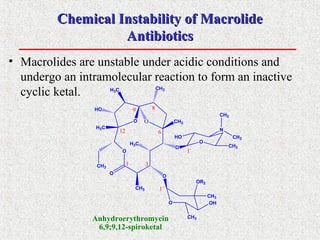
• Macrolides are unstable under acidic conditions and
undergo an intramolecular reaction to form an inactive
cyclic ketal.
Chemical Instability….Chemical Instability….
The cyclic ketal is is the cause of intestinal cramp
which is reported after the use of erythromycin.
Water-insoluble salts and enteric coated dosageenteric coated dosage
forms of macrolides have less such a side effect.
Water insoluble forms cannot take part in the
reactions which occur in aqueous solutions.
 Stearate saltStearate salt is an example of insoluble salts of
erythromycin.
Therapeutic AgentsTherapeutic Agents
ErythromycinErythromycin
 ErythromycinErythromycin is a naturally-occurring macrolide derived
from Streptomyces erythreus – problems with acid
lability, narrow spectrum, poor GI intolerance, short
elimination half-life.
Structural derivatives include clarithromycinclarithromycin and
azithromycin, roxithromycin (Newerazithromycin, roxithromycin (Newer macrolides)-
-Broader spectrum of activity
-Improved PK properties – better bioavailability, better
tissue penetration, prolonged half-lives
-Improved tolerability
Pharmacokinetics
Erythromycin baseErythromycin base
 Absorption incomplete but adequate from intestine.
 Inactivated by gastric HCL, hence given as :
Enteric coated tablets or ester (stearate, ethyl succinate )
 Food delays absorption.
 Not metabolized and actively secreted in bile ( major route of
excretion ).
 Only 2-5 % is excreted in active form in urine.
 Widely distributed into most tissues, except the brain and CSF.
 Cross the placental barrier.
 Protein binding – 70- 80 %
 Half – life approx. 1.5 hr.Half – life approx. 1.5 hr.
 Dose: 250-500mg/BD/oralDose: 250-500mg/BD/oral max. 4gm/daymax. 4gm/day
30-60mg/kg/day30-60mg/kg/day childrenschildrens
Clinical ApplicationClinical Application
of Erythromycinof Erythromycin
It is used to treat -
The upper part of the respiratory tract infections,
Soft tissue G(+) infections,
Mycoplasma pneumonia
Diphtheria
Tetanus
Clamidia infections.
Gonorrhoea & syphilis.
It is a good choice for penicillin-sensitive cases.
ClarithromycinClarithromycin
O
O
O
CH3
HO
H3C
CH3
CH3
O
H3C
OH
H3C
O
O
O
HO
CH3
N
CH3
CH3
O OH
CH3
CH3
OH
1 3
5
9
12
1`
1``
Clarithromycin
H3C
CH3
6
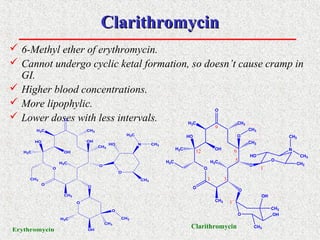
 6-Methyl ether of erythromycin.
 Cannot undergo cyclic ketal formation, so doesn’t cause cramp in
GI.
 Higher blood concentrations.
 More lipophylic.
 Lower doses with less intervals.
O
O
O
CH3
HO
H3C
CH3
CH3
O
H3C
O
HO
CH3
N CH3
H3C
OH
H3C
CH3
OH
O
O
OH
O
H3C
CH3
CH3
Erythromycin
ClarithromycinClarithromycin
Pharmacokinetics
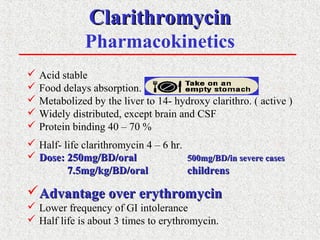
 Acid stable
 Food delays absorption.
 Metabolized by the liver to 14- hydroxy clarithro. ( active )
 Widely distributed, except brain and CSF
 Protein binding 40 – 70 %
 Half- life clarithromycin 4 – 6 hr.
 Dose: 250mg/BD/oralDose: 250mg/BD/oral 500mg/BD/in severe cases500mg/BD/in severe cases
7.5mg/kg/BD/oral7.5mg/kg/BD/oral childrenschildrens
Advantage over erythromycinAdvantage over erythromycin
 Lower frequency of GI intolerance
 Half life is about 3 times to erythromycin.
AzithromycinAzithromycin
 Azalide, a semisynthetic macrolide with a15 membered ring.
 Stable under acidic conditions, because it doesn’t form cyclic
ketal.
 In the treatment of urogenital infections caused by N. gonorrhoeae
and Chlamidia trachomatis.
 Longer half-life.
O
O
CH3
HO
H3C
CH3
O
H3C
OH
CH3
OH
O
O
HO
CH3
N
CH3
CH3
O OH
CH3
CH3
OCH3
1 3
5
12
1`
1``
N
CH3
H3C
H3C
Azithromycin
AzithromycinAzithromycin
PharmacokineticsPharmacokinetics
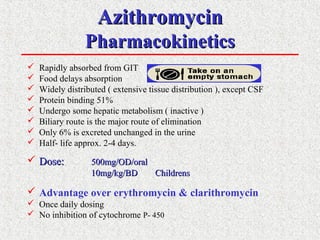
 Rapidly absorbed from GIT
 Food delays absorption
 Widely distributed ( extensive tissue distribution ), except CSF
 Protein binding 51%
 Undergo some hepatic metabolism ( inactive )
 Biliary route is the major route of elimination
 Only 6% is excreted unchanged in the urine
 Half- life approx. 2-4 days.
 Dose:Dose: 500mg/OD/oral500mg/OD/oral
10mg/kg/BD10mg/kg/BD ChildrensChildrens
 Advantage over erythromycin & clarithromycin
 Once daily dosing
 No inhibition of cytochrome P- 450
Macrolide Spectrum of
Activity
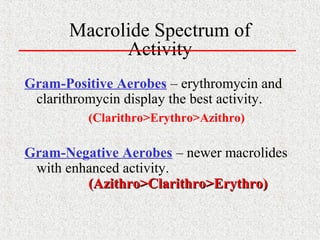
Gram-Positive Aerobes – erythromycin and
clarithromycin display the best activity.
(Clarithro>Erythro>Azithro)
Gram-Negative Aerobes – newer macrolides
with enhanced activity.
(Azithro>Clarithro>Erythro)(Azithro>Clarithro>Erythro)
Spectrum of Antibacterial ActivitySpectrum of Antibacterial Activity
Macrolides are similar to penicillins regarding their
spectrum of activity.
They are effective against penicillin-resistant strains.
Macrolides are effective against most of the G(+)
bacteria, cocci or bacillus, they have antibiotic activity
against G(-) cocci ,especially Neisseria Spp too.
Macrolide antibiotics are effective against
Mycoplasma, Clamidia, Campylobacter and Legionella
in contrast to penicillins.
They are less effective against G(-) bacteria, though
some strains of H. influenza and Brucella are sensitive
to the antibacterial activity of this class of antibiotics.
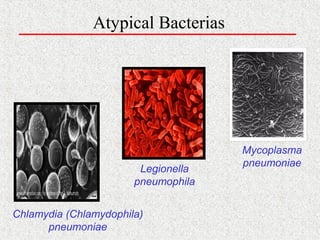
Atypical Bacterias
Mycoplasma
pneumoniae
Legionella
pneumophila
Chlamydia (Chlamydophila)
pneumoniae
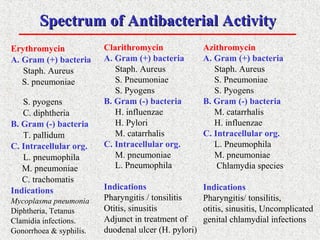
Erythromycin
A. Gram (+) bacteria
Staph. Aureus
S. pneumoniae
S. pyogens
C. diphtheria
B. Gram (-) bacteria
T. pallidum
C. Intracellular org.
L. pneumophila
M. pneumoniae
C. trachomatis
Indications
Mycoplasma pneumonia
Diphtheria, Tetanus
Clamidia infections.
Gonorrhoea & syphilis.
Spectrum of Antibacterial ActivitySpectrum of Antibacterial Activity
Clarithromycin
A. Gram (+) bacteria
Staph. Aureus
S. Pneumoniae
S. Pyogens
B. Gram (-) bacteria
H. influenzae
H. Pylori
M. catarrhalis
C. Intracellular org.
M. pneumoniae
L. Pneumophila
Indications
Pharyngitis / tonsilitis
Otitis, sinusitis
Adjunct in treatment of
duodenal ulcer (H. pylori)
Azithromycin
A. Gram (+) bacteria
Staph. Aureus
S. Pneumoniae
S. Pyogens
B. Gram (-) bacteria
M. catarrhalis
H. influenzae
C. Intracellular org.
L. Pneumophila
M. pneumoniae
Chlamydia species
Indications
Pharyngitis/ tonsilitis,
otitis, sinusitis, Uncomplicated
genital chlamydial infections
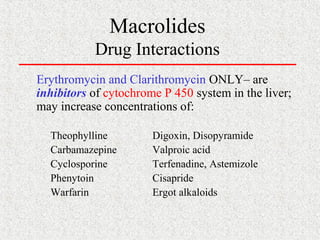
Macrolides
Drug Interactions
Erythromycin and Clarithromycin ONLY– are
inhibitors of cytochrome P 450 system in the liver;
may increase concentrations of:
Theophylline Digoxin, Disopyramide
Carbamazepine Valproic acid
Cyclosporine Terfenadine, Astemizole
Phenytoin Cisapride
Warfarin Ergot alkaloids
Vancomycin
Tricyclic glycopeptide - Streptomyces orientalis.
Inhibits synthesis of cell wall phospholipids and
prevents cross-linking of peptidoglycans at an earlier
step than B-lactams.
Active against gram positive bacteria, highly resistant
Strep. pneumo, Clostridia, Enterococcus, Staph. epi
and MRSA.MRSA.
Synergy with aminoglycosides.
Used in treatment of MRSA and highly resistant Strep.
species.
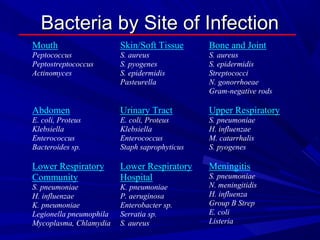
Bacteria by Site of InfectionBacteria by Site of Infection
Mouth
Peptococcus
Peptostreptococcus
Actinomyces
Skin/Soft Tissue
S. aureus
S. pyogenes
S. epidermidis
Pasteurella
Bone and Joint
S. aureus
S. epidermidis
Streptococci
N. gonorrhoeae
Gram-negative rods
Abdomen
E. coli, Proteus
Klebsiella
Enterococcus
Bacteroides sp.
Urinary Tract
E. coli, Proteus
Klebsiella
Enterococcus
Staph saprophyticus
Upper Respiratory
S. pneumoniae
H. influenzae
M. catarrhalis
S. pyogenes
Lower Respiratory
Community
S. pneumoniae
H. influenzae
K. pneumoniae
Legionella pneumophila
Mycoplasma, Chlamydia
Lower Respiratory
Hospital
K. pneumoniae
P. aeruginosa
Enterobacter sp.
Serratia sp.
S. aureus
Meningitis
S. pneumoniae
N. meningitidis
H. influenza
Group B Strep
E. coli
Listeria
Dirithromycin
• A more lipophyl prodrug with high oral absorption.
• Unstable 9N,11O oxazine ring which easily hydrolysis to
erythromyclamine.
O
O
CH3
HO
H3C
CH3
CH3
O
H3C
O
H3C
CH3
OH
O
O
HO
CH3
N
CH3
CH3
O OH
CH3
OCH3
HN O
O
CH3
Dirithromycin
1 3
6
7
8
9
11
10
12
 Erythromyclamin is another semisynthetic derivative of
erythromycin with 9-amino instead of 9-keto group.
 It has the same antibacterial effects as erythromycin.
 Less oral absorption than erythromycin has lead chemists to
prepare more lipophyl prodrug, dirithromycin.
 Dirithromycin is protected against gastric acid with the enteric
coated form.
 It is readily absorbed orally, but has low plasma concentration
because of high volume of distribution.
 Infections of the upper and lower parts of respiratory system
with only one oral dose.
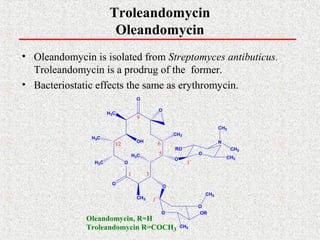
Troleandomycin
Oleandomycin
O
O
O
CH3
H3C
CH3
O
H3C
OH
H3C
H3C
O
O
RO
CH3
N
CH3
CH3
O OR
CH3
1 3
5
9
12
1`
1``
Oleandomycin, R=H
Troleandomycin R=COCH3
6
O
O
CH3
• Oleandomycin is isolated from Streptomyces antibuticus.
Troleandomycin is a prodrug of the former.
• Bacteriostatic effects the same as erythromycin.
Macrolide Spectrum of
Activity
Gram-Positive Aerobes – erythromycin and
clarithromycin display the best activity
(Clarithro>Erythro>Azithro)
• Methicillin-susceptible Staphylococcus aureus
• Streptococcus pneumoniae (only PSSP) – resistance is
developing
• Group and viridans streptococci
• Bacillus sp., Corynebacterium sp.
Macrolide Spectrum of Activity
Gram-Negative Aerobes – newer macrolides
with enhanced activity
(Azithro>Clarithro>Erythro)
• H. influenzae (not erythro), M. catarrhalis,
Neisseria sp.
• Do NOT have activity against any
Enterobacteriaceae
Macrolide Spectrum of Activity
Anaerobes – activity against upper airway anaerobes
Atypical Bacteria – all macrolides have excellent
activity against atypical bacteria including:
• Legionella pneumophila
• Chlamydia sp.
• Mycoplasma sp.
• Ureaplasma urealyticum
Other Bacteria – Mycobacterium avium complex
(MAC – only A and C), Treponema pallidum,
Campylobacter, Borrelia, Bordetella, Brucella.
Pasteurella
Macrolides
Pharmacology
Absorption
 Erythromycin – variable absorption (F = 15-45%);
food may decrease the absorption
• Base: destroyed by gastric acid; enteric coated
• Esters and ester salts: more acid stable
 Clarithromycin – acid stable and well-absorbed
(F = 55%) regardless of presence of food
 Azithromycin –acid stable; F = 38%; food
decreases absorption of capsules
Macrolides
Pharmacology
Distribution
 Extensive tissue and cellular distribution – clarithromycin and
azithromycin with extensive penetration
 Minimal CSF penetration
Elimination
 Clarithromycin is the only macrolide partially eliminated by the
kidney (18% of parent and all metabolites); requires dose
adjustment when CrCl < 30 ml/min
 Hepatically eliminated: ALL
 NONE of the macrolides are removed during hemodialysis!
 Variable elimination half-lives (1.4 hours for erythro; 3 to 7
hours for clarithro; 68 hours for azithro)
Macrolides
Adverse Effects
• Gastrointestinal – up to 33 %
 Nausea, vomiting, diarrhea, dyspepsia
 Most common with erythro; less with new agents
• Cholestatic hepatitis - rare
 > 1 to 2 weeks of erythromycin estolate
• Thrombophlebitis – IV Erythro and Azithro
 Dilution of dose; slow administration
• Other: ototoxicity (high dose erythro in patients with RI);
QTc prolongation; allergy

Macrolide antibiotics

  • 1.
    Macrolide AntibioticsMacrolide Antibiotics VINAYGUPTAVINAY GUPTA DEPT OF PHARMACOLOGYDEPT OF PHARMACOLOGY UP UNIVERSITY OF MEDICALUP UNIVERSITY OF MEDICAL SCIENCES,SCIENCES, SAIFAI, ETAWAH (UP) INDIASAIFAI, ETAWAH (UP) INDIA
  • 2.
    IntroductionIntroduction O O O O CH3 HO H3C CH3 CH3 O H3C H3C O HO CH3 N CH3 H3C Picromycin Theterm Macrolide was originally given to antibiotics produced by species of Strptomyces. In 1950 the first drug of this class was isolated:Picromycin In 1952 Erythromycin and Carbomycin were introduced into clinic.
  • 3.
    General StructureGeneral Structure Theyall contain three characteristics parts in the molecule:  A highly substituted macrocyclic lactone: aglycone.  A ketone group.  An amino desoxysugar: glycon, and in some of the macrolides, a neutral desoxysugar which are glycosisically attached to the aglycone ring. O O O CH3 R1 H3C CH3 CH3 O H3C OH H3C CH3 OH O O HO CH3 N CH3 CH3 O OH CH3 CH3 OR2 1 3 5 9 12 1` 1`` Erythromycin Glycon Aglycone
  • 4.
    The lactone ringusually has 12, 14, or 16 atoms12, 14, or 16 atoms and is often unsaturated & conjugated with the ketone groupketone group. Having a dimethyl amino group on the glycon part, macrolide antibiotics are weak bases and different salts with pKa range of 6.0-9.0pKa range of 6.0-9.0 can be formed on the amino group. Macrolides are water-insolublewater-insoluble molecules. Macrolides are stable in aqueous solutions at or below room temperature. They are unstable in acidic or basic conditions or at high temperatures.
  • 5.
    Mechanism of AntimicrobialActivityMechanism of Antimicrobial Activity Macrolides attach to the 50s portion of bacterialbacterial ribosomesribosomes and inhibit the protein synthesisinhibit the protein synthesis (interferes with Translocation).(interferes with Translocation).  Suppression of RNA-dependent protein synthesis They block the enzymes that catalyse the transfer of the new amino acid residue to the peptide chain, that is, prevent elongation in prokaryotic cells. Macrolides typically display bacteriostaticbacteriostatic activity, but may be bactericidal when present at high concentrations against very susceptible organisms
  • 6.
    Macrolides – AdverseEffectsMacrolides – Adverse Effects Gastrointestinal – up to 33 % Nausea, vomiting, diarrhea, dyspepsia Most common with erythro; less with new agents On oral therapy – mild to severe epigastric pain. High doses may cause reversible hearing impairment. Hypersenstivity. Thrombophlebitis – IV Erythro and Azithro (Dilution of dose; slow administration)
  • 7.
    Chemical Instability ofMacrolideChemical Instability of Macrolide AntibioticsAntibiotics O O CH3 CH3 O H3C CH3 O O CH3 1 3 12 6 89 O H3C HO H3C Anhydroerythromycin 6,9;9,12-spiroketal O OH CH3 CH3 OR2 1`` O HO CH3 N CH3 CH3 1` • Macrolides are unstable under acidic conditions and undergo an intramolecular reaction to form an inactive cyclic ketal.
  • 8.
    Chemical Instability….Chemical Instability…. Thecyclic ketal is is the cause of intestinal cramp which is reported after the use of erythromycin. Water-insoluble salts and enteric coated dosageenteric coated dosage forms of macrolides have less such a side effect. Water insoluble forms cannot take part in the reactions which occur in aqueous solutions.  Stearate saltStearate salt is an example of insoluble salts of erythromycin.
  • 9.
    Therapeutic AgentsTherapeutic Agents ErythromycinErythromycin ErythromycinErythromycin is a naturally-occurring macrolide derived from Streptomyces erythreus – problems with acid lability, narrow spectrum, poor GI intolerance, short elimination half-life. Structural derivatives include clarithromycinclarithromycin and azithromycin, roxithromycin (Newerazithromycin, roxithromycin (Newer macrolides)- -Broader spectrum of activity -Improved PK properties – better bioavailability, better tissue penetration, prolonged half-lives -Improved tolerability
  • 10.
    Pharmacokinetics Erythromycin baseErythromycin base Absorption incomplete but adequate from intestine.  Inactivated by gastric HCL, hence given as : Enteric coated tablets or ester (stearate, ethyl succinate )  Food delays absorption.  Not metabolized and actively secreted in bile ( major route of excretion ).  Only 2-5 % is excreted in active form in urine.  Widely distributed into most tissues, except the brain and CSF.  Cross the placental barrier.  Protein binding – 70- 80 %  Half – life approx. 1.5 hr.Half – life approx. 1.5 hr.  Dose: 250-500mg/BD/oralDose: 250-500mg/BD/oral max. 4gm/daymax. 4gm/day 30-60mg/kg/day30-60mg/kg/day childrenschildrens
  • 11.
    Clinical ApplicationClinical Application ofErythromycinof Erythromycin It is used to treat - The upper part of the respiratory tract infections, Soft tissue G(+) infections, Mycoplasma pneumonia Diphtheria Tetanus Clamidia infections. Gonorrhoea & syphilis. It is a good choice for penicillin-sensitive cases.
  • 12.
    ClarithromycinClarithromycin O O O CH3 HO H3C CH3 CH3 O H3C OH H3C O O O HO CH3 N CH3 CH3 O OH CH3 CH3 OH 1 3 5 9 12 1` 1`` Clarithromycin H3C CH3 6 6-Methyl ether of erythromycin.  Cannot undergo cyclic ketal formation, so doesn’t cause cramp in GI.  Higher blood concentrations.  More lipophylic.  Lower doses with less intervals. O O O CH3 HO H3C CH3 CH3 O H3C O HO CH3 N CH3 H3C OH H3C CH3 OH O O OH O H3C CH3 CH3 Erythromycin
  • 13.
    ClarithromycinClarithromycin Pharmacokinetics  Acid stable Food delays absorption.  Metabolized by the liver to 14- hydroxy clarithro. ( active )  Widely distributed, except brain and CSF  Protein binding 40 – 70 %  Half- life clarithromycin 4 – 6 hr.  Dose: 250mg/BD/oralDose: 250mg/BD/oral 500mg/BD/in severe cases500mg/BD/in severe cases 7.5mg/kg/BD/oral7.5mg/kg/BD/oral childrenschildrens Advantage over erythromycinAdvantage over erythromycin  Lower frequency of GI intolerance  Half life is about 3 times to erythromycin.
  • 14.
    AzithromycinAzithromycin  Azalide, asemisynthetic macrolide with a15 membered ring.  Stable under acidic conditions, because it doesn’t form cyclic ketal.  In the treatment of urogenital infections caused by N. gonorrhoeae and Chlamidia trachomatis.  Longer half-life. O O CH3 HO H3C CH3 O H3C OH CH3 OH O O HO CH3 N CH3 CH3 O OH CH3 CH3 OCH3 1 3 5 12 1` 1`` N CH3 H3C H3C Azithromycin
  • 15.
    AzithromycinAzithromycin PharmacokineticsPharmacokinetics  Rapidly absorbedfrom GIT  Food delays absorption  Widely distributed ( extensive tissue distribution ), except CSF  Protein binding 51%  Undergo some hepatic metabolism ( inactive )  Biliary route is the major route of elimination  Only 6% is excreted unchanged in the urine  Half- life approx. 2-4 days.  Dose:Dose: 500mg/OD/oral500mg/OD/oral 10mg/kg/BD10mg/kg/BD ChildrensChildrens  Advantage over erythromycin & clarithromycin  Once daily dosing  No inhibition of cytochrome P- 450
  • 16.
    Macrolide Spectrum of Activity Gram-PositiveAerobes – erythromycin and clarithromycin display the best activity. (Clarithro>Erythro>Azithro) Gram-Negative Aerobes – newer macrolides with enhanced activity. (Azithro>Clarithro>Erythro)(Azithro>Clarithro>Erythro)
  • 17.
    Spectrum of AntibacterialActivitySpectrum of Antibacterial Activity Macrolides are similar to penicillins regarding their spectrum of activity. They are effective against penicillin-resistant strains. Macrolides are effective against most of the G(+) bacteria, cocci or bacillus, they have antibiotic activity against G(-) cocci ,especially Neisseria Spp too. Macrolide antibiotics are effective against Mycoplasma, Clamidia, Campylobacter and Legionella in contrast to penicillins. They are less effective against G(-) bacteria, though some strains of H. influenza and Brucella are sensitive to the antibacterial activity of this class of antibiotics.
  • 18.
  • 19.
    Erythromycin A. Gram (+)bacteria Staph. Aureus S. pneumoniae S. pyogens C. diphtheria B. Gram (-) bacteria T. pallidum C. Intracellular org. L. pneumophila M. pneumoniae C. trachomatis Indications Mycoplasma pneumonia Diphtheria, Tetanus Clamidia infections. Gonorrhoea & syphilis. Spectrum of Antibacterial ActivitySpectrum of Antibacterial Activity Clarithromycin A. Gram (+) bacteria Staph. Aureus S. Pneumoniae S. Pyogens B. Gram (-) bacteria H. influenzae H. Pylori M. catarrhalis C. Intracellular org. M. pneumoniae L. Pneumophila Indications Pharyngitis / tonsilitis Otitis, sinusitis Adjunct in treatment of duodenal ulcer (H. pylori) Azithromycin A. Gram (+) bacteria Staph. Aureus S. Pneumoniae S. Pyogens B. Gram (-) bacteria M. catarrhalis H. influenzae C. Intracellular org. L. Pneumophila M. pneumoniae Chlamydia species Indications Pharyngitis/ tonsilitis, otitis, sinusitis, Uncomplicated genital chlamydial infections
  • 20.
    Macrolides Drug Interactions Erythromycin andClarithromycin ONLY– are inhibitors of cytochrome P 450 system in the liver; may increase concentrations of: Theophylline Digoxin, Disopyramide Carbamazepine Valproic acid Cyclosporine Terfenadine, Astemizole Phenytoin Cisapride Warfarin Ergot alkaloids
  • 21.
    Vancomycin Tricyclic glycopeptide -Streptomyces orientalis. Inhibits synthesis of cell wall phospholipids and prevents cross-linking of peptidoglycans at an earlier step than B-lactams. Active against gram positive bacteria, highly resistant Strep. pneumo, Clostridia, Enterococcus, Staph. epi and MRSA.MRSA. Synergy with aminoglycosides. Used in treatment of MRSA and highly resistant Strep. species.
  • 22.
    Bacteria by Siteof InfectionBacteria by Site of Infection Mouth Peptococcus Peptostreptococcus Actinomyces Skin/Soft Tissue S. aureus S. pyogenes S. epidermidis Pasteurella Bone and Joint S. aureus S. epidermidis Streptococci N. gonorrhoeae Gram-negative rods Abdomen E. coli, Proteus Klebsiella Enterococcus Bacteroides sp. Urinary Tract E. coli, Proteus Klebsiella Enterococcus Staph saprophyticus Upper Respiratory S. pneumoniae H. influenzae M. catarrhalis S. pyogenes Lower Respiratory Community S. pneumoniae H. influenzae K. pneumoniae Legionella pneumophila Mycoplasma, Chlamydia Lower Respiratory Hospital K. pneumoniae P. aeruginosa Enterobacter sp. Serratia sp. S. aureus Meningitis S. pneumoniae N. meningitidis H. influenza Group B Strep E. coli Listeria
  • 23.
    Dirithromycin • A morelipophyl prodrug with high oral absorption. • Unstable 9N,11O oxazine ring which easily hydrolysis to erythromyclamine. O O CH3 HO H3C CH3 CH3 O H3C O H3C CH3 OH O O HO CH3 N CH3 CH3 O OH CH3 OCH3 HN O O CH3 Dirithromycin 1 3 6 7 8 9 11 10 12
  • 24.
     Erythromyclamin isanother semisynthetic derivative of erythromycin with 9-amino instead of 9-keto group.  It has the same antibacterial effects as erythromycin.  Less oral absorption than erythromycin has lead chemists to prepare more lipophyl prodrug, dirithromycin.  Dirithromycin is protected against gastric acid with the enteric coated form.  It is readily absorbed orally, but has low plasma concentration because of high volume of distribution.  Infections of the upper and lower parts of respiratory system with only one oral dose.
  • 25.
    Troleandomycin Oleandomycin O O O CH3 H3C CH3 O H3C OH H3C H3C O O RO CH3 N CH3 CH3 O OR CH3 1 3 5 9 12 1` 1`` Oleandomycin,R=H Troleandomycin R=COCH3 6 O O CH3 • Oleandomycin is isolated from Streptomyces antibuticus. Troleandomycin is a prodrug of the former. • Bacteriostatic effects the same as erythromycin.
  • 26.
    Macrolide Spectrum of Activity Gram-PositiveAerobes – erythromycin and clarithromycin display the best activity (Clarithro>Erythro>Azithro) • Methicillin-susceptible Staphylococcus aureus • Streptococcus pneumoniae (only PSSP) – resistance is developing • Group and viridans streptococci • Bacillus sp., Corynebacterium sp.
  • 27.
    Macrolide Spectrum ofActivity Gram-Negative Aerobes – newer macrolides with enhanced activity (Azithro>Clarithro>Erythro) • H. influenzae (not erythro), M. catarrhalis, Neisseria sp. • Do NOT have activity against any Enterobacteriaceae
  • 28.
    Macrolide Spectrum ofActivity Anaerobes – activity against upper airway anaerobes Atypical Bacteria – all macrolides have excellent activity against atypical bacteria including: • Legionella pneumophila • Chlamydia sp. • Mycoplasma sp. • Ureaplasma urealyticum Other Bacteria – Mycobacterium avium complex (MAC – only A and C), Treponema pallidum, Campylobacter, Borrelia, Bordetella, Brucella. Pasteurella
  • 29.
    Macrolides Pharmacology Absorption  Erythromycin –variable absorption (F = 15-45%); food may decrease the absorption • Base: destroyed by gastric acid; enteric coated • Esters and ester salts: more acid stable  Clarithromycin – acid stable and well-absorbed (F = 55%) regardless of presence of food  Azithromycin –acid stable; F = 38%; food decreases absorption of capsules
  • 30.
    Macrolides Pharmacology Distribution  Extensive tissueand cellular distribution – clarithromycin and azithromycin with extensive penetration  Minimal CSF penetration Elimination  Clarithromycin is the only macrolide partially eliminated by the kidney (18% of parent and all metabolites); requires dose adjustment when CrCl < 30 ml/min  Hepatically eliminated: ALL  NONE of the macrolides are removed during hemodialysis!  Variable elimination half-lives (1.4 hours for erythro; 3 to 7 hours for clarithro; 68 hours for azithro)
  • 31.
    Macrolides Adverse Effects • Gastrointestinal– up to 33 %  Nausea, vomiting, diarrhea, dyspepsia  Most common with erythro; less with new agents • Cholestatic hepatitis - rare  > 1 to 2 weeks of erythromycin estolate • Thrombophlebitis – IV Erythro and Azithro  Dilution of dose; slow administration • Other: ototoxicity (high dose erythro in patients with RI); QTc prolongation; allergy

Editor's Notes

  • #19 This slide shows 3 organisms that are found in patients with community acquired pneumonia: Chlamydia pneumoniae, Legionella pneumophila, and Mycoplasma pneumoniae. These organisms are relatively less important in other respiratory track infections but should under at least some circumstances be taken into consideration as causes of community acquired pneumonia.