Presented By
Dr. Manoj Kumar
Assistant Professor
Dept. of Pharmacology
Adesh Medical College & Hospital Ambala Can’t
Introduction
 The term Macrolide was originally given to
antibiotics produced by species of Streptomyces.
 Erythromycin was discovered in 1952,
 obtainedfromStreptomyces erythreus.
 Its semi synthetic derivative
2
Macrolides
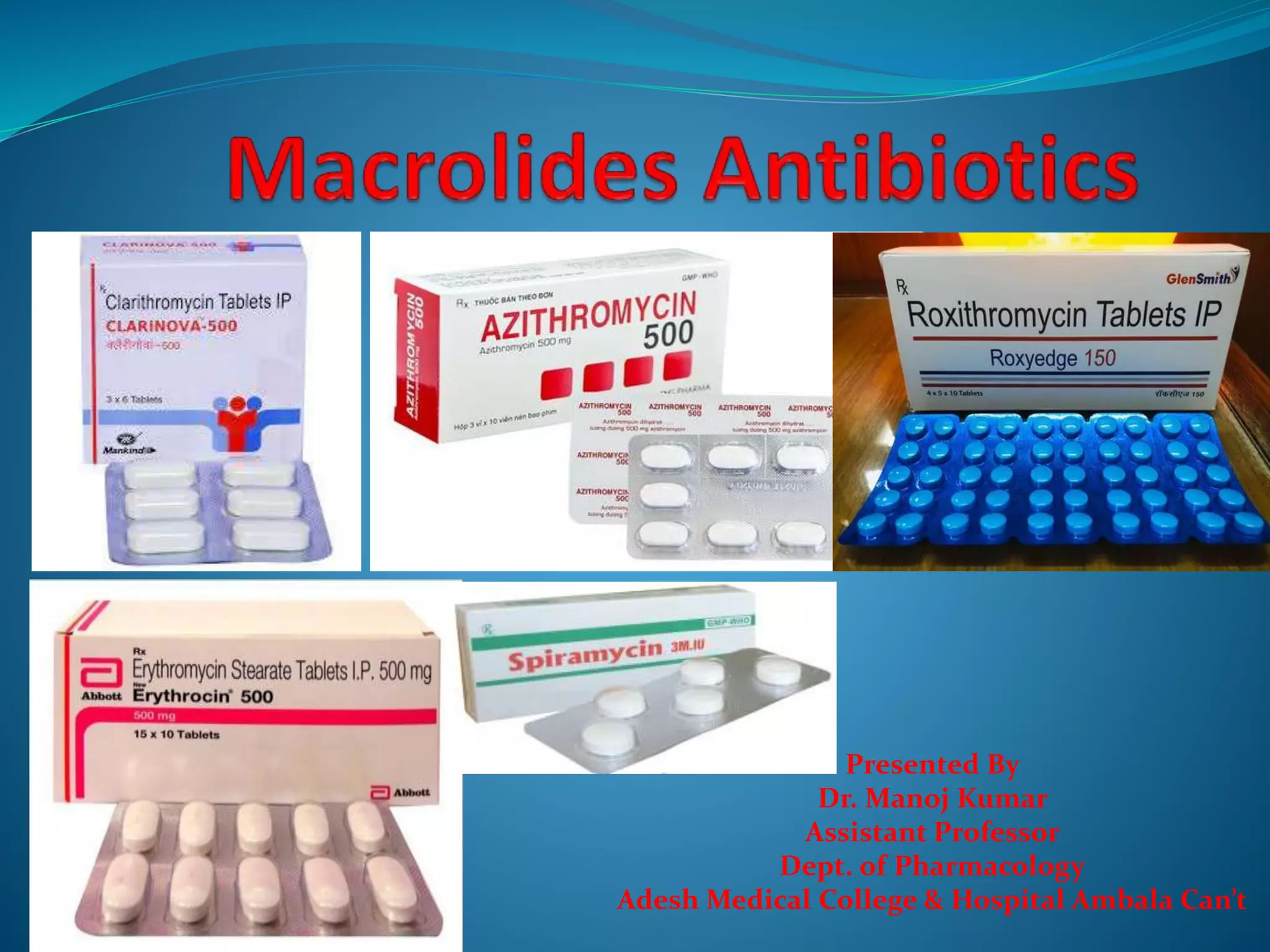
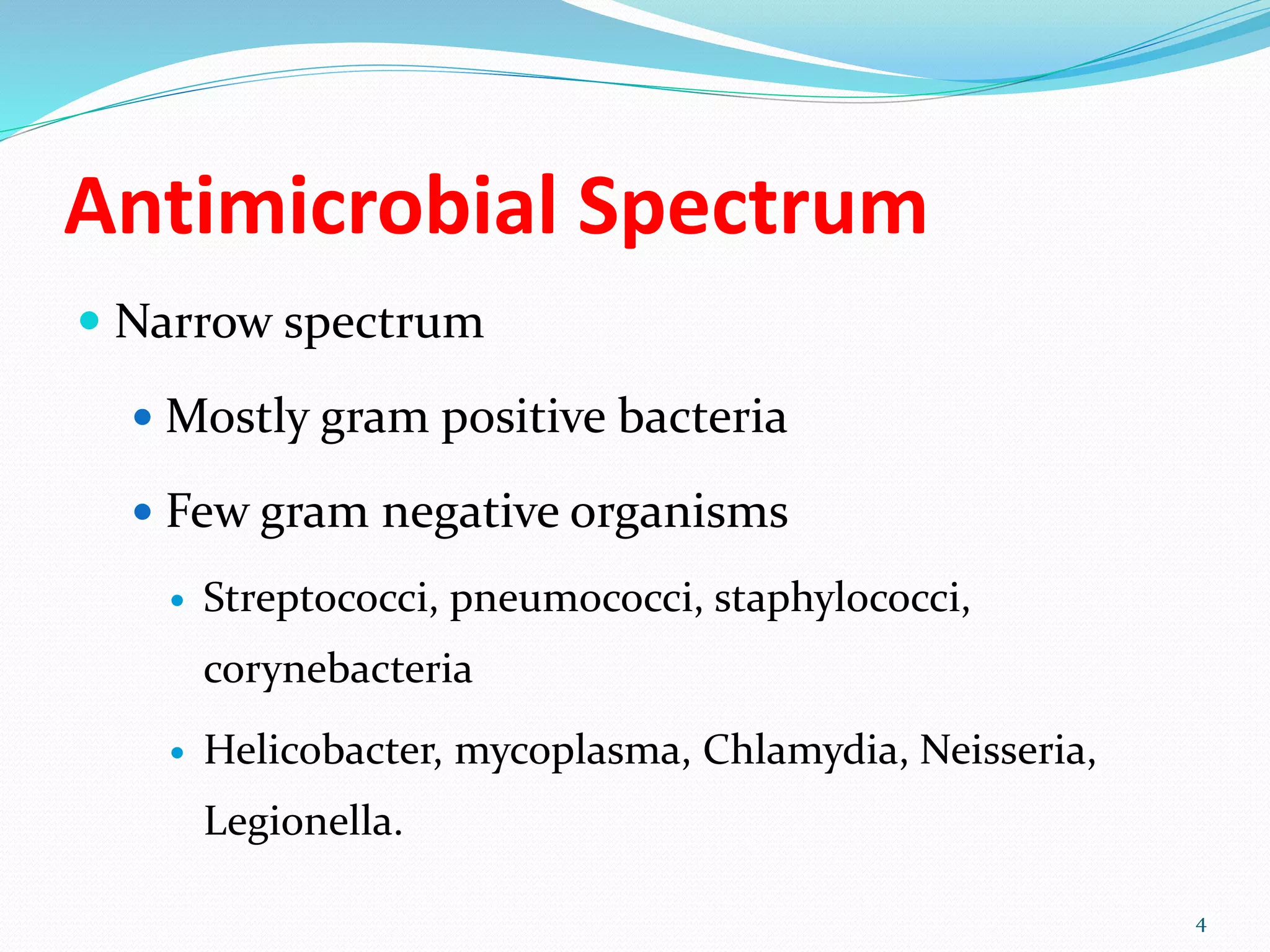
 Erythromycin
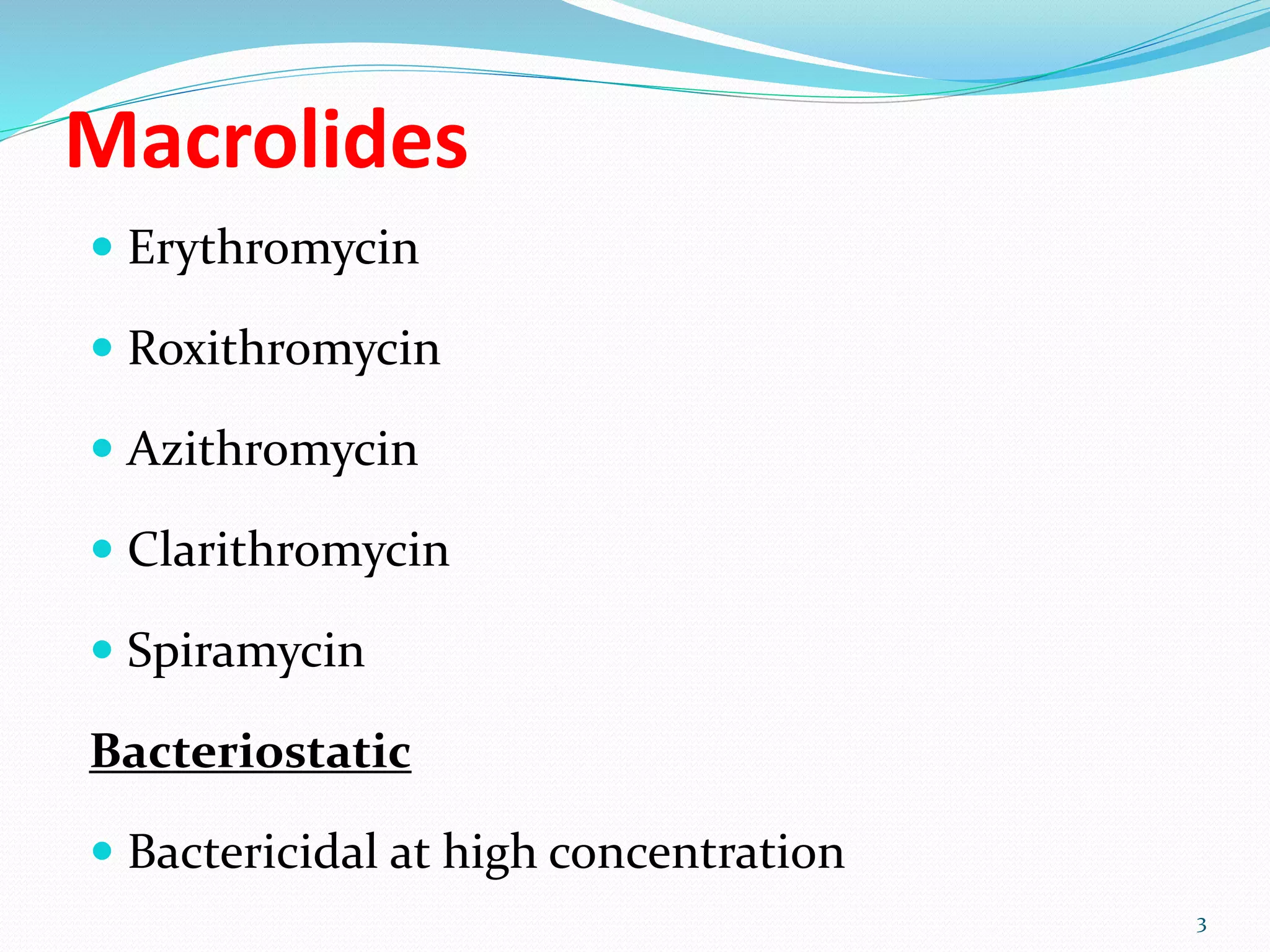
 Roxithromycin
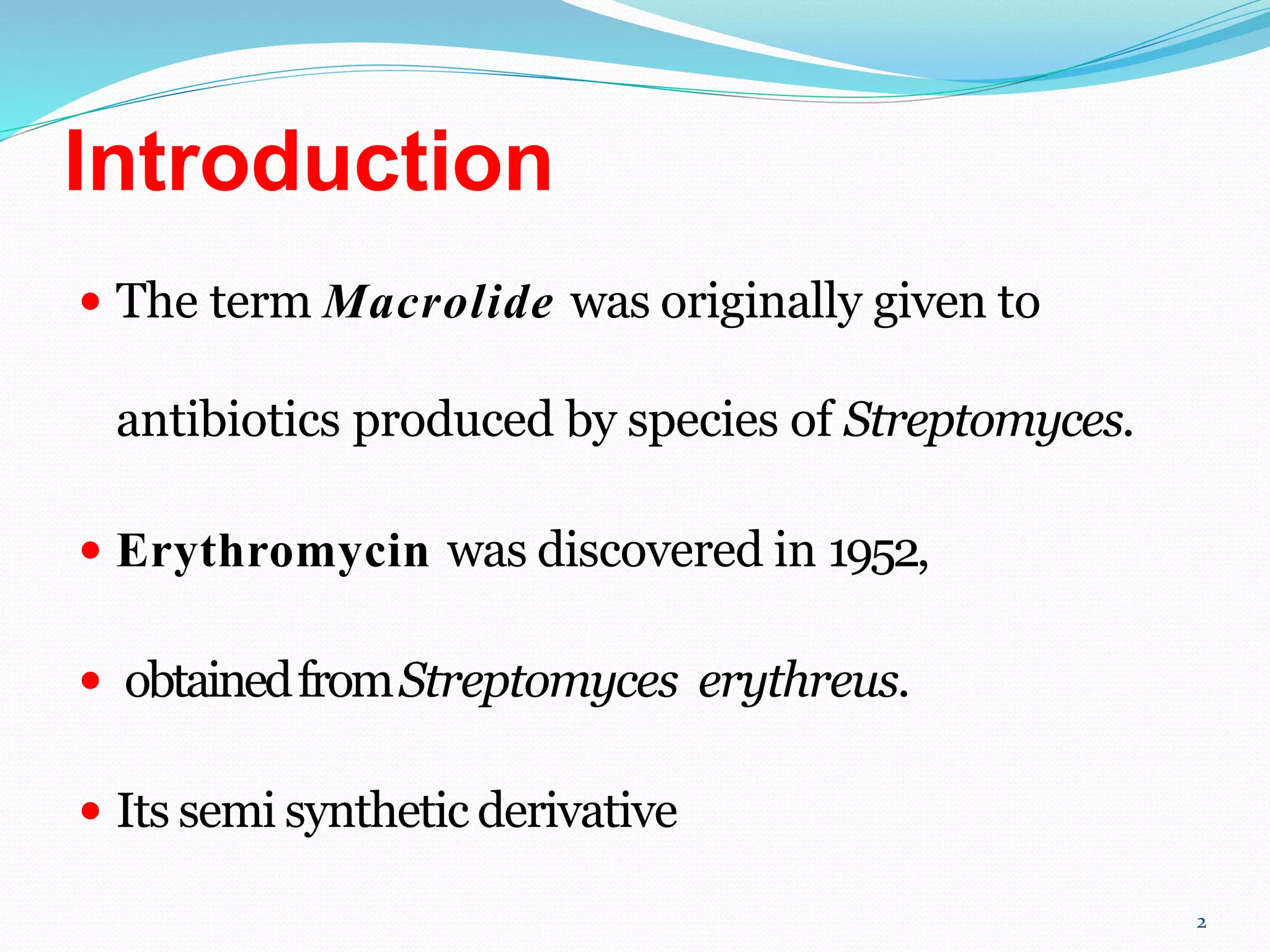
 Azithromycin
 Clarithromycin
 Spiramycin
Bacteriostatic
 Bactericidal at high concentration
3
Antimicrobial Spectrum
 Narrow spectrum
 Mostly gram positive bacteria
 Few gram negative organisms
 Streptococci, pneumococci, staphylococci,
corynebacteria
 Helicobacter, mycoplasma, Chlamydia, Neisseria,
Legionella.
4
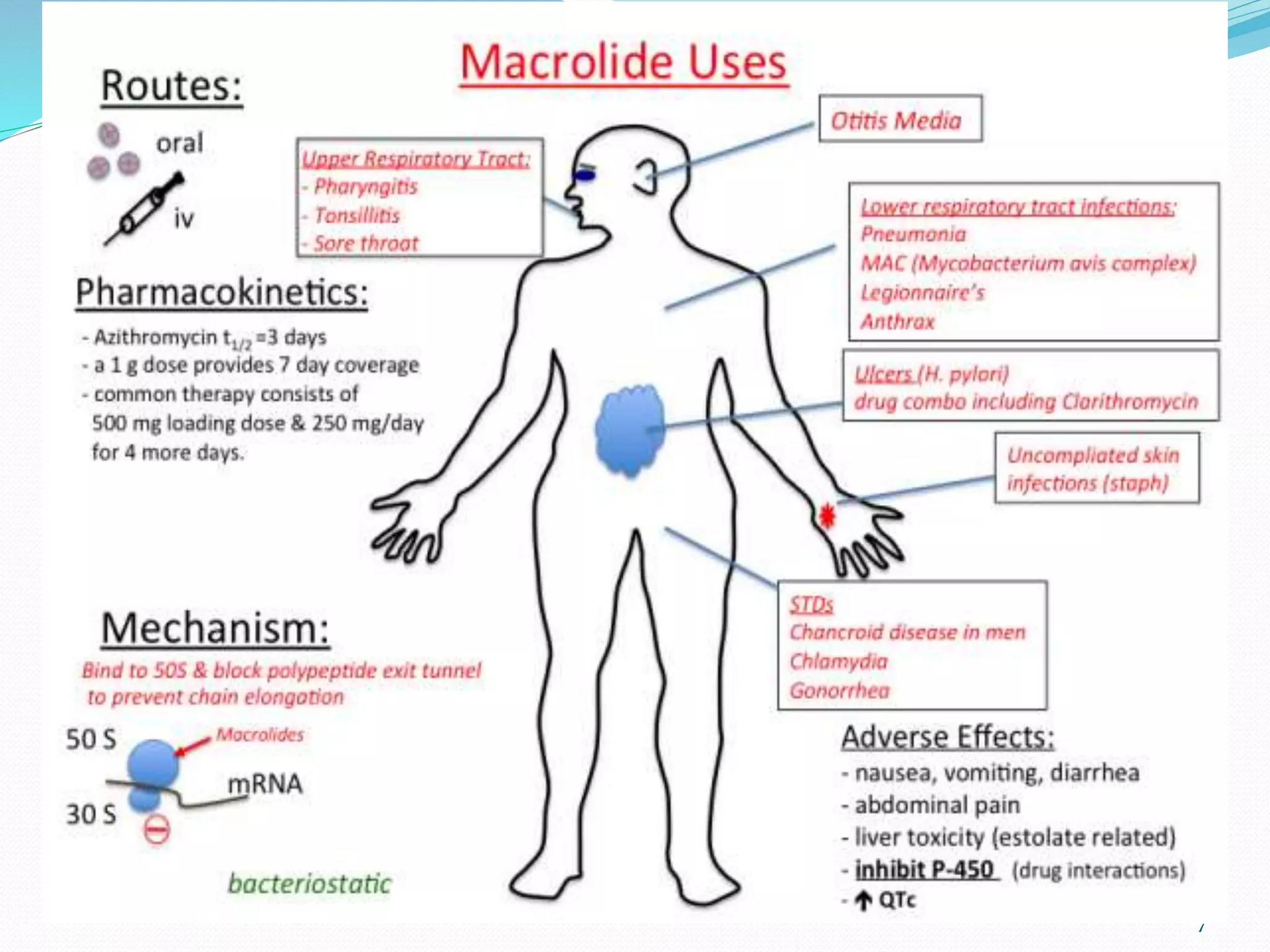
MOA
 Inhibit protein synthesis
 Bind at 50S ribosome
 Nascent peptide chain at the A site is
prevented from moving back to P site
↓
 ↓ protein synthesis
 Do not inhibit the 60s/40ssubunits of
mammalian cells
5
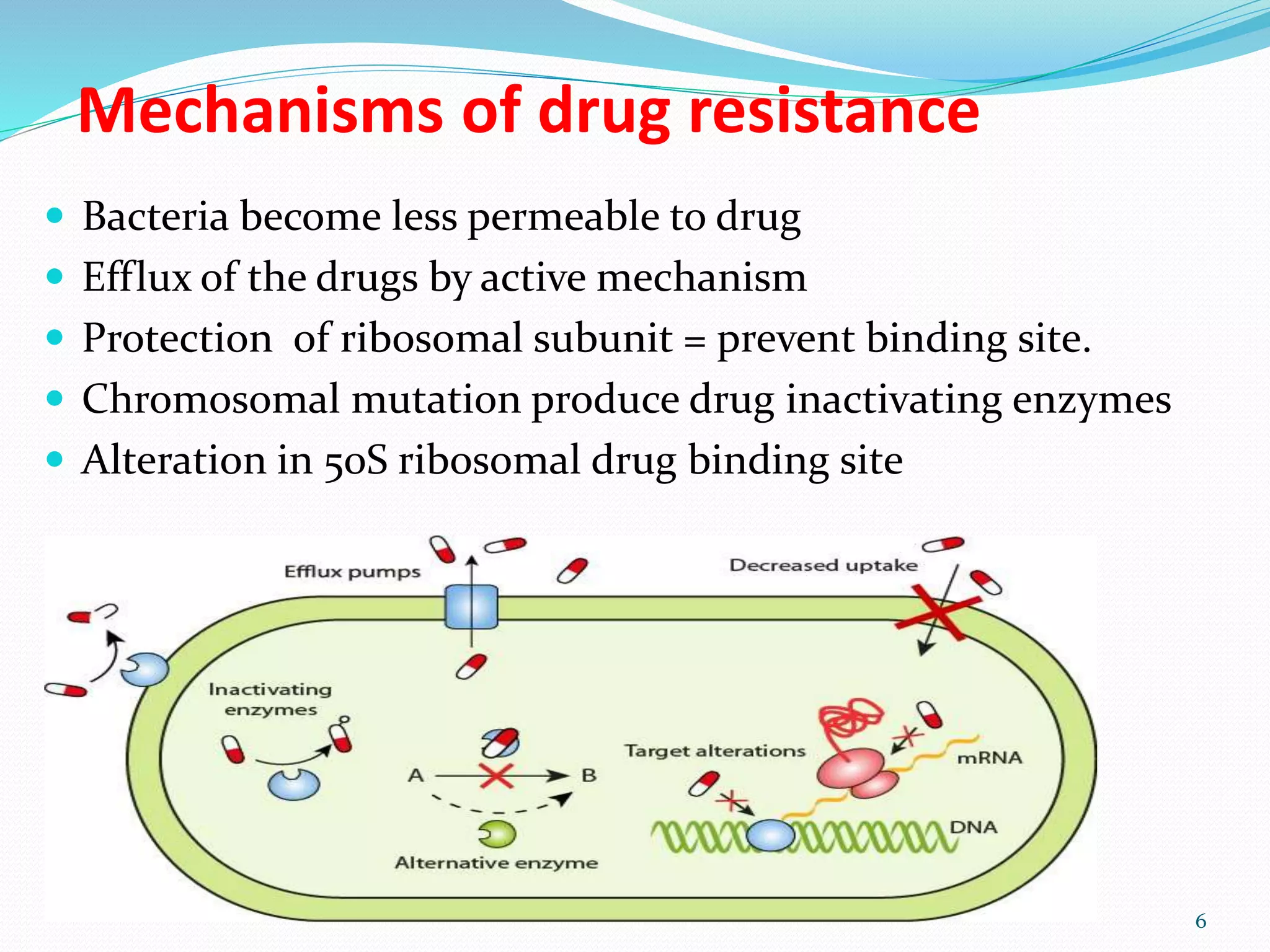
Mechanisms of drug resistance
 Bacteria become less permeable to drug
 Efflux of the drugs by active mechanism
 Protection of ribosomal subunit = prevent binding site.
 Chromosomal mutation produce drug inactivating enzymes
 Alteration in 50S ribosomal drug binding site
6
7
ERYTHROMYCIN
Oral
Incomplete absorption
Destroyed by gastric acid
Given as enteric coated tablets
Metabolized in liver
Undergoes enterohepatic circulation
Food delays absorption
Water solubility is limited rumen stability is cold
water.
Widely distributed, 70-80% plasma protein
bound.
8
Erythromycin con..
Does not cross blood brain barrier
T1/2-1.5 hr, persists longer in tissues
No need of dose alteration in renal failure
 Enzyme inhibition
 Also clarithromycin
 Increase blood levels of theophylline,
carbamazepine, valproate, warfarin
 Newer alternative: Roxithromycin
9
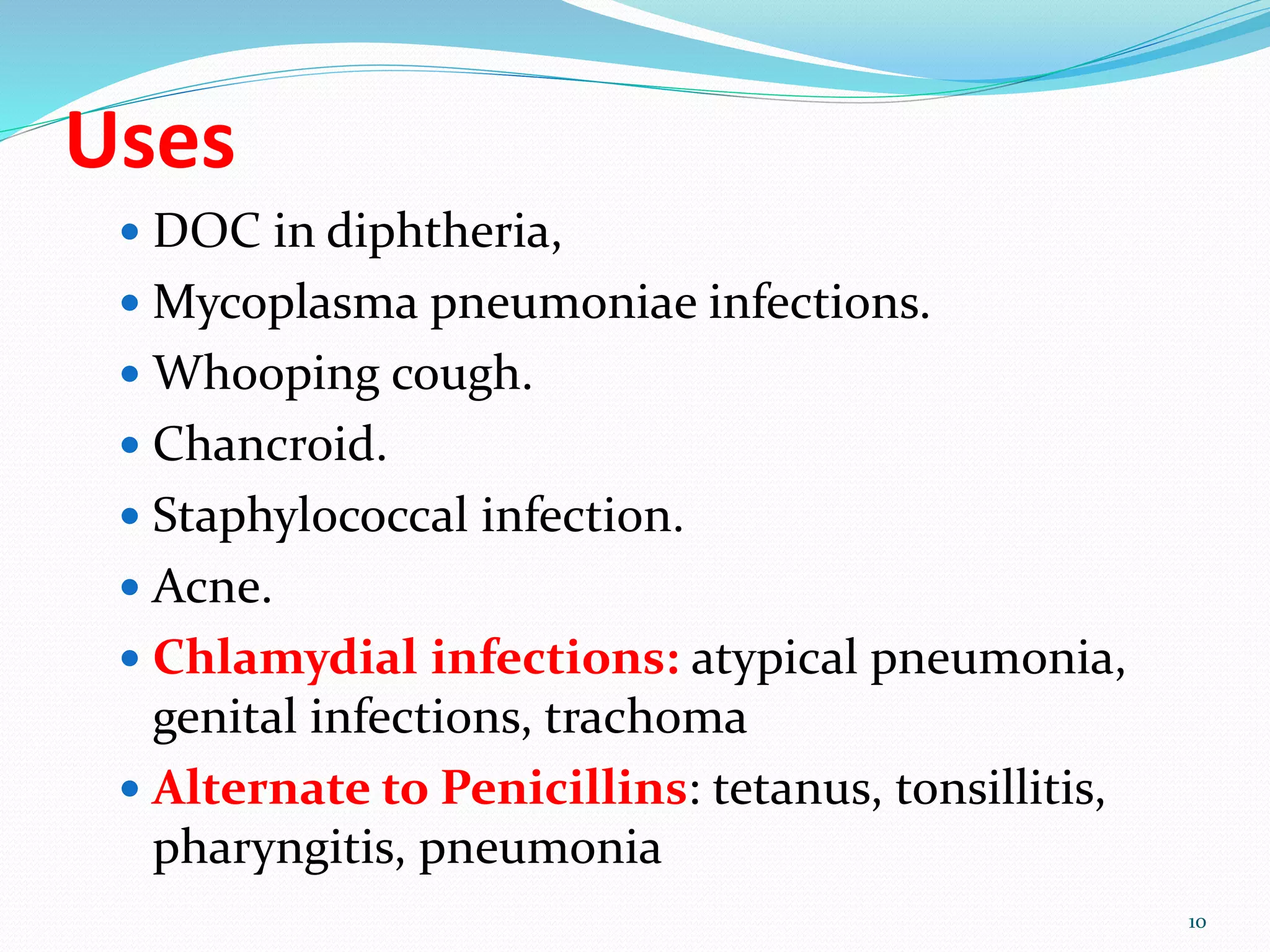
Uses
 DOC in diphtheria,
 Mycoplasma pneumoniae infections.
 Whooping cough.
 Chancroid.
 Staphylococcal infection.
 Acne.
 Chlamydial infections: atypical pneumonia,
genital infections, trachoma
 Alternate to Penicillins: tetanus, tonsillitis,
pharyngitis, pneumonia
10
Adverse effects
 GIT: Nausea, vomiting, epigastric pain, diarrhoea
 Hypersensitivity reactions: skin rash, fever,
hepatitis with jaundice
 Reversible hearing impairment (at very high
dose)
 Superinfection
 Hepatitis with cholestatic jaundice
 Caution: Avoid in liver disease
11
ROXITHROMYCIN
 Roxithromycin has same spectrum as of Erythromycin but
 it is more potent against
 Good eternal absorption and t1/2 of 12 hr
 Dose 150 – 300 mg BD
 THERAPEUTIC USES
 Pharyngitis.
 Respiratory infection.
Skin and soft tissue infection.
 ENT
12
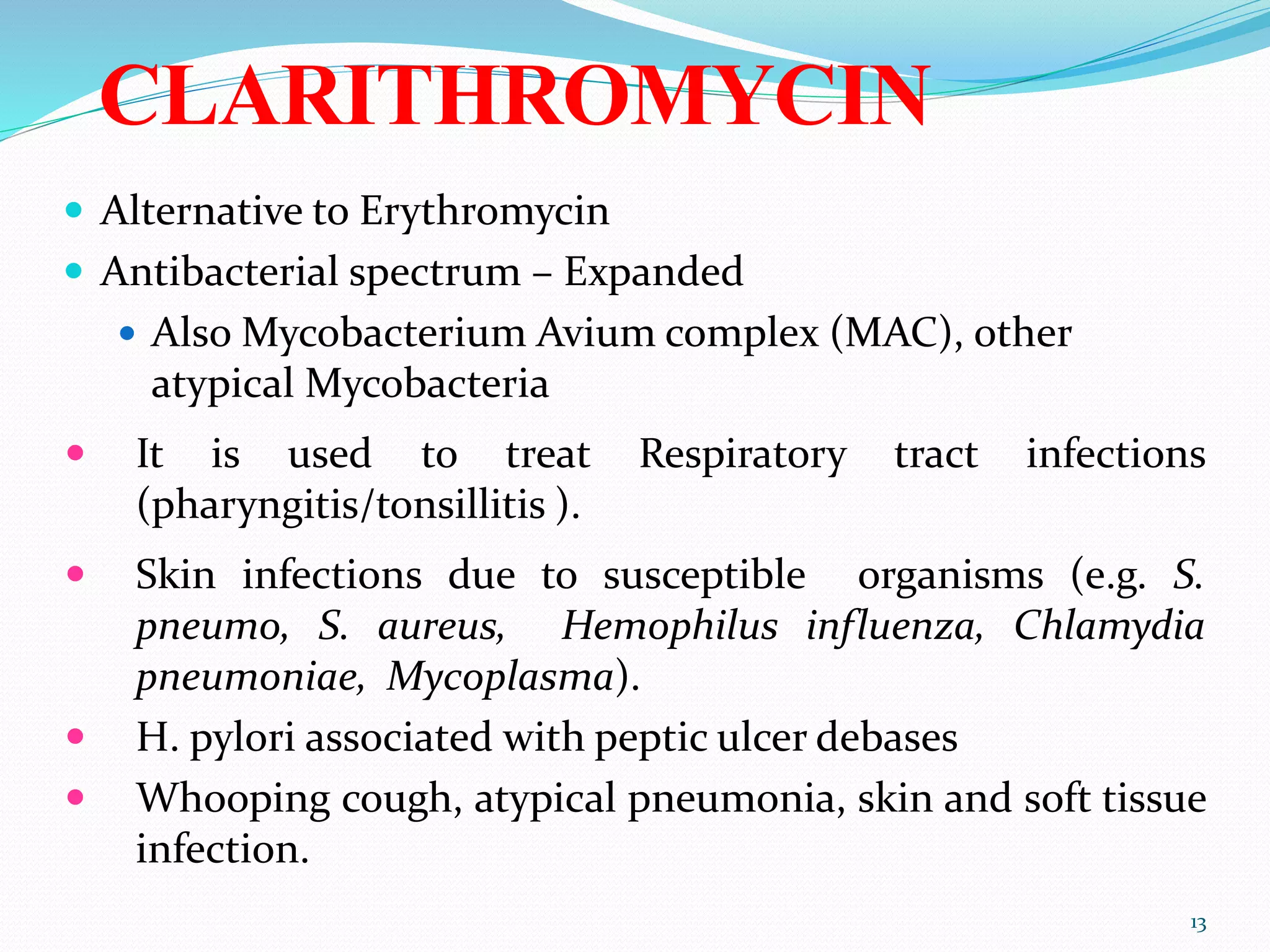
CLARITHROMYCIN
 Alternative to Erythromycin
 Antibacterial spectrum – Expanded
 Also Mycobacterium Avium complex (MAC), other
atypical Mycobacteria
 It is used to treat Respiratory tract infections
(pharyngitis/tonsillitis ).
 Skin infections due to susceptible organisms (e.g. S.
pneumo, S. aureus, Hemophilus influenza, Chlamydia
pneumoniae, Mycoplasma).
 H. pylori associated with peptic ulcer debases
 Whooping cough, atypical pneumonia, skin and soft tissue
infection.
13
ADVERSE DRUG REACTIONS :
 Hepatic failure,
 Pseudomembranous colitis,
 Stevens-Johnson syndrome,
 Toxic epidermal necrolysis,
 Drug rash (with eosinophilia)
14
AZITHROMYCIN
 Once daily dosing (OD)
 Inhibition of cytochromeP450
 It has an extended spectrum compared to
Erythromycin.
 Elimination by kidney & t½ is almost 3 days
 it is effective even in a single dose.
 Higher activity against Mycoplasma pneumoniae,
Nesseria gonorrhoeae, toxoplasma Gondi,
Chlamydia trachomatis .
15
Advantages of azithromycin over
erythromycin are:
 Azithromycin has excellent activity against H.
influenzae.
 It is acid-stable
 Rapidly absorbed
 Has better tissue penetrability
 Longer acting–once daily.
 Azithromycin remains in the tissues for a long
period
 Better tolerated than erythromycin.
16
USE
 Campylobacter jejuni (most common bacterial
infections of humans, food borne illness.)
 H. Influenza (Meningitis, Epiglottis, Cellulitis,
Infectious arthritis).
 Respiratory system infection, middle ear, eye,
central nervous system infection.
 It is used to acute bacterial infection
17
.
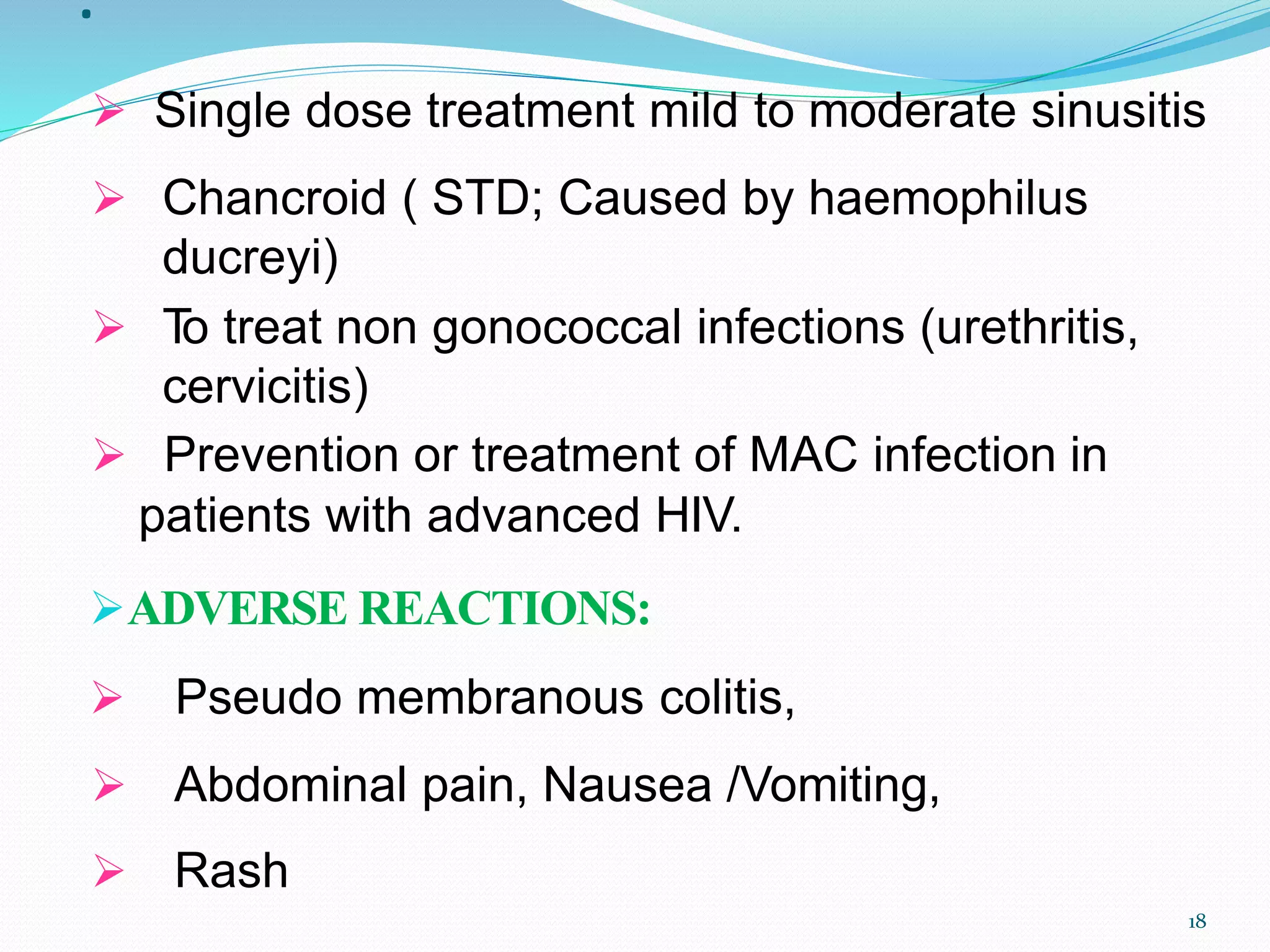
 Single dose treatment mild to moderate sinusitis
 Chancroid ( STD; Caused by haemophilus
ducreyi)
 T
o treat non gonococcal infections (urethritis,
cervicitis)
 Prevention or treatment of MAC infection in
patients with advanced HIV.
ADVERSE REACTIONS:
 Pseudo membranous colitis,
 Abdominal pain, Nausea /Vomiting,
 Rash
18
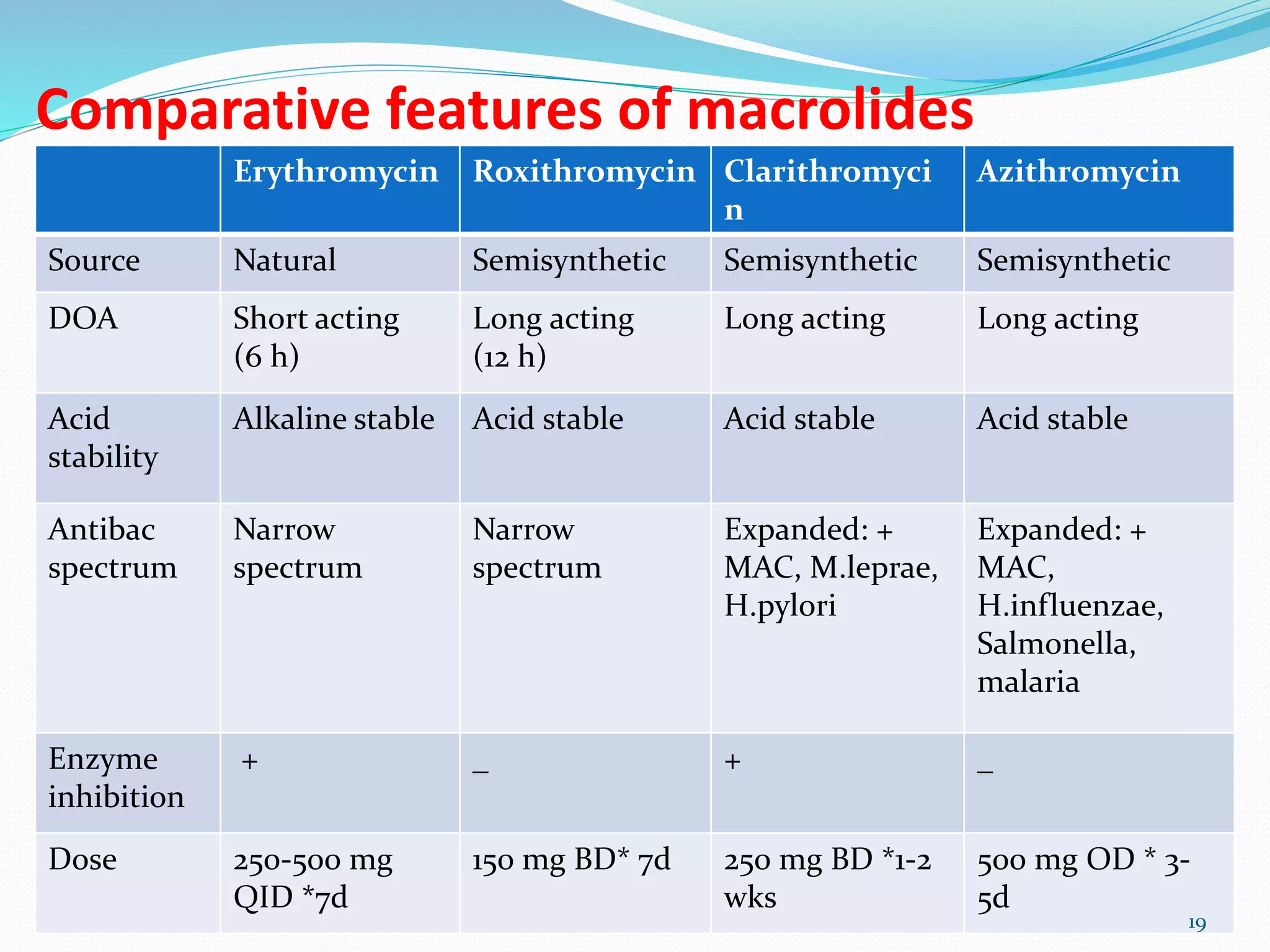
Comparative features of macrolides
Erythromycin Roxithromycin Clarithromyci
n
Azithromycin
Source Natural Semisynthetic Semisynthetic Semisynthetic
DOA Short acting
(6 h)
Long acting
(12 h)
Long acting Long acting
Acid
stability
Alkaline stable Acid stable Acid stable Acid stable
Antibac
spectrum
Narrow
spectrum
Narrow
spectrum
Expanded: +
MAC, M.leprae,
H.pylori
Expanded: +
MAC,
H.influenzae,
Salmonella,
malaria
Enzyme
inhibition
+ _ + _
Dose 250-500 mg
QID *7d
150 mg BD* 7d 250 mg BD *1-2
wks
500 mg OD * 3-
5d
19
Drug interactions
 With Cisapride, Terfendine: ↓CYP3A4 → ↑
QT, Ventricular Arrhythmias & Death
 CYP-450 inhibitor: ↑ levels of Theophylline,
Warfarin, Carbamazepine, Valproate
 Not seen with Azithromycin
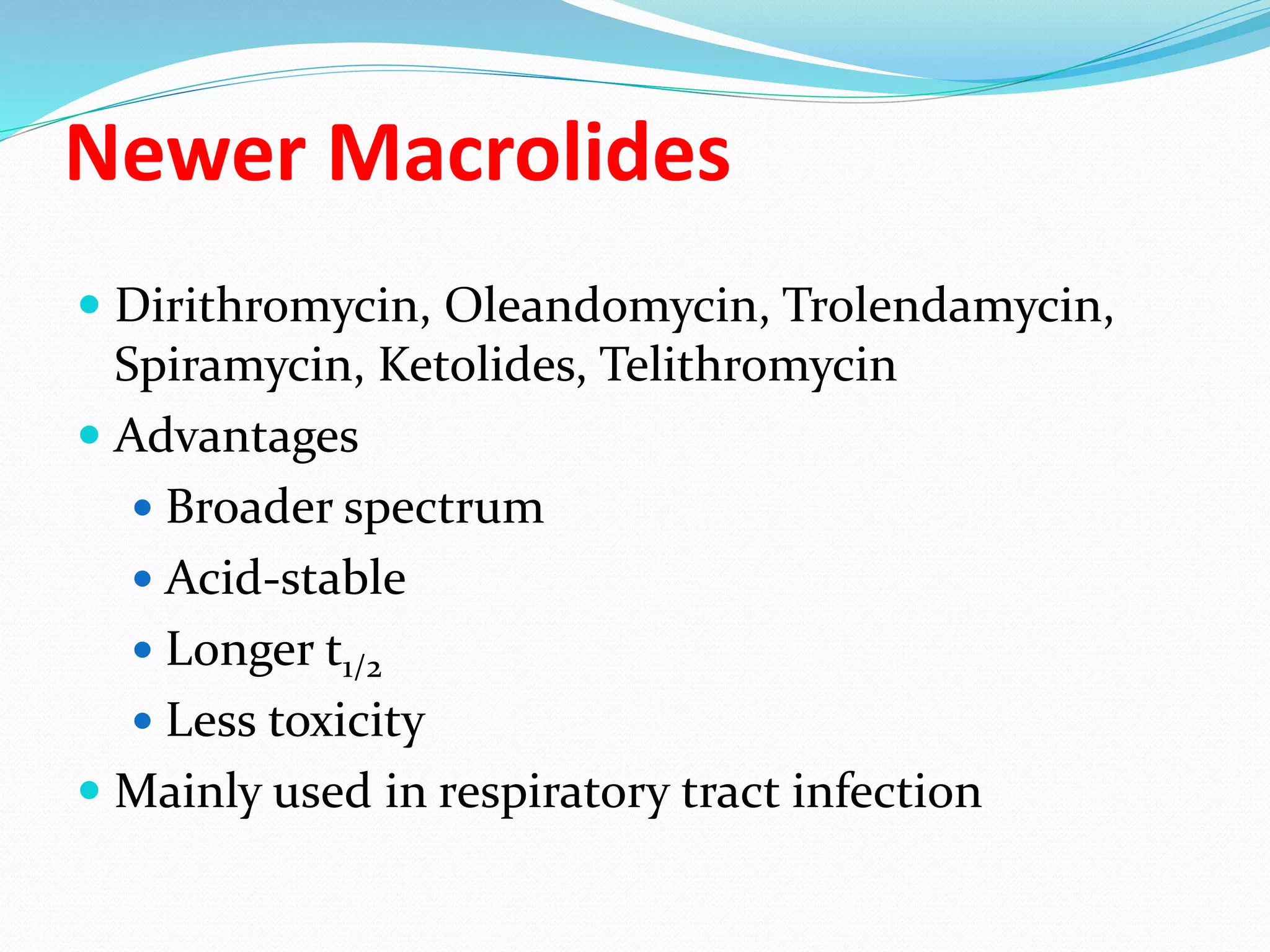
Newer Macrolides
 Dirithromycin, Oleandomycin, Trolendamycin,
Spiramycin, Ketolides, Telithromycin
 Advantages
 Broader spectrum
 Acid-stable
 Longer t1/2
 Less toxicity
 Mainly used in respiratory tract infection
THANK YOU
22

Macrolides Antibiotics

  • 1.
    Presented By Dr. ManojKumar Assistant Professor Dept. of Pharmacology Adesh Medical College & Hospital Ambala Can’t
  • 2.
    Introduction  The termMacrolide was originally given to antibiotics produced by species of Streptomyces.  Erythromycin was discovered in 1952,  obtainedfromStreptomyces erythreus.  Its semi synthetic derivative 2
  • 3.
    Macrolides  Erythromycin  Roxithromycin Azithromycin  Clarithromycin  Spiramycin Bacteriostatic  Bactericidal at high concentration 3
  • 4.
    Antimicrobial Spectrum  Narrowspectrum  Mostly gram positive bacteria  Few gram negative organisms  Streptococci, pneumococci, staphylococci, corynebacteria  Helicobacter, mycoplasma, Chlamydia, Neisseria, Legionella. 4
  • 5.
    MOA  Inhibit proteinsynthesis  Bind at 50S ribosome  Nascent peptide chain at the A site is prevented from moving back to P site ↓  ↓ protein synthesis  Do not inhibit the 60s/40ssubunits of mammalian cells 5
  • 6.
    Mechanisms of drugresistance  Bacteria become less permeable to drug  Efflux of the drugs by active mechanism  Protection of ribosomal subunit = prevent binding site.  Chromosomal mutation produce drug inactivating enzymes  Alteration in 50S ribosomal drug binding site 6
  • 7.
  • 8.
    ERYTHROMYCIN Oral Incomplete absorption Destroyed bygastric acid Given as enteric coated tablets Metabolized in liver Undergoes enterohepatic circulation Food delays absorption Water solubility is limited rumen stability is cold water. Widely distributed, 70-80% plasma protein bound. 8
  • 9.
    Erythromycin con.. Does notcross blood brain barrier T1/2-1.5 hr, persists longer in tissues No need of dose alteration in renal failure  Enzyme inhibition  Also clarithromycin  Increase blood levels of theophylline, carbamazepine, valproate, warfarin  Newer alternative: Roxithromycin 9
  • 10.
    Uses  DOC indiphtheria,  Mycoplasma pneumoniae infections.  Whooping cough.  Chancroid.  Staphylococcal infection.  Acne.  Chlamydial infections: atypical pneumonia, genital infections, trachoma  Alternate to Penicillins: tetanus, tonsillitis, pharyngitis, pneumonia 10
  • 11.
    Adverse effects  GIT:Nausea, vomiting, epigastric pain, diarrhoea  Hypersensitivity reactions: skin rash, fever, hepatitis with jaundice  Reversible hearing impairment (at very high dose)  Superinfection  Hepatitis with cholestatic jaundice  Caution: Avoid in liver disease 11
  • 12.
    ROXITHROMYCIN  Roxithromycin hassame spectrum as of Erythromycin but  it is more potent against  Good eternal absorption and t1/2 of 12 hr  Dose 150 – 300 mg BD  THERAPEUTIC USES  Pharyngitis.  Respiratory infection. Skin and soft tissue infection.  ENT 12
  • 13.
    CLARITHROMYCIN  Alternative toErythromycin  Antibacterial spectrum – Expanded  Also Mycobacterium Avium complex (MAC), other atypical Mycobacteria  It is used to treat Respiratory tract infections (pharyngitis/tonsillitis ).  Skin infections due to susceptible organisms (e.g. S. pneumo, S. aureus, Hemophilus influenza, Chlamydia pneumoniae, Mycoplasma).  H. pylori associated with peptic ulcer debases  Whooping cough, atypical pneumonia, skin and soft tissue infection. 13
  • 14.
    ADVERSE DRUG REACTIONS:  Hepatic failure,  Pseudomembranous colitis,  Stevens-Johnson syndrome,  Toxic epidermal necrolysis,  Drug rash (with eosinophilia) 14
  • 15.
    AZITHROMYCIN  Once dailydosing (OD)  Inhibition of cytochromeP450  It has an extended spectrum compared to Erythromycin.  Elimination by kidney & t½ is almost 3 days  it is effective even in a single dose.  Higher activity against Mycoplasma pneumoniae, Nesseria gonorrhoeae, toxoplasma Gondi, Chlamydia trachomatis . 15
  • 16.
    Advantages of azithromycinover erythromycin are:  Azithromycin has excellent activity against H. influenzae.  It is acid-stable  Rapidly absorbed  Has better tissue penetrability  Longer acting–once daily.  Azithromycin remains in the tissues for a long period  Better tolerated than erythromycin. 16
  • 17.
    USE  Campylobacter jejuni(most common bacterial infections of humans, food borne illness.)  H. Influenza (Meningitis, Epiglottis, Cellulitis, Infectious arthritis).  Respiratory system infection, middle ear, eye, central nervous system infection.  It is used to acute bacterial infection 17
  • 18.
    .  Single dosetreatment mild to moderate sinusitis  Chancroid ( STD; Caused by haemophilus ducreyi)  T o treat non gonococcal infections (urethritis, cervicitis)  Prevention or treatment of MAC infection in patients with advanced HIV. ADVERSE REACTIONS:  Pseudo membranous colitis,  Abdominal pain, Nausea /Vomiting,  Rash 18
  • 19.
    Comparative features ofmacrolides Erythromycin Roxithromycin Clarithromyci n Azithromycin Source Natural Semisynthetic Semisynthetic Semisynthetic DOA Short acting (6 h) Long acting (12 h) Long acting Long acting Acid stability Alkaline stable Acid stable Acid stable Acid stable Antibac spectrum Narrow spectrum Narrow spectrum Expanded: + MAC, M.leprae, H.pylori Expanded: + MAC, H.influenzae, Salmonella, malaria Enzyme inhibition + _ + _ Dose 250-500 mg QID *7d 150 mg BD* 7d 250 mg BD *1-2 wks 500 mg OD * 3- 5d 19
  • 20.
    Drug interactions  WithCisapride, Terfendine: ↓CYP3A4 → ↑ QT, Ventricular Arrhythmias & Death  CYP-450 inhibitor: ↑ levels of Theophylline, Warfarin, Carbamazepine, Valproate  Not seen with Azithromycin
  • 21.
    Newer Macrolides  Dirithromycin,Oleandomycin, Trolendamycin, Spiramycin, Ketolides, Telithromycin  Advantages  Broader spectrum  Acid-stable  Longer t1/2  Less toxicity  Mainly used in respiratory tract infection
  • 22.