MEDICINAL CHEMISTRY-III (BP-601T) - B Pharmacy - VI Sem
ARUNAI COLLEGE OF PHARMACY - Tiruvannamalai
Unit 1 - ANTIBIOTIC Part 5 – MACROLIDE’S
Approved by PHARMACY COUNCIL OF INDIA – New delhi
Affiliated to THE TAMILNADU DR MGR MEDICAL UNIVERSITY - Chennai
Prepared & Lecture by
Mr. Murugan
(Associate professor)
Syllabus:
Historical background, Nomenclature, Stereochemistry, Structure activity relationship, Chemical
degradation classification and important products of the following classes.
Macrolide: Erythromycin Clarithromycin, Azithromycin
Pervious The Tamilnadu Dr MGR Medical university exam question
Mar 2021 Write a note on Macrolide antibiotics (5 mark)
Mar 2021 Mechanism action of Erythromycin (2 mark)
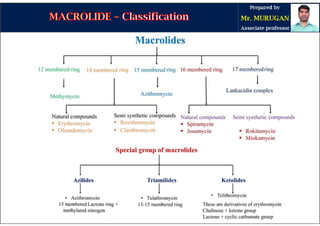
Oct 2022 Classify macrolides with examples (2 mark)
Aug 2023 Give the structure and uses of: a) Tetracycline b) Erythromycin (5 mark)
Dec 2023 Structure and uses of Azithromycin and Clindamycin (5 mark)
Dec 2023 Mechanism action of Clarithromycin (2 mark)
History:
 antibiotics isolated from actinomycetes is the group of chemically related compounds called the macrolides.
 1950, picromycin, the first of this group to be identified as a macrolide compound,
 1952, erythromycin and carbomycin were reported as new antibiotics,
 1970 – 1980 semisynthetic derivatives of macrolide was developed
 Currently, more than 40 such compounds are identified
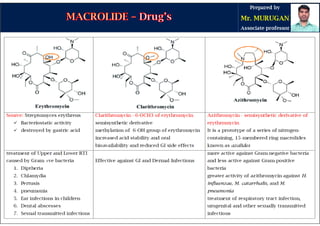
 erythromycin and semisynthetic derivatives of erythromycin (e.g., clarithromycin and azithromycin), which
have superior pharmacokinetic properties, enhanced acid stability and improved distribution properties
Definition:
Macrolide are a group of broad-spectrum antibiotics, produced by various strains of streptomyces and
having a macrolide ring structure linked to one or more sugar moiety. Which inhibit the protein synthesis
to produce bacteriostatic activity.
Example: Erythromycin, Clarithromycin and Azithromycin
 Macrolides belong to polyketide class of natural products,
 structurally contains macrocyclic lactone ring of 12 to 17 carbon atoms.
 Generally 14, 15, and 16-membered are a widely used family of antibiotics.
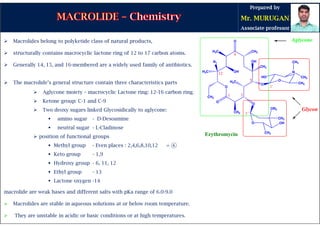
 The macrolide’s general structure contain three characteristics parts
 Aglycone moiety – macrocyclic Lactone ring: 12-16 carbon ring.
 Ketone group: C-1 and C-9
 Two deoxy sugars linked Glycosidically to aglycone:
 amino sugar - D-Desoamine
 neutral sugar - L-Cladinose
 position of functional groups
 Methyl group - Even places : 2,4,6,8,10,12 = ⑥
 Keto group - 1,9
 Hydroxy group - 6, 11, 12
 Ethyl group - 13
 Lactone oxygen -14
macrolide are weak bases and different salts with pKa range of 6.0-9.0
 Macrolides are stable in aqueous solutions at or below room temperature.
 They are unstable in acidic or basic conditions or at high temperatures.
O
O
O
CH3
R1
H3C
CH3
CH3
O
H3C
OH
H3C
CH3
OH
O
O
HO
CH3
N
CH3
CH3
O OH
CH3
CH3
OR2
1 3
5
9
12
1`
1``
Erythromycin
Glycon
Aglycone
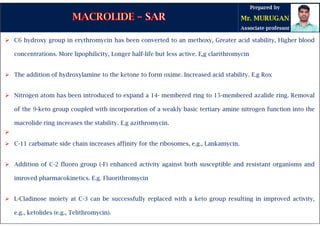
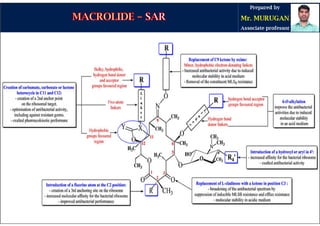
 C6 hydroxy group in erythromycin has been converted to an methoxy, Greater acid stability, Higher blood
concentrations. More lipophilicity, Longer half-life but less active. E,g clarithromycin
 The addition of hydroxylamine to the ketone to form oxime. Increased acid stability. E.g Rox
 Nitrogen atom has been introduced to expand a 14- membered ring to 15-membered azalide ring. Removal
of the 9-keto group coupled with incorporation of a weakly basic tertiary amine nitrogen function into the
macrolide ring increases the stability. E.g azithromycin.

 C-11 carbamate side chain increases affinity for the ribosomes, e.g., Lankamycin.
 Addition of C-2 fluoro group (-F) enhanced activity against both susceptible and resistant organisms and
imroved pharmacokinetics. E.g. Fluorithromycin
 L-Cladinose moiety at C-3 can be successfully replaced with a keto group resulting in improved activity,
e.g., ketolides (e.g., Telithromycin).
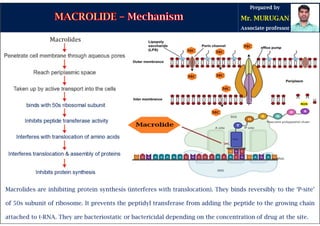
Macrolides are inhibiting protein synthesis (interferes with translocation). They binds reversibly to the ‘P-site’
of 50s subunit of ribosome. It prevents the peptidyl transferase from adding the peptide to the growing chain
attached to t-RNA. They are bacteriostatic or bactericidal depending on the concentration of drug at the site.
Erythromycin is a naturally-occurring macrolide derived from Streptomyces erythreus – problems with
acid lability,
narrow spectrum,
poor GI intolerance,
short half-life.
Structural derivatives include clarithromycin and azithromycin, roxithromycin (Newer macrolides)-
Broader spectrum of activity ,
better bioavailability,
better tissue penetration,
prolonged half-lives
Gram Positive Aerobes: Clarithro>Erythro>Azithro
Erythromycin & Clarithromycin display best activity
Example: Stayphyloccous aureus
Streptococcus pneumoniae
Corynebacterium sp.
Gram negative Aerobes: Azithro>Clarithro>Erythro
Newer macrolides - Azithromycin has enhanced activity.
Example: H. influenzae
Neisseria sp.
Bordetella pertussis
Therapeutic uses
 Skin & soft tissue infection
 Whooping cough
 Sinusitis, Pharyngitis, Tonsillitis
 Pneumonia
 Respiratory tract infection
 Eradication of H.Pylori
 Diphtheria
 Gonorrhoea & Syphilis
 Typhoid & malaria
Adverse effects
 Headache, Dizziness
 Taste disturbances
 Stomatitis, Mild gastric upset, Abdominal pain
 Hepatitis, Jaundice
 Hearing problem

MC - III, Unit - 1, Part 9 - Macrolide.pdf

  • 1.
    MEDICINAL CHEMISTRY-III (BP-601T)- B Pharmacy - VI Sem ARUNAI COLLEGE OF PHARMACY - Tiruvannamalai Unit 1 - ANTIBIOTIC Part 5 – MACROLIDE’S Approved by PHARMACY COUNCIL OF INDIA – New delhi Affiliated to THE TAMILNADU DR MGR MEDICAL UNIVERSITY - Chennai Prepared & Lecture by Mr. Murugan (Associate professor)
  • 2.
    Syllabus: Historical background, Nomenclature,Stereochemistry, Structure activity relationship, Chemical degradation classification and important products of the following classes. Macrolide: Erythromycin Clarithromycin, Azithromycin Pervious The Tamilnadu Dr MGR Medical university exam question Mar 2021 Write a note on Macrolide antibiotics (5 mark) Mar 2021 Mechanism action of Erythromycin (2 mark) Oct 2022 Classify macrolides with examples (2 mark) Aug 2023 Give the structure and uses of: a) Tetracycline b) Erythromycin (5 mark) Dec 2023 Structure and uses of Azithromycin and Clindamycin (5 mark) Dec 2023 Mechanism action of Clarithromycin (2 mark)
  • 3.
    History:  antibiotics isolatedfrom actinomycetes is the group of chemically related compounds called the macrolides.  1950, picromycin, the first of this group to be identified as a macrolide compound,  1952, erythromycin and carbomycin were reported as new antibiotics,  1970 – 1980 semisynthetic derivatives of macrolide was developed  Currently, more than 40 such compounds are identified  erythromycin and semisynthetic derivatives of erythromycin (e.g., clarithromycin and azithromycin), which have superior pharmacokinetic properties, enhanced acid stability and improved distribution properties Definition: Macrolide are a group of broad-spectrum antibiotics, produced by various strains of streptomyces and having a macrolide ring structure linked to one or more sugar moiety. Which inhibit the protein synthesis to produce bacteriostatic activity. Example: Erythromycin, Clarithromycin and Azithromycin
  • 4.
     Macrolides belongto polyketide class of natural products,  structurally contains macrocyclic lactone ring of 12 to 17 carbon atoms.  Generally 14, 15, and 16-membered are a widely used family of antibiotics.  The macrolide’s general structure contain three characteristics parts  Aglycone moiety – macrocyclic Lactone ring: 12-16 carbon ring.  Ketone group: C-1 and C-9  Two deoxy sugars linked Glycosidically to aglycone:  amino sugar - D-Desoamine  neutral sugar - L-Cladinose  position of functional groups  Methyl group - Even places : 2,4,6,8,10,12 = ⑥  Keto group - 1,9  Hydroxy group - 6, 11, 12  Ethyl group - 13  Lactone oxygen -14 macrolide are weak bases and different salts with pKa range of 6.0-9.0  Macrolides are stable in aqueous solutions at or below room temperature.  They are unstable in acidic or basic conditions or at high temperatures. O O O CH3 R1 H3C CH3 CH3 O H3C OH H3C CH3 OH O O HO CH3 N CH3 CH3 O OH CH3 CH3 OR2 1 3 5 9 12 1` 1`` Erythromycin Glycon Aglycone
  • 7.
     C6 hydroxygroup in erythromycin has been converted to an methoxy, Greater acid stability, Higher blood concentrations. More lipophilicity, Longer half-life but less active. E,g clarithromycin  The addition of hydroxylamine to the ketone to form oxime. Increased acid stability. E.g Rox  Nitrogen atom has been introduced to expand a 14- membered ring to 15-membered azalide ring. Removal of the 9-keto group coupled with incorporation of a weakly basic tertiary amine nitrogen function into the macrolide ring increases the stability. E.g azithromycin.   C-11 carbamate side chain increases affinity for the ribosomes, e.g., Lankamycin.  Addition of C-2 fluoro group (-F) enhanced activity against both susceptible and resistant organisms and imroved pharmacokinetics. E.g. Fluorithromycin  L-Cladinose moiety at C-3 can be successfully replaced with a keto group resulting in improved activity, e.g., ketolides (e.g., Telithromycin).
  • 9.
    Macrolides are inhibitingprotein synthesis (interferes with translocation). They binds reversibly to the ‘P-site’ of 50s subunit of ribosome. It prevents the peptidyl transferase from adding the peptide to the growing chain attached to t-RNA. They are bacteriostatic or bactericidal depending on the concentration of drug at the site.
  • 10.
    Erythromycin is anaturally-occurring macrolide derived from Streptomyces erythreus – problems with acid lability, narrow spectrum, poor GI intolerance, short half-life. Structural derivatives include clarithromycin and azithromycin, roxithromycin (Newer macrolides)- Broader spectrum of activity , better bioavailability, better tissue penetration, prolonged half-lives Gram Positive Aerobes: Clarithro>Erythro>Azithro Erythromycin & Clarithromycin display best activity Example: Stayphyloccous aureus Streptococcus pneumoniae Corynebacterium sp. Gram negative Aerobes: Azithro>Clarithro>Erythro Newer macrolides - Azithromycin has enhanced activity. Example: H. influenzae Neisseria sp. Bordetella pertussis
  • 11.
    Therapeutic uses  Skin& soft tissue infection  Whooping cough  Sinusitis, Pharyngitis, Tonsillitis  Pneumonia  Respiratory tract infection  Eradication of H.Pylori  Diphtheria  Gonorrhoea & Syphilis  Typhoid & malaria Adverse effects  Headache, Dizziness  Taste disturbances  Stomatitis, Mild gastric upset, Abdominal pain  Hepatitis, Jaundice  Hearing problem