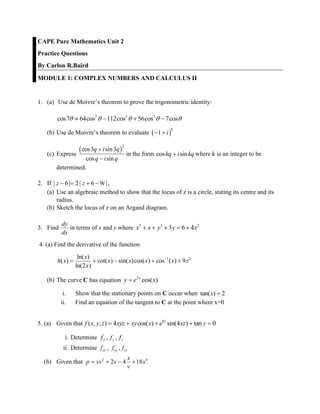
CAPE PURE MATHEMATICS UNIT 2 MODULE 1 PRACTICE QUESTIONS
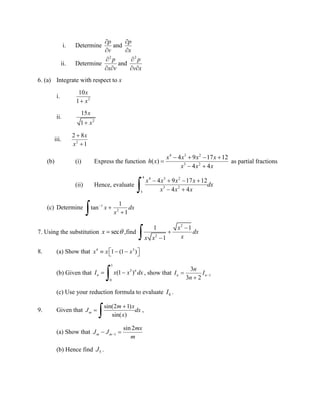
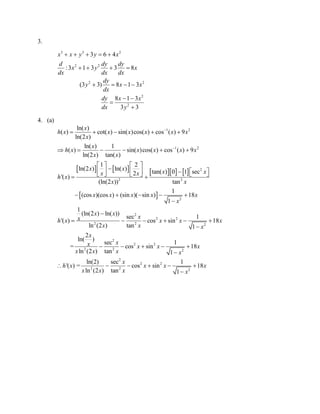
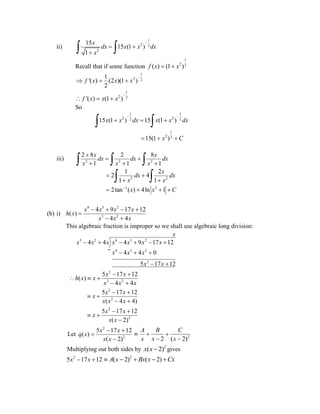
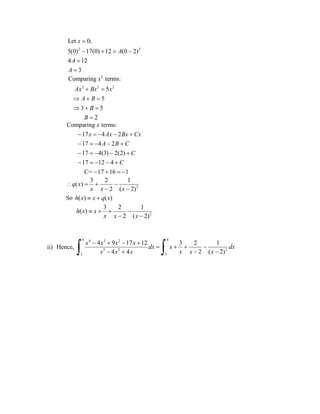
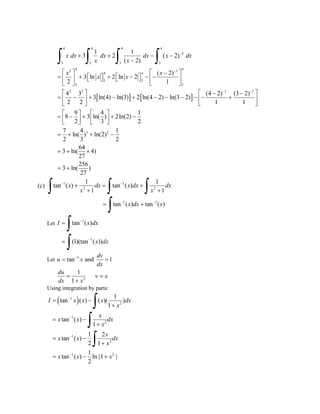
dy/dx = (x - 3y)/(6x - 4)
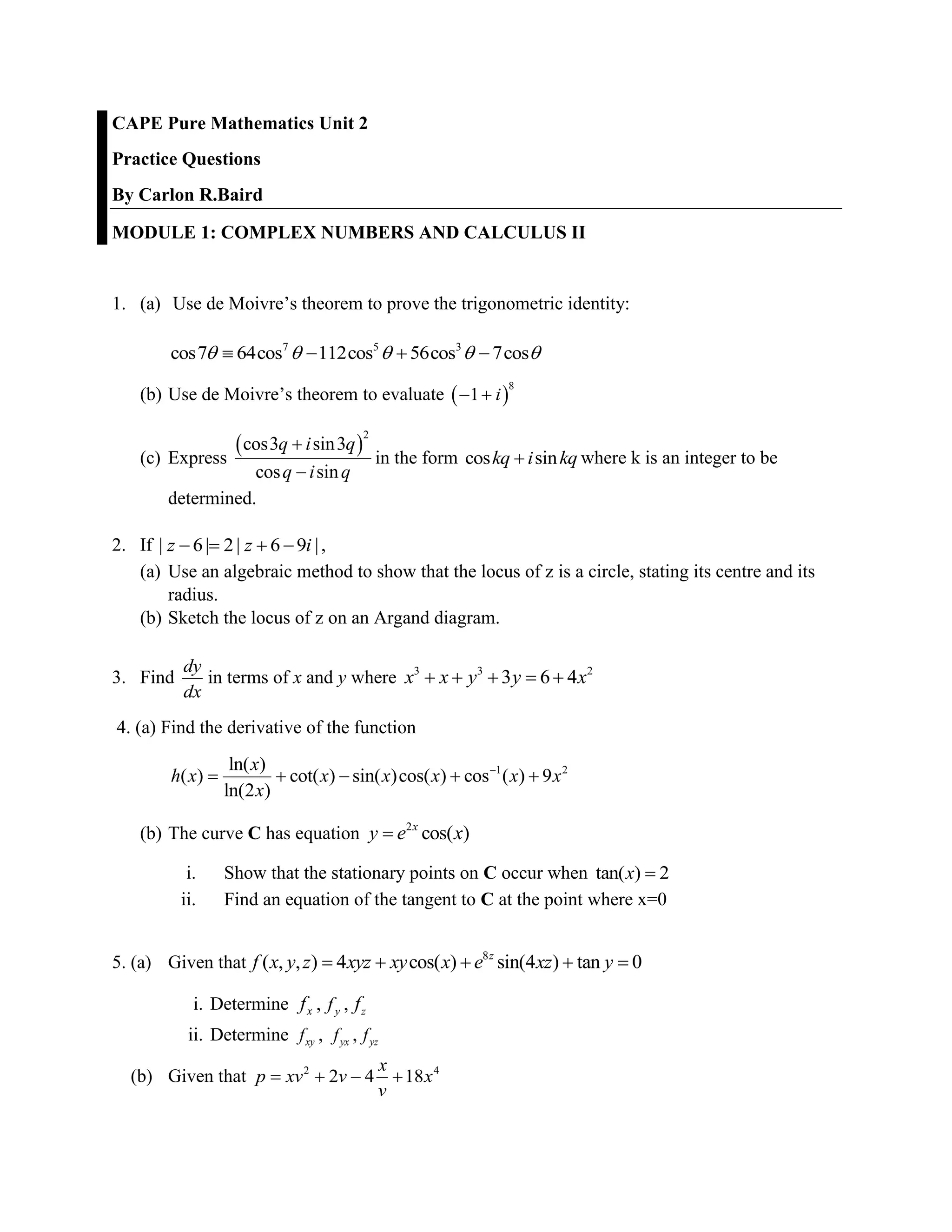
The stationary points on the curve C occur when tan(x) = 2.
The equation of the tangent to C at the point where x=0 is y = 2ex.
CAPE PURE MATHEMATICS UNIT 2 MODULE 1 PRACTICE QUESTIONS
1.
CAPE Pure MathematicsUnit 2
Practice Questions
By Carlon R.Baird
MODULE 1: COMPLEX NUMBERS AND CALCULUS II
1. (a) Use de Moivre’s theorem to prove the trigonometric identity:
7 5 3
cos7 64cos 112cos 56cos 7cos
(b) Use de Moivre’s theorem to evaluate
8
1 i
(c) Express
2
cos3 sin3
cos sin
q i q
q i q
in the form cos sinkq i kq where k is an integer to be
determined.
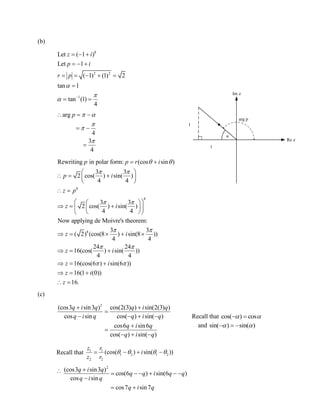
2. If | 6| 2| 6 9 |z z i ,
(a) Use an algebraic method to show that the locus of z is a circle, stating its centre and its
radius.
(b) Sketch the locus of z on an Argand diagram.
3. Find
dy
dx
in terms of x and y where 3 3 2
3 6 4x x y y x
4. (a) Find the derivative of the function
1 2ln( )
( ) cot( ) sin( )cos( ) cos ( ) 9
ln(2 )
x
h x x x x x x
x
(b) The curve C has equation 2
cos( )x
y e x
i. Show that the stationary points on C occur when tan( ) 2x
ii. Find an equation of the tangent to C at the point where x=0
5. (a) Given that 8
( , , ) 4 cos( ) sin(4 ) tan 0z
f x y z xyz xy x e xz y
i. Determine xf , yf , zf
ii. Determine xyf , yxf , yzf
(b) Given that 2 4
2 4 18
x
p xv v x
v
2.
i. Determine
p
v
and
p
x
ii. Determine
2
p
xv
and
2
p
v x
6. (a) Integrate with respect to x
i. 2
10
1
x
x
ii.
2
15
1
x
x
iii. 2
2 8
1
x
x
(b) (i) Express the function
4 3 2
3 2
4 9 17 12
( )
4 4
x x x x
h x
x x x
as partial fractions
(ii) Hence, evaluate
4 4 3 2
3 2
3
4 9 17 12
4 4
x x x x
dx
x x x
(c) Determine 1
2
1
tan
1
x dx
x
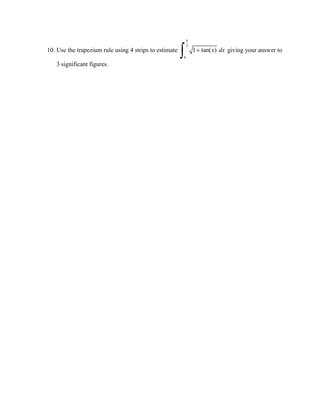
7. Using the substitution secx ,find
2
2
1 1
1
x
dx
xx x
8. (a) Show that 4 3
1 (1 )x x x
(b) Given that
1
3
0
(1 )n
nI x x dx
, show that 1
3
3 2
n n
n
I I
n
(c) Use your reduction formula to evaluate 4I .
9. Given that
sin(2 1)
sin( )
m
m x
J dx
x
,
(a) Show that 1
sin2
m m
mx
J J
m
(b) Hence find 5J .
3.
10. Use thetrapezium rule using 4 strips to estimate
3
0
1 tan( )x dx
giving your answer to
3 significant figures.
1. (a) Firstlet’s consider 7
(cos sin )i
Now, by de Moivre’s theorem
7
7
(cos sin ) cos7 sin7
cos7 sin7 (cos sin )
Using binomial expansion:
i i
i i
7 7 6 7 5 2 7 4 3
1 2 3
7 3 4 7 2 5 7 6 7
4 5 6
7 6 5 2 2 4 3 3
cos7 sin7 cos (cos )( sin ) (cos )( sin ) (cos )( sin )
(cos )( sin ) (cos )( sin ) (cos )( sin ) ( sin )
cos 7(cos )( sin ) 21(cos )( sin ) 35(cos )( sin )
i C i C i C i
C i C i C i i
i i i
3 4 4 2 5 5 6 6 7 7
7 6 5 2 4 3
3 4 2 5 6 7
35(cos )( sin ) 21(cos )( sin ) 7(cos )( sin ) sin
cos 7cos sin 21cos sin 35cos sin
35cos sin 21cos sin 7cos sin sin
i i i i
i i
i i
Now equating real parts:
7 5 2 3 4 6
7 5 2 3 2 2 2 3
7 5 7 3 2 4
3 3 0 3 2 3 1
0 1 2
cos7 cos 21cos sin 35cos sin 7cos sin
cos 21cos (1 cos ) 35cos (1 cos ) 7cos (1 cos )
cos 21cos 21cos 35cos 1 2cos cos
7cos (1) ( cos ) (1) ( cos ) (1) ( cC C C
2 3 0 3
3
7 5 7 3 5 7
2 4 6
7 5 7 3 5 7 3
5 7
7 7 7
os ) (1) ( cos )
cos 21cos 21cos 35cos 70cos 35cos
7cos 1 3cos 3cos cos
cos 21cos 21cos 35cos 70cos 35cos 7cos 21cos
21cos 7cos
cos 21cos 35cos
C
7 5 5 5 3
3
7cos 21cos 70cos 21cos 35cos
21cos 7cos
7 5 3
cos7 64cos 112cos 56cos 7cos
6.
2
(cos3 sin3 )
cos(6) sin(6 )
cos sin
cos7 sin7
q i q
q q i q q
q i q
q i q
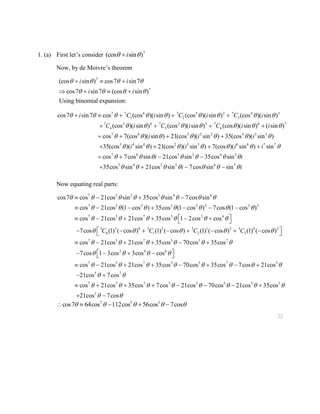
(b)
8
2 2
1
Let ( 1 )
Let 1
( 1) (1) 2
tan 1
tan (1)
4
z i
p i
r p
arg
4
3
4
p
8
8
8
Rewriting in polar form: (cos sin )
3 3
2 cos( ) sin( )
4 4
3 3
2 cos( ) sin( )
4 4
Now applying de Moivre's theorem:
3 3
( 2) (cos(8 ) sin(8 ))
4 4
24 24
16(cos( ) sin( )
4 4
p p r i
p i
z p
z i
z i
z i
)
16(cos(6 ) sin(6 ))
16(1 (0))
16.
z i
z i
z
(c)
2
(cos3 sin3 ) cos(2(3) ) sin(2(3) )
cos sin cos( ) sin( )
cos6 sin6
cos( ) sin( )
q i q q i q
q i q q i q
q i q
q i q
Recall that 1 1
1 2 1 2
2 2
(cos( ) sin( ))
z r
i
z r
α
Im z
Re z
arg p
1
1
Recall that cos( ) cos
and sin( ) sin( )
7.
C(-10,12)
O
12
-10
y
x
7k
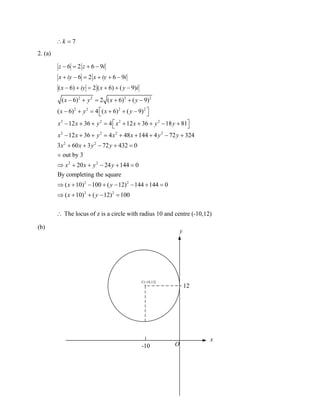
2. (a)
22 2 2
2 2 2 2
2 2 2 2
2 2 2 2
2 2
6 2 6 9
6 2 6 9
( 6) 2 ( 6) ( 9)
( 6) 2 ( 6) ( 9)
( 6) 4 ( 6) ( 9)
12 36 4 12 36 18 81
12 36 4 48 144 4 72 324
3 60 3 72 432 0
ou
z z i
x iy x iy i
x iy x y i
x y x y
x y x y
x x y x x y y
x x y x x y y
x x y y
2 2
2 2
2 2
t by 3
20 24 144 0
By completing the square
( 10) 100 ( 12) 144 144 0
( 10) ( 12) 100
The locus of z is a circle with radius 10 and centre (-10,12)
x x y y
x y
x y
(b)
8.
3.
3 3 2
22
2 2
2
2
3 6 4
:3 1 3 3 8
(3 3) 8 1 3
8 1 3
3 3
x x y y x
d dy dy
x y x
dx dx dx
dy
y x x
dx
dy x x
dx y
4. (a)
1 2
1 2
2
2 2
ln( )
( ) cot( ) sin( )cos( ) cos ( ) 9
ln(2 )
ln( ) 1
( ) sin( )cos( ) cos ( ) 9
ln(2 ) tan( )
1 2
ln(2 ) ln( ) tan( ) 0 1 sec2
'( )
(ln(2 )) tan
(cos )(cos ) (sin )(
x
h x x x x x x
x
x
h x x x x x
x x
x x x xx x
h x
x x
x x x
2
2
2 2
2 2 2
2
2 2
2 2 2
2
2 2
2 2 2
1
sin ) 18
1
1
(ln(2 ) ln( ))
sec 1
'( ) cos sin 18
ln (2 ) tan 1
2
ln( )
sec 1
= cos sin 18
ln (2 ) tan 1
ln(2) sec 1
'( ) = cos sin 18
ln (2 ) tan 1
x x
x
x x
xxh x x x x
x x x
x
xx x x x
x x x x
x
h x x x x
x x x x
9.
(b) i) 2
cosx
ye x
2 2
2 2
2
2
2
cos( ) 2 sin( )
=2 cos( ) sin( )
= 2cos( ) sin( )
At stationary pts. 0
2cos( ) sin( ) 0
0 and 2cos( ) sin( ) 0
2cos( ) sin( ) 0
2cos( ) sin( )
x x
x x
x
x
x
dy
x e e x
dx
e x e x
e x x
dy
dx
e x x
e x x
x x
x x
sin( )
2=
cos( )
tan( ) 2
x
x
x
ii) When 0x , 2(0)
cos(0) 1y e
We have co-ordinates (0,1)
2(0)
0
1 1
2cos(0) sin(0) 2
Gradient of tangent at x=0 is 2
So equation of tangent : ( )
1 2( 0)
2 1
x
dy
e
dx
y y m x x
y x
y x
5. (a) 8
( , , ) 4 cos( ) sin(4 ) tan( )z
f x y z xyz xy x e xz y
i)
8
8
4 (cos )( ) ( )( sin( )) (sin(4 )(0) ( )(4 cos(4 )) 0
4 cos( ) sin( ) 4 cos(4 ).
z
x
z
f yz x y xy x xz e z xz
yz y x xy x ze xz
2
2
4 [( )(0) (cos )( )] 0 sec
4 cos( ) sec
yf xz xy x x y
xz x x y
10.
88
8 8
8
4 0 [ 4 cos(4 ) (sin(4 )(8 )] 0
4 4 cos(4 ) 8 sin(4 )
4 4 ( cos(4 ) sin(4 ))
z z
z
z z
z
f xy e x xz xz e
xy xe xz e xz
xy e x xz xz
ii)
4 [ ][ sin( )] [cos( )][1] 0
4 sin( ) cos( )
xyf z x x x
z x x x
4 cos( ) ( )(0) (sin( ))( ) 0
4 cos( ) sin( )
yxf z x xy x x
z x x x
4 0 0
4
yxf x
x
(b) 2 4
2 4 18
x
p xv v x
v
i)
2
2
2 2 4 0
4
2 2
p
xv xv
v
x
xv
v
2 3
2 3
4
0 72
4
72
p
v x
x v
v x
v
ii)
2
2
2
4
2 0
4
2
p
v
x v v
v
v
2
2
2
2 4 0
4
2
p
v v
v x
v
v
6 (a) i)
2 2
2
10 2
5
1 1
=5ln 1
x x
dx dx
x x
x c
11.
ii)
1
2 2
2
15
15 (1)
1
x
dx x x dx
x
Recall that if some function
1
2 2
( ) (1 )f x x
1
2 2
1
2 2
1
'( ) (2 )(1 )
2
'( ) (1 )
f x x x
f x x x
So
1 1
2 22 2
1
2 2
15 (1 ) 15 (1 )
15(1 )
x x dx x x dx
x C
iii) 2 2 2
2 8 2 8
1 1 1
x x
dx dx dx
x x x
2 2
1 2
1 2
2 4
1 1
2tan ( ) 4ln 1
x
dx dx
x x
x x C
(b) i)
4 3 2
3 2
4 9 17 12
( )
4 4
x x x x
h x
x x x
This algebraic fraction is improper so we shall use algebraic long division:
3 2 4 3 2
4 3 2
2
4 4 4 9 17 12
4 4 0
5 17 12
x
x x x x x x x
x x x
x x
2
3 2
5 17 12
( )
4 4
x x
h x x
x x x
2
2
2
2
5 17 12
( 4 4)
5 17 12
( 2)
x x
x
x x x
x x
x
x x
Let
2
2
5 17 12
( )
( 2)
x x
q x
x x
2
2 ( 2)
A B C
x x x
Multiplying out both sides by 2
( 2)x x gives
2
5 17 12x x 2
( 2) ( 2)A x Bx x Cx
12.
2 2
Let 0;
5(0)17(0) 12 (0 2)
4 12
3
x
A
A
A
2
2 2 2
Comparing terms:
5
5
3 5
2
x
Ax Bx x
A B
B
B
Comparing terms:
17 4 2
17 4 2
17 4(3) 2(2)
17 12 4
C= 17 16 1
x
x Ax Bx Cx
A B C
C
C
2
3 2 1
( )
2 ( 2)
q x
x x x
So ( ) ( )h x x q x
2
3 2 1
( )
2 ( 2)
h x x
x x x
ii) Hence,
4 44 3 2
3 2 2
3 3
4 9 17 12 3 2 1
4 4 2 ( 2)
x x x x
dx x dx
x x x x x x
13.
4 4 44
2
3 3 3 3
1 1
3 2 ( 2)
( 2)
x dx dx dx x dx
x x
4 42 1
4 4
3 3
3 3
2 2 1 1
3 2
( 2)
3 ln 2 ln 2
2 1
4 3 (4 2) (3 2)
3 ln(4) ln(3) 2 ln(4 2) ln(3 2)
2 2 1 1
9 4 1
8 3 ln( ) 2ln(2)
2 3 2
7 4 1
ln( ) ln(2)
2 3 2
64
3 ln( 4)
27
25
3 ln(
x x
x x
6
)
27
(c) 1 1
2 2
1 1
tan ( ) tan ( )
1 1
x dx x dx dx
x x
1 1
tan ( ) tan ( )x dx x
Let
1
tan ( )I x dx
1
(1)(tan ( ))x dx
Let 1
tan and 1
dv
u x
dx
2
1
1
du
dx x
v x
Using integration by parts:
1
2
1
2
1
2
1 2
1
tan ( ) ( )( )
1
tan ( )
1
1 2
tan ( )
2 1
1
tan ( ) ln |1 |
2
I x x x dx
x
x
x x dx
x
x
x x dx
x
x x x
14.
1 1 21
2
1 1
tan ( ) tan ( ) ln |1 | tan ( )
1 2
x dx x x x x C
x
7.
2
2
1 1
1
x
dx
xx x
Using the substitution
1
sec
cos
x
2
2
[cos ][0] [1][ sin ]
cos
sin
cos
sin 1
cos cos
dx
d
tan sec
tan sec
dx
d
dx d
2 2
2 2
1 1 1 sec 1
tan sec
sec1 sec sec 1
1
sec
x
dx d
xx x
2
2
1
tan tan sec
tan
2
1
tan tan
tan
1 tan
tan
d
d
tan
2
2
1 tan
sec
tan
d
d
d
C
Remember in the question that
1
sec
cos
x
1
cos
adj
x hyp
15.
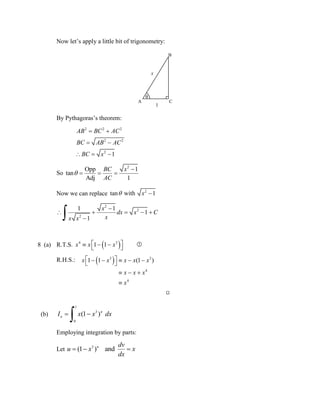
Now let’s applya little bit of trigonometry:
θ
x
1
A
B
C
By Pythagoras’s theorem:
2 2 2
2 2
2
1
AB BC AC
BC AB AC
BC x
So
2
Opp 1
tan
Adj 1
BC x
AC
Now we can replace 2
tan with 1x
2
2
2
1 1
1
1
x
dx x C
xx x
8 (a) R.T.S. 4 3
1 1x x x
R.H.S.:
(b)
1
3
0
(1 )n
nI x x dx
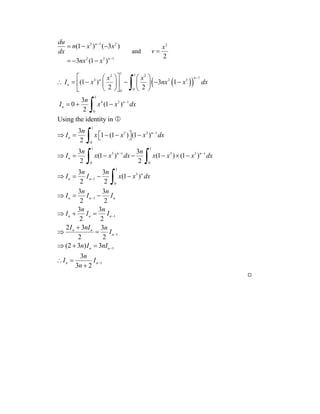
Employing integration by parts:
Let 3
(1 ) andn dv
u x x
dx
3 3
4
4
1 1 (1 )x x x x x
x x x
x
16.
3 1 2
23 1
(1 ) ( 3 )
3 (1 )
n
n
du
n x x
dx
nx x
and
2
2
x
v
1 12 2
1
3 2 3
00
1
4 3 1
0
1
3 3 1
0
1 1
3 1 3 3 1
0 0
1
(1 ) 3 1
2 2
3
0 (1 )
2
Using the identity in
3
1 (1 ) (1 )
2
3 3
(1 ) (1 ) (1 )
2 2
3 3
2
n
n
n
n
n
n
n
n n
n
n n
x x
I x nx x dx
n
I x x dx
n
I x x x dx
n n
I x x dx x x x dx
n n
I I
1
3
0
1
1
1
1
1
(1 )
2
3 3
2 2
3 3
2 2
2 3 3
2 2
(2 3 ) 3
3
3 2
n
n n n
n n n
n n
n
n n
n n
x x dx
n n
I I I
n n
I I I
I nI n
I
n I nI
n
I I
n
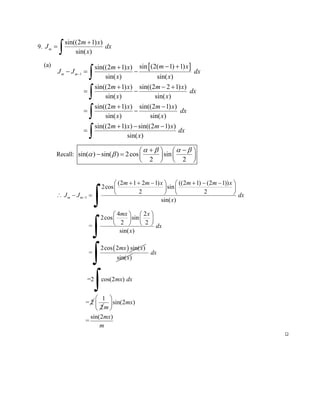
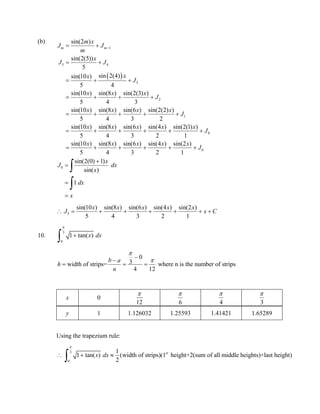
9.
sin((2 1) )
sin()
m
m x
J dx
x
(a)
Recall: sin( ) sin( ) 2cos sin
2 2
1
(2 1 2 1) ((2 1) (2 1))
2cos sin
2 2
sin( )
4 2
2cos sin
2 2
=
sin( )
2cos 2 sin( )
=
m m
m m x m m x
J J dx
x
mx x
dx
x
mx x
sin( )x
=2 cos(2 )
= 2
dx
mx dx
1
2
sin(2 )
sin(2 )
=
mx
m
mx
m
1
sin (2( 1) 1)sin((2 1) )
sin( ) sin( )
sin((2 1) ) sin((2 2 1) )
sin( ) sin( )
sin((2 1) ) sin((2 1) )
sin( ) sin( )
sin((2 1) ) sin((2 1) )
sin( )
m m
m xm x
J J dx
x x
m x m x
dx
x x
m x m x
dx
x x
m x m x
dx
x
19.
(b)
0
sin(2(0) 1)
sin( )
1
x
Jdx
x
dx
x
5
sin(10 ) sin(8 ) sin(6 ) sin(4 ) sin(2 )
5 4 3 2 1
x x x x x
J x C
10.
3
0
1 tan( )x dx
0
3width of strips= where n is the number of strips
4 12
b a
h
n
x 0
12
6
4
3
y 1 1.126032 1.25593 1.41421 1.65289
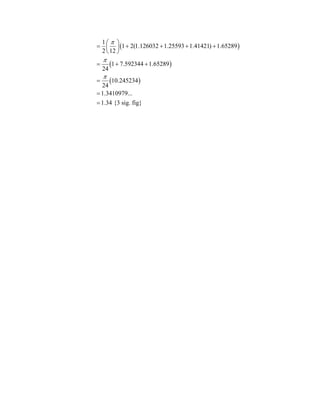
Using the trapezium rule:
3
0
1
1 tan( ) (width of strips)(1 height+2(sum of all middle heights)+last height)
2
st
x dx
1
5 4
3
2
1
0
sin(2 )
sin(2(5))
5
sin 2(4)sin(10 )
5 4
sin(10 ) sin(8 ) sin(2(3) )
5 4 3
sin(10 ) sin(8 ) sin(6 ) sin(2(2) )
5 4 3 2
sin(10 ) sin(8 ) sin(6 ) sin(4 ) sin(2(1) )
5 4 3 2 1
sin(10 ) sin
5
m m
m x
J J
m
x
J J
xx
J
x x x
J
x x x x
J
x x x x x
J
x
0
(8 ) sin(6 ) sin(4 ) sin(2 )
4 3 2 1
x x x x
J
![(b) i) 2
cosx
y e x
2 2
2 2
2
2
2
cos( ) 2 sin( )
=2 cos( ) sin( )
= 2cos( ) sin( )
At stationary pts. 0
2cos( ) sin( ) 0
0 and 2cos( ) sin( ) 0
2cos( ) sin( ) 0
2cos( ) sin( )
x x
x x
x
x
x
dy
x e e x
dx
e x e x
e x x
dy
dx
e x x
e x x
x x
x x
sin( )
2=
cos( )
tan( ) 2
x
x
x
ii) When 0x , 2(0)
cos(0) 1y e
We have co-ordinates (0,1)
2(0)
0
1 1
2cos(0) sin(0) 2
Gradient of tangent at x=0 is 2
So equation of tangent : ( )
1 2( 0)
2 1
x
dy
e
dx
y y m x x
y x
y x
5. (a) 8
( , , ) 4 cos( ) sin(4 ) tan( )z
f x y z xyz xy x e xz y
i)
8
8
4 (cos )( ) ( )( sin( )) (sin(4 )(0) ( )(4 cos(4 )) 0
4 cos( ) sin( ) 4 cos(4 ).
z
x
z
f yz x y xy x xz e z xz
yz y x xy x ze xz
2
2
4 [( )(0) (cos )( )] 0 sec
4 cos( ) sec
yf xz xy x x y
xz x x y
](https://image.slidesharecdn.com/puremathu2m1quests-130908190225-/85/CAPE-PURE-MATHEMATICS-UNIT-2-MODULE-1-PRACTICE-QUESTIONS-9-320.jpg)
![ 8 8
8 8
8
4 0 [ 4 cos(4 ) (sin(4 )(8 )] 0
4 4 cos(4 ) 8 sin(4 )
4 4 ( cos(4 ) sin(4 ))
z z
z
z z
z
f xy e x xz xz e
xy xe xz e xz
xy e x xz xz
ii)
4 [ ][ sin( )] [cos( )][1] 0
4 sin( ) cos( )
xyf z x x x
z x x x
4 cos( ) ( )(0) (sin( ))( ) 0
4 cos( ) sin( )
yxf z x xy x x
z x x x
4 0 0
4
yxf x
x
(b) 2 4
2 4 18
x
p xv v x
v
i)
2
2
2 2 4 0
4
2 2
p
xv xv
v
x
xv
v
2 3
2 3
4
0 72
4
72
p
v x
x v
v x
v
ii)
2
2
2
4
2 0
4
2
p
v
x v v
v
v
2
2
2
2 4 0
4
2
p
v v
v x
v
v
6 (a) i)
2 2
2
10 2
5
1 1
=5ln 1
x x
dx dx
x x
x c
](https://image.slidesharecdn.com/puremathu2m1quests-130908190225-/85/CAPE-PURE-MATHEMATICS-UNIT-2-MODULE-1-PRACTICE-QUESTIONS-10-320.jpg)
![1 1 2 1
2
1 1
tan ( ) tan ( ) ln |1 | tan ( )
1 2
x dx x x x x C
x
7.
2
2
1 1
1
x
dx
xx x
Using the substitution
1
sec
cos
x
2
2
[cos ][0] [1][ sin ]
cos
sin
cos
sin 1
cos cos
dx
d
tan sec
tan sec
dx
d
dx d
2 2
2 2
1 1 1 sec 1
tan sec
sec1 sec sec 1
1
sec
x
dx d
xx x
2
2
1
tan tan sec
tan
2
1
tan tan
tan
1 tan
tan
d
d
tan
2
2
1 tan
sec
tan
d
d
d
C
Remember in the question that
1
sec
cos
x
1
cos
adj
x hyp
](https://image.slidesharecdn.com/puremathu2m1quests-130908190225-/85/CAPE-PURE-MATHEMATICS-UNIT-2-MODULE-1-PRACTICE-QUESTIONS-14-320.jpg)


![228277372383828838484828015 Delhi [10th].pdf](https://cdn.slidesharecdn.com/ss_thumbnails/2015delhi10th-251230045159-55f98f80-thumbnail.jpg?width=640&height=640&fit=bounds)


