
Signals & Systems
Lecture#01
COURSE CONTENT
 Signals& Systems,ClassificationofContinuousandDiscreteTimesignals, Standard
ContinuousandDiscreteTimeSignals
 BlockDiagramRepresentationofSystem,PropertiesofSystem
 LinearTimeInvariantSystems(LTI)
 Convolution,Propertiesof Convolution,PerformingConvolution
 DifferentialandDifferenceEquationRepresentationofLTI Systems
 FourierSeries,DirichlitCondition,DeterminationofFourier Coefficeints,WaveSymmetry,
ExponentialForm ofFourierSeries
 FourierTransform,DiscreteTimeFourierTransform
 LaplaceTransform,Inverse LaplaceTransform,PropertiesofLaplaceTransform
 Z-Transform,PropertiesofZ-Transform,Inverse Z-Transform
BOOKS
Text Book
Signal & Systems (2nd Edition)
By A. V. Oppenheim, A. S. Willsky &S. H. Nawa
Signal & Systems
By Prentice Hall
Reference Book
Signal & Systems (2nd Edition)
By S. Haykin&B.V. Veen
Signals & Systems
By Smarajit Gosh
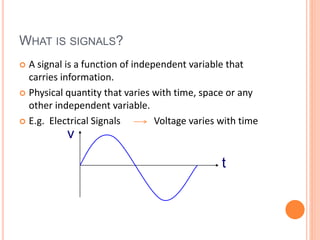
WHAT IS SIGNALS?
 A signal is a function of independent variable that
carries information.
 Physical quantity that varies with time, space or any
other independent variable.
 E.g. Electrical Signals Voltage varies with time
t
v
SIGNALS (EXAMPLES)
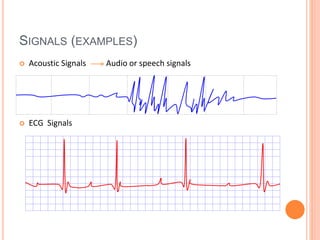
 Acoustic Signals Audio or speech signals
 ECG Signals
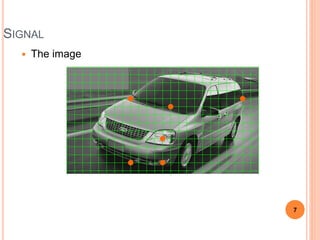
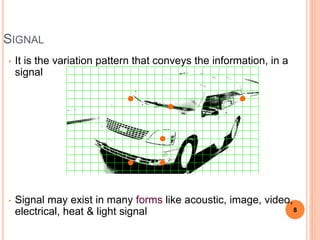
IMAGE
SIGNAL
 The image
7
SIGNAL
• It is the variation pattern that conveys the information, in a
signal
• Signal may exist in many forms like acoustic, image, video,
electrical, heat & light signal 8
SIGNALS
One –Dimensional Signal
Depends on single variable e.g. Speech signal
Multidimensional Signals
Depends on two or more variables e.g. image
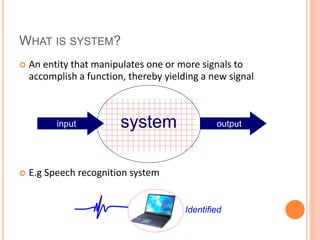
WHAT IS SYSTEM?
 An entity that manipulates one or more signals to
accomplish a function, thereby yielding a new signal.
 E.g Speech recognition system
systeminput output
Identified
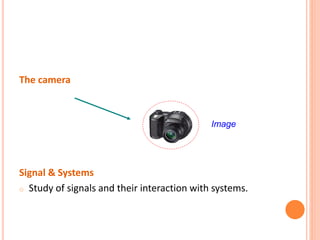
The camera
Signal & Systems
o Study of signals and their interaction with systems.
Image
MATHEMATICAL REPRESENTATION
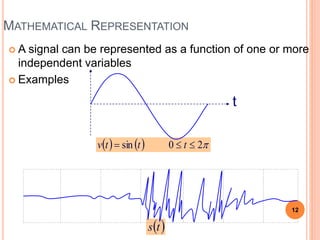
 A signal can be represented as a function of one or more
independent variables
 Examples
    20sin  tttv
 ts
12
t
MATHEMATICAL REPRESENTATION
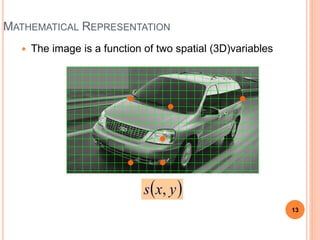
 The image is a function of two spatial (3D)variables
 yxs ,
13
TYPES OF SIGNALS
 Two types of signals
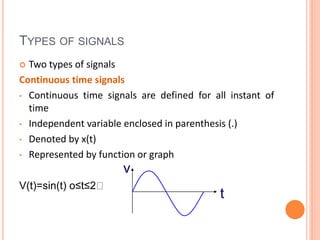
Continuous time signals
• Continuous time signals are defined for all instant of
time
• Independent variable enclosed in parenthesis (.)
• Denoted by x(t)
• Represented by function or graph
V(t)=sin(t) o≤t≤2
t
v
CONTINUOUS-TIME SIGNALS
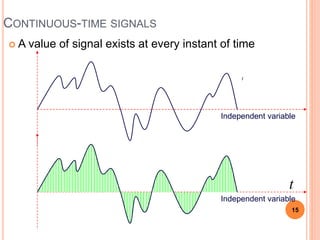
 A value of signal exists at every instant of time
t
15
Independent variable
t
DISCRETE TIME SIGNAL
• Defined on discrete instant of time.
• Independent variable is enclosed in brackets [.]
• Denoted by x[n]
• Discrete signal is obtained by taking samples of analog
signal at discrete instant of time.
X[1]
n0 1 2 3 4-1-2-3-4
X[n]
X[2]
X[-1]
CONTINUOUS AND DISCRETE SIGNALS
 Examples of continuous signals
 Speech, video, image
 The variation of atmospheric pressure, wind speed
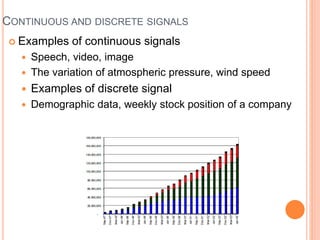
 Examples of discrete signal
 Demographic data, weekly stock position of a company
3/26/2019UAJK-MZD
REPRESENTATION
OF DISCRETE TIME
SIGNALS
REPRESENTATION OF DISCRETE TIME
SIGNALS
 Fours ways for representing discrete time signals.
Graphical representation of signal
Consider a signal x[n] having values
x[-2]=-4,x[-1]=1,X[0]=2, x[1]=1,x[2]=2
X[1]
n0 1 2-1-2
X[n] X[2]
X[-1]
FUNCTIONAL REPRESENTATION OF DISCRETE
SIGNALS
 Signals can be represented using functional
representation as:
x[n]= -4 for n= -2
1 for n=-1
2 for n=0
1 for n=1
2 for n=2
Tabular representation of discrete signals
• In this method, sampling instant n and the magnitude of
signal at the sampling instant are represented in tabular
form.
n -2 -1 0 1 2
X[n] -4 1 2 1 2
SEQUENCE REPRESENTATION OF DISCRETE
SIGNALS
 A finite duration sequence can be represented as:
x[n]= { 2, -4, 3, 0, 1, 3, 2 }
o The arrow denotes n=0 term.
o When no arrow is indicated then first term indicates the n=0 term.
x[n]= { 2, 4, 3, 1, 5 }

Lecture No:1 Signals & Systems

  • 1.
  • 2.
    COURSE CONTENT  Signals&Systems,ClassificationofContinuousandDiscreteTimesignals, Standard ContinuousandDiscreteTimeSignals  BlockDiagramRepresentationofSystem,PropertiesofSystem  LinearTimeInvariantSystems(LTI)  Convolution,Propertiesof Convolution,PerformingConvolution  DifferentialandDifferenceEquationRepresentationofLTI Systems  FourierSeries,DirichlitCondition,DeterminationofFourier Coefficeints,WaveSymmetry, ExponentialForm ofFourierSeries  FourierTransform,DiscreteTimeFourierTransform  LaplaceTransform,Inverse LaplaceTransform,PropertiesofLaplaceTransform  Z-Transform,PropertiesofZ-Transform,Inverse Z-Transform
  • 3.
    BOOKS Text Book Signal &Systems (2nd Edition) By A. V. Oppenheim, A. S. Willsky &S. H. Nawa Signal & Systems By Prentice Hall Reference Book Signal & Systems (2nd Edition) By S. Haykin&B.V. Veen Signals & Systems By Smarajit Gosh
  • 4.
    WHAT IS SIGNALS? A signal is a function of independent variable that carries information.  Physical quantity that varies with time, space or any other independent variable.  E.g. Electrical Signals Voltage varies with time t v
  • 5.
    SIGNALS (EXAMPLES)  AcousticSignals Audio or speech signals  ECG Signals
  • 6.
  • 7.
  • 8.
    SIGNAL • It isthe variation pattern that conveys the information, in a signal • Signal may exist in many forms like acoustic, image, video, electrical, heat & light signal 8
  • 9.
    SIGNALS One –Dimensional Signal Dependson single variable e.g. Speech signal Multidimensional Signals Depends on two or more variables e.g. image
  • 10.
    WHAT IS SYSTEM? An entity that manipulates one or more signals to accomplish a function, thereby yielding a new signal.  E.g Speech recognition system systeminput output Identified
  • 11.
    The camera Signal &Systems o Study of signals and their interaction with systems. Image
  • 12.
    MATHEMATICAL REPRESENTATION  Asignal can be represented as a function of one or more independent variables  Examples     20sin  tttv  ts 12 t
  • 13.
    MATHEMATICAL REPRESENTATION  Theimage is a function of two spatial (3D)variables  yxs , 13
  • 14.
    TYPES OF SIGNALS Two types of signals Continuous time signals • Continuous time signals are defined for all instant of time • Independent variable enclosed in parenthesis (.) • Denoted by x(t) • Represented by function or graph V(t)=sin(t) o≤t≤2 t v
  • 15.
    CONTINUOUS-TIME SIGNALS  Avalue of signal exists at every instant of time t 15 Independent variable Independent variable t
  • 16.
    DISCRETE TIME SIGNAL •Defined on discrete instant of time. • Independent variable is enclosed in brackets [.] • Denoted by x[n] • Discrete signal is obtained by taking samples of analog signal at discrete instant of time. X[1] n0 1 2 3 4-1-2-3-4 X[n] X[2] X[-1]
  • 17.
    CONTINUOUS AND DISCRETESIGNALS  Examples of continuous signals  Speech, video, image  The variation of atmospheric pressure, wind speed  Examples of discrete signal  Demographic data, weekly stock position of a company 3/26/2019UAJK-MZD
  • 18.
  • 19.
    REPRESENTATION OF DISCRETETIME SIGNALS  Fours ways for representing discrete time signals. Graphical representation of signal Consider a signal x[n] having values x[-2]=-4,x[-1]=1,X[0]=2, x[1]=1,x[2]=2 X[1] n0 1 2-1-2 X[n] X[2] X[-1]
  • 20.
    FUNCTIONAL REPRESENTATION OFDISCRETE SIGNALS  Signals can be represented using functional representation as: x[n]= -4 for n= -2 1 for n=-1 2 for n=0 1 for n=1 2 for n=2 Tabular representation of discrete signals • In this method, sampling instant n and the magnitude of signal at the sampling instant are represented in tabular form. n -2 -1 0 1 2 X[n] -4 1 2 1 2
  • 21.
    SEQUENCE REPRESENTATION OFDISCRETE SIGNALS  A finite duration sequence can be represented as: x[n]= { 2, -4, 3, 0, 1, 3, 2 } o The arrow denotes n=0 term. o When no arrow is indicated then first term indicates the n=0 term. x[n]= { 2, 4, 3, 1, 5 }