GujaratPower EngineeingAndResearch
Institute
Sub :- Calculus
Topic :- Taylor’s and Maclaurin’s
Series
Nikhil Patel (161040119038)
Parth Patel (161040119040)
Smit Patel (161040119043)
Amit Prajapati (161040119047)
Created By :-Guided By :-
Prof. Janki Gajjar
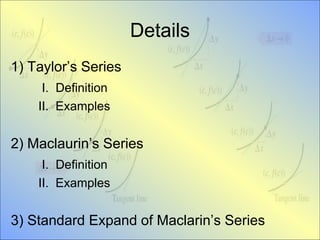
Details
1) Taylor’s Series
I. Definition
II. Examples
2) Maclaurin’s Series
I. Definition
II. Examples
3) Standard Expand of Maclarin’s Series
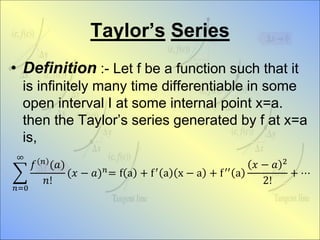
Taylor’s Series
• Definition :- Let f be a function such that it
is infinitely many time differentiable in some
open interval I at some internal point x=a.
then the Taylor’s series generated by f at x=a
is,
𝑛=0
∞
𝑓 𝑛
(𝑎)
𝑛!
(𝑥 − 𝑎) 𝑛
= f a + f′
a x − a + f′′
a
𝑥 − 𝑎 2
2!
+ ⋯
• Let, x-a=h
∴ 𝑥 = 𝑎 + ℎ.
• 𝑓 𝑎 + ℎ = f a + hf′
a + ℎ2 𝑓′′(𝑎)
2!
+ ⋯
EXAMPLES
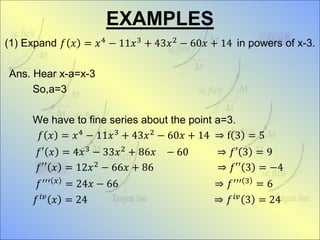
(1) Expand 𝑓 𝑥 = 𝑥4 − 11𝑥3 + 43𝑥2 − 60𝑥 + 14 in powers of x-3.
Ans. Hear x-a=x-3
So,a=3
We have to fine series about the point a=3.
𝑓 𝑥 = 𝑥4 − 11𝑥3 + 43𝑥2 − 60𝑥 + 14 ⇒ f 3 = 5
𝑓′ 𝑥 = 4𝑥3 − 33𝑥2 + 86𝑥 − 60 ⇒ 𝑓′ 3 = 9
𝑓′′ 𝑥 = 12𝑥2 − 66𝑥 + 86 ⇒ 𝑓′′ 3 = −4
𝑓′′′ 𝑥 = 24𝑥 − 66 ⇒ 𝑓′′′ 3 = 6
𝑓 𝑖𝑣
𝑥 = 24 ⇒ 𝑓 𝑖𝑣
3 = 24
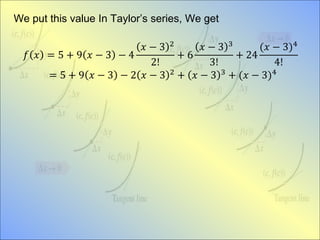
We put this value In Taylor’s series, We get
𝑓 𝑥 = 5 + 9 𝑥 − 3 − 4
𝑥 − 3 2
2!
+ 6
𝑥 − 3 3
3!
+ 24
(𝑥 − 3)4
4!
= 5 + 9 𝑥 − 3 − 2 𝑥 − 3 2 + 𝑥 − 3 3 + (𝑥 − 3)4
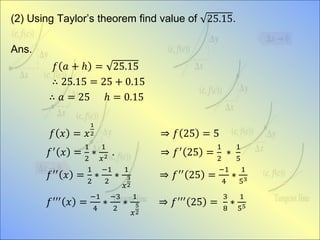
(2) Using Taylor’s theorem find value of 25.15.
Ans.
𝑓 𝑎 + ℎ = 25.15
∴ 25.15 = 25 + 0.15
∴ 𝑎 = 25 ℎ = 0.15
𝑓 𝑥 = 𝑥
1
2 ⇒ 𝑓 25 = 5
𝑓′ 𝑥 =
1
2
∗
1
𝑥2 . ⇒ 𝑓′ 25 =
1
2
∗
1
5
𝑓′′ 𝑥 =
1
2
∗
−1
2
∗
1
𝑥
3
2
⇒ 𝑓′′ 25 =
−1
4
∗
1
53
𝑓′′′ 𝑥 =
−1
4
∗
−3
2
∗
1
𝑥
5
2
⇒ 𝑓′′′ 25 =
3
8
∗
1
55
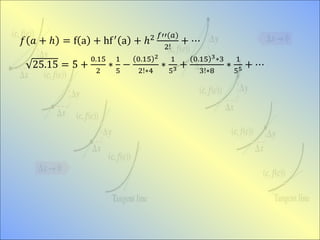
𝑓 𝑎 + ℎ = f a + hf′ a + ℎ2 𝑓′′(𝑎)
2!
+ ⋯
25.15 = 5 +
0.15
2
∗
1
5
−
0.15 2
2!∗4
∗
1
53 +
0.15 3∗3
3!∗8
∗
1
55 + ⋯
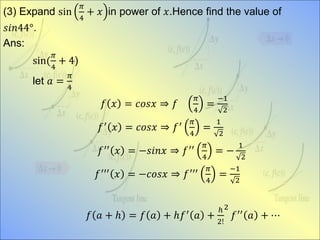
(3) Expand sin
𝜋
4
+ 𝑥 in power of 𝑥.Hence find the value of
𝑠𝑖𝑛44°.
Ans:
sin(
𝜋
4
+ 4)
let 𝑎 =
𝜋
4
𝑓 𝑥 = 𝑐𝑜𝑠𝑥 ⇒ 𝑓
𝜋
4
=
−1
2
𝑓′ 𝑥 = 𝑐𝑜𝑠𝑥 ⇒ 𝑓′ 𝜋
4
=
1
2
𝑓′′ 𝑥 = −𝑠𝑖𝑛𝑥 ⇒ 𝑓′′ 𝜋
4
= −
1
2
𝑓′′′ 𝑥 = −𝑐𝑜𝑠𝑥 ⇒ 𝑓′′′ 𝜋
4
=
−1
2
𝑓 𝑎 + ℎ = 𝑓 𝑎 + ℎ𝑓′ 𝑎 +
ℎ
2!
2
𝑓′′ 𝑎 + ⋯
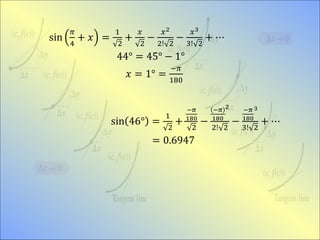
sin
𝜋
4
+ 𝑥 =
1
2
+
𝑥
2
−
𝑥2
2! 2
−
𝑥3
3! 2
+ ⋯
44° = 45° − 1°
𝑥 = 1° =
−𝜋
180
sin 46° =
1
2
+
−𝜋
180
2
−
−𝜋
180
2
2! 2
−
−𝜋
180
3
3! 2
+ ⋯
= 0.6947
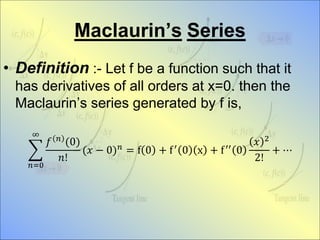
Maclaurin’s Series
• Definition :- Let f be a function such that it
has derivatives of all orders at x=0. then the
Maclaurin’s series generated by f is,
𝑛=0
∞
𝑓 𝑛
(0)
𝑛!
(𝑥 − 0) 𝑛 = f 0 + f′ 0 x + f′′ 0
𝑥 2
2!
+ ⋯
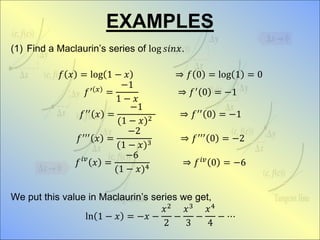
EXAMPLES
(1) Find a Maclaurin’s series of log 𝑠𝑖𝑛𝑥.
𝑓 𝑥 = log 1 − 𝑥 ⇒ 𝑓 0 = log 1 = 0
𝑓′ 𝑥 =
−1
1 − 𝑥
⇒ 𝑓′ 0 = −1
𝑓′′ 𝑥 =
−1
(1 − 𝑥)2
⇒ 𝑓′′ 0 = −1
𝑓′′′
𝑥 =
−2
(1 − 𝑥)3 ⇒ 𝑓′′′
0 = −2
𝑓 𝑖𝑣
𝑥 =
−6
(1 − 𝑥)4 ⇒ 𝑓 𝑖𝑣
0 = −6
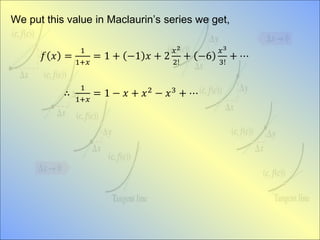
We put this value in Maclaurin’s series we get,
ln 1 − 𝑥 = −𝑥 −
𝑥2
2
−
𝑥3
3
−
𝑥4
4
− ⋯
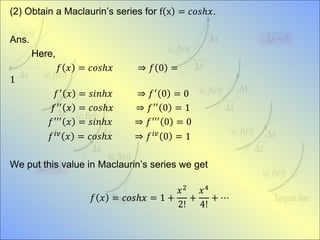
(2) Obtain a Maclaurin’s series for f x = 𝑐𝑜𝑠ℎ𝑥.
Ans.
Here,
𝑓 𝑥 = 𝑐𝑜𝑠ℎ𝑥 ⇒ 𝑓 0 =
1
𝑓′
𝑥 = 𝑠𝑖𝑛ℎ𝑥 ⇒ 𝑓′
0 = 0
𝑓′′
𝑥 = 𝑐𝑜𝑠ℎ𝑥 ⇒ 𝑓′′
0 = 1
𝑓′′′
𝑥 = 𝑠𝑖𝑛ℎ𝑥 ⇒ 𝑓′′′
0 = 0
𝑓 𝑖𝑣
𝑥 = 𝑐𝑜𝑠ℎ𝑥 ⇒ 𝑓 𝑖𝑣
0 = 1
We put this value in Maclaurin’s series we get
𝑓 𝑥 = 𝑐𝑜𝑠ℎ𝑥 = 1 +
𝑥2
2!
+
𝑥4
4!
+ ⋯
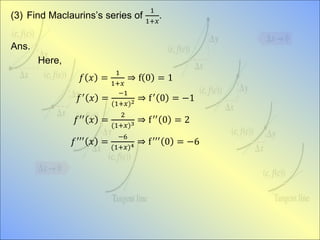
(3) Find Maclaurins’s series of
1
1+𝑥
.
Ans.
Here,
𝑓 𝑥 =
1
1+𝑥
⇒ f 0 = 1
𝑓′ 𝑥 =
−1
(1+𝑥)2 ⇒ f′ 0 = −1
𝑓′′
𝑥 =
2
(1+𝑥)3 ⇒ f′′
0 = 2
𝑓′′′
𝑥 =
−6
(1+𝑥)4 ⇒ f′′′
0 = −6
We put this value in Maclaurin’s series we get,
𝑓 𝑥 =
1
1+𝑥
= 1 + −1 𝑥 + 2
𝑥2
2!
+ −6
𝑥3
3!
+ ⋯
∴
1
1+𝑥
= 1 − 𝑥 + 𝑥2
− 𝑥3
+ ⋯
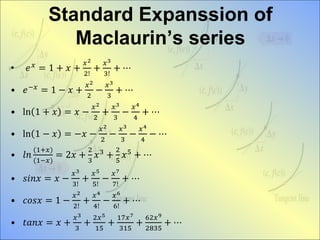
Standard Expanssion of
Maclaurin’s series
• 𝑒 𝑥 = 1 + 𝑥 +
𝑥2
2!
+
𝑥3
3!
+ ⋯
• 𝑒−𝑥
= 1 − 𝑥 +
𝑥2
2
−
𝑥3
3
+ ⋯
• ln 1 + 𝑥 = 𝑥 −
𝑥2
2
+
𝑥3
3
−
𝑥4
4
+ ⋯
• ln 1 − 𝑥 = −𝑥 −
𝑥2
2
−
𝑥3
3
−
𝑥4
4
− ⋯
• 𝑙𝑛
(1+𝑥)
(1−𝑥)
= 2𝑥 +
2
3
𝑥3 +
2
5
𝑥5 + ⋯
• 𝑠𝑖𝑛𝑥 = 𝑥 −
𝑥3
3!
+
𝑥5
5!
−
𝑥7
7!
+ ⋯
• 𝑐𝑜𝑠𝑥 = 1 −
𝑥2
2!
+
𝑥4
4!
−
𝑥6
6!
+ ⋯
• 𝑡𝑎𝑛𝑥 = 𝑥 +
𝑥3
3
+
2𝑥5
15
+
17𝑥7
315
+
62𝑥9
2835
+ ⋯
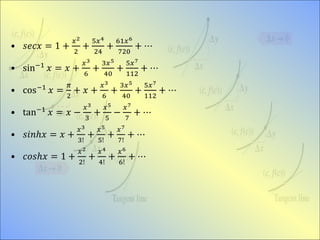
• 𝑠𝑒𝑐𝑥 = 1 +
𝑥2
2
+
5𝑥4
24
+
61𝑥6
720
+ ⋯
• sin−1
𝑥 = 𝑥 +
𝑥3
6
+
3𝑥5
40
+
5𝑥7
112
+ ⋯
• cos−1
𝑥 =
𝜋
2
+ 𝑥 +
𝑥3
6
+
3𝑥5
40
+
5𝑥7
112
+ ⋯
• tan−1 𝑥 = 𝑥 −
𝑥3
3
+
𝑥5
5
−
𝑥7
7
+ ⋯
• 𝑠𝑖𝑛ℎ𝑥 = 𝑥 +
𝑥3
3!
+
𝑥5
5!
+
𝑥7
7!
+ ⋯
• 𝑐𝑜𝑠ℎ𝑥 = 1 +
𝑥2
2!
+
𝑥4
4!
+
𝑥6
6!
+ ⋯
Taylor's & Maclaurin's series simple

Taylor's & Maclaurin's series simple

  • 1.
    GujaratPower EngineeingAndResearch Institute Sub :-Calculus Topic :- Taylor’s and Maclaurin’s Series Nikhil Patel (161040119038) Parth Patel (161040119040) Smit Patel (161040119043) Amit Prajapati (161040119047) Created By :-Guided By :- Prof. Janki Gajjar
  • 2.
    Details 1) Taylor’s Series I.Definition II. Examples 2) Maclaurin’s Series I. Definition II. Examples 3) Standard Expand of Maclarin’s Series
  • 3.
    Taylor’s Series • Definition:- Let f be a function such that it is infinitely many time differentiable in some open interval I at some internal point x=a. then the Taylor’s series generated by f at x=a is, 𝑛=0 ∞ 𝑓 𝑛 (𝑎) 𝑛! (𝑥 − 𝑎) 𝑛 = f a + f′ a x − a + f′′ a 𝑥 − 𝑎 2 2! + ⋯
  • 4.
    • Let, x-a=h ∴𝑥 = 𝑎 + ℎ. • 𝑓 𝑎 + ℎ = f a + hf′ a + ℎ2 𝑓′′(𝑎) 2! + ⋯
  • 5.
    EXAMPLES (1) Expand 𝑓𝑥 = 𝑥4 − 11𝑥3 + 43𝑥2 − 60𝑥 + 14 in powers of x-3. Ans. Hear x-a=x-3 So,a=3 We have to fine series about the point a=3. 𝑓 𝑥 = 𝑥4 − 11𝑥3 + 43𝑥2 − 60𝑥 + 14 ⇒ f 3 = 5 𝑓′ 𝑥 = 4𝑥3 − 33𝑥2 + 86𝑥 − 60 ⇒ 𝑓′ 3 = 9 𝑓′′ 𝑥 = 12𝑥2 − 66𝑥 + 86 ⇒ 𝑓′′ 3 = −4 𝑓′′′ 𝑥 = 24𝑥 − 66 ⇒ 𝑓′′′ 3 = 6 𝑓 𝑖𝑣 𝑥 = 24 ⇒ 𝑓 𝑖𝑣 3 = 24
  • 6.
    We put thisvalue In Taylor’s series, We get 𝑓 𝑥 = 5 + 9 𝑥 − 3 − 4 𝑥 − 3 2 2! + 6 𝑥 − 3 3 3! + 24 (𝑥 − 3)4 4! = 5 + 9 𝑥 − 3 − 2 𝑥 − 3 2 + 𝑥 − 3 3 + (𝑥 − 3)4
  • 7.
    (2) Using Taylor’stheorem find value of 25.15. Ans. 𝑓 𝑎 + ℎ = 25.15 ∴ 25.15 = 25 + 0.15 ∴ 𝑎 = 25 ℎ = 0.15 𝑓 𝑥 = 𝑥 1 2 ⇒ 𝑓 25 = 5 𝑓′ 𝑥 = 1 2 ∗ 1 𝑥2 . ⇒ 𝑓′ 25 = 1 2 ∗ 1 5 𝑓′′ 𝑥 = 1 2 ∗ −1 2 ∗ 1 𝑥 3 2 ⇒ 𝑓′′ 25 = −1 4 ∗ 1 53 𝑓′′′ 𝑥 = −1 4 ∗ −3 2 ∗ 1 𝑥 5 2 ⇒ 𝑓′′′ 25 = 3 8 ∗ 1 55
  • 8.
    𝑓 𝑎 +ℎ = f a + hf′ a + ℎ2 𝑓′′(𝑎) 2! + ⋯ 25.15 = 5 + 0.15 2 ∗ 1 5 − 0.15 2 2!∗4 ∗ 1 53 + 0.15 3∗3 3!∗8 ∗ 1 55 + ⋯
  • 9.
    (3) Expand sin 𝜋 4 +𝑥 in power of 𝑥.Hence find the value of 𝑠𝑖𝑛44°. Ans: sin( 𝜋 4 + 4) let 𝑎 = 𝜋 4 𝑓 𝑥 = 𝑐𝑜𝑠𝑥 ⇒ 𝑓 𝜋 4 = −1 2 𝑓′ 𝑥 = 𝑐𝑜𝑠𝑥 ⇒ 𝑓′ 𝜋 4 = 1 2 𝑓′′ 𝑥 = −𝑠𝑖𝑛𝑥 ⇒ 𝑓′′ 𝜋 4 = − 1 2 𝑓′′′ 𝑥 = −𝑐𝑜𝑠𝑥 ⇒ 𝑓′′′ 𝜋 4 = −1 2 𝑓 𝑎 + ℎ = 𝑓 𝑎 + ℎ𝑓′ 𝑎 + ℎ 2! 2 𝑓′′ 𝑎 + ⋯
  • 10.
    sin 𝜋 4 + 𝑥 = 1 2 + 𝑥 2 − 𝑥2 2!2 − 𝑥3 3! 2 + ⋯ 44° = 45° − 1° 𝑥 = 1° = −𝜋 180 sin 46° = 1 2 + −𝜋 180 2 − −𝜋 180 2 2! 2 − −𝜋 180 3 3! 2 + ⋯ = 0.6947
  • 11.
    Maclaurin’s Series • Definition:- Let f be a function such that it has derivatives of all orders at x=0. then the Maclaurin’s series generated by f is, 𝑛=0 ∞ 𝑓 𝑛 (0) 𝑛! (𝑥 − 0) 𝑛 = f 0 + f′ 0 x + f′′ 0 𝑥 2 2! + ⋯
  • 12.
    EXAMPLES (1) Find aMaclaurin’s series of log 𝑠𝑖𝑛𝑥. 𝑓 𝑥 = log 1 − 𝑥 ⇒ 𝑓 0 = log 1 = 0 𝑓′ 𝑥 = −1 1 − 𝑥 ⇒ 𝑓′ 0 = −1 𝑓′′ 𝑥 = −1 (1 − 𝑥)2 ⇒ 𝑓′′ 0 = −1 𝑓′′′ 𝑥 = −2 (1 − 𝑥)3 ⇒ 𝑓′′′ 0 = −2 𝑓 𝑖𝑣 𝑥 = −6 (1 − 𝑥)4 ⇒ 𝑓 𝑖𝑣 0 = −6 We put this value in Maclaurin’s series we get, ln 1 − 𝑥 = −𝑥 − 𝑥2 2 − 𝑥3 3 − 𝑥4 4 − ⋯
  • 13.
    (2) Obtain aMaclaurin’s series for f x = 𝑐𝑜𝑠ℎ𝑥. Ans. Here, 𝑓 𝑥 = 𝑐𝑜𝑠ℎ𝑥 ⇒ 𝑓 0 = 1 𝑓′ 𝑥 = 𝑠𝑖𝑛ℎ𝑥 ⇒ 𝑓′ 0 = 0 𝑓′′ 𝑥 = 𝑐𝑜𝑠ℎ𝑥 ⇒ 𝑓′′ 0 = 1 𝑓′′′ 𝑥 = 𝑠𝑖𝑛ℎ𝑥 ⇒ 𝑓′′′ 0 = 0 𝑓 𝑖𝑣 𝑥 = 𝑐𝑜𝑠ℎ𝑥 ⇒ 𝑓 𝑖𝑣 0 = 1 We put this value in Maclaurin’s series we get 𝑓 𝑥 = 𝑐𝑜𝑠ℎ𝑥 = 1 + 𝑥2 2! + 𝑥4 4! + ⋯
  • 14.
    (3) Find Maclaurins’sseries of 1 1+𝑥 . Ans. Here, 𝑓 𝑥 = 1 1+𝑥 ⇒ f 0 = 1 𝑓′ 𝑥 = −1 (1+𝑥)2 ⇒ f′ 0 = −1 𝑓′′ 𝑥 = 2 (1+𝑥)3 ⇒ f′′ 0 = 2 𝑓′′′ 𝑥 = −6 (1+𝑥)4 ⇒ f′′′ 0 = −6
  • 15.
    We put thisvalue in Maclaurin’s series we get, 𝑓 𝑥 = 1 1+𝑥 = 1 + −1 𝑥 + 2 𝑥2 2! + −6 𝑥3 3! + ⋯ ∴ 1 1+𝑥 = 1 − 𝑥 + 𝑥2 − 𝑥3 + ⋯
  • 16.
    Standard Expanssion of Maclaurin’sseries • 𝑒 𝑥 = 1 + 𝑥 + 𝑥2 2! + 𝑥3 3! + ⋯ • 𝑒−𝑥 = 1 − 𝑥 + 𝑥2 2 − 𝑥3 3 + ⋯ • ln 1 + 𝑥 = 𝑥 − 𝑥2 2 + 𝑥3 3 − 𝑥4 4 + ⋯ • ln 1 − 𝑥 = −𝑥 − 𝑥2 2 − 𝑥3 3 − 𝑥4 4 − ⋯ • 𝑙𝑛 (1+𝑥) (1−𝑥) = 2𝑥 + 2 3 𝑥3 + 2 5 𝑥5 + ⋯ • 𝑠𝑖𝑛𝑥 = 𝑥 − 𝑥3 3! + 𝑥5 5! − 𝑥7 7! + ⋯ • 𝑐𝑜𝑠𝑥 = 1 − 𝑥2 2! + 𝑥4 4! − 𝑥6 6! + ⋯ • 𝑡𝑎𝑛𝑥 = 𝑥 + 𝑥3 3 + 2𝑥5 15 + 17𝑥7 315 + 62𝑥9 2835 + ⋯
  • 17.
    • 𝑠𝑒𝑐𝑥 =1 + 𝑥2 2 + 5𝑥4 24 + 61𝑥6 720 + ⋯ • sin−1 𝑥 = 𝑥 + 𝑥3 6 + 3𝑥5 40 + 5𝑥7 112 + ⋯ • cos−1 𝑥 = 𝜋 2 + 𝑥 + 𝑥3 6 + 3𝑥5 40 + 5𝑥7 112 + ⋯ • tan−1 𝑥 = 𝑥 − 𝑥3 3 + 𝑥5 5 − 𝑥7 7 + ⋯ • 𝑠𝑖𝑛ℎ𝑥 = 𝑥 + 𝑥3 3! + 𝑥5 5! + 𝑥7 7! + ⋯ • 𝑐𝑜𝑠ℎ𝑥 = 1 + 𝑥2 2! + 𝑥4 4! + 𝑥6 6! + ⋯