EE 6601-SOLID STATE DRIVES
Two Marks Questions
Unit-1
1. What is an electrical drive?
2. What are all the components of load torque?
3. What are the types of load torques?
4. How are loads classified?
5. Define active load torque.
6. Define dynamic torque.
7. What are the three modes of operation of an electrical drive.
8. What is meant by acceleration mode of an electric drive?
9. Mention the necessary condition to obtain the three modes of operation of an
electric drive.
10. Write the differential equation which describes the motor load system.
11. Write down the fundamental torque equation of motor-load system.
12. State the condition for steady state stability of a motor load system.
13. What is regenerative braking?
14. What are all the conditions to be satisfied for the regenerative braking
operation to take place?
Unit-2
1. What are the disadvantages of dc motors as compared to ac motors.
2. List out the drawbacks of ac-dc converter fed dc drive.
3. What is the necessity of DC choke coil and freewheeling diode in a converter
circuit?
4. What is meant by continuous and discontinuous modes of operation.
5. When is discontinuous conduction expected with the operation of converter
fed dc drives?
6. Explain whether discontinuous conduction will occur in the operation of
chopper fed dc drives?
7. Write the expression for the average output voltage of a full converter fed dc
drive.
8. What are advantages in operating choppers at high frequency?
9. What are the types of electric braking? Is braking applicable for any type of
motor?
10. What are the types of control strategies in a dc chopper?
11. What is TRC scheme?
12. What is CLC in chopper fed drives.
13. State the advantages of DC chopper drives.
14. Give the condition to be satisfied to operate a motor in regenerative braking
mode.
15. Write down the speed torque equation of dc separately excited motor fed
drive.
16. What are the advantages of chopper fed drive over converter fed drive.
Unit-3
1. What are the advantages of closed loop speed control?
2. What are the advantages of PI controller.
3. Give the transfer function relating speed and armature current of a dc motor.
4. What are the functions of feed back loops in an electric drive?
5. Mention the types of current controllers for drive system.
6. Write the transfer function of converter.
7. What is the function of inner current control loop closed loop speed control
system?
8. What is the mechanical time constant of dc motor?
9. What is field weakening mode of control of dc drives.
10. Name any two simulation packages used for drive systems.
11. Write the real and reactive power equations of a balanced 3 phase
ac system.
12. What are the factors to be considered for the selection of controller.
Unit-4
1. What are the different methods of speed control of induction motor.State the
advantages of PI controller used in closed loop control of induction motor
drives.
2. What are the merits and demerits of stator voltage control.
3. What are the various applications of stator voltage control scheme?
4. Compare voltage source and current source inverter fed drives.
5. Name the methods of speed control applicable on the rotor side of a three
phase induction motor.
6. What are the advantages of static rotor resistance control over conventional
rotor resistance control.
7. What are the different methods employed to achieve variable frequency
control in synchronous motors?
8. Draw the speed-torque characteristics of Induction motor.
9. What do you understand by V/F control?
10. State the applications of induction motor drives controlled by ac voltage
controllers.
11. Write down the consequences of increasing the frequency of induction motor
without a change in the terminal voltage.
12. Write any two advantages of vector control.
13. What are the drawbacks of stepped wave inverter fed drives.
Unit-5
1. Mention different types of PMSM.
2. Write any two applications of synchronous motor drives. Justify the selection.
3. What is the necessity of delay unit in a open loop v/f control of synchronous
motor?
4. Mention any two advantages of self control of synchronous motor.
5. Write down the torque equation of synchronous motor.
6. When can a synchronous motor be load commutated?
7. What is self control of synchronous motor drive?
8. State the advantages of PMSM.
9. Define self control technique in synchronous motor.
10. Why is self controlled synchronous motor free from hunting oscillations.
11. List out the factors concerned with the selection of converters.
12. What are the modes of adjustable frequency control in synchronous motor drives.
13. Write down the torque equation of synchronous motor.
BIG QUESTIONS (16 MARKS)
Unit-1
1. State the essential parts of electrical drive. What are the functions of power
modulator? (8)
2. What are the main factors which decide the choice of an electrical drive for a given
application. (8)
3. Explain about electrical and mechanical characteristics of commonly used electrical
motors? (16)
4. Derive the fundamental torque equations of a motor load system. (6)
5. Explain the four quadrant operation of low speed hoist in detail. (8)
6. Explain in detail about steady state stability of equilibrium point in electrical drive.
(16)
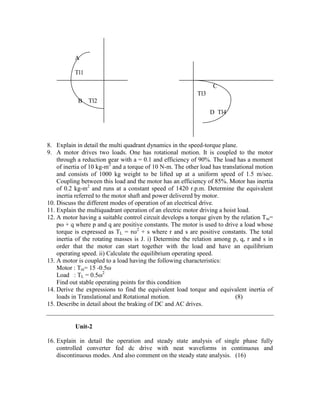
7. Derive the mathematical condition for steady state stability of equilibrium point.(8)
Based on the mathematical condition, examine the stability of equilibrium points
A, B, C & D given in the figures.
X-axis : Torque Y –axis : Speed
8. Explain in detail the multi quadrant dynamics in the speed-torque plane.
9. A motor drives two loads. One has rotational motion. It is coupled to the motor
through a reduction gear with a = 0.1 and efficiency of 90%. The load has a moment
of inertia of 10 kg-m2
and a torque of 10 N-m. The other load has translational motion
and consists of 1000 kg weight to be lifted up at a uniform speed of 1.5 m/sec.
Coupling between this load and the motor has an efficiency of 85%. Motor has inertia
of 0.2 kg-m2
and runs at a constant speed of 1420 r.p.m. Determine the equivalent
inertia referred to the motor shaft and power delivered by motor.
10. Discuss the different modes of operation of an electrical drive.
11. Explain the multiquadrant operation of an electric motor driving a hoist load.
12. A motor having a suitable control circuit develops a torque given by the relation Tm=
pω + q where p and q are positive constants. The motor is used to drive a load whose
torque is expressed as TL = rω2
+ s where r and s are positive constants. The total
inertia of the rotating masses is J. i) Determine the relation among p, q, r and s in
order that the motor can start together with the load and have an equilibrium
operating speed. ii) Calculate the equilibrium operating speed.
13. A motor is coupled to a load having the following characteristics:
Motor : Tm= 15 -0.5ω
Load : TL = 0.5ω2
Find out stable operating points for this condition
14. Derive the expressions to find the equivalent load torque and equivalent inertia of
loads in Translational and Rotational motion. (8)
15. Describe in detail about the braking of DC and AC drives.
Unit-2
16. Explain in detail the operation and steady state analysis of single phase fully
controlled converter fed dc drive with neat waveforms in continuous and
discontinuous modes. And also comment on the steady state analysis. (16)
A
Tl1
B Tl2
C
Tl3
D Tl4
17. Derive the expression for critical speed which separates the continuous conduction
from discontinuous conduction mode of operation in a separately excited dc motor.
(8)
18. A 220V , 1500rpm,10A separately excited DC motor has an armature resistance of
1Ω. It is fed from a single phase fully controlled bridge rectifier with an ac source
voltage of 230 V at 50 Hz. Assuming continuous load current, compute (1) the motor
speed at a firing angle of 300
and torque of 5 N-m, (2) developed torque at a firing
angle of 4500
and speed 100rpm. (8)
19. Explain about the regenerative operation of three phase fully controlled converter fed
separately excited DC motor.
20. Explain the different control techniques of chopper in detail. (8)
(ii) Discuss the four quadrant operation of DC-DC converter. (8)
21. Explain chopper control of dc series motor.
22. Explain how regenerative braking is obtained with chopper control in a series motor.
23. Explain the operation of four quadrant chopper control in dc motor drives. (16)
24. A 250V separately excited dc motor has an armature resistance of 2.5Ω when driving
a load at 600 r.p.m. with constant torque, the armature takes 20 A. This motor is
controlled by a chopper circuit with a frequency of 400 Hz and an input voltage
of 250 V. (i) What should be the value of the duty ratio if one desires to reduce the
speed from 600 to 540 r.p.m. with the load torque maintained constant. (ii) Find out
the value of duty ratio for which the per unit ripple current will be maximum.
25. A separately excited dc motor operating from a single phase half controlled bridge at
a speed of 1400 rpm has an input voltage of 330 sin 314t and a back emf of 80 V. The
SCR are fired symmetrically at α = 30º
in every half cycle. The armature has a
resistance of 4 ohms. Calculate the average armature current and the motor torque.
26. Describe how DC Shunt motor can be made to run as a motor and operate in the
braking mode using chopper.
27. A DC Shunt motor fed from 400 V dc source through a chopper has the following
parameters. Ra = 0.02 ohms Rf = 0.04 ohms k = 5×10⁻³
Nm/Amp2
. The average
armature current of 300 Amps is ripple free. For a chopper duty cycle of 50%
determine (i) Input power from the source (ii) Motor speed and (iii) Motor Torque.
28. A 220 V, 1500 rpm, 50 A separately excited motor with armature resistance of 0.5 Ω
is fed from a 3-phase fully controlled rectifier. Available ac source has a line voltage
of 440 V,50Hz. A star delta connected transformer is used to feed the armature so that
the motor terminal voltage equals rated voltage when converter firing angle is zero.
a. (i) Calculate transformer turns ratio. (ii) Determine the value of firing
angle when
i. motor is running at 1200rpm and rated torque
ii. when motor is running at 800rpm and twice the rated torque.
Assume continuous conduction.
29. A 200 V, 875 rpm, 150 A separately excited dc motor has an armature resistance of
0.06 Ω. It is fed from a single phase fully controlled rectifier with an ac source of 220
V, 50 Hz. Assuming continuous conduction, calculate the firing angle for rated motor
torque and 750 rpm.
30. A 220 V, 960 rpm and 200 A separately excited dc motor has an armature resistance
of 0.02 Ω. The motor is fed from a chopper which provides both motoring and
braking operations. The source has a voltage of 230 V . Assuming continuous
conduction, (i) Calculate duty ratio of chopper for motoring operation at rated torque
and 350 rpm (ii) Calculate duty ratio of chopper for braking operation at rated torque
and 350 rpm.
Unit-3
1. Derive closed loop transfer function of converter fed separately excited dc motor.
(16)
2. Derive transfer function of speed controller. (8)
3. Explain armature voltage control with field weakening mode operation of
separately excited dc motor drive. (16)
4. Explain design procedure of speed controller with inner current controller of a
separately excited dc motor.
5. Discuss current controller design using (i) P controller and (ii) PI controller for a
separately excited dc motor drive system. (16)
6. A 50KW, 240V, 1700rpm separately excited dc motor is controlled by a
converter. the field current is maintained at 1.4 amps and machine back emf
constant is Kv=0.91V/A rad/s.the armature resistance Rm=0.1Ω and the viscous
friction constant is B=0.3Nm/rad/s. the amplification of the speed sensor is K1=
95mV/rad/s and gain of the power controller is is K2=100.
(i) Determine the reference voltage Vr to drive the motor at rated speed. (8)
(ii) If the reference voltage is kept unchanged, determine the speed at which
the motor develops rated torque. (8)
7. Explain in detail about converter selection and characteristics? (8)
8. Explain in detail the use of simulation software packages with flowchart. (8)
Unit-4 INDUCTION MOTOR DRIVES
31. Explain in detail with suitable diagrams and waveforms the (v/f) control applied to
induction motor drives. (8)
32. Explain in detail the static rotor resistance controlof induction motor.
33. Explain the variable frequency operation of induction motor in closed loop with
constant air gap flux. (8)
34. Explain about VSI fed induction motors and also about closed loop control of vSI fed
induction motor drives.
35. Explain with neat diagram closed loop control of CSI fed induction motor drive.(8)
36. Compare VSI and CSI fed induction motor drives. (8)
37. With necessary diagrams, explain vector control of induction motor drives. (16)
38. A three phase 60KW 4000rpm 460V 60Hz, 2 pole star connected induction motor has
the following parameters: Rs=0, Rr= 0.28Ω, Xs= 0.23Ω, Xr=0.3Ω and Xm=11Ω. The
motor is controlled by varying supply frequency. If the breakdown torque
requirement is 70Nm, calculate the supply frequency and speed ωm at the maximum
torque.
39. A 3 Phase , Star Connected, 60 Hz, 4 pole induction motor has the following
parameters for its equivalent circuit. Ra = Rr = 0.024 Ω and Xs = Xr = 0.12 Ω. The
motor is controlled by the variable frequency control with a constant (v/f) ratio. For
an operating frequency of 12 Hz, Calculate (i) the breakdown torque as a ratio of its
value at the rated frequency for both motoring and braking. (ii) the starting torque and
rotor current in terms of their values at the rated frequency.
40. Discuss how the speed of a three phase induction motor can be controlled by varying
the frequency of the applied voltage. Draw the speed torque characteristics of the
motor with constant supply voltage and variable frequency.
Unit-5 SYNCHRONOUS MOTOR DRIVES
1. Explain open loop V/f control method of multiple synchronous motor drive .(8)
2. Explain self controlled mode of operation of synchronous motor. (8)
3. Explain torque angle control of self controlled synchronous motor drives. (8)
4. Explain constant margin angle control of synchronous motor. (8)
5. Briefly explain the types of PMSM. (8)
6. Explain vector control of sinusoidal SPM in constant torque region (8)
7. Explain power factor control of synchronous motor drive. (8)
8. Explain closed loop operation of PMSM drive in detail. (16)
9. With a neat diagram, explain the closed loop control of load commutated inverter fed
synchronous motor drive. (16)
10. Explain the construction and working of permanent magnet synchronous
motor. (16)
11. Write short notes on different types of permanent magnet synchronous motors. (8)
12. .A 3 phase, 40V, 50Hz,6 pole star connected round rotor synchronous motor has
Zs=0+j2 .Load torque proportional to sped squared is 340Nm at rated synchronous
sped. The sped of the motor is lowered by keeping v/f constant and maintaining unity
pf by field control of the motor. For the motor operation at 60rpm, calculate a) supply
voltage b) armature current. c) excitation angle d) load angle e) pull out torque.
Neglect rotational loses. (16)

EE6601 Solid State Drives

  • 1.
    EE 6601-SOLID STATEDRIVES Two Marks Questions Unit-1 1. What is an electrical drive? 2. What are all the components of load torque? 3. What are the types of load torques? 4. How are loads classified? 5. Define active load torque. 6. Define dynamic torque. 7. What are the three modes of operation of an electrical drive. 8. What is meant by acceleration mode of an electric drive? 9. Mention the necessary condition to obtain the three modes of operation of an electric drive. 10. Write the differential equation which describes the motor load system. 11. Write down the fundamental torque equation of motor-load system. 12. State the condition for steady state stability of a motor load system. 13. What is regenerative braking? 14. What are all the conditions to be satisfied for the regenerative braking operation to take place? Unit-2 1. What are the disadvantages of dc motors as compared to ac motors. 2. List out the drawbacks of ac-dc converter fed dc drive. 3. What is the necessity of DC choke coil and freewheeling diode in a converter circuit? 4. What is meant by continuous and discontinuous modes of operation. 5. When is discontinuous conduction expected with the operation of converter fed dc drives? 6. Explain whether discontinuous conduction will occur in the operation of chopper fed dc drives? 7. Write the expression for the average output voltage of a full converter fed dc drive. 8. What are advantages in operating choppers at high frequency? 9. What are the types of electric braking? Is braking applicable for any type of motor? 10. What are the types of control strategies in a dc chopper? 11. What is TRC scheme? 12. What is CLC in chopper fed drives. 13. State the advantages of DC chopper drives.
  • 2.
    14. Give thecondition to be satisfied to operate a motor in regenerative braking mode. 15. Write down the speed torque equation of dc separately excited motor fed drive. 16. What are the advantages of chopper fed drive over converter fed drive. Unit-3 1. What are the advantages of closed loop speed control? 2. What are the advantages of PI controller. 3. Give the transfer function relating speed and armature current of a dc motor. 4. What are the functions of feed back loops in an electric drive? 5. Mention the types of current controllers for drive system. 6. Write the transfer function of converter. 7. What is the function of inner current control loop closed loop speed control system? 8. What is the mechanical time constant of dc motor? 9. What is field weakening mode of control of dc drives. 10. Name any two simulation packages used for drive systems. 11. Write the real and reactive power equations of a balanced 3 phase ac system. 12. What are the factors to be considered for the selection of controller. Unit-4 1. What are the different methods of speed control of induction motor.State the advantages of PI controller used in closed loop control of induction motor drives. 2. What are the merits and demerits of stator voltage control. 3. What are the various applications of stator voltage control scheme? 4. Compare voltage source and current source inverter fed drives. 5. Name the methods of speed control applicable on the rotor side of a three phase induction motor. 6. What are the advantages of static rotor resistance control over conventional rotor resistance control. 7. What are the different methods employed to achieve variable frequency control in synchronous motors? 8. Draw the speed-torque characteristics of Induction motor. 9. What do you understand by V/F control? 10. State the applications of induction motor drives controlled by ac voltage controllers. 11. Write down the consequences of increasing the frequency of induction motor without a change in the terminal voltage. 12. Write any two advantages of vector control.
  • 3.
    13. What arethe drawbacks of stepped wave inverter fed drives. Unit-5 1. Mention different types of PMSM. 2. Write any two applications of synchronous motor drives. Justify the selection. 3. What is the necessity of delay unit in a open loop v/f control of synchronous motor? 4. Mention any two advantages of self control of synchronous motor. 5. Write down the torque equation of synchronous motor. 6. When can a synchronous motor be load commutated? 7. What is self control of synchronous motor drive? 8. State the advantages of PMSM. 9. Define self control technique in synchronous motor. 10. Why is self controlled synchronous motor free from hunting oscillations. 11. List out the factors concerned with the selection of converters. 12. What are the modes of adjustable frequency control in synchronous motor drives. 13. Write down the torque equation of synchronous motor. BIG QUESTIONS (16 MARKS) Unit-1 1. State the essential parts of electrical drive. What are the functions of power modulator? (8) 2. What are the main factors which decide the choice of an electrical drive for a given application. (8) 3. Explain about electrical and mechanical characteristics of commonly used electrical motors? (16) 4. Derive the fundamental torque equations of a motor load system. (6) 5. Explain the four quadrant operation of low speed hoist in detail. (8) 6. Explain in detail about steady state stability of equilibrium point in electrical drive. (16) 7. Derive the mathematical condition for steady state stability of equilibrium point.(8) Based on the mathematical condition, examine the stability of equilibrium points A, B, C & D given in the figures. X-axis : Torque Y –axis : Speed
  • 4.
    8. Explain indetail the multi quadrant dynamics in the speed-torque plane. 9. A motor drives two loads. One has rotational motion. It is coupled to the motor through a reduction gear with a = 0.1 and efficiency of 90%. The load has a moment of inertia of 10 kg-m2 and a torque of 10 N-m. The other load has translational motion and consists of 1000 kg weight to be lifted up at a uniform speed of 1.5 m/sec. Coupling between this load and the motor has an efficiency of 85%. Motor has inertia of 0.2 kg-m2 and runs at a constant speed of 1420 r.p.m. Determine the equivalent inertia referred to the motor shaft and power delivered by motor. 10. Discuss the different modes of operation of an electrical drive. 11. Explain the multiquadrant operation of an electric motor driving a hoist load. 12. A motor having a suitable control circuit develops a torque given by the relation Tm= pω + q where p and q are positive constants. The motor is used to drive a load whose torque is expressed as TL = rω2 + s where r and s are positive constants. The total inertia of the rotating masses is J. i) Determine the relation among p, q, r and s in order that the motor can start together with the load and have an equilibrium operating speed. ii) Calculate the equilibrium operating speed. 13. A motor is coupled to a load having the following characteristics: Motor : Tm= 15 -0.5ω Load : TL = 0.5ω2 Find out stable operating points for this condition 14. Derive the expressions to find the equivalent load torque and equivalent inertia of loads in Translational and Rotational motion. (8) 15. Describe in detail about the braking of DC and AC drives. Unit-2 16. Explain in detail the operation and steady state analysis of single phase fully controlled converter fed dc drive with neat waveforms in continuous and discontinuous modes. And also comment on the steady state analysis. (16) A Tl1 B Tl2 C Tl3 D Tl4
  • 5.
    17. Derive theexpression for critical speed which separates the continuous conduction from discontinuous conduction mode of operation in a separately excited dc motor. (8) 18. A 220V , 1500rpm,10A separately excited DC motor has an armature resistance of 1Ω. It is fed from a single phase fully controlled bridge rectifier with an ac source voltage of 230 V at 50 Hz. Assuming continuous load current, compute (1) the motor speed at a firing angle of 300 and torque of 5 N-m, (2) developed torque at a firing angle of 4500 and speed 100rpm. (8) 19. Explain about the regenerative operation of three phase fully controlled converter fed separately excited DC motor. 20. Explain the different control techniques of chopper in detail. (8) (ii) Discuss the four quadrant operation of DC-DC converter. (8) 21. Explain chopper control of dc series motor. 22. Explain how regenerative braking is obtained with chopper control in a series motor. 23. Explain the operation of four quadrant chopper control in dc motor drives. (16) 24. A 250V separately excited dc motor has an armature resistance of 2.5Ω when driving a load at 600 r.p.m. with constant torque, the armature takes 20 A. This motor is controlled by a chopper circuit with a frequency of 400 Hz and an input voltage of 250 V. (i) What should be the value of the duty ratio if one desires to reduce the speed from 600 to 540 r.p.m. with the load torque maintained constant. (ii) Find out the value of duty ratio for which the per unit ripple current will be maximum. 25. A separately excited dc motor operating from a single phase half controlled bridge at a speed of 1400 rpm has an input voltage of 330 sin 314t and a back emf of 80 V. The SCR are fired symmetrically at α = 30º in every half cycle. The armature has a resistance of 4 ohms. Calculate the average armature current and the motor torque. 26. Describe how DC Shunt motor can be made to run as a motor and operate in the braking mode using chopper. 27. A DC Shunt motor fed from 400 V dc source through a chopper has the following parameters. Ra = 0.02 ohms Rf = 0.04 ohms k = 5×10⁻³ Nm/Amp2 . The average armature current of 300 Amps is ripple free. For a chopper duty cycle of 50% determine (i) Input power from the source (ii) Motor speed and (iii) Motor Torque. 28. A 220 V, 1500 rpm, 50 A separately excited motor with armature resistance of 0.5 Ω is fed from a 3-phase fully controlled rectifier. Available ac source has a line voltage of 440 V,50Hz. A star delta connected transformer is used to feed the armature so that the motor terminal voltage equals rated voltage when converter firing angle is zero. a. (i) Calculate transformer turns ratio. (ii) Determine the value of firing angle when i. motor is running at 1200rpm and rated torque ii. when motor is running at 800rpm and twice the rated torque. Assume continuous conduction. 29. A 200 V, 875 rpm, 150 A separately excited dc motor has an armature resistance of 0.06 Ω. It is fed from a single phase fully controlled rectifier with an ac source of 220 V, 50 Hz. Assuming continuous conduction, calculate the firing angle for rated motor torque and 750 rpm. 30. A 220 V, 960 rpm and 200 A separately excited dc motor has an armature resistance of 0.02 Ω. The motor is fed from a chopper which provides both motoring and
  • 6.
    braking operations. Thesource has a voltage of 230 V . Assuming continuous conduction, (i) Calculate duty ratio of chopper for motoring operation at rated torque and 350 rpm (ii) Calculate duty ratio of chopper for braking operation at rated torque and 350 rpm. Unit-3 1. Derive closed loop transfer function of converter fed separately excited dc motor. (16) 2. Derive transfer function of speed controller. (8) 3. Explain armature voltage control with field weakening mode operation of separately excited dc motor drive. (16) 4. Explain design procedure of speed controller with inner current controller of a separately excited dc motor. 5. Discuss current controller design using (i) P controller and (ii) PI controller for a separately excited dc motor drive system. (16) 6. A 50KW, 240V, 1700rpm separately excited dc motor is controlled by a converter. the field current is maintained at 1.4 amps and machine back emf constant is Kv=0.91V/A rad/s.the armature resistance Rm=0.1Ω and the viscous friction constant is B=0.3Nm/rad/s. the amplification of the speed sensor is K1= 95mV/rad/s and gain of the power controller is is K2=100. (i) Determine the reference voltage Vr to drive the motor at rated speed. (8) (ii) If the reference voltage is kept unchanged, determine the speed at which the motor develops rated torque. (8) 7. Explain in detail about converter selection and characteristics? (8) 8. Explain in detail the use of simulation software packages with flowchart. (8) Unit-4 INDUCTION MOTOR DRIVES 31. Explain in detail with suitable diagrams and waveforms the (v/f) control applied to induction motor drives. (8) 32. Explain in detail the static rotor resistance controlof induction motor. 33. Explain the variable frequency operation of induction motor in closed loop with constant air gap flux. (8) 34. Explain about VSI fed induction motors and also about closed loop control of vSI fed induction motor drives. 35. Explain with neat diagram closed loop control of CSI fed induction motor drive.(8) 36. Compare VSI and CSI fed induction motor drives. (8) 37. With necessary diagrams, explain vector control of induction motor drives. (16)
  • 7.
    38. A threephase 60KW 4000rpm 460V 60Hz, 2 pole star connected induction motor has the following parameters: Rs=0, Rr= 0.28Ω, Xs= 0.23Ω, Xr=0.3Ω and Xm=11Ω. The motor is controlled by varying supply frequency. If the breakdown torque requirement is 70Nm, calculate the supply frequency and speed ωm at the maximum torque. 39. A 3 Phase , Star Connected, 60 Hz, 4 pole induction motor has the following parameters for its equivalent circuit. Ra = Rr = 0.024 Ω and Xs = Xr = 0.12 Ω. The motor is controlled by the variable frequency control with a constant (v/f) ratio. For an operating frequency of 12 Hz, Calculate (i) the breakdown torque as a ratio of its value at the rated frequency for both motoring and braking. (ii) the starting torque and rotor current in terms of their values at the rated frequency. 40. Discuss how the speed of a three phase induction motor can be controlled by varying the frequency of the applied voltage. Draw the speed torque characteristics of the motor with constant supply voltage and variable frequency. Unit-5 SYNCHRONOUS MOTOR DRIVES 1. Explain open loop V/f control method of multiple synchronous motor drive .(8) 2. Explain self controlled mode of operation of synchronous motor. (8) 3. Explain torque angle control of self controlled synchronous motor drives. (8) 4. Explain constant margin angle control of synchronous motor. (8) 5. Briefly explain the types of PMSM. (8) 6. Explain vector control of sinusoidal SPM in constant torque region (8) 7. Explain power factor control of synchronous motor drive. (8) 8. Explain closed loop operation of PMSM drive in detail. (16) 9. With a neat diagram, explain the closed loop control of load commutated inverter fed synchronous motor drive. (16) 10. Explain the construction and working of permanent magnet synchronous motor. (16) 11. Write short notes on different types of permanent magnet synchronous motors. (8) 12. .A 3 phase, 40V, 50Hz,6 pole star connected round rotor synchronous motor has Zs=0+j2 .Load torque proportional to sped squared is 340Nm at rated synchronous sped. The sped of the motor is lowered by keeping v/f constant and maintaining unity pf by field control of the motor. For the motor operation at 60rpm, calculate a) supply voltage b) armature current. c) excitation angle d) load angle e) pull out torque. Neglect rotational loses. (16)