Flaps in ENT
DR SAFIKA ZAMAN
DEPT OF ENT & HEAD NECK SURGERY
VIMS,RKMSP
Introduction
Indication-
 Trauma
 Infection
 Osteonecrosis
 Tumour excision
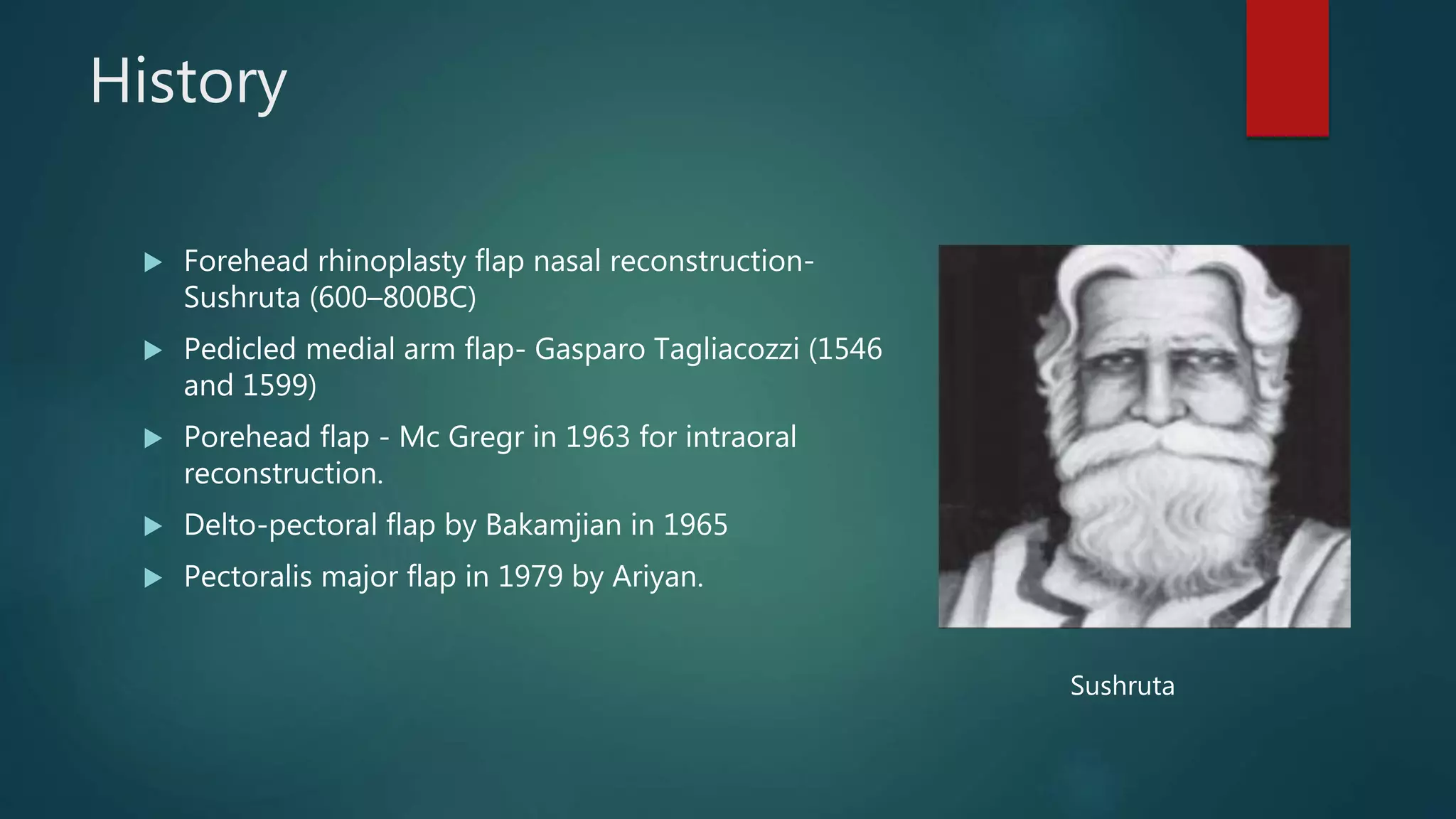
History
 Forehead rhinoplasty flap nasal reconstruction-
Sushruta (600–800BC)
 Pedicled medial arm flap- Gasparo Tagliacozzi (1546
and 1599)
 Porehead flap - Mc Gregr in 1963 for intraoral
reconstruction.
 Delto-pectoral flap by Bakamjian in 1965
 Pectoralis major flap in 1979 by Ariyan.
Sushruta
History
Mucosal Reconstruction principle
Oral cavity- maintenance of tongue mobility, lingual sulcus,& mouth opening
avoidance of convexities at sites of concavity.
Oropharynx - prevent nasal escape and hypernasality,
maintaining velopharyngeal competence.
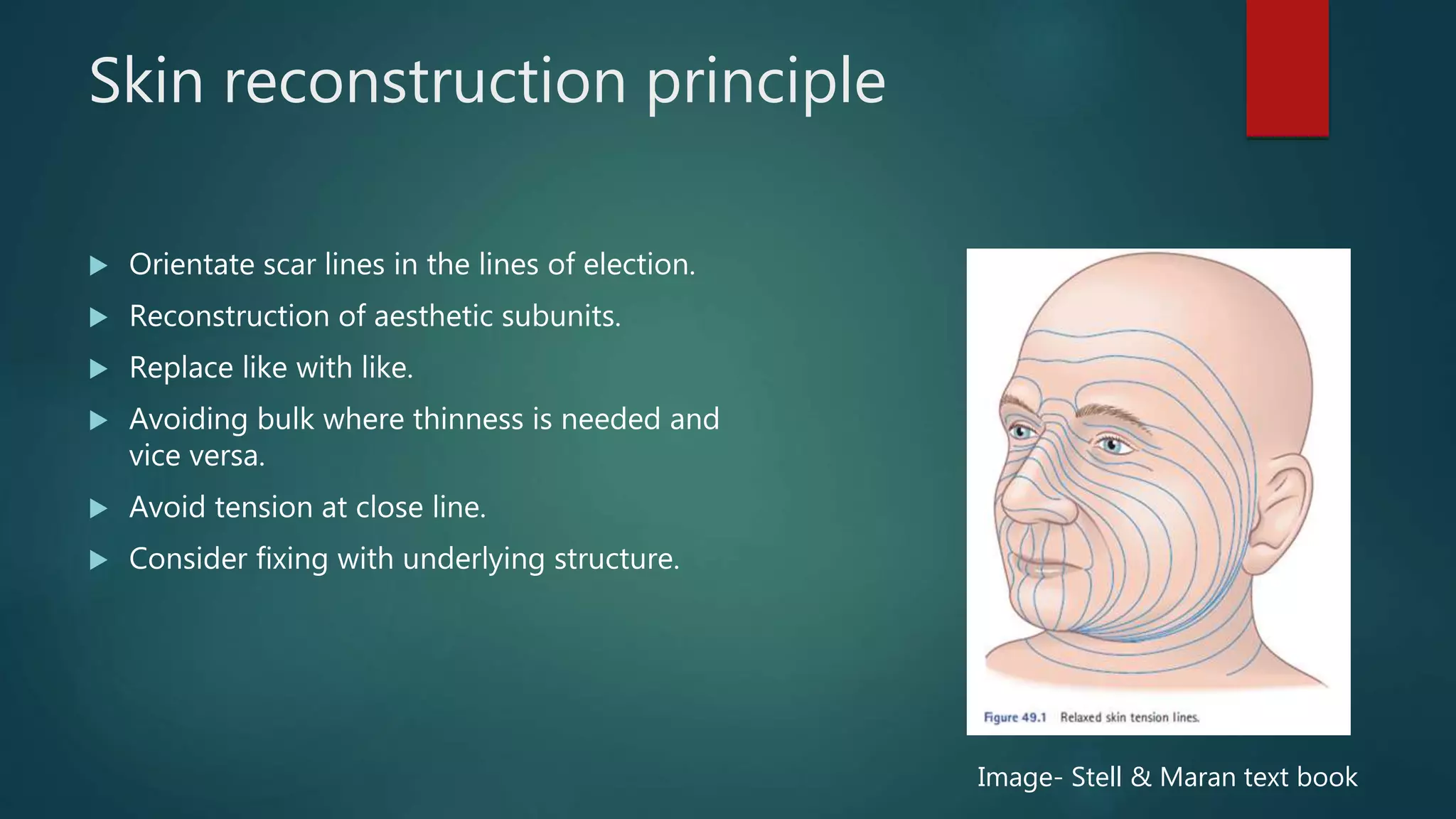
Skin reconstruction principle
 Orientate scar lines in the lines of election.
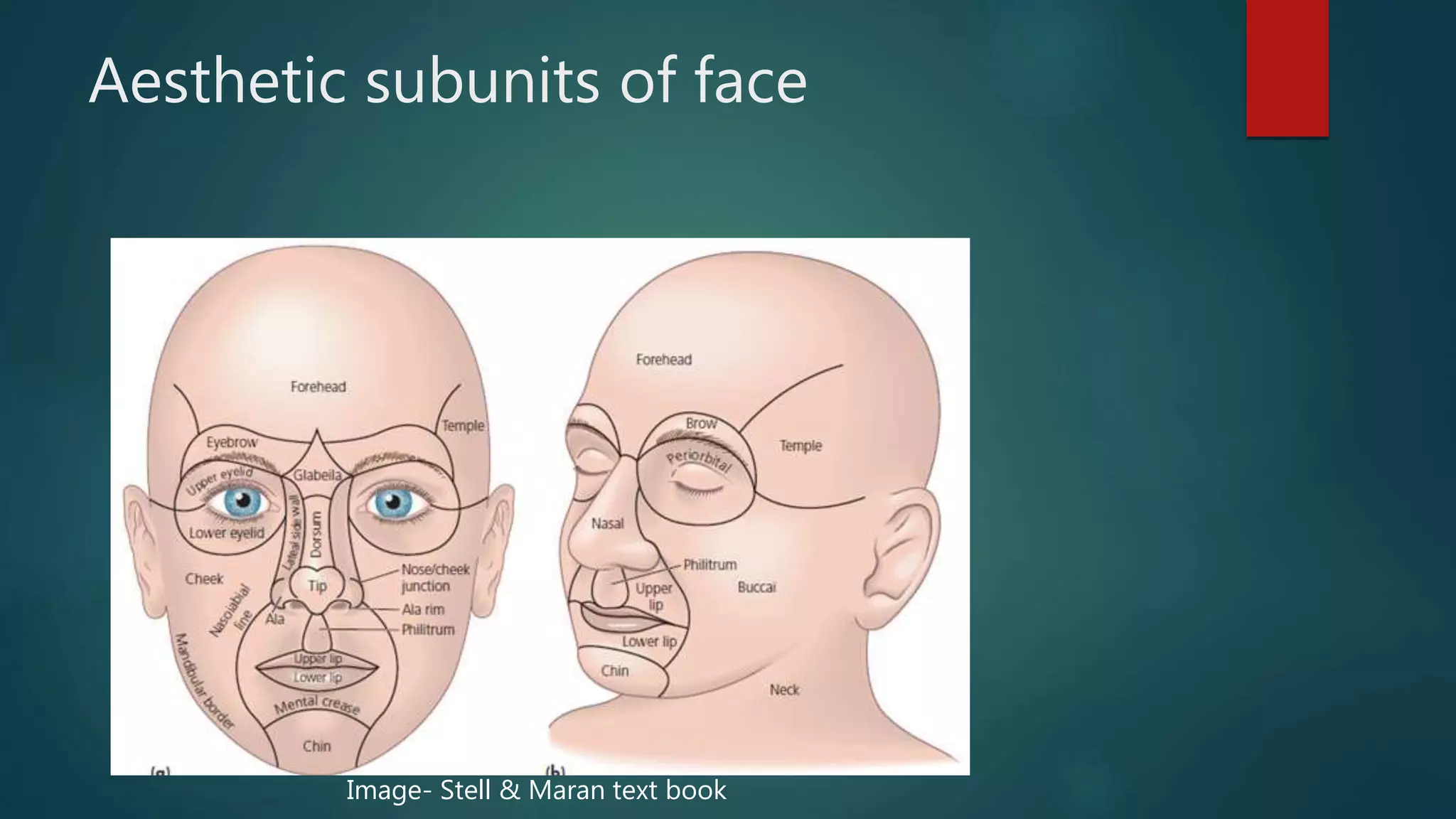
 Reconstruction of aesthetic subunits.
 Replace like with like.
 Avoiding bulk where thinness is needed and
vice versa.
 Avoid tension at close line.
 Consider fixing with underlying structure.
Image- Stell & Maran text book
Aesthetic subunits of face
Image- Stell & Maran text book
Principle of bony reconstruction
 Two main bone - Mandible and Maxilla.
 Principles of reconstruction-
cosmesis,
speech,
swallowing,
chewing and dental occlusion
Bony reconstruction
Decision making in bony reconstruction –
 Defect
 Postoperative radiotherapy
 Radio-necrosis
 Donor vessels in the region
 Fitness
 Height of the native mandible
 Presence of teeth
 Availability of donor sites
Lip reconstruction
 Principles-
Oral competence
Labial sensation
Lower sulcus
Aperture size
Cummings -ENT book
Nasal reconstruction
 Skin
 Skeletal support
 Mucosal lining
Pinna reconstruction
 Partial auricular reconstruction
 Total pinna reconstruction-
multistage, costal cartilage use
 Autologous
 prosthetic.
Flap
 Flap is a piece of tissue with its own
blood supply and its survival is not
dependent upon the recipient site.
Advantage of a local flap
 Reliable blood supply
 Good skin texture and colour match
 Single stage procedure
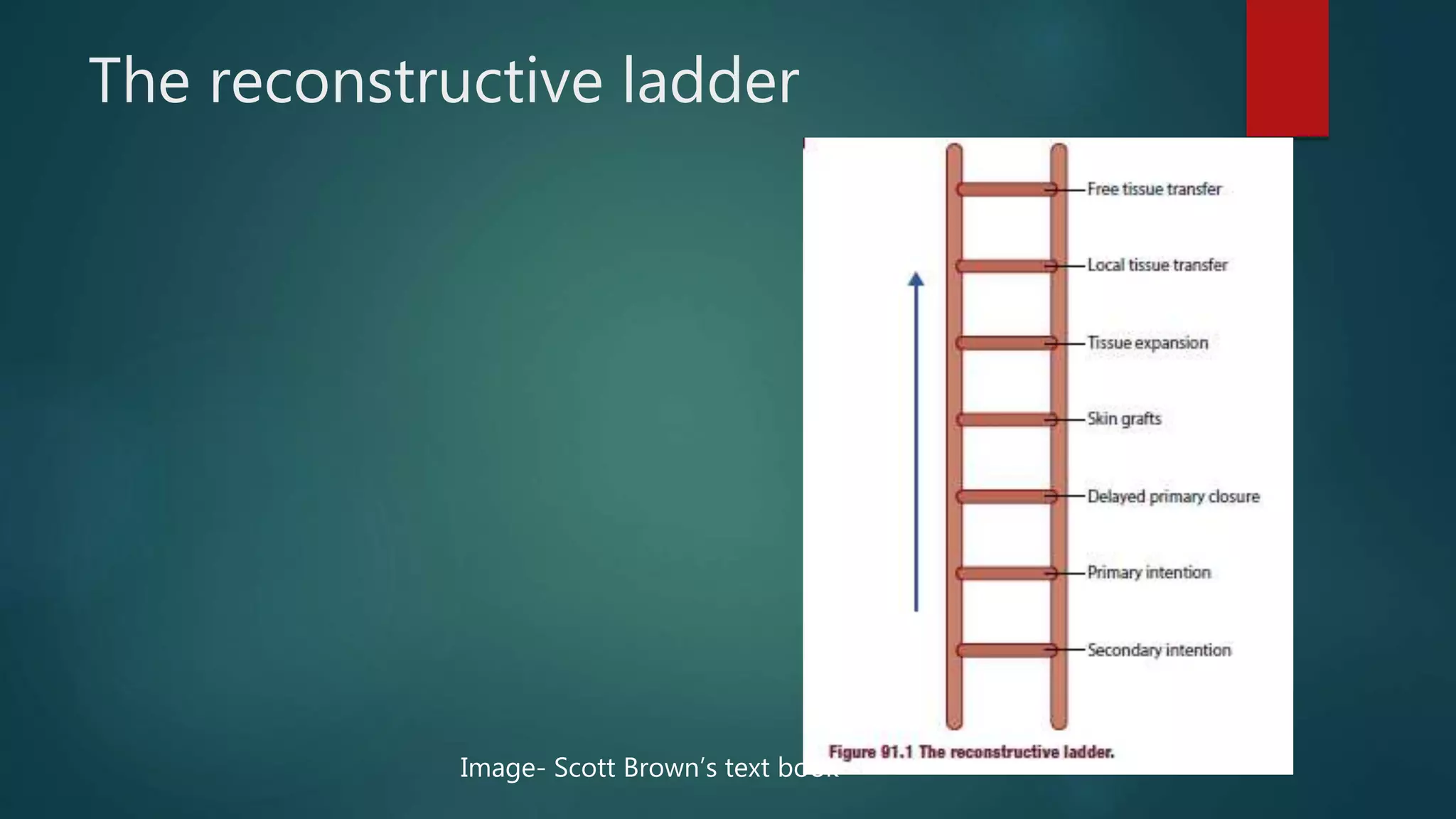
The reconstructive ladder
Image- Scott Brown’s text book
Vascular supply
When the perfusion pressure drops below a critical
closing pressure of the arterioles in the subdermal
plexus, nutritional blood flow ceases and flap
ischemia occurs.
Composition of a flap
 Cutaneous
 Fascio-cutaneous
 Musculocutaneous
 Osteomusculo-cutaneous
Free fibula graft
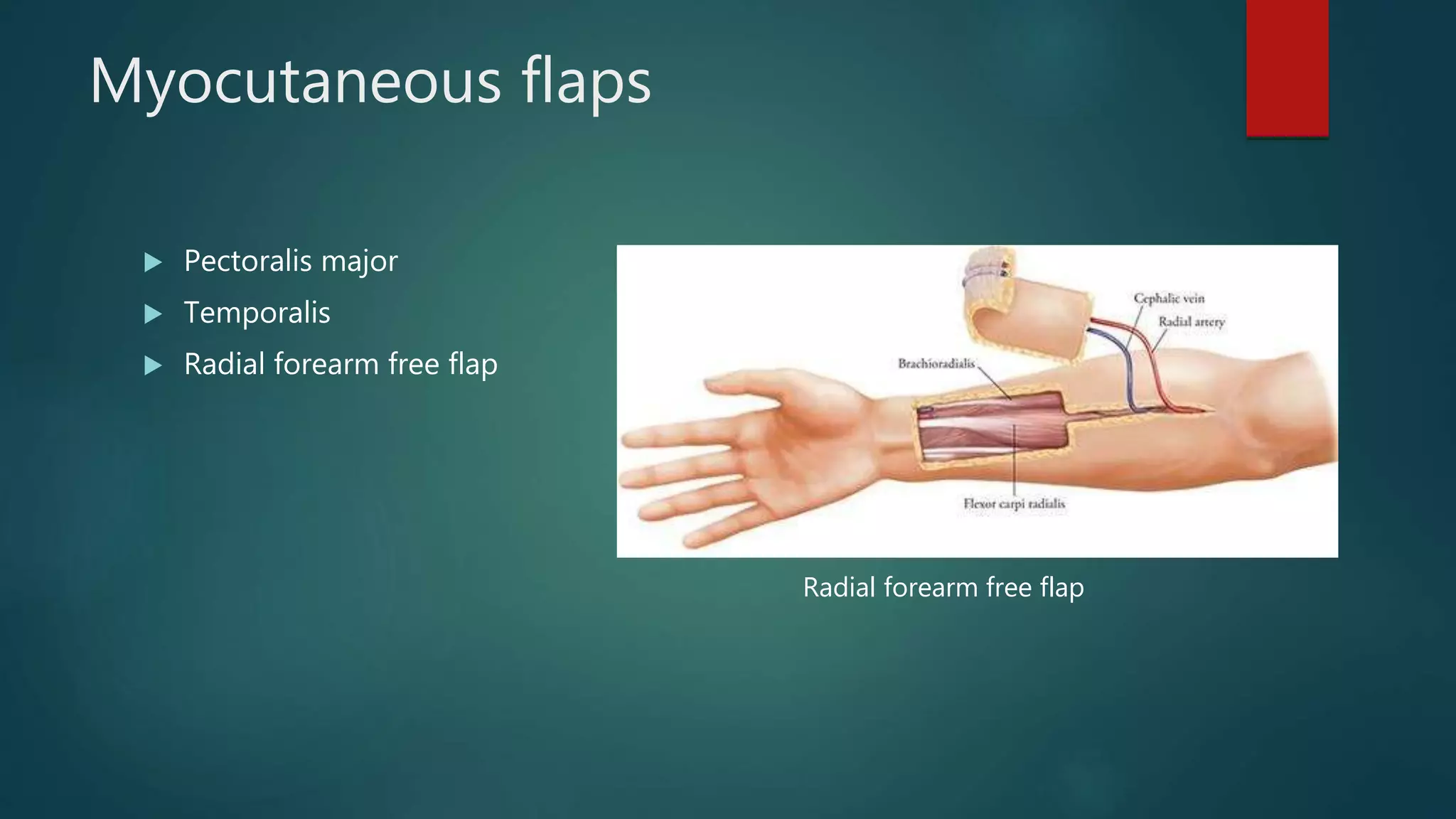
Myocutaneous flaps
 Pectoralis major
 Temporalis
 Radial forearm free flap
Radial forearm free flap
Method of transfer and design
Advancement Flaps
 Slide along a linear vector to close a
defect.
 The flap relies on stretching of tissue for
advancement.
 Utilized in areas of good skin elasticity.
 Point of greatest wound tension is at the
distal border of the flap.
 Uni-pedicle, bi-pedicle, and V-Y flaps
Bilateral unipedicle advancement flap
OPEN ACCESS ATLAS OF OTOLARYNGOLOGY, HEAD &
NECK OPERATIVE SURGERY
LOCAL FLAPS FOR FACIAL RECONSTRUCTION
Shiayin Yang, Carl Truesdale, Jeffrey Moyer
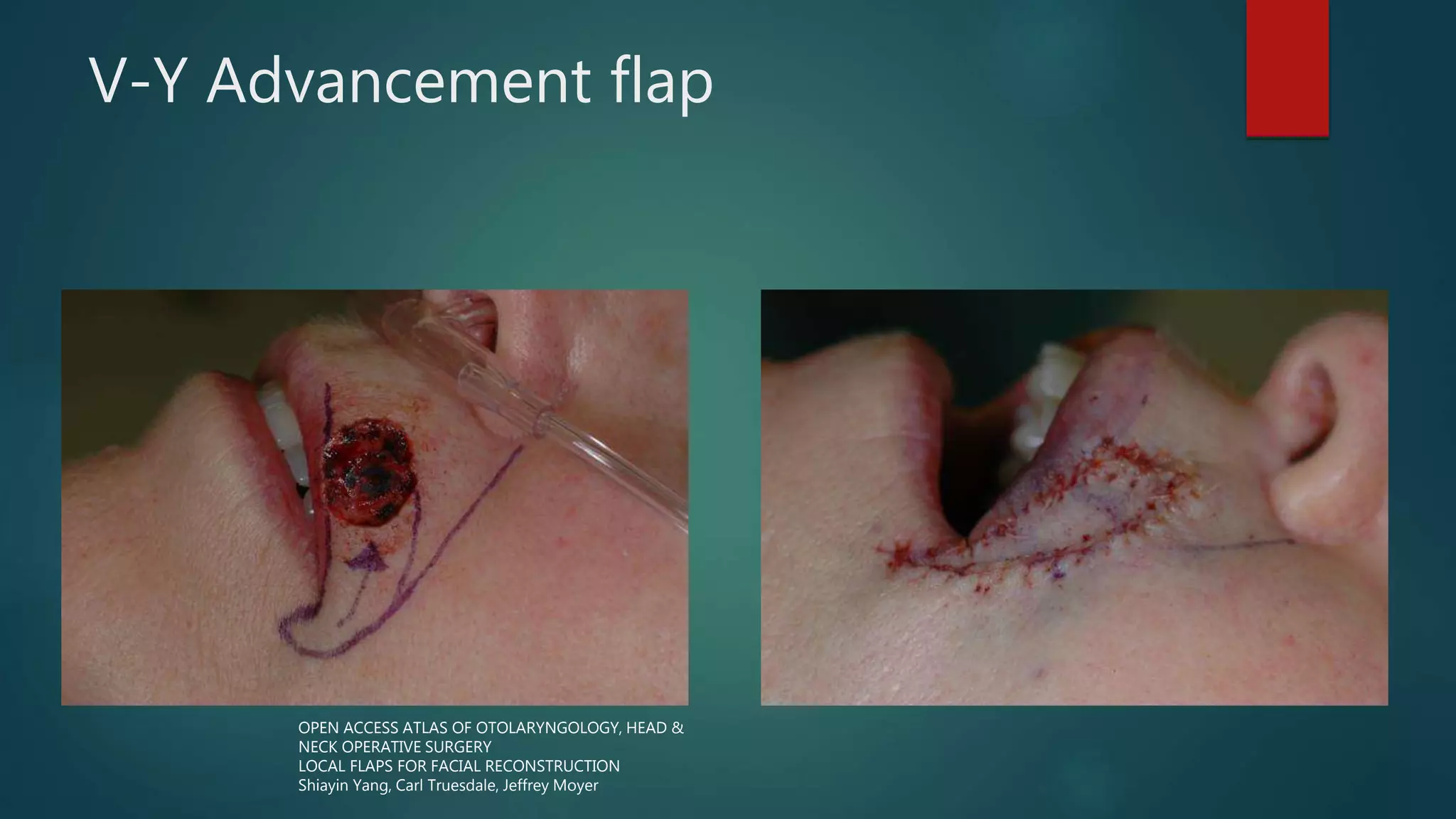
V-Y Advancement flap
OPEN ACCESS ATLAS OF OTOLARYNGOLOGY, HEAD &
NECK OPERATIVE SURGERY
LOCAL FLAPS FOR FACIAL RECONSTRUCTION
Shiayin Yang, Carl Truesdale, Jeffrey Moyer
Rotational flaps
 Versatile flaps
 Flap is designed in a
curvilinear fashion with the
defect forming a portion of
the flap’s arc of rotation
 The point of greatest wound
tension is at the apex of the
flap Image-double
rotational flap
Rotation flap
OPEN ACCESS ATLAS OF OTOLARYNGOLOGY, HEAD & NECK OPERATIVE SURGERY
LOCAL FLAPS FOR FACIAL RECONSTRUCTION
Shiayin Yang, Carl Truesdale, Jeffrey Moyer
Transposition flaps
 Designed remotely from the primary
defect.
 Base is contiguous with the defect
 Greatest wound closure tension is at the
closure site of the secondary defect.
 Small and medium-sized defects of the
cheek and nose
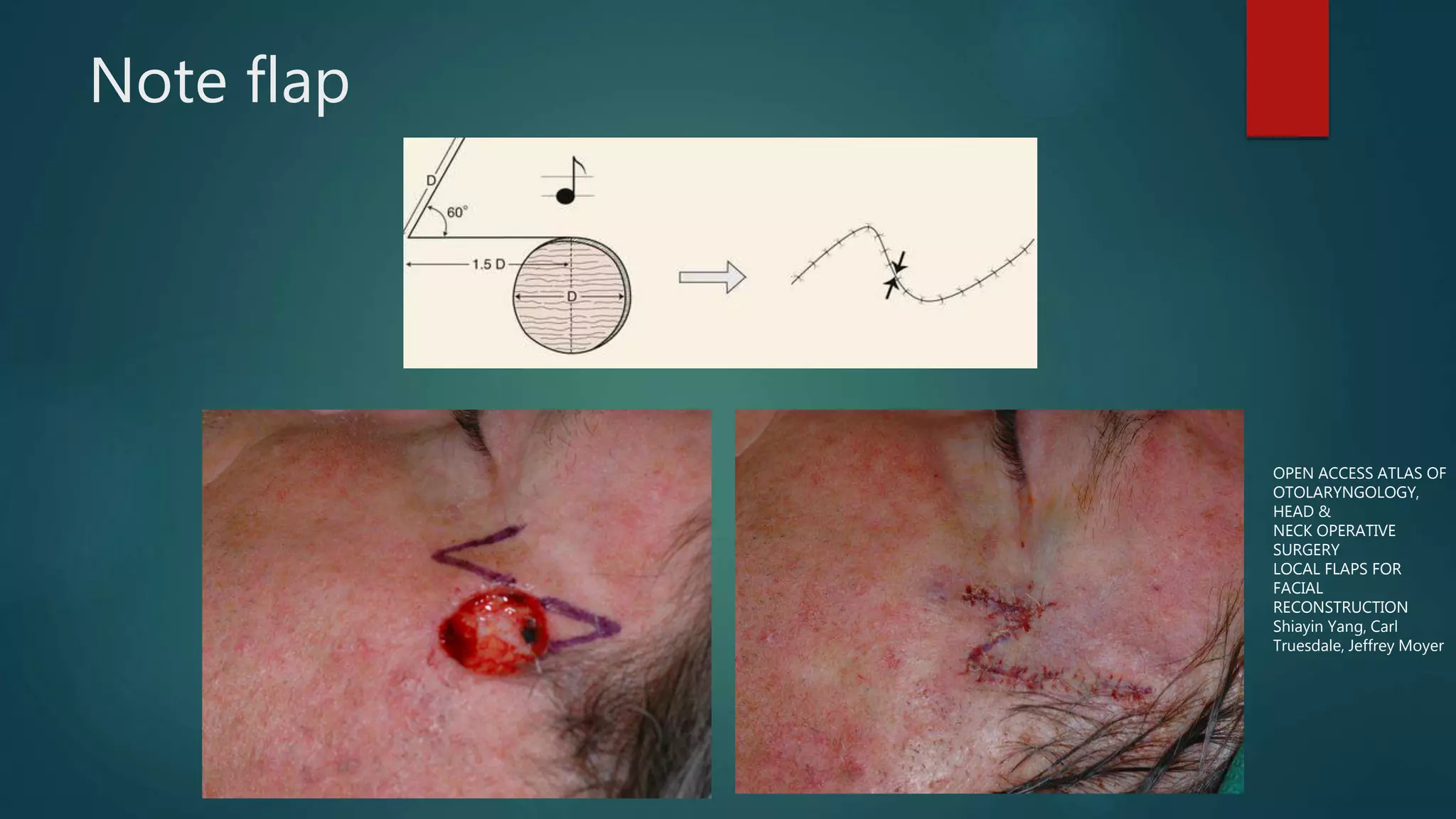
Note flap
OPEN ACCESS ATLAS OF
OTOLARYNGOLOGY,
HEAD &
NECK OPERATIVE
SURGERY
LOCAL FLAPS FOR
FACIAL
RECONSTRUCTION
Shiayin Yang, Carl
Truesdale, Jeffrey Moyer
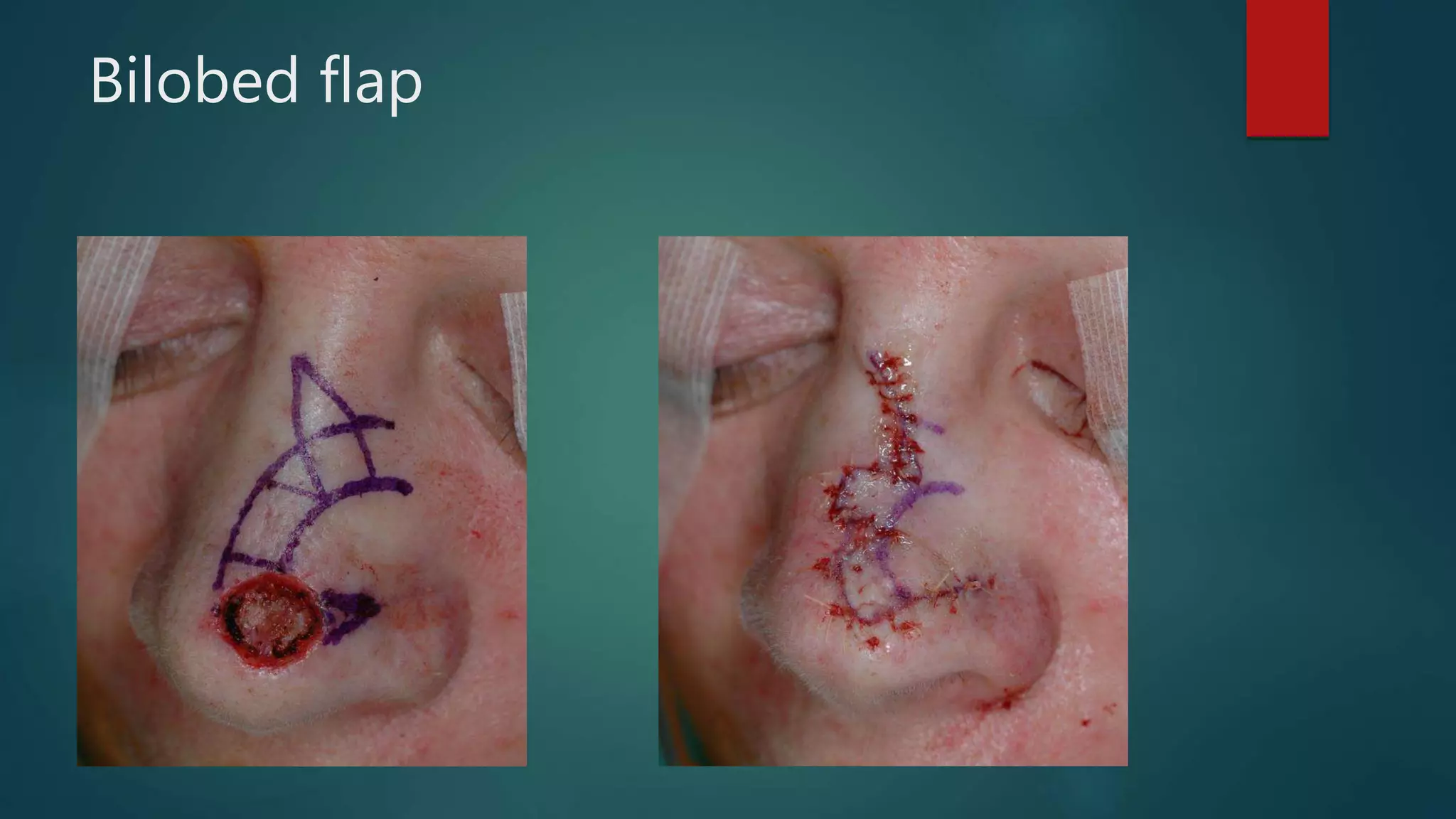
Bilobed flap
Bilobe flap with 90° axis of
rota-tion. The first lobe is
equal in diameter to the
defect while the second
lobe has a small-er
diameter
Bilobed flap
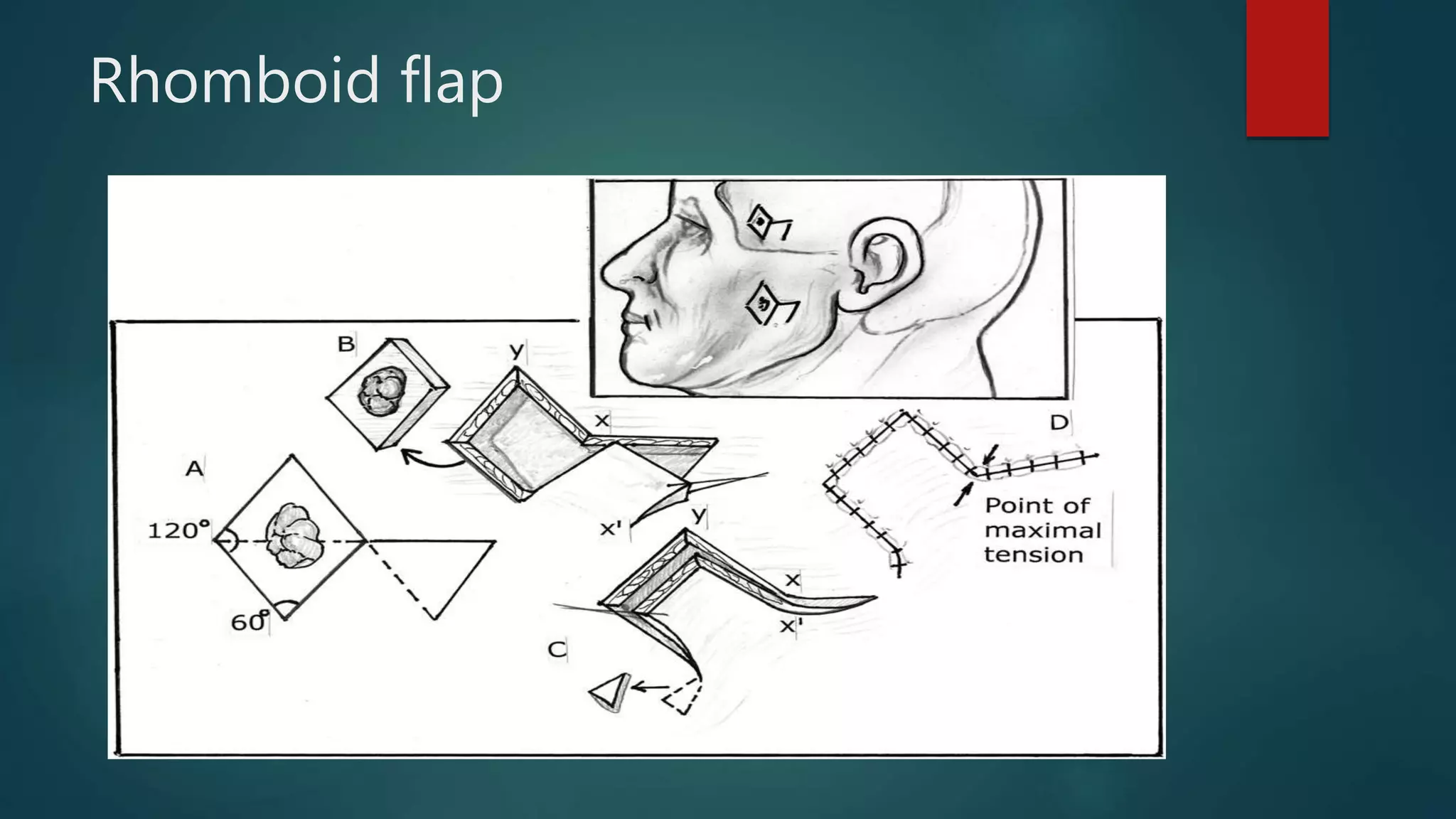
Rhomboid flap
Rhomboid flap
OPEN ACCESS ATLAS OF OTOLARYNGOLOGY, HEAD &
NECK OPERATIVE SURGERY
LOCAL FLAPS FOR FACIAL RECONSTRUCTION
Shiayin Yang, Carl Truesdale, Jeffrey Moyer
Interpolated flaps
 Base of the flap is not contiguous with
the defect.
 Pedicle passes over intervening tissue
to close the primary defect.
 Need a 2nd stage procedure.
Para-median forehead flap
Nasal reconstruction for
large defect
supratrochlear artery and
with some contributions
from the supraorbital artery
Melolabial flap
Melolabial flap is an interpolated flap that
transfers tissue from the cheek to recon-
struct nasal ala defects.
Abbe flap
 Labial artery based flap
 Labial artery runs between the
orbicularis oris and lip mucosa.
 When lip defect > 25%.
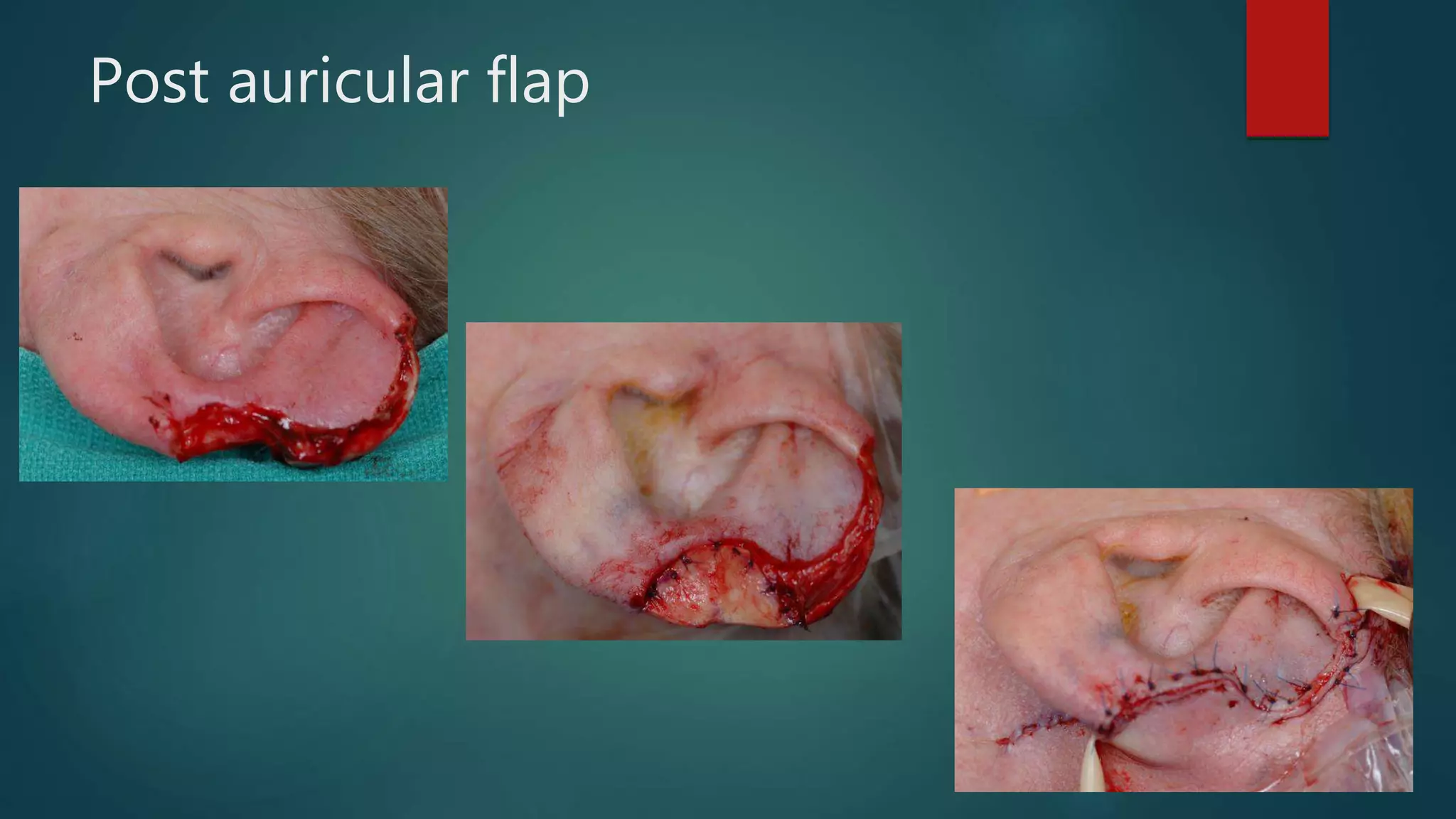
Post auricular flap
Glabellar flap
 V-Y advancement flap.
 Mainly in upper nose & medial eye.
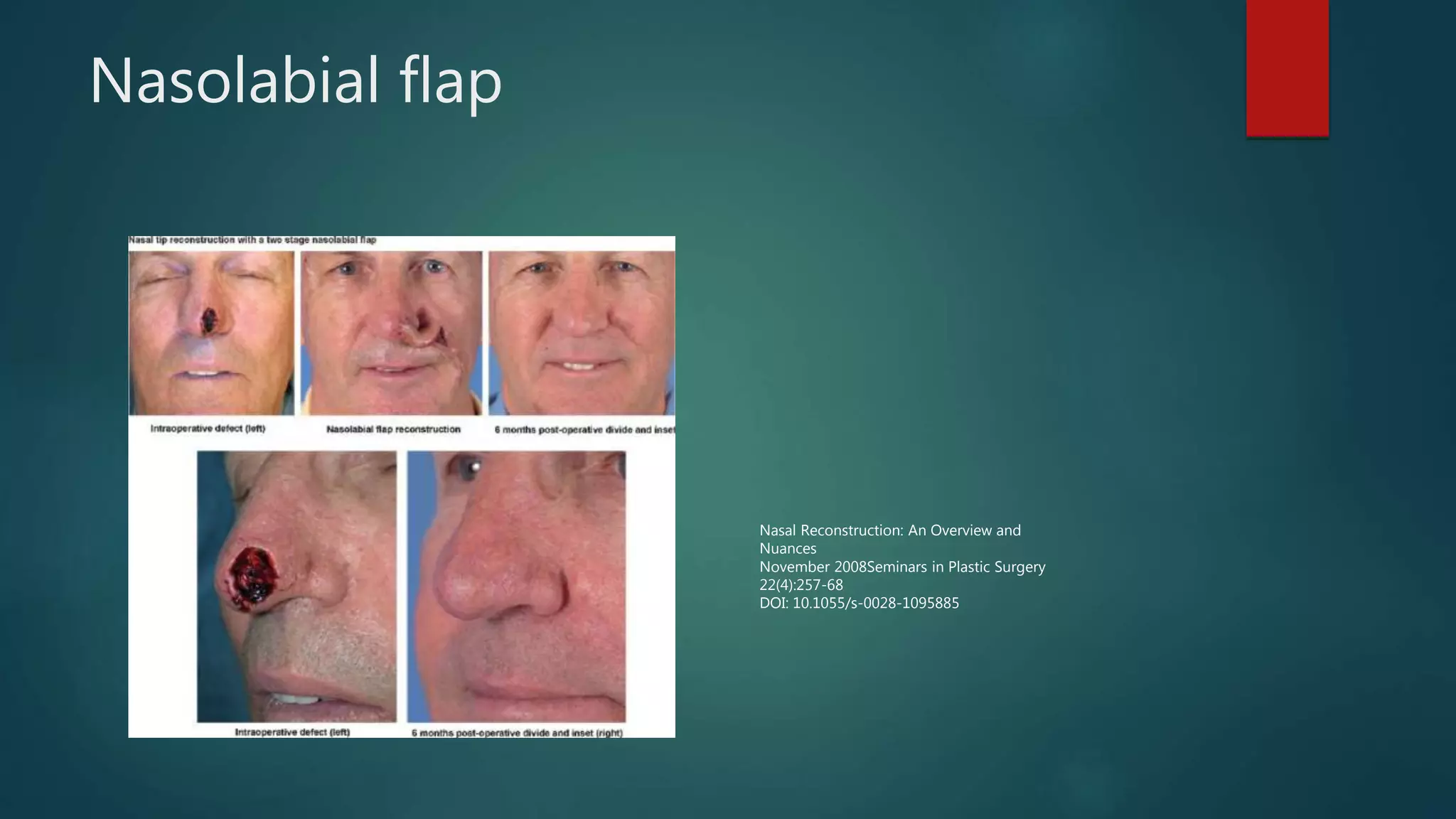
Nasolabial flap
Nasal Reconstruction: An Overview and
Nuances
November 2008Seminars in Plastic Surgery
22(4):257-68
DOI: 10.1055/s-0028-1095885
Pectoralis major myocutaneous flap
 Flap comprises the pectoralis major muscle, with or
without overlying skin.
 Pectoral branch of the thoracoacromial artery.
 Soft tissue defects of the oropharynx, oral cavity,
hypopharynx, and skin of the neck;
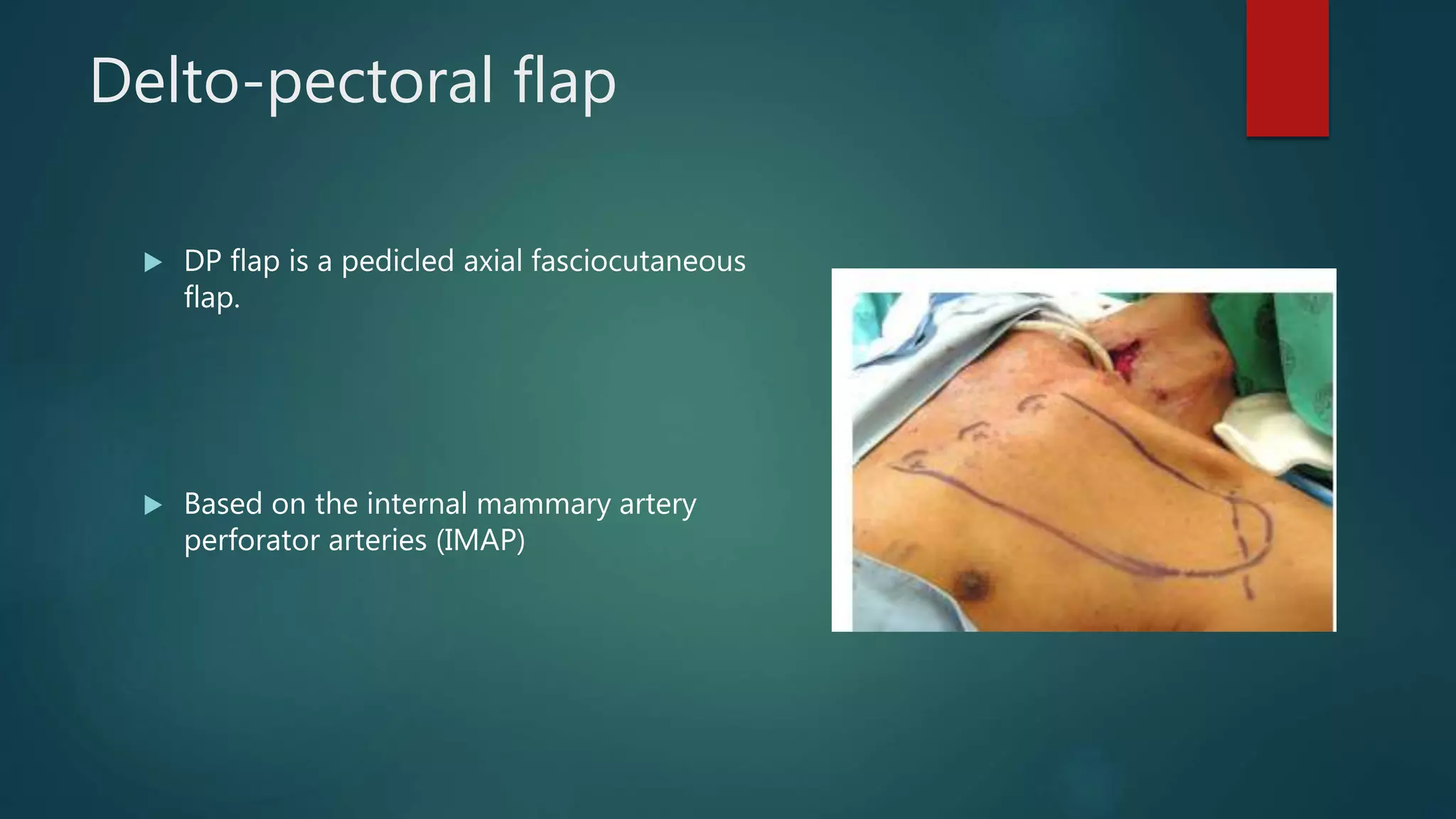
Delto-pectoral flap
 DP flap is a pedicled axial fasciocutaneous
flap.
 Based on the internal mammary artery
perforator arteries (IMAP)
Temporoparietal flap
 Versatile flap
 Repair craniofacial defect.
 For scalp, auricle, facial soft tissue, orbital,
oral cavity nasopharyngeal, and skull base
defects.
Submental flap
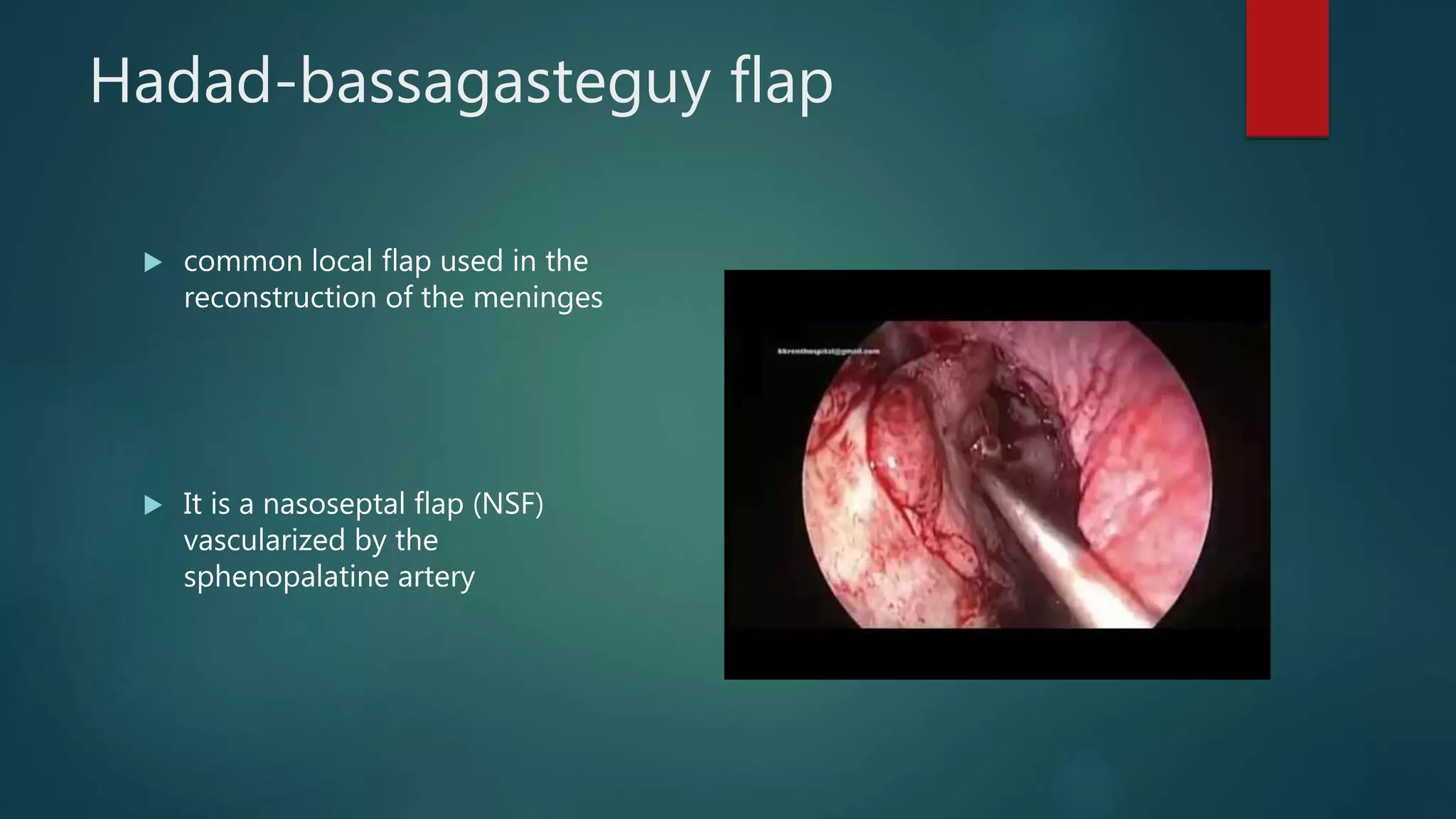
Hadad-bassagasteguy flap
 common local flap used in the
reconstruction of the meninges
 It is a nasoseptal flap (NSF)
vascularized by the
sphenopalatine artery
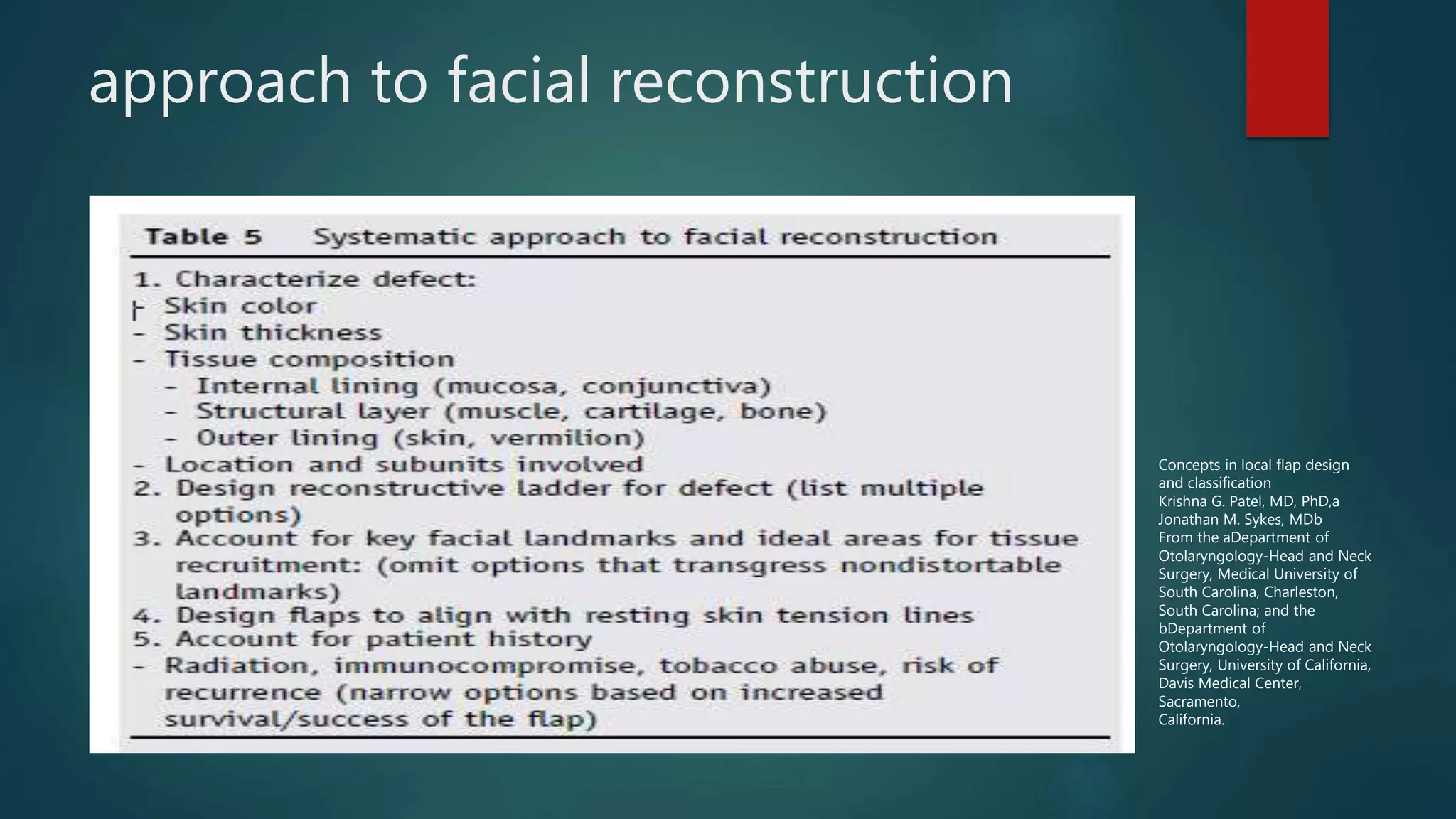
approach to facial reconstruction
Concepts in local flap design
and classification
Krishna G. Patel, MD, PhD,a
Jonathan M. Sykes, MDb
From the aDepartment of
Otolaryngology-Head and Neck
Surgery, Medical University of
South Carolina, Charleston,
South Carolina; and the
bDepartment of
Otolaryngology-Head and Neck
Surgery, University of California,
Davis Medical Center,
Sacramento,
California.
THANK YOU
Life-size wax model of the head and
upper torso, constructed for teaching
purposes, illustrating surgical techniques
including forehead and tubed pedicle
flaps. Part of the New Zealand records
returned to Sidcup in 1989 and
subsequently restored at Madame
Tussaud’s.

Local flaps in ent

  • 1.
    Flaps in ENT DRSAFIKA ZAMAN DEPT OF ENT & HEAD NECK SURGERY VIMS,RKMSP
  • 2.
  • 3.
    History  Forehead rhinoplastyflap nasal reconstruction- Sushruta (600–800BC)  Pedicled medial arm flap- Gasparo Tagliacozzi (1546 and 1599)  Porehead flap - Mc Gregr in 1963 for intraoral reconstruction.  Delto-pectoral flap by Bakamjian in 1965  Pectoralis major flap in 1979 by Ariyan. Sushruta
  • 4.
  • 5.
    Mucosal Reconstruction principle Oralcavity- maintenance of tongue mobility, lingual sulcus,& mouth opening avoidance of convexities at sites of concavity. Oropharynx - prevent nasal escape and hypernasality, maintaining velopharyngeal competence.
  • 6.
    Skin reconstruction principle Orientate scar lines in the lines of election.  Reconstruction of aesthetic subunits.  Replace like with like.  Avoiding bulk where thinness is needed and vice versa.  Avoid tension at close line.  Consider fixing with underlying structure. Image- Stell & Maran text book
  • 7.
    Aesthetic subunits offace Image- Stell & Maran text book
  • 8.
    Principle of bonyreconstruction  Two main bone - Mandible and Maxilla.  Principles of reconstruction- cosmesis, speech, swallowing, chewing and dental occlusion
  • 9.
    Bony reconstruction Decision makingin bony reconstruction –  Defect  Postoperative radiotherapy  Radio-necrosis  Donor vessels in the region  Fitness  Height of the native mandible  Presence of teeth  Availability of donor sites
  • 10.
    Lip reconstruction  Principles- Oralcompetence Labial sensation Lower sulcus Aperture size Cummings -ENT book
  • 11.
    Nasal reconstruction  Skin Skeletal support  Mucosal lining
  • 12.
    Pinna reconstruction  Partialauricular reconstruction  Total pinna reconstruction- multistage, costal cartilage use  Autologous  prosthetic.
  • 13.
    Flap  Flap isa piece of tissue with its own blood supply and its survival is not dependent upon the recipient site.
  • 14.
    Advantage of alocal flap  Reliable blood supply  Good skin texture and colour match  Single stage procedure
  • 15.
    The reconstructive ladder Image-Scott Brown’s text book
  • 16.
    Vascular supply When theperfusion pressure drops below a critical closing pressure of the arterioles in the subdermal plexus, nutritional blood flow ceases and flap ischemia occurs.
  • 17.
    Composition of aflap  Cutaneous  Fascio-cutaneous  Musculocutaneous  Osteomusculo-cutaneous Free fibula graft
  • 18.
    Myocutaneous flaps  Pectoralismajor  Temporalis  Radial forearm free flap Radial forearm free flap
  • 19.
  • 20.
    Advancement Flaps  Slidealong a linear vector to close a defect.  The flap relies on stretching of tissue for advancement.  Utilized in areas of good skin elasticity.  Point of greatest wound tension is at the distal border of the flap.  Uni-pedicle, bi-pedicle, and V-Y flaps
  • 21.
    Bilateral unipedicle advancementflap OPEN ACCESS ATLAS OF OTOLARYNGOLOGY, HEAD & NECK OPERATIVE SURGERY LOCAL FLAPS FOR FACIAL RECONSTRUCTION Shiayin Yang, Carl Truesdale, Jeffrey Moyer
  • 22.
    V-Y Advancement flap OPENACCESS ATLAS OF OTOLARYNGOLOGY, HEAD & NECK OPERATIVE SURGERY LOCAL FLAPS FOR FACIAL RECONSTRUCTION Shiayin Yang, Carl Truesdale, Jeffrey Moyer
  • 23.
    Rotational flaps  Versatileflaps  Flap is designed in a curvilinear fashion with the defect forming a portion of the flap’s arc of rotation  The point of greatest wound tension is at the apex of the flap Image-double rotational flap
  • 24.
    Rotation flap OPEN ACCESSATLAS OF OTOLARYNGOLOGY, HEAD & NECK OPERATIVE SURGERY LOCAL FLAPS FOR FACIAL RECONSTRUCTION Shiayin Yang, Carl Truesdale, Jeffrey Moyer
  • 25.
    Transposition flaps  Designedremotely from the primary defect.  Base is contiguous with the defect  Greatest wound closure tension is at the closure site of the secondary defect.  Small and medium-sized defects of the cheek and nose
  • 26.
    Note flap OPEN ACCESSATLAS OF OTOLARYNGOLOGY, HEAD & NECK OPERATIVE SURGERY LOCAL FLAPS FOR FACIAL RECONSTRUCTION Shiayin Yang, Carl Truesdale, Jeffrey Moyer
  • 27.
    Bilobed flap Bilobe flapwith 90° axis of rota-tion. The first lobe is equal in diameter to the defect while the second lobe has a small-er diameter
  • 28.
  • 29.
  • 30.
    Rhomboid flap OPEN ACCESSATLAS OF OTOLARYNGOLOGY, HEAD & NECK OPERATIVE SURGERY LOCAL FLAPS FOR FACIAL RECONSTRUCTION Shiayin Yang, Carl Truesdale, Jeffrey Moyer
  • 31.
    Interpolated flaps  Baseof the flap is not contiguous with the defect.  Pedicle passes over intervening tissue to close the primary defect.  Need a 2nd stage procedure.
  • 32.
    Para-median forehead flap Nasalreconstruction for large defect supratrochlear artery and with some contributions from the supraorbital artery
  • 33.
    Melolabial flap Melolabial flapis an interpolated flap that transfers tissue from the cheek to recon- struct nasal ala defects.
  • 34.
    Abbe flap  Labialartery based flap  Labial artery runs between the orbicularis oris and lip mucosa.  When lip defect > 25%.
  • 35.
  • 36.
    Glabellar flap  V-Yadvancement flap.  Mainly in upper nose & medial eye.
  • 37.
    Nasolabial flap Nasal Reconstruction:An Overview and Nuances November 2008Seminars in Plastic Surgery 22(4):257-68 DOI: 10.1055/s-0028-1095885
  • 38.
    Pectoralis major myocutaneousflap  Flap comprises the pectoralis major muscle, with or without overlying skin.  Pectoral branch of the thoracoacromial artery.  Soft tissue defects of the oropharynx, oral cavity, hypopharynx, and skin of the neck;
  • 39.
    Delto-pectoral flap  DPflap is a pedicled axial fasciocutaneous flap.  Based on the internal mammary artery perforator arteries (IMAP)
  • 40.
    Temporoparietal flap  Versatileflap  Repair craniofacial defect.  For scalp, auricle, facial soft tissue, orbital, oral cavity nasopharyngeal, and skull base defects.
  • 41.
  • 42.
    Hadad-bassagasteguy flap  commonlocal flap used in the reconstruction of the meninges  It is a nasoseptal flap (NSF) vascularized by the sphenopalatine artery
  • 43.
    approach to facialreconstruction Concepts in local flap design and classification Krishna G. Patel, MD, PhD,a Jonathan M. Sykes, MDb From the aDepartment of Otolaryngology-Head and Neck Surgery, Medical University of South Carolina, Charleston, South Carolina; and the bDepartment of Otolaryngology-Head and Neck Surgery, University of California, Davis Medical Center, Sacramento, California.
  • 44.
    THANK YOU Life-size waxmodel of the head and upper torso, constructed for teaching purposes, illustrating surgical techniques including forehead and tubed pedicle flaps. Part of the New Zealand records returned to Sidcup in 1989 and subsequently restored at Madame Tussaud’s.