DISCHARGING MASTOID
CAVITY
&
CAVITY OBLITERATION
Dr. Sayan Hazra, Senior Resident, ENT.
IPGMER
2012- Describe management of postoperative
discharging mastoid cavity.
2016- Outline the causes and management of post
operative discharging mastoid cavity in a
case of CWD mastoidectomy.
2018- Cavity problems in CWD mastoidectomy and
methods of cavity obliteration.
RECENT MS
QUESTIONS
IMPORTANT
TERMINOLOGIES
IMPORTANT
TERMINOLOGIES
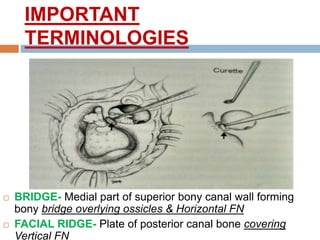
 BRIDGE- Medial part of superior bony canal wall forming
bony bridge overlying ossicles & Horizontal FN
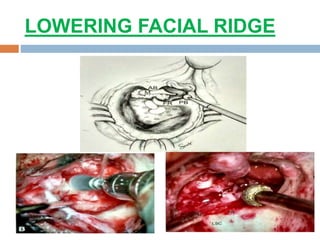
 FACIAL RIDGE- Plate of posterior canal bone covering
Vertical FN
IMPORTANT
TERMINOLOGIES
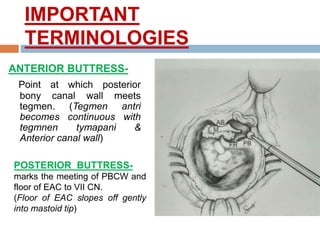
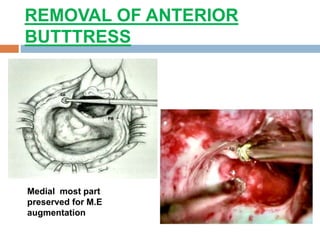
ANTERIOR BUTTRESS-
Point at which posterior
bony canal wall meets
tegmen. (Tegmen antri
becomes continuous with
tegmnen tymapani &
Anterior canal wall)
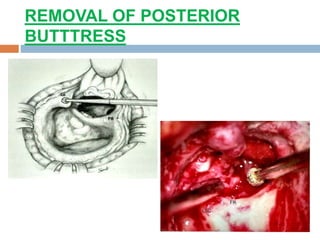
POSTERIOR BUTTRESS-
marks the meeting of PBCW and
floor of EAC to VII CN.
(Floor of EAC slopes off gently
into mastoid tip)
FACTORS FOR
DISCHARGING MASTOID CAVITY
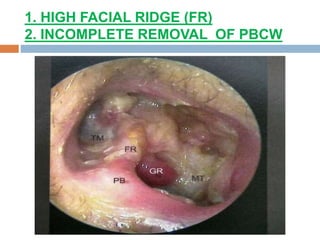
1. HIGH FACIAL RIDGE (FR)
2. INCOMPLETE REMOVAL OF PBCW
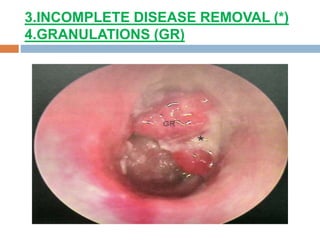
3.INCOMPLETE DISEASE REMOVAL (*)
4.GRANULATIONS (GR)
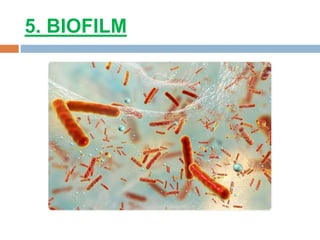
5. BIOFILM
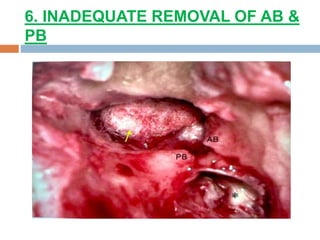
6. INADEQUATE REMOVAL OF AB &
PB
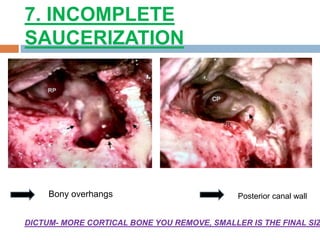
7. INCOMPLETE
SAUCERIZATION
Bony overhangs Posterior canal wall
DICTUM- MORE CORTICAL BONE YOU REMOVE, SMALLER IS THE FINAL SIZ
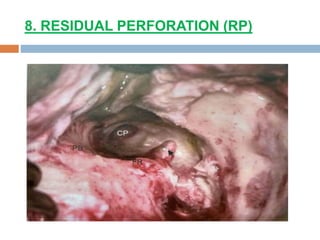
8. RESIDUAL PERFORATION (RP)
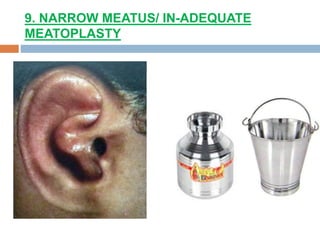
9. NARROW MEATUS/ IN-ADEQUATE
MEATOPLASTY
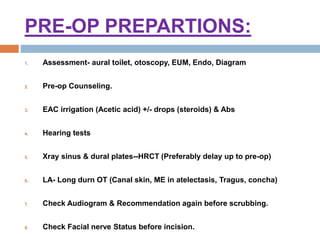
PRE-OP PREPARTIONS:
1. Assessment- aural toilet, otoscopy, EUM, Endo, Diagram
2. Pre-op Counseling.
3. EAC irrigation (Acetic acid) +/- drops (steroids) & Abs
4. Hearing tests
5. Xray sinus & dural plates--HRCT (Preferably delay up to pre-op)
6. LA- Long durn OT (Canal skin, ME in atelectasis, Tragus, concha)
7. Check Audiogram & Recommendation again before scrubbing.
8. Check Facial nerve Status before incision.
SURGICAL STEPS
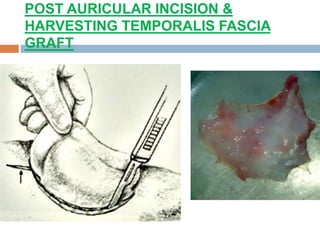
POST AURICULAR INCISION &
HARVESTING TEMPORALIS FASCIA
GRAFT
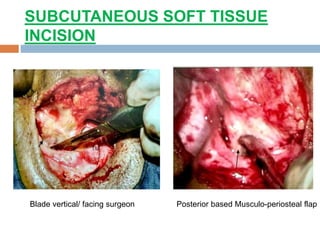
SUBCUTANEOUS SOFT TISSUE
INCISION
Blade vertical/ facing surgeon Posterior based Musculo-periosteal flap
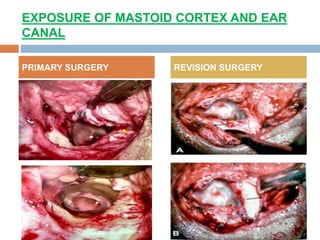
EXPOSURE OF MASTOID CORTEX AND EAR
CANAL
PRIMARY SURGERY REVISION SURGERY
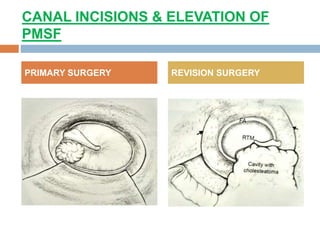
CANAL INCISIONS & ELEVATION OF
PMSF
PRIMARY SURGERY REVISION SURGERY
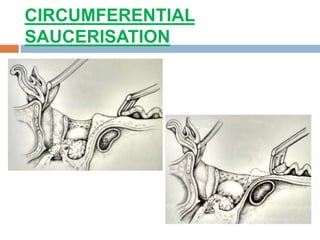
CIRCUMFERENTIAL
SAUCERISATION
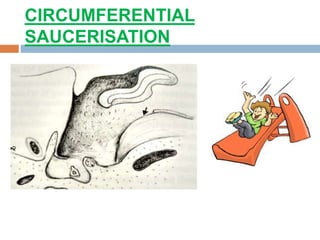
CIRCUMFERENTIAL
SAUCERISATION
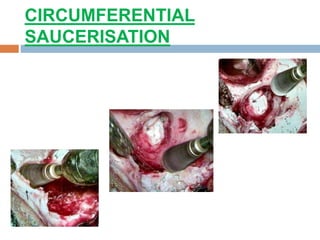
CIRCUMFERENTIAL
SAUCERISATION
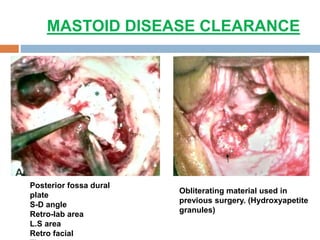
MASTOID DISEASE CLEARANCE
Posterior fossa dural
plate
S-D angle
Retro-lab area
L.S area
Retro facial
Obliterating material used in
previous surgery. (Hydroxyapetite
granules)
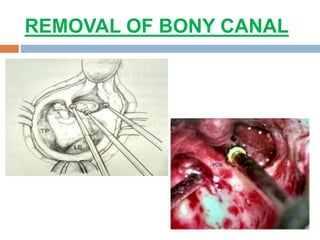
REMOVAL OF BONY CANAL
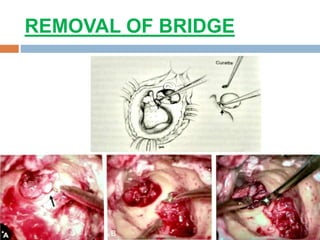
REMOVAL OF BRIDGE
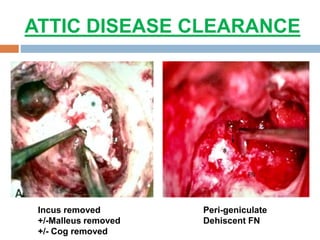
ATTIC DISEASE CLEARANCE
Incus removed
+/-Malleus removed
+/- Cog removed
Peri-geniculate
Dehiscent FN
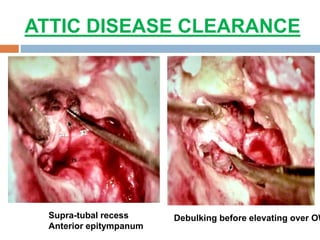
ATTIC DISEASE CLEARANCE
Supra-tubal recess
Anterior epitympanum
Debulking before elevating over OW
LOWERING FACIAL RIDGE
REMOVAL OF ANTERIOR
BUTTTRESS
Medial most part
preserved for M.E
augmentation
REMOVAL OF POSTERIOR
BUTTTRESS
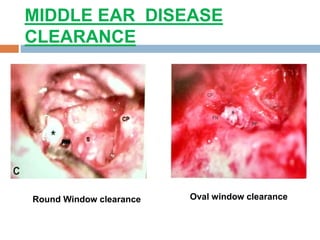
MIDDLE EAR DISEASE
CLEARANCE
Round Window clearance Oval window clearance
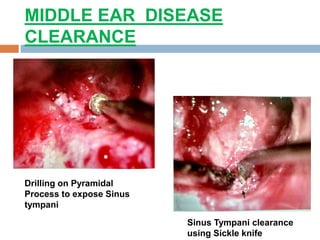
MIDDLE EAR DISEASE
CLEARANCE
Drilling on Pyramidal
Process to expose Sinus
tympani
Sinus Tympani clearance
using Sickle knife
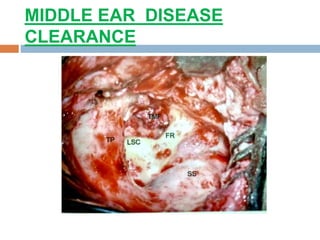
MIDDLE EAR DISEASE
CLEARANCE
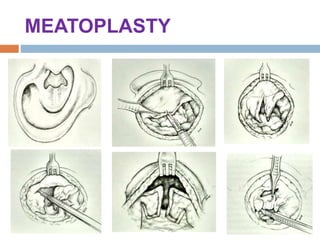
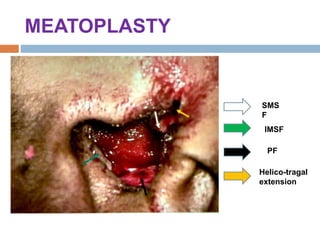
MEATOPLASTY
MEATOPLASTY
SMS
F
IMSF
PF
Helico-tragal
extension
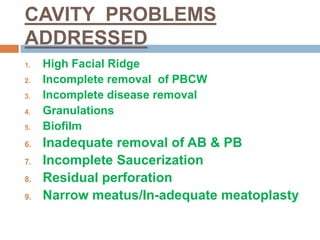
CAVITY PROBLEMS
ADDRESSED
1. High Facial Ridge
2. Incomplete removal of PBCW
3. Incomplete disease removal
4. Granulations
5. Biofilm
6. Inadequate removal of AB & PB
7. Incomplete Saucerization
8. Residual perforation
9. Narrow meatus/In-adequate meatoplasty
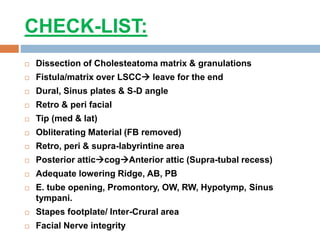
CHECK-LIST:
 Dissection of Cholesteatoma matrix & granulations
 Fistula/matrix over LSCC leave for the end
 Dural, Sinus plates & S-D angle
 Retro & peri facial
 Tip (med & lat)
 Obliterating Material (FB removed)
 Retro, peri & supra-labyrintine area
 Posterior atticcogAnterior attic (Supra-tubal recess)
 Adequate lowering Ridge, AB, PB
 E. tube opening, Promontory, OW, RW, Hypotymp, Sinus
tympani.
 Stapes footplate/ Inter-Crural area
 Facial Nerve integrity
CAVITY OBLITERATION
CAVITY OBLITERATION
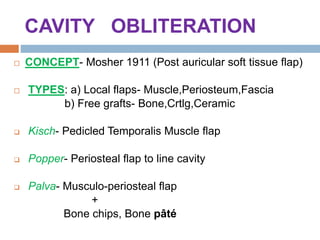
 CONCEPT- Mosher 1911 (Post auricular soft tissue flap)
 TYPES: a) Local flaps- Muscle,Periosteum,Fascia
b) Free grafts- Bone,Crtlg,Ceramic
 Kisch- Pedicled Temporalis Muscle flap
 Popper- Periosteal flap to line cavity
 Palva- Musculo-periosteal flap
+
Bone chips, Bone pâté
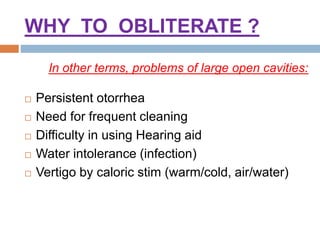
WHY TO OBLITERATE ?
 Persistent otorrhea
 Need for frequent cleaning
 Difficulty in using Hearing aid
 Water intolerance (infection)
 Vertigo by caloric stim (warm/cold, air/water)
In other terms, problems of large open cavities:
INDICATIONS OF CAVITY
OBLITERATION
BOX-1:
Indications
of cavity
obliteration
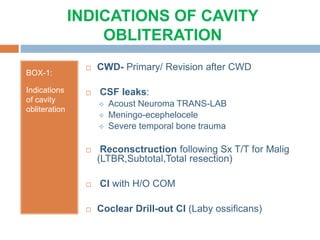
 CWD- Primary/ Revision after CWD
 CSF leaks:
 Acoust Neuroma TRANS-LAB
 Meningo-ecephelocele
 Severe temporal bone trauma
 Reconsctruction following Sx T/T for Malig
(LTBR,Subtotal,Total resection)
 CI with H/O COM
 Coclear Drill-out CI (Laby ossificans)
RELATIVE CONTRA-
INDICATIONS OF CAVITY
OBLITERATION
BOX-2:
Relative
Contra-
Indications of
cavity
obliteration
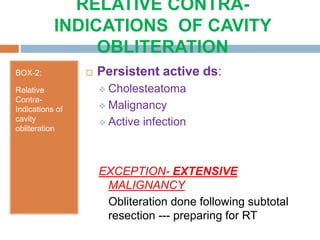
 Persistent active ds:
 Cholesteatoma
 Malignancy
 Active infection
EXCEPTION- EXTENSIVE
MALIGNANCY
Obliteration done following subtotal
resection --- preparing for RT
OBLITERATION
TECHNIQUES
BOX -3
Techniques
of Mastoid
obliteration
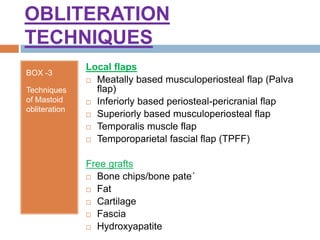
Local flaps
 Meatally based musculoperiosteal flap (Palva
flap)
 Inferiorly based periosteal-pericranial flap
 Superiorly based musculoperiosteal flap
 Temporalis muscle flap
 Temporoparietal fascial flap (TPFF)
Free grafts
 Bone chips/bone pate´
 Fat
 Cartilage
 Fascia
 Hydroxyapatite
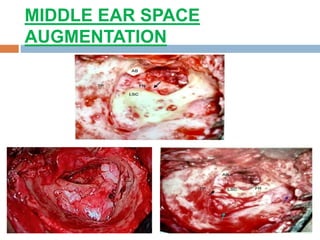
MIDDLE EAR SPACE
AUGMENTATION
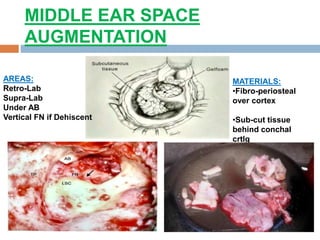
AREAS:
Retro-Lab
Supra-Lab
Under AB
Vertical FN if Dehiscent
MATERIALS:
•Fibro-periosteal
over cortex
•Sub-cut tissue
behind conchal
crtlg
MIDDLE EAR SPACE
AUGMENTATION
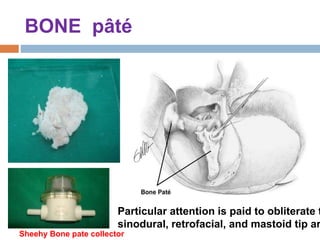
BONE pâté
Sheehy Bone pate collector
Particular attention is paid to obliterate t
sinodural, retrofacial, and mastoid tip ar
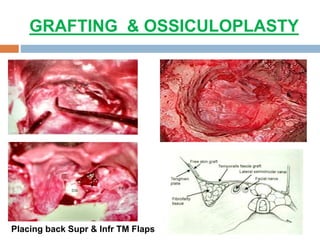
GRAFTING & OSSICULOPLASTY
Placing back Supr & Infr TM Flaps
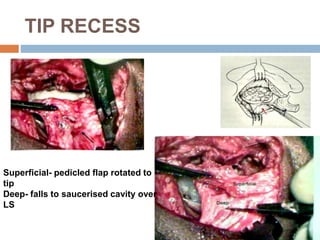
TIP RECESS
Superficial- pedicled flap rotated to
tip
Deep- falls to saucerised cavity over
LS
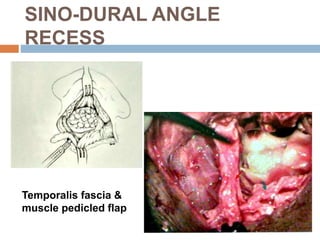
SINO-DURAL ANGLE
RECESS
Temporalis fascia &
muscle pedicled flap
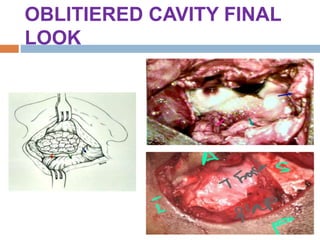
OBLITIERED CAVITY FINAL
LOOK
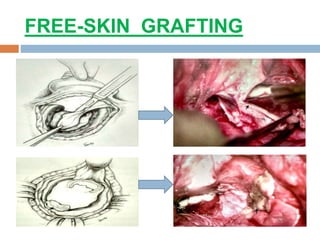
FREE-SKIN GRAFTING
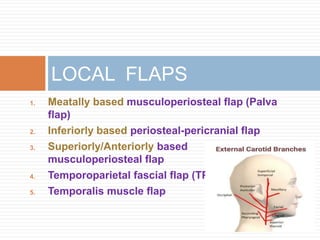
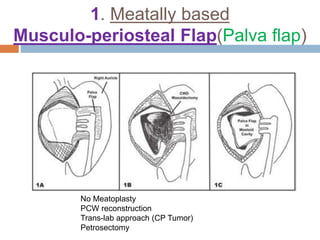
1. Meatally based musculoperiosteal flap (Palva
flap)
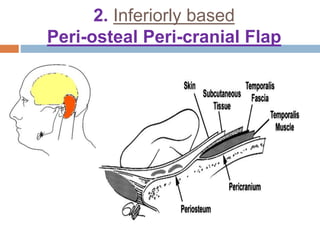
2. Inferiorly based periosteal-pericranial flap
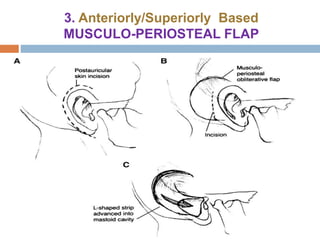
3. Superiorly/Anteriorly based
musculoperiosteal flap
4. Temporoparietal fascial flap (TPFF)
5. Temporalis muscle flap
LOCAL FLAPS
1. Meatally based
Musculo-periosteal Flap(Palva flap)
No Meatoplasty
PCW reconstruction
Trans-lab approach (CP Tumor)
Petrosectomy
2. Inferiorly based
Peri-osteal Peri-cranial Flap
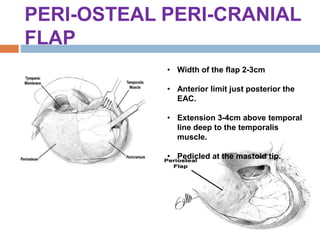
PERI-OSTEAL PERI-CRANIAL
FLAP
• Width of the flap 2-3cm
• Anterior limit just posterior the
EAC.
• Extension 3-4cm above temporal
line deep to the temporalis
muscle.
• Pedicled at the mastoid tip.
3. Anteriorly/Superiorly Based
MUSCULO-PERIOSTEAL FLAP
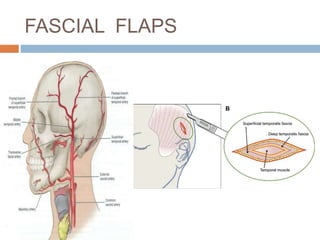
FASCIAL FLAPS
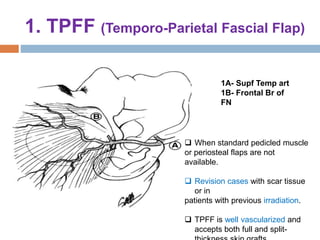
1. TPFF (Temporo-Parietal Fascial Flap)
1A- Supf Temp art
1B- Frontal Br of
FN
 When standard pedicled muscle
or periosteal flaps are not
available.
 Revision cases with scar tissue
or in
patients with previous irradiation.
 TPFF is well vascularized and
accepts both full and split-
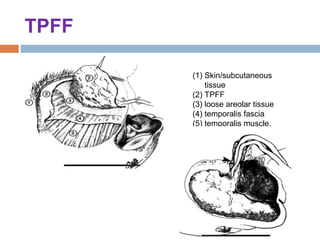
TPFF
(1) Skin/subcutaneous
tissue
(2) TPFF
(3) loose areolar tissue
(4) temporalis fascia
(5) temporalis muscle.
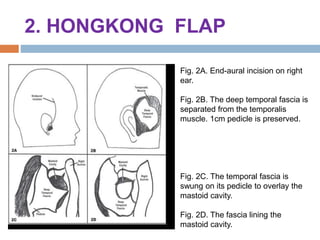
2. HONGKONG FLAP
Fig. 2A. End-aural incision on right
ear.
Fig. 2B. The deep temporal fascia is
separated from the temporalis
muscle. 1cm pedicle is preserved.
Fig. 2C. The temporal fascia is
swung on its pedicle to overlay the
mastoid cavity.
Fig. 2D. The fascia lining the
mastoid cavity.
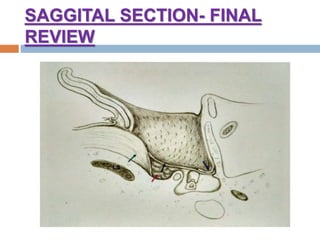
SAGGITAL SECTION- FINAL
REVIEW
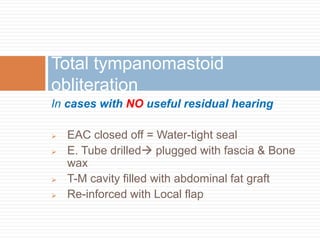
In cases with NO useful residual hearing
 EAC closed off = Water-tight seal
 E. Tube drilled plugged with fascia & Bone
wax
 T-M cavity filled with abdominal fat graft
 Re-inforced with Local flap
Total tympanomastoid
obliteration
Total tympanomastoid
obliteration
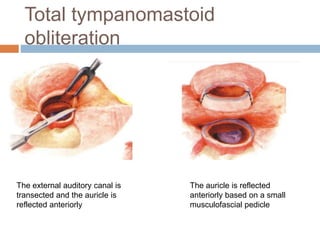
The external auditory canal is
transected and the auricle is
reflected anteriorly
The auricle is reflected
anteriorly based on a small
musculofascial pedicle
Total tympanomastoid
obliteration
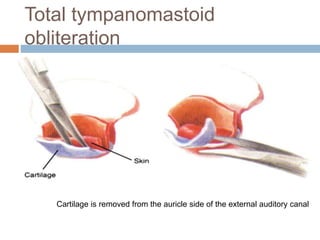
Cartilage is removed from the auricle side of the external auditory canal
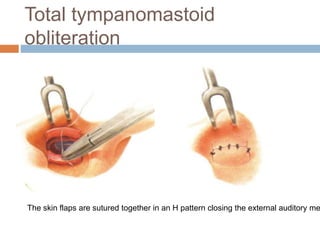
Total tympanomastoid
obliteration
The skin flaps are sutured together in an H pattern closing the external auditory me
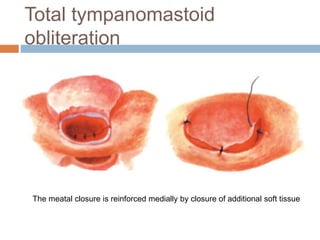
Total tympanomastoid
obliteration
The meatal closure is reinforced medially by closure of additional soft tissue
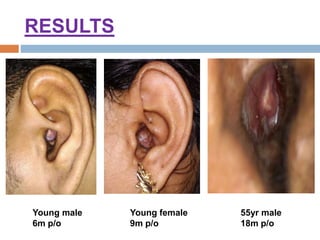
RESULTS
Young male
6m p/o
Young female
9m p/o
55yr male
18m p/o
TAKE HOME MESSAGE
 Pre-op Diagnosis & Preparation
 Counselling of patient
 HRCT reading & surgical planning
 LA infiltration
 Quick decision on Surgical approach/route/extent
 Respect & preserve landmarks and soft tissue
 Factors for discharging cavity
 Prepare for obliteration from beginning of surgery
 Management of complications/mistakes
 Senior consultation
 OT Note & post op counselling- f/u regime, discharge, pain, cavity
drying time.
 Self follow up
 Audit your results
 Never repeat mistakes
Follow any one rational
technique,
make it perfect and do not
change it.
OCNA, Elsevier
2006, Vol 39.
Issue 6.
MASTOID
OBLITERATIO
N
Page 1129-
1142
REFERENCES
VIJEYANDRA SIR VIDEOS:
1.https://www.youtube.com/watch?v=Up
c1vmnW3jY&t=2681s
2.
https://www.youtube.com/watch?v=Hncu
-0uP_As&t=1557s
THANK

Cavity obliteration @ sayan