Local flaps 
 Dr V.RAMKUMAR 
 CONSULTANT DENTAL&FACIOMAXILLARY 
SURGEON 
 REG NO:4118-TAMILNADU-INDIA(ASIA)
Principles techniques of wound closure
What is …… 
Flap : It is defined as a tongue of tissue 
consisting of entire thickness of skin and 
variable thickness of subcutaneous tissue 
which is transferred from one site to 
another and is based on its own blood 
supply.
Local / Regional flaps – Goals 
(Kinnerw & Jeter) 
1. Adequate color match 
2. Adequate thickness – avoid protrusions or 
deficiencies 
3. Preservation of clinically perceivable 
sensory innervation 
4. Sufficient laxity – avoid retraction or 
deranged function 
5. Resultant suture lines of either primary or 
secondary defects are restricted to 
anatomic units and fall within natural skin 
lines.
Delay of Flap: surgical outlining - before 
actual transfer -improve circulation. 
(1- 2 weeks) 
2 basic schools 
1. Delay improves nutrient blood flow 
2. Delay increases the tolerance of the 
cells to ischemia, allowing them to 
survive at a lower flow rate.
Classification of flaps 
1. Based on movement 
Local flaps: 
Advancement (single / bipedicle, V-Y) 
Pivotal : Rotation 
Transposition 
Interpolation 
Distant flaps 
Direct 
Tube 
Microvascular (free)
Local Flap: 
skin flap taken from an area close to the wound. 
E.g. a wound on the lip may be repaired by a 
flap from the adjacent cheek. 
Regional Flap: 
skin flap is not from the adjacent area, but is 
from the same region of the body. 
E.g. a wound on the tip of nose might be repaired with 
a flap from the forehead.
Distant Flap: 
- When a flap is from a different part of 
the body. 
- Any flap taken from below the lower 
border of the mandible is considered a 
distant flap. 
A local flap repair is usually 
done in one operation, whereas 
regional and distant flaps need two or 
more operations.
Free Flap: 
This is a distant flap, but the whole 
procedure is done in one stage by 
repairing the donor and recipient 
blood vessels by microsurgery.
2. Based on blood supply: 
Axial 
Random 
Daniel (1973) blood supply to skin: 
Musculocutaneous arteries 
random arteries 
myocutaneous 
Septocutaneous arteries 
fasciocutaneous 
arterial 
Septocutaneous arteries
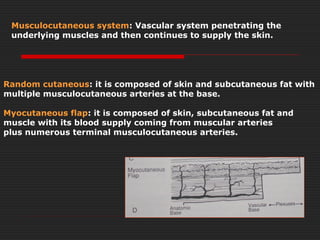
Musculocutaneous system: Vascular system penetrating the 
underlying muscles and then continues to supply the skin. 
Random cutaneous: it is composed of skin and subcutaneous fat with 
multiple musculocutaneous arteries at the base. 
Myocutaneous flap: it is composed of skin, subcutaneous fat and 
muscle with its blood supply coming from muscular arteries 
plus numerous terminal musculocutaneous arteries.
Septocutaneous system: vascular system reaching the skin 
through septa between muscles. (groin & DP flaps)
3. Based on composition 
Skin (cutaneous) 
Visceral ( colon, omentum) 
Muscle 
Mucosal 
Composite 
Fasciocutaneous 
Myocutaneous 
Osseocutaneous 
Tendocutaneous 
Sensory/innervated flaps 
Osseo-myo-cutaneous
Based on vascular pedicle types 
In muscles 
Mathes and Nahai (1979) 
Type I: one vascular pedicle 
Type II: dominant pedicle (s) + minor pedicles 
Type III: two dominant pedicles 
Type IV: Segmental vascular pedicles 
Type V: dominant pedicle + secondary segmental pedicles
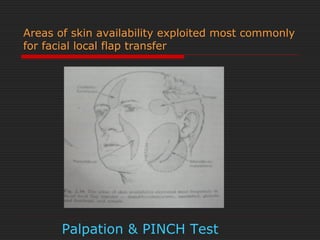
Areas of skin availability exploited most commonly 
for facial local flap transfer 
Palpation & PINCH Test
Advancement flaps 
flap moves in a straight path without any lateral 
movement into the primary defect. 
(Burrows Triangle’s) 
sites – forehead, brow, cheek. 
Single advancement flap: 
movement is entirely in one direction.
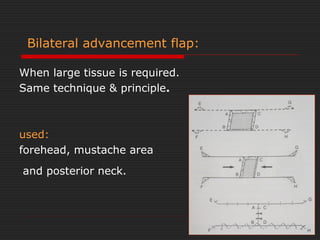
Bilateral advancement flap: 
When large tissue is required. 
Same technique & principle. 
used: 
forehead, mustache area 
and posterior neck.
A to T flap: 
variant of bilateral advancement flap 
Useful for 
defects at the periphery of the face 
around the nasal ala and upper lip 
dog–ear almost always forms 
Disadvantages: 
number of scars- created with the three limbs and Burow’s triangle 
and with the three point closure
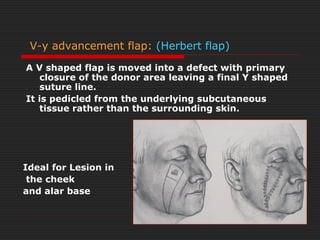
V-y advancement flap: (Herbert flap) 
A V shaped flap is moved into a defect with primary 
closure of the donor area leaving a final Y shaped 
suture line. 
It is pedicled from the underlying subcutaneous 
tissue rather than the surrounding skin. 
Ideal for Lesion in 
the cheek 
and alar base
Burow’s triangular flap 
Variation of advancement flap 
cover those areas on the face where there are 
anatomical structures on one side of the defect 
that should not be pulled or stretched. 
repair of upper lip or over the lateral eyebrow, 
Point C moves to point B 
& 
point D moves to point F
Panthographic expansion: 
variation of the advancement 
instead of the flap being advanced as a rectangle, 
the limbs of the flap are designed at 120º with back cuts at the 
bottom so that it looks like an inverted tumbler. 
The flap is then advanced so that the donor site closes primarily. 
This technique is particularly useful on the cheek and neck.
Pivot flaps: 
Derives its name from the pivot point at the base of the flap 
as well as its arc of rotation . 
When flap moves laterally into the primary defect - transposition 
flap 
when it is rotated into the defect - rotation flap 
isosceles triangle- triangulation of the defect
Pivot point 
Is the axis around which the transfer takes place. 
Flap is designed so that the distance from the pivot 
point to each part of the flap before transfer is 
atleast equal to the distance to be expected after 
transfer 
pivot point is on the side of the flap away from 
the direction of movement of the flap.
Rotation flaps: it is semicircular flap that rotates about a pivot point 
to fill the defect. 
Place the arc closest to the defect higher than the defect itself, 
to reach the most distal point of the defect 
Should be 5-8 times the width of the defect
Simple rotation flap 
Ideally suited on a convex surface 
cheek 
Submandibular area
Bilateral rotation flap
Transposition flaps 
Classic form - a rectangle or near square which is raised 
and moved laterally into a triangular defect 
In a correctly designed flap, the distance from the pivot point to A 
equals the distance to B and the transfer is carried without tension 
sites of choice 
retroauricular area 
submandibular area 
perioral area for upper and 
lower lip reconstructions. 
scalp 
A 
B
not to rotate more than 90º 
More acute –less dog ear
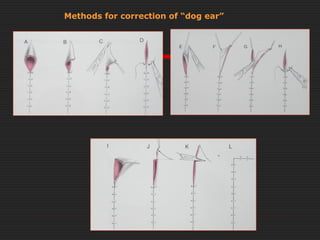
Methods for correction of “dog ear”
Limberg’s flap: 
combination of flap rotation and 
transposition 
BD=DE=EF 
EF at angle of 60º & 
Parallel to one side 
Disadvantages: 
Excess tension 
Anatomic landmark displacement because the tissue used to resurface 
the rhomboid defect is borrowed from single area. 
Rotation pucker at Point C 
Best in temple region between the eyebrows and anterior hair line
Dufourmental flap: 
variation of a rhomboid flap 
Need not convert into 60º rhomboid 
Such flaps are designed for closure of 
square & rectangular defects. 
Adv: 
less closure tension 
Disadv: 
rotation puckering at point C
Double ‘Z’ rhomboid flap: by Cuono 
Advantage over Limberg flap: 
Excessive tension is reduced by using 
two flaps 
anatomic landmark displacement in 
minimized because tissue used to 
resurface the rhomboid defect is 
borrowed from two areas. 
Rotation pucker seen with Limberg flap is avoided and the 
resultant scar forms an elongated ‘Z’ plasty.
Bilobed flap: First by Esser in 1918 
popularized by Zimany 
reconstruct nasal and facial defects and even full thickness cheek 
defects. 
Tension free closure of original and secondary defects. 
90º is the optimal angle between the first and second flap 
Maximum distortion occurs around 
the flap bases and the second donor 
lobe closure sites 
Disadvantages: 
Rotation pucker
‘ 
S’ plasty: Schrudder 
First by Szymanowski 
modification of transposition flap 
Difference between transposition and S- plasty 
Proximity of the flap base to the defect. 
It is positioned tangential to the wound margin 
leaving a ‘V’ shaped flap between them. 
Intermediate flap created between the flap and the defect.
60 degree between the flap and the 
defect will avoid ‘dog ear’ 
1/5th to 1/6th higher 
½ or ¾ the defect 
width
Interpolation flaps: 
An interpolation flap is from a nearby, but not immediately 
adjacent donor Site and transposed either above or below 
the intervening skin to the Recipient defect 
Types: 
Cutaneous: requires two stage procedure but more reliable 
Subcutaneous 
Island 
Ex: Median forehead flap 
Nasolabial flap
LOCAL FLAPS 
Buccal fat flap / Syssarcosis : 
Masticatory space 
average volume of the fat is 9.6ml (8.4 to 11.9) 
cover defects of up to 4cm 
blood supply from branches of facial, transverse facial 
and internal maxillary arteries. 
epithelization within 2-3 wks
Uses: 
Oro-antral & oro-nasal communications 
reconstruction of ablative defects of the 
maxilla and cheek, hard and soft palate, retro-molar 
and pterygo-mandibular regions, as 
An interpositional graft in OSMF 
Advantages: 
Easy 
Donor site complications rare 
Disadvantages: 
Facial asymmetry is a possible complication
Buccal Pad Fat
Tongue flaps 
First by Gersuny 
Eiselberg popularized in 1901 
Blood supply: lingual artery 
advantages: 
reliance on an excellent blood supply 
low morbidity 
Can be used in irradiated patients 
Used to cover defects in cheek, floor of the mouth, soft palate and 
hard palate, alveolus, oroantral fistulas and vermillion 
and lip reconstruction
Classification of tongue flaps: 
Flaps from dorsum of tongue 
Posteriorly based dorsal tongue flap 
Anteriorly based dorsal tongue flap 
Transverse based dorsal tongue flap 
Flaps from lingual tip 
Perimeter flap 
Unipedicle and bipedicle 
Dorsoventrally disposed flaps 
Flaps from ventral surface of tongue
Posteriorly based dorsal tongue flap 
Uses: 
To repair a defect of moderate size in the 
retromolar trigone, tonsillar fossa of the 
ipsilateral side 
To cover a posterior mucosal defect in cheek 
minimum thickness of the flap 
should be 8mm
Anteriorly based dorsal tongue flap 
Uses: to repair defects in the 
anterior cheek, 
lip, 
anterior floor of the mouth, 
anterolateral floor of the mouth and 
palate
Transverse based dorsal tongue flap 
to repair anterior floor of the mouth and lower lip
Perimeter flap 
unipedicled or bipedicled 
for repair of vermillion border of either lip 
Upper and lower lip reconstruction
Dorsoventrally disposed flaps 
Flaps reflected ventrally on a anterior base: 
Used for lining in lower lip reconstruction 
Flaps reflected dorsally on a posterior base. 
Used for lining in upper lip reconstruction 
Flaps from ventral surface of tongue 
cover defect on anterior floor 
of the mouth
Nasolabial flap: 
Sushruta in 600 BC 
popularized by Esser and Ganzer 
reconstruction of facial skin defects of the upper lip, 
nose and cheek following extirpation of skin cancers. 
superiorly based nasolabial flap- closure of the oro antral 
fistulae. 
The bilateral inferiorly based nasolabial flap has utility in the 
reconstruction of the anterior defects of the floor of the mouth. 
Defect in the anterior face, nose and upper lip, floor of the mouth 
OAF
Adv: 
It provides thin, local tissue for coverage of small defects. 
It may also be deepitheliazed at the base 
for one stage procedure. 
Disadv: 
Limited donor tissue 
Facial scarring 
Second surgical procedure might me needed 
Difficult to use in the floor of the mouth if 
the patient is not edentulous 
Transfer of beard in male patients
Inferiorly based Superiorly based 
For reconstruction in the 
anterior floor of the mouth
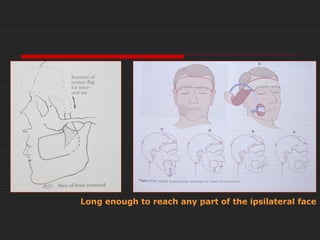
Forehead flap: McGregor. 
Blood supply 
superficial temporal artery and posterior auricular artery. 
Hemiforehead flap or total forehead flap
Long enough to reach any part of the ipsilateral face
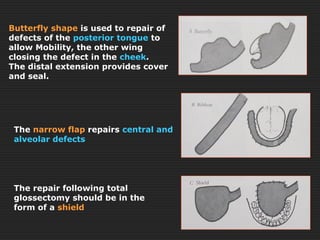
Butterfly shape is used to repair of 
defects of the posterior tongue to 
allow Mobility, the other wing 
closing the defect in the cheek. 
The distal extension provides cover 
and seal. 
The narrow flap repairs central and 
alveolar defects 
The repair following total 
glossectomy should be in the 
form of a shield
Advantages: 
Near to the oral cavity 
Hairless 
Tissue is firm and holds sutures well 
Excellent blood supply 
Thin and suitable for intraoral lining 
Disadvantages: 
Noticeable donor defect 
Need to divide the pedicle and close the 
oral fistula at a second operation 
Bleeding 
Flap necrosis can occur
Glabellar Flap 
- Axial pattern flap 
- Based on supra-trochlear 
artery 
uses: 
-nasal reconstruction 
-cheek defects 
disadvantages: 
-donor site morbidity 
-limited amount of tissue
Intra –oral flaps 
Palatal flaps (Ashley) 
Buccal advancement flaps 
-Rehrman’s 
-Moczair buccal sliding trapezoidal flap. 
(is slid to use the papilla of the adjacent tooth 
to rotate into the defect)
Intraoral flaps (buccal)
Bipedicled flap
Ashley palatal flap
RECONSTRUCTION OF LIP 
GILLIES principle 
Any anatomic reconstruction should 
attempt to restore 
‘lip with lip & cheek with cheek’
Vermillion loss replacement 
 Mucosal-advancement 
possible in forwards ,sideways or as 
vascularised island 
 Mucosa from contra-lateral lip 
 Mucosal grafts from palate 
 Tongue flap 
 Mucosa from inner cheek
Lower lip reconstruction 
 Central defects 
-Smaller defects 
- V excision 
- W plasty 
- advancement (muco-muscular) 
- Larger defects 
-Schuchardt flap (1954) 
-Stair case technique(1974) 
-Abbe flap (1898)
Lower lip reconstruction 
-Bernard modification (1853) 
-Freeman modification (1958) 
-Webster modification (1960) 
-Meyer-Abul-Failat technique (1982) 
-Naso-labial flap 
-Standard fan flap 
-Neurovascular fan flap (Karapandzic) 
-Modified fan flap
Commissural defects 
 Abbe-Estlander flap 
 V excision & primary closure
Upper lip reconstruction 
 Central defects 
Smaller defects 
- V excision 
- W plasty 
- Peri-alar crescents & cheek advancement 
- Burrows Triangles (Rhomboid flap)
Upper lip reconstruction 
Larger defects 
- Abbe flap 
- Cheek advancement flap 
- Distant – scalp, neck, free flap
V excision & W plasty 
 The defect is designed in the shape of the V & 
primary closure is done. 
 The V shaped defect can be designed in the 
shape of W and can be closed primarily.
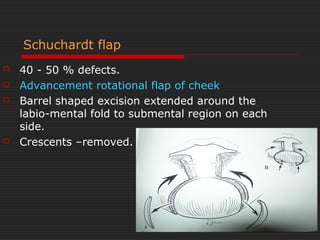
Schuchardt flap 
 40 - 50 % defects. 
 Advancement rotational flap of cheek 
 Barrel shaped excision extended around the 
labio-mental fold to submental region on each 
side. 
 Crescents –removed.
Staircase technique ( Johanson, 1974) 
 Up to 60 % defects. 
 Central & lateral defects 
 2-4 steps. Width -1/2 defect & height 8mm. 
 Rectangular shaped defect ( full thickness)
Abbe flap (1898) 
 V shaped flap raised on a narrow pedicle 
containing inferior labial vessels and rotated 
180o into the opposite lip 
 In philtral area V can be converted into W. 
 Pedicle divided in 2 weeks.
Double ABBE Flap
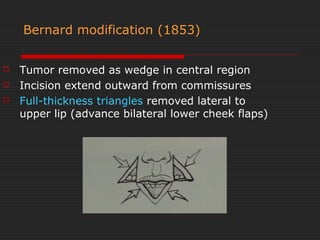
Bernard modification (1853) 
 Tumor removed as wedge in central region 
 Incision extend outward from commissures 
 Full-thickness triangles removed lateral to 
upper lip (advance bilateral lower cheek flaps)
Freeman modification (1958) 
 Only skin & subcutaneous tissue is excised 
rather than full-thickness lateral triangles 
 Incisions were extended more laterally to 
confirm to graceful lines of nasolabial fold.
Webster modification (1960) 
 ‘physiologic flap’ 
 Also hold good for 
complete upper lip 
reconstruction 
 Tumor excised in 
quadrilateral shape 
 Flaps of buccal mucosa 
provide new vermillion. 
 Lower cheek flap extended 
as in schuchardt flap 
 Vertical lines may be 
interrupted by Z-plasty
Meyer- Abul- Failat technique (1982) 
 Recent modification of Bernard. 
 80 % -central defects 
 Tumor excised as trapezoidal (full-thickness) 
 Upper lip Abbe flap – peri-alar crescents 
 Lower skin incised as schuchardt flap 
 Mucosal lining raised 
inferior to stensons duct.
Standard fan flap (Gillies & Millard, 1957) 
 Correction of lower lip if the defects are less than 
60% to 80% 
 Rectangular shaped defect. 
 Incision- full thickness –lip & cheek and passes 
round the angle of mouth to upper lip –then 
continued as a back-cut to the vicinity of the 
vermillion border 
 Totally denervated
Neurovascular Fan Flap (Karpandzic flap,1974) 
Nerves & blood vessels –intact. 
Design reduces the amount of advancement (no 
back cut) 
Incision-carried as in standard flap, extending till 
alar base. 
Drawbacks: 
Microstomia 
Circum-oral scar.
Modified fan flap (Mc Gregor, 1983) 
 When resection extends till angle & when ½ lip 
is involved. 
 Defect – square. 
 A vertical full thickness cheek flap is designed 
adjacent to defect. 
 Pedicle provides a static pivot point around 
which the rectangular flap rotates. 
 At the completion, the angle of the mouth 
remains in its original position. 
 Denervated. 
 Can be used for total lower lip reconstruction.
Modified fan flap
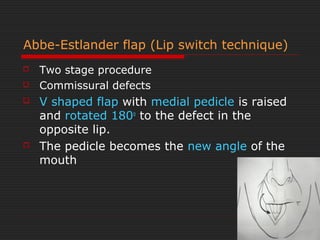
Abbe-Estlander flap (Lip switch technique) 
 Two stage procedure 
 Commissural defects 
 V shaped flap with medial pedicle is raised 
and rotated 180o to the defect in the 
opposite lip. 
 The pedicle becomes the new angle of the 
mouth
V excision & primary closure (angle) 
 When the defect is in the angle alone, a small 
lesion may be managed with a straight V 
excision passing directly laterally from the 
angle with direct closure
Peri-alar crescents & cheek advancement 
(Webster, 1955) 
 Uses nasolabial area of availabity 
 Incision is made around the alar base, 
extending along the groove between nose and 
cheek for approximately 1.5 cm. 
 Lateral to this incision a deep crescent of tissue 
is removed, the cheek is mobilized off the 
maxilla – and lip & cheek are advanced 
medially 
 Advancement closes the peri-alar defect and 
reduces the width of defect, on occasion closing 
it completely.
Peri-alar crescents & cheek advancement
Flaps used in eye reconstruction 
1. Bucket handle / TRIPIER flap 
2. Half Tripier flap 
3. Superiorly based naso-labial flap 
4. Forehead flap
Thank U

Local flaps seminar

  • 1.
    Local flaps Dr V.RAMKUMAR  CONSULTANT DENTAL&FACIOMAXILLARY SURGEON  REG NO:4118-TAMILNADU-INDIA(ASIA)
  • 2.
  • 3.
    What is …… Flap : It is defined as a tongue of tissue consisting of entire thickness of skin and variable thickness of subcutaneous tissue which is transferred from one site to another and is based on its own blood supply.
  • 4.
    Local / Regionalflaps – Goals (Kinnerw & Jeter) 1. Adequate color match 2. Adequate thickness – avoid protrusions or deficiencies 3. Preservation of clinically perceivable sensory innervation 4. Sufficient laxity – avoid retraction or deranged function 5. Resultant suture lines of either primary or secondary defects are restricted to anatomic units and fall within natural skin lines.
  • 5.
    Delay of Flap:surgical outlining - before actual transfer -improve circulation. (1- 2 weeks) 2 basic schools 1. Delay improves nutrient blood flow 2. Delay increases the tolerance of the cells to ischemia, allowing them to survive at a lower flow rate.
  • 6.
    Classification of flaps 1. Based on movement Local flaps: Advancement (single / bipedicle, V-Y) Pivotal : Rotation Transposition Interpolation Distant flaps Direct Tube Microvascular (free)
  • 7.
    Local Flap: skinflap taken from an area close to the wound. E.g. a wound on the lip may be repaired by a flap from the adjacent cheek. Regional Flap: skin flap is not from the adjacent area, but is from the same region of the body. E.g. a wound on the tip of nose might be repaired with a flap from the forehead.
  • 8.
    Distant Flap: -When a flap is from a different part of the body. - Any flap taken from below the lower border of the mandible is considered a distant flap. A local flap repair is usually done in one operation, whereas regional and distant flaps need two or more operations.
  • 9.
    Free Flap: Thisis a distant flap, but the whole procedure is done in one stage by repairing the donor and recipient blood vessels by microsurgery.
  • 10.
    2. Based onblood supply: Axial Random Daniel (1973) blood supply to skin: Musculocutaneous arteries random arteries myocutaneous Septocutaneous arteries fasciocutaneous arterial Septocutaneous arteries
  • 11.
    Musculocutaneous system: Vascularsystem penetrating the underlying muscles and then continues to supply the skin. Random cutaneous: it is composed of skin and subcutaneous fat with multiple musculocutaneous arteries at the base. Myocutaneous flap: it is composed of skin, subcutaneous fat and muscle with its blood supply coming from muscular arteries plus numerous terminal musculocutaneous arteries.
  • 12.
    Septocutaneous system: vascularsystem reaching the skin through septa between muscles. (groin & DP flaps)
  • 13.
    3. Based oncomposition Skin (cutaneous) Visceral ( colon, omentum) Muscle Mucosal Composite Fasciocutaneous Myocutaneous Osseocutaneous Tendocutaneous Sensory/innervated flaps Osseo-myo-cutaneous
  • 14.
    Based on vascularpedicle types In muscles Mathes and Nahai (1979) Type I: one vascular pedicle Type II: dominant pedicle (s) + minor pedicles Type III: two dominant pedicles Type IV: Segmental vascular pedicles Type V: dominant pedicle + secondary segmental pedicles
  • 15.
    Areas of skinavailability exploited most commonly for facial local flap transfer Palpation & PINCH Test
  • 16.
    Advancement flaps flapmoves in a straight path without any lateral movement into the primary defect. (Burrows Triangle’s) sites – forehead, brow, cheek. Single advancement flap: movement is entirely in one direction.
  • 17.
    Bilateral advancement flap: When large tissue is required. Same technique & principle. used: forehead, mustache area and posterior neck.
  • 18.
    A to Tflap: variant of bilateral advancement flap Useful for defects at the periphery of the face around the nasal ala and upper lip dog–ear almost always forms Disadvantages: number of scars- created with the three limbs and Burow’s triangle and with the three point closure
  • 19.
    V-y advancement flap:(Herbert flap) A V shaped flap is moved into a defect with primary closure of the donor area leaving a final Y shaped suture line. It is pedicled from the underlying subcutaneous tissue rather than the surrounding skin. Ideal for Lesion in the cheek and alar base
  • 20.
    Burow’s triangular flap Variation of advancement flap cover those areas on the face where there are anatomical structures on one side of the defect that should not be pulled or stretched. repair of upper lip or over the lateral eyebrow, Point C moves to point B & point D moves to point F
  • 21.
    Panthographic expansion: variationof the advancement instead of the flap being advanced as a rectangle, the limbs of the flap are designed at 120º with back cuts at the bottom so that it looks like an inverted tumbler. The flap is then advanced so that the donor site closes primarily. This technique is particularly useful on the cheek and neck.
  • 22.
    Pivot flaps: Derivesits name from the pivot point at the base of the flap as well as its arc of rotation . When flap moves laterally into the primary defect - transposition flap when it is rotated into the defect - rotation flap isosceles triangle- triangulation of the defect
  • 23.
    Pivot point Isthe axis around which the transfer takes place. Flap is designed so that the distance from the pivot point to each part of the flap before transfer is atleast equal to the distance to be expected after transfer pivot point is on the side of the flap away from the direction of movement of the flap.
  • 24.
    Rotation flaps: itis semicircular flap that rotates about a pivot point to fill the defect. Place the arc closest to the defect higher than the defect itself, to reach the most distal point of the defect Should be 5-8 times the width of the defect
  • 25.
    Simple rotation flap Ideally suited on a convex surface cheek Submandibular area
  • 26.
  • 27.
    Transposition flaps Classicform - a rectangle or near square which is raised and moved laterally into a triangular defect In a correctly designed flap, the distance from the pivot point to A equals the distance to B and the transfer is carried without tension sites of choice retroauricular area submandibular area perioral area for upper and lower lip reconstructions. scalp A B
  • 28.
    not to rotatemore than 90º More acute –less dog ear
  • 29.
    Methods for correctionof “dog ear”
  • 30.
    Limberg’s flap: combinationof flap rotation and transposition BD=DE=EF EF at angle of 60º & Parallel to one side Disadvantages: Excess tension Anatomic landmark displacement because the tissue used to resurface the rhomboid defect is borrowed from single area. Rotation pucker at Point C Best in temple region between the eyebrows and anterior hair line
  • 31.
    Dufourmental flap: variationof a rhomboid flap Need not convert into 60º rhomboid Such flaps are designed for closure of square & rectangular defects. Adv: less closure tension Disadv: rotation puckering at point C
  • 32.
    Double ‘Z’ rhomboidflap: by Cuono Advantage over Limberg flap: Excessive tension is reduced by using two flaps anatomic landmark displacement in minimized because tissue used to resurface the rhomboid defect is borrowed from two areas. Rotation pucker seen with Limberg flap is avoided and the resultant scar forms an elongated ‘Z’ plasty.
  • 33.
    Bilobed flap: Firstby Esser in 1918 popularized by Zimany reconstruct nasal and facial defects and even full thickness cheek defects. Tension free closure of original and secondary defects. 90º is the optimal angle between the first and second flap Maximum distortion occurs around the flap bases and the second donor lobe closure sites Disadvantages: Rotation pucker
  • 34.
    ‘ S’ plasty:Schrudder First by Szymanowski modification of transposition flap Difference between transposition and S- plasty Proximity of the flap base to the defect. It is positioned tangential to the wound margin leaving a ‘V’ shaped flap between them. Intermediate flap created between the flap and the defect.
  • 35.
    60 degree betweenthe flap and the defect will avoid ‘dog ear’ 1/5th to 1/6th higher ½ or ¾ the defect width
  • 36.
    Interpolation flaps: Aninterpolation flap is from a nearby, but not immediately adjacent donor Site and transposed either above or below the intervening skin to the Recipient defect Types: Cutaneous: requires two stage procedure but more reliable Subcutaneous Island Ex: Median forehead flap Nasolabial flap
  • 37.
    LOCAL FLAPS Buccalfat flap / Syssarcosis : Masticatory space average volume of the fat is 9.6ml (8.4 to 11.9) cover defects of up to 4cm blood supply from branches of facial, transverse facial and internal maxillary arteries. epithelization within 2-3 wks
  • 38.
    Uses: Oro-antral &oro-nasal communications reconstruction of ablative defects of the maxilla and cheek, hard and soft palate, retro-molar and pterygo-mandibular regions, as An interpositional graft in OSMF Advantages: Easy Donor site complications rare Disadvantages: Facial asymmetry is a possible complication
  • 39.
  • 40.
    Tongue flaps Firstby Gersuny Eiselberg popularized in 1901 Blood supply: lingual artery advantages: reliance on an excellent blood supply low morbidity Can be used in irradiated patients Used to cover defects in cheek, floor of the mouth, soft palate and hard palate, alveolus, oroantral fistulas and vermillion and lip reconstruction
  • 41.
    Classification of tongueflaps: Flaps from dorsum of tongue Posteriorly based dorsal tongue flap Anteriorly based dorsal tongue flap Transverse based dorsal tongue flap Flaps from lingual tip Perimeter flap Unipedicle and bipedicle Dorsoventrally disposed flaps Flaps from ventral surface of tongue
  • 42.
    Posteriorly based dorsaltongue flap Uses: To repair a defect of moderate size in the retromolar trigone, tonsillar fossa of the ipsilateral side To cover a posterior mucosal defect in cheek minimum thickness of the flap should be 8mm
  • 43.
    Anteriorly based dorsaltongue flap Uses: to repair defects in the anterior cheek, lip, anterior floor of the mouth, anterolateral floor of the mouth and palate
  • 44.
    Transverse based dorsaltongue flap to repair anterior floor of the mouth and lower lip
  • 45.
    Perimeter flap unipedicledor bipedicled for repair of vermillion border of either lip Upper and lower lip reconstruction
  • 46.
    Dorsoventrally disposed flaps Flaps reflected ventrally on a anterior base: Used for lining in lower lip reconstruction Flaps reflected dorsally on a posterior base. Used for lining in upper lip reconstruction Flaps from ventral surface of tongue cover defect on anterior floor of the mouth
  • 47.
    Nasolabial flap: Sushrutain 600 BC popularized by Esser and Ganzer reconstruction of facial skin defects of the upper lip, nose and cheek following extirpation of skin cancers. superiorly based nasolabial flap- closure of the oro antral fistulae. The bilateral inferiorly based nasolabial flap has utility in the reconstruction of the anterior defects of the floor of the mouth. Defect in the anterior face, nose and upper lip, floor of the mouth OAF
  • 48.
    Adv: It providesthin, local tissue for coverage of small defects. It may also be deepitheliazed at the base for one stage procedure. Disadv: Limited donor tissue Facial scarring Second surgical procedure might me needed Difficult to use in the floor of the mouth if the patient is not edentulous Transfer of beard in male patients
  • 49.
    Inferiorly based Superiorlybased For reconstruction in the anterior floor of the mouth
  • 50.
    Forehead flap: McGregor. Blood supply superficial temporal artery and posterior auricular artery. Hemiforehead flap or total forehead flap
  • 51.
    Long enough toreach any part of the ipsilateral face
  • 52.
    Butterfly shape isused to repair of defects of the posterior tongue to allow Mobility, the other wing closing the defect in the cheek. The distal extension provides cover and seal. The narrow flap repairs central and alveolar defects The repair following total glossectomy should be in the form of a shield
  • 53.
    Advantages: Near tothe oral cavity Hairless Tissue is firm and holds sutures well Excellent blood supply Thin and suitable for intraoral lining Disadvantages: Noticeable donor defect Need to divide the pedicle and close the oral fistula at a second operation Bleeding Flap necrosis can occur
  • 54.
    Glabellar Flap -Axial pattern flap - Based on supra-trochlear artery uses: -nasal reconstruction -cheek defects disadvantages: -donor site morbidity -limited amount of tissue
  • 55.
    Intra –oral flaps Palatal flaps (Ashley) Buccal advancement flaps -Rehrman’s -Moczair buccal sliding trapezoidal flap. (is slid to use the papilla of the adjacent tooth to rotate into the defect)
  • 56.
  • 57.
  • 58.
  • 59.
    RECONSTRUCTION OF LIP GILLIES principle Any anatomic reconstruction should attempt to restore ‘lip with lip & cheek with cheek’
  • 60.
    Vermillion loss replacement  Mucosal-advancement possible in forwards ,sideways or as vascularised island  Mucosa from contra-lateral lip  Mucosal grafts from palate  Tongue flap  Mucosa from inner cheek
  • 61.
    Lower lip reconstruction  Central defects -Smaller defects - V excision - W plasty - advancement (muco-muscular) - Larger defects -Schuchardt flap (1954) -Stair case technique(1974) -Abbe flap (1898)
  • 62.
    Lower lip reconstruction -Bernard modification (1853) -Freeman modification (1958) -Webster modification (1960) -Meyer-Abul-Failat technique (1982) -Naso-labial flap -Standard fan flap -Neurovascular fan flap (Karapandzic) -Modified fan flap
  • 63.
    Commissural defects Abbe-Estlander flap  V excision & primary closure
  • 64.
    Upper lip reconstruction  Central defects Smaller defects - V excision - W plasty - Peri-alar crescents & cheek advancement - Burrows Triangles (Rhomboid flap)
  • 65.
    Upper lip reconstruction Larger defects - Abbe flap - Cheek advancement flap - Distant – scalp, neck, free flap
  • 66.
    V excision &W plasty  The defect is designed in the shape of the V & primary closure is done.  The V shaped defect can be designed in the shape of W and can be closed primarily.
  • 67.
    Schuchardt flap 40 - 50 % defects.  Advancement rotational flap of cheek  Barrel shaped excision extended around the labio-mental fold to submental region on each side.  Crescents –removed.
  • 68.
    Staircase technique (Johanson, 1974)  Up to 60 % defects.  Central & lateral defects  2-4 steps. Width -1/2 defect & height 8mm.  Rectangular shaped defect ( full thickness)
  • 69.
    Abbe flap (1898)  V shaped flap raised on a narrow pedicle containing inferior labial vessels and rotated 180o into the opposite lip  In philtral area V can be converted into W.  Pedicle divided in 2 weeks.
  • 70.
  • 71.
    Bernard modification (1853)  Tumor removed as wedge in central region  Incision extend outward from commissures  Full-thickness triangles removed lateral to upper lip (advance bilateral lower cheek flaps)
  • 72.
    Freeman modification (1958)  Only skin & subcutaneous tissue is excised rather than full-thickness lateral triangles  Incisions were extended more laterally to confirm to graceful lines of nasolabial fold.
  • 73.
    Webster modification (1960)  ‘physiologic flap’  Also hold good for complete upper lip reconstruction  Tumor excised in quadrilateral shape  Flaps of buccal mucosa provide new vermillion.  Lower cheek flap extended as in schuchardt flap  Vertical lines may be interrupted by Z-plasty
  • 74.
    Meyer- Abul- Failattechnique (1982)  Recent modification of Bernard.  80 % -central defects  Tumor excised as trapezoidal (full-thickness)  Upper lip Abbe flap – peri-alar crescents  Lower skin incised as schuchardt flap  Mucosal lining raised inferior to stensons duct.
  • 75.
    Standard fan flap(Gillies & Millard, 1957)  Correction of lower lip if the defects are less than 60% to 80%  Rectangular shaped defect.  Incision- full thickness –lip & cheek and passes round the angle of mouth to upper lip –then continued as a back-cut to the vicinity of the vermillion border  Totally denervated
  • 76.
    Neurovascular Fan Flap(Karpandzic flap,1974) Nerves & blood vessels –intact. Design reduces the amount of advancement (no back cut) Incision-carried as in standard flap, extending till alar base. Drawbacks: Microstomia Circum-oral scar.
  • 77.
    Modified fan flap(Mc Gregor, 1983)  When resection extends till angle & when ½ lip is involved.  Defect – square.  A vertical full thickness cheek flap is designed adjacent to defect.  Pedicle provides a static pivot point around which the rectangular flap rotates.  At the completion, the angle of the mouth remains in its original position.  Denervated.  Can be used for total lower lip reconstruction.
  • 78.
  • 79.
    Abbe-Estlander flap (Lipswitch technique)  Two stage procedure  Commissural defects  V shaped flap with medial pedicle is raised and rotated 180o to the defect in the opposite lip.  The pedicle becomes the new angle of the mouth
  • 80.
    V excision &primary closure (angle)  When the defect is in the angle alone, a small lesion may be managed with a straight V excision passing directly laterally from the angle with direct closure
  • 81.
    Peri-alar crescents &cheek advancement (Webster, 1955)  Uses nasolabial area of availabity  Incision is made around the alar base, extending along the groove between nose and cheek for approximately 1.5 cm.  Lateral to this incision a deep crescent of tissue is removed, the cheek is mobilized off the maxilla – and lip & cheek are advanced medially  Advancement closes the peri-alar defect and reduces the width of defect, on occasion closing it completely.
  • 82.
    Peri-alar crescents &cheek advancement
  • 83.
    Flaps used ineye reconstruction 1. Bucket handle / TRIPIER flap 2. Half Tripier flap 3. Superiorly based naso-labial flap 4. Forehead flap
  • 84.