Dr.Ajay Manickam
Junior Resident ENT & Head Neck Surgery
R.G. Kar Medical College
 Simple injury/
surgical
 Repairable ….???
 Many defects can be
directly closed if
small & enough
tissue available
locally
 If the defect becomes larger......
 Ablative cancer surgery
 Larger defects
1. Grafts
2. Local flaps
3. Pedicled flaps
4. Free flaps
5. Combination
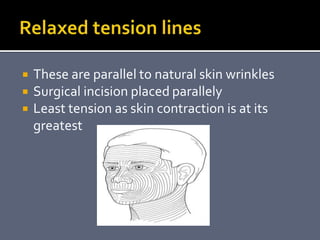
 These are parallel to natural skin wrinkles
 Surgical incision placed parallely
 Least tension as skin contraction is at its
greatest
 Ellipse three times as long as its wide
 If ellipse is too short dog ear deformity
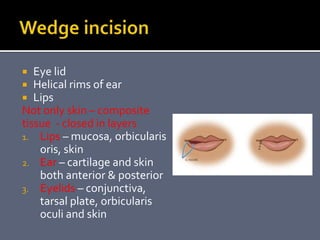
 Eye lid
 Helical rims of ear
 Lips
Not only skin – composite
tissue - closed in layers
1. Lips – mucosa, orbicularis
oris, skin
2. Ear – cartilage and skin
both anterior & posterior
3. Eyelids – conjunctiva,
tarsal plate, orbicularis
oculi and skin
 1817 – Sir Astley Cooper
 1871 – Lawson – elective
full thickness graft
 1872- Ollier – split skin
graft
 1929 – Brown & Blair –
differentiated full
thickness and split
thickness skin grafts
advantages &
disadvantages
 Split thickness – part
of dermis
 Full thickness – all of
dermis
 Composite – skin &
another tissue
Graft origin
1. Auto graft – same person
2. Isograft – identical twin
3. Allograft –same species
4. Xenograft – diff species
5. Alloplastic - synthetic
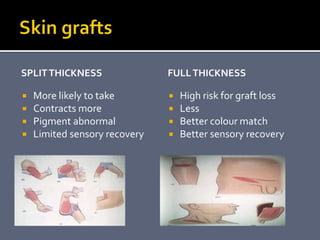
SPLITTHICKNESS
 More likely to take
 Contracts more
 Pigment abnormal
 Limited sensory recovery
FULLTHICKNESS
 High risk for graft loss
 Less
 Better colour match
 Better sensory recovery
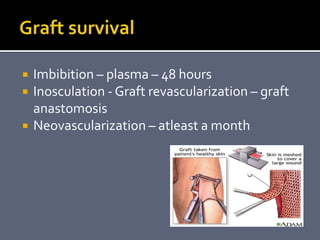
 Imbibition – plasma – 48 hours
 Inosculation - Graft revascularization – graft
anastomosis
 Neovascularization – atleast a month
 Relies on skin elasticity
 Modified in a number of ways – burow
triangle
 Simple
Rintalla flap
 Modified
V-Y flap (axial flap)
 Bipedicled flap
Tripier flap
 Simple flap lesions in nasal tip
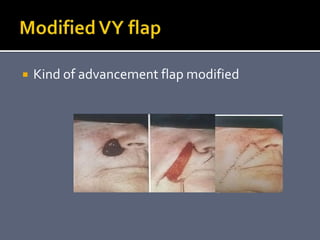
 Kind of advancement flap modified
 Lower eyelid reconstruction
 Bipedicled flap – receives blood supply from
both ends
 Moves around a pivot point – transposition
flap or rotation flap
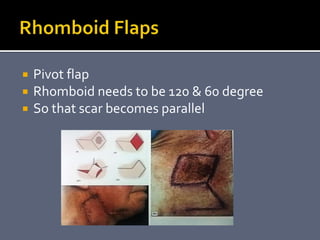
 Rhomboid flaps – transposition flaps – donor
defect closed directly
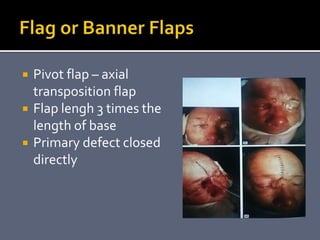
 Flag or banner flaps – transposition flaps –
donor site closed directly
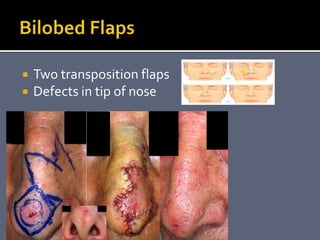
 Bilobed flaps – two transposition flaps
 Pivot flap
 Rhomboid needs to be 120 & 60 degree
 So that scar becomes parallel
 Pivot flap – axial
transposition flap
 Flap lengh 3 times the
length of base
 Primary defect closed
directly
 Two transposition flaps
 Defects in tip of nose
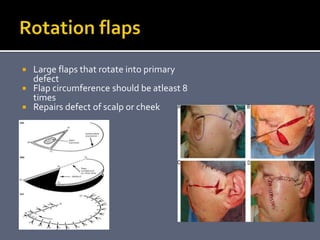
 Large flaps that rotate into primary
defect
 Flap circumference should be atleast 8
times
 Repairs defect of scalp or cheek
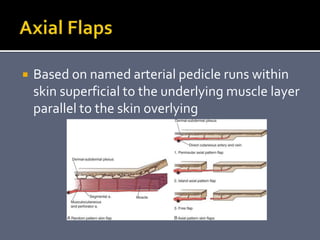
 Based on named arterial pedicle runs within
skin superficial to the underlying muscle layer
parallel to the skin overlying
Forehead flap
Nasolabial flap
Submental island flap
Facial artery myomucosal flap
Temporo parietal fascial flap
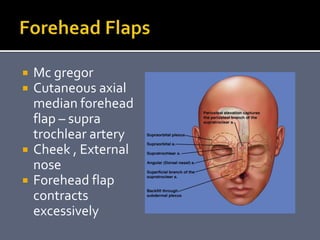
 Mc gregor
 Cutaneous axial
median forehead
flap – supra
trochlear artery
 Cheek , External
nose
 Forehead flap
contracts
excessively
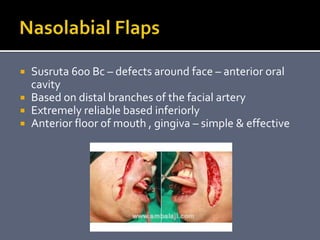
 Susruta 600 Bc – defects around face – anterior oral
cavity
 Based on distal branches of the facial artery
 Extremely reliable based inferiorly
 Anterior floor of mouth , gingiva – simple & effective
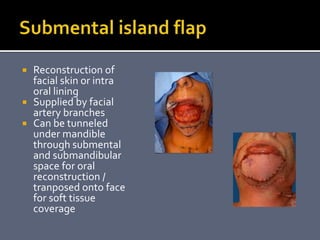
 Reconstruction of
facial skin or intra
oral lining
 Supplied by facial
artery branches
 Can be tunneled
under mandible
through submental
and submandibular
space for oral
reconstruction /
tranposed onto face
for soft tissue
coverage
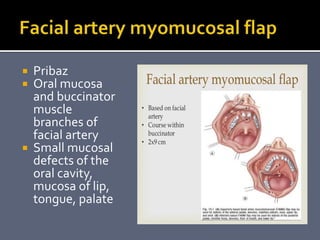
 Pribaz
 Oral mucosa
and buccinator
muscle
branches of
facial artery
 Small mucosal
defects of the
oral cavity,
mucosa of lip,
tongue, palate
 Golovine
 Free facial flap for
reconstruction of head &
neck
 Superficial temporal
artery – external carotid
artery
 Teardrop, elliptical shape
 Orbital reconstruction,
auricular reconstruction,
palate reconstruction,
buccal mucosal
reconstruction.
 Deltopectoral flap
 Myocutaneous and muscle only axial distant
flaps
1. Pectoralis major
2. Lattissimus dorsi
3. Sternomastoid
4. Trapezius
5. Platysma
 Bakamjian and littlewood 1964
 Upper 3 perforating internal mammary artery
branches
 Single stage reconstruction – anterior neck skin
 Two stage reconstruction – over neck structures to
resurface distant sites
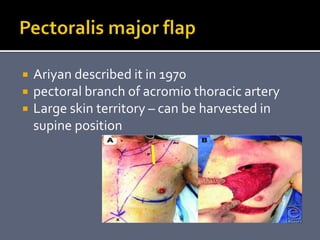
 Ariyan described it in 1970
 pectoral branch of acromio thoracic artery
 Large skin territory – can be harvested in
supine position
 Local flaps & regional flaps plays an
important role in head & neck reconstruction
 When using local flaps in the head & neck
preoperative planning of the flap is prime
importance
 Grafts are reliant on blood supply of recipient
site but flaps takes their blood supply with
them
Local flaps in ent

Local flaps in ent

  • 1.
    Dr.Ajay Manickam Junior ResidentENT & Head Neck Surgery R.G. Kar Medical College
  • 2.
     Simple injury/ surgical Repairable ….???  Many defects can be directly closed if small & enough tissue available locally
  • 3.
     If thedefect becomes larger......  Ablative cancer surgery
  • 4.
     Larger defects 1.Grafts 2. Local flaps 3. Pedicled flaps 4. Free flaps 5. Combination
  • 5.
     These areparallel to natural skin wrinkles  Surgical incision placed parallely  Least tension as skin contraction is at its greatest
  • 6.
     Ellipse threetimes as long as its wide  If ellipse is too short dog ear deformity
  • 7.
     Eye lid Helical rims of ear  Lips Not only skin – composite tissue - closed in layers 1. Lips – mucosa, orbicularis oris, skin 2. Ear – cartilage and skin both anterior & posterior 3. Eyelids – conjunctiva, tarsal plate, orbicularis oculi and skin
  • 8.
     1817 –Sir Astley Cooper  1871 – Lawson – elective full thickness graft  1872- Ollier – split skin graft  1929 – Brown & Blair – differentiated full thickness and split thickness skin grafts advantages & disadvantages
  • 9.
     Split thickness– part of dermis  Full thickness – all of dermis  Composite – skin & another tissue
  • 10.
    Graft origin 1. Autograft – same person 2. Isograft – identical twin 3. Allograft –same species 4. Xenograft – diff species 5. Alloplastic - synthetic
  • 11.
    SPLITTHICKNESS  More likelyto take  Contracts more  Pigment abnormal  Limited sensory recovery FULLTHICKNESS  High risk for graft loss  Less  Better colour match  Better sensory recovery
  • 12.
     Imbibition –plasma – 48 hours  Inosculation - Graft revascularization – graft anastomosis  Neovascularization – atleast a month
  • 13.
     Relies onskin elasticity  Modified in a number of ways – burow triangle  Simple Rintalla flap  Modified V-Y flap (axial flap)  Bipedicled flap Tripier flap
  • 14.
     Simple flaplesions in nasal tip
  • 15.
     Kind ofadvancement flap modified
  • 16.
     Lower eyelidreconstruction  Bipedicled flap – receives blood supply from both ends
  • 17.
     Moves arounda pivot point – transposition flap or rotation flap  Rhomboid flaps – transposition flaps – donor defect closed directly  Flag or banner flaps – transposition flaps – donor site closed directly  Bilobed flaps – two transposition flaps
  • 18.
     Pivot flap Rhomboid needs to be 120 & 60 degree  So that scar becomes parallel
  • 19.
     Pivot flap– axial transposition flap  Flap lengh 3 times the length of base  Primary defect closed directly
  • 20.
     Two transpositionflaps  Defects in tip of nose
  • 21.
     Large flapsthat rotate into primary defect  Flap circumference should be atleast 8 times  Repairs defect of scalp or cheek
  • 23.
     Based onnamed arterial pedicle runs within skin superficial to the underlying muscle layer parallel to the skin overlying
  • 24.
    Forehead flap Nasolabial flap Submentalisland flap Facial artery myomucosal flap Temporo parietal fascial flap
  • 25.
     Mc gregor Cutaneous axial median forehead flap – supra trochlear artery  Cheek , External nose  Forehead flap contracts excessively
  • 26.
     Susruta 600Bc – defects around face – anterior oral cavity  Based on distal branches of the facial artery  Extremely reliable based inferiorly  Anterior floor of mouth , gingiva – simple & effective
  • 27.
     Reconstruction of facialskin or intra oral lining  Supplied by facial artery branches  Can be tunneled under mandible through submental and submandibular space for oral reconstruction / tranposed onto face for soft tissue coverage
  • 28.
     Pribaz  Oralmucosa and buccinator muscle branches of facial artery  Small mucosal defects of the oral cavity, mucosa of lip, tongue, palate
  • 29.
     Golovine  Freefacial flap for reconstruction of head & neck  Superficial temporal artery – external carotid artery  Teardrop, elliptical shape  Orbital reconstruction, auricular reconstruction, palate reconstruction, buccal mucosal reconstruction.
  • 30.
     Deltopectoral flap Myocutaneous and muscle only axial distant flaps 1. Pectoralis major 2. Lattissimus dorsi 3. Sternomastoid 4. Trapezius 5. Platysma
  • 31.
     Bakamjian andlittlewood 1964  Upper 3 perforating internal mammary artery branches  Single stage reconstruction – anterior neck skin  Two stage reconstruction – over neck structures to resurface distant sites
  • 32.
     Ariyan describedit in 1970  pectoral branch of acromio thoracic artery  Large skin territory – can be harvested in supine position
  • 33.
     Local flaps& regional flaps plays an important role in head & neck reconstruction  When using local flaps in the head & neck preoperative planning of the flap is prime importance  Grafts are reliant on blood supply of recipient site but flaps takes their blood supply with them