LOCAL AND
REGIONAL FLAPS
PART I
CONTENTS
• History of Flaps
• Flap Classification
• Physiology of Flaps
• General Considerations
• Local Flaps
HISTORY OF FLAPS
• “Flappe” - Dutch word
• Sushruta Samita, ca. 700 B.C. - Indian Flap
• Gaspari Tagliacozzi, 1597 - Italian Flap
Evolution of flaps may be divided in to 3 periods
• 1950- Flaps where confined to skin and subcutaneous
fat.
• 1950s - late 1960s, new flaps related mainly to H & N
reconstruction. McGregor & Jackson described axial
pattern skin flaps
• 1970s & 1980s. A wider knowledge of blood supply to
the skin led to use of musculocutaneous flap
FLAPS DEFINITION
• A local flap is defined as movement of adjacent skin and
subcutaneous tissue from one location to another with a
direct vascular supply – Shan R Baker.
• “A sheet (or sheets) of soft tissue partially or totally detached
to gain access to structures underneath or to be used in
repairing defects in an adjacent or a remote part of the body.”
GENERAL CONSIDERATION
Lines of Relaxed Skin Tension
(RSTL)
Lines of Maximum Extensibility
(LME)
ESTHETIC REGION & UNITS
BLOOD SUPPLY PATTERN TO
THE SKIN
PHYSIOLOGY OF FLAPS
Donor site
• Interrupts vascular & lymphatic continuity
• Stimulates immunologic & reparative procedure
• Initiates neural & hormonal compensatory reflexes
• Accelerates metabolic requirement of the healing donor
bed
FLAP PHYSIOLOGY
• Relative anoxia
• Hypoperfusion
• Lymphatic & venous stasis
• Gravitational stress
• Multiple secondary compensatory & reparative process act
within the flap tissue
RECIPIENT SITE
• Size & shape different than that of the flap
• Presence of saliva
• Different vascular architecture than the donor site
Total systemic & local physiological response of the donor site,
recipient site & the flap itself ultimately determine whether the flap
will survive
VASCULAR SPASM
May result from
1. Sympathetic neural vasoconstriction
2. Vessel wall smooth muscle injury
3. Release of local agents
Its is generally agreed that major cause of flap failure is inadequate
arterial inflow to the flap. Poor venous out flow may also be a
factor
GOALS OF LOCAL & REGIONAL FLAPS
• Suitable color match
• Compatible thickness
• Retention or recovery of sensory innervations
• Protection of carotid artery system
• Minimal scaring
• Assistance in restoration of physiology
• Minimal donor site morbidity
BASIC PRINCIPLES OF FLAP SURGERY
• Plan
• Design
• Arc of rotation
• Transfer
• Positioning
• Support
LOCAL FLAPS IN HEAD & NECK
• Face with free of wrinkles are un suitable for local flaps
• Richness of vascularity permits a degree of laxity in design
• Below the level of ZA - dermal & subdermal circulation
• Above the level of ZA - wealth of vessels with sizeable caliber
• Standard plane of elevation
• Face - subdermal, superficial to facial muscles
• Neck - deep to platysma
• Forehead - deep to frontalis
• Scalp - deep to galea
FLAPS CLASSIFICATION
• Based on :-
• Blood supply
• Location
• Configuration
• Tissue content
• Method of transfer
BLOOD SUPPLY
Proposed by McGregor (First classification)
• Random flap
• Axial flap
Blood supply is usually the limiting factor in flap
success
RANDOM FLAP
• Blood supply is not derived from recognized artery
• Unnamed vessels
• Limited in size
• Facial random pattern flaps (local flaps) unique in
having rich dermal-subdermal vascular plexus
• This permits flaps of long length to width ratio
• Excellent viability & used with out delay
LOCAL FLAPS (RANDOM PATTERN FLAPS)
AXIAL FLAP
• Most regional flap of H & N
• Incorporate anatomically distinct
arteriovenous system running along the axis of
the tissue to be transferred
• Flaps are of high length to breath ratios
• Single type of tissue or multiple type of tissue
DIRECT CUTANEOUS SYSTEM
MUSCULOCUTANEOUS FLAP
FASCIOCUTANEOUS FLAP
CLASSIFICATIONOFVASCULARANATOMYOFMUSCLE
Mathes & S. J. F. Nahai
*Type I - 1 vascular pedicle.
*Type II - Dominant pedicle(s) and minor pedicle(s).
*Type III - 2 dominant pedicles.
* Type IV - Segmental vascular pedicles.
* Type V - 1 dominant pedicle and secondary segmental
pedicles.
CONFIGURATION
Geometric configuration
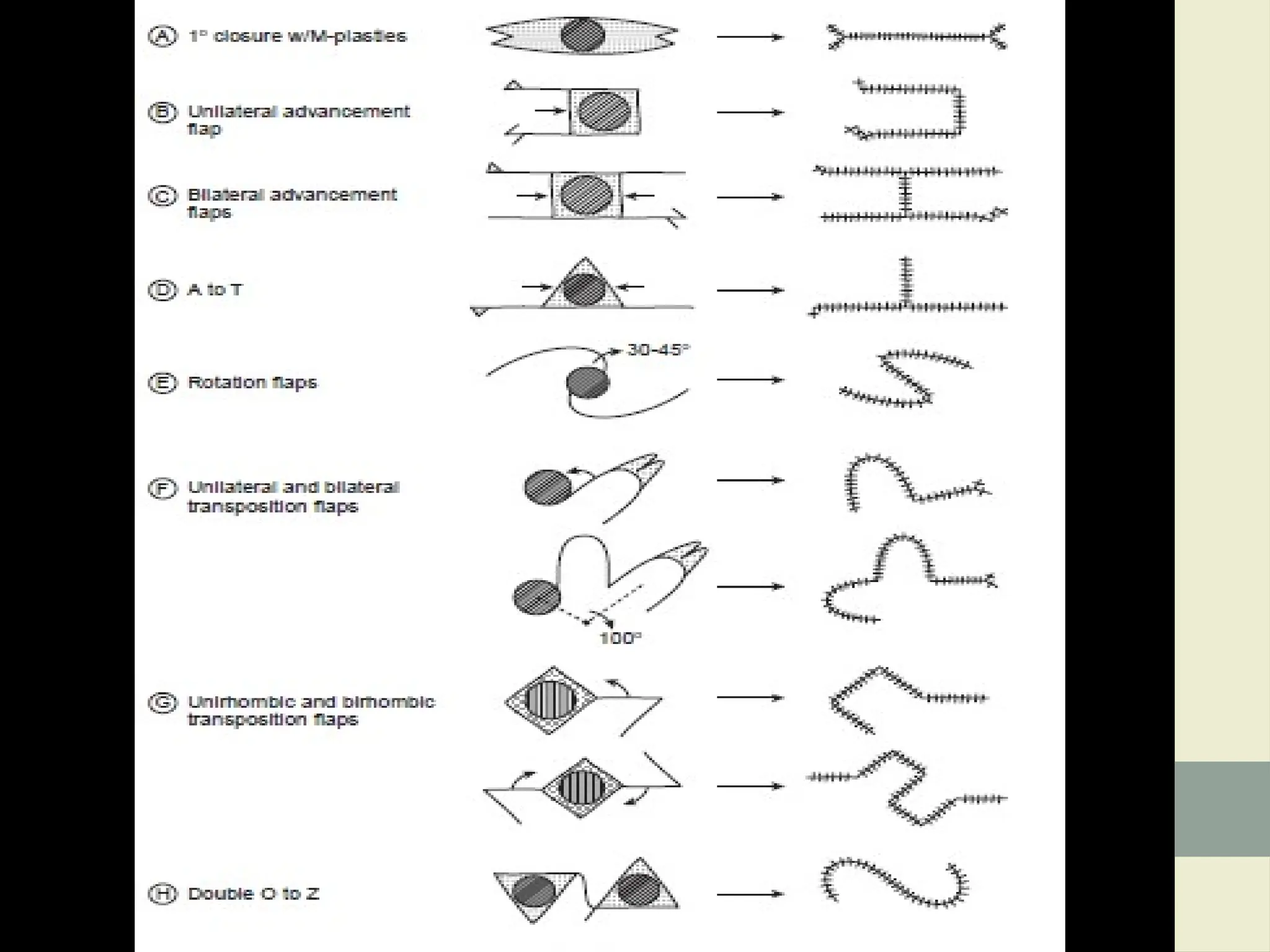
LOCAL FLAPS CLASSIFICATION -
BAKER
• Local random flaps
• Sliding :-
• Advancement
• Rotation combination
• Alphabets ( O>T, A->T)
• Lifting
• Single transposition
• Bilobed transposition
• Rhombic and variations
• Melolabial interpolation
• Local axial pattern flaps
• Sliding
• Reiger
• Island pedicle
• Lifting
• Forehead direct
• Forehead interpolation
LOCATION
• Local flap
• Regional flap
• Distant flap
Distant flap may be either pedicled (transferred
while still attached to their original blood supply)
or “ free “.
METHOD OF TRANSFER
• Advancement flap
• Rotation flap
• Transposition
• Interposition
• Interpolation
• Microvascular tissue transfer
ADVANCEMENT FLAP
• Linear configuration
• Advanced into the defect along a single vector
• Surrounding skin - good tissue laxity
• Resulting incision lines can be hidden in natural creases
• Created by parallel incisions approximately the width of the defect
• Burow’s triangle may be performed at the base of the flap, reducing
the standing cutaneous deformities
• Limited wound tension
• Used in Forehead, lips, and cheek region
ROTATION FLAP
• Curvilinear configuration
• Defects reconstructed should be ~
triangular or modified in to a triangular
defect
• Large base, random or axial in
vascularity
• Increasing the size of the flap in
relation to the defect reduces the
tension of the transfer
• Pivot point lies at the extremity of the
semicircle opposite the defect
• Back-cut is made along the diameter
line of the semicircle
To minimize standing
cutaneous deformity
For symmetric orientation of flap
TRANSPOSITION FLAP
• Rotated and advanced over adjacent skin to close a defect
• Straight linear axis
• Design - One border of the flap is also a border of the defect
• The secondary defect is larger than the primary defect & should
always be covered with skin graft
• Nasal tip and ala, the inferior eyelid, and the lips
VARIOUS CONFIGURATION OF
TRANSPOSTITION FLAPS
• Rectangular
• Parabola
• Triangular
• Note
• 30 degree webster
• Bilobe
• Rhombic
• 60-120 degree limberg
• Dufourmental flap
• Z plasty
• Island
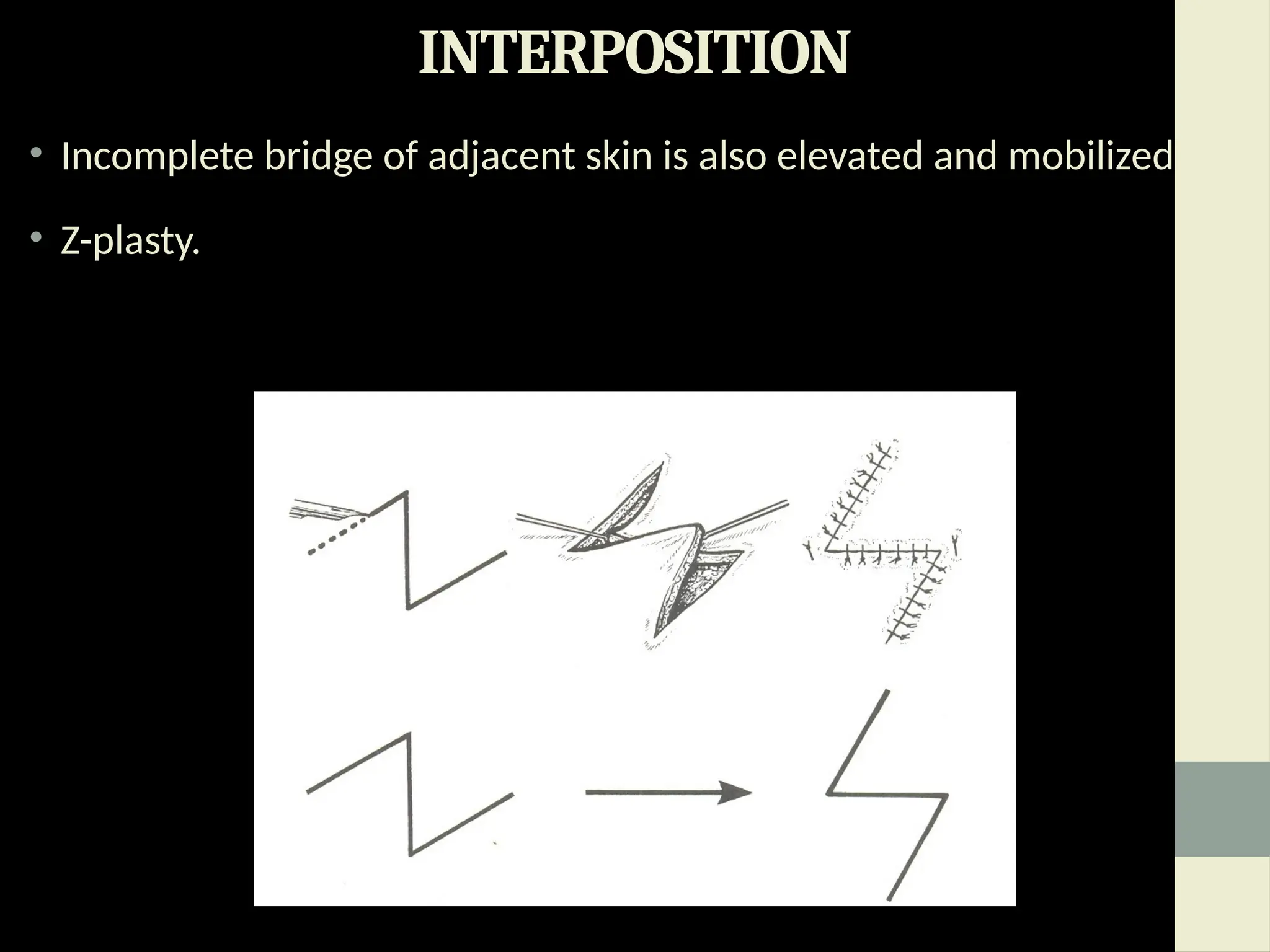
INTERPOSITION
• Incomplete bridge of adjacent skin is also elevated and mobilized
• Z-plasty.
INTERPOLATION
• Contain a pedicle that must pass over or under intact intervening tissue
• Disadvantage - pedicle must be detached during a second surgical procedure
• Single-stage procedure by de-epithelializing the pedicle and passing it under the
intervening skin
Z - PLASTY
• Originally used in releasing contracted scar
• Center limb of the Z is positioned along the line of contracture
Z-PLASTY
• Flap transposition follows naturally from the change in shape
of the parallelogram.
Z-plasty
Single&MultipleZ-plasty
VARIATIONS TOINCREASEBLOODSUPPLY
V-Y PLASTY & Y-V PLASTY
Bilobed flap
• 1918- Esser first described the bilobed
flap
• Consists of 2 lobes separated by an angle
and based on a common pedicle - Zimany
• Bilobed flap is a double transposition flap
• Allows for the movement of more skin
over a longer distance
• Random flap
• Used where skin is less mobile
ESSERTECHNIQUE
• 2 flaps identical in size & form &
separated by angles of 90 degree
• This design resulted in prominent
tissue protrusion at the point of
rotation
• Skin flap transposed over 180
degree
MODIFIED TECHNIQUE
• Lobes are not identical in size
• Larger flap is slightly narrower than
the defect
• Second flap is half the width of the
larger flap
• Length are identical
• Angles b/w lobes < 90
• Second flap elliptical tip
• Each flap transposed over 45 degree
RHOMBOID FLAP (LIMBERG)
In 1946, Limberg first described a technique for closing a
60° rhombus-shaped defect with a transposition flap.
RHOMBOID FLAP
• Length of all sides & short
diagonal are equal
• Distal end of flap
• Side of the flap next to the defect
• Side of the flap farthest from
defect
• Pivot point
• Four potential donor sites
RHOMBOID FLAP
RHOMBOID FLAP
Forehead flap
• Provides largest area of donor site (25cm) with matching
color & texture to facial skin
• One of the safest cutaneous flap
• 85% to 95% success
• Long enough to reach any part of the ipsilateral face
• Provides approximately 90sqcm of tissue
• Different types due to variation in flap pedicle
FOREHEAD FLAP
• Periosteum from frontal bone
should not be lifted
• Coagulation diathermy should be
minimal
• Small defect direct closure
• Marginal step deformity should be
kept to a minimum
FOREHEADFLAP
Outlineofvariousforeheadflapsforintraoraluse
FOREHEAD FLAP
FINGER FOREHEAD FLAP
AXIAL PARAMEDIAN FOREHEAD FLAP
MIDLINE FOREHEAD SKIN FLAP (SEAGULL
FLAP)
FOREHEAD FLAP
Variousformsofforeheadflap
GILLIES- McGREGOR FAN FLAP
• Used for very large central full thickness defects of both upper & lower lips
• Axial flap with small pedicle
• Angle of mouth remains in its original site
• Donor site primary closure
• Secondary procedure - commissuroplasty
BILATERAL FAN FLAP WITH TONGUE
FLAP
LIP-SWITCH (ABBE) FLAP
• Most commonly switched
from the lower to the upper
lip
• Composite flap based on
one inferior/superior labial
vessel
• One-third of lip
• Donor lip is closed directly
& reduced in width
LIP-SWITCH (ABBE) FLAP
MODIFIED LIP-SWITCH (ABBE-ESTLANDER) FLAP
• Defect extending to the angle of the mouth, same method can
still be used, pedicle becoming the new angle
KARAPANDZIC FLAP
JOHNNSEN FLAP
R.A. Ord, A.E. Pazoki / Oral Maxillofacial Surg Clin N Am 15 (2003) 497–511 503
LIP RECONSTRUCTION
McCarn KE, Park SS, Lip reconstruction. Facial Plast Surg Clin N Am 13 (2005) 301 – 314
PALATAL FLAP
• Axial flap based on greater palatine artery
• 180-360° rotation.
• Hard palatal, partial soft palatal, and retromolar defects; OAF.
• Maximum - 10 cmsq. of tissue.
BUCCAL FAT
• Egyedi
• Allowed to heal secondarily & rapid
mucolization takes place within weeks
• A defect of 4 cms can be covered
adequately
• Easy to harvest
• Low rate of complication
• Partial necrosis as been reported in irradiated tissue
• Necrosis can result from inappropriate tension on the flap if it is
transferred to great distance
• Reconstruction of appropriately sized defects of maxilla or cheek
following ablative surgical procedure
• Commonly used to reconstruct posterior maxilla & soft palate
• Donor site complication rare
NASOLABIAL FLAP
•Reconstruction of facial skin defects of the upper lip, nose & cheek following
extirpation of skin cancer & in OSMF
•Inferiorly based /superiorly based
•Unilaterally / bilaterally
•Is a axial flap based on the nasolabial branch of the facial artery
Disadvantages
• Limited donor tissue
• Facial scarring
• Second surgical procedure
• Extremely difficult to use in dentate patient
• Hair growth
Uses
• Major use is in closure of oro-antral fistula & coverage of small defect
of anterior floor of the mouth in edentulous patient
• Oral submucous fibrosis
• When simple reconstruction is advantageous
TONGUE FLAP
• Based anteriorly, dorsally, posteriorly or bipedicled
• A muscular random pattern flap
• Anteriorly based - vermilion or floor of the mouth
• Dorsally based - palatal fistula
• Posteriorly based - tonsillar, retromolar or lateral floor of the mouth
defect
• Bipedicled dorsally based- replacement of vermillion
• Best results are obtained if tongue tip are not violated
TONGUE AS AN AXIAL FLAP
END OF PART I
LOCAL AND REGIONAL
FLAPS – PART 2
MASSETER FLAP
• Lexer and Eden for facial reanimation in
1911.
• Indications:
• Facial reanimation
• Reconstruction of mucosal defects of
posterior oral cavity, Lateral pharyngeal
wall.
• Advantages
• Ease of transfer
• Dependable neurovascular supply
• Ability to depress paralyzed lower lip.
TEMPORALIS MUSCLE FLAP
• Golovine 1898 - orbital
exenteration
• Gilles - reanimation of
paralyzed face
• Fan - shaped muscle arising
from temporal fossa & the
superior temporal line
• Main blood supply - anterior & posterior
deep temporal artery
• Anterior deep temporal artery &
Posterior deep temporal enter the
muscle approximately 1cm anterior &
1.7cm posterior to coronoid process
respectively
• This vascular anatomy allows splitting of
muscle into anterior & posterior flap
HARVESTING
HARVESTING
TEMPORALIS MUSCLE FLAP
ADVANTAGES
• Ease of elevation
• Reliable blood supply
• Proximity
• Camouflage of incision
with in hair line
• Muscle support graft &
alloplast well
DISADVANTAGES
• Sensory disturbances
• Potential facial nerve
injury
• Temporal hallowing
TEMPOROPARIETAL FLAP
• Fascial or Fasciocutaneous flap
• Thin, pliable, abundant & well vascularized
• Superficial temporal artery
• Anterior & posterior division occur about 2cm
above & 2cm anterior to superior attachment of
helix in 80% of cases
• Venous drainage is STV - superficial to artery
TEMPOROPARIETAL FLAP
• Vascularised pedicle is carefully
skeletonized
• ZA can be osteotomised
• Flap is allowed to epithelialised or skin
grafted
• Donor site - alopecia
TEMPOROPARIETAL FLAP
ADVANTAGES
• Rich blood supply
• Thinner
• Lack of hair
• Well camouflaged donor
site
• Ease of elevation
• Vascularised Autogenous
bone graft ( calvarial )
DISADVANTAGES
• Limited rotation
• Lack of skin paddle to
monitor flap
• Numbness of donor site
• Alopecia
CERVICAL FLAP
• Regional flap with random pattern circulation
• Superiorly or Posteriorly - Based
• Vertical or Transverse plane - Orientation
• Anterior Cervical Flap
• Posterior Cervical Flap (Mutter flap)
• 250 sq cm of neck skin
• May or may not contain regional muscles of neck
ADVANTAGES
• Regionality
• Delicate & flexible
• Lack of bulk
• One stage
• Used with other regional flap
• Arc of rotation
• Donor site - minimal
DISADVANTAGES
• In male upper cervical flap is hair bearing
• Neck may be scarred
• No sufficient bulk
• Obviated by other ablative procedure
• Atrophic cervical tissue in elderly patients
• Effect of heavy irradiation in some neck
• It may not be large enough
Since the blood supply of flap is random, width to length ratio should not exceed 1 : 3
POSTERIOR CERVICAL FLAP
• Blood supply - occipital & posterior
auricular
• Random blood supply to distal part of
flap
• Lateral aspect of neck &
retromadibular area
• Esthetic deformity - donor site
• Not preferred choice for intra oral
reconstruction
PLATYSMA FLAP
• Extremely thin band like & variable muscle forming
superficial boundary of neck
• Arises from clavicle superiorly continues with the SMAS &
has some attachment to the mandible
• Submental branch of the facial artery
• Flap size
Muscle - 10 x 10 cm to 10 x 20 cm
skin paddle - 3 x 6 cm to 6 x 20 cm
PLATYSMA FLAP
ADVANTAGES
• Proximity &
Regionality
• Thin & delicate
• Reliable when vascu-
-lar criteria adhered
• Arc of rotation - 180
• No donor site
disability
DISADVANTAGES
• Lack of bulk
• Hair bearing in male
• Reliability 85%
• Complication like skin
loss & fistula
PECTORALIS MAJOR MYOCUTANEOUS FLAP
• Ariyan 1979
• Broad triangular muscle
• Arises from bony portion of 4th
,
5th
& 6th
ribs, cartilaginous portion
of the first six ribs & medial half of
clavicle
• Insertion in to greater tubercle of
humerus
• Thoracoacromial artery, 1st
or 2nd
division of axillary artery
• Superior and lateral thoracic
arteries - additional pedicles
• Overlying skin additionally
supplied by intercostal
perforators
• Action - adduct, flex &
medially rotate the humerus
• 3 subunits each with its own
vascular & motor supply
HARVESTING
HARVESTING
HARVESTING
ADVANTAGES
• One stage
• Generous portion of skin & soft tissue
• Consistent blood supply – highly reliable
• Adequate arc of rotation for facial defects
• Donor site can be closed primarily
• Two skin islands on the same muscle paddle
• Protects the carotid artery
• Technically, the flap is ease to elevate
DISADVANTAGES
• It can be to bulky
• Arc of rotation limited for oromaxillary defects
• There is distortion of symmetry at the donor site
• Shoulder function is impaired
• Distal skin of the flap is not reliable
STERNOCLEDOMASTOID MYOCUTANEOUS
FLAP
• Long strap muscle
• Muscular origin Tendinous origin
• Insertion
• Branch of spinal accessory nerve
• Dominant blood supply – branches of
occipital artery & its draining vein
• Middle third of the muscle
• Inferior third of the muscle
INDICATIONS
• Provision of epithelial lining for mucosal reconstruction
• Closure of orocutaneous fistulas
• Release of scar contracture in submandibular & angle
region
• Provision of additional vascularized tissue around a bone
graft when the tissue bed has been heavily irradiated
• 6 x 8 cm paddle of skin
• Skin paddle should be kept
overlying the muscle above the
level of clavicle
• Skin paddle is tacked down to
the muscle fascia
• Muscle dissected & elevated by
incising the fascia
• Inferior blood supply
• Branches of superior thyroid artery
are noted to enter the anterior
aspect of muscle at the level of
carotid bifurcation
• Spinal accessory nerve enters the
posterior dorsal surface of the
muscle just below the level of the
carotid bifurcation
TRAPEZIUS FLAP
• Flat & triangular and cover the
superoposterior aspect of the neck
& shoulder
• Type 2 Pedicle system - Dominant
pedicle, the transverse cervical
artery
• Functions to rotate the scapula & to
elevate, rotate & adduct upper arm
• 10 x 20 cm in size
ADVANTAGES
• Flap is versatile
• Regionality of flap
• Strong vascular security
• Supplies considerable bulk
• Arc of rotation 90 – 180 degree
• One stage procedure
• Minimum deficit at donor area
DISADVANTAGES
• Venous system difficult to preserve
• Vascular supply in general difficult to preserve
• Can present with excessive bulk
• Cannot be easily tubed
• Moderate shoulder drop postoperatively
DELTOPECTORAL FLAP
• First axial pattern skin flap
• The base of flap is parasternal includes the first three or four
perforating branches of internal mammary artery, second
perforator is largest
• Artery as rich anastomosis, accompanied by Vein
• Width 8 - 12 cm, Length 18 - 22 cm
ADVANTAGES
• High biologic dependability
• Readily accessible
• Arc of rotation 45 - 135
• May be used in male,
female & children
DISADVANTAGES
• Donor site require skin grafting
• Moderate amount of scarring & deformity
is unacceptable in women
• Physiologic disadvantage in malnourished
patient or post operative irradiation
• Flap should not be used if previous scarring
on donor area
• Superior incision is placed just below the
clavicle inferior one run parallel to it
• Flap raised from lateral extent medially
• Incision is carried down through the pectoral
fascia
• Plane of dissection is sub fascial
• Dissection proceeds up to 2 cm of lateral
border of sternum
• Back cut on medial aspect - improve the flap
rotation
• 90% success rate
HARVESTING
LATISSIMUS DORSI MYOCUTANEOUS
FLAP
• Distant flap, provides largest possible skin paddle, involves
the most complex donor site dissection, and arc of rotation
extremely versatile
• Donor site skin paddle measures 40 by 25 cm & still allows
primary closure
• Major pedicle is thoracodorsal artery, a terminal branch of
the subscapular artery
• Perforators enter the muscle medially along the spine –
secondary supply- type 5
• Repositioning of the patient in lateral
or prone position
• Skin paddle sutured to the fascia
• Full extent of the muscle is identified
(midline, laterally, superiorly, caudally)
• Elevation – inferiomedially
• Fully mobilized – passed through the
axillary tunnel
ADVANTAGES
• Size – largest flap in the body
• Flap location
• Arc of rotation - 180
• Large, reliable unicentric neurovascular pedicle
• Donor area
• 90% success rate
• Relatively flat muscle can be used for
reconstruction of tubular structure like
pharynx.
COMPLICATIONS OF LOCO-
REGIONAL FLAPS
• Flap failure
• Necrosis
• Infection
• Scar formation
• Unaesthetic results
• Donor site complications
• Haemorrhage
• Plueral tears
• Temporal hollowing( temporalis flap)
• Inappropriate flap design
• Recurrent malignancy
• Muscle atrophy
CONCLUSION
• Local & regional flaps have been used in the reconstruction
of head and neck defects.
• Due to extensive blood supply in the head and neck, these
flaps are generally safe & predictable.
REFERENCES
• Local Flaps in Facial Reconstruction – 2nd
Edition : Shan Baker
• GRABB’S Encyclopedia Of Flaps -2nd
Edition
• Oral Cancer - Jatin P Shah
• Oral cancer- Stell and Maran
• Atlas of flaps – Urken L
• Maxillofacial Surgery Vol.1 Peter Ward Booth
• Oral And Maxillofacial Surgery Clinics Of North America: August2014
• Oral And Maxillofacial Surgery Clinics Of North America:- September 2006
• Atlas Of Oral And Maxillofacial Surgery Clinics Of North America – November
2003.
LOCAL AND REGIONAL FLAPS IN ORAL SURGERY.pptx

LOCAL AND REGIONAL FLAPS IN ORAL SURGERY.pptx

  • 1.
  • 2.
    CONTENTS • History ofFlaps • Flap Classification • Physiology of Flaps • General Considerations • Local Flaps
  • 3.
    HISTORY OF FLAPS •“Flappe” - Dutch word • Sushruta Samita, ca. 700 B.C. - Indian Flap • Gaspari Tagliacozzi, 1597 - Italian Flap
  • 4.
    Evolution of flapsmay be divided in to 3 periods • 1950- Flaps where confined to skin and subcutaneous fat. • 1950s - late 1960s, new flaps related mainly to H & N reconstruction. McGregor & Jackson described axial pattern skin flaps • 1970s & 1980s. A wider knowledge of blood supply to the skin led to use of musculocutaneous flap
  • 5.
    FLAPS DEFINITION • Alocal flap is defined as movement of adjacent skin and subcutaneous tissue from one location to another with a direct vascular supply – Shan R Baker. • “A sheet (or sheets) of soft tissue partially or totally detached to gain access to structures underneath or to be used in repairing defects in an adjacent or a remote part of the body.”
  • 6.
    GENERAL CONSIDERATION Lines ofRelaxed Skin Tension (RSTL) Lines of Maximum Extensibility (LME)
  • 7.
  • 8.
  • 9.
    PHYSIOLOGY OF FLAPS Donorsite • Interrupts vascular & lymphatic continuity • Stimulates immunologic & reparative procedure • Initiates neural & hormonal compensatory reflexes • Accelerates metabolic requirement of the healing donor bed
  • 10.
    FLAP PHYSIOLOGY • Relativeanoxia • Hypoperfusion • Lymphatic & venous stasis • Gravitational stress • Multiple secondary compensatory & reparative process act within the flap tissue
  • 11.
    RECIPIENT SITE • Size& shape different than that of the flap • Presence of saliva • Different vascular architecture than the donor site Total systemic & local physiological response of the donor site, recipient site & the flap itself ultimately determine whether the flap will survive
  • 12.
    VASCULAR SPASM May resultfrom 1. Sympathetic neural vasoconstriction 2. Vessel wall smooth muscle injury 3. Release of local agents Its is generally agreed that major cause of flap failure is inadequate arterial inflow to the flap. Poor venous out flow may also be a factor
  • 13.
    GOALS OF LOCAL& REGIONAL FLAPS • Suitable color match • Compatible thickness • Retention or recovery of sensory innervations • Protection of carotid artery system • Minimal scaring • Assistance in restoration of physiology • Minimal donor site morbidity
  • 14.
    BASIC PRINCIPLES OFFLAP SURGERY • Plan • Design • Arc of rotation • Transfer • Positioning • Support
  • 15.
    LOCAL FLAPS INHEAD & NECK • Face with free of wrinkles are un suitable for local flaps • Richness of vascularity permits a degree of laxity in design • Below the level of ZA - dermal & subdermal circulation • Above the level of ZA - wealth of vessels with sizeable caliber • Standard plane of elevation • Face - subdermal, superficial to facial muscles • Neck - deep to platysma • Forehead - deep to frontalis • Scalp - deep to galea
  • 16.
    FLAPS CLASSIFICATION • Basedon :- • Blood supply • Location • Configuration • Tissue content • Method of transfer
  • 17.
    BLOOD SUPPLY Proposed byMcGregor (First classification) • Random flap • Axial flap Blood supply is usually the limiting factor in flap success
  • 19.
    RANDOM FLAP • Bloodsupply is not derived from recognized artery • Unnamed vessels • Limited in size • Facial random pattern flaps (local flaps) unique in having rich dermal-subdermal vascular plexus • This permits flaps of long length to width ratio • Excellent viability & used with out delay
  • 20.
    LOCAL FLAPS (RANDOMPATTERN FLAPS)
  • 21.
    AXIAL FLAP • Mostregional flap of H & N • Incorporate anatomically distinct arteriovenous system running along the axis of the tissue to be transferred • Flaps are of high length to breath ratios • Single type of tissue or multiple type of tissue
  • 22.
  • 23.
  • 24.
  • 25.
    CLASSIFICATIONOFVASCULARANATOMYOFMUSCLE Mathes & S.J. F. Nahai *Type I - 1 vascular pedicle. *Type II - Dominant pedicle(s) and minor pedicle(s). *Type III - 2 dominant pedicles. * Type IV - Segmental vascular pedicles. * Type V - 1 dominant pedicle and secondary segmental pedicles.
  • 26.
  • 27.
    LOCAL FLAPS CLASSIFICATION- BAKER • Local random flaps • Sliding :- • Advancement • Rotation combination • Alphabets ( O>T, A->T) • Lifting • Single transposition • Bilobed transposition • Rhombic and variations • Melolabial interpolation • Local axial pattern flaps • Sliding • Reiger • Island pedicle • Lifting • Forehead direct • Forehead interpolation
  • 28.
    LOCATION • Local flap •Regional flap • Distant flap Distant flap may be either pedicled (transferred while still attached to their original blood supply) or “ free “.
  • 29.
    METHOD OF TRANSFER •Advancement flap • Rotation flap • Transposition • Interposition • Interpolation • Microvascular tissue transfer
  • 30.
    ADVANCEMENT FLAP • Linearconfiguration • Advanced into the defect along a single vector • Surrounding skin - good tissue laxity • Resulting incision lines can be hidden in natural creases • Created by parallel incisions approximately the width of the defect • Burow’s triangle may be performed at the base of the flap, reducing the standing cutaneous deformities • Limited wound tension • Used in Forehead, lips, and cheek region
  • 31.
    ROTATION FLAP • Curvilinearconfiguration • Defects reconstructed should be ~ triangular or modified in to a triangular defect • Large base, random or axial in vascularity • Increasing the size of the flap in relation to the defect reduces the tension of the transfer • Pivot point lies at the extremity of the semicircle opposite the defect • Back-cut is made along the diameter line of the semicircle
  • 32.
    To minimize standing cutaneousdeformity For symmetric orientation of flap
  • 34.
    TRANSPOSITION FLAP • Rotatedand advanced over adjacent skin to close a defect • Straight linear axis • Design - One border of the flap is also a border of the defect • The secondary defect is larger than the primary defect & should always be covered with skin graft • Nasal tip and ala, the inferior eyelid, and the lips
  • 35.
    VARIOUS CONFIGURATION OF TRANSPOSTITIONFLAPS • Rectangular • Parabola • Triangular • Note • 30 degree webster • Bilobe • Rhombic • 60-120 degree limberg • Dufourmental flap • Z plasty • Island
  • 36.
    INTERPOSITION • Incomplete bridgeof adjacent skin is also elevated and mobilized • Z-plasty.
  • 37.
    INTERPOLATION • Contain apedicle that must pass over or under intact intervening tissue • Disadvantage - pedicle must be detached during a second surgical procedure • Single-stage procedure by de-epithelializing the pedicle and passing it under the intervening skin
  • 39.
    Z - PLASTY •Originally used in releasing contracted scar • Center limb of the Z is positioned along the line of contracture
  • 40.
    Z-PLASTY • Flap transpositionfollows naturally from the change in shape of the parallelogram.
  • 41.
  • 42.
  • 45.
    V-Y PLASTY &Y-V PLASTY
  • 46.
    Bilobed flap • 1918-Esser first described the bilobed flap • Consists of 2 lobes separated by an angle and based on a common pedicle - Zimany • Bilobed flap is a double transposition flap • Allows for the movement of more skin over a longer distance • Random flap • Used where skin is less mobile
  • 47.
    ESSERTECHNIQUE • 2 flapsidentical in size & form & separated by angles of 90 degree • This design resulted in prominent tissue protrusion at the point of rotation • Skin flap transposed over 180 degree
  • 48.
    MODIFIED TECHNIQUE • Lobesare not identical in size • Larger flap is slightly narrower than the defect • Second flap is half the width of the larger flap • Length are identical • Angles b/w lobes < 90 • Second flap elliptical tip • Each flap transposed over 45 degree
  • 49.
    RHOMBOID FLAP (LIMBERG) In1946, Limberg first described a technique for closing a 60° rhombus-shaped defect with a transposition flap.
  • 50.
    RHOMBOID FLAP • Lengthof all sides & short diagonal are equal • Distal end of flap • Side of the flap next to the defect • Side of the flap farthest from defect • Pivot point • Four potential donor sites
  • 51.
  • 52.
  • 53.
    Forehead flap • Provideslargest area of donor site (25cm) with matching color & texture to facial skin • One of the safest cutaneous flap • 85% to 95% success • Long enough to reach any part of the ipsilateral face • Provides approximately 90sqcm of tissue • Different types due to variation in flap pedicle
  • 54.
    FOREHEAD FLAP • Periosteumfrom frontal bone should not be lifted • Coagulation diathermy should be minimal • Small defect direct closure • Marginal step deformity should be kept to a minimum
  • 55.
  • 56.
  • 57.
  • 58.
  • 59.
    MIDLINE FOREHEAD SKINFLAP (SEAGULL FLAP)
  • 60.
  • 61.
    GILLIES- McGREGOR FANFLAP • Used for very large central full thickness defects of both upper & lower lips • Axial flap with small pedicle • Angle of mouth remains in its original site • Donor site primary closure • Secondary procedure - commissuroplasty
  • 63.
    BILATERAL FAN FLAPWITH TONGUE FLAP
  • 64.
    LIP-SWITCH (ABBE) FLAP •Most commonly switched from the lower to the upper lip • Composite flap based on one inferior/superior labial vessel • One-third of lip • Donor lip is closed directly & reduced in width
  • 65.
  • 66.
    MODIFIED LIP-SWITCH (ABBE-ESTLANDER)FLAP • Defect extending to the angle of the mouth, same method can still be used, pedicle becoming the new angle
  • 67.
  • 68.
    JOHNNSEN FLAP R.A. Ord,A.E. Pazoki / Oral Maxillofacial Surg Clin N Am 15 (2003) 497–511 503
  • 69.
    LIP RECONSTRUCTION McCarn KE,Park SS, Lip reconstruction. Facial Plast Surg Clin N Am 13 (2005) 301 – 314
  • 70.
    PALATAL FLAP • Axialflap based on greater palatine artery • 180-360° rotation. • Hard palatal, partial soft palatal, and retromolar defects; OAF. • Maximum - 10 cmsq. of tissue.
  • 71.
    BUCCAL FAT • Egyedi •Allowed to heal secondarily & rapid mucolization takes place within weeks • A defect of 4 cms can be covered adequately
  • 72.
    • Easy toharvest • Low rate of complication • Partial necrosis as been reported in irradiated tissue • Necrosis can result from inappropriate tension on the flap if it is transferred to great distance • Reconstruction of appropriately sized defects of maxilla or cheek following ablative surgical procedure • Commonly used to reconstruct posterior maxilla & soft palate • Donor site complication rare
  • 74.
    NASOLABIAL FLAP •Reconstruction offacial skin defects of the upper lip, nose & cheek following extirpation of skin cancer & in OSMF •Inferiorly based /superiorly based •Unilaterally / bilaterally •Is a axial flap based on the nasolabial branch of the facial artery
  • 75.
    Disadvantages • Limited donortissue • Facial scarring • Second surgical procedure • Extremely difficult to use in dentate patient • Hair growth Uses • Major use is in closure of oro-antral fistula & coverage of small defect of anterior floor of the mouth in edentulous patient • Oral submucous fibrosis • When simple reconstruction is advantageous
  • 76.
    TONGUE FLAP • Basedanteriorly, dorsally, posteriorly or bipedicled • A muscular random pattern flap • Anteriorly based - vermilion or floor of the mouth • Dorsally based - palatal fistula • Posteriorly based - tonsillar, retromolar or lateral floor of the mouth defect • Bipedicled dorsally based- replacement of vermillion • Best results are obtained if tongue tip are not violated
  • 79.
    TONGUE AS ANAXIAL FLAP
  • 80.
  • 81.
  • 82.
    MASSETER FLAP • Lexerand Eden for facial reanimation in 1911. • Indications: • Facial reanimation • Reconstruction of mucosal defects of posterior oral cavity, Lateral pharyngeal wall. • Advantages • Ease of transfer • Dependable neurovascular supply • Ability to depress paralyzed lower lip.
  • 84.
    TEMPORALIS MUSCLE FLAP •Golovine 1898 - orbital exenteration • Gilles - reanimation of paralyzed face • Fan - shaped muscle arising from temporal fossa & the superior temporal line
  • 85.
    • Main bloodsupply - anterior & posterior deep temporal artery • Anterior deep temporal artery & Posterior deep temporal enter the muscle approximately 1cm anterior & 1.7cm posterior to coronoid process respectively • This vascular anatomy allows splitting of muscle into anterior & posterior flap
  • 86.
  • 88.
  • 91.
    TEMPORALIS MUSCLE FLAP ADVANTAGES •Ease of elevation • Reliable blood supply • Proximity • Camouflage of incision with in hair line • Muscle support graft & alloplast well DISADVANTAGES • Sensory disturbances • Potential facial nerve injury • Temporal hallowing
  • 92.
    TEMPOROPARIETAL FLAP • Fascialor Fasciocutaneous flap • Thin, pliable, abundant & well vascularized • Superficial temporal artery • Anterior & posterior division occur about 2cm above & 2cm anterior to superior attachment of helix in 80% of cases • Venous drainage is STV - superficial to artery
  • 93.
    TEMPOROPARIETAL FLAP • Vascularisedpedicle is carefully skeletonized • ZA can be osteotomised • Flap is allowed to epithelialised or skin grafted • Donor site - alopecia
  • 94.
    TEMPOROPARIETAL FLAP ADVANTAGES • Richblood supply • Thinner • Lack of hair • Well camouflaged donor site • Ease of elevation • Vascularised Autogenous bone graft ( calvarial ) DISADVANTAGES • Limited rotation • Lack of skin paddle to monitor flap • Numbness of donor site • Alopecia
  • 95.
    CERVICAL FLAP • Regionalflap with random pattern circulation • Superiorly or Posteriorly - Based • Vertical or Transverse plane - Orientation • Anterior Cervical Flap • Posterior Cervical Flap (Mutter flap) • 250 sq cm of neck skin • May or may not contain regional muscles of neck
  • 96.
    ADVANTAGES • Regionality • Delicate& flexible • Lack of bulk • One stage • Used with other regional flap • Arc of rotation • Donor site - minimal DISADVANTAGES • In male upper cervical flap is hair bearing • Neck may be scarred • No sufficient bulk • Obviated by other ablative procedure • Atrophic cervical tissue in elderly patients • Effect of heavy irradiation in some neck • It may not be large enough Since the blood supply of flap is random, width to length ratio should not exceed 1 : 3
  • 97.
    POSTERIOR CERVICAL FLAP •Blood supply - occipital & posterior auricular • Random blood supply to distal part of flap • Lateral aspect of neck & retromadibular area • Esthetic deformity - donor site • Not preferred choice for intra oral reconstruction
  • 98.
    PLATYSMA FLAP • Extremelythin band like & variable muscle forming superficial boundary of neck • Arises from clavicle superiorly continues with the SMAS & has some attachment to the mandible • Submental branch of the facial artery • Flap size Muscle - 10 x 10 cm to 10 x 20 cm skin paddle - 3 x 6 cm to 6 x 20 cm
  • 99.
    PLATYSMA FLAP ADVANTAGES • Proximity& Regionality • Thin & delicate • Reliable when vascu- -lar criteria adhered • Arc of rotation - 180 • No donor site disability DISADVANTAGES • Lack of bulk • Hair bearing in male • Reliability 85% • Complication like skin loss & fistula
  • 100.
    PECTORALIS MAJOR MYOCUTANEOUSFLAP • Ariyan 1979 • Broad triangular muscle • Arises from bony portion of 4th , 5th & 6th ribs, cartilaginous portion of the first six ribs & medial half of clavicle • Insertion in to greater tubercle of humerus • Thoracoacromial artery, 1st or 2nd division of axillary artery
  • 101.
    • Superior andlateral thoracic arteries - additional pedicles • Overlying skin additionally supplied by intercostal perforators • Action - adduct, flex & medially rotate the humerus • 3 subunits each with its own vascular & motor supply
  • 102.
  • 104.
  • 105.
  • 107.
    ADVANTAGES • One stage •Generous portion of skin & soft tissue • Consistent blood supply – highly reliable • Adequate arc of rotation for facial defects • Donor site can be closed primarily • Two skin islands on the same muscle paddle • Protects the carotid artery • Technically, the flap is ease to elevate
  • 108.
    DISADVANTAGES • It canbe to bulky • Arc of rotation limited for oromaxillary defects • There is distortion of symmetry at the donor site • Shoulder function is impaired • Distal skin of the flap is not reliable
  • 109.
    STERNOCLEDOMASTOID MYOCUTANEOUS FLAP • Longstrap muscle • Muscular origin Tendinous origin • Insertion • Branch of spinal accessory nerve • Dominant blood supply – branches of occipital artery & its draining vein • Middle third of the muscle • Inferior third of the muscle
  • 110.
    INDICATIONS • Provision ofepithelial lining for mucosal reconstruction • Closure of orocutaneous fistulas • Release of scar contracture in submandibular & angle region • Provision of additional vascularized tissue around a bone graft when the tissue bed has been heavily irradiated
  • 111.
    • 6 x8 cm paddle of skin • Skin paddle should be kept overlying the muscle above the level of clavicle • Skin paddle is tacked down to the muscle fascia • Muscle dissected & elevated by incising the fascia
  • 112.
    • Inferior bloodsupply • Branches of superior thyroid artery are noted to enter the anterior aspect of muscle at the level of carotid bifurcation • Spinal accessory nerve enters the posterior dorsal surface of the muscle just below the level of the carotid bifurcation
  • 113.
    TRAPEZIUS FLAP • Flat& triangular and cover the superoposterior aspect of the neck & shoulder • Type 2 Pedicle system - Dominant pedicle, the transverse cervical artery • Functions to rotate the scapula & to elevate, rotate & adduct upper arm • 10 x 20 cm in size
  • 115.
    ADVANTAGES • Flap isversatile • Regionality of flap • Strong vascular security • Supplies considerable bulk • Arc of rotation 90 – 180 degree • One stage procedure • Minimum deficit at donor area
  • 116.
    DISADVANTAGES • Venous systemdifficult to preserve • Vascular supply in general difficult to preserve • Can present with excessive bulk • Cannot be easily tubed • Moderate shoulder drop postoperatively
  • 117.
    DELTOPECTORAL FLAP • Firstaxial pattern skin flap • The base of flap is parasternal includes the first three or four perforating branches of internal mammary artery, second perforator is largest • Artery as rich anastomosis, accompanied by Vein • Width 8 - 12 cm, Length 18 - 22 cm
  • 118.
    ADVANTAGES • High biologicdependability • Readily accessible • Arc of rotation 45 - 135 • May be used in male, female & children
  • 119.
    DISADVANTAGES • Donor siterequire skin grafting • Moderate amount of scarring & deformity is unacceptable in women • Physiologic disadvantage in malnourished patient or post operative irradiation • Flap should not be used if previous scarring on donor area
  • 120.
    • Superior incisionis placed just below the clavicle inferior one run parallel to it • Flap raised from lateral extent medially • Incision is carried down through the pectoral fascia • Plane of dissection is sub fascial • Dissection proceeds up to 2 cm of lateral border of sternum • Back cut on medial aspect - improve the flap rotation • 90% success rate HARVESTING
  • 121.
    LATISSIMUS DORSI MYOCUTANEOUS FLAP •Distant flap, provides largest possible skin paddle, involves the most complex donor site dissection, and arc of rotation extremely versatile • Donor site skin paddle measures 40 by 25 cm & still allows primary closure • Major pedicle is thoracodorsal artery, a terminal branch of the subscapular artery • Perforators enter the muscle medially along the spine – secondary supply- type 5
  • 122.
    • Repositioning ofthe patient in lateral or prone position • Skin paddle sutured to the fascia • Full extent of the muscle is identified (midline, laterally, superiorly, caudally) • Elevation – inferiomedially • Fully mobilized – passed through the axillary tunnel
  • 123.
    ADVANTAGES • Size –largest flap in the body • Flap location • Arc of rotation - 180 • Large, reliable unicentric neurovascular pedicle • Donor area • 90% success rate • Relatively flat muscle can be used for reconstruction of tubular structure like pharynx.
  • 124.
    COMPLICATIONS OF LOCO- REGIONALFLAPS • Flap failure • Necrosis • Infection • Scar formation • Unaesthetic results • Donor site complications • Haemorrhage • Plueral tears • Temporal hollowing( temporalis flap) • Inappropriate flap design • Recurrent malignancy • Muscle atrophy
  • 125.
    CONCLUSION • Local &regional flaps have been used in the reconstruction of head and neck defects. • Due to extensive blood supply in the head and neck, these flaps are generally safe & predictable.
  • 126.
    REFERENCES • Local Flapsin Facial Reconstruction – 2nd Edition : Shan Baker • GRABB’S Encyclopedia Of Flaps -2nd Edition • Oral Cancer - Jatin P Shah • Oral cancer- Stell and Maran • Atlas of flaps – Urken L • Maxillofacial Surgery Vol.1 Peter Ward Booth • Oral And Maxillofacial Surgery Clinics Of North America: August2014 • Oral And Maxillofacial Surgery Clinics Of North America:- September 2006 • Atlas Of Oral And Maxillofacial Surgery Clinics Of North America – November 2003.

Editor's Notes

  • #6 RSTL – formed by the direction of collagen fibres, more prominent with aging and wrinkling. RSTLs are parallel to LME. Orientation of incision and wound closure is done mostly parallel to RSTL. Such that the maximum tension on the wound will be paralle to the LME. Therefore least tension.
  • #7 Face is divided into many esthetic region such as forehead, nasal etc. these regions are further divided into units know as the esthetic units. Reconstruction of a local defect is best done when limited within the esthetic unit.
  • #8 There are two types of blood supply to the skin septocutaneous and myocutaneous. Myocutaneous bran arises from the major supply and progressively continues to supply the muscle fascia, subcutaneous tissue and skin. Whereas the septocutaneous brach traverses along the fascial planes, giving off separate branches to muscle and fascia and then dividing into its terminal supply to skin.
  • #10 Once a flap is raised there are many factors or events that take place within the flap. Once the flap is separated from the host site blood vessel, there appears a state of relative anoxia, hypoperfusion, lymphatic and venous stasis, increased gravitation stress, multiple secondaty compensatory and reparative process within the tissue, including biochemical changes.
  • #11 Factors to consider in regards to the recipient site includes the different size and shape of the defect, presence of saliva( large number of micro-organisms), The recipient vessel is of different architecture when compared to the donor blood vessel.
  • #17 This system recognized the importance of the presence or absence of a major vessel running axially to the axis of the flap
  • #18 Random pattern flap is not based on a major vessel, whereas the axial pattern flap depends on a major vessel for its viability. Free flap are those that are harvested along with a vascular pedicle which are later anastamosed with the recipient vessels at host site.
  • #20 Most common random pattern flap harvested from the facial region are depicted in the image.
  • #22 Direct cutaneous system has a vessel supplying separately only to skin and the subcutaneous tissue. The vascular pedicle of muscle has no connection with overlying direct cutaneous system.
  • #23 In musculocutaneous system , the branch of the vascular pedicle supplying the muscle known as the perforator supplies the subcutaneous and skin of the island flap.
  • #24 In fasciocutaneous system, the vessel that runs through the fascia, divides into many perforator branches which then go on to supply the muslce and the skin island.
  • #26 Based on geometric configuration, Z flap, trapezoidal flap, bilobed flap.
  • #32 To minimize the standing cutaneous defect the width:height of the defect must be in the ratio of 1:2 For symmetric orientation the length of the defect must be 0.5 times the radius of the flap.
  • #33 An example of rotation flap from the temple region used to reconstruct the defect in the supraorbital region
  • #40 Incision over the scar tissue done to release the contracture in subcutaneous plane.
  • #41 When a single z plasty is used, the lengthening and shortening in two planes will be almost equal with concentrated lateral tension whereas when multiple z plasties are used then the lengthening is more, but shortening is less due to diffused lateral tension.
  • #42 Different variations of z plasty includes those with curved arms, angulation between arms to be between 30-90 degrees for better results due to comparative increase in blood supply.
  • #45 V shaped defect sutured into Y form and vice versa
  • #49 One arm of the rhombus is same as that of the defect.
  • #51 There are 4 different possibilities for reconstruction of the defect within the RSTL distribution
  • #52 Example of rhomboid flap used for reconstruction of defect present on the temple region
  • #55 Variations in the shape design of the forehead flap
  • #56 Example of forehead flap used to reconstruct the defect in cheek by subcutaneous tunneling
  • #57 Pedicled Finger forehead flap used to reconstruct defect of nasal tip. Pedicle is severed at a later stage.
  • #58 Nasal tip and dorsum defect. The excised defect is used a template to harvest a flap from the forehead region. Following harvest of the flap, the pedicled flap is rotated and used to reconstruct the defect.
  • #59 Seagul forehead flap used to reconstruct the nasal dorsum and tip defect, disadvantages visible obvious scarring
  • #60 Various forms of pedicled forehead flap
  • #62 Single or Double totally denervated, but sensation returns gradually with motor activity, but more slowly
  • #63 Used to reconstruct the lower lip and alveolus. Shaded areas- defect. Fan flap includes the corner of the mouth, rotated and suture. Disadvanges. Scarring, microsmia.
  • #65 The cross-lip flap is designed from the opposite lip, based on the labial artery, and is one half the width of the primary defect (Fig. 8). In this way, the two lips will be of equal width once complete. One should take into account the pull of the orbicularis oris on the wound edges when estimating the size of the defect. The vascular supply is through the contralateral artery. An Abbe flap within the left lower lip is based on the right labial artery. A full-thickness incision is made to create the flap, with preservation of the labial artery within the vermilion. The flap is rotated 180 degrees and sutured in multiple layers, with attention to the muscular layer and the vermilion border. The wound is dressed to minimize tension on the flap, and the patient is placed on a soft or liquid diet to minimize the possibility of damage to the pedicle. The pedicle is divided at 14 to 21 days and inset.
  • #66 Disadvantage, microsmia, scarring
  • #67 Rotational advancement flap midlip defect Karapandzic [9] described a modification of the Gillies fan flap in 1974. The full-thickness cuts of the Gillies flap are eliminated in favor of partial-thickness incisions that preserve the radial neurovascular pedicle (Fig. 9). Muscle fibers are mobilized by blunt dissection, and neurovascular structures are identified and preserved. The primary advantage of the Karapandzic flap over the Gillies fan flap is the preservation of neurovascular pedicles and a functional lip. Microstomia and rounding of the commissures are problems associated with this method.
  • #68 Fig. 8. (A) In Johansson flaps, the resection is marked out and the horizontal length divided into A and B. Line ‘‘a’’ is equal in length to ‘‘A’’ and line ‘‘b’’ to ‘‘B.’’ The other steps are 1-cm long and 8-mm deep. (B) Areas of skin to be resected are marked out. (C) Flaps are raised through skin only after full-thickness cancer resection. (D) Sutured flaps. R.A. Ord, A.E. Pazoki / Oral Maxillofacial Surg Clin N Am 15 (2003) 497–511 503
  • #70 The connection between the two greater palatine arteries across the midline has been termed the macronet and allows the entire flap to be based on a single greater palatine arterial supply.
  • #71 Technique Horizontal vestibular incision or directly from the margin of surgical resection Mobilized by blunt dissection & delivered passively The fat pad is typically encased with a thin fascial envelop which aids in this dissection Fat is sutured in position with absorbable suture
  • #73 Maxillectomy defect with buccal fat pad exposed after resection of tumor. Blunt dissection of the buccal fat pad to allow mobilization into the surgical defect. Buccal fat pad completely mobilized and secured to maxillary defect in a tension-free manner.
  • #76 3-10 mm
  • #77 Finger shaped flap lateral surface of tongue from the circumvallate papilla to 1-2 cms behind the tongue tip Silk traction suture  provide traction Flap raised  blunt & sharp dissection Multiple small bleeders encountered Widthincreased by longitudinally scoring the musclescalpel blade allowing it to “unroll” The site is closed in two layers & shortening of tongue is avoided by closing it on itself Main disadvantage limited arc of rotation & small size
  • #78 Tongue flap used to reconstruct defect of buccal mucosa, Incision placed on lateral surface of the tongue, submucosal dissection carried out superiorly and inferiorly, and sutured to upper and lower vestibule respectively. Once separated (at a later stage) from the tongue free ends are sutured.
  • #79 Defect on the lateral border of the tongue reconstructed with axial patter tongue flap. Once the defect is excised full thickness flap is designed by placing midline incision till the base of the tongue along with dissection done to separate hyoglossus attachement, the flap is based on dorsal lingual artery. The flap is mobilised and sutured to the anterior aspect of the defect.
  • #83 Masseter muscle separated from its attachement and sutured to corner of the lip. Can ve used for facial reanimation. Dissection should be carefully done so as to preserve the massetric artery supply…
  • #84 The muscle is bipennate, with an additional superficial origin from the temporalis fascia
  • #85 Mobilized flap consists of fascia, muscle, & pericranium Two distinct fascial layers, the superficial & deep temporal fascia Superficial temporal fascia is a thin, highly vascular layer of moderately dense Connective tissue The absence of vascularity between this two layers
  • #88 Hemicoronal flap provides excellent access Incision ends above the superior temporal line Dissections proceeds down to the deep temporal fascia until the entire muscle is exposed Dissection in this plane protects the temporal branch of facial nerve Reflection of muscle of temporal bone should be performed in a strict subperiosteal plane Rotation can be improved by dividing ZA & base of the coronoid If the muscle is split in coronal plane posterior portion of muscle is transposed anteriorly Donor site - secondarily reconstructed by alloplastic implants Alopecia avoided by careful placement of coronal incision parallel to hair shaft Bradley & Brock hank - flap does not require skin grafting & rapid mucolization occur
  • #91 INDICATION SREAD FROM XEROX
  • #93 Temporal Br. - 7th nerve Auriculotemporal nerve
  • #102 Ariyan’s technique - “strip technique” A improved technique for development of the PMMC flap (JOMS 48 - 1990 by Marx & Smith) Entire muscle from chest wall Based primarily on thoracoacromial artery & secondarily on the lateral & superior thoracic artery Cadaver studies of vascular anatomy of the PMM demonstrated lateral thoracic artery was larger than pectoral branch of the thoracoacromial artery in 25% of cases Remaining 75% of cases artery were about equal size Draw back of strip technique Total complication rate of 58% - review by Huang et al of 45 cases, 7 total loss & 16 partial loss Major axial branches of the pedicle are likely to be transected in developing only strip of muscle Contribution from lateral & superior thoracic artery is lost
  • #113 Mutter 1842 Originally Superior based cutaneous flap TCA, passes from the anterior neck to the posterior neck to enter the muscle At the border of the muscle the vessel divides into:- Ascending branch – muscle that overlies the spine of the scapula & acromion Descending branch passes beneath the muscle at the base of the neck & supplies the most of the muscle located on the back Also supplied by deep perforating vessels from intercostal system
  • #114 Lateral neck & lower face Raised in lateral decubitus position Base should be wide to incorporate paraspinal perforator Donor site - skin graft at distal aspect Two stage Myocutaneous flap overlying acromio-clavicular region Require integrity of TCA Limited in its surface extent & arc of rotation Limited to small defects in oral cavity Dissection is carried deep to anterior border Donor site closed primarily Lateral positioning of patient to elevate flap Ideally suited for radical parotidectomy Generous amount of soft tissue & large portion of skin island 90 – 95 % of success
  • #117 It extend laterally over the upper chest at the level of clavicle on to the deltoid muscle & shoulder Reverse of deltopectoral flap - Thoracoacromial flap
  • #118 Hairless skin
  • #121 Origin from T7 to T12, from the lumbar & sacral vertebrae, from posterior crest of the ilium & also minor origination from the last four ribs Insertion - intertubercular groove of the humerus Extend, adduct, & medially rotate the arm