Asok kumar RS OMFS
 “When a part of one's person is lost, it should be replaced in kind, bone for bone, muscle for
muscle, hairless skin for hairless skin, an eye for an eye, a tooth for a tooth”. (Ralph
Millard)
 Definition : A flap is a unit of tissue that is transferred from donor site to recipient site while
maintaining its own blood supply.
 The Term Flap , originated from Dutch word “FLAPPE” which means “anything that hung
broad and loose, fastened only by one side”.
 Flaps are usually used to repair structural defects following surgery for malignant conditions
of head and neck.
Asok kumar RS OMFS
 600 B.C : Susrutha performed nasal reconstruction using cheek flap
 1440 A.D: Forehead rhinoplasty (India).
 Pivotal flaps was preferred during early days. This involves rotation of the flap around its
vascular pedicle.
 Advancement flap (French surgeons). This involves transfer of skin from adjacent area
without rotation.
 Gaspar Tagliocozzi (1597), Italy: Experimented with the fabrication of noses from the
tissues of the upper arm.
 Tansini (1896), described the concept of muscle and skin flap.
Asok kumar RS OMFS
 Harold Gillies - Tube flaps in 1950s
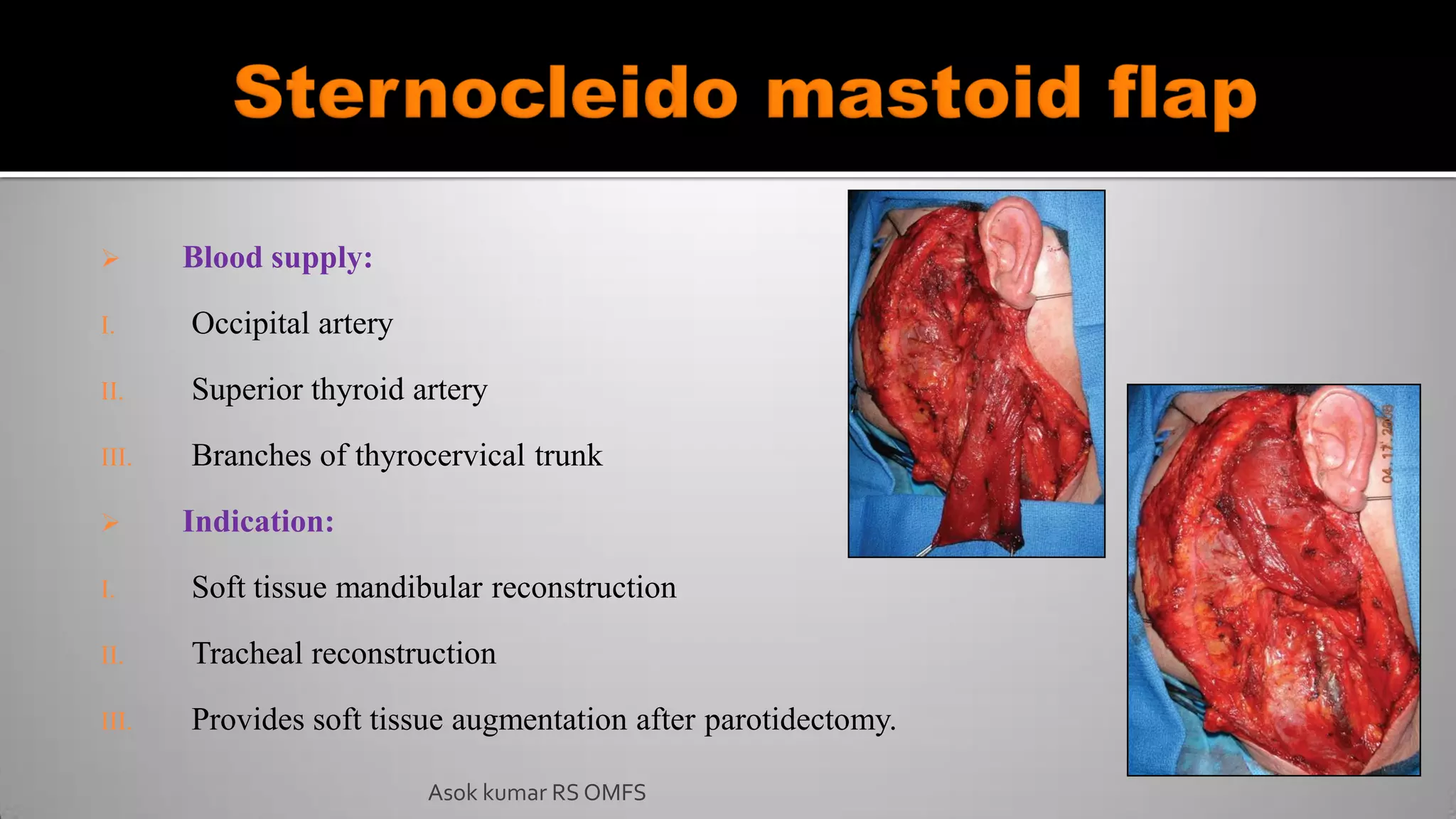
 Owens (1952): Stenocledomastoid flap.
 Conley (1960): Regional flaps.
 McGregor - Introduced the Forehead flap in 1963
 Bakamjian - Introduced the Deltopectoral flap in 1965
 Daniel & Taylor - Pioneered the Free flap in 1973
 Ariyan - Pioneered the Pectoralis major myocutaneous flap in 1979
Asok kumar RS OMFS
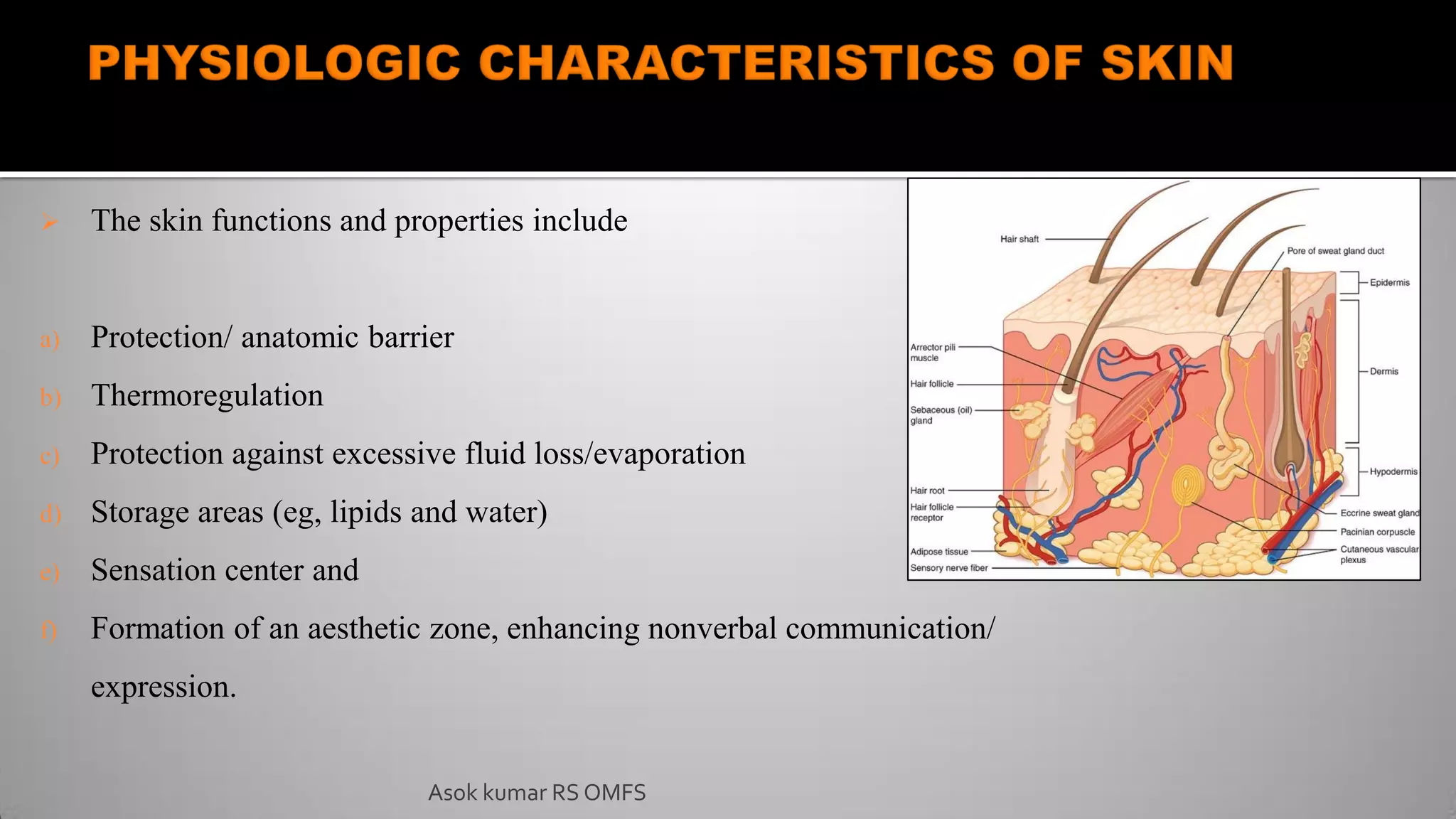
 The skin functions and properties include
a) Protection/ anatomic barrier
b) Thermoregulation
c) Protection against excessive fluid loss/evaporation
d) Storage areas (eg, lipids and water)
e) Sensation center and
f) Formation of an aesthetic zone, enhancing nonverbal communication/
expression.
Asok kumar RS OMFS
 Nature of the wound determines the approach for closure.
 Risk Factors: Location, Size,Adjacent structures, Etiology
(eg, trauma, malignancy, or cosmetic defect) and Medical
comorbidities
 The goal of proper flap design is to closely restore the skin’s
functions and properties
 Understanding of proper wound closure, wound healing,
relaxed skin tension lines, and the facial esthetic zones is
essential in this task
Asok kumar RS OMFS
 Primary defect: Wound to be closed by local cutaneous flaps.
 Secondary defect: Wound created when skin flap is transferred to repair primary defect
 Wound closure tension: Amount of stress per unit along the suture line of a repaired
wound.
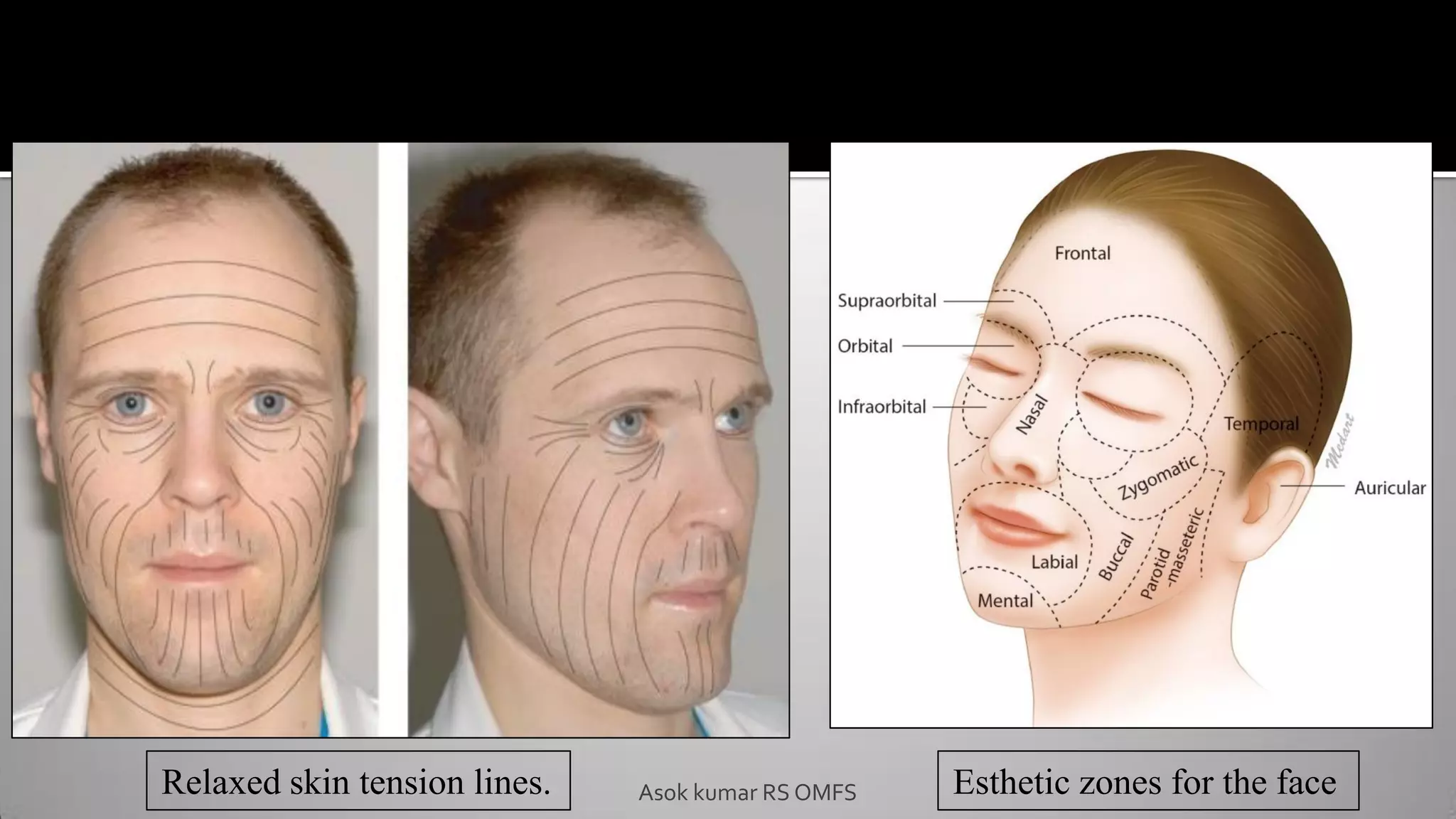
 RSTL (Relaxed skin tension line)- Orientation of collagen fibres to skin and
manifested as a creases and wrinkles.
 These lines are perpendicular to the lines of maximal extensibility. Knowledge of these
lines is essential for cosmetic and functional wound closure
 Primary tissue movement : Transfer of skin to defect
 Secondary tissue movement: Displacement of skin surrounding the defect.
Asok kumar RS OMFS
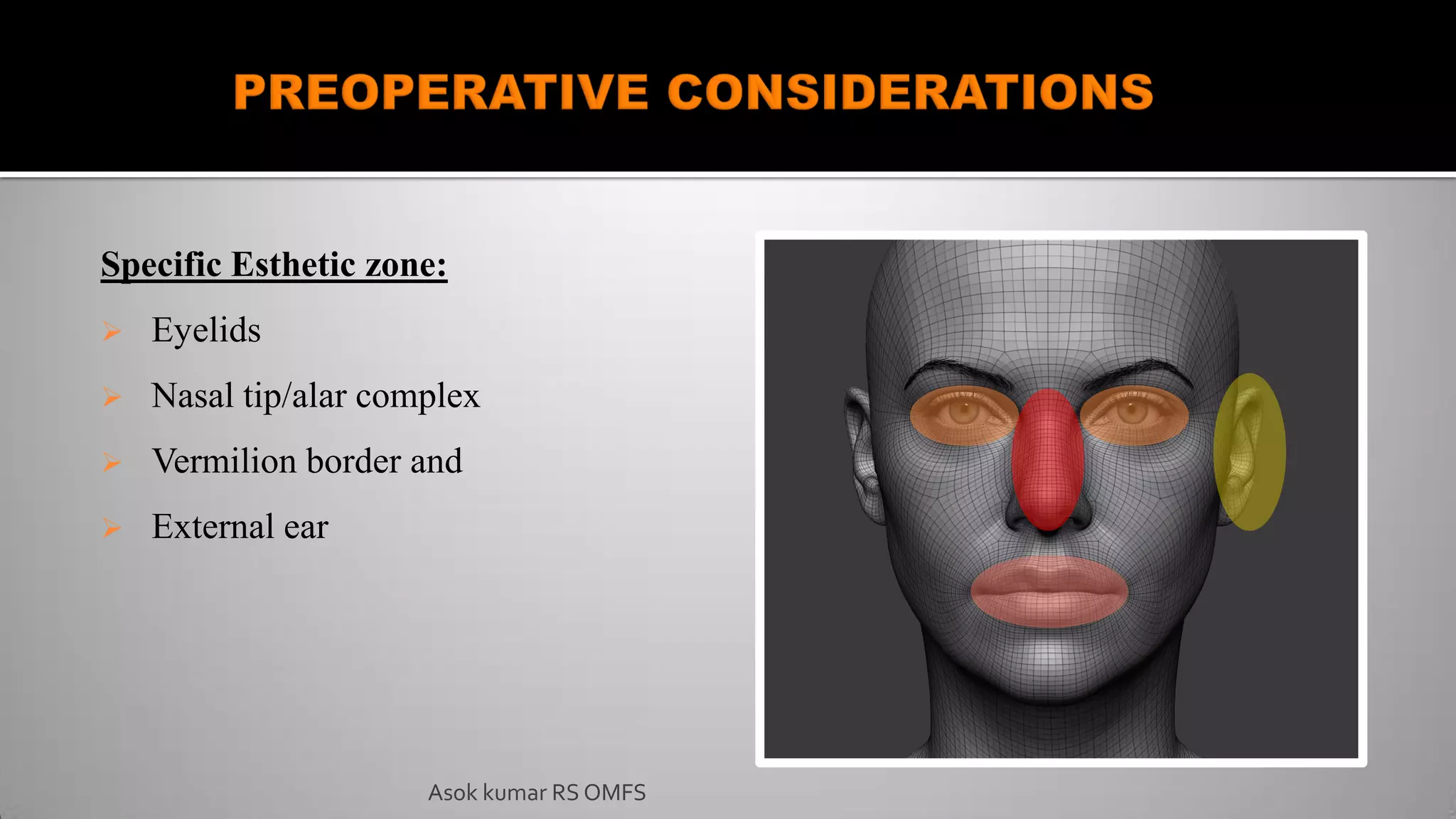
Specific Esthetic zone:
 Eyelids
 Nasal tip/alar complex
 Vermilion border and
 External ear
Asok kumar RS OMFS
Relaxed skin tension lines. Esthetic zones for the face
Asok kumar RS OMFS
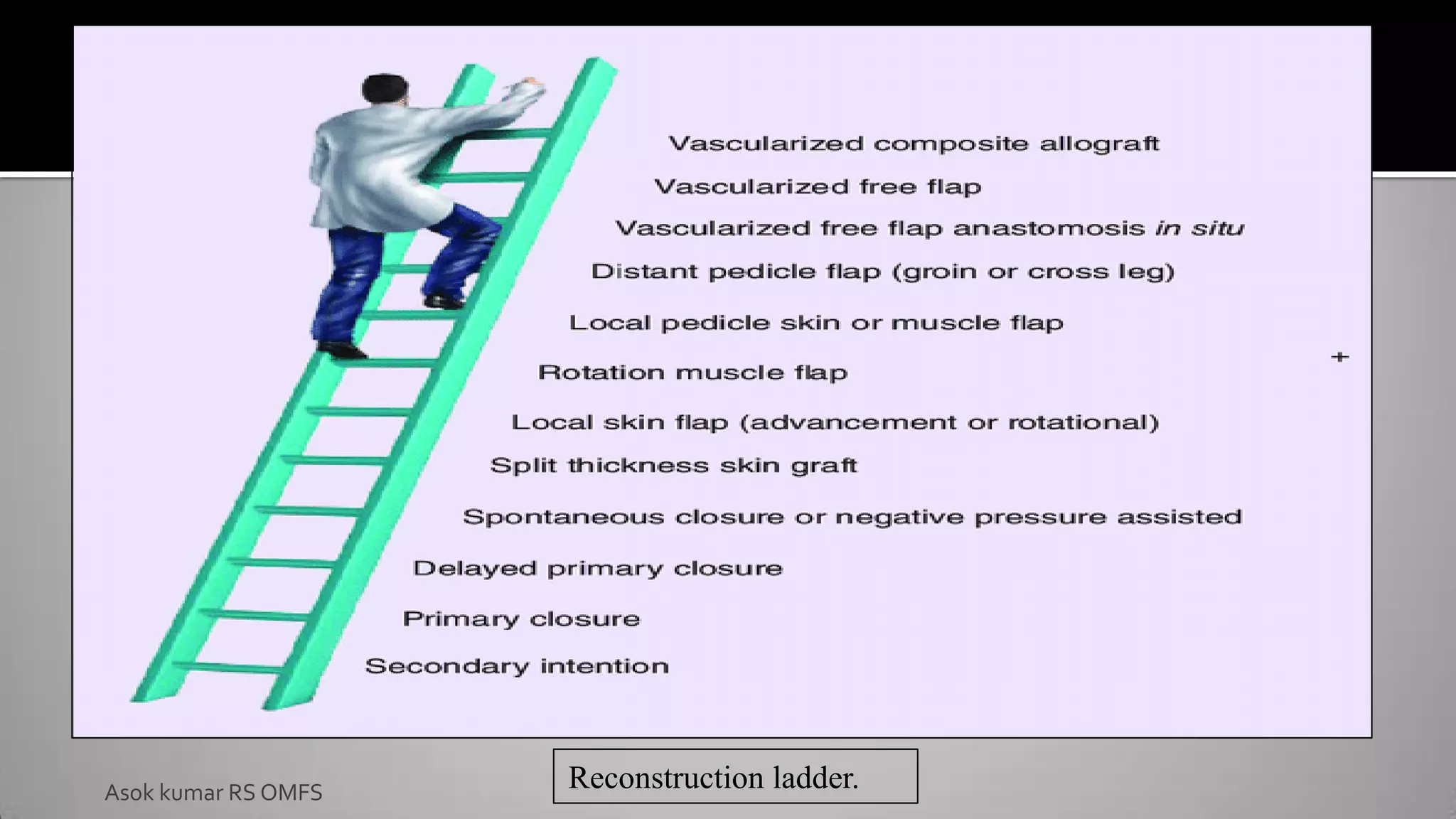
Reconstruction ladder.
Asok kumar RS OMFS
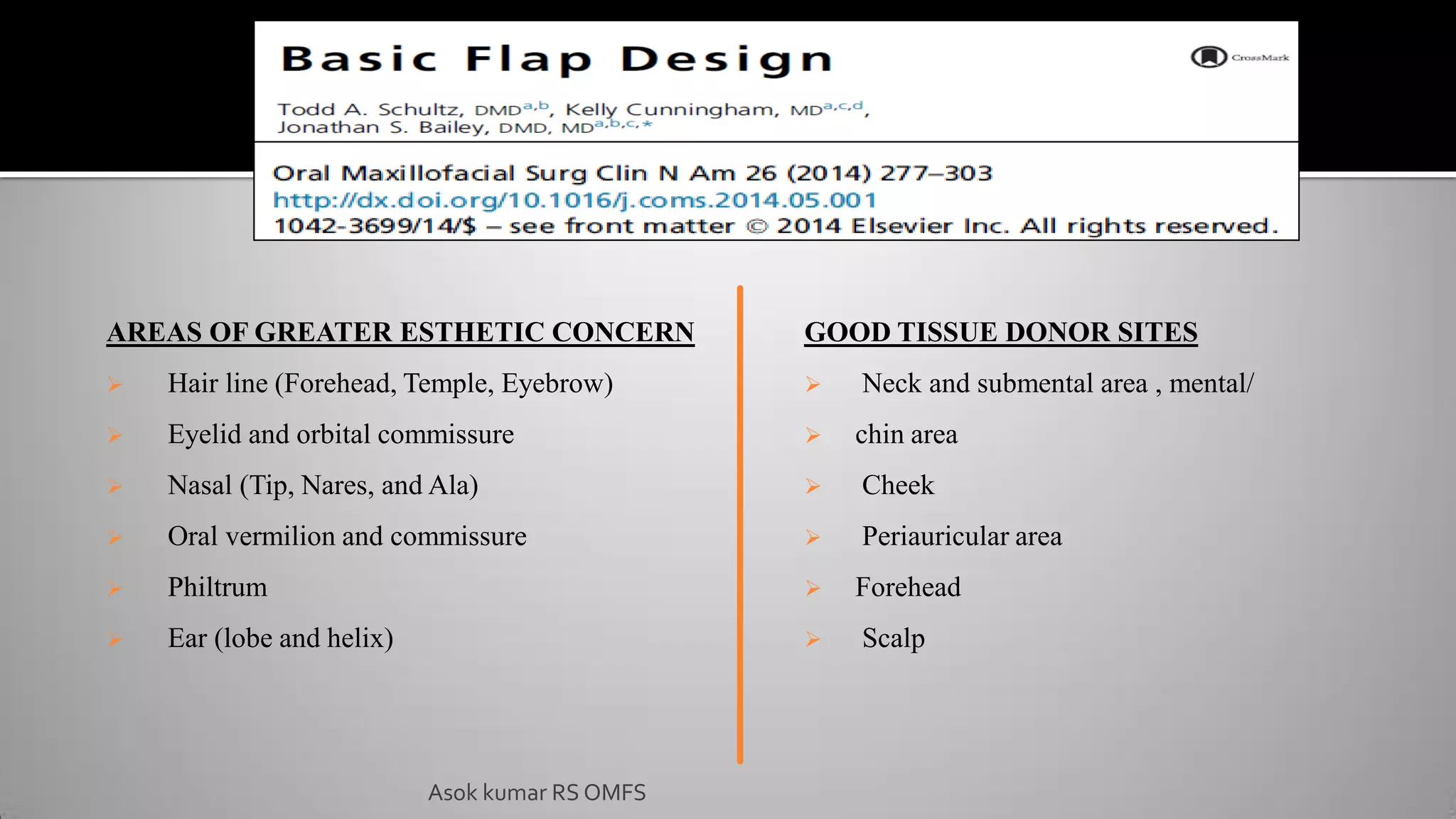
AREAS OF GREATER ESTHETIC CONCERN
 Hair line (Forehead, Temple, Eyebrow)
 Eyelid and orbital commissure
 Nasal (Tip, Nares, and Ala)
 Oral vermilion and commissure
 Philtrum
 Ear (lobe and helix)
GOOD TISSUE DONOR SITES
 Neck and submental area , mental/
 chin area
 Cheek
 Periauricular area
 Forehead
 Scalp
Asok kumar RS OMFS
Flaps may be classified according to their:
I. Blood supply
II. Location of donor site
III. Tissue content
IV. Configuration
V. Method of transfer
Asok kumar RS OMFS
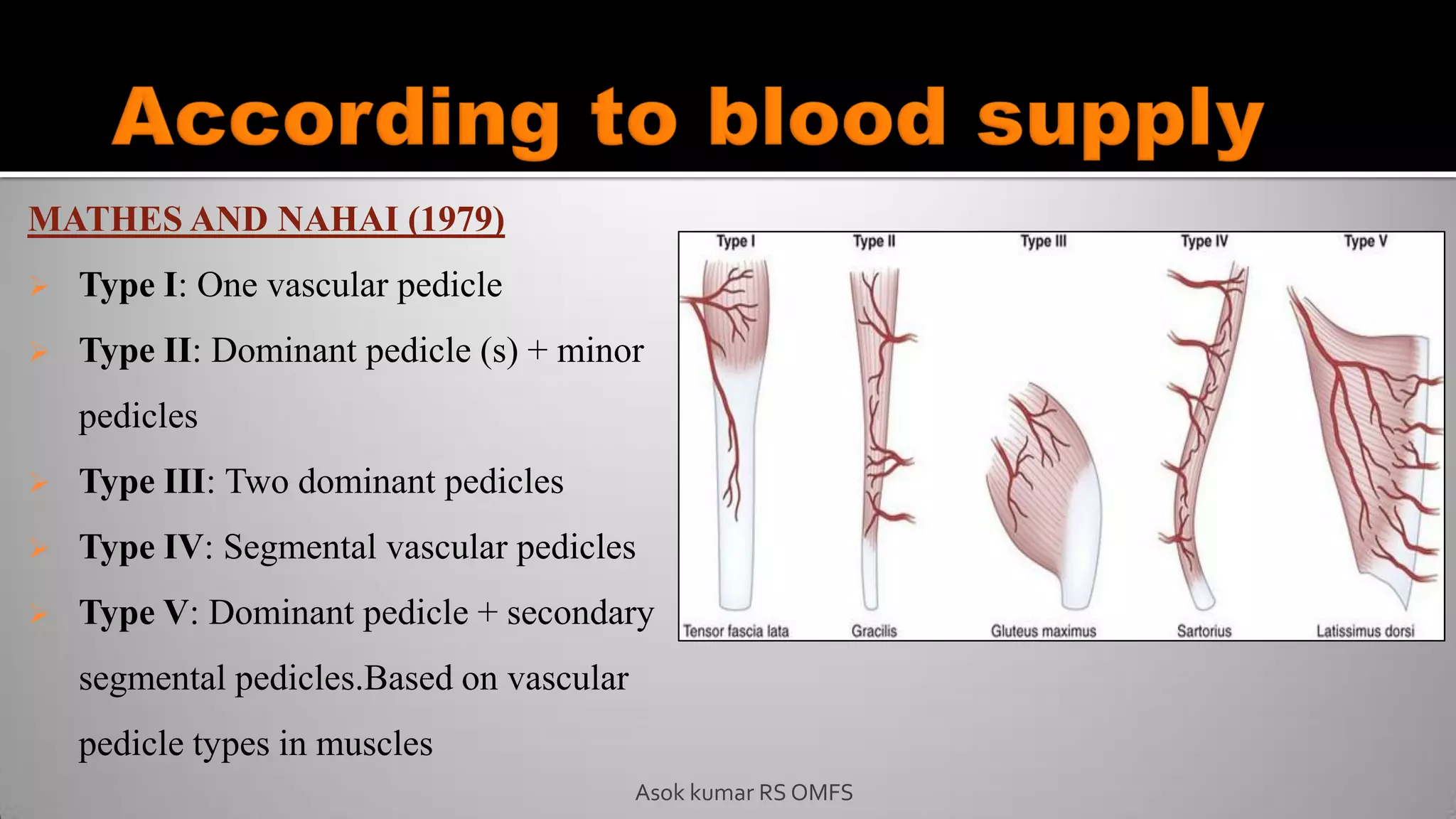
MATHES AND NAHAI (1979)
 Type I: One vascular pedicle
 Type II: Dominant pedicle (s) + minor
pedicles
 Type III: Two dominant pedicles
 Type IV: Segmental vascular pedicles
 Type V: Dominant pedicle + secondary
segmental pedicles.Based on vascular
pedicle types in muscles
Asok kumar RS OMFS
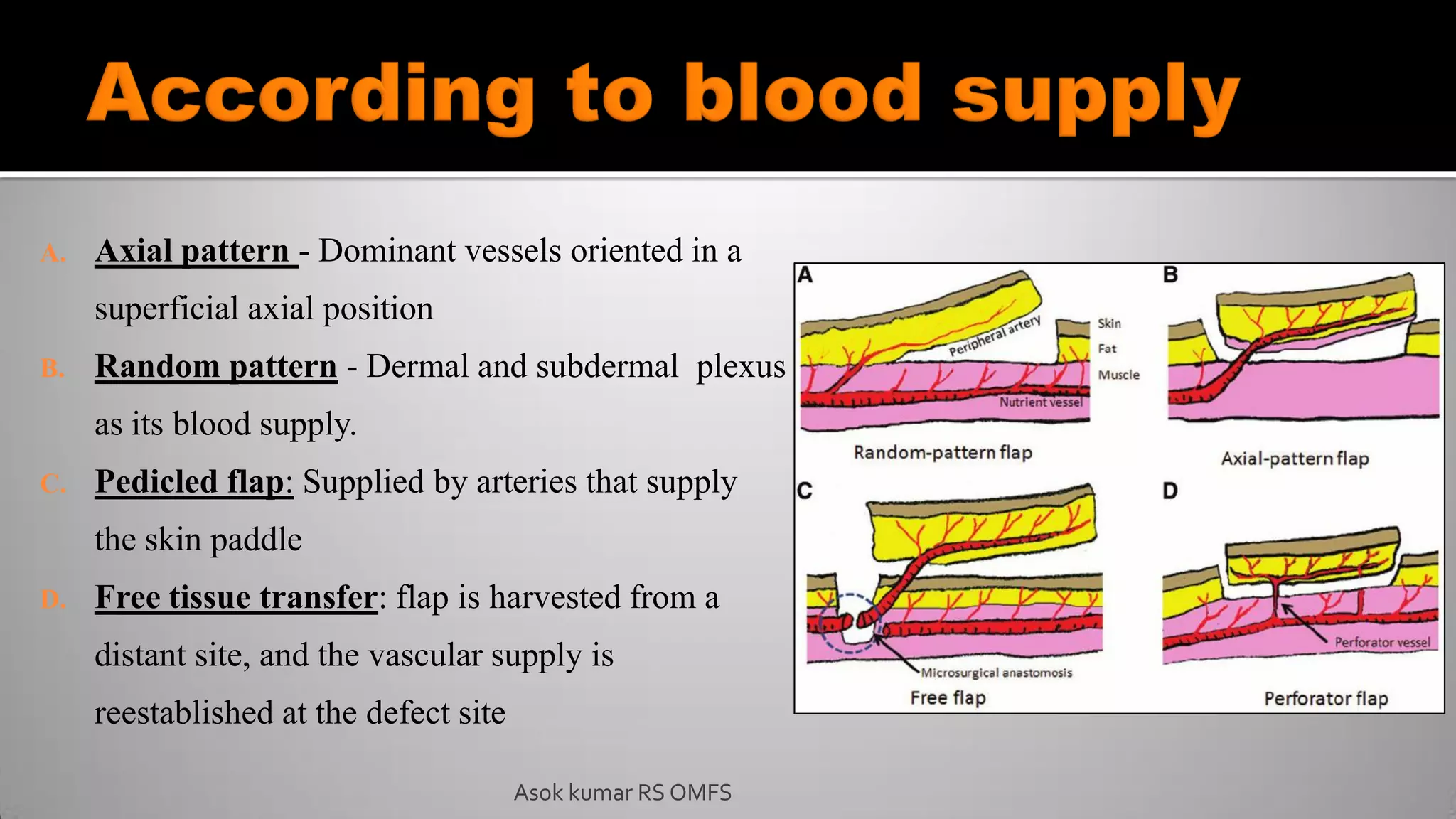
A. Axial pattern - Dominant vessels oriented in a
superficial axial position
B. Random pattern - Dermal and subdermal plexus
as its blood supply.
C. Pedicled flap: Supplied by arteries that supply
the skin paddle
D. Free tissue transfer: flap is harvested from a
distant site, and the vascular supply is
reestablished at the defect site
Asok kumar RS OMFS
A. Local Flaps: Use of tissue adjacent to defect
B. Regional flaps: Flaps located near to the defect but not in immediate proximity
to the defect
C. Distant flap: Flap harvested from different part of body
Asok kumar RS OMFS
A. Advancement flap
B. Rotational flap
C. Transpositional flap
D. Interpolated flap
E. Interpositioned flap
Asok kumar RS OMFS
A. Skin
B. Viscera
C. Muscle
D. Mucosa
Composite
A. Fasciocutaneous
B. Myocutaneous
C. Osseocutaneous
D. Tendocutaneous
E. Sensory/innervated flaps
F. Osseo-myocutaneous Asok kumar RS OMFS
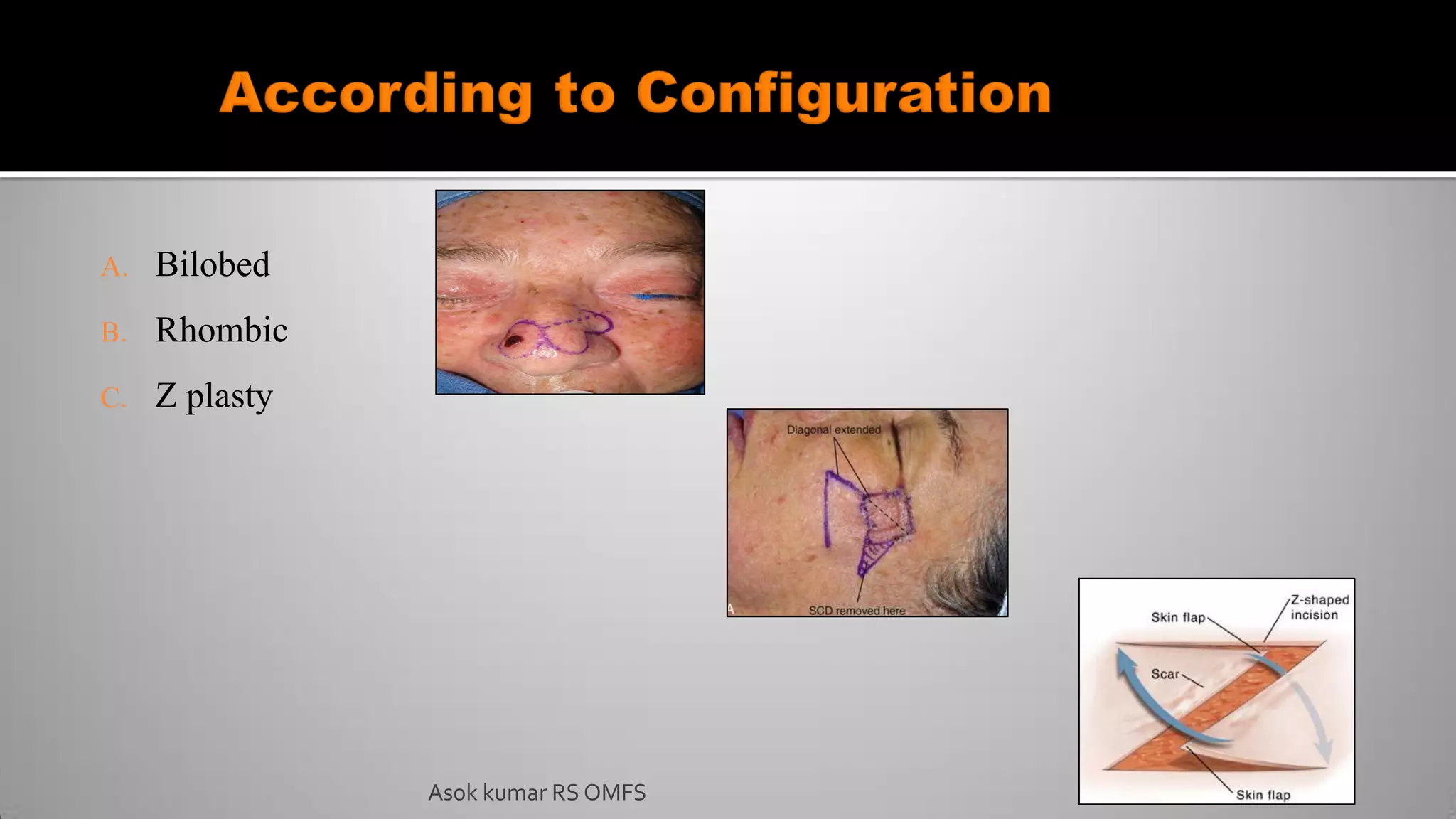
A. Bilobed
B. Rhombic
C. Z plasty
Asok kumar RS OMFS
Kinner & Jeter
 Adequate color match
 Adequate thickness – avoid protrusions or deficiencies
 Preservation of clinically perceivable sensory innervation
 Sufficient laxity – avoid retraction or deranged function
 Resultant suture lines of either primary or secondary defects are restricted to
anatomic units and fall within natural skin lines
Asok kumar RS OMFS
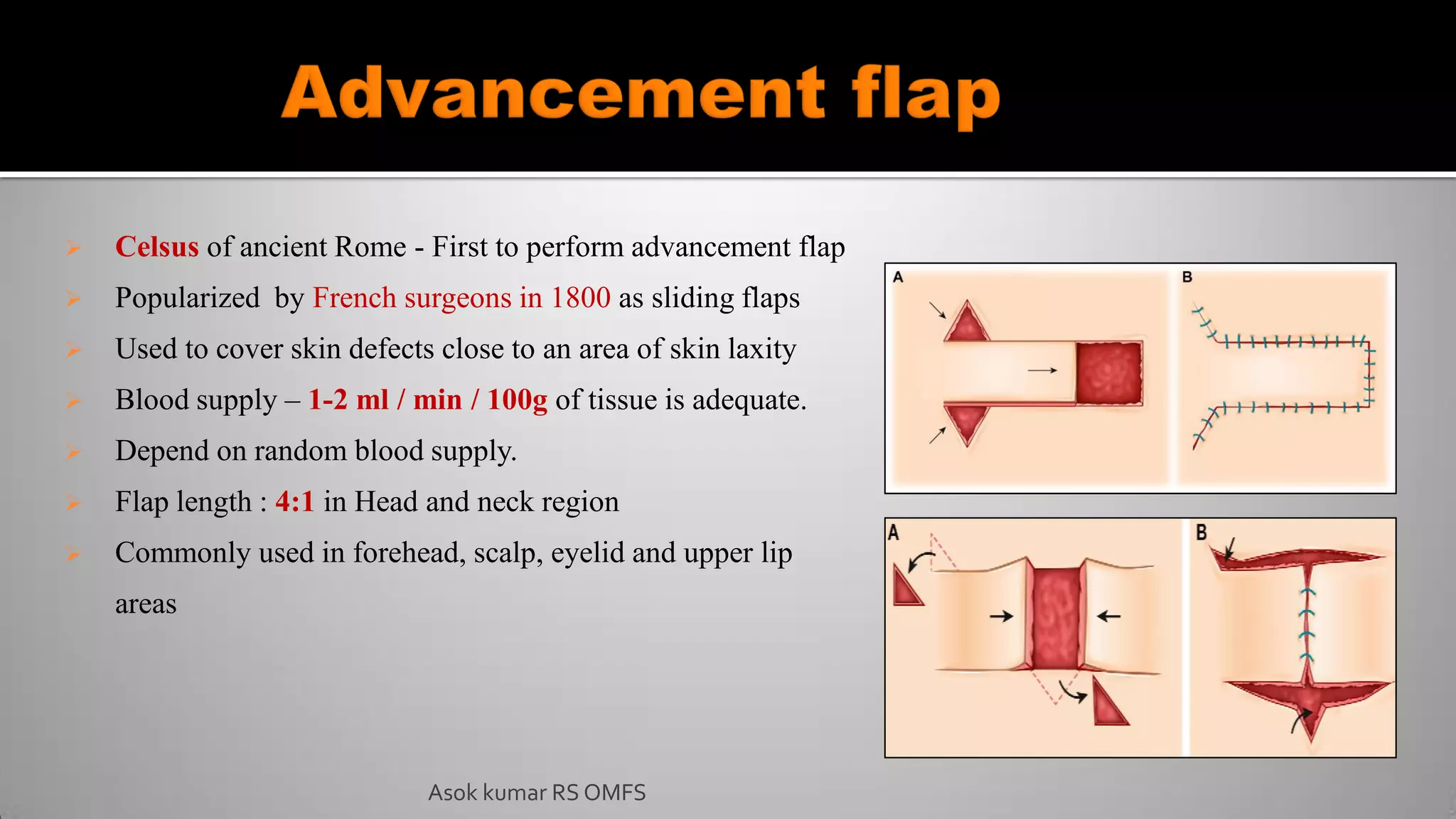
 Celsus of ancient Rome - First to perform advancement flap
 Popularized by French surgeons in 1800 as sliding flaps
 Used to cover skin defects close to an area of skin laxity
 Blood supply – 1-2 ml / min / 100g of tissue is adequate.
 Depend on random blood supply.
 Flap length : 4:1 in Head and neck region
 Commonly used in forehead, scalp, eyelid and upper lip
areas
Asok kumar RS OMFS
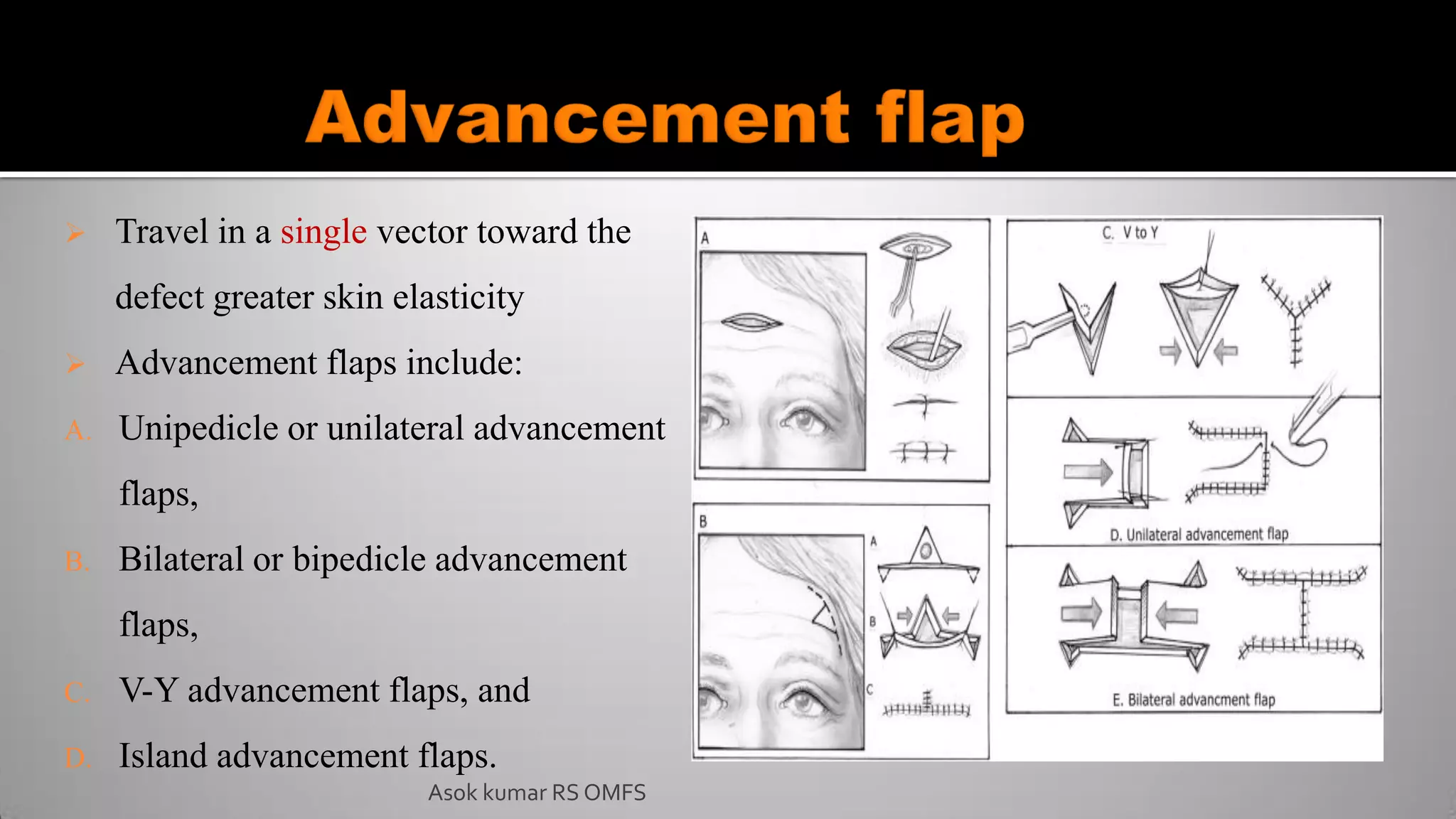
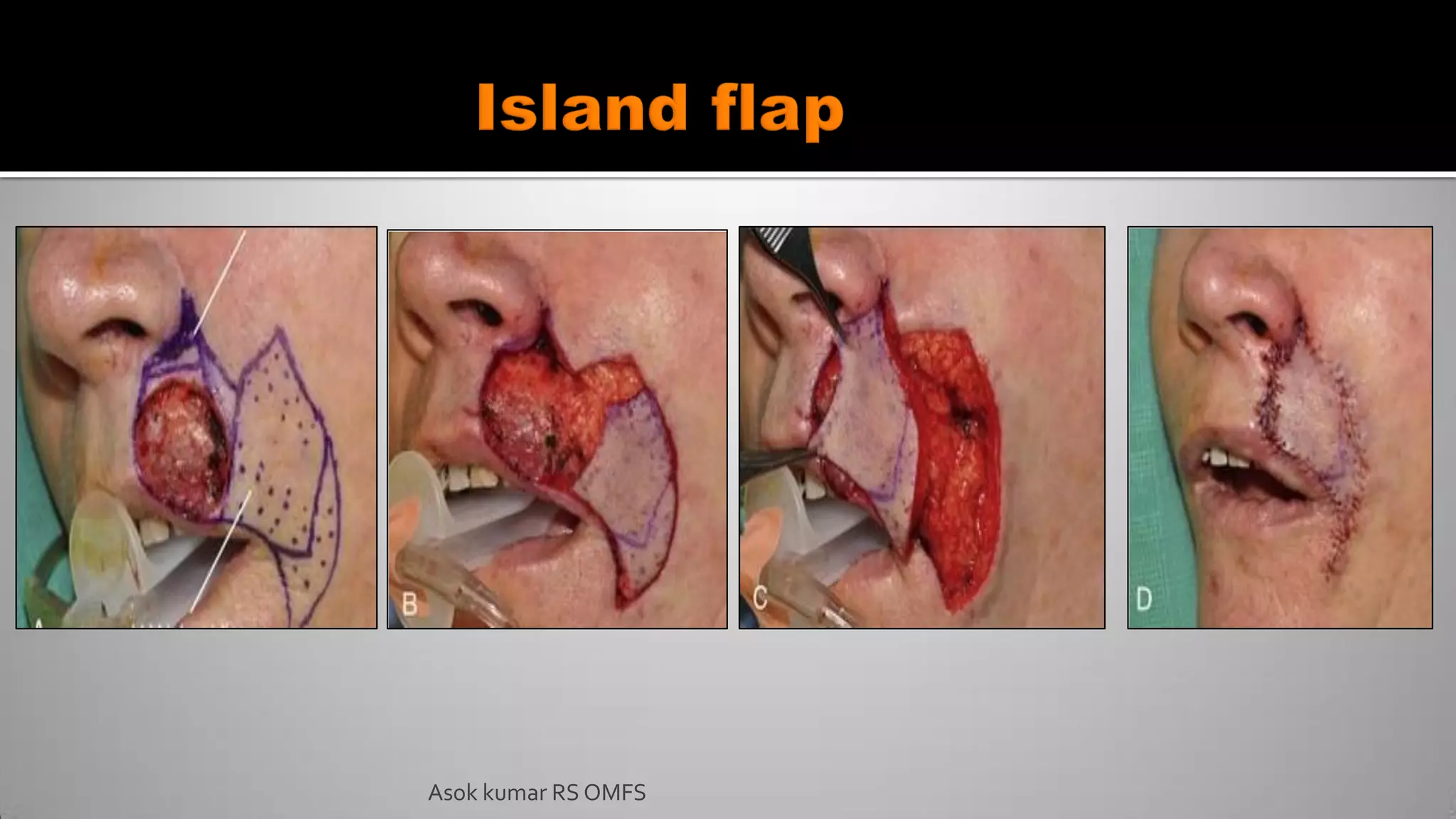
 Travel in a single vector toward the
defect greater skin elasticity
 Advancement flaps include:
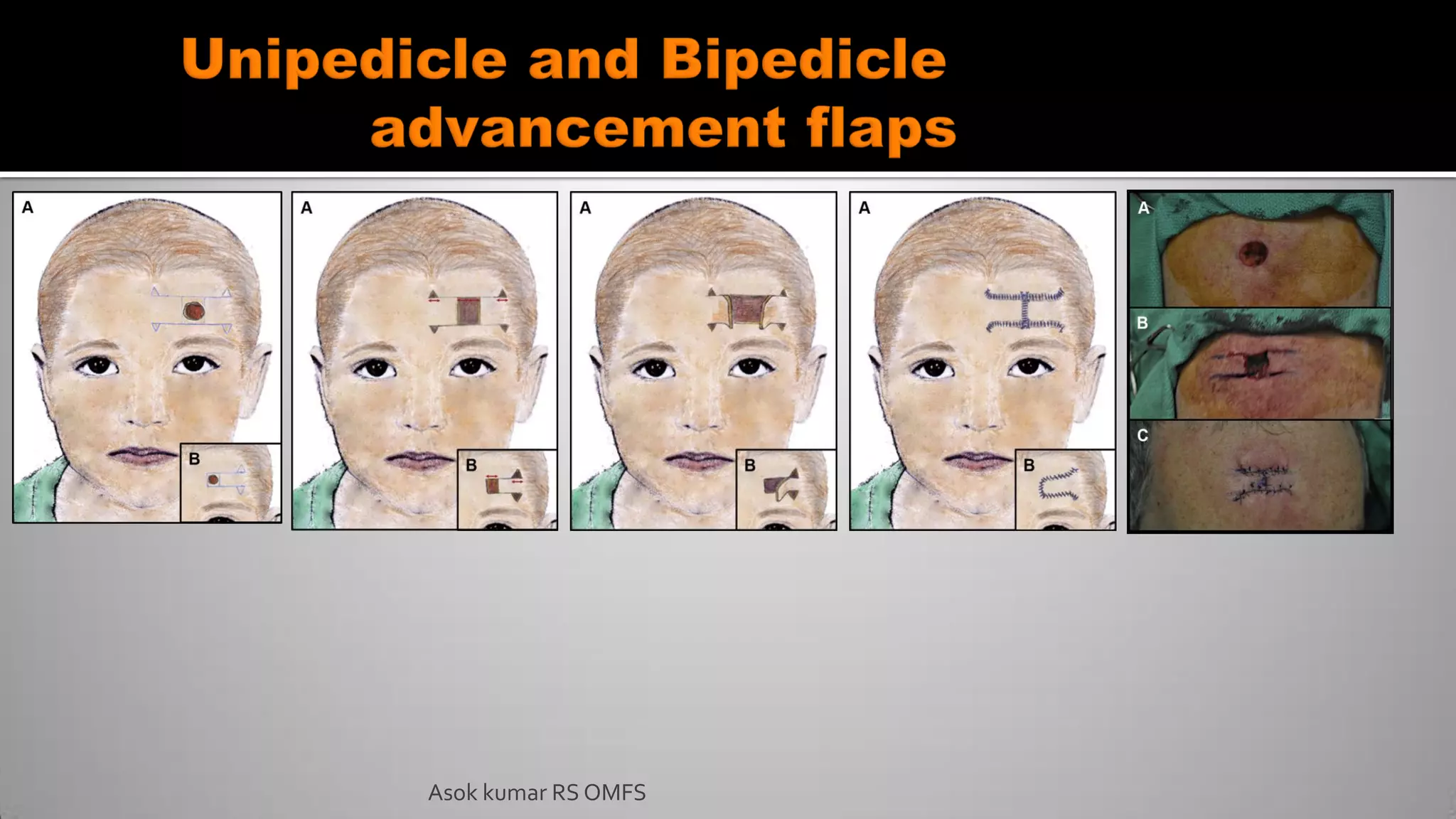
A. Unipedicle or unilateral advancement
flaps,
B. Bilateral or bipedicle advancement
flaps,
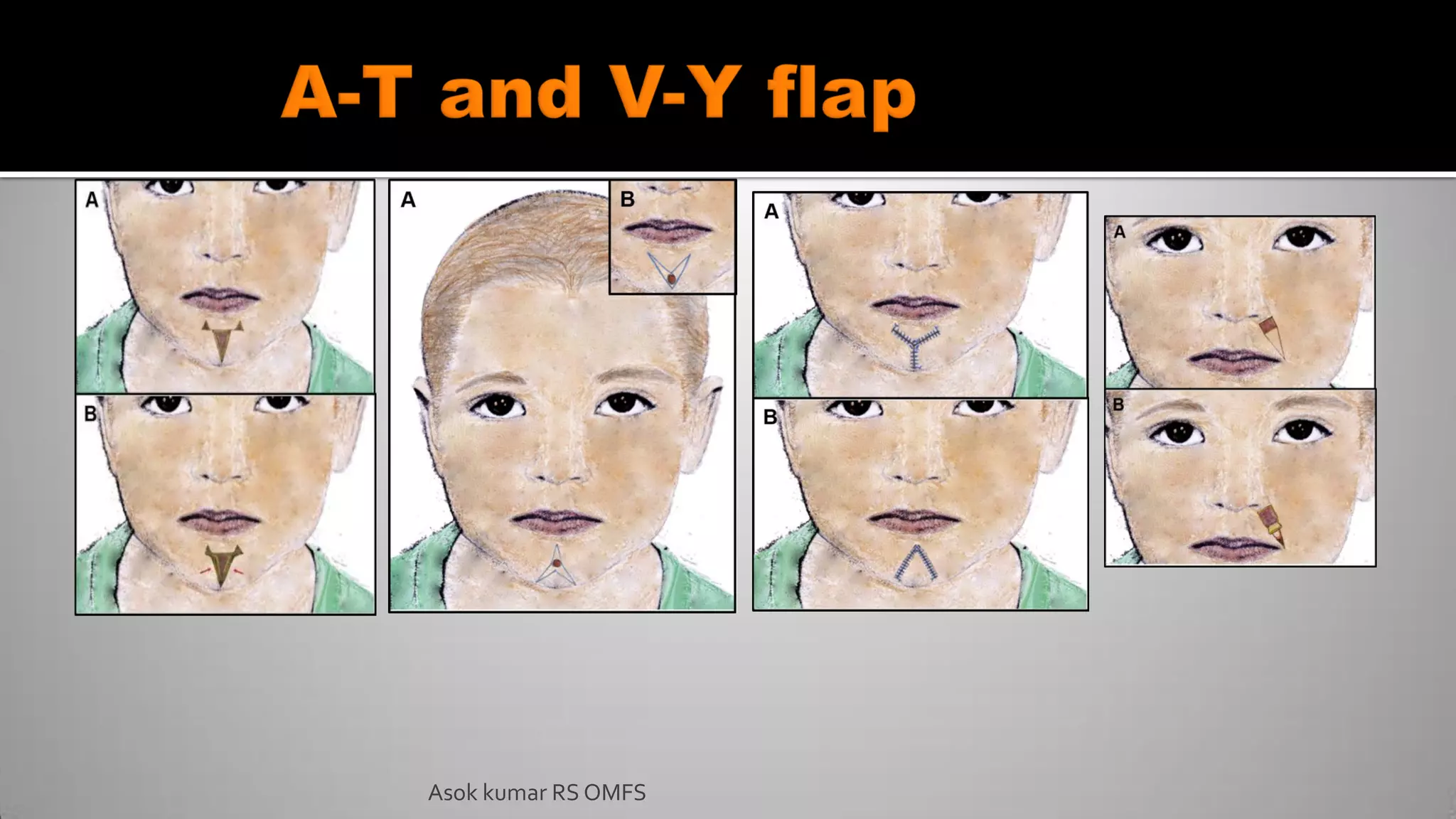
C. V-Y advancement flaps, and
D. Island advancement flaps.
Asok kumar RS OMFS
Uses:
 Reconstructing defects involving the forehead, lips and cheeks
 Closure of oro antral fistula and alveolar clefts.
 Advantage :Limit wound tension to a single vector.
Indications:
 Single pedicle flap: defects of forehead ,helical rims,upper and lower lips and medial
cheek.
 Bipedicle flap: large defects of the skull
 V-Y advancement flap: lengthening the columnella in the repair of cleft lip nasal
deformities and used in releasing contracted scars .
Asok kumar RS OMFS
Asok kumar RS OMFS
Asok kumar RS OMFS
Asok kumar RS OMFS
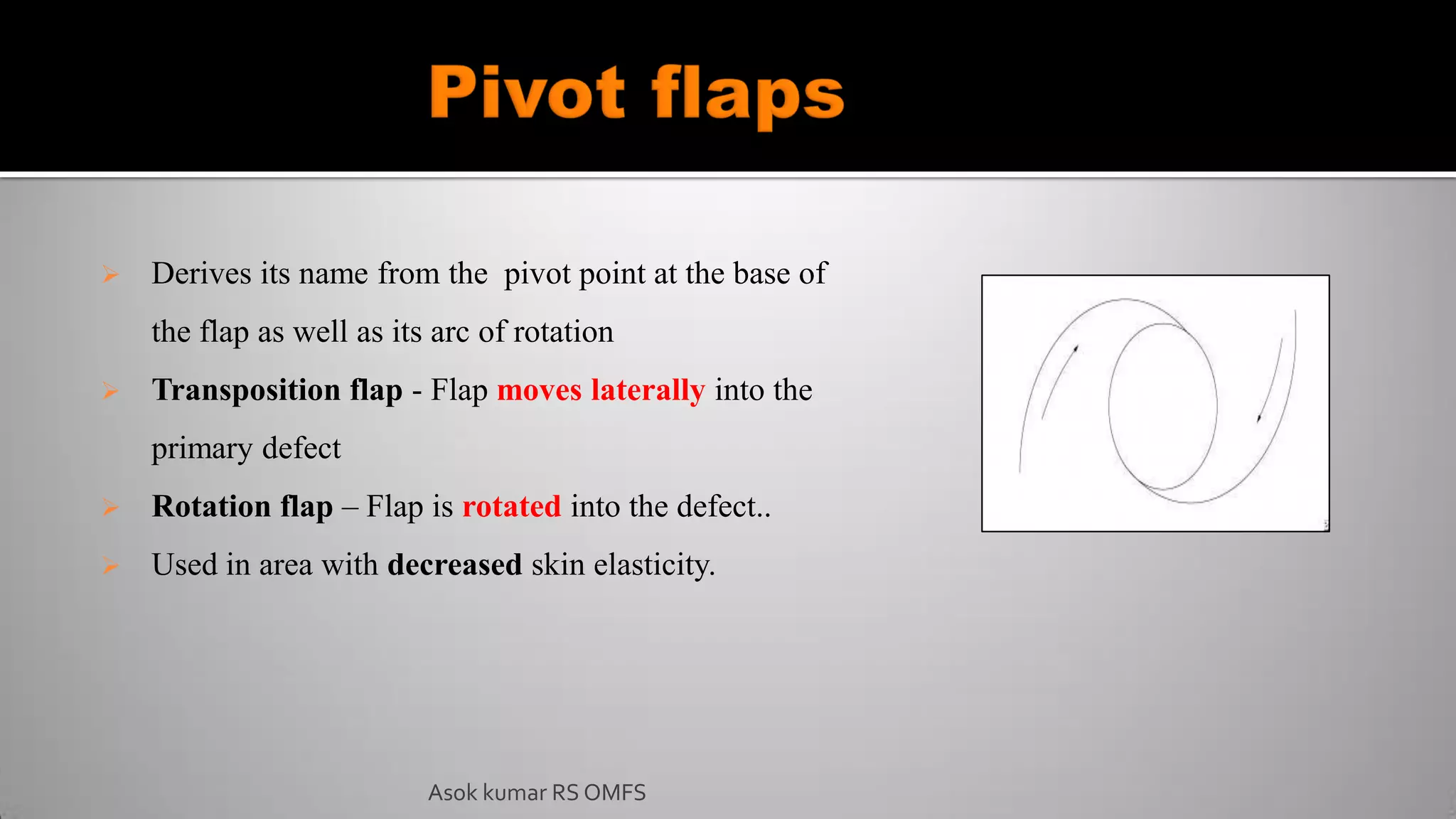
 Derives its name from the pivot point at the base of
the flap as well as its arc of rotation
 Transposition flap - Flap moves laterally into the
primary defect
 Rotation flap – Flap is rotated into the defect..
 Used in area with decreased skin elasticity.
Asok kumar RS OMFS
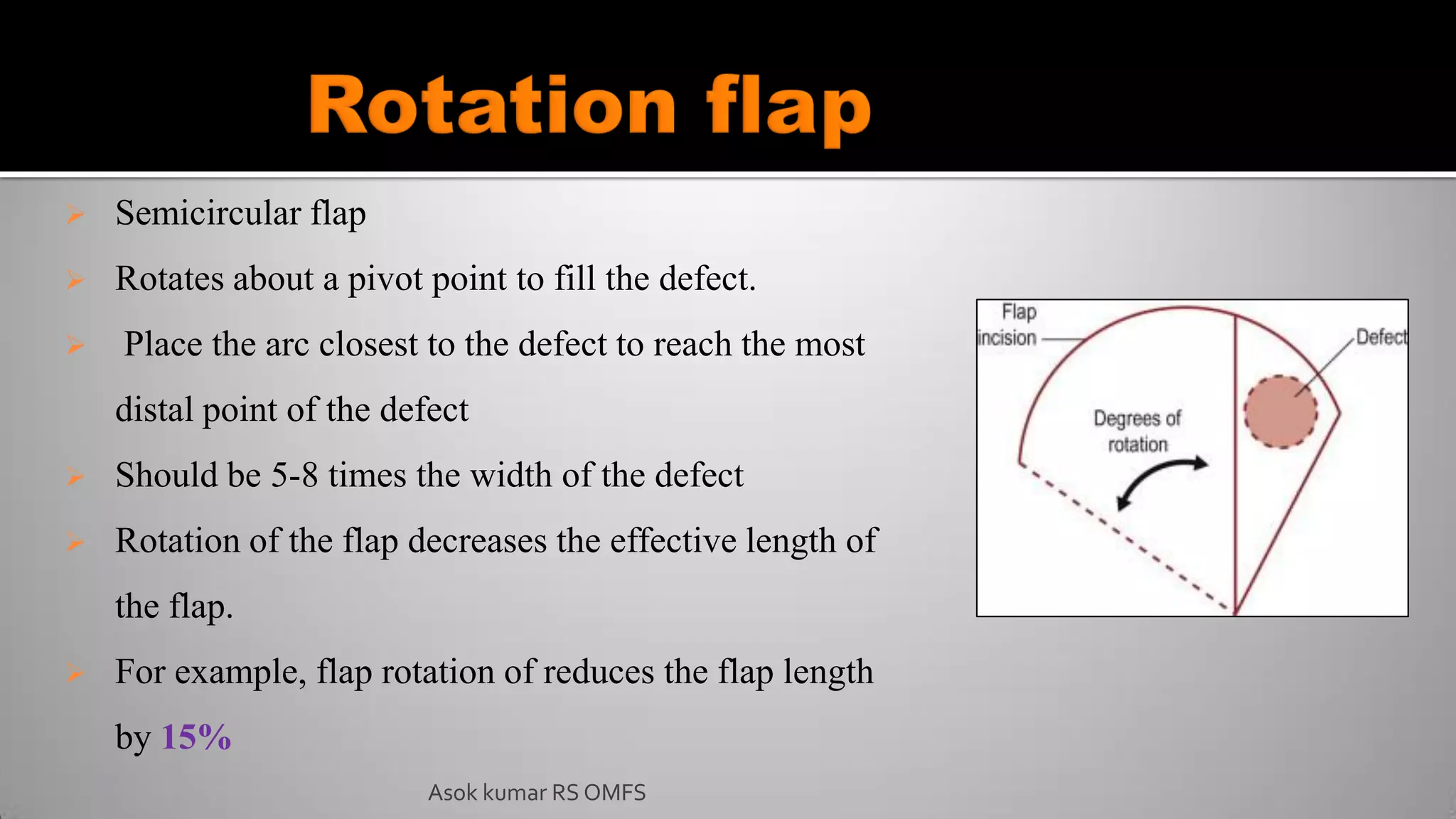
 Semicircular flap
 Rotates about a pivot point to fill the defect.
 Place the arc closest to the defect to reach the most
distal point of the defect
 Should be 5-8 times the width of the defect
 Rotation of the flap decreases the effective length of
the flap.
 For example, flap rotation of reduces the flap length
by 15%
Asok kumar RS OMFS
Asok kumar RS OMFS
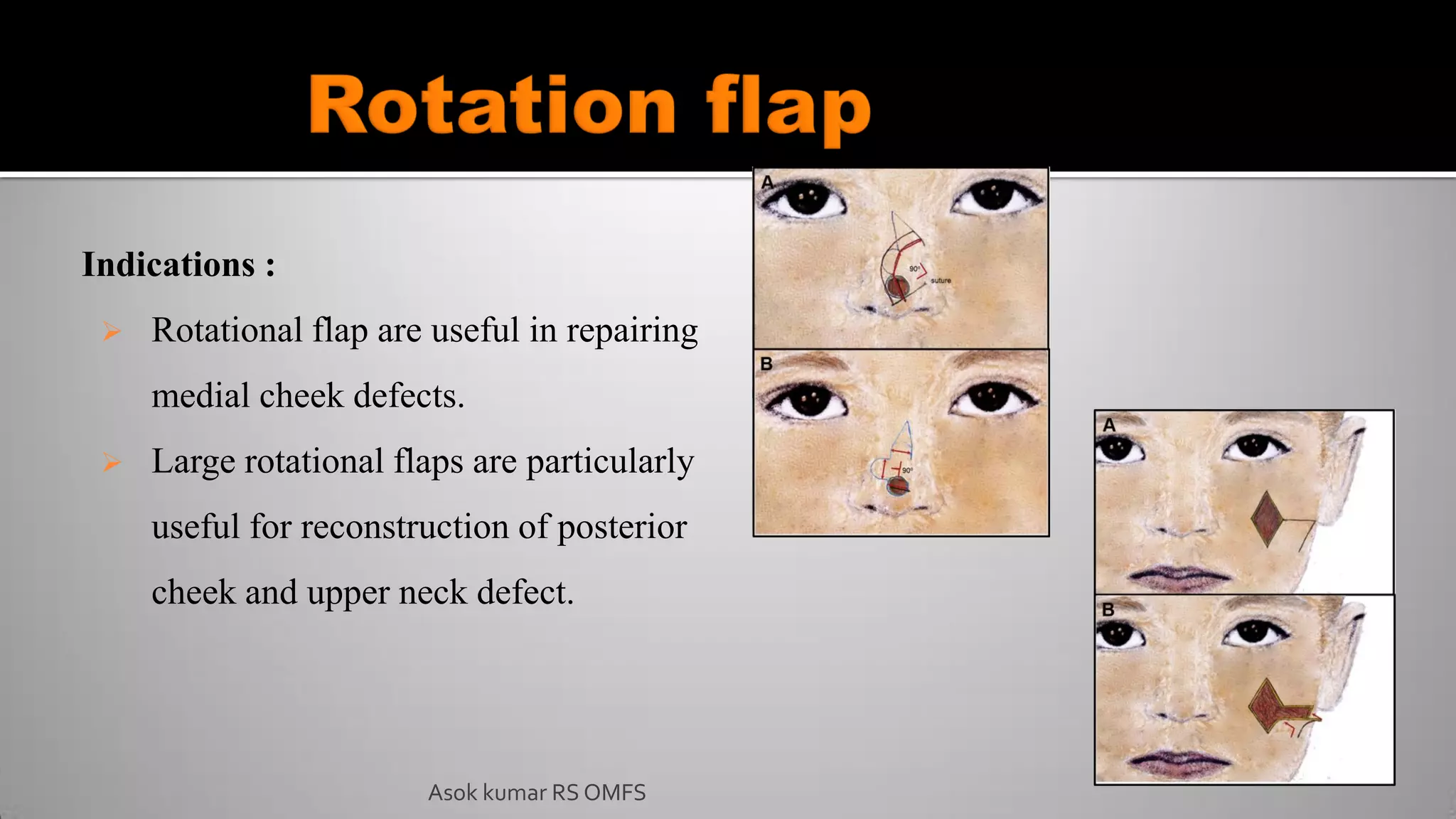
Indications :
 Rotational flap are useful in repairing
medial cheek defects.
 Large rotational flaps are particularly
useful for reconstruction of posterior
cheek and upper neck defect.
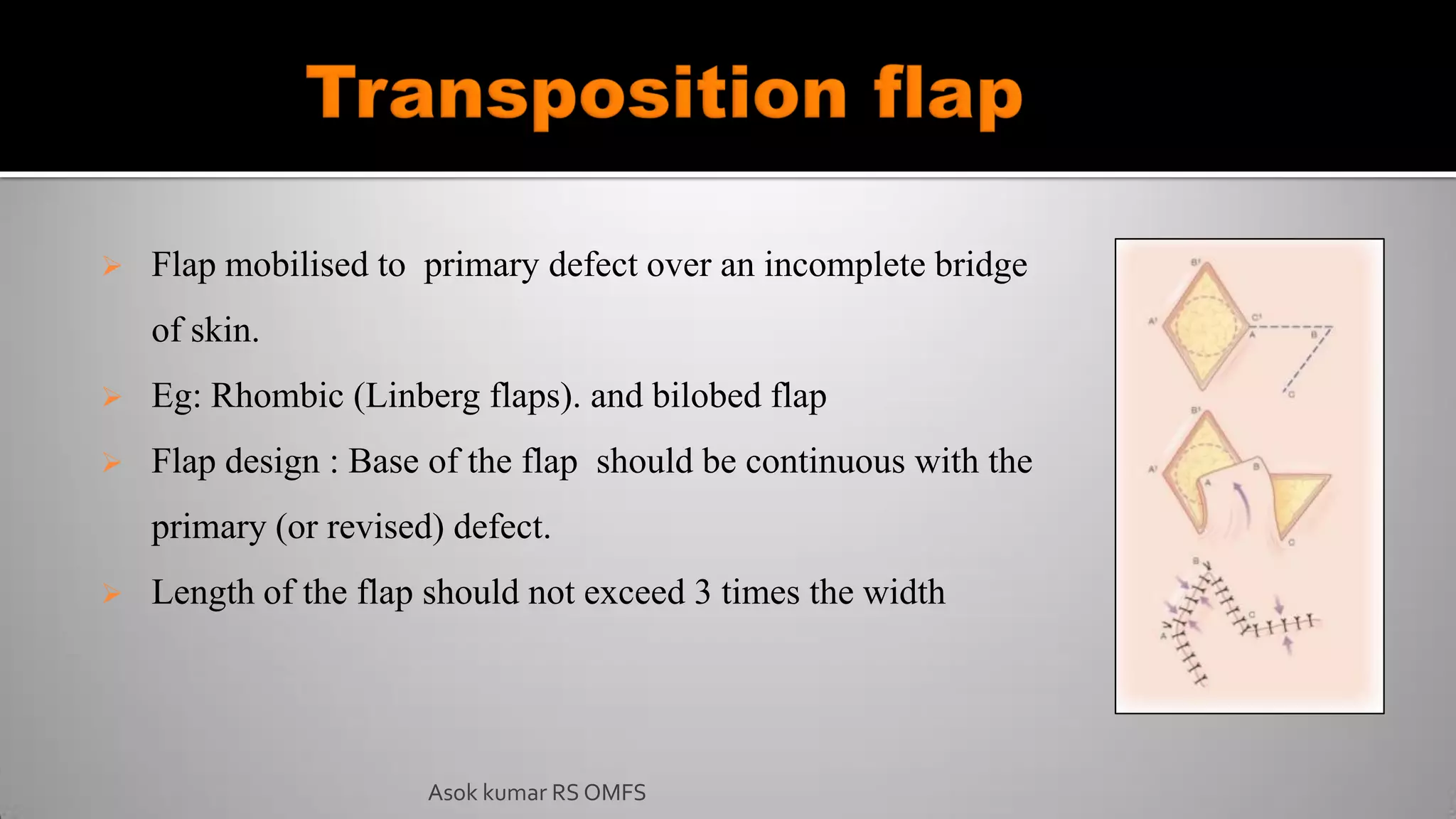
 Flap mobilised to primary defect over an incomplete bridge
of skin.
 Eg: Rhombic (Linberg flaps). and bilobed flap
 Flap design : Base of the flap should be continuous with the
primary (or revised) defect.
 Length of the flap should not exceed 3 times the width
Asok kumar RS OMFS
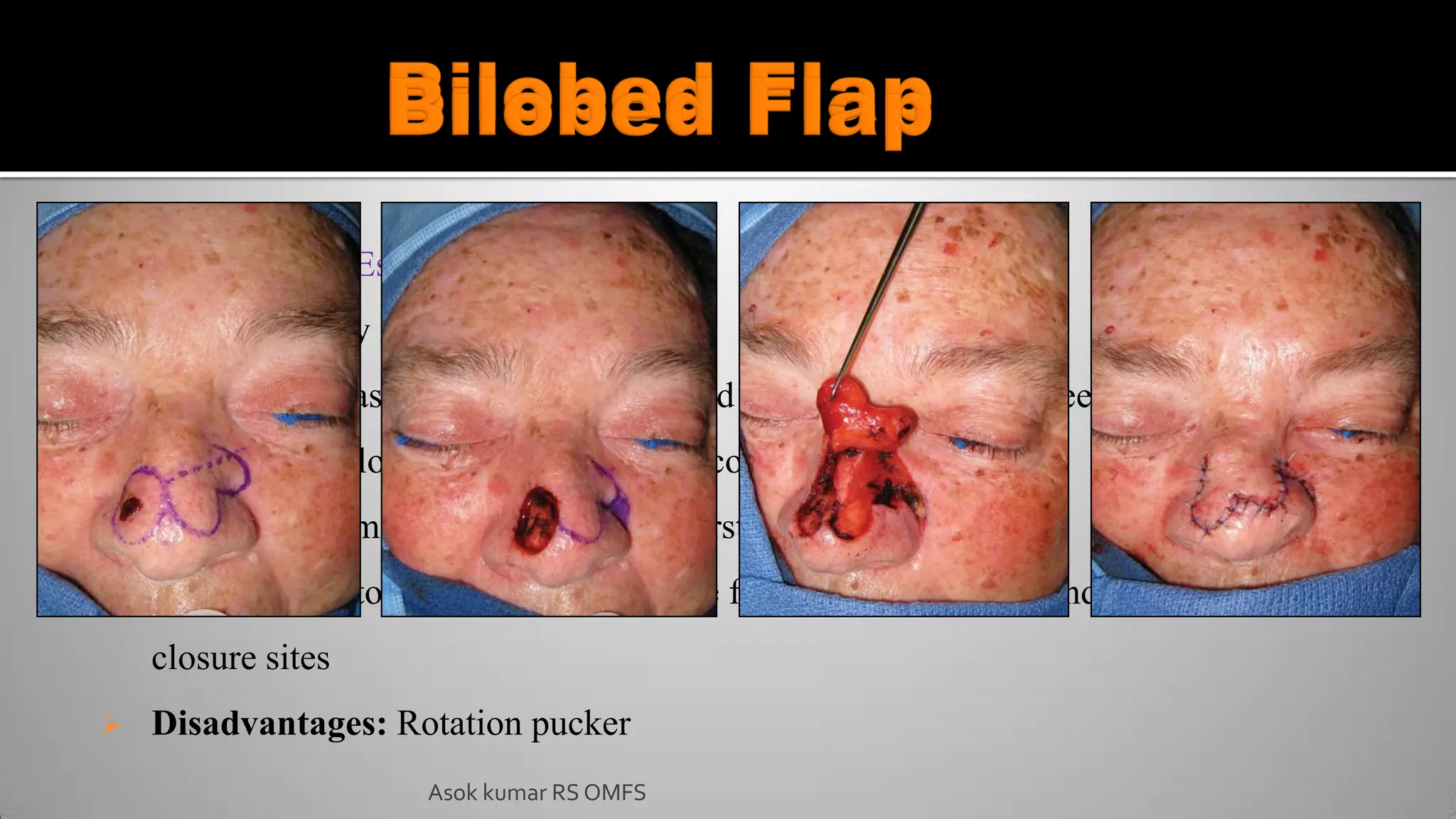
 Described by Esser (1918)
 Popularized by Zimany
 Reconstruct nasal and facial defects and even full thickness cheek defects.
 Tension free closure of original and secondary defects.
 90º is the optimal angle between the first and second flap
 Maximum distortion occurs around the flap bases and the second donor lobe
closure sites
 Disadvantages: Rotation pucker
Asok kumar RS OMFS
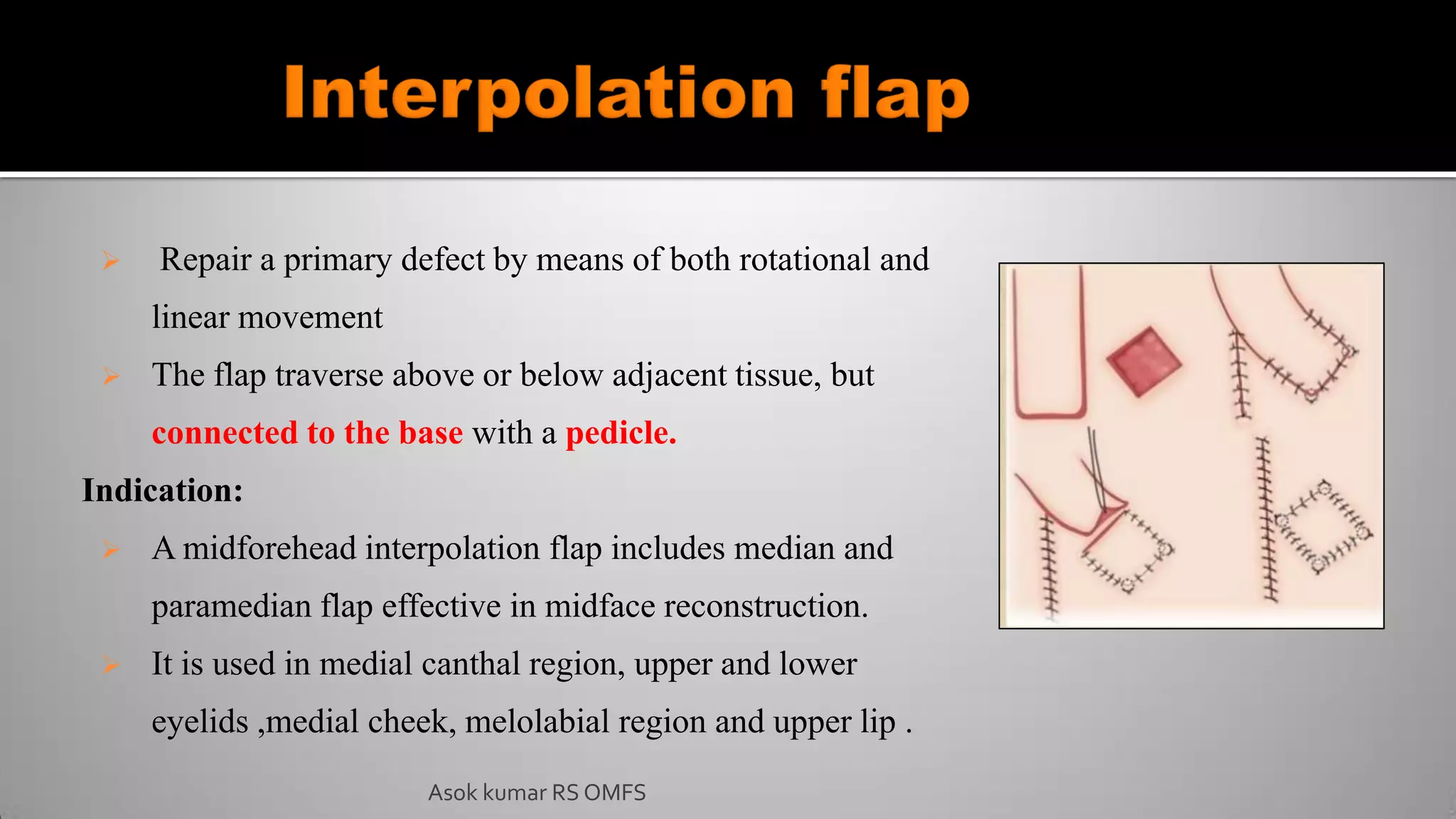
 Repair a primary defect by means of both rotational and
linear movement
 The flap traverse above or below adjacent tissue, but
connected to the base with a pedicle.
Indication:
 A midforehead interpolation flap includes median and
paramedian flap effective in midface reconstruction.
 It is used in medial canthal region, upper and lower
eyelids ,medial cheek, melolabial region and upper lip .
Asok kumar RS OMFS
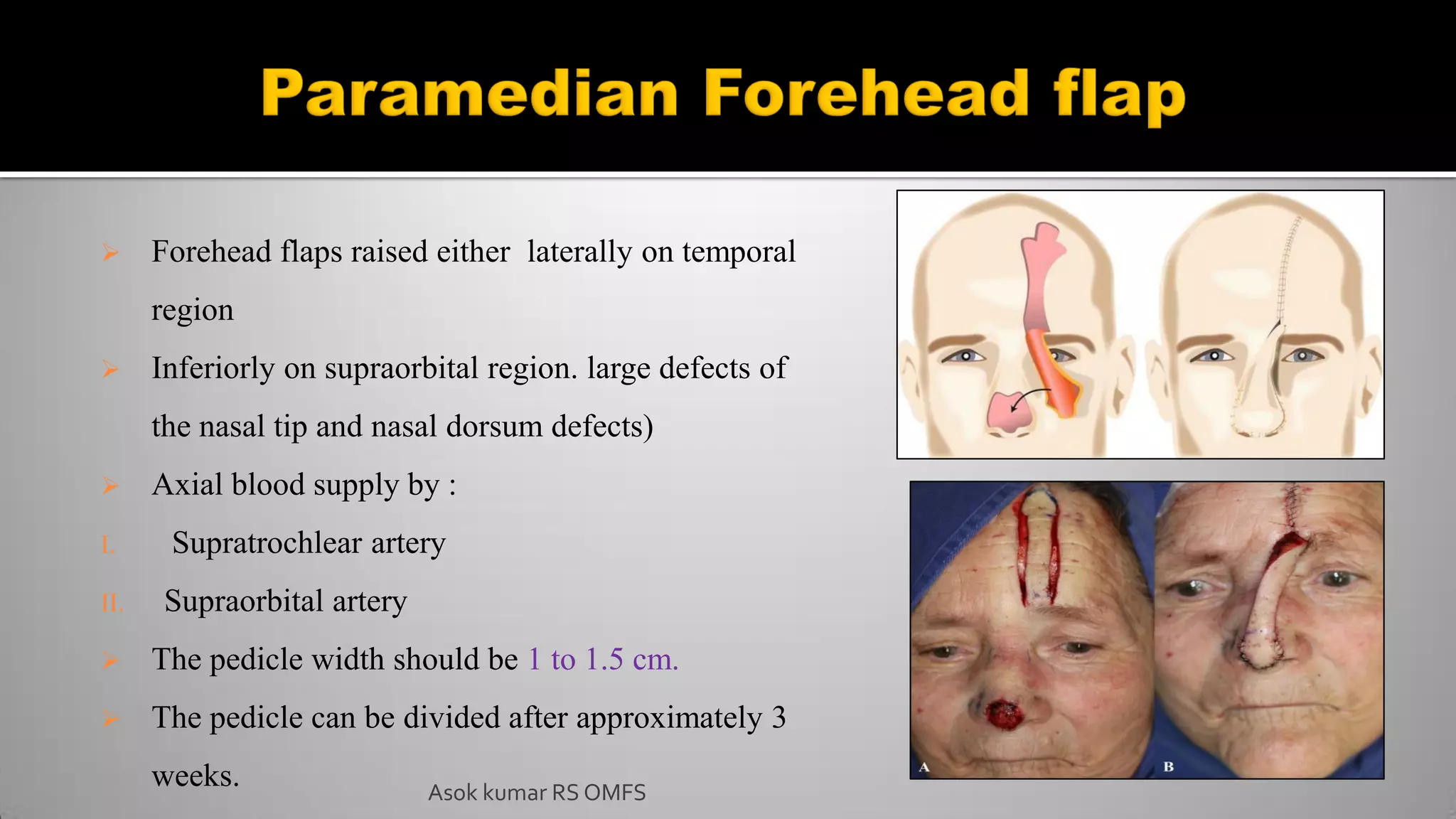
 Forehead flaps raised either laterally on temporal
region
 Inferiorly on supraorbital region. large defects of
the nasal tip and nasal dorsum defects)
 Axial blood supply by :
I. Supratrochlear artery
II. Supraorbital artery
 The pedicle width should be 1 to 1.5 cm.
 The pedicle can be divided after approximately 3
weeks. Asok kumar RS OMFS
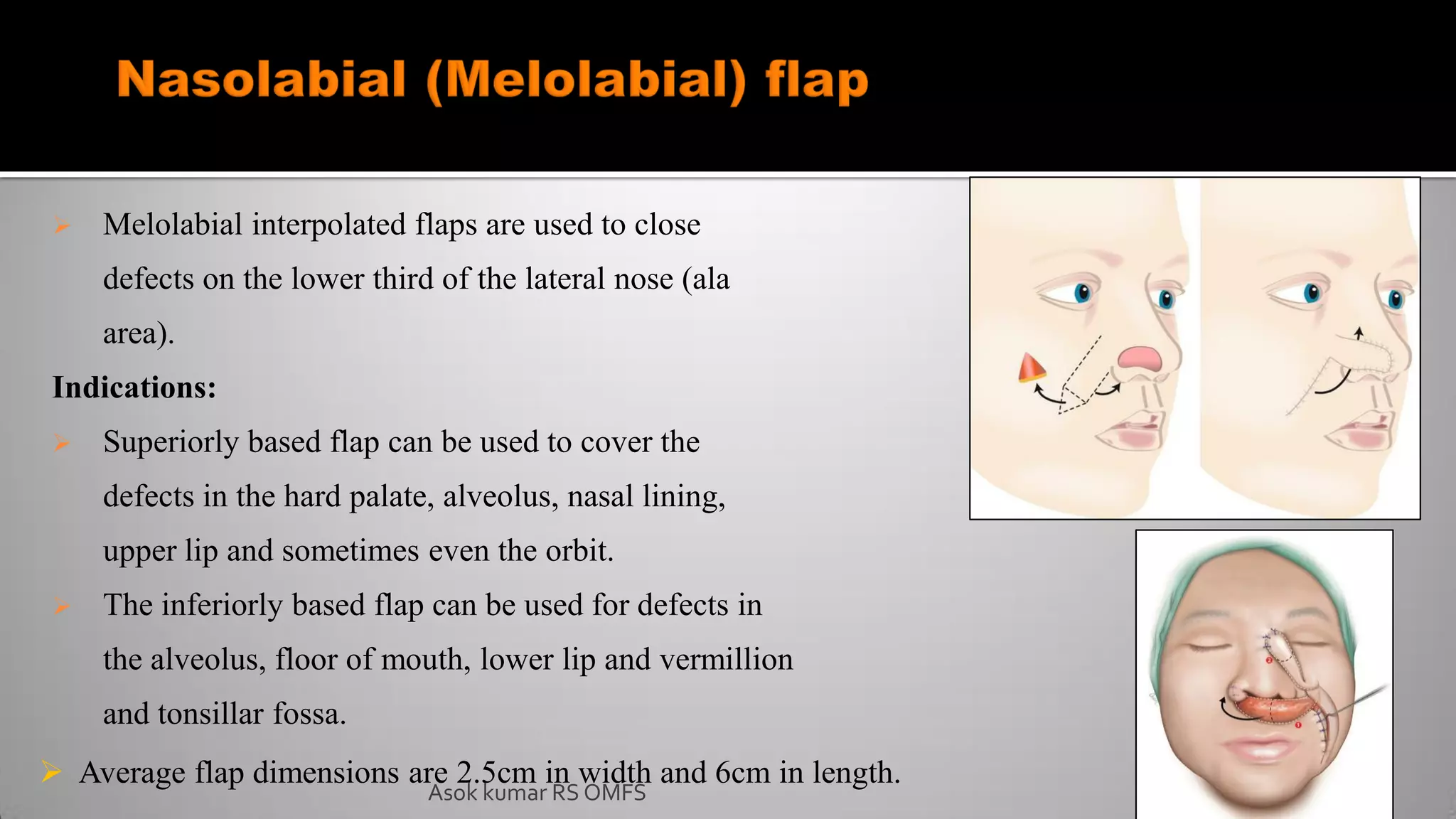
 Melolabial interpolated flaps are used to close
defects on the lower third of the lateral nose (ala
area).
Indications:
 Superiorly based flap can be used to cover the
defects in the hard palate, alveolus, nasal lining,
upper lip and sometimes even the orbit.
 The inferiorly based flap can be used for defects in
the alveolus, floor of mouth, lower lip and vermillion
and tonsillar fossa.
 Average flap dimensions are 2.5cm in width and 6cm in length.
Asok kumar RS OMFS
Asok kumar RS OMFS
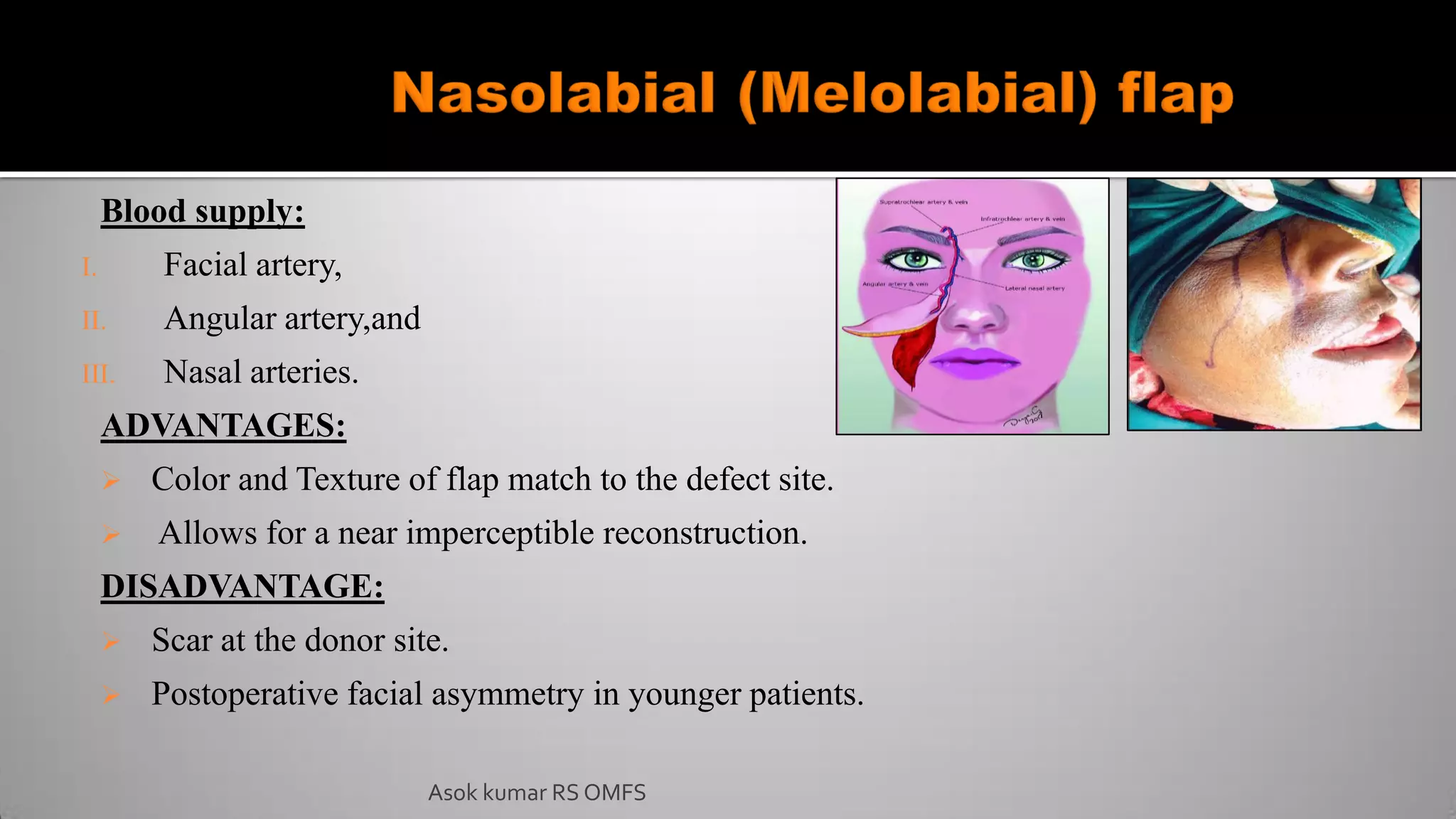
Blood supply:
I. Facial artery,
II. Angular artery,and
III. Nasal arteries.
ADVANTAGES:
 Color and Texture of flap match to the defect site.
 Allows for a near imperceptible reconstruction.
DISADVANTAGE:
 Scar at the donor site.
 Postoperative facial asymmetry in younger patients.
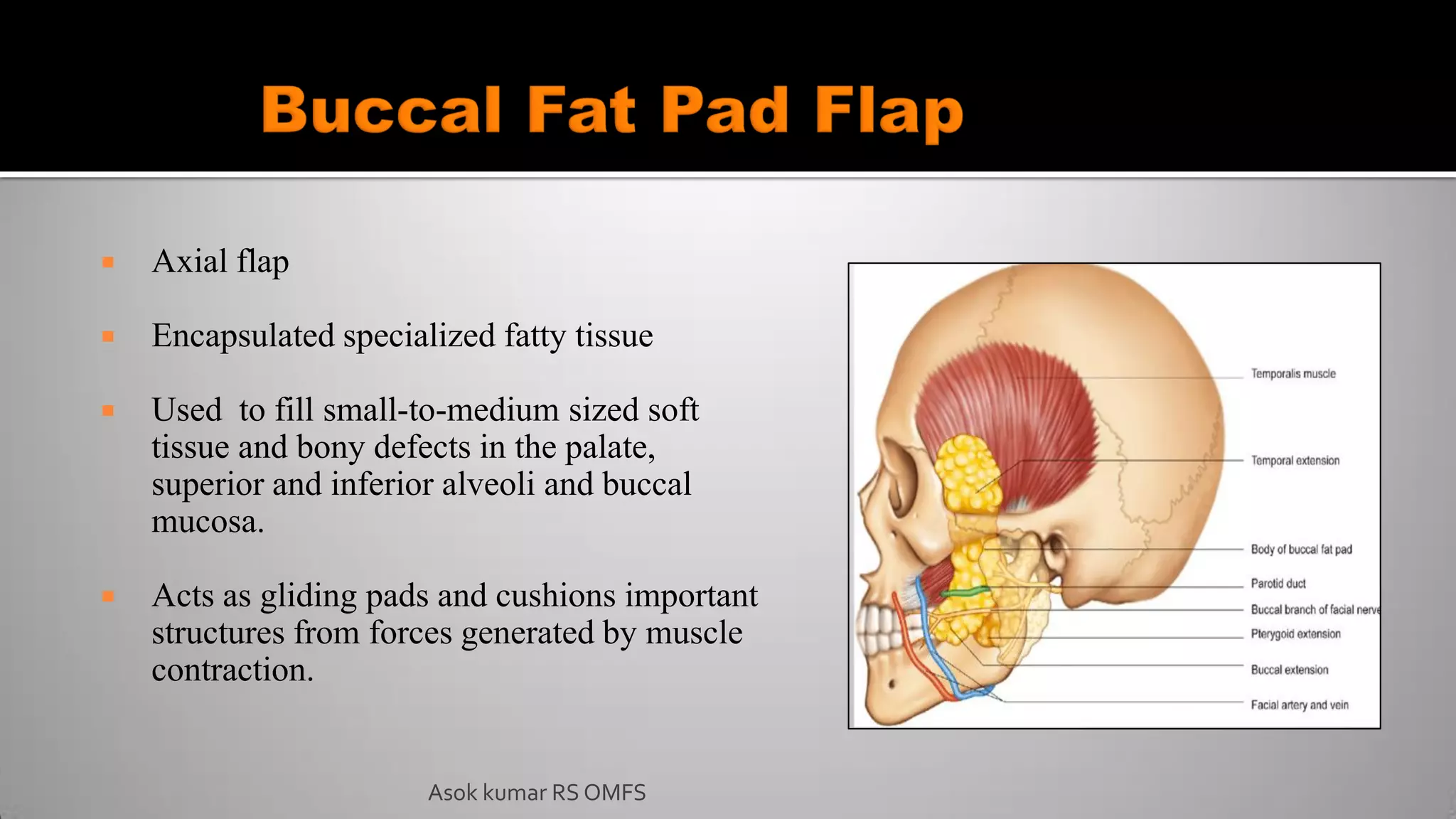
 Axial flap
 Encapsulated specialized fatty tissue
 Used to fill small-to-medium sized soft
tissue and bony defects in the palate,
superior and inferior alveoli and buccal
mucosa.
 Acts as gliding pads and cushions important
structures from forces generated by muscle
contraction.
Asok kumar RS OMFS
Asok kumar RS OMFS
The buccal fat pad has a body and four processes. The body is divided into
3 lobes – anterior, intermediate and posterior.
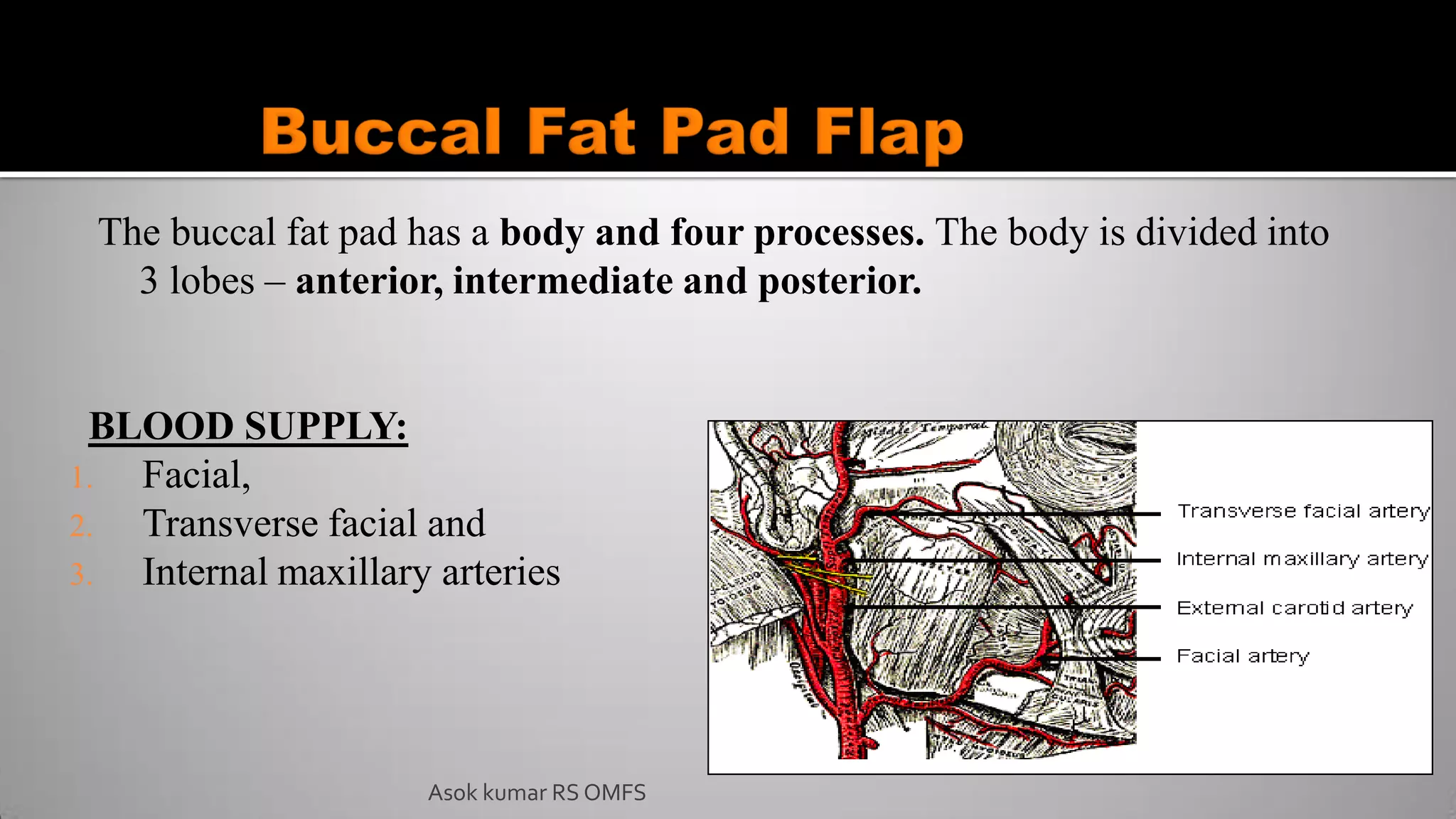
BLOOD SUPPLY:
1. Facial,
2. Transverse facial and
3. Internal maxillary arteries
Asok kumar RS OMFS
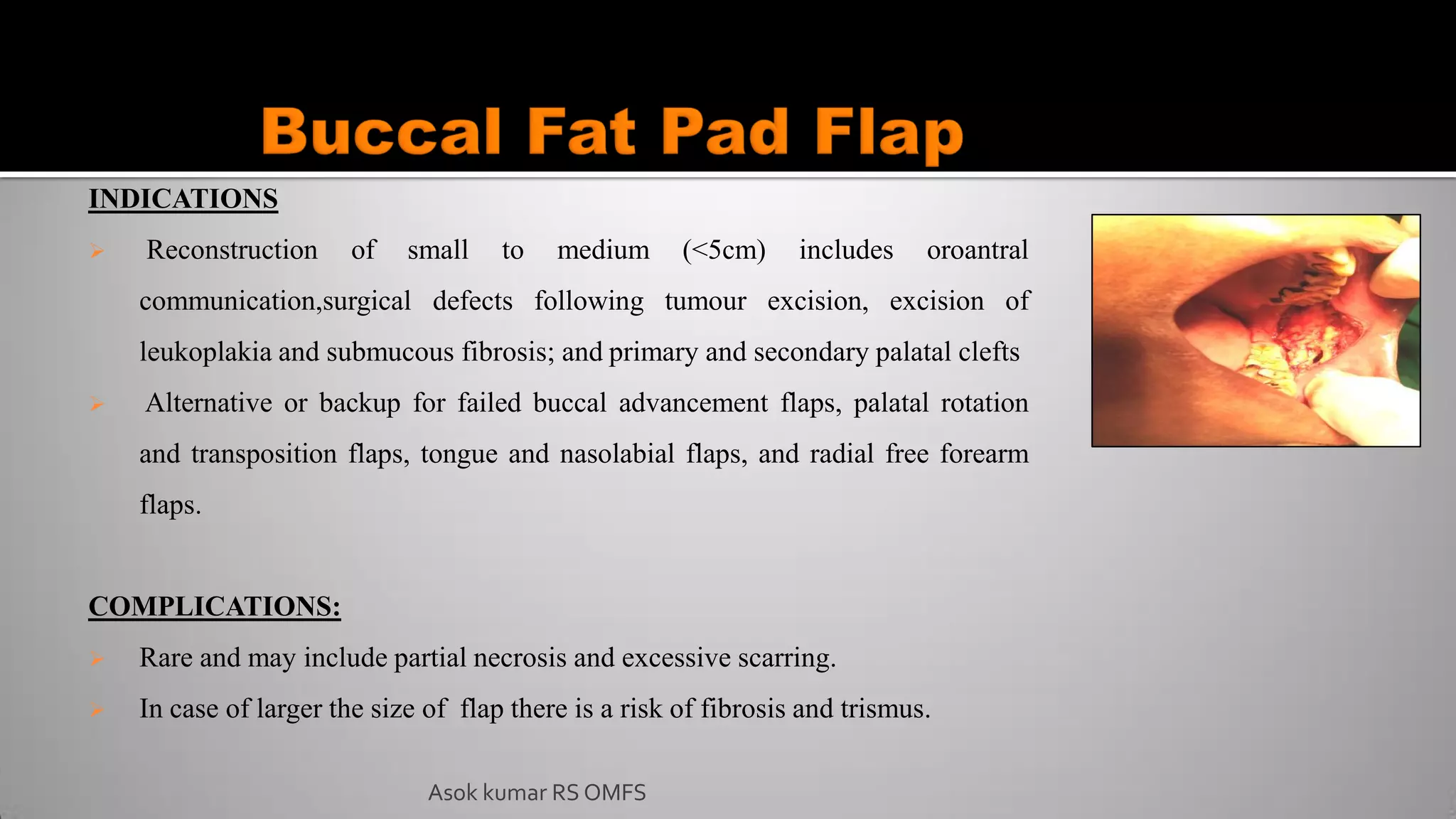
INDICATIONS
 Reconstruction of small to medium (<5cm) includes oroantral
communication,surgical defects following tumour excision, excision of
leukoplakia and submucous fibrosis; and primary and secondary palatal clefts
 Alternative or backup for failed buccal advancement flaps, palatal rotation
and transposition flaps, tongue and nasolabial flaps, and radial free forearm
flaps.
COMPLICATIONS:
 Rare and may include partial necrosis and excessive scarring.
 In case of larger the size of flap there is a risk of fibrosis and trismus.
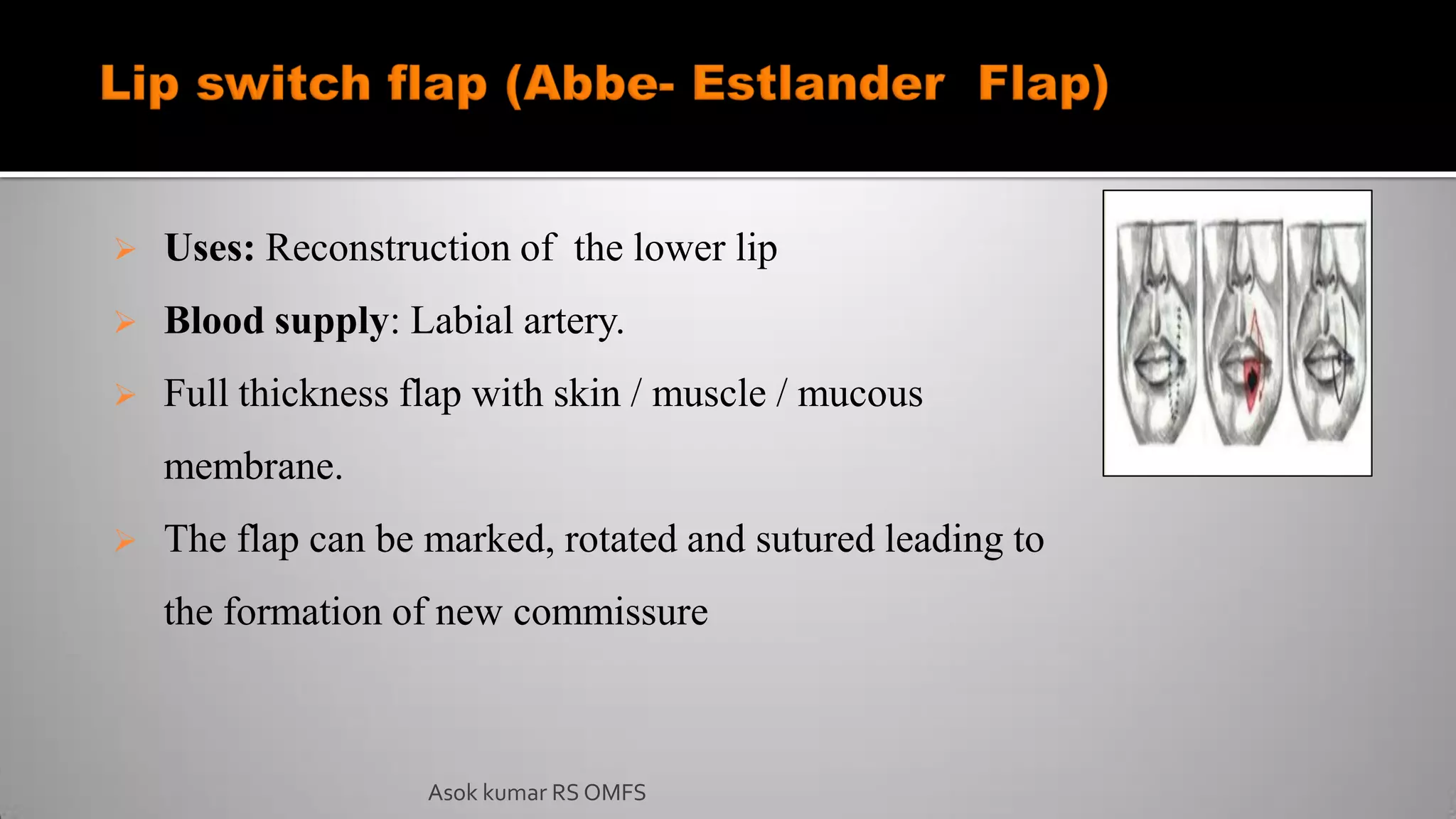
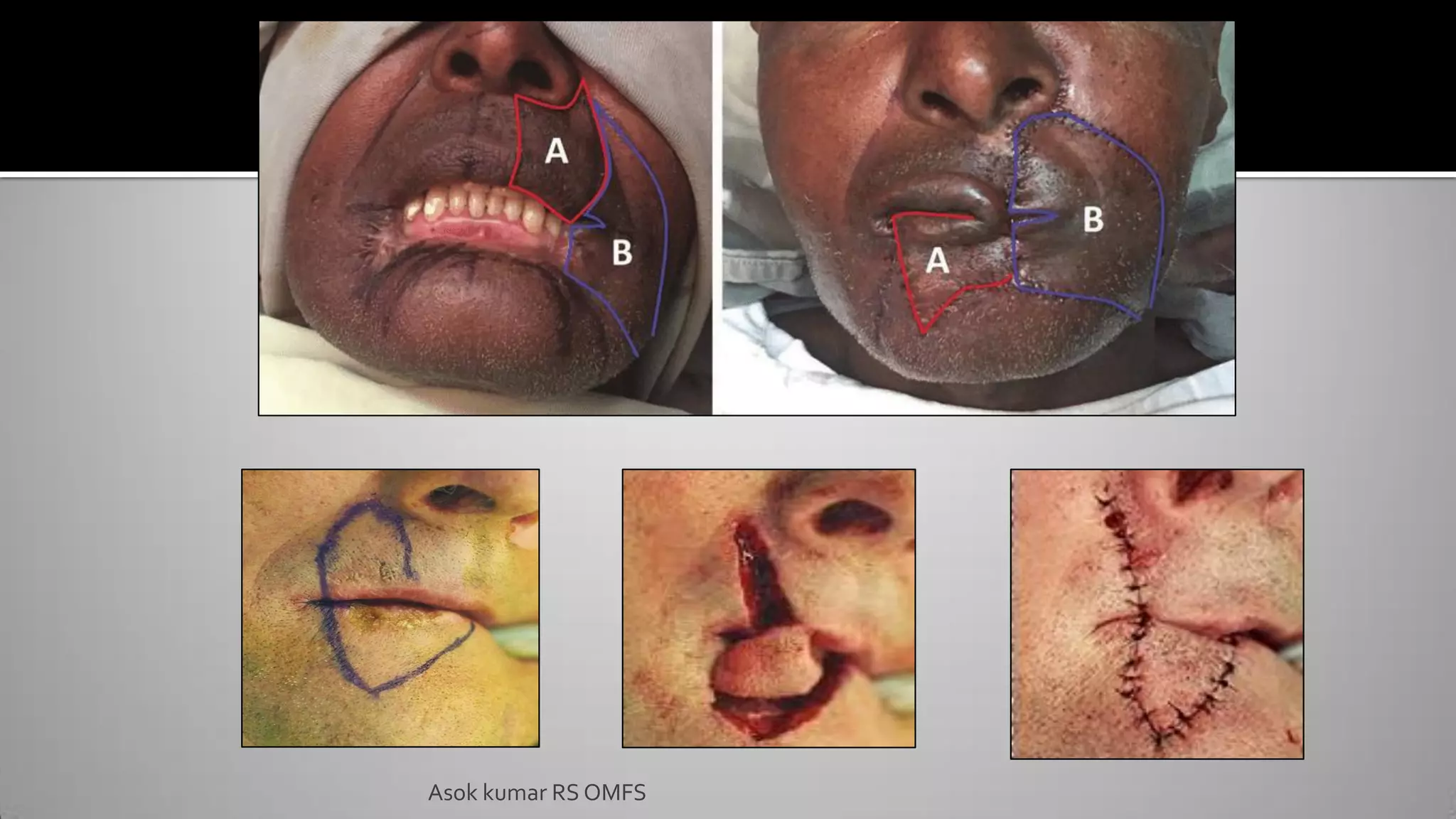
 Uses: Reconstruction of the lower lip
 Blood supply: Labial artery.
 Full thickness flap with skin / muscle / mucous
membrane.
 The flap can be marked, rotated and sutured leading to
the formation of new commissure
Asok kumar RS OMFS
Asok kumar RS OMFS
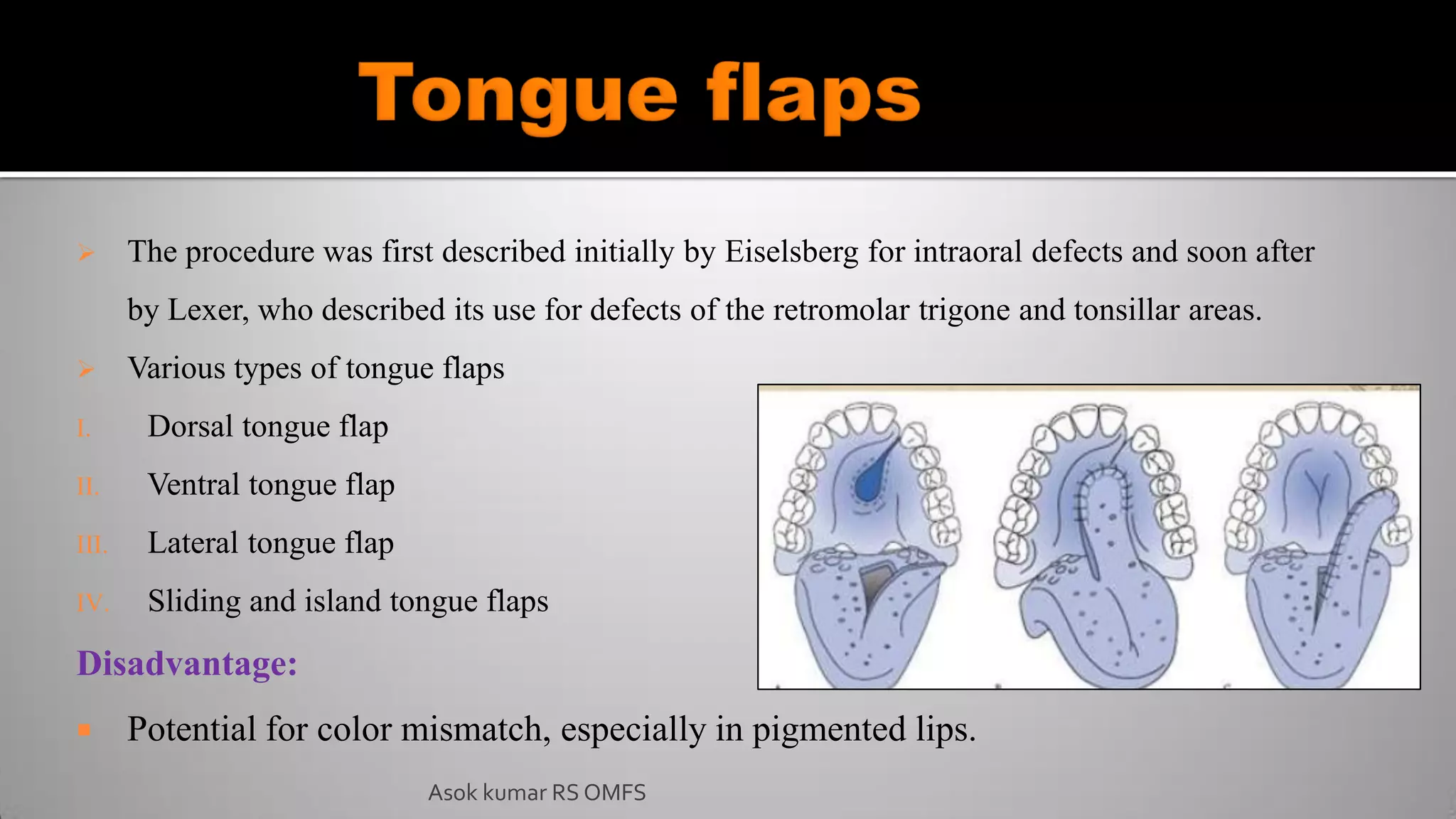
 The procedure was first described initially by Eiselsberg for intraoral defects and soon after
by Lexer, who described its use for defects of the retromolar trigone and tonsillar areas.
 Various types of tongue flaps
I. Dorsal tongue flap
II. Ventral tongue flap
III. Lateral tongue flap
IV. Sliding and island tongue flaps
Disadvantage:
 Potential for color mismatch, especially in pigmented lips.
Asok kumar RS OMFS
 Versatile flap used for the reconstruction of many oral, pharyngeal defects.
 Reconstruction of congenital or traumatic defects of the lip; buccal
mucosa; palate; alveolus; tongue; floor of mouth
 Reconstruct the vermillion border with excellent esthetic results
 Reconstruction of buccal mucosa secondary to surgical management of
oral submucous fibrosis with similar results in postoperative mouth
opening compared with buccal fat pad grafts, nasolabial fold flaps
Asok kumar RS OMFS
 Fan-shaped muscle covered by a strong fibrous aponuerotic
sheath.
 Blood supply: Anterior and posterior deep temporal artery
 Advantage :Ease of access to the muscle,
 Quantity of muscle harvested, and
 Ability to transfer the muscle to the oral cavity.
 Disadvantage :Hollowing associated with the use of the
muscle.
Asok kumar RS OMFS
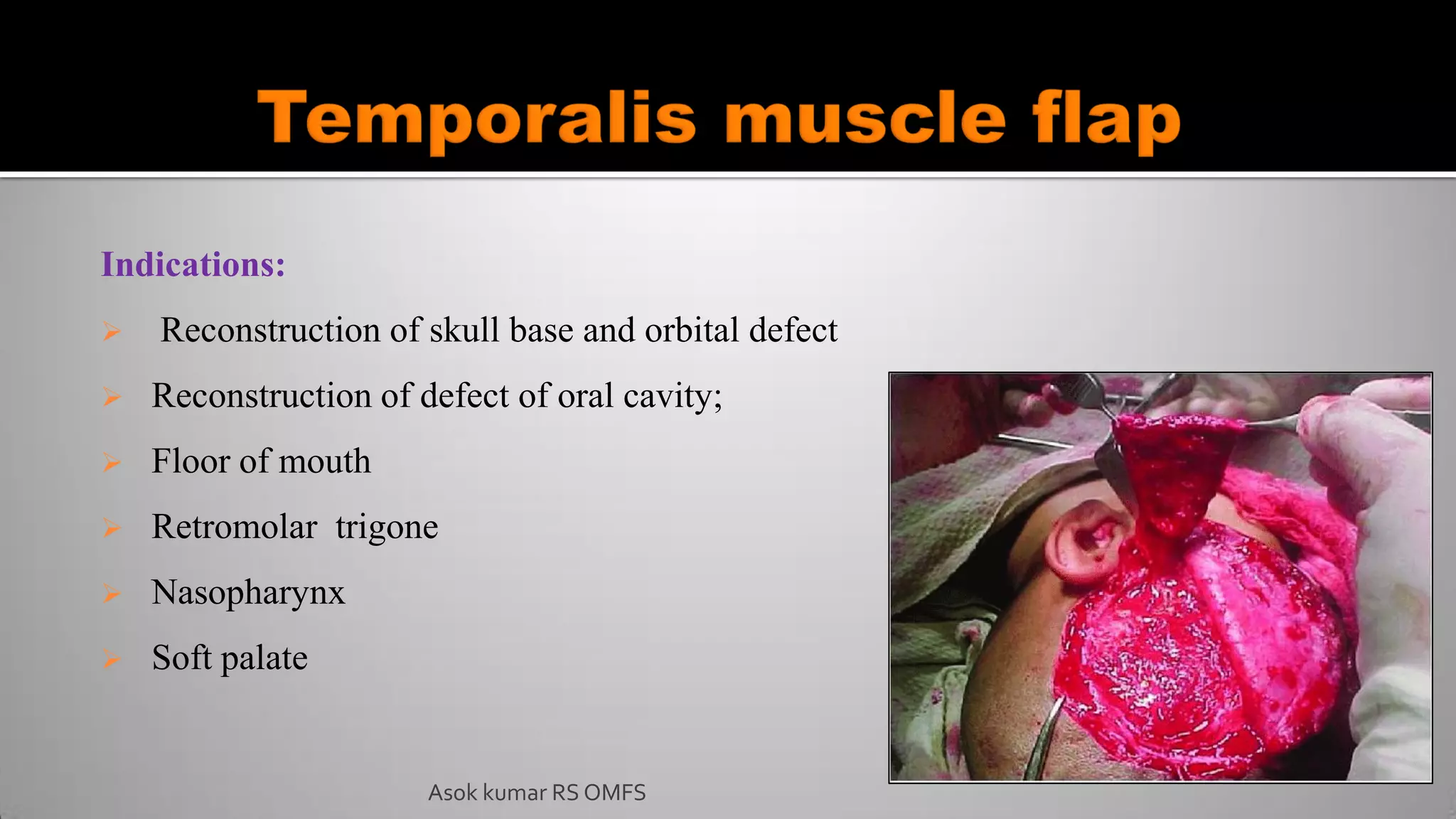
Indications:
 Reconstruction of skull base and orbital defect
 Reconstruction of defect of oral cavity;
 Floor of mouth
 Retromolar trigone
 Nasopharynx
 Soft palate
Asok kumar RS OMFS
 Flaps located near to the defect but not in the immediate proximity.
INDICATION:
 Large facial defect where local flaps doesn’t provide sufficient tissue to
restore .
 Advantage : Availability of adequate amount of tissue.
 Disadvantage:
1. Donor site morbidity
2. Poor color and texture match
3. Excessive bulkiness of flap
Asok kumar RS OMFS
 Transfer of tissue from one site of body to the another one along with it
blood supply but detatched from the original location.
 Blood supply is reconstituted using microsurgery to reconnect artery and
vein.
Asok kumar RS OMFS
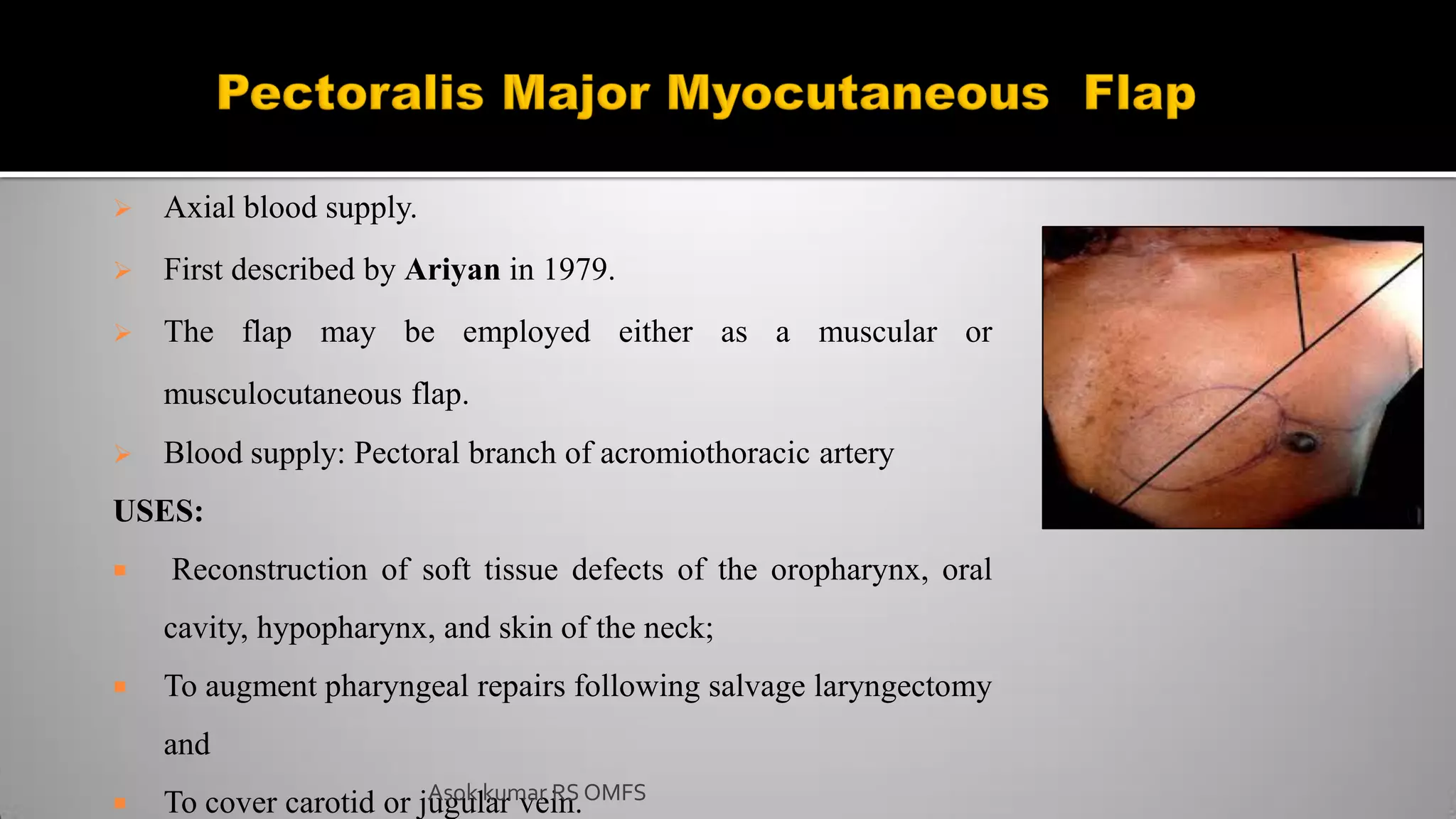
 Axial blood supply.
 First described by Ariyan in 1979.
 The flap may be employed either as a muscular or
musculocutaneous flap.
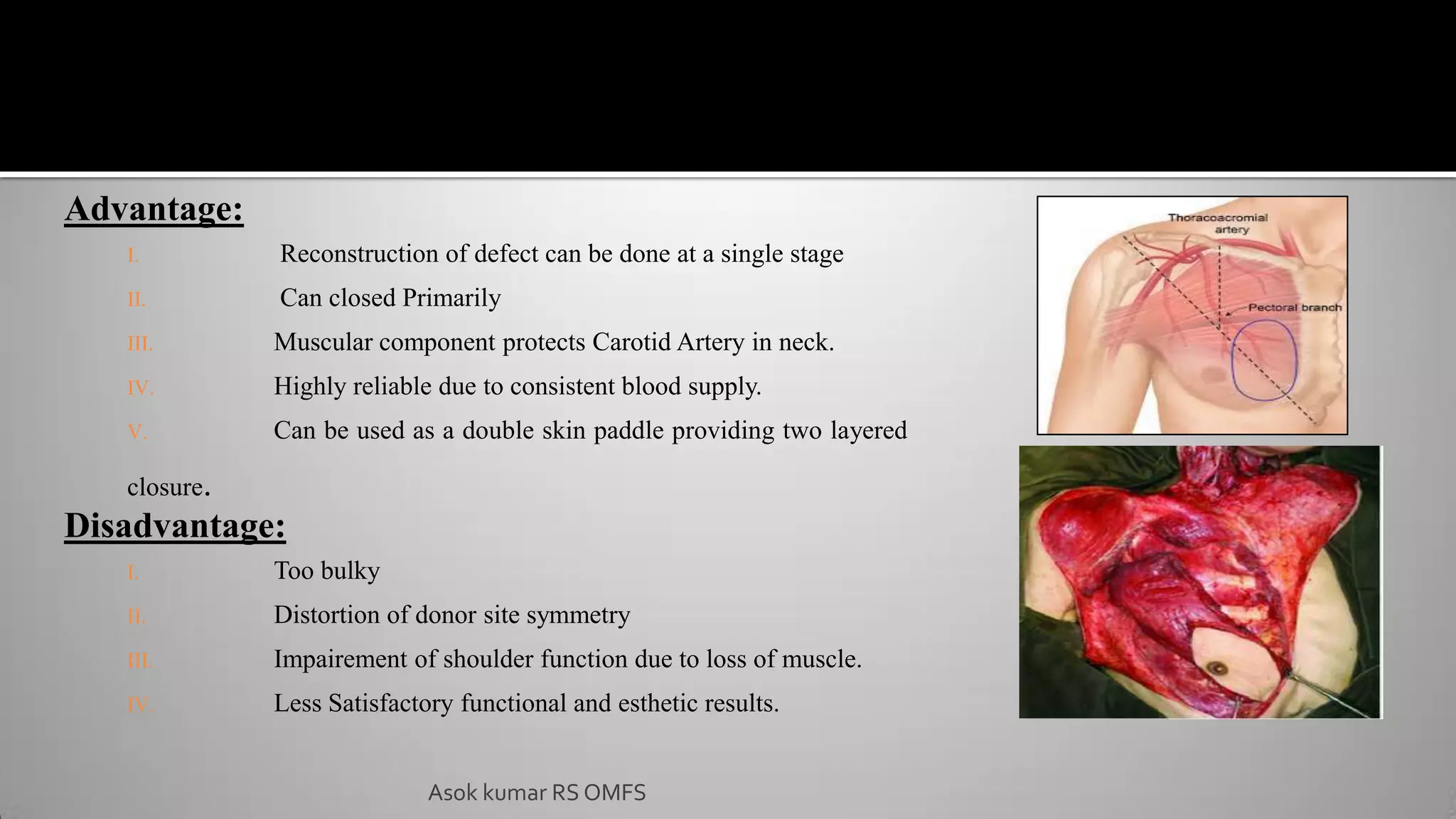
 Blood supply: Pectoral branch of acromiothoracic artery
USES:
 Reconstruction of soft tissue defects of the oropharynx, oral
cavity, hypopharynx, and skin of the neck;
 To augment pharyngeal repairs following salvage laryngectomy
and
 To cover carotid or jugular vein.
Asok kumar RS OMFS
Asok kumar RS OMFS
Advantage:
I. Reconstruction of defect can be done at a single stage
II. Can closed Primarily
III. Muscular component protects Carotid Artery in neck.
IV. Highly reliable due to consistent blood supply.
V. Can be used as a double skin paddle providing two layered
closure.
Disadvantage:
I. Too bulky
II. Distortion of donor site symmetry
III. Impairement of shoulder function due to loss of muscle.
IV. Less Satisfactory functional and esthetic results.
Asok kumar RS OMFS
Flap related:
 Marginal necrosis
 Wound dehiscence
 Hematoma
 Infection
 Formation of oro cutaneous fistula.
Flap unrelated:
 Pleural emphysema
 Chyle leak
 Parotid fistula
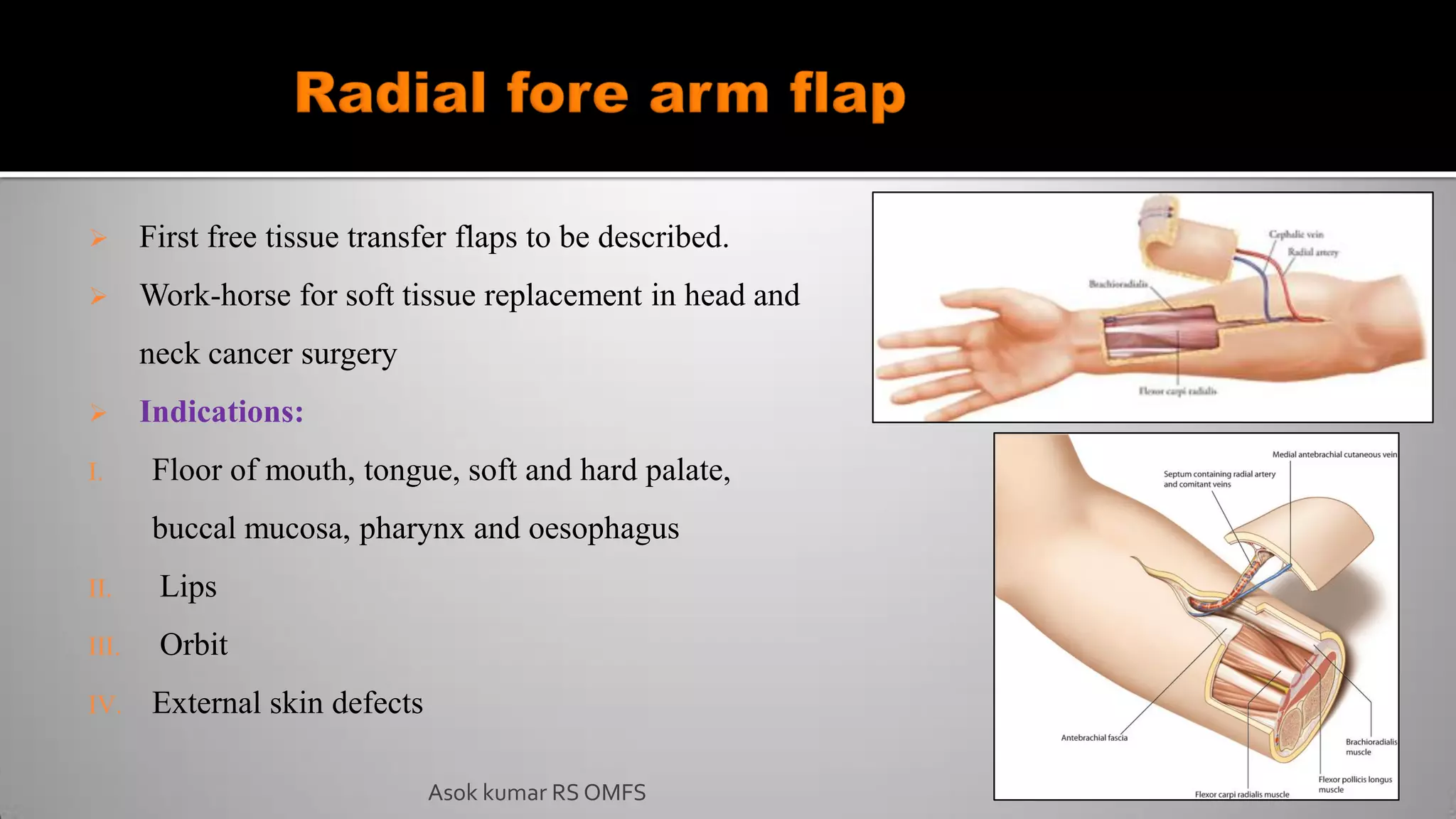
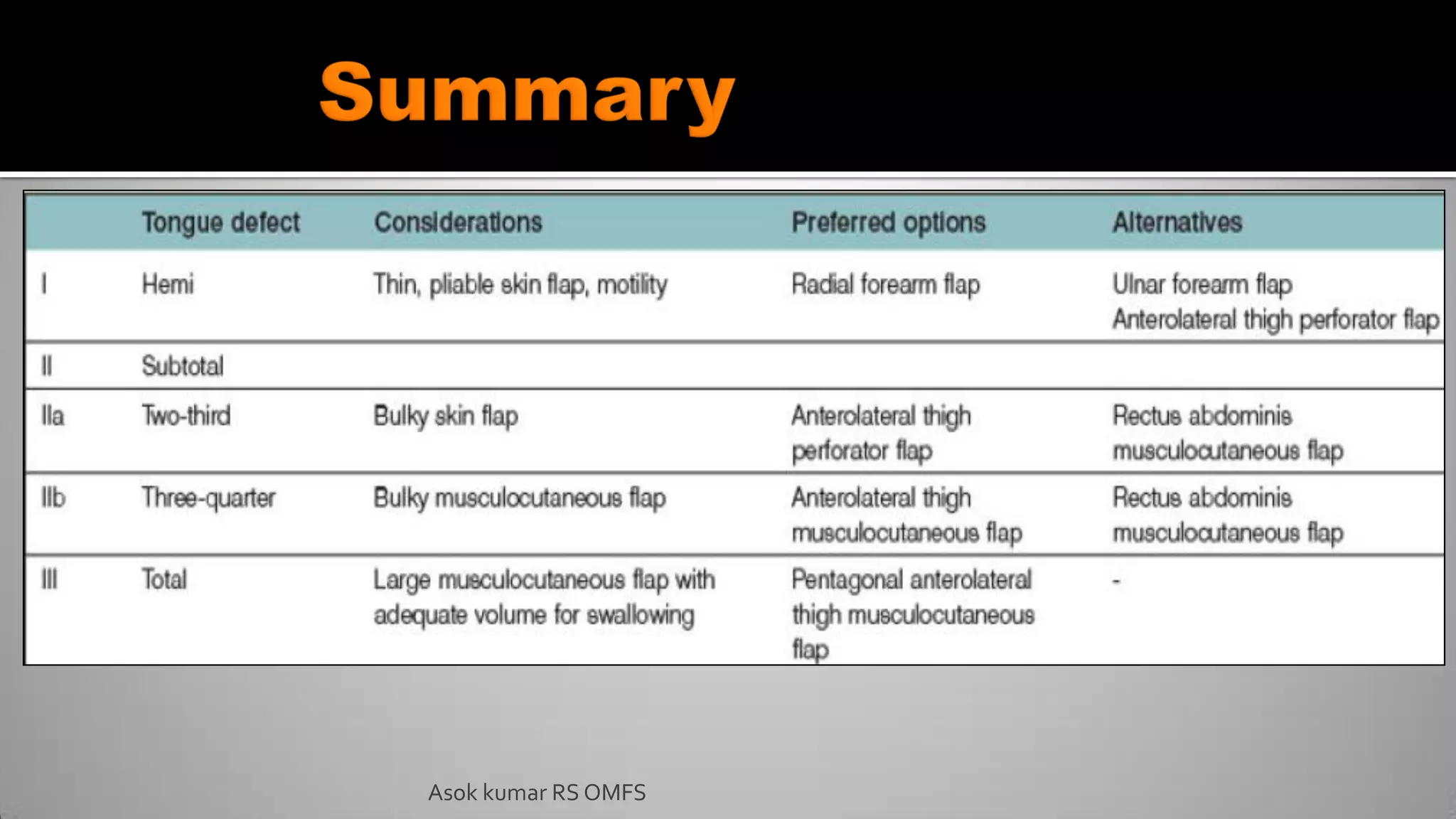
 First free tissue transfer flaps to be described.
 Work-horse for soft tissue replacement in head and
neck cancer surgery
 Indications:
I. Floor of mouth, tongue, soft and hard palate,
buccal mucosa, pharynx and oesophagus
II. Lips
III. Orbit
IV. External skin defects
Asok kumar RS OMFS
Asok kumar RS OMFS
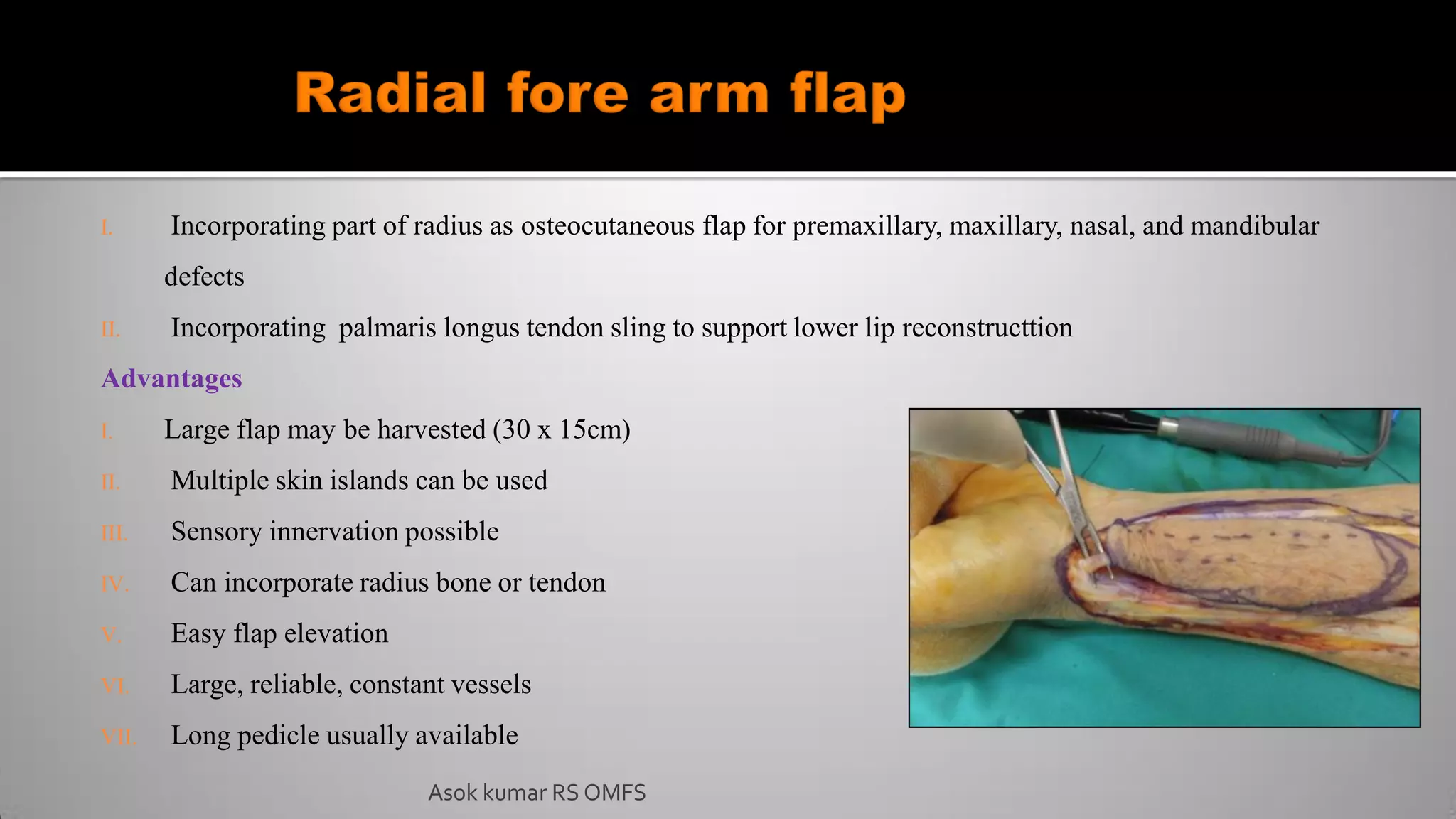
I. Incorporating part of radius as osteocutaneous flap for premaxillary, maxillary, nasal, and mandibular
defects
II. Incorporating palmaris longus tendon sling to support lower lip reconstructtion
Advantages
I. Large flap may be harvested (30 x 15cm)
II. Multiple skin islands can be used
III. Sensory innervation possible
IV. Can incorporate radius bone or tendon
V. Easy flap elevation
VI. Large, reliable, constant vessels
VII. Long pedicle usually available
Asok kumar RS OMFS
Disadvantage:
I. Potentially poor skin quality
II. Donor site morbidity
III. Poor cosmetic result
IV. Atherosclerosis and postoperative vascular
compromise.
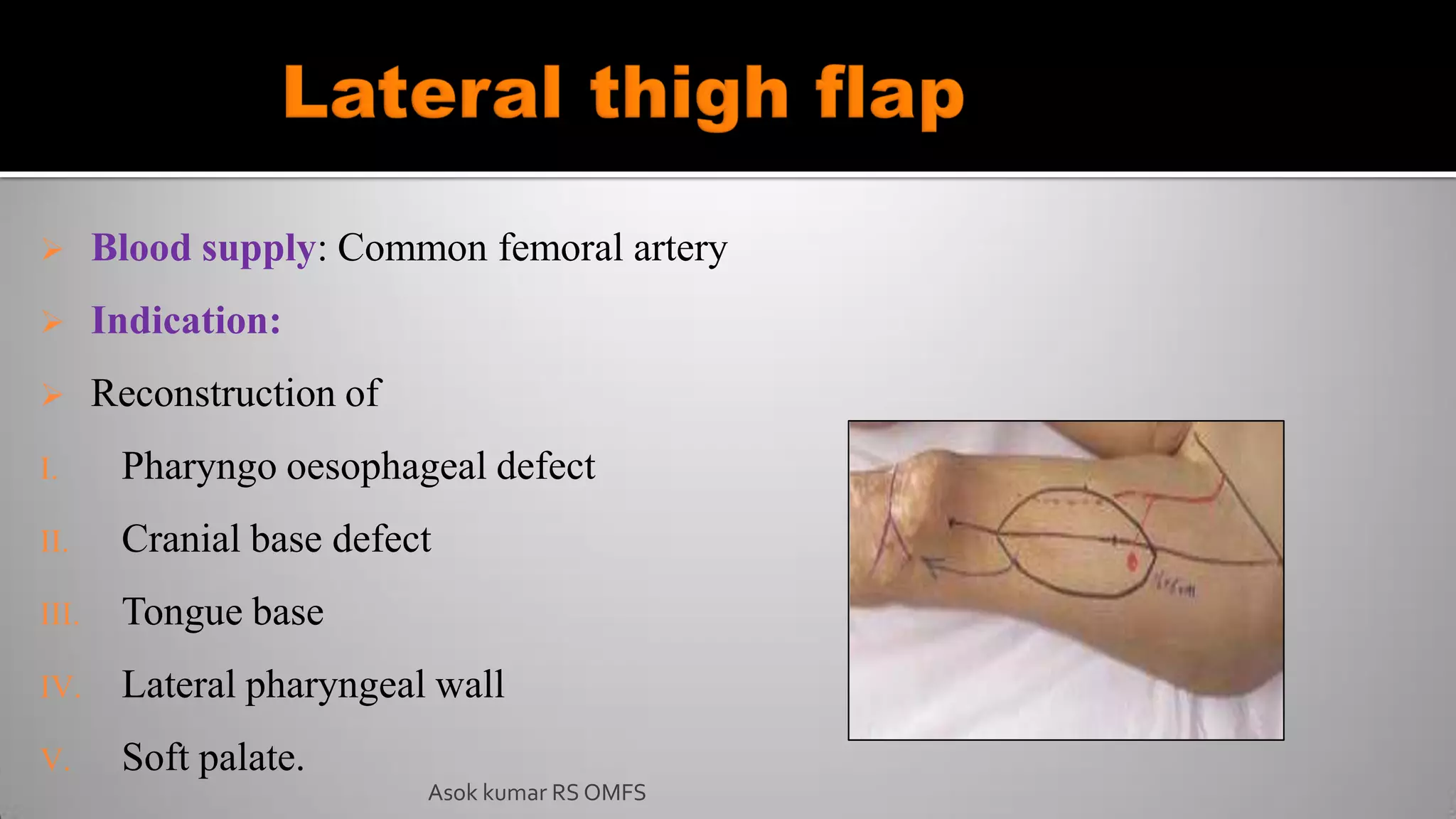
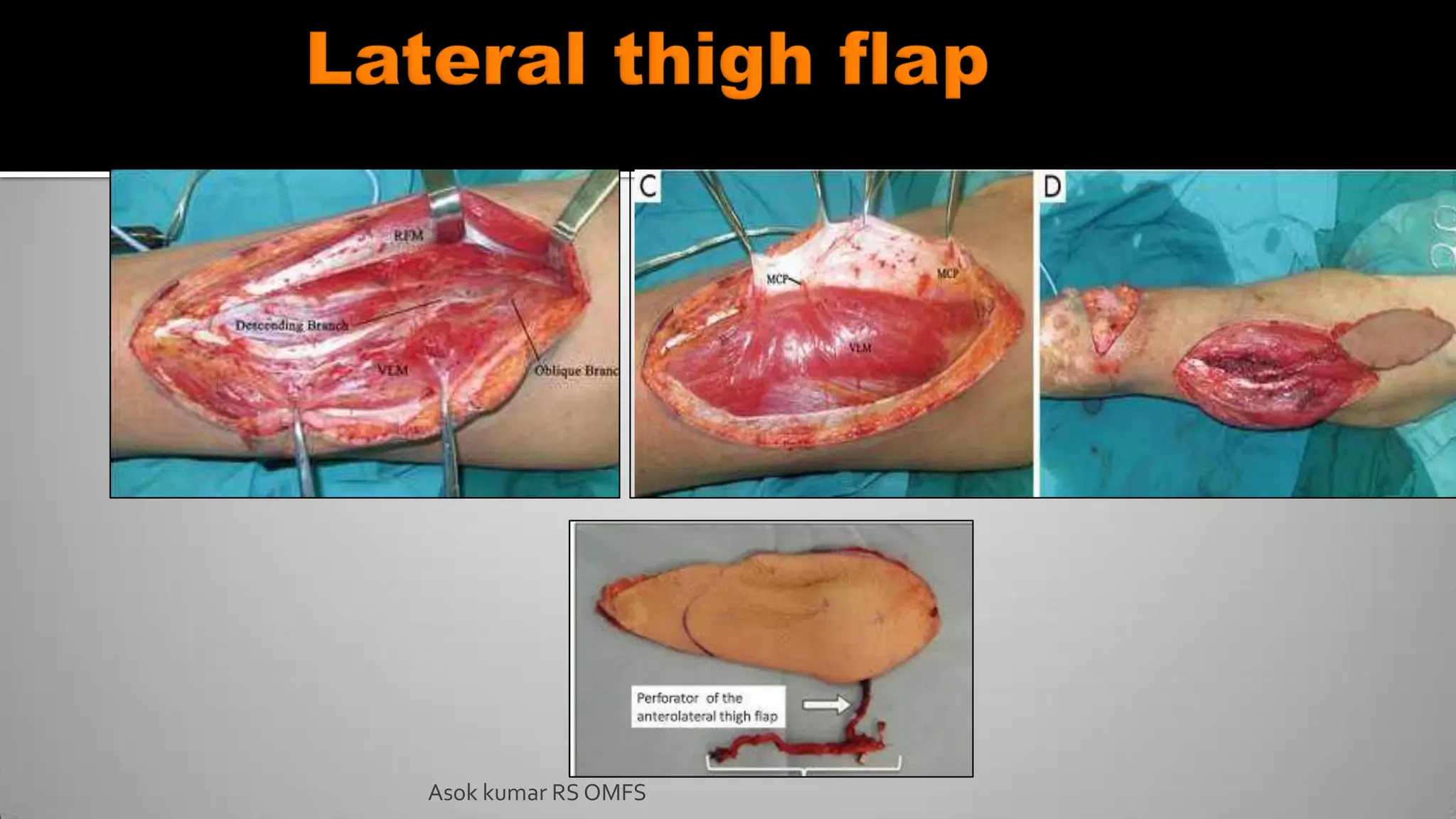
 Blood supply: Common femoral artery
 Indication:
 Reconstruction of
I. Pharyngo oesophageal defect
II. Cranial base defect
III. Tongue base
IV. Lateral pharyngeal wall
V. Soft palate.
Asok kumar RS OMFS
Asok kumar RS OMFS
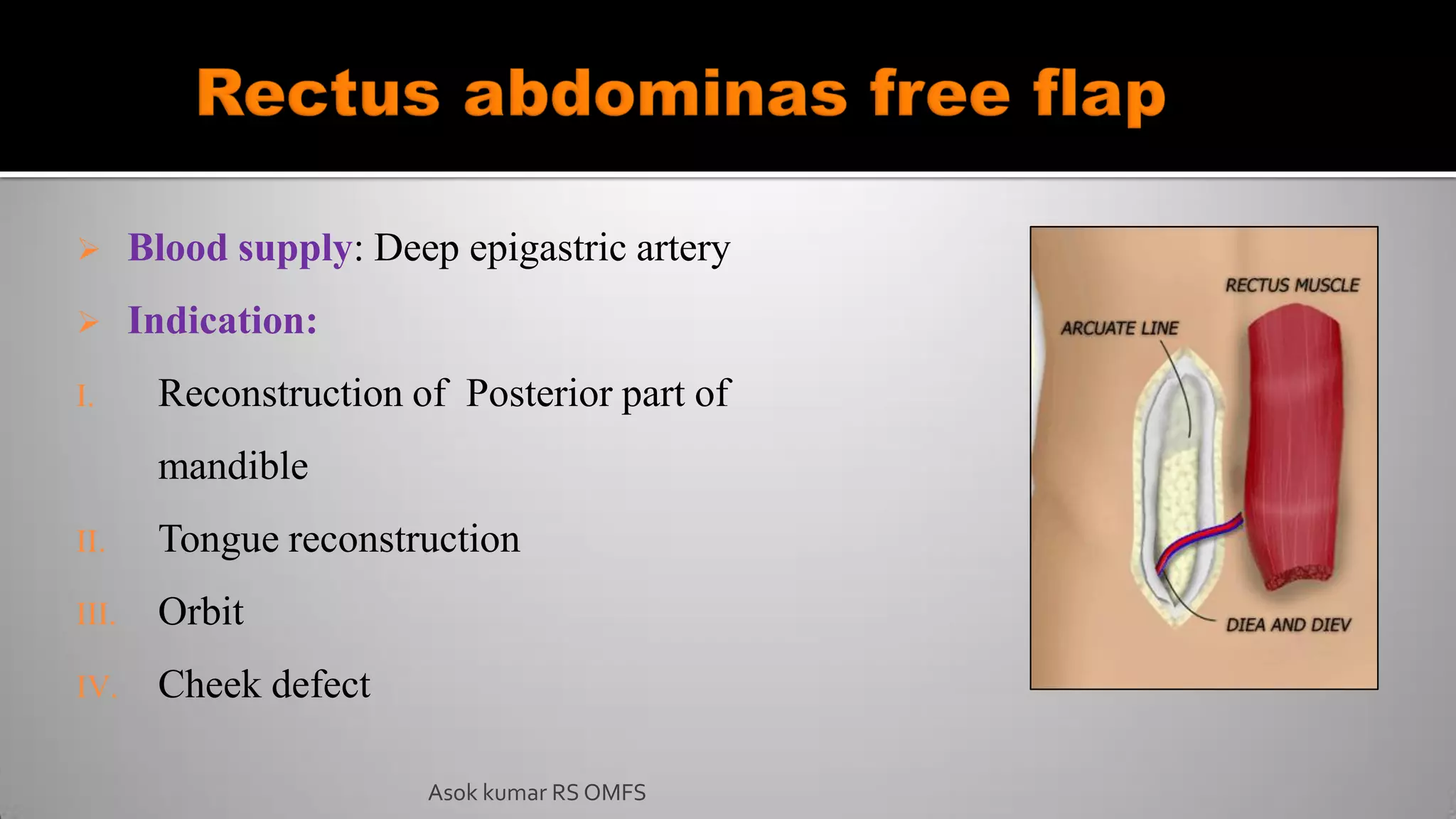
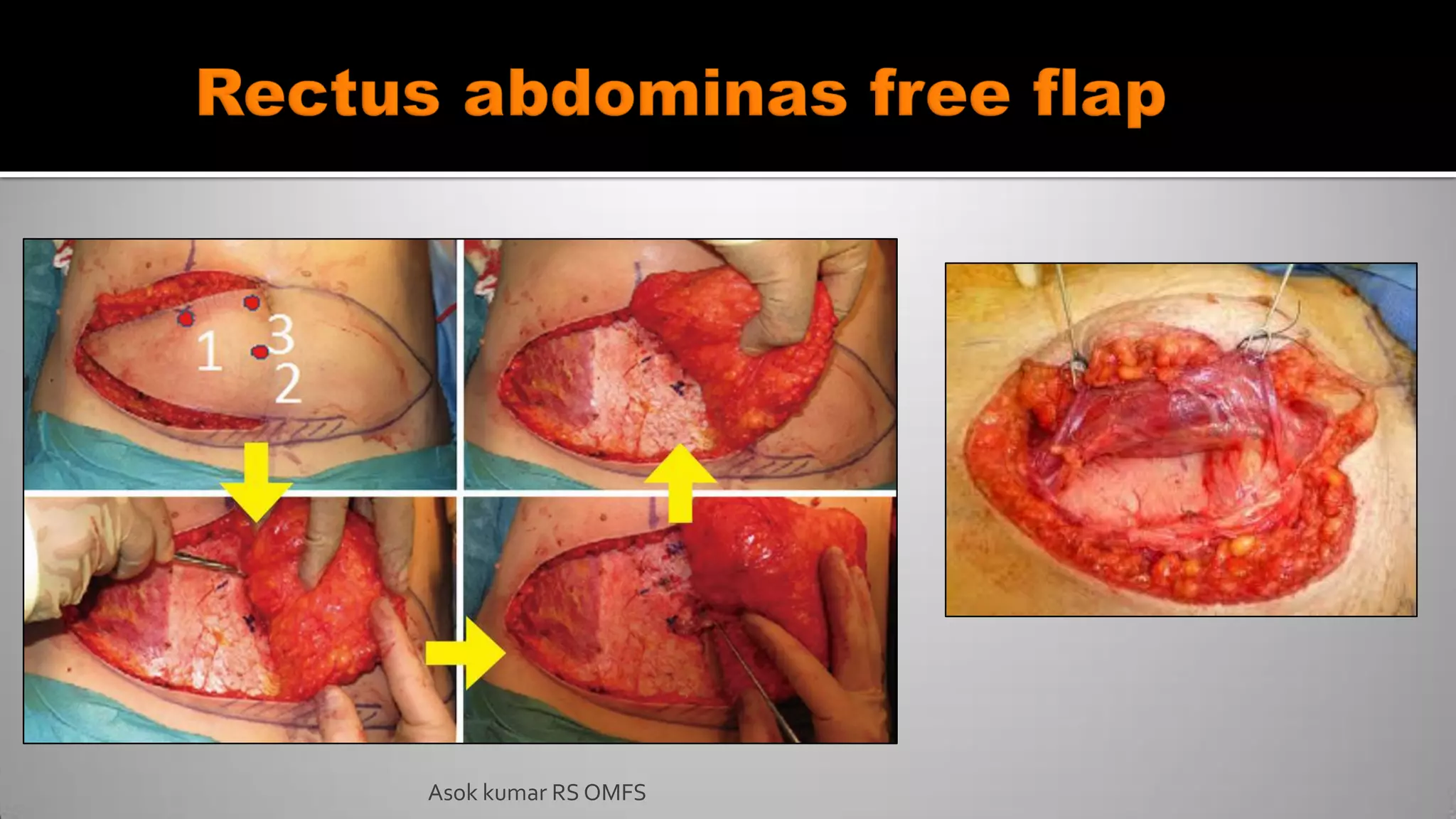
 Blood supply: Deep epigastric artery
 Indication:
I. Reconstruction of Posterior part of
mandible
II. Tongue reconstruction
III. Orbit
IV. Cheek defect
Asok kumar RS OMFS
Asok kumar RS OMFS
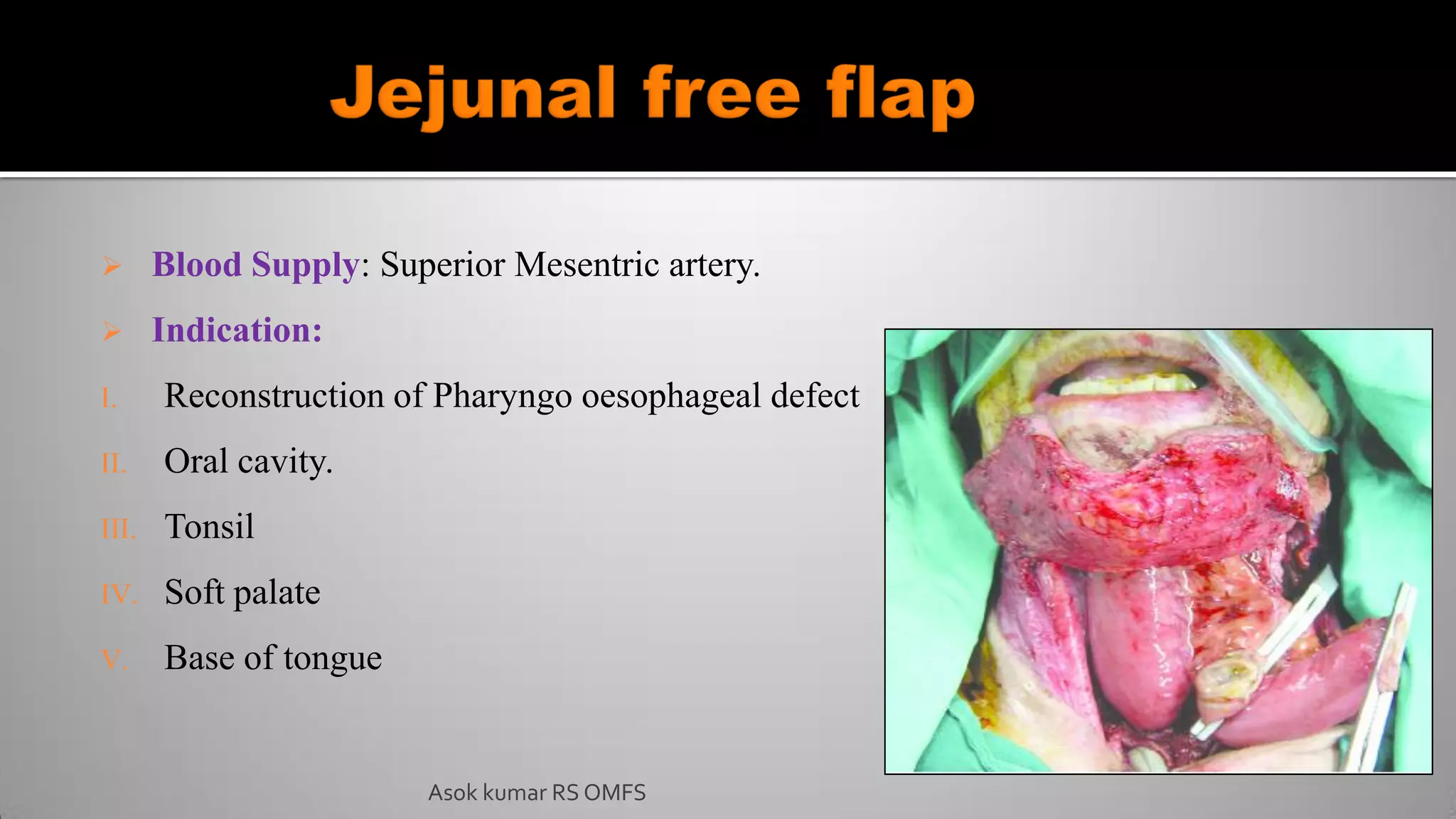
 Blood Supply: Superior Mesentric artery.
 Indication:
I. Reconstruction of Pharyngo oesophageal defect
II. Oral cavity.
III. Tonsil
IV. Soft palate
V. Base of tongue
Asok kumar RS OMFS
 Blood supply:
I. Occipital artery
II. Superior thyroid artery
III. Branches of thyrocervical trunk
 Indication:
I. Soft tissue mandibular reconstruction
II. Tracheal reconstruction
III. Provides soft tissue augmentation after parotidectomy.
Asok kumar RS OMFS
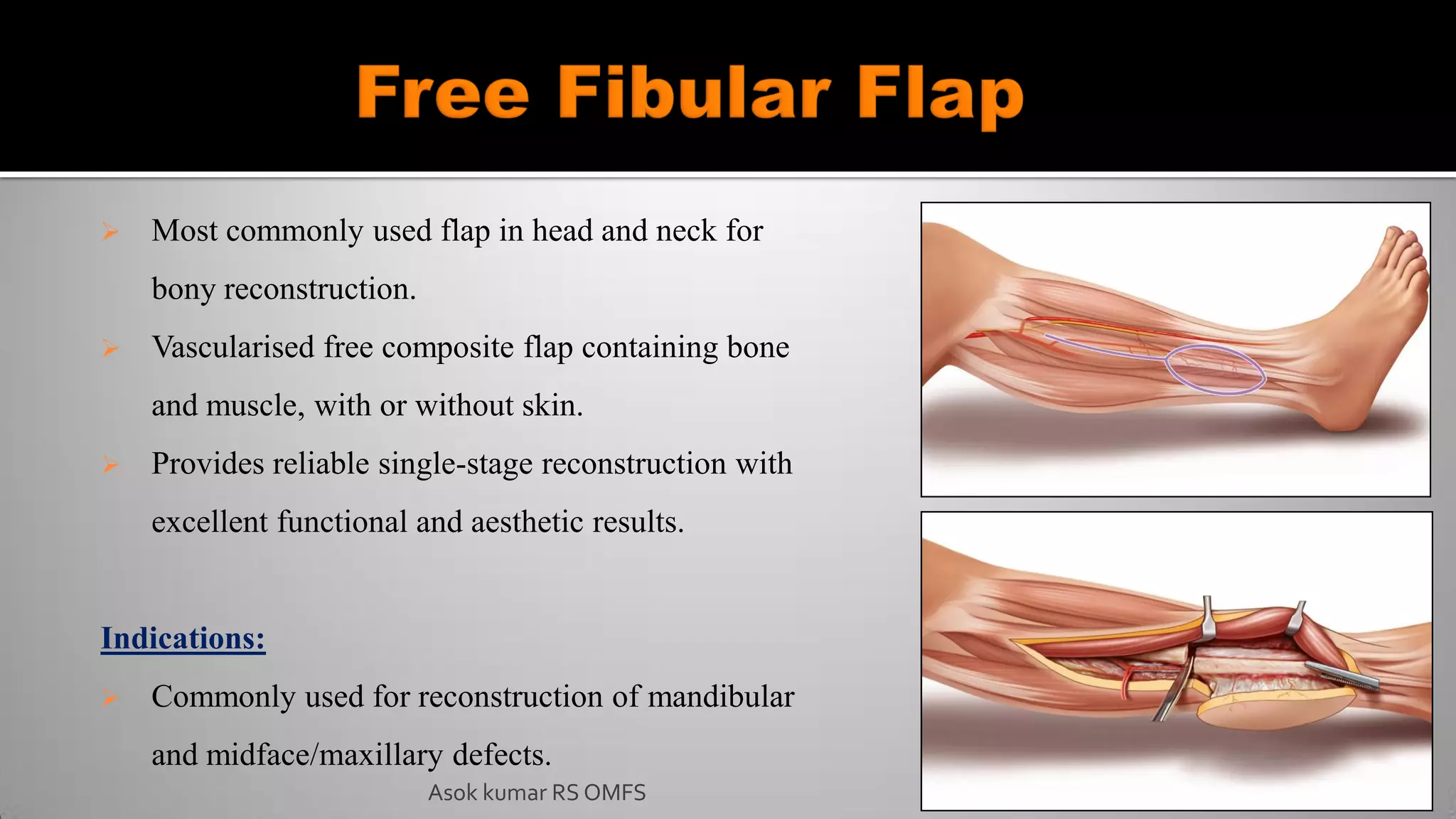
 Most commonly used flap in head and neck for
bony reconstruction.
 Vascularised free composite flap containing bone
and muscle, with or without skin.
 Provides reliable single-stage reconstruction with
excellent functional and aesthetic results.
Indications:
 Commonly used for reconstruction of mandibular
and midface/maxillary defects.
Asok kumar RS OMFS
Advantages:
 Well vascularised and Long vascular pedicle
 Adequate length of donor bone (>25cm)
 Adequate bone strength
 Bony reconstruction can be shaped with multiple segmental
osteotomies
 Stable bicortical osseointegrated dental implant fixation is
possible
 Thin, pliable overlying skin
 Very little soft tissue bulk (usually)
 Simultaneous resection and harvesting of flap possible due to
distant location of the donor site from head and neck resection
Disadvantage:
 Donor site morbidity:
 Delayed wound healing and skin graft loss
especially following peroneal tendon
exposure;
 muscle necrosis
 Poor skin quality:
Asok kumar RS OMFS
 Blood supply:
I. Internal mammary artery
 Indication:
a. As an alternative to pectoralis major
myocutaneous flap for reconstruction of maxilla
and mandible. Asok kumar RS OMFS
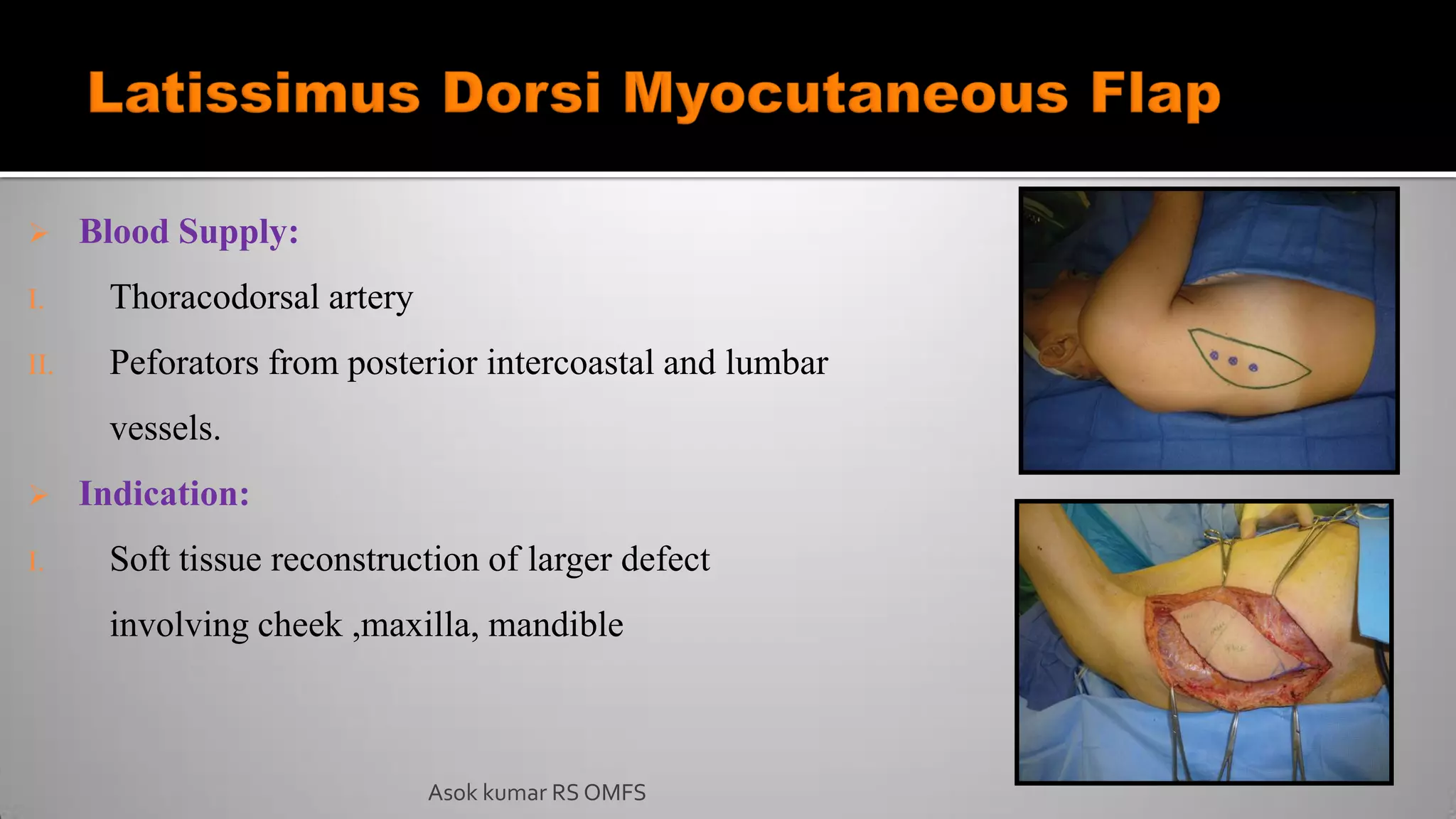
 Blood Supply:
I. Thoracodorsal artery
II. Peforators from posterior intercoastal and lumbar
vessels.
 Indication:
I. Soft tissue reconstruction of larger defect
involving cheek ,maxilla, mandible
Asok kumar RS OMFS
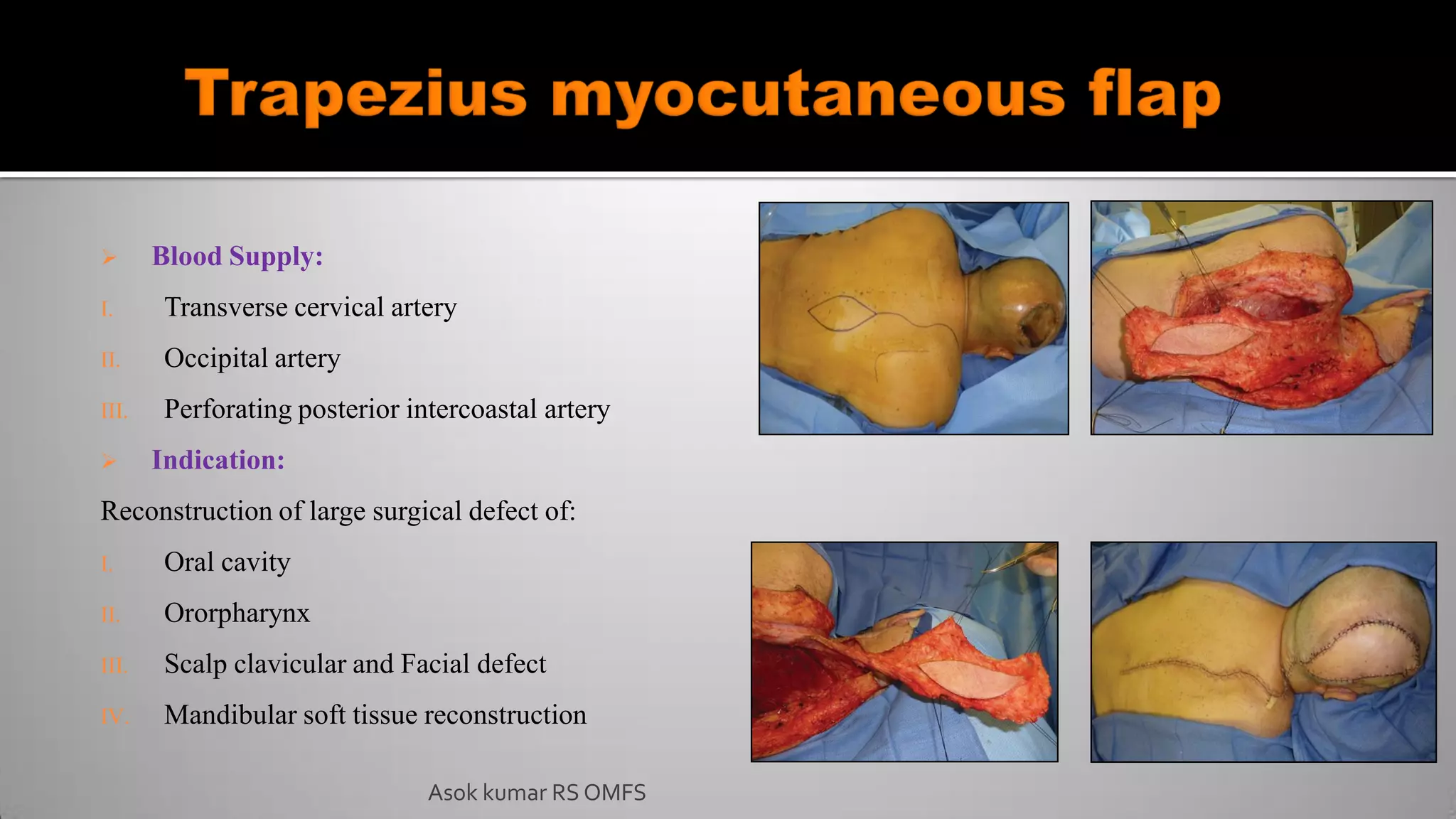
 Blood Supply:
I. Transverse cervical artery
II. Occipital artery
III. Perforating posterior intercoastal artery
 Indication:
Reconstruction of large surgical defect of:
I. Oral cavity
II. Ororpharynx
III. Scalp clavicular and Facial defect
IV. Mandibular soft tissue reconstruction
Asok kumar RS OMFS
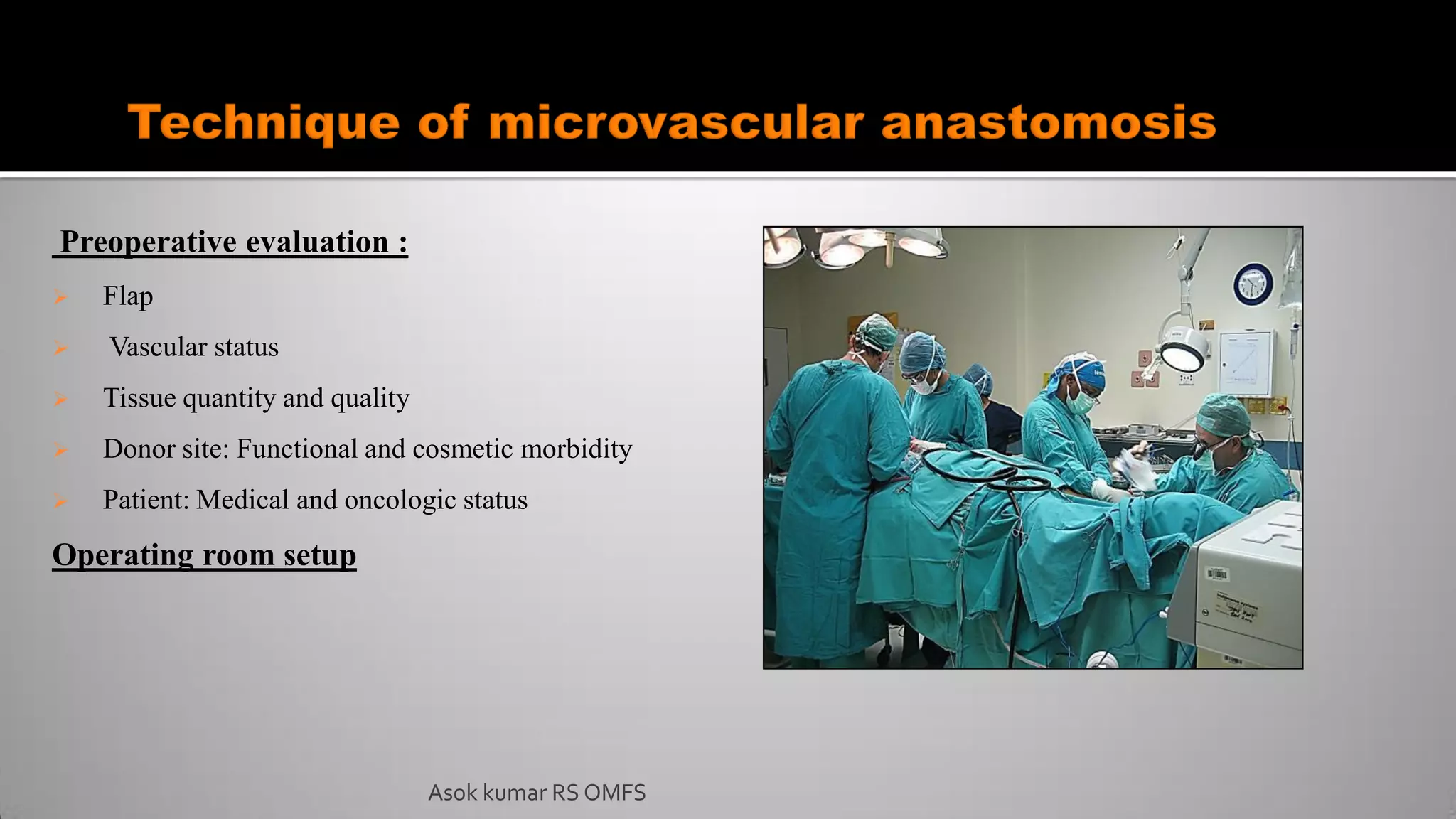
Preoperative evaluation :
 Flap
 Vascular status
 Tissue quantity and quality
 Donor site: Functional and cosmetic morbidity
 Patient: Medical and oncologic status
Operating room setup
Asok kumar RS OMFS
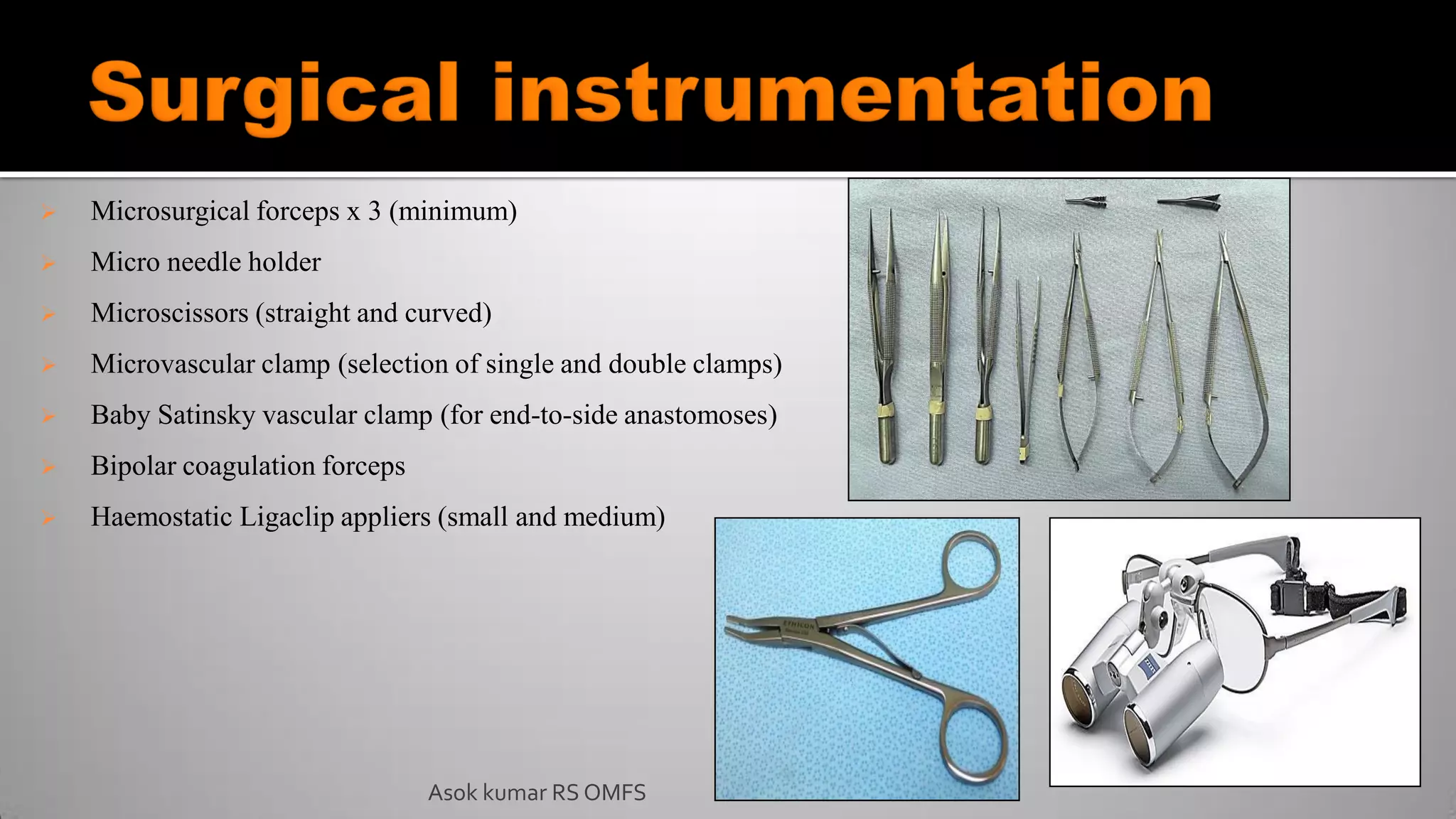
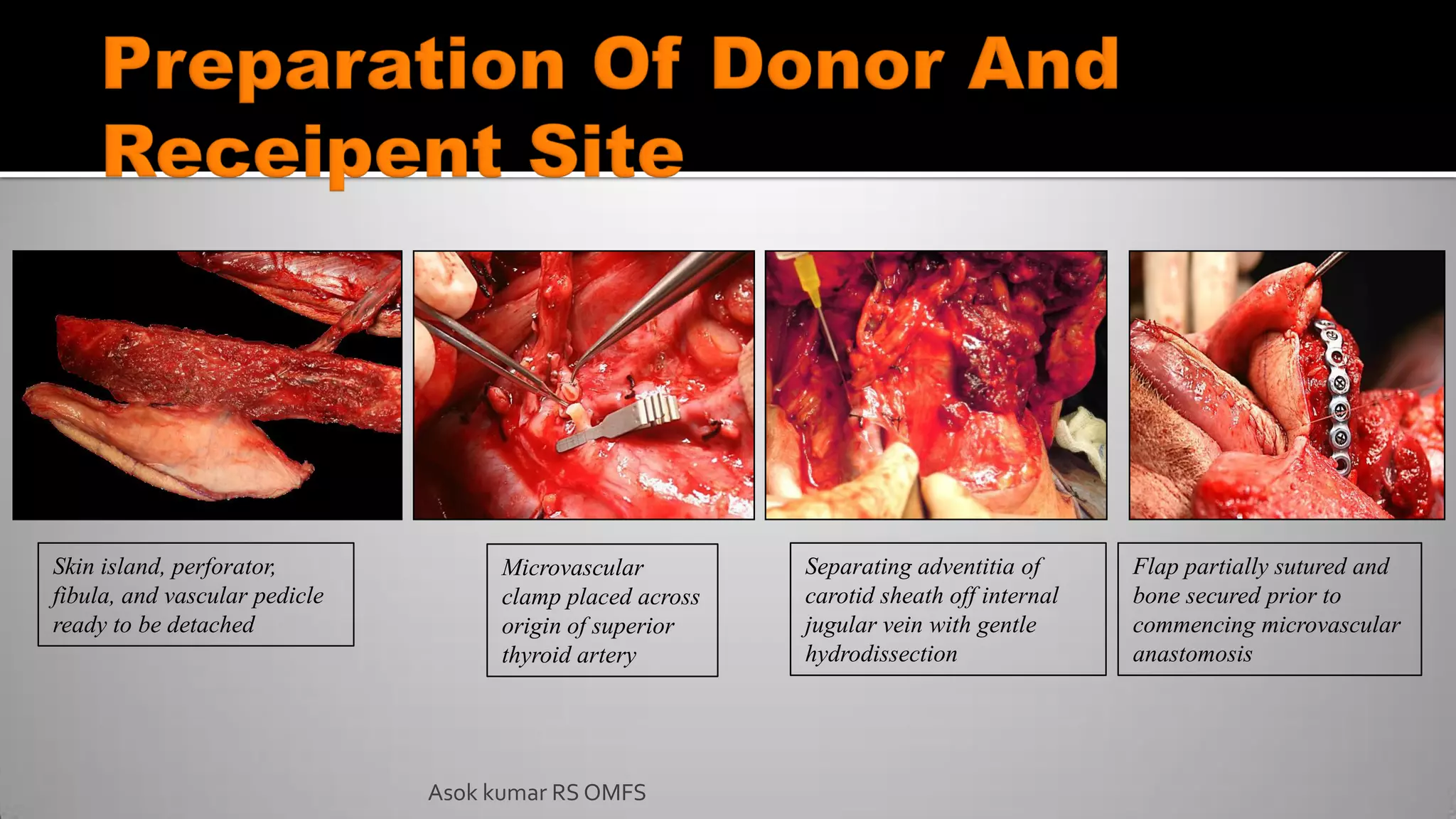
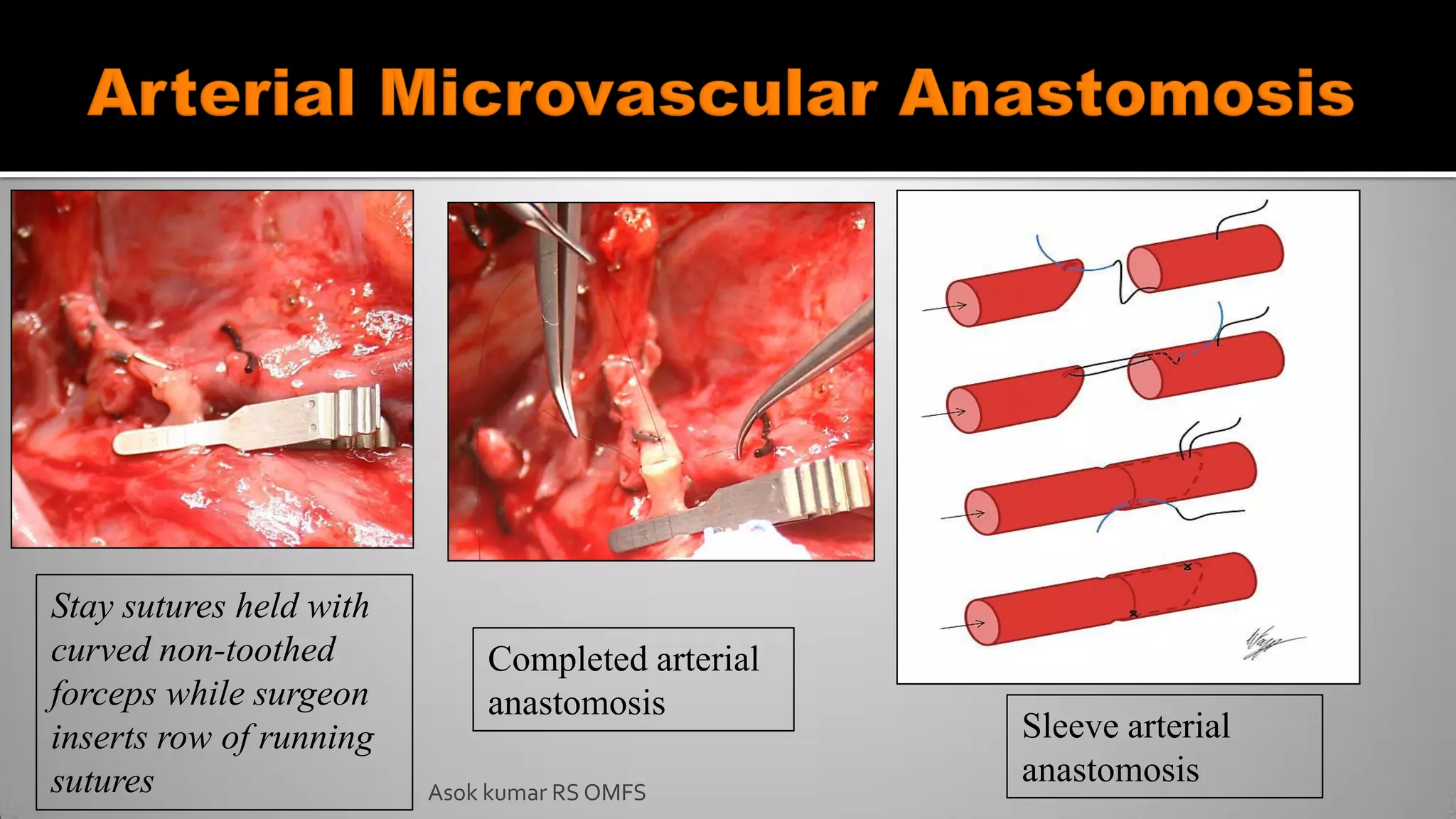
 Microsurgical forceps x 3 (minimum)
 Micro needle holder
 Microscissors (straight and curved)
 Microvascular clamp (selection of single and double clamps)
 Baby Satinsky vascular clamp (for end-to-side anastomoses)
 Bipolar coagulation forceps
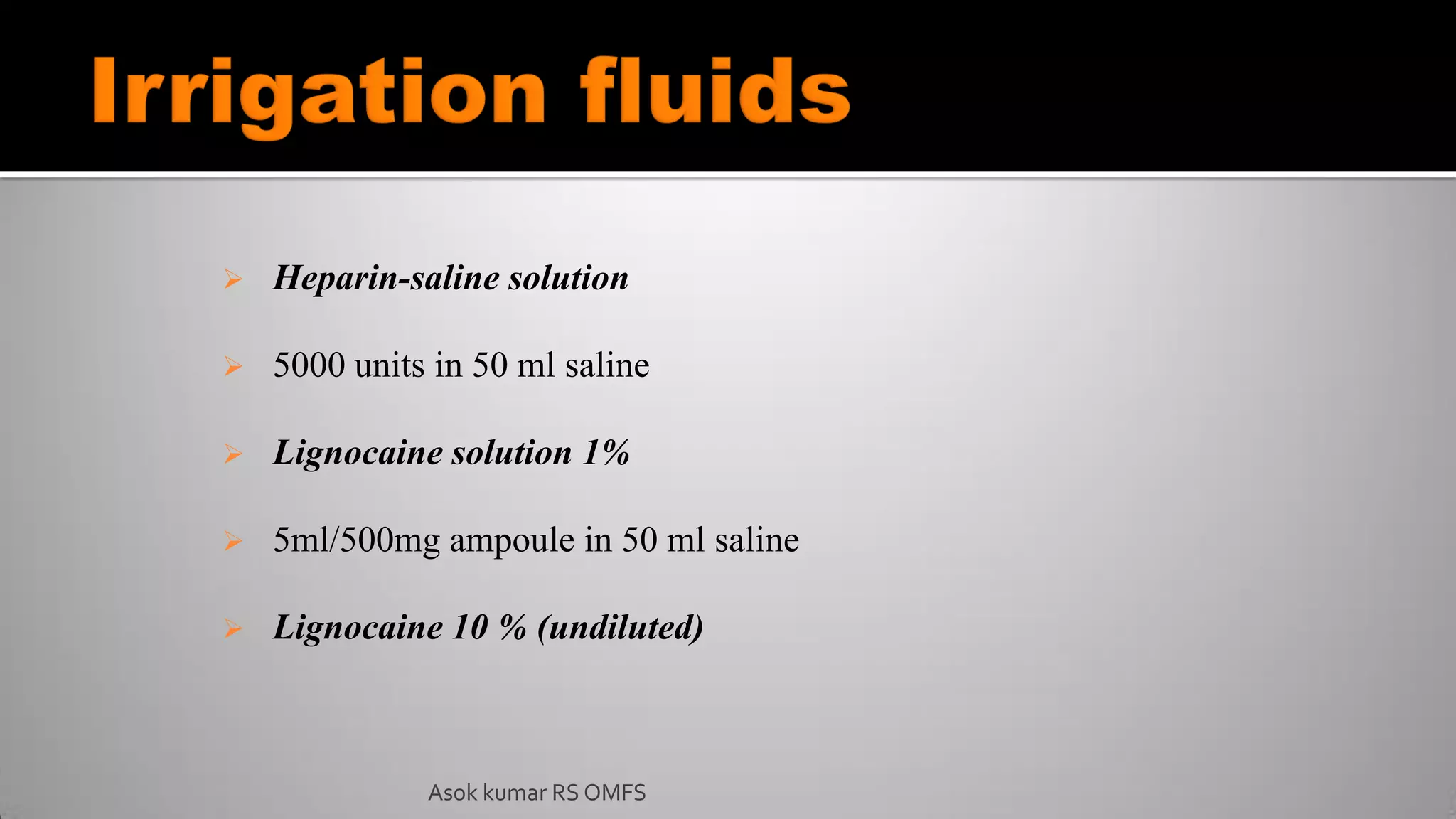
 Haemostatic Ligaclip appliers (small and medium)
Asok kumar RS OMFS
 Heparin-saline solution
 5000 units in 50 ml saline
 Lignocaine solution 1%
 5ml/500mg ampoule in 50 ml saline
 Lignocaine 10 % (undiluted)
Asok kumar RS OMFS
Asok kumar RS OMFS
Skin island, perforator,
fibula, and vascular pedicle
ready to be detached
Microvascular
clamp placed across
origin of superior
thyroid artery
Flap partially sutured and
bone secured prior to
commencing microvascular
anastomosis
Separating adventitia of
carotid sheath off internal
jugular vein with gentle
hydrodissection
Sleeve arterial
anastomosis
Completed arterial
anastomosis
Stay sutures held with
curved non-toothed
forceps while surgeon
inserts row of running
sutures Asok kumar RS OMFS
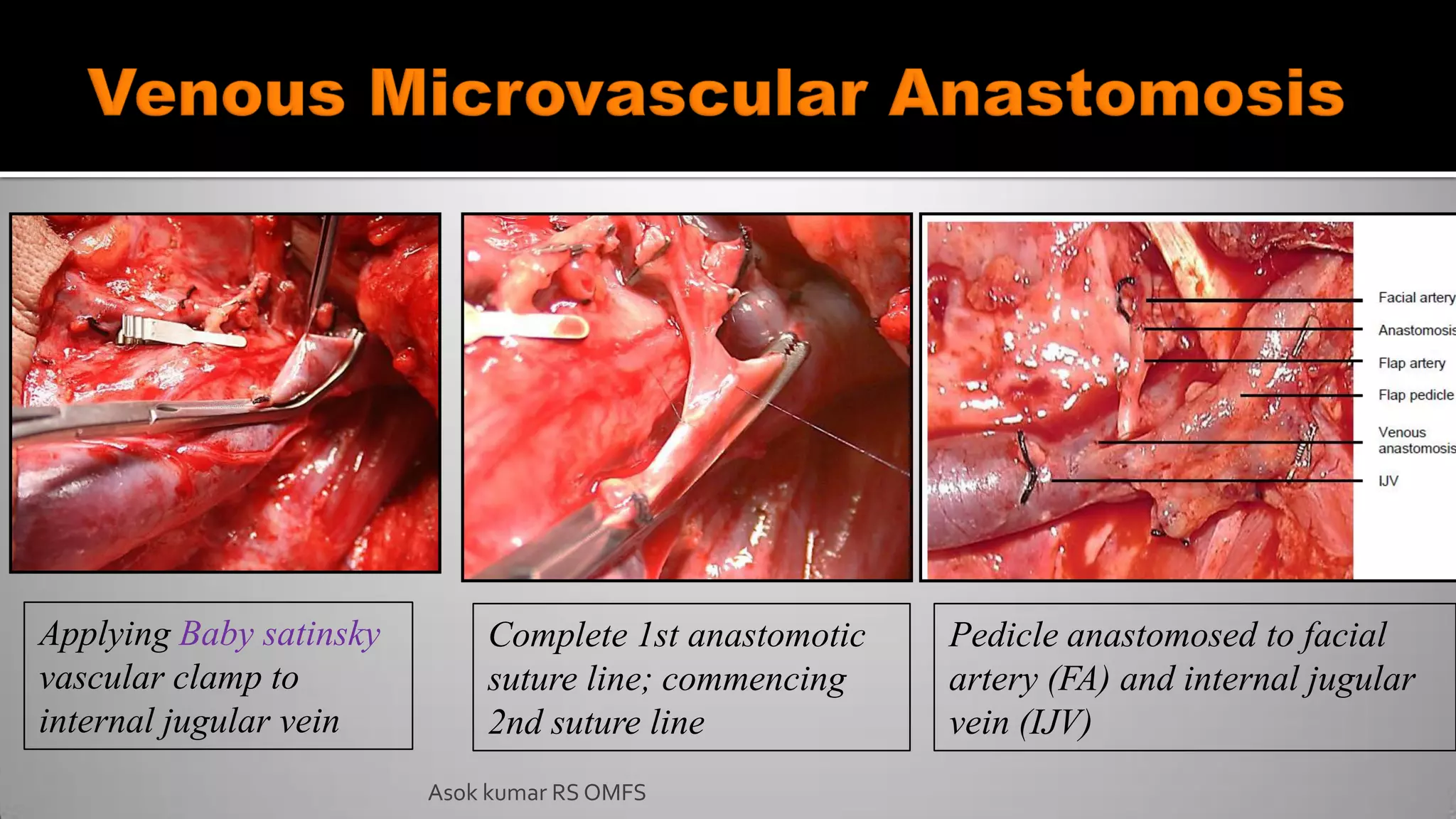
Complete 1st anastomotic
suture line; commencing
2nd suture line
Pedicle anastomosed to facial
artery (FA) and internal jugular
vein (IJV)
Applying Baby satinsky
vascular clamp to
internal jugular vein
Asok kumar RS OMFS
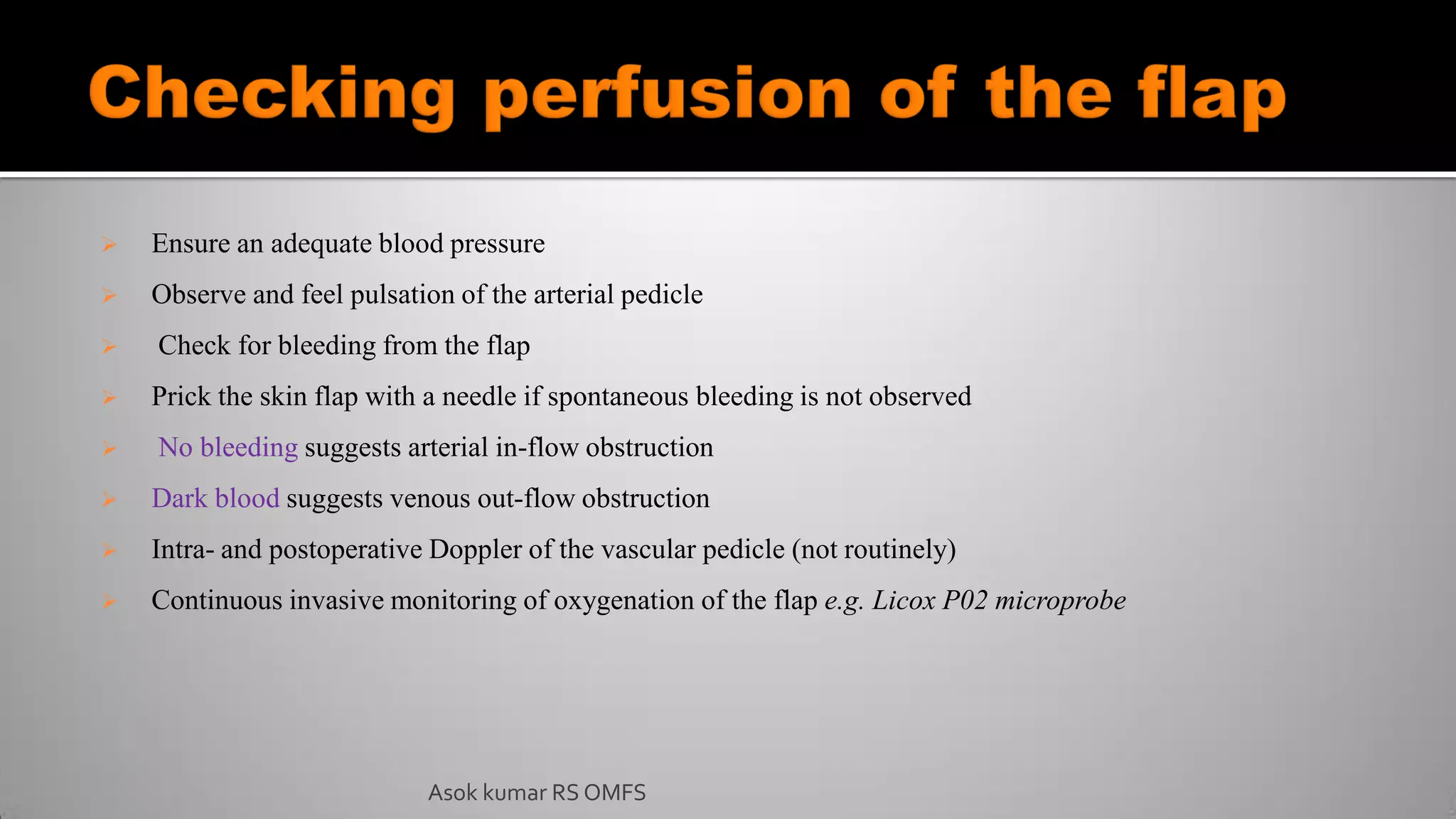
 Ensure an adequate blood pressure
 Observe and feel pulsation of the arterial pedicle
 Check for bleeding from the flap
 Prick the skin flap with a needle if spontaneous bleeding is not observed
 No bleeding suggests arterial in-flow obstruction
 Dark blood suggests venous out-flow obstruction
 Intra- and postoperative Doppler of the vascular pedicle (not routinely)
 Continuous invasive monitoring of oxygenation of the flap e.g. Licox P02 microprobe
Asok kumar RS OMFS
Asok kumar RS OMFS
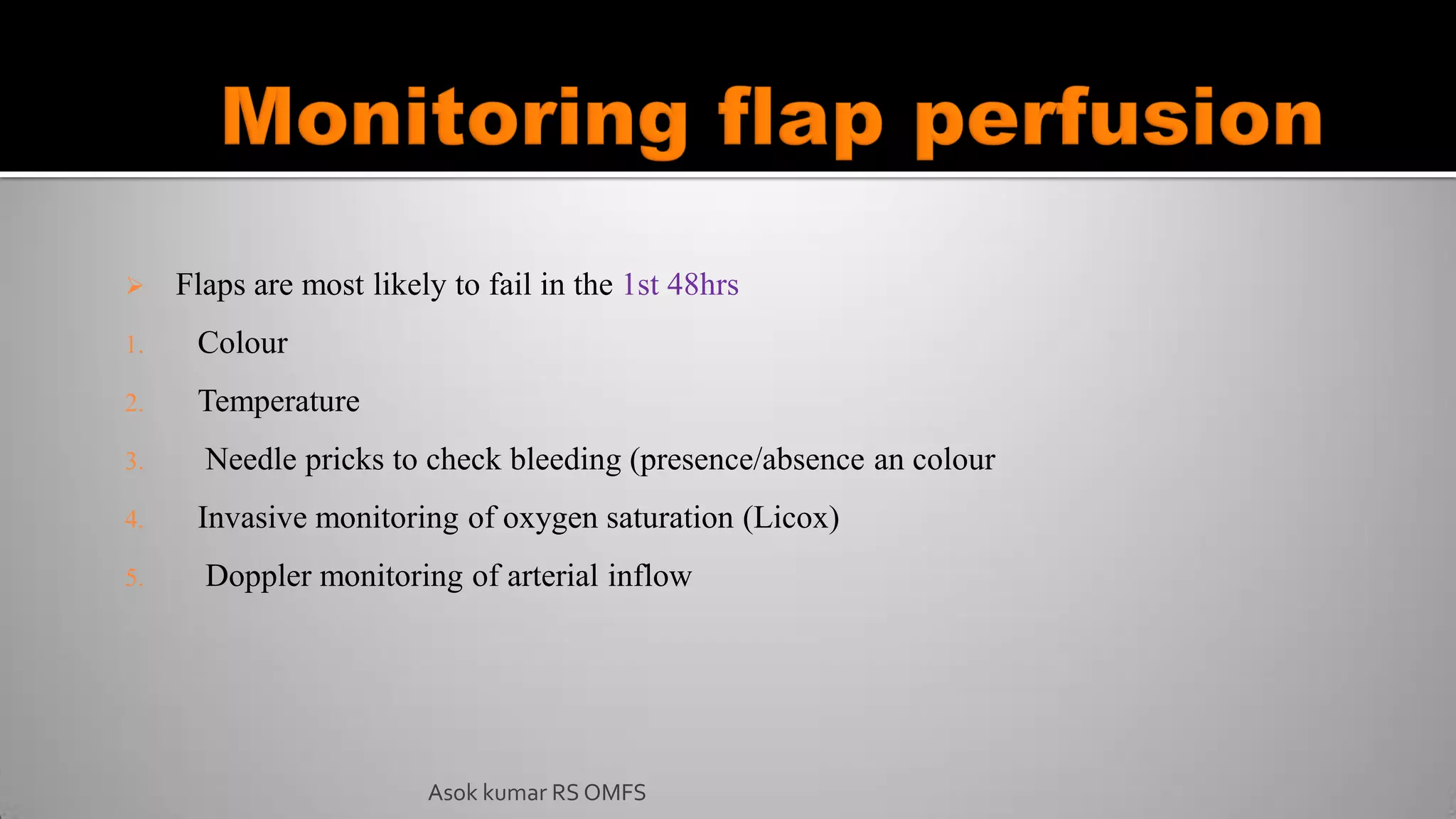
 Flaps are most likely to fail in the 1st 48hrs
1. Colour
2. Temperature
3. Needle pricks to check bleeding (presence/absence an colour
4. Invasive monitoring of oxygen saturation (Licox)
5. Doppler monitoring of arterial inflow
Asok kumar RS OMFS
Asok kumar RS OMFS
 Bakers Local flaps in facial reconstruction – Second edition
 Stell and Marans textbook of head and neck surgery and oncology
 Local and Regional Flaps in Head & Neck Reconstruction -A Practical Approach : Rui Fernandes.
 Raising of microvascular flap. K.D.Wolff
 Radial forearm free flap for reconstruction of the oral cavity: clinical experience in 55 cases :R.
González-García
 Matthew H. Rigby and S. Mark Taylor Soft tissue reconstruction of the oral cavity:a review of current
options. Curr Opin Otolaryngol Head Neck Surg 2013, 21:311–317
 Todd A. Schultz et al .Basic Flap Design Oral Maxillofacial Surg Clin N Am 26 (2014) 277–303
 Krishna G. Patel et al Concepts in local flap design and classification Operative Techniques in
Otolaryngology (2011) 22, 13-23
Asok kumar RS OMFS
Flaps in OMFS

Flaps in OMFS

  • 1.
  • 2.
     “When apart of one's person is lost, it should be replaced in kind, bone for bone, muscle for muscle, hairless skin for hairless skin, an eye for an eye, a tooth for a tooth”. (Ralph Millard)  Definition : A flap is a unit of tissue that is transferred from donor site to recipient site while maintaining its own blood supply.  The Term Flap , originated from Dutch word “FLAPPE” which means “anything that hung broad and loose, fastened only by one side”.  Flaps are usually used to repair structural defects following surgery for malignant conditions of head and neck. Asok kumar RS OMFS
  • 3.
     600 B.C: Susrutha performed nasal reconstruction using cheek flap  1440 A.D: Forehead rhinoplasty (India).  Pivotal flaps was preferred during early days. This involves rotation of the flap around its vascular pedicle.  Advancement flap (French surgeons). This involves transfer of skin from adjacent area without rotation.  Gaspar Tagliocozzi (1597), Italy: Experimented with the fabrication of noses from the tissues of the upper arm.  Tansini (1896), described the concept of muscle and skin flap. Asok kumar RS OMFS
  • 4.
     Harold Gillies- Tube flaps in 1950s  Owens (1952): Stenocledomastoid flap.  Conley (1960): Regional flaps.  McGregor - Introduced the Forehead flap in 1963  Bakamjian - Introduced the Deltopectoral flap in 1965  Daniel & Taylor - Pioneered the Free flap in 1973  Ariyan - Pioneered the Pectoralis major myocutaneous flap in 1979 Asok kumar RS OMFS
  • 5.
     The skinfunctions and properties include a) Protection/ anatomic barrier b) Thermoregulation c) Protection against excessive fluid loss/evaporation d) Storage areas (eg, lipids and water) e) Sensation center and f) Formation of an aesthetic zone, enhancing nonverbal communication/ expression. Asok kumar RS OMFS
  • 6.
     Nature ofthe wound determines the approach for closure.  Risk Factors: Location, Size,Adjacent structures, Etiology (eg, trauma, malignancy, or cosmetic defect) and Medical comorbidities  The goal of proper flap design is to closely restore the skin’s functions and properties  Understanding of proper wound closure, wound healing, relaxed skin tension lines, and the facial esthetic zones is essential in this task Asok kumar RS OMFS
  • 7.
     Primary defect:Wound to be closed by local cutaneous flaps.  Secondary defect: Wound created when skin flap is transferred to repair primary defect  Wound closure tension: Amount of stress per unit along the suture line of a repaired wound.  RSTL (Relaxed skin tension line)- Orientation of collagen fibres to skin and manifested as a creases and wrinkles.  These lines are perpendicular to the lines of maximal extensibility. Knowledge of these lines is essential for cosmetic and functional wound closure  Primary tissue movement : Transfer of skin to defect  Secondary tissue movement: Displacement of skin surrounding the defect. Asok kumar RS OMFS
  • 8.
    Specific Esthetic zone: Eyelids  Nasal tip/alar complex  Vermilion border and  External ear Asok kumar RS OMFS
  • 9.
    Relaxed skin tensionlines. Esthetic zones for the face Asok kumar RS OMFS
  • 10.
  • 11.
    AREAS OF GREATERESTHETIC CONCERN  Hair line (Forehead, Temple, Eyebrow)  Eyelid and orbital commissure  Nasal (Tip, Nares, and Ala)  Oral vermilion and commissure  Philtrum  Ear (lobe and helix) GOOD TISSUE DONOR SITES  Neck and submental area , mental/  chin area  Cheek  Periauricular area  Forehead  Scalp Asok kumar RS OMFS
  • 12.
    Flaps may beclassified according to their: I. Blood supply II. Location of donor site III. Tissue content IV. Configuration V. Method of transfer Asok kumar RS OMFS
  • 13.
    MATHES AND NAHAI(1979)  Type I: One vascular pedicle  Type II: Dominant pedicle (s) + minor pedicles  Type III: Two dominant pedicles  Type IV: Segmental vascular pedicles  Type V: Dominant pedicle + secondary segmental pedicles.Based on vascular pedicle types in muscles Asok kumar RS OMFS
  • 14.
    A. Axial pattern- Dominant vessels oriented in a superficial axial position B. Random pattern - Dermal and subdermal plexus as its blood supply. C. Pedicled flap: Supplied by arteries that supply the skin paddle D. Free tissue transfer: flap is harvested from a distant site, and the vascular supply is reestablished at the defect site Asok kumar RS OMFS
  • 15.
    A. Local Flaps:Use of tissue adjacent to defect B. Regional flaps: Flaps located near to the defect but not in immediate proximity to the defect C. Distant flap: Flap harvested from different part of body Asok kumar RS OMFS
  • 16.
    A. Advancement flap B.Rotational flap C. Transpositional flap D. Interpolated flap E. Interpositioned flap Asok kumar RS OMFS
  • 17.
    A. Skin B. Viscera C.Muscle D. Mucosa Composite A. Fasciocutaneous B. Myocutaneous C. Osseocutaneous D. Tendocutaneous E. Sensory/innervated flaps F. Osseo-myocutaneous Asok kumar RS OMFS
  • 18.
    A. Bilobed B. Rhombic C.Z plasty Asok kumar RS OMFS
  • 19.
    Kinner & Jeter Adequate color match  Adequate thickness – avoid protrusions or deficiencies  Preservation of clinically perceivable sensory innervation  Sufficient laxity – avoid retraction or deranged function  Resultant suture lines of either primary or secondary defects are restricted to anatomic units and fall within natural skin lines Asok kumar RS OMFS
  • 20.
     Celsus ofancient Rome - First to perform advancement flap  Popularized by French surgeons in 1800 as sliding flaps  Used to cover skin defects close to an area of skin laxity  Blood supply – 1-2 ml / min / 100g of tissue is adequate.  Depend on random blood supply.  Flap length : 4:1 in Head and neck region  Commonly used in forehead, scalp, eyelid and upper lip areas Asok kumar RS OMFS
  • 21.
     Travel ina single vector toward the defect greater skin elasticity  Advancement flaps include: A. Unipedicle or unilateral advancement flaps, B. Bilateral or bipedicle advancement flaps, C. V-Y advancement flaps, and D. Island advancement flaps. Asok kumar RS OMFS
  • 22.
    Uses:  Reconstructing defectsinvolving the forehead, lips and cheeks  Closure of oro antral fistula and alveolar clefts.  Advantage :Limit wound tension to a single vector. Indications:  Single pedicle flap: defects of forehead ,helical rims,upper and lower lips and medial cheek.  Bipedicle flap: large defects of the skull  V-Y advancement flap: lengthening the columnella in the repair of cleft lip nasal deformities and used in releasing contracted scars . Asok kumar RS OMFS
  • 23.
  • 24.
  • 25.
  • 26.
     Derives itsname from the pivot point at the base of the flap as well as its arc of rotation  Transposition flap - Flap moves laterally into the primary defect  Rotation flap – Flap is rotated into the defect..  Used in area with decreased skin elasticity. Asok kumar RS OMFS
  • 27.
     Semicircular flap Rotates about a pivot point to fill the defect.  Place the arc closest to the defect to reach the most distal point of the defect  Should be 5-8 times the width of the defect  Rotation of the flap decreases the effective length of the flap.  For example, flap rotation of reduces the flap length by 15% Asok kumar RS OMFS
  • 28.
    Asok kumar RSOMFS Indications :  Rotational flap are useful in repairing medial cheek defects.  Large rotational flaps are particularly useful for reconstruction of posterior cheek and upper neck defect.
  • 29.
     Flap mobilisedto primary defect over an incomplete bridge of skin.  Eg: Rhombic (Linberg flaps). and bilobed flap  Flap design : Base of the flap should be continuous with the primary (or revised) defect.  Length of the flap should not exceed 3 times the width Asok kumar RS OMFS
  • 30.
     Described byEsser (1918)  Popularized by Zimany  Reconstruct nasal and facial defects and even full thickness cheek defects.  Tension free closure of original and secondary defects.  90º is the optimal angle between the first and second flap  Maximum distortion occurs around the flap bases and the second donor lobe closure sites  Disadvantages: Rotation pucker Asok kumar RS OMFS
  • 31.
     Repair aprimary defect by means of both rotational and linear movement  The flap traverse above or below adjacent tissue, but connected to the base with a pedicle. Indication:  A midforehead interpolation flap includes median and paramedian flap effective in midface reconstruction.  It is used in medial canthal region, upper and lower eyelids ,medial cheek, melolabial region and upper lip . Asok kumar RS OMFS
  • 32.
     Forehead flapsraised either laterally on temporal region  Inferiorly on supraorbital region. large defects of the nasal tip and nasal dorsum defects)  Axial blood supply by : I. Supratrochlear artery II. Supraorbital artery  The pedicle width should be 1 to 1.5 cm.  The pedicle can be divided after approximately 3 weeks. Asok kumar RS OMFS
  • 33.
     Melolabial interpolatedflaps are used to close defects on the lower third of the lateral nose (ala area). Indications:  Superiorly based flap can be used to cover the defects in the hard palate, alveolus, nasal lining, upper lip and sometimes even the orbit.  The inferiorly based flap can be used for defects in the alveolus, floor of mouth, lower lip and vermillion and tonsillar fossa.  Average flap dimensions are 2.5cm in width and 6cm in length. Asok kumar RS OMFS
  • 34.
    Asok kumar RSOMFS Blood supply: I. Facial artery, II. Angular artery,and III. Nasal arteries. ADVANTAGES:  Color and Texture of flap match to the defect site.  Allows for a near imperceptible reconstruction. DISADVANTAGE:  Scar at the donor site.  Postoperative facial asymmetry in younger patients.
  • 35.
     Axial flap Encapsulated specialized fatty tissue  Used to fill small-to-medium sized soft tissue and bony defects in the palate, superior and inferior alveoli and buccal mucosa.  Acts as gliding pads and cushions important structures from forces generated by muscle contraction. Asok kumar RS OMFS
  • 36.
    Asok kumar RSOMFS The buccal fat pad has a body and four processes. The body is divided into 3 lobes – anterior, intermediate and posterior. BLOOD SUPPLY: 1. Facial, 2. Transverse facial and 3. Internal maxillary arteries
  • 37.
    Asok kumar RSOMFS INDICATIONS  Reconstruction of small to medium (<5cm) includes oroantral communication,surgical defects following tumour excision, excision of leukoplakia and submucous fibrosis; and primary and secondary palatal clefts  Alternative or backup for failed buccal advancement flaps, palatal rotation and transposition flaps, tongue and nasolabial flaps, and radial free forearm flaps. COMPLICATIONS:  Rare and may include partial necrosis and excessive scarring.  In case of larger the size of flap there is a risk of fibrosis and trismus.
  • 38.
     Uses: Reconstructionof the lower lip  Blood supply: Labial artery.  Full thickness flap with skin / muscle / mucous membrane.  The flap can be marked, rotated and sutured leading to the formation of new commissure Asok kumar RS OMFS
  • 39.
  • 40.
     The procedurewas first described initially by Eiselsberg for intraoral defects and soon after by Lexer, who described its use for defects of the retromolar trigone and tonsillar areas.  Various types of tongue flaps I. Dorsal tongue flap II. Ventral tongue flap III. Lateral tongue flap IV. Sliding and island tongue flaps Disadvantage:  Potential for color mismatch, especially in pigmented lips. Asok kumar RS OMFS
  • 41.
     Versatile flapused for the reconstruction of many oral, pharyngeal defects.  Reconstruction of congenital or traumatic defects of the lip; buccal mucosa; palate; alveolus; tongue; floor of mouth  Reconstruct the vermillion border with excellent esthetic results  Reconstruction of buccal mucosa secondary to surgical management of oral submucous fibrosis with similar results in postoperative mouth opening compared with buccal fat pad grafts, nasolabial fold flaps Asok kumar RS OMFS
  • 42.
     Fan-shaped musclecovered by a strong fibrous aponuerotic sheath.  Blood supply: Anterior and posterior deep temporal artery  Advantage :Ease of access to the muscle,  Quantity of muscle harvested, and  Ability to transfer the muscle to the oral cavity.  Disadvantage :Hollowing associated with the use of the muscle. Asok kumar RS OMFS
  • 43.
    Indications:  Reconstruction ofskull base and orbital defect  Reconstruction of defect of oral cavity;  Floor of mouth  Retromolar trigone  Nasopharynx  Soft palate Asok kumar RS OMFS
  • 44.
     Flaps locatednear to the defect but not in the immediate proximity. INDICATION:  Large facial defect where local flaps doesn’t provide sufficient tissue to restore .  Advantage : Availability of adequate amount of tissue.  Disadvantage: 1. Donor site morbidity 2. Poor color and texture match 3. Excessive bulkiness of flap Asok kumar RS OMFS
  • 45.
     Transfer oftissue from one site of body to the another one along with it blood supply but detatched from the original location.  Blood supply is reconstituted using microsurgery to reconnect artery and vein. Asok kumar RS OMFS
  • 46.
     Axial bloodsupply.  First described by Ariyan in 1979.  The flap may be employed either as a muscular or musculocutaneous flap.  Blood supply: Pectoral branch of acromiothoracic artery USES:  Reconstruction of soft tissue defects of the oropharynx, oral cavity, hypopharynx, and skin of the neck;  To augment pharyngeal repairs following salvage laryngectomy and  To cover carotid or jugular vein. Asok kumar RS OMFS
  • 47.
    Asok kumar RSOMFS Advantage: I. Reconstruction of defect can be done at a single stage II. Can closed Primarily III. Muscular component protects Carotid Artery in neck. IV. Highly reliable due to consistent blood supply. V. Can be used as a double skin paddle providing two layered closure. Disadvantage: I. Too bulky II. Distortion of donor site symmetry III. Impairement of shoulder function due to loss of muscle. IV. Less Satisfactory functional and esthetic results.
  • 48.
    Asok kumar RSOMFS Flap related:  Marginal necrosis  Wound dehiscence  Hematoma  Infection  Formation of oro cutaneous fistula. Flap unrelated:  Pleural emphysema  Chyle leak  Parotid fistula
  • 49.
     First freetissue transfer flaps to be described.  Work-horse for soft tissue replacement in head and neck cancer surgery  Indications: I. Floor of mouth, tongue, soft and hard palate, buccal mucosa, pharynx and oesophagus II. Lips III. Orbit IV. External skin defects Asok kumar RS OMFS
  • 50.
    Asok kumar RSOMFS I. Incorporating part of radius as osteocutaneous flap for premaxillary, maxillary, nasal, and mandibular defects II. Incorporating palmaris longus tendon sling to support lower lip reconstructtion Advantages I. Large flap may be harvested (30 x 15cm) II. Multiple skin islands can be used III. Sensory innervation possible IV. Can incorporate radius bone or tendon V. Easy flap elevation VI. Large, reliable, constant vessels VII. Long pedicle usually available
  • 51.
    Asok kumar RSOMFS Disadvantage: I. Potentially poor skin quality II. Donor site morbidity III. Poor cosmetic result IV. Atherosclerosis and postoperative vascular compromise.
  • 52.
     Blood supply:Common femoral artery  Indication:  Reconstruction of I. Pharyngo oesophageal defect II. Cranial base defect III. Tongue base IV. Lateral pharyngeal wall V. Soft palate. Asok kumar RS OMFS
  • 53.
  • 54.
     Blood supply:Deep epigastric artery  Indication: I. Reconstruction of Posterior part of mandible II. Tongue reconstruction III. Orbit IV. Cheek defect Asok kumar RS OMFS
  • 55.
  • 56.
     Blood Supply:Superior Mesentric artery.  Indication: I. Reconstruction of Pharyngo oesophageal defect II. Oral cavity. III. Tonsil IV. Soft palate V. Base of tongue Asok kumar RS OMFS
  • 57.
     Blood supply: I.Occipital artery II. Superior thyroid artery III. Branches of thyrocervical trunk  Indication: I. Soft tissue mandibular reconstruction II. Tracheal reconstruction III. Provides soft tissue augmentation after parotidectomy. Asok kumar RS OMFS
  • 58.
     Most commonlyused flap in head and neck for bony reconstruction.  Vascularised free composite flap containing bone and muscle, with or without skin.  Provides reliable single-stage reconstruction with excellent functional and aesthetic results. Indications:  Commonly used for reconstruction of mandibular and midface/maxillary defects. Asok kumar RS OMFS
  • 59.
    Advantages:  Well vascularisedand Long vascular pedicle  Adequate length of donor bone (>25cm)  Adequate bone strength  Bony reconstruction can be shaped with multiple segmental osteotomies  Stable bicortical osseointegrated dental implant fixation is possible  Thin, pliable overlying skin  Very little soft tissue bulk (usually)  Simultaneous resection and harvesting of flap possible due to distant location of the donor site from head and neck resection Disadvantage:  Donor site morbidity:  Delayed wound healing and skin graft loss especially following peroneal tendon exposure;  muscle necrosis  Poor skin quality: Asok kumar RS OMFS
  • 60.
     Blood supply: I.Internal mammary artery  Indication: a. As an alternative to pectoralis major myocutaneous flap for reconstruction of maxilla and mandible. Asok kumar RS OMFS
  • 61.
     Blood Supply: I.Thoracodorsal artery II. Peforators from posterior intercoastal and lumbar vessels.  Indication: I. Soft tissue reconstruction of larger defect involving cheek ,maxilla, mandible Asok kumar RS OMFS
  • 62.
     Blood Supply: I.Transverse cervical artery II. Occipital artery III. Perforating posterior intercoastal artery  Indication: Reconstruction of large surgical defect of: I. Oral cavity II. Ororpharynx III. Scalp clavicular and Facial defect IV. Mandibular soft tissue reconstruction Asok kumar RS OMFS
  • 63.
    Preoperative evaluation : Flap  Vascular status  Tissue quantity and quality  Donor site: Functional and cosmetic morbidity  Patient: Medical and oncologic status Operating room setup Asok kumar RS OMFS
  • 64.
     Microsurgical forcepsx 3 (minimum)  Micro needle holder  Microscissors (straight and curved)  Microvascular clamp (selection of single and double clamps)  Baby Satinsky vascular clamp (for end-to-side anastomoses)  Bipolar coagulation forceps  Haemostatic Ligaclip appliers (small and medium) Asok kumar RS OMFS
  • 65.
     Heparin-saline solution 5000 units in 50 ml saline  Lignocaine solution 1%  5ml/500mg ampoule in 50 ml saline  Lignocaine 10 % (undiluted) Asok kumar RS OMFS
  • 66.
    Asok kumar RSOMFS Skin island, perforator, fibula, and vascular pedicle ready to be detached Microvascular clamp placed across origin of superior thyroid artery Flap partially sutured and bone secured prior to commencing microvascular anastomosis Separating adventitia of carotid sheath off internal jugular vein with gentle hydrodissection
  • 67.
    Sleeve arterial anastomosis Completed arterial anastomosis Staysutures held with curved non-toothed forceps while surgeon inserts row of running sutures Asok kumar RS OMFS
  • 68.
    Complete 1st anastomotic sutureline; commencing 2nd suture line Pedicle anastomosed to facial artery (FA) and internal jugular vein (IJV) Applying Baby satinsky vascular clamp to internal jugular vein Asok kumar RS OMFS
  • 69.
     Ensure anadequate blood pressure  Observe and feel pulsation of the arterial pedicle  Check for bleeding from the flap  Prick the skin flap with a needle if spontaneous bleeding is not observed  No bleeding suggests arterial in-flow obstruction  Dark blood suggests venous out-flow obstruction  Intra- and postoperative Doppler of the vascular pedicle (not routinely)  Continuous invasive monitoring of oxygenation of the flap e.g. Licox P02 microprobe Asok kumar RS OMFS
  • 70.
    Asok kumar RSOMFS  Flaps are most likely to fail in the 1st 48hrs 1. Colour 2. Temperature 3. Needle pricks to check bleeding (presence/absence an colour 4. Invasive monitoring of oxygen saturation (Licox) 5. Doppler monitoring of arterial inflow
  • 71.
  • 72.
  • 73.
     Bakers Localflaps in facial reconstruction – Second edition  Stell and Marans textbook of head and neck surgery and oncology  Local and Regional Flaps in Head & Neck Reconstruction -A Practical Approach : Rui Fernandes.  Raising of microvascular flap. K.D.Wolff  Radial forearm free flap for reconstruction of the oral cavity: clinical experience in 55 cases :R. González-García  Matthew H. Rigby and S. Mark Taylor Soft tissue reconstruction of the oral cavity:a review of current options. Curr Opin Otolaryngol Head Neck Surg 2013, 21:311–317  Todd A. Schultz et al .Basic Flap Design Oral Maxillofacial Surg Clin N Am 26 (2014) 277–303  Krishna G. Patel et al Concepts in local flap design and classification Operative Techniques in Otolaryngology (2011) 22, 13-23 Asok kumar RS OMFS