Laryngeal Framework
Surgery
DR SAFIKA ZAMAN
DEPT OF ENT & HNS
RKMSP, VIMS
Introduction
 Voice – identity of a person.
Production of voice
 Pulmonary reserve.
 Resonance created in the nose , PNS, oral cavity and pharynx.
 Movement of cord, shape , size and structural integrity of cord.
History
 1911- Brunnings , made the 1st attempt to
medialize vocal fold by injecting paraffin.
 1915- Payr – pedicle flap of cartilage.
 1974- Isshiki –proposed different type of
thyroplasty for different dysphonia.
http://www.entandaudiologynews.com/
Definition
 Surgical procedures performed on the laryngeal skeleton and the insertion
of muscles to correct vocal fold positioning and tension.
 Objective: improve the voice without directly intervening in the vocal folds.
Laryngeal framework
 Cartilages
 Ligaments
 Membranes
 Muscles
Cartilages
Thyroid cartilage
 Most prominent cartilage
 Two laminae
 Thyroid notch
 Superior and inferior cornua
 Vocal fold lies closer to the inferior
border of the thyroid cartilage
Muscles
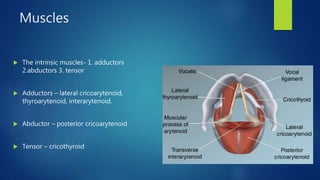
 The intrinsic muscles- 1. adductors
2.abductors 3. tensor
 Adductors – lateral cricoarytenoid,
thyroarytenoid, interarytenoid.
 Abductor – posterior cricoarytenoid
 Tensor – cricothyroid
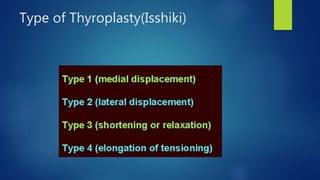
Type of Thyroplasty(Isshiki)
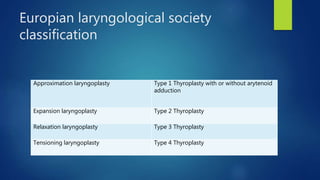
Europian laryngological society
classification
Approximation laryngoplasty Type 1 Thyroplasty with or without arytenoid
adduction
Expansion laryngoplasty Type 2 Thyroplasty
Relaxation laryngoplasty Type 3 Thyroplasty
Tensioning laryngoplasty Type 4 Thyroplasty
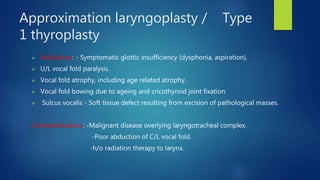
Approximation laryngoplasty / Type
1 thyroplasty
 Indications: - Symptomatic glottic insufficiency (dysphonia, aspiration).
 U/L vocal fold paralysis.
 Vocal fold atrophy, including age related atrophy.
 Vocal fold bowing due to ageing and cricothyroid joint fixation.
 Sulcus vocalis - Soft tissue defect resulting from excision of pathological masses.
Contraindications: -Malignant disease overlying laryngotracheal complex.
-Poor abduction of C/L vocal fold.
-h/o radiation therapy to larynx.
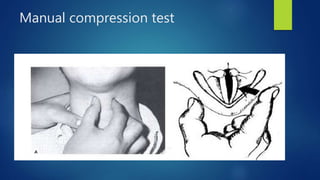
Manual compression test
Treatment options for unilateral VFP
 Observation
 Voice therapy
 Surgical intervention
 Injection augmentation
 Laryngeal frame work surgery
 Re-innervation
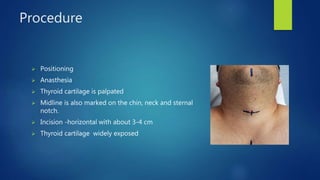
Procedure
 Positioning
 Anasthesia
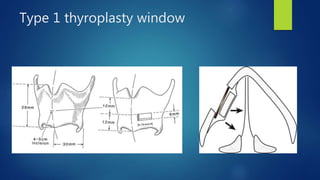
 Thyroid cartilage is palpated
 Midline is also marked on the chin, neck and sternal
notch.
 Incision -horizontal with about 3-4 cm
 Thyroid cartilage widely exposed
Type 1 thyroplasty window
Implants
Titanium Implants
Cont..
Textbook of Laryngology – N K Narukar, A Roychoudhury
Complication
 Penetration of endo-laryngeal mucosa - assess air leak before placement
of implant in window.
 Wound infection – Chondritis.
 Airway obstruction – overnight monitoring is required.
 Implant extrusion-Can become displaced and even extrude into the airway.
Limitation
 Mechanical nature of the procedure.
 Imparts only static change to laryngeal framework with no effect on
dynamic function.
 No effect on vocal fold muscle mass, innervation and mobility.
 Closure of posterior glottis limited.
 No effect on vocal fold level in vertical plane.
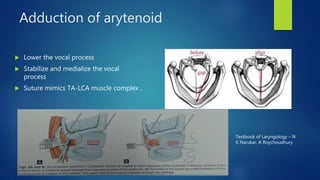
Adduction of arytenoid
 Lower the vocal process
 Stabilize and medialize the vocal
process
 Suture mimics TA-LCA muscle complex .
Textbook of Laryngology – N
K Narukar, A Roychoudhury
Expansion laryngoplasty
Indication - adductor spasmotic dysphonia( involuntary muscle spasms in the
intrinsic muscles of larynx).
Treatment options – botulinum toxin injection , recurrent nerve avulsion and
expansion laryngoplasty
Type 2 thyroplasty – lateral approach
 purpose of this procedure is to increase
the transverse diameter of the thyroid
cartilage, extending the glottic space.
Catani GSA, Catani MEC, Kinasz LRS, et al. Laryngeal framework surgery. J Otolaryngol ENT Res.
2020;12(5):151‒154
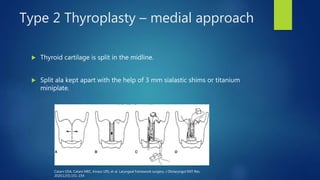
Type 2 Thyroplasty – medial approach
 Thyroid cartilage is split in the midline.
 Split ala kept apart with the help of 3 mm sialastic shims or titanium
miniplate.
Catani GSA, Catani MEC, Kinasz LRS, et al. Laryngeal framework surgery. J Otolaryngol ENT Res.
2020;12(5):151‒154
Thyroarytenoid myomectomy
 Endoscopic or open approach
 Vocal cord abduction by suture method
 Partial arytenoidectomy
Advantage and disadvantage of type 2
Advantages: Optimal glottal closure can be adjusted and readjusted
- No damage of physiologic function
- Reversible
Disadvantages: Technically difficult
Shim displacement
Does not relieve cause of Spasmodic Dysphonia.
Relaxation laryngoplasty
 Tension of the vocal folds reduced by antero-posterior shortening of
thyroid ala.
 Lowers the pitch.
Relaxation laryngoplasty
 Indication – 1.Males with high pitch voice resistant to voice therapy.(
Puberphonia/ Mutational falsetto)
2. Stiff VF with high pitched breathy voice.
3. Spastic dysphonia
Cont …
Lateral approach : ( Type III) Thyroid ala is
incised at about junction of anterior and middle
one third, and 2-5 mm cartilage strip is excised.
Cont…
 Medial approach: ( Anterior
commissure retrusion) - Retrusion of
the middle portion of the thyroid
cartilage and leads to reduction in
the length of vocal folds.
 - Vertical incision was made either
side of the midline of the thyroid
cartilage.
Type 4 thyroplasty
 Increases the vocal pitch.
 It increases the distance between the vocal fold attachments and thus raise
the tension of vocal fold.
 Indications: Androphonia -Abnormally low pitched voice in female. -
Male to female trans-sexualism
- Abnormallly lax or bowed vocal folds (presbyphonia)
Cricothyroid approximation
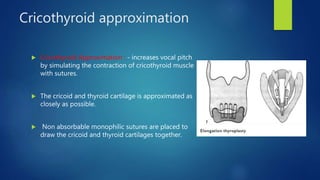
 Cricothyroid Approximation : - increases vocal pitch
by simulating the contraction of cricothyroid muscle
with sutures.
 The cricoid and thyroid cartilage is approximated as
closely as possible.
 Non absorbable monophilic sutures are placed to
draw the cricoid and thyroid cartilages together.
Anterior commissure advancement
Potentially the comfortable speaking pitch is higher .
Catani GSA, Catani MEC, Kinasz LRS, et al. Laryngeal framework surgery. J Otolaryngol ENT Res.
2020;12(5):151‒154
Webbing of the ant vocal fold
 Microlaryngoscopy under general
anaesthesia.
 Vocal fold mucosa from ant half of
vocal fold removed, then sewn
together.
https://els-jbs-prod-cdn.jbs.elsevierhealth.com/cms/attachment/c1e59191-23f6-4dfd-b306-
d6018364c3e1/gr1.jpg
Femlar
 Anterior 25% of false cords and 50% of true cords are removed
 Upper part of thyroid cartilage removed
 Larynx suspended high in the neck by sutureing to hyoid bone
 Advantage: physical size and location of the larynx in the neck is close
approximation of a female larynx.
FemLar
https://www.google.com/url?sa=i&url=https%3A%2F%
2Fortholibrary.in%2FeReader%2Fchapter%2F97893863
22449%2Fch22&psig=AOvVaw2DDrvUjnnj8SD-
c7ZW8znT&ust=1629400870964000&source=images&
cd=vfe&ved=0CAsQjRxqFwoTCMi7ub6lu_ICFQAAAAAd
AAAAABAT
Thank You

Laryngeal framework surgery

  • 1.
    Laryngeal Framework Surgery DR SAFIKAZAMAN DEPT OF ENT & HNS RKMSP, VIMS
  • 2.
    Introduction  Voice –identity of a person. Production of voice  Pulmonary reserve.  Resonance created in the nose , PNS, oral cavity and pharynx.  Movement of cord, shape , size and structural integrity of cord.
  • 3.
    History  1911- Brunnings, made the 1st attempt to medialize vocal fold by injecting paraffin.  1915- Payr – pedicle flap of cartilage.  1974- Isshiki –proposed different type of thyroplasty for different dysphonia. http://www.entandaudiologynews.com/
  • 4.
    Definition  Surgical proceduresperformed on the laryngeal skeleton and the insertion of muscles to correct vocal fold positioning and tension.  Objective: improve the voice without directly intervening in the vocal folds.
  • 5.
    Laryngeal framework  Cartilages Ligaments  Membranes  Muscles
  • 6.
  • 7.
    Thyroid cartilage  Mostprominent cartilage  Two laminae  Thyroid notch  Superior and inferior cornua  Vocal fold lies closer to the inferior border of the thyroid cartilage
  • 8.
    Muscles  The intrinsicmuscles- 1. adductors 2.abductors 3. tensor  Adductors – lateral cricoarytenoid, thyroarytenoid, interarytenoid.  Abductor – posterior cricoarytenoid  Tensor – cricothyroid
  • 9.
  • 10.
    Europian laryngological society classification Approximationlaryngoplasty Type 1 Thyroplasty with or without arytenoid adduction Expansion laryngoplasty Type 2 Thyroplasty Relaxation laryngoplasty Type 3 Thyroplasty Tensioning laryngoplasty Type 4 Thyroplasty
  • 11.
    Approximation laryngoplasty /Type 1 thyroplasty  Indications: - Symptomatic glottic insufficiency (dysphonia, aspiration).  U/L vocal fold paralysis.  Vocal fold atrophy, including age related atrophy.  Vocal fold bowing due to ageing and cricothyroid joint fixation.  Sulcus vocalis - Soft tissue defect resulting from excision of pathological masses. Contraindications: -Malignant disease overlying laryngotracheal complex. -Poor abduction of C/L vocal fold. -h/o radiation therapy to larynx.
  • 12.
  • 14.
    Treatment options forunilateral VFP  Observation  Voice therapy  Surgical intervention  Injection augmentation  Laryngeal frame work surgery  Re-innervation
  • 15.
    Procedure  Positioning  Anasthesia Thyroid cartilage is palpated  Midline is also marked on the chin, neck and sternal notch.  Incision -horizontal with about 3-4 cm  Thyroid cartilage widely exposed
  • 16.
  • 17.
  • 18.
  • 19.
    Cont.. Textbook of Laryngology– N K Narukar, A Roychoudhury
  • 20.
    Complication  Penetration ofendo-laryngeal mucosa - assess air leak before placement of implant in window.  Wound infection – Chondritis.  Airway obstruction – overnight monitoring is required.  Implant extrusion-Can become displaced and even extrude into the airway.
  • 21.
    Limitation  Mechanical natureof the procedure.  Imparts only static change to laryngeal framework with no effect on dynamic function.  No effect on vocal fold muscle mass, innervation and mobility.  Closure of posterior glottis limited.  No effect on vocal fold level in vertical plane.
  • 22.
    Adduction of arytenoid Lower the vocal process  Stabilize and medialize the vocal process  Suture mimics TA-LCA muscle complex . Textbook of Laryngology – N K Narukar, A Roychoudhury
  • 23.
    Expansion laryngoplasty Indication -adductor spasmotic dysphonia( involuntary muscle spasms in the intrinsic muscles of larynx). Treatment options – botulinum toxin injection , recurrent nerve avulsion and expansion laryngoplasty
  • 24.
    Type 2 thyroplasty– lateral approach  purpose of this procedure is to increase the transverse diameter of the thyroid cartilage, extending the glottic space. Catani GSA, Catani MEC, Kinasz LRS, et al. Laryngeal framework surgery. J Otolaryngol ENT Res. 2020;12(5):151‒154
  • 25.
    Type 2 Thyroplasty– medial approach  Thyroid cartilage is split in the midline.  Split ala kept apart with the help of 3 mm sialastic shims or titanium miniplate. Catani GSA, Catani MEC, Kinasz LRS, et al. Laryngeal framework surgery. J Otolaryngol ENT Res. 2020;12(5):151‒154
  • 26.
    Thyroarytenoid myomectomy  Endoscopicor open approach  Vocal cord abduction by suture method  Partial arytenoidectomy
  • 27.
    Advantage and disadvantageof type 2 Advantages: Optimal glottal closure can be adjusted and readjusted - No damage of physiologic function - Reversible Disadvantages: Technically difficult Shim displacement Does not relieve cause of Spasmodic Dysphonia.
  • 28.
    Relaxation laryngoplasty  Tensionof the vocal folds reduced by antero-posterior shortening of thyroid ala.  Lowers the pitch.
  • 29.
    Relaxation laryngoplasty  Indication– 1.Males with high pitch voice resistant to voice therapy.( Puberphonia/ Mutational falsetto) 2. Stiff VF with high pitched breathy voice. 3. Spastic dysphonia
  • 30.
    Cont … Lateral approach: ( Type III) Thyroid ala is incised at about junction of anterior and middle one third, and 2-5 mm cartilage strip is excised.
  • 31.
    Cont…  Medial approach:( Anterior commissure retrusion) - Retrusion of the middle portion of the thyroid cartilage and leads to reduction in the length of vocal folds.  - Vertical incision was made either side of the midline of the thyroid cartilage.
  • 32.
    Type 4 thyroplasty Increases the vocal pitch.  It increases the distance between the vocal fold attachments and thus raise the tension of vocal fold.  Indications: Androphonia -Abnormally low pitched voice in female. - Male to female trans-sexualism - Abnormallly lax or bowed vocal folds (presbyphonia)
  • 33.
    Cricothyroid approximation  CricothyroidApproximation : - increases vocal pitch by simulating the contraction of cricothyroid muscle with sutures.  The cricoid and thyroid cartilage is approximated as closely as possible.  Non absorbable monophilic sutures are placed to draw the cricoid and thyroid cartilages together.
  • 34.
    Anterior commissure advancement Potentiallythe comfortable speaking pitch is higher . Catani GSA, Catani MEC, Kinasz LRS, et al. Laryngeal framework surgery. J Otolaryngol ENT Res. 2020;12(5):151‒154
  • 35.
    Webbing of theant vocal fold  Microlaryngoscopy under general anaesthesia.  Vocal fold mucosa from ant half of vocal fold removed, then sewn together. https://els-jbs-prod-cdn.jbs.elsevierhealth.com/cms/attachment/c1e59191-23f6-4dfd-b306- d6018364c3e1/gr1.jpg
  • 36.
    Femlar  Anterior 25%of false cords and 50% of true cords are removed  Upper part of thyroid cartilage removed  Larynx suspended high in the neck by sutureing to hyoid bone  Advantage: physical size and location of the larynx in the neck is close approximation of a female larynx.
  • 37.
  • 38.