WOUND HEALING
Dr Safika Zaman
Dept of ENT & HNS
RKMSP,VIMS
INTRODUCTION
• Wound: break in the integrity of the skin epithelium, often accompanied by
concurrent disruption of the underlying dermis.
• Whether small or large, acute or chronic, all wounds heal by a complex, dynamic,
highly orchestrated biological process.
CONT..
• A wound is ‘healed’ when:
• - connective tissue repair and complete re-epithelialization have occurred.
• - skin cover has been resorted with scar tissue without the necessity of drains or
dressings.
SKIN ANATOMY
FUNCTIONS OF SKIN
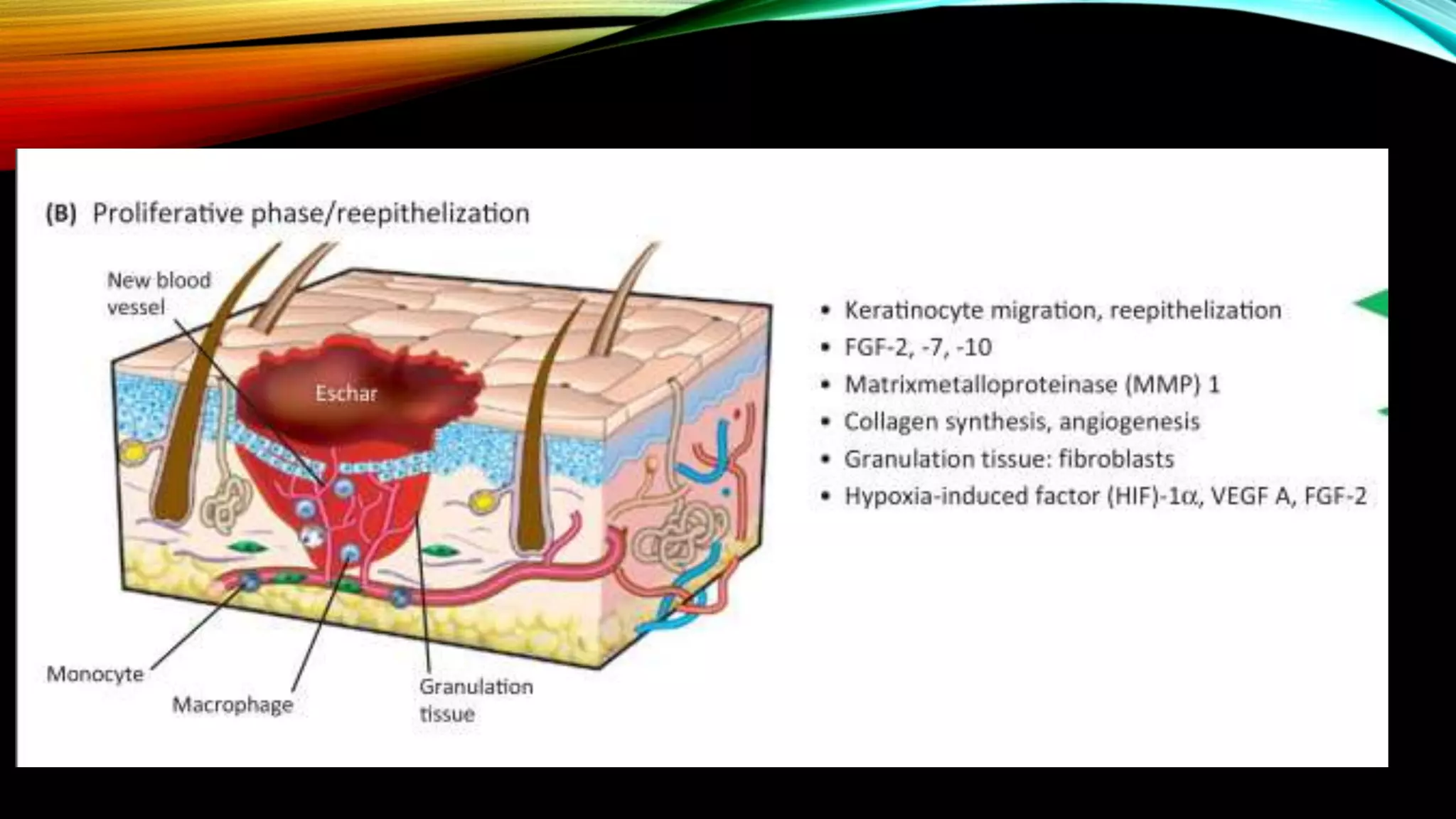
STAGES OF WOUND HEALING
Wound healing - A literature review*Ana Cristina de Oliveira
Gonzalez,1 Tila Fortuna Costa,2 Zilton de Araújo Andrade,1
and Alen Ribeiro Alves Peixoto Medrado2
RE-EPITHELIALIZATION
• Replication and movement of the epidermal cells from the wound edges in order to
reconstitute an organized, keratinized, stratified squamous epithelium.
• Initially, migration of epidermal cells creates a delicate covering over the raw area(epiboly).
• This process of migration is dependent on the oxygen tension present in the wound and is
most rapid in hyperbaric conditions.
• ‘Contact inhibition’ prevents movement when epithelial sheets meet.
Scott Brown`s text book of ENT – 8TH Edition
TYPES OF WOUND
TYPES OF WOUND
https://epomedici
ne.com/medical-
students/wound-
its-types/
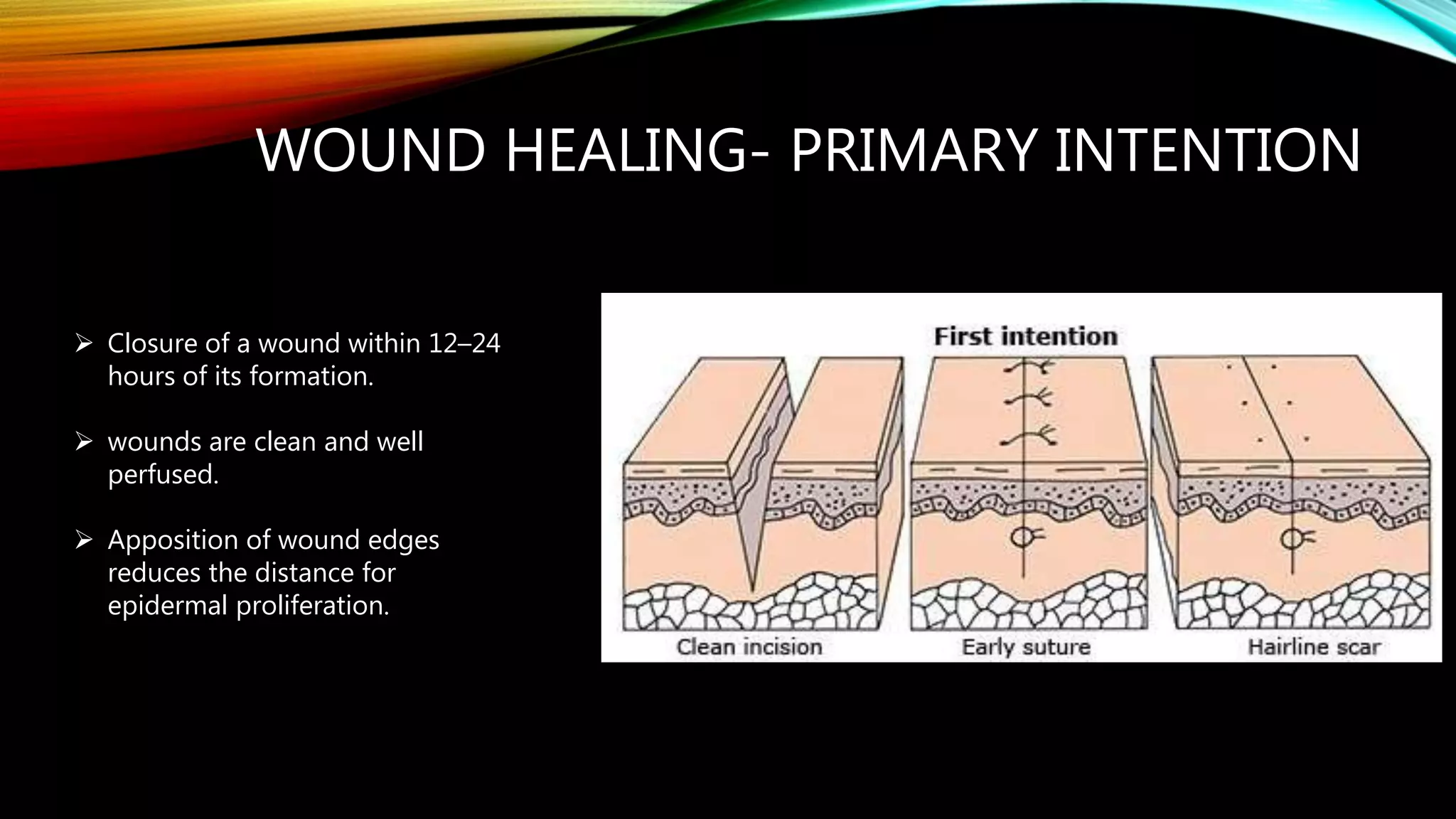
WOUND HEALING- PRIMARY INTENTION
 Closure of a wound within 12–24
hours of its formation.
 wounds are clean and well
perfused.
 Apposition of wound edges
reduces the distance for
epidermal proliferation.
PRINCIPLES OF WOUND SUTURING
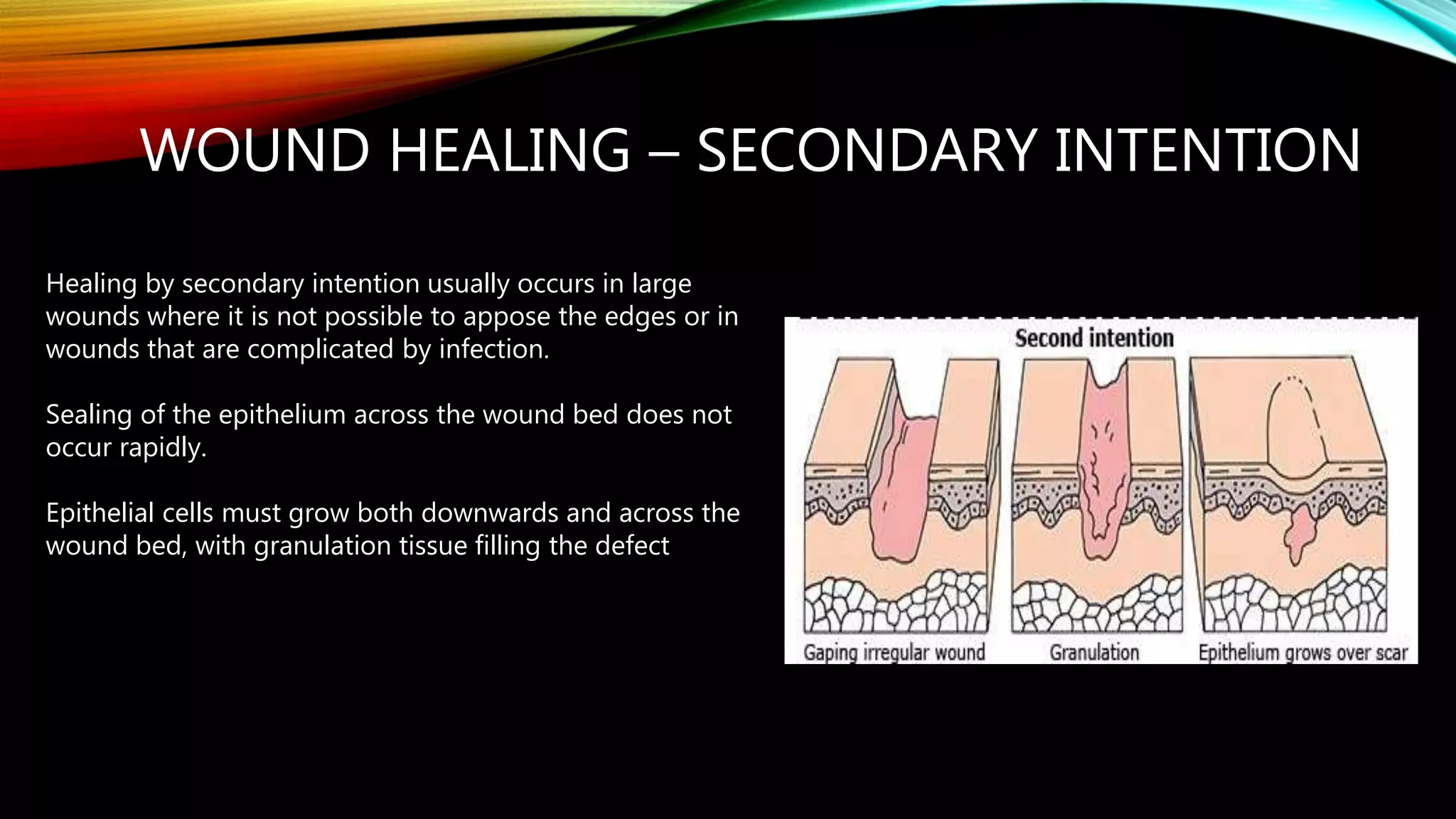
WOUND HEALING – SECONDARY INTENTION
Healing by secondary intention usually occurs in large
wounds where it is not possible to appose the edges or in
wounds that are complicated by infection.
Sealing of the epithelium across the wound bed does not
occur rapidly.
Epithelial cells must grow both downwards and across the
wound bed, with granulation tissue filling the defect
THIRD INTENSION
Process mainly occurs in contaminated
wounds.
The wound edges are usually approximated
after
3–4 days.
BONE HEALING
TISSUE HEALING TIME
CHRONIC WOUND
If a wound does not follow the normal trajectory then it may become stuck in 1 of the
4 phases, becoming chronic.
“wound failed to proceed through an orderly and timely process to produce anatomic
and functional integrity, or proceeded through the repair process without establishing
a sustained anatomic and functional result.”
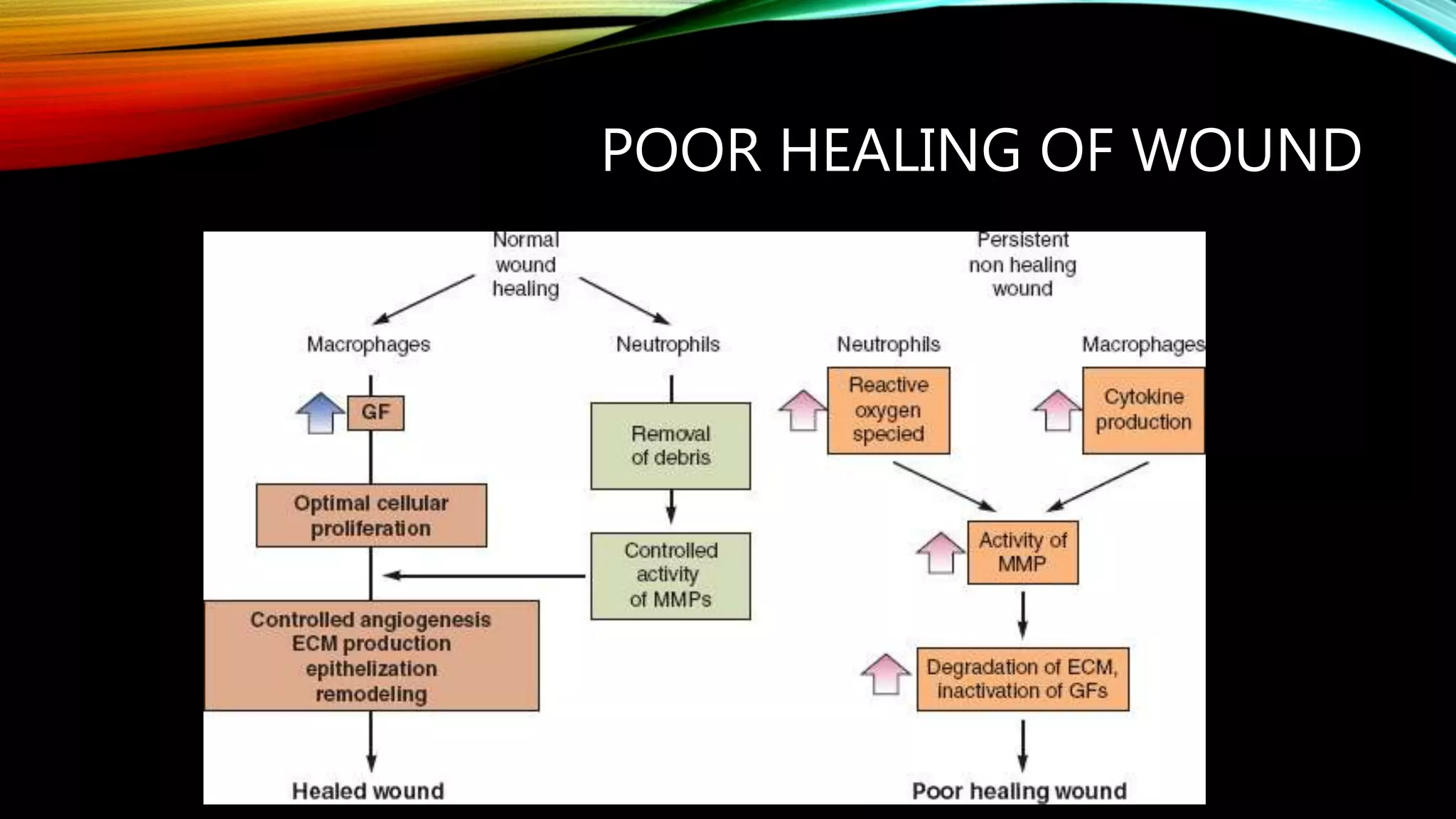
POOR HEALING OF WOUND
WOUND HEALING APPROACH
1. What are the causes of abnormal wound healing?
2. Which local and systemic factors impede wound healing?
3. How do we assess wounds?
4. How do we manage wounds?
ASSESSMENT OF A WOUND
• Size of the wound
• Location of the wound
• Wound edges
• Floor of the wound
WOUND INFECTION
• Pyrexia
• Pus
• Erythema (particularly when spreading)
• Malodour
• Wound dehiscence
• Poor healing
• Increased pain
• Sinus formation
BIOFILMS
• Collection of bacteria, fungi, and/or other microorganisms that can adapt,
communicate, and spread.
• Bacterial biofilms form when planktonik or free-floating bacteria attach to a suitable
surface and begin producing an extracellular polymeric substance (EPS) consisting of
sugars, proteins and nucleic acids.
FACTORS INTERFERE WOUND HEALING
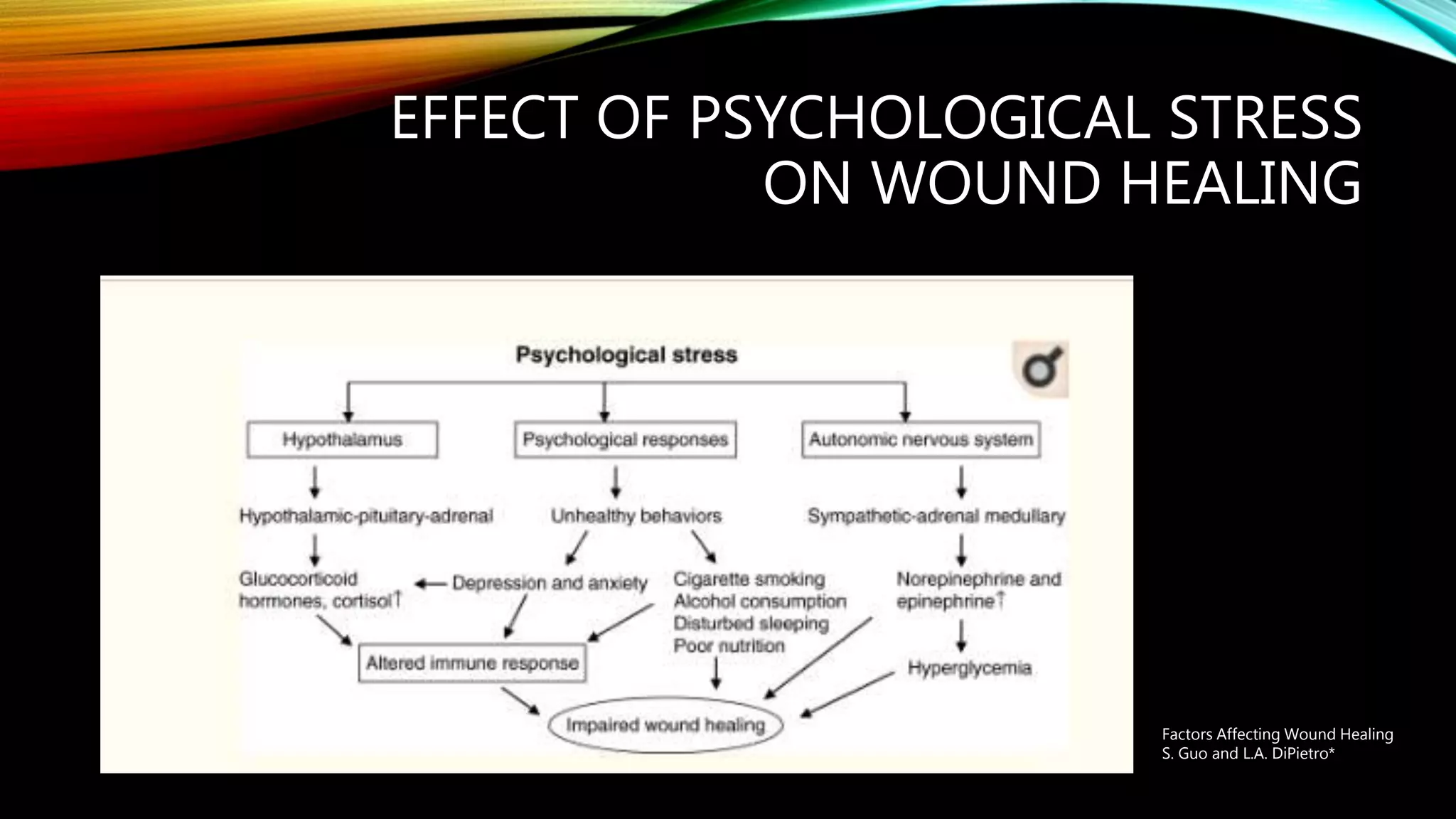
EFFECT OF PSYCHOLOGICAL STRESS
ON WOUND HEALING
Factors Affecting Wound Healing
S. Guo and L.A. DiPietro*
EFFFECT OF DIABETES ON WOUND
HEALING
Factors Affecting Wound Healing
S. Guo and L.A. di pietro
OBESITY IN WOUND HEALING
Factors Affecting Wound Healing
S. Guo and L.A. DiPietro
FACTORS INFLUENCING HEALING OF
A SURGICAL WOUND
• Presence of an existing chronic infection
• Time interval between skin preparation and surgery.
• Nature of the invasive procedure – especially if involving the bowel
• Extent of tissue loss and/or trauma to tissues during surgery
• Poor application of the principles of asepsis at the time of wound dressing changes
• Presence of devitalized tissue within the wound – necrotic tissue or slough, if over
50%
• Nature and prolonged presence of exudate not managed by a closed drainage
system.
MANAGING ACUTE WOUND
Baily & Love short practice of surgery- 27th edition
WOUND DRESSING
• Produce rapid and cosmetically acceptable healing
• Reduce pain
• Remove odour
• Treat or prevent infection
• Cover a cosmetically unpleasant wound
APPROPRIATE DRESSING MATERIAL
• wound-related factors:
- size
- depth
-amount and characteristics of exudate
- necrotic/viable
- surrounding tissue appearance (pigmented, scarred or cellulitic)
• product factors
• patient factors.
Fonlinelibrary.wiley.com%2Fdoi%2Ffull%2F10.1002%2F
TIME CONCEPT FOR WOUND BED
BASIC WOUND DRESSING
EFFECT OF RADIATION TO TISSUE
• The acute effects are usually manifested in tissues which are rapidly proliferating
such as mucosa and epithelium and this leads to painful ulcers, mucositis and
desquamation.
• The chronic problems like tissue fibrosis and degeneration can manifest even years
after treatment.
RADIATION RELATED TISSUE INJURY
• Affected factors include - TGFβ,VEGF, TNF-α, and proinflammatory cytokines such as
interleukin-1 and interleukin-8.
• These cytokines are overexpressed after the radiation injury leading to uncontrolled
matrix accumulation and fibrosis.
• MMP-1 is decreased after radiation therapy, which may contribute to inadequate
soft tissue reconstitution
• Nitric oxide (NO) promotes wound healing by an induction of collagen deposition.
NO levels are decreased.
CURRENT EXPERIMENTAL STRATEGIES IN THE
TREATMENT OF IRRADIATED WOUNDS
Wound healing after radiation therapy: Review of the literature
Frank Haubner, Elisabeth Ohmann, Fabian Pohl, Jürgen Strutz & Holger G Gassner
COMPLICATION OF WOUND HEALING
• Infection,tissue necrosis and gangrene,
• Periwound dermatitis
• Periwound edema
• Osteomyelitis
• Hematomas
• Dehiscence
• Hypertrophic scar
• Keloid
• Wound contracture
NECROTISING INFECTIONS
Baily & Love short practice of surgery- 27th edition
Thank you

wound healing

  • 1.
    WOUND HEALING Dr SafikaZaman Dept of ENT & HNS RKMSP,VIMS
  • 2.
    INTRODUCTION • Wound: breakin the integrity of the skin epithelium, often accompanied by concurrent disruption of the underlying dermis. • Whether small or large, acute or chronic, all wounds heal by a complex, dynamic, highly orchestrated biological process.
  • 3.
    CONT.. • A woundis ‘healed’ when: • - connective tissue repair and complete re-epithelialization have occurred. • - skin cover has been resorted with scar tissue without the necessity of drains or dressings.
  • 4.
  • 5.
  • 6.
    STAGES OF WOUNDHEALING Wound healing - A literature review*Ana Cristina de Oliveira Gonzalez,1 Tila Fortuna Costa,2 Zilton de Araújo Andrade,1 and Alen Ribeiro Alves Peixoto Medrado2
  • 9.
    RE-EPITHELIALIZATION • Replication andmovement of the epidermal cells from the wound edges in order to reconstitute an organized, keratinized, stratified squamous epithelium. • Initially, migration of epidermal cells creates a delicate covering over the raw area(epiboly). • This process of migration is dependent on the oxygen tension present in the wound and is most rapid in hyperbaric conditions. • ‘Contact inhibition’ prevents movement when epithelial sheets meet.
  • 12.
    Scott Brown`s textbook of ENT – 8TH Edition
  • 13.
    Scott Brown`s textbook of ENT – 8TH Edition
  • 14.
  • 15.
  • 16.
    WOUND HEALING- PRIMARYINTENTION  Closure of a wound within 12–24 hours of its formation.  wounds are clean and well perfused.  Apposition of wound edges reduces the distance for epidermal proliferation.
  • 17.
  • 18.
    WOUND HEALING –SECONDARY INTENTION Healing by secondary intention usually occurs in large wounds where it is not possible to appose the edges or in wounds that are complicated by infection. Sealing of the epithelium across the wound bed does not occur rapidly. Epithelial cells must grow both downwards and across the wound bed, with granulation tissue filling the defect
  • 19.
    THIRD INTENSION Process mainlyoccurs in contaminated wounds. The wound edges are usually approximated after 3–4 days.
  • 20.
  • 21.
  • 22.
    CHRONIC WOUND If awound does not follow the normal trajectory then it may become stuck in 1 of the 4 phases, becoming chronic. “wound failed to proceed through an orderly and timely process to produce anatomic and functional integrity, or proceeded through the repair process without establishing a sustained anatomic and functional result.”
  • 23.
  • 24.
    WOUND HEALING APPROACH 1.What are the causes of abnormal wound healing? 2. Which local and systemic factors impede wound healing? 3. How do we assess wounds? 4. How do we manage wounds?
  • 25.
    ASSESSMENT OF AWOUND • Size of the wound • Location of the wound • Wound edges • Floor of the wound
  • 26.
    WOUND INFECTION • Pyrexia •Pus • Erythema (particularly when spreading) • Malodour • Wound dehiscence • Poor healing • Increased pain • Sinus formation
  • 27.
    BIOFILMS • Collection ofbacteria, fungi, and/or other microorganisms that can adapt, communicate, and spread. • Bacterial biofilms form when planktonik or free-floating bacteria attach to a suitable surface and begin producing an extracellular polymeric substance (EPS) consisting of sugars, proteins and nucleic acids.
  • 29.
  • 30.
    EFFECT OF PSYCHOLOGICALSTRESS ON WOUND HEALING Factors Affecting Wound Healing S. Guo and L.A. DiPietro*
  • 31.
    EFFFECT OF DIABETESON WOUND HEALING Factors Affecting Wound Healing S. Guo and L.A. di pietro
  • 32.
    OBESITY IN WOUNDHEALING Factors Affecting Wound Healing S. Guo and L.A. DiPietro
  • 33.
    FACTORS INFLUENCING HEALINGOF A SURGICAL WOUND • Presence of an existing chronic infection • Time interval between skin preparation and surgery. • Nature of the invasive procedure – especially if involving the bowel • Extent of tissue loss and/or trauma to tissues during surgery • Poor application of the principles of asepsis at the time of wound dressing changes • Presence of devitalized tissue within the wound – necrotic tissue or slough, if over 50% • Nature and prolonged presence of exudate not managed by a closed drainage system.
  • 34.
    MANAGING ACUTE WOUND Baily& Love short practice of surgery- 27th edition
  • 35.
    WOUND DRESSING • Producerapid and cosmetically acceptable healing • Reduce pain • Remove odour • Treat or prevent infection • Cover a cosmetically unpleasant wound
  • 36.
    APPROPRIATE DRESSING MATERIAL •wound-related factors: - size - depth -amount and characteristics of exudate - necrotic/viable - surrounding tissue appearance (pigmented, scarred or cellulitic) • product factors • patient factors.
  • 37.
  • 38.
  • 40.
  • 42.
    EFFECT OF RADIATIONTO TISSUE • The acute effects are usually manifested in tissues which are rapidly proliferating such as mucosa and epithelium and this leads to painful ulcers, mucositis and desquamation. • The chronic problems like tissue fibrosis and degeneration can manifest even years after treatment.
  • 43.
    RADIATION RELATED TISSUEINJURY • Affected factors include - TGFβ,VEGF, TNF-α, and proinflammatory cytokines such as interleukin-1 and interleukin-8. • These cytokines are overexpressed after the radiation injury leading to uncontrolled matrix accumulation and fibrosis. • MMP-1 is decreased after radiation therapy, which may contribute to inadequate soft tissue reconstitution • Nitric oxide (NO) promotes wound healing by an induction of collagen deposition. NO levels are decreased.
  • 44.
    CURRENT EXPERIMENTAL STRATEGIESIN THE TREATMENT OF IRRADIATED WOUNDS Wound healing after radiation therapy: Review of the literature Frank Haubner, Elisabeth Ohmann, Fabian Pohl, Jürgen Strutz & Holger G Gassner
  • 45.
    COMPLICATION OF WOUNDHEALING • Infection,tissue necrosis and gangrene, • Periwound dermatitis • Periwound edema • Osteomyelitis • Hematomas • Dehiscence • Hypertrophic scar • Keloid • Wound contracture
  • 46.
    NECROTISING INFECTIONS Baily &Love short practice of surgery- 27th edition
  • 48.