Physiology of Nose
DR SAFIKA ZAMAN
DEPT OF ENT AND HEAD NECK SURGERY
VIMS & RKMSP, KOLKATA
Introduction
Knowing physiology is important to understand
pathology.
We should distinguish normal nasal function from
pathological symptoms to prevent unnecessary
surgery.
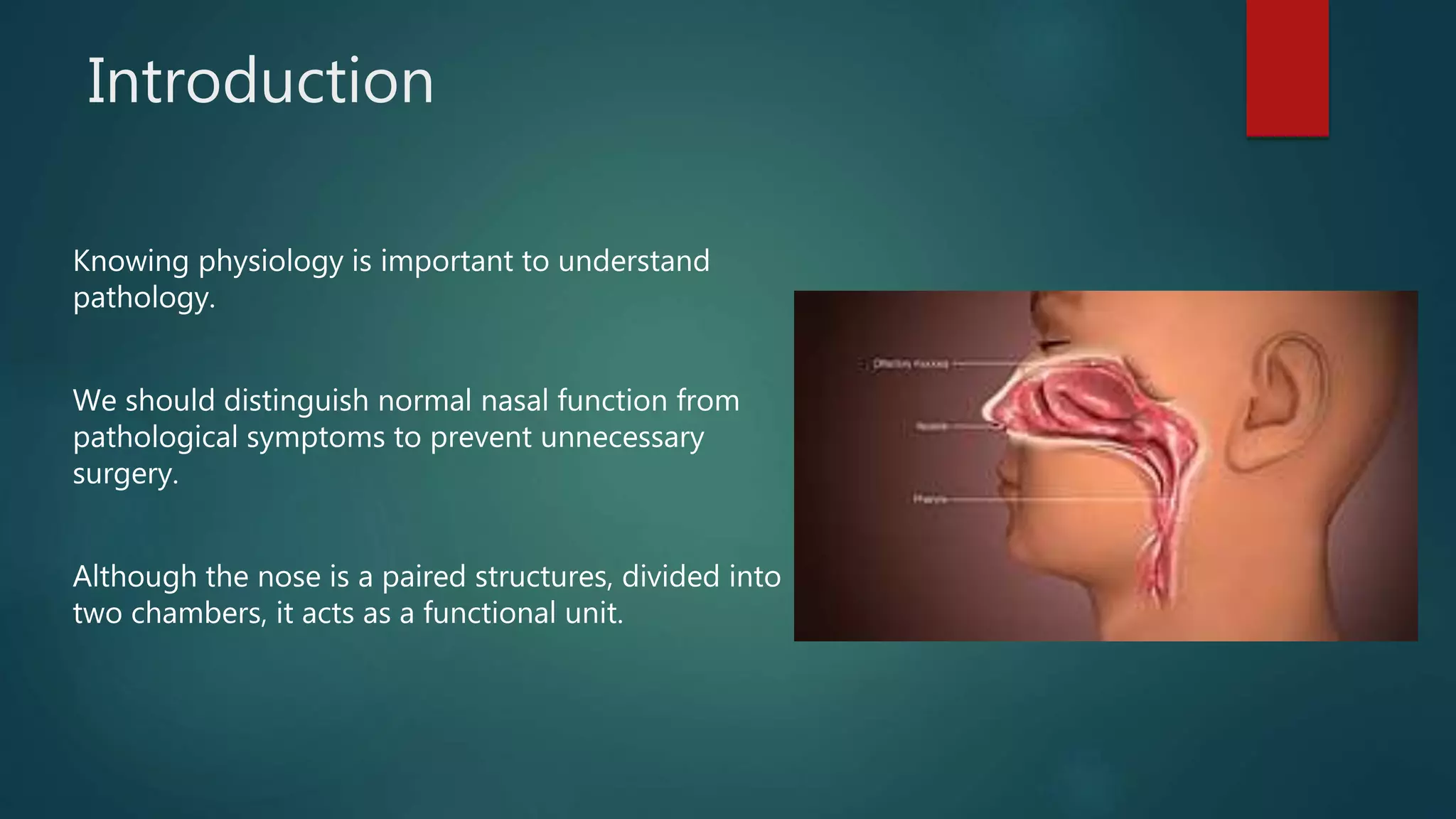
Although the nose is a paired structures, divided into
two chambers, it acts as a functional unit.
Functions of the nose
 Respiration
 Olfaction
 Protective function
 Vocal resonance
 Reflex functions
 Humidification
 Drainage cavity of PNS and NLD
Respiration
 Inspiration: Air passes from before
backward forming a parabolic curve.
 Expiration: Air passes from behind
forward forming an eddy current.
Wen, J., Inthavong, K., Tian, Z.F., Tu, J., Xue, C.C., & Li, C. (2007). Airflow Patterns in Both
Sides of a Realistic Human Nasal Cavity for Laminar and Turbulent Conditions.
Turbinates and distribution of air
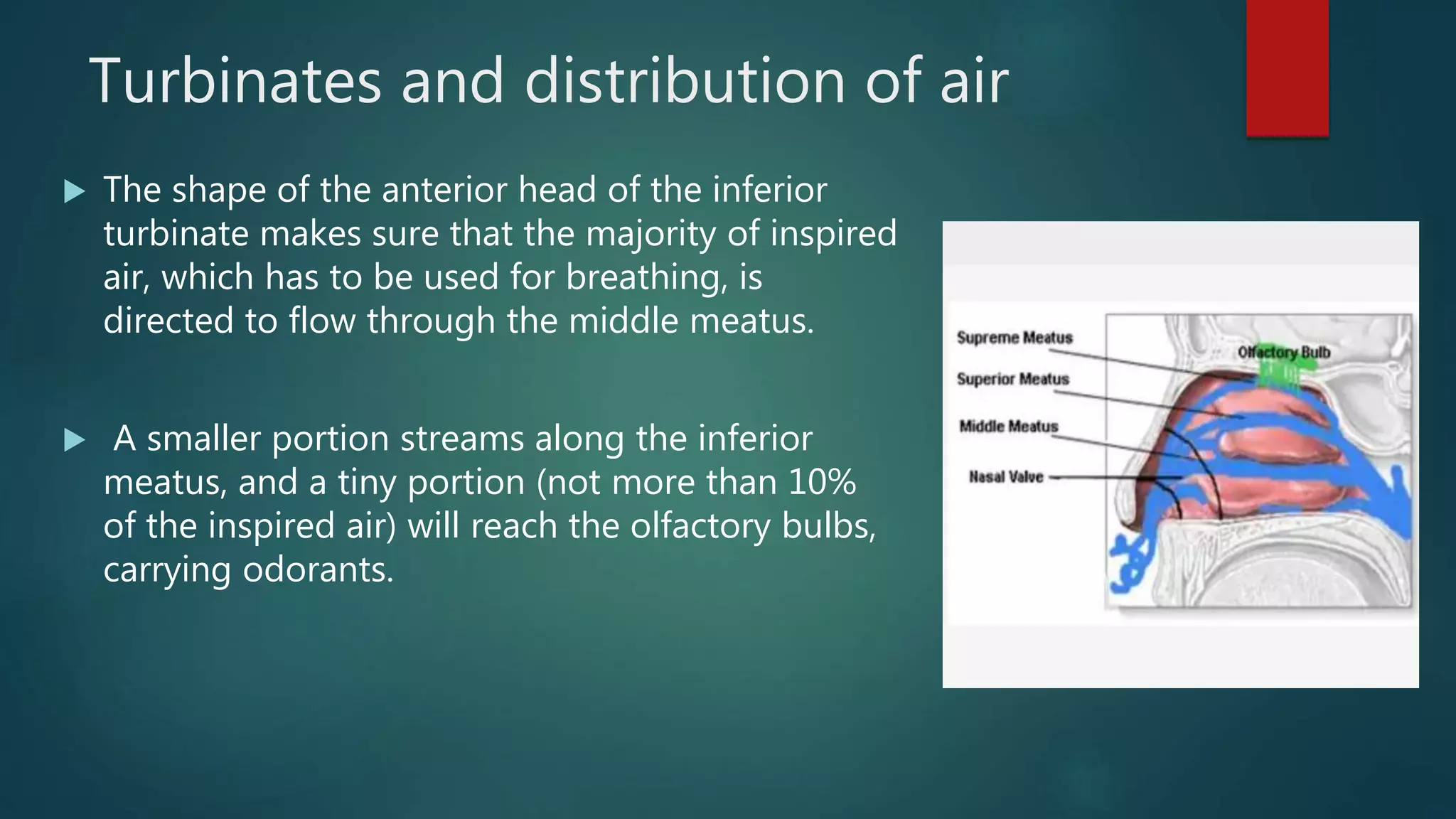
 The shape of the anterior head of the inferior
turbinate makes sure that the majority of inspired
air, which has to be used for breathing, is
directed to flow through the middle meatus.
 A smaller portion streams along the inferior
meatus, and a tiny portion (not more than 10%
of the inspired air) will reach the olfactory bulbs,
carrying odorants.
Why lameller flow is important?
 Because when the air flows in a laminar way – it is
distributed neatly all over the nasal cavity, under and above
the turbinates, reaching the olfactory receptors at the
cribriform plate, and ventilating the upper sinuses. In this
way the air gets to stream alongside the entire volume of
nasal mucosa, with all it’s curves, complicated structures
and sinuses – this allows the inspired air to receive
maximum levels of heat and humidity from the turbinates
and the rest of the nose. This heat and especially –
humidity – are crucial for pulmonary health and function,
The role of nasal valve
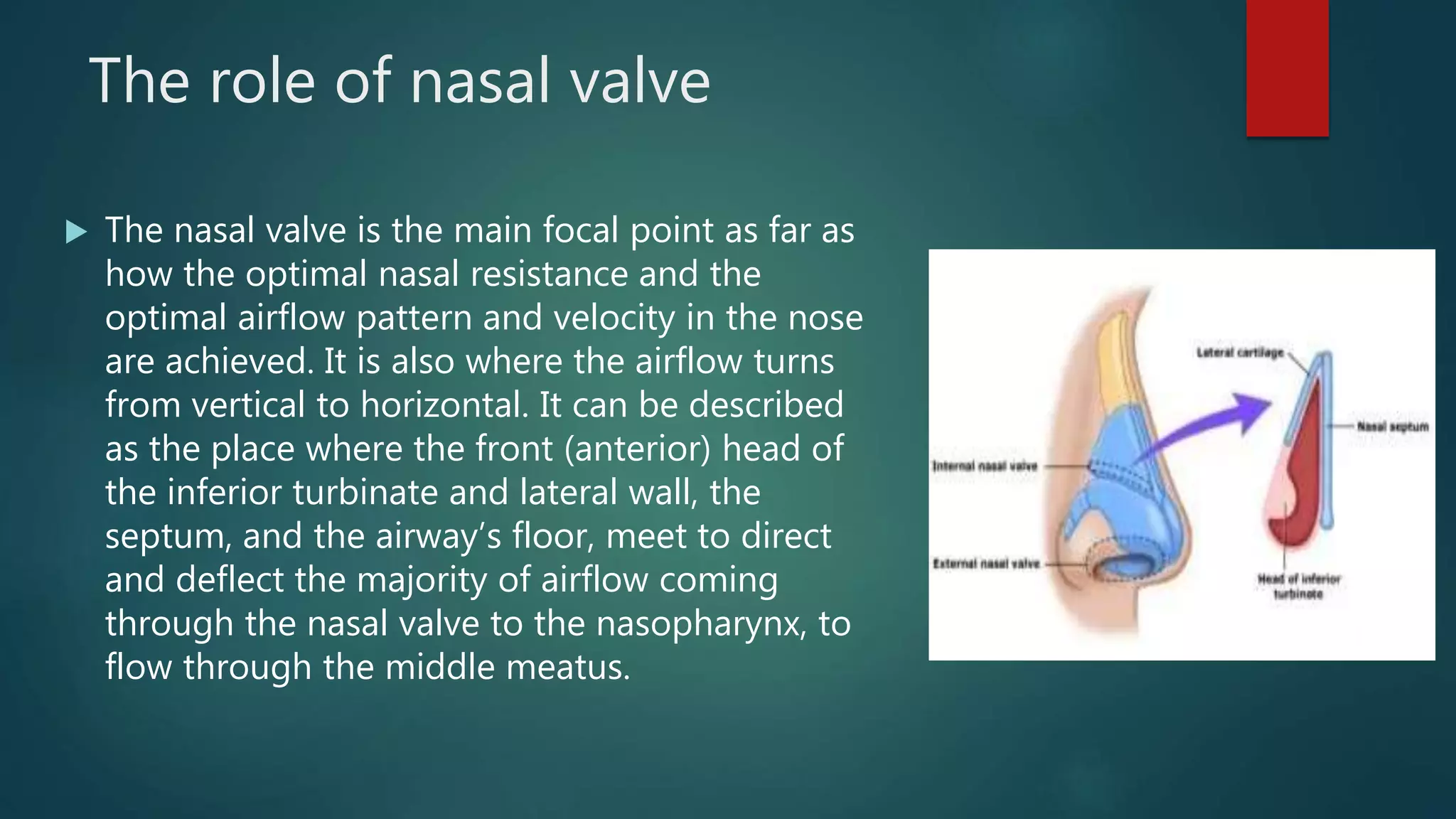
 The nasal valve is the main focal point as far as
how the optimal nasal resistance and the
optimal airflow pattern and velocity in the nose
are achieved. It is also where the airflow turns
from vertical to horizontal. It can be described
as the place where the front (anterior) head of
the inferior turbinate and lateral wall, the
septum, and the airway’s floor, meet to direct
and deflect the majority of airflow coming
through the nasal valve to the nasopharynx, to
flow through the middle meatus.
Nasal valves
Flow pattern during expiration
Image from scott
Brown’s book of
otorhinolaryngology,h
ead and neck surgery
Expiration
 Expiration lasts longer than inspiration and is more
turbulent.
 This is because the direction changes, the calibre varies
markedly and the walls are not smooth.
 Nasal resistance is made up of 2 elements, fixed
comprising bone cartilage and muscle, and the other
variable the mucosa.
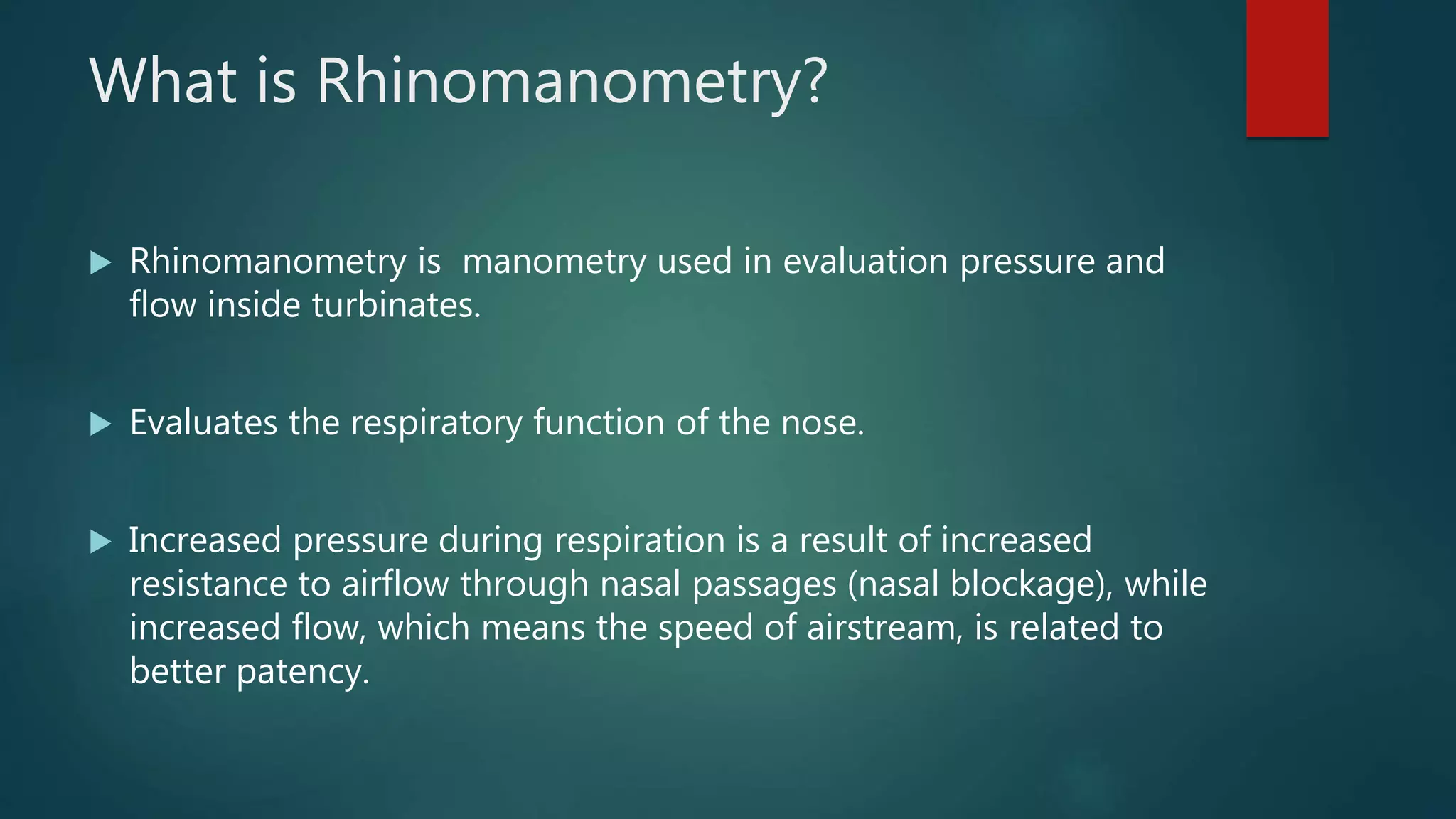
What is Rhinomanometry?
 Rhinomanometry is manometry used in evaluation pressure and
flow inside turbinates.
 Evaluates the respiratory function of the nose.
 Increased pressure during respiration is a result of increased
resistance to airflow through nasal passages (nasal blockage), while
increased flow, which means the speed of airstream, is related to
better patency.
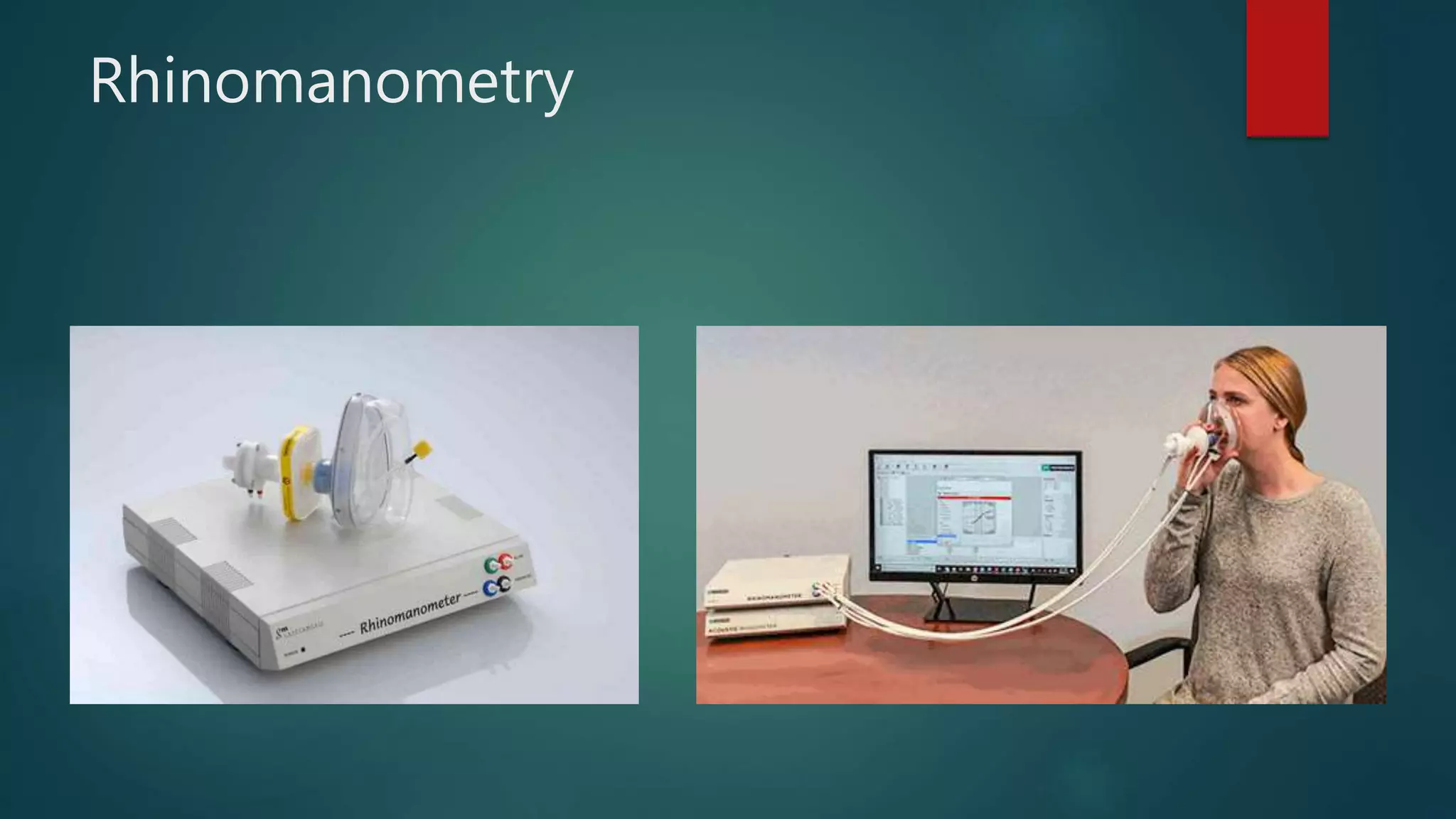
Rhinomanometry
Use of Rhinomanometry
 Rhinomanometry can be used to test nasal
patency in basal conditions in order to
differentiate between anatomical and
mucosal abnormalities by performing a test
with a decongestant. It can also be used to
check impact of other treatments, like nasal
steroid sprays.
Technique of Rhinomanometry
Source – Scott Brown- 8th edition
Chemical stimulation to action
potential generation
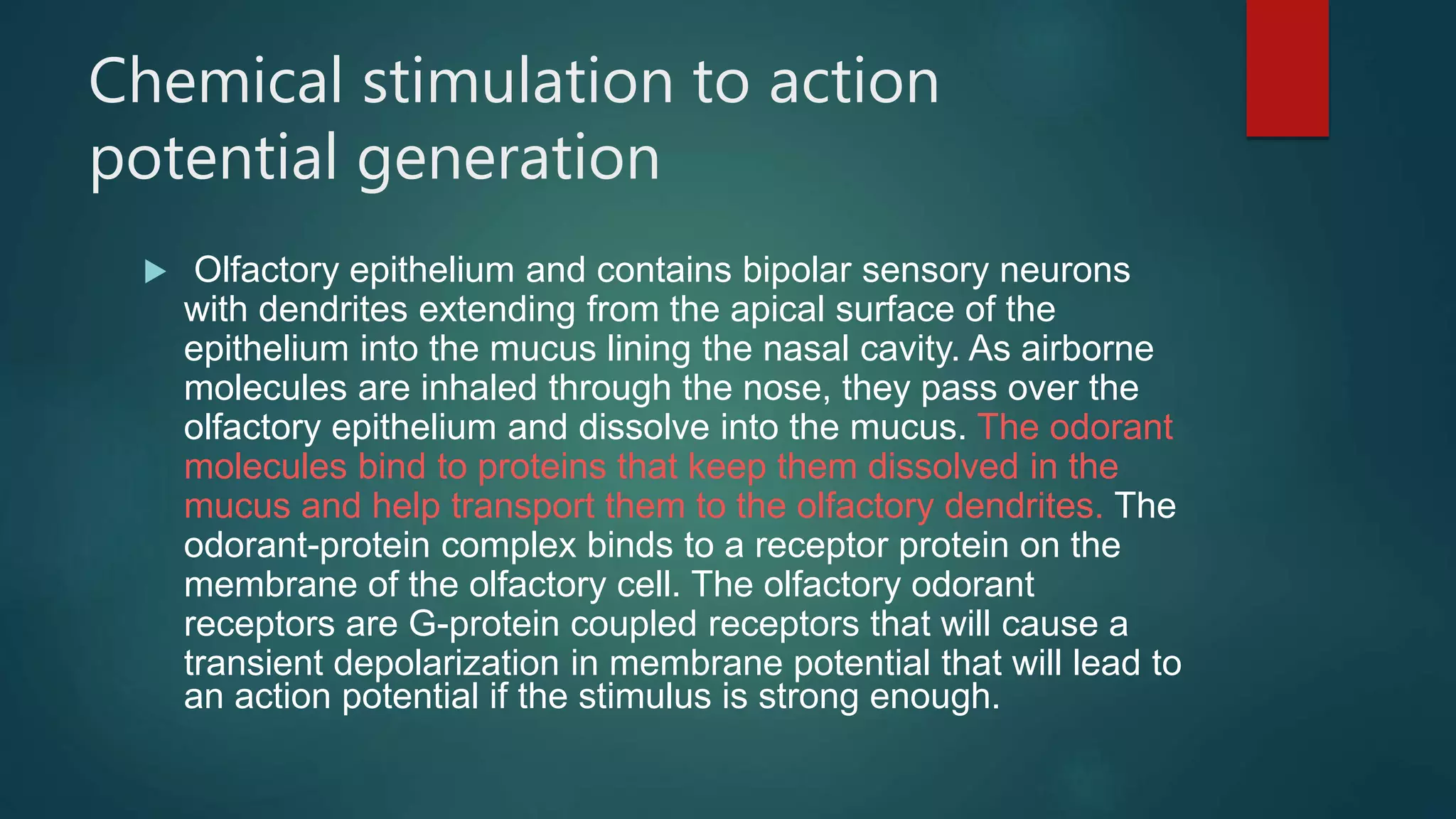
 Olfactory epithelium and contains bipolar sensory neurons
with dendrites extending from the apical surface of the
epithelium into the mucus lining the nasal cavity. As airborne
molecules are inhaled through the nose, they pass over the
olfactory epithelium and dissolve into the mucus. The odorant
molecules bind to proteins that keep them dissolved in the
mucus and help transport them to the olfactory dendrites. The
odorant-protein complex binds to a receptor protein on the
membrane of the olfactory cell. The olfactory odorant
receptors are G-protein coupled receptors that will cause a
transient depolarization in membrane potential that will lead to
an action potential if the stimulus is strong enough.
Olfaction
CNS projections of olfactory pathway
Central Nervous System Regions
that Receive Information from the
Olfactory Bulb.
Olfaction
 Smell is the one sensory modality that
does not require a synaptic connection in
the thalamus before connecting to the
cerebral cortex.
 Smell can often be a potent trigger for
memories because of this intimate
connection of the olfactory system with
the cerebral cortex.
 It can also trigger visceral reflexes
through connections within the reticular
formation.
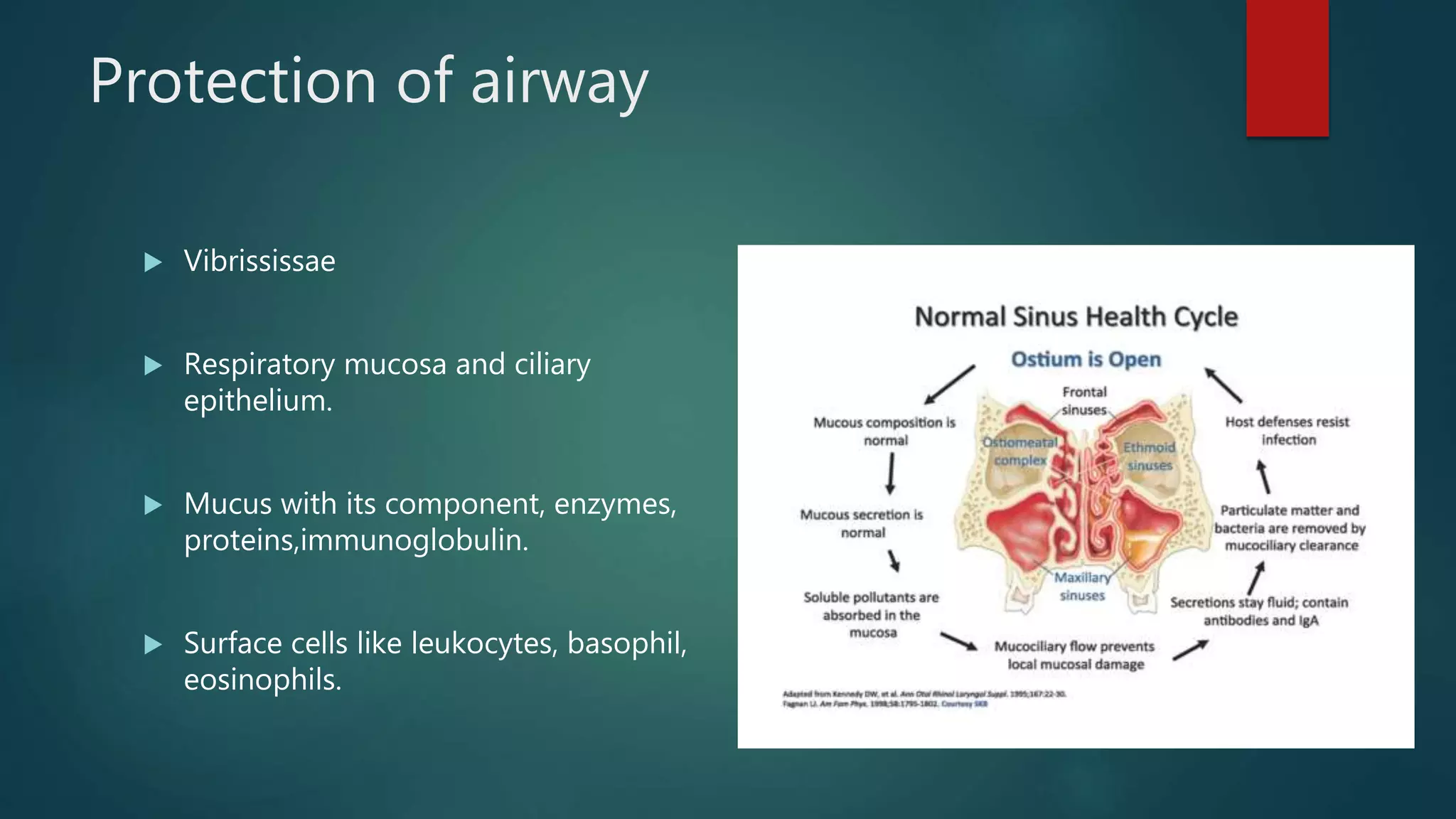
Protection of airway
 Vibrississae
 Respiratory mucosa and ciliary
epithelium.
 Mucus with its component, enzymes,
proteins,immunoglobulin.
 Surface cells like leukocytes, basophil,
eosinophils.
Vocal resonance
 Nose adds to quality of voice by
allowing some air to escape through it.
 Sound resonates within nose and mouth.
 The most effective resonance occurs in
lower laryngeal frequencies.
 Any nasal condition that alters air
passage may alter voice .
Nasal reflexes
 Chemical irritation, temperature change and physical stimuli
may cause widespread cardiovascular and respiratory
responses. Starting from sneezing to cardiopulmonary arrest.
 Sensory stimulation can result in intense vasoconstriction of
skin and mucosa.
 Nasopulnonary reflex is increasing airflow through one side
of nose is associated with increased ventilation of same side.
 Exercise emotion and stress may cause vasoconstriction.
 Hyperventilation cause nasal congestion.
Humidification
 Humidification of inspired air is due to vaporization of the water from the
mucosal surface.
 During inspiration saturation follows the temperature rise of inspiratory air
rapidly.
 The temp of the expired air at the back of the nose is slightly below the
core body temperature, and is saturated. As the temp drops along the
nose, some water condens into mucosa, thus some water is recycled .
 People who breathe in through the nose and out through the mouth will
dry the nasal mucosa.
Drainage of PNS & NLD
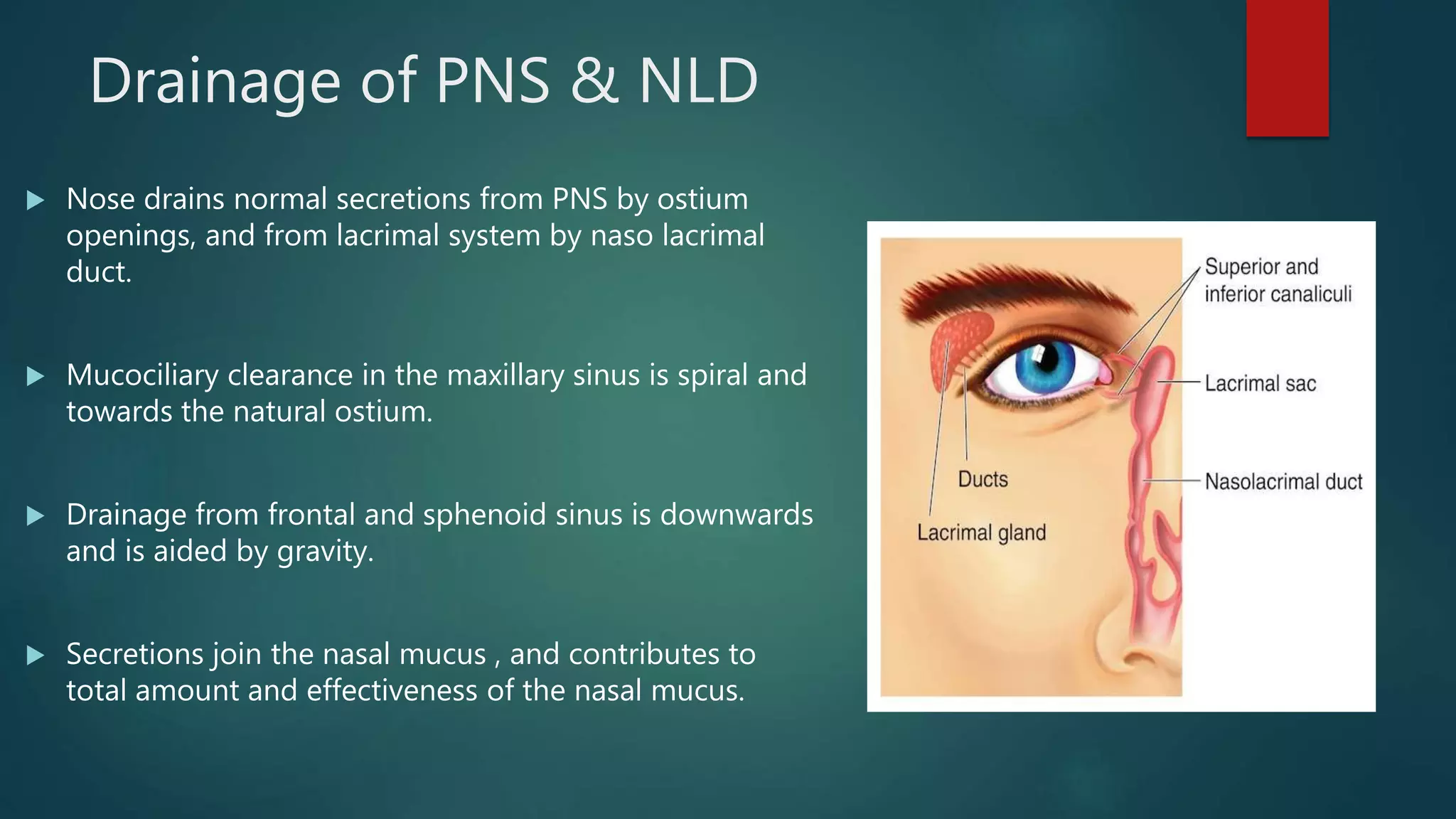
 Nose drains normal secretions from PNS by ostium
openings, and from lacrimal system by naso lacrimal
duct.
 Mucociliary clearance in the maxillary sinus is spiral and
towards the natural ostium.
 Drainage from frontal and sphenoid sinus is downwards
and is aided by gravity.
 Secretions join the nasal mucus , and contributes to
total amount and effectiveness of the nasal mucus.
Few words about PNS
 Functions are-
 Vocal resonance .
 Air conditioning
 Pressure damper.
 Reduction of skull weight
 Flotation of skull In water.
 Mechanical rigidity.
 Heat insulation.
Thank you 

Physiology of Nose.pptx

  • 1.
    Physiology of Nose DRSAFIKA ZAMAN DEPT OF ENT AND HEAD NECK SURGERY VIMS & RKMSP, KOLKATA
  • 2.
    Introduction Knowing physiology isimportant to understand pathology. We should distinguish normal nasal function from pathological symptoms to prevent unnecessary surgery. Although the nose is a paired structures, divided into two chambers, it acts as a functional unit.
  • 3.
    Functions of thenose  Respiration  Olfaction  Protective function  Vocal resonance  Reflex functions  Humidification  Drainage cavity of PNS and NLD
  • 4.
    Respiration  Inspiration: Airpasses from before backward forming a parabolic curve.  Expiration: Air passes from behind forward forming an eddy current. Wen, J., Inthavong, K., Tian, Z.F., Tu, J., Xue, C.C., & Li, C. (2007). Airflow Patterns in Both Sides of a Realistic Human Nasal Cavity for Laminar and Turbulent Conditions.
  • 5.
    Turbinates and distributionof air  The shape of the anterior head of the inferior turbinate makes sure that the majority of inspired air, which has to be used for breathing, is directed to flow through the middle meatus.  A smaller portion streams along the inferior meatus, and a tiny portion (not more than 10% of the inspired air) will reach the olfactory bulbs, carrying odorants.
  • 6.
    Why lameller flowis important?  Because when the air flows in a laminar way – it is distributed neatly all over the nasal cavity, under and above the turbinates, reaching the olfactory receptors at the cribriform plate, and ventilating the upper sinuses. In this way the air gets to stream alongside the entire volume of nasal mucosa, with all it’s curves, complicated structures and sinuses – this allows the inspired air to receive maximum levels of heat and humidity from the turbinates and the rest of the nose. This heat and especially – humidity – are crucial for pulmonary health and function,
  • 7.
    The role ofnasal valve  The nasal valve is the main focal point as far as how the optimal nasal resistance and the optimal airflow pattern and velocity in the nose are achieved. It is also where the airflow turns from vertical to horizontal. It can be described as the place where the front (anterior) head of the inferior turbinate and lateral wall, the septum, and the airway’s floor, meet to direct and deflect the majority of airflow coming through the nasal valve to the nasopharynx, to flow through the middle meatus.
  • 8.
  • 9.
    Flow pattern duringexpiration Image from scott Brown’s book of otorhinolaryngology,h ead and neck surgery
  • 10.
    Expiration  Expiration lastslonger than inspiration and is more turbulent.  This is because the direction changes, the calibre varies markedly and the walls are not smooth.  Nasal resistance is made up of 2 elements, fixed comprising bone cartilage and muscle, and the other variable the mucosa.
  • 11.
    What is Rhinomanometry? Rhinomanometry is manometry used in evaluation pressure and flow inside turbinates.  Evaluates the respiratory function of the nose.  Increased pressure during respiration is a result of increased resistance to airflow through nasal passages (nasal blockage), while increased flow, which means the speed of airstream, is related to better patency.
  • 12.
  • 13.
    Use of Rhinomanometry Rhinomanometry can be used to test nasal patency in basal conditions in order to differentiate between anatomical and mucosal abnormalities by performing a test with a decongestant. It can also be used to check impact of other treatments, like nasal steroid sprays.
  • 14.
    Technique of Rhinomanometry Source– Scott Brown- 8th edition
  • 15.
    Chemical stimulation toaction potential generation  Olfactory epithelium and contains bipolar sensory neurons with dendrites extending from the apical surface of the epithelium into the mucus lining the nasal cavity. As airborne molecules are inhaled through the nose, they pass over the olfactory epithelium and dissolve into the mucus. The odorant molecules bind to proteins that keep them dissolved in the mucus and help transport them to the olfactory dendrites. The odorant-protein complex binds to a receptor protein on the membrane of the olfactory cell. The olfactory odorant receptors are G-protein coupled receptors that will cause a transient depolarization in membrane potential that will lead to an action potential if the stimulus is strong enough.
  • 16.
  • 17.
    CNS projections ofolfactory pathway Central Nervous System Regions that Receive Information from the Olfactory Bulb.
  • 18.
    Olfaction  Smell isthe one sensory modality that does not require a synaptic connection in the thalamus before connecting to the cerebral cortex.  Smell can often be a potent trigger for memories because of this intimate connection of the olfactory system with the cerebral cortex.  It can also trigger visceral reflexes through connections within the reticular formation.
  • 19.
    Protection of airway Vibrississae  Respiratory mucosa and ciliary epithelium.  Mucus with its component, enzymes, proteins,immunoglobulin.  Surface cells like leukocytes, basophil, eosinophils.
  • 20.
    Vocal resonance  Noseadds to quality of voice by allowing some air to escape through it.  Sound resonates within nose and mouth.  The most effective resonance occurs in lower laryngeal frequencies.  Any nasal condition that alters air passage may alter voice .
  • 21.
    Nasal reflexes  Chemicalirritation, temperature change and physical stimuli may cause widespread cardiovascular and respiratory responses. Starting from sneezing to cardiopulmonary arrest.  Sensory stimulation can result in intense vasoconstriction of skin and mucosa.  Nasopulnonary reflex is increasing airflow through one side of nose is associated with increased ventilation of same side.  Exercise emotion and stress may cause vasoconstriction.  Hyperventilation cause nasal congestion.
  • 22.
    Humidification  Humidification ofinspired air is due to vaporization of the water from the mucosal surface.  During inspiration saturation follows the temperature rise of inspiratory air rapidly.  The temp of the expired air at the back of the nose is slightly below the core body temperature, and is saturated. As the temp drops along the nose, some water condens into mucosa, thus some water is recycled .  People who breathe in through the nose and out through the mouth will dry the nasal mucosa.
  • 23.
    Drainage of PNS& NLD  Nose drains normal secretions from PNS by ostium openings, and from lacrimal system by naso lacrimal duct.  Mucociliary clearance in the maxillary sinus is spiral and towards the natural ostium.  Drainage from frontal and sphenoid sinus is downwards and is aided by gravity.  Secretions join the nasal mucus , and contributes to total amount and effectiveness of the nasal mucus.
  • 24.
    Few words aboutPNS  Functions are-  Vocal resonance .  Air conditioning  Pressure damper.  Reduction of skull weight  Flotation of skull In water.  Mechanical rigidity.  Heat insulation.
  • 25.