Dr Utkal Mishra
1

 Concept described by Lazars in 1826.
 Syme first performed it in 1828.
 Portman described sublabial transoral approach in 1927.
 Smith described extended maxillectomy in 1954.
 Fairbanks & Barbosa described infratemporal fossa approach
for advanced maxillary sinus tumors in 1961.
 Midfacial degloving approach was popularized in 1970.
History
2

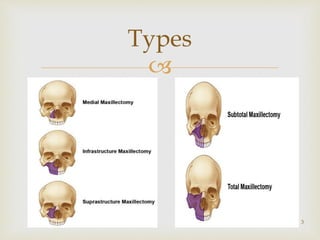
Types
3

 Malignant tumors involving maxilla – Sq Cell Carcinoma
 Benign tumors of maxilla causing extensive bone destruction
(fibrous dysplasia)
 Extensive fungal / Granulomatous infections (rare)
 Malignant tumors of oral cavity with extensive involvement of
palate
Indications
4

 Lymphoreticular malignancies – Lymphoma and Pediatric
Rhabdomyosarcoma
 Bilateral tumors with bilateral orbital involvement
 Malignant tumors with skull base extension.
 Systemic disorders like uncontrolled diabetes / poor cardio
respiratory reserve
 Poor general condition of the patient
 Patient not consenting to undergo the procedure
Contraindications
5

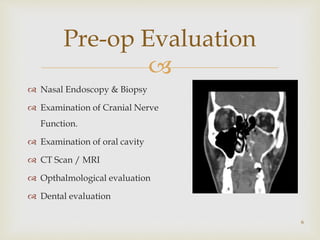
Pre-op Evaluation
 Nasal Endoscopy & Biopsy
 Examination of Cranial Nerve
Function.
 Examination of oral cavity
 CT Scan / MRI
 Opthalmological evaluation
 Dental evaluation
6
Surgery
7

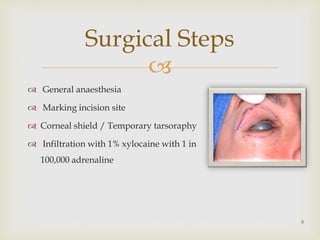
 General anaesthesia
 Marking incision site
 Corneal shield / Temporary tarsoraphy
 Infiltration with 1% xylocaine with 1 in
100,000 adrenaline
Surgical Steps
8

 Hypotensive Anaesthesia.
 Transoral Intubation is preferable.
 E.T. Tube secured opposite the side of tumor in lower lip.
 If Trismus present – Tracheostomy / Trans-nasal fibreoptic
intubation.
9
Anaesthetic Considerations

Incision
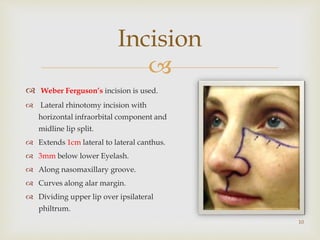
 Weber Ferguson’s incision is used.
 Lateral rhinotomy incision with
horizontal infraorbital component and
midline lip split.
 Extends 1cm lateral to lateral canthus.
 3mm below lower Eyelash.
 Along nasomaxillary groove.
 Curves along alar margin.
 Dividing upper lip over ipsilateral
philtrum.
10

11
Incision
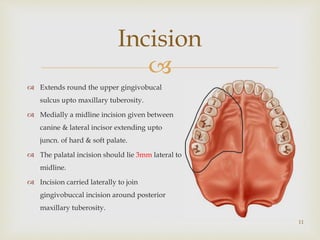
 Extends round the upper gingivobucal
sulcus upto maxillary tuberosity.
 Medially a midline incision given between
canine & lateral incisor extending upto
juncn. of hard & soft palate.
 The palatal incision should lie 3mm lateral to
midline.
 Incision carried laterally to join
gingivobuccal incision around posterior
maxillary tuberosity.

Flap
12
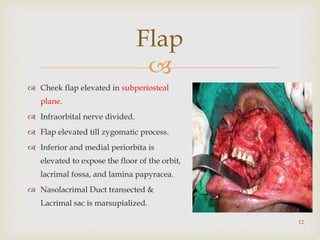
 Cheek flap elevated in subperiosteal
plane.
 Infraorbital nerve divided.
 Flap elevated till zygomatic process.
 Inferior and medial periorbita is
elevated to expose the floor of the orbit,
lacrimal fossa, and lamina papyracea.
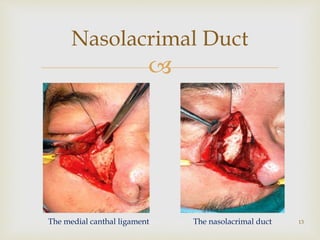
 Nasolacrimal Duct transected &
Lacrimal sac is marsupialized.

13
Nasolacrimal Duct
The medial canthal ligament The nasolacrimal duct

Bone cuts
14
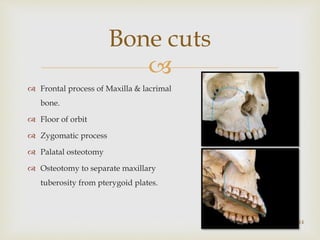
 Frontal process of Maxilla & lacrimal
bone.
 Floor of orbit
 Zygomatic process
 Palatal osteotomy
 Osteotomy to separate maxillary
tuberosity from pterygoid plates.

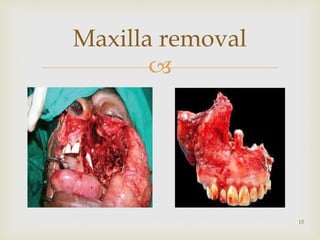
Maxilla removal
15

Hemostasis
16
 Bleeding from maxillary artery is controlled by ligation
 Venous bleeding from pterygoid plexus is controlled with
packing.
 Use of powered osteotomes results in less bleeding.

Obturator Prosthesis
17
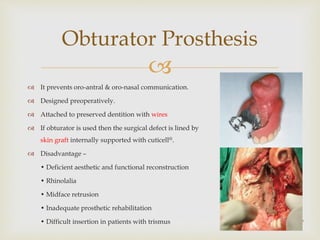
 It prevents oro-antral & oro-nasal communication.
 Designed preoperatively.
 Attached to preserved dentition with wires
 If obturator is used then the surgical defect is lined by
skin graft internally supported with cuticell@.
 Disadvantage –
• Deficient aesthetic and functional reconstruction
• Rhinolalia
• Midface retrusion
• Inadequate prosthetic rehabilitation
• Difficult insertion in patients with trismus

Closure
18

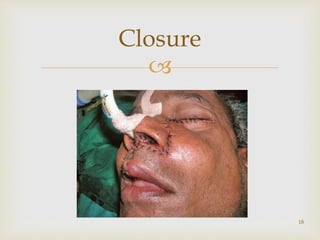
 In early postoperative period, frequent oral irrigation is
encouraged.
 Oronasal irrigations are encouraged after removal of Vaseline
gauze.
 Jaw stretching exercise is advised to prevent development of
trismus.
 Once the raw area has healed satisfactory (3–4 weeks),
patient may be referred to the prosthodontic department
for permanent prosthesis
19
Post op Care
Complication
20

 Bleeding
 Mid face retrusion
 Epiphora
 Break down of skin graft
 Numbness of cheek area
Complications
21

 Commonest site – Maxillary Artery
 Breaking maxilla from pterygoid process will cause bleeding from
internal maxillary artery. Simple hot packs will help in reducing
bleeding during this stage.
 Can be minimized by coagulating bleeders.
 Angular vessels should be secured properly.
 When lip splitting incision is used bleeding from labial vessels is
common and should be secured at the earliest
Bleeding
22

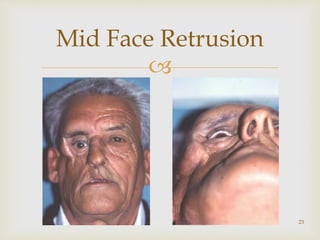
Mid Face Retrusion
23

 Nasolacrimal duct is transected during maxillectomy thus
causing epiphora.
 Simple transection of nasolacrimal duct rarely causes epiphora
unless followed by stricture which usually occurs following
radiotherapy
 Marsupialization of lacrimal sac.
 Insertion of silicone tube after transection of nasolacrimal duct.
Epiphora
24

 Caused due to transection of infraorbial nerve.
 Infraorbital nerve can be conserved if not involved by the
tumor.
Numbness of cheek area
25
Reconstruction
26

Objectives
27
 Closure of the surgical wound
 Elimination of the maxillary defect
 Restoration of Midfacial contour
 Support Eyeball
 Reconstruction of the palate
 Restore normal mastication and deglutition.

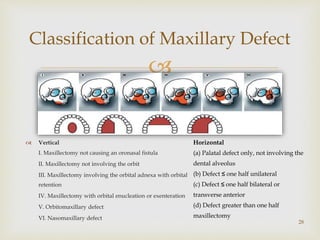
Classification of Maxillary Defect
28
 Vertical
I. Maxillectomy not causing an oronasal fistula
II. Maxillectomy not involving the orbit
III. Maxillectomy involving the orbital adnexa with orbital
retention
IV. Maxillectomy with orbital enucleation or exenteration
V. Orbitomaxillary defect
VI. Nasomaxillary defect
Horizontal
(a) Palatal defect only, not involving the
dental alveolus
(b) Defect ≤ one half unilateral
(c) Defect ≤ one half bilateral or
transverse anterior
(d) Defect greater than one half
maxillectomy

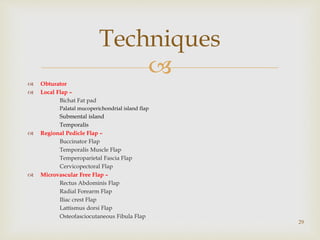
 Obturator
 Local Flap –
Bichat Fat pad
Palatal mucoperichondrial island flap
Submental island
Temporalis
 Regional Pedicle Flap –
Buccinator Flap
Temporalis Muscle Flap
Temperoparietal Fascia Flap
Cervicopectoral Flap
 Microvascular Free Flap –
Rectus Abdominis Flap
Radial Forearm Flap
Iliac crest Flap
Lattismus dorsi Flap
Osteofasciocutaneous Fibula Flap
29
Techniques

Class I – IIb Defect
30
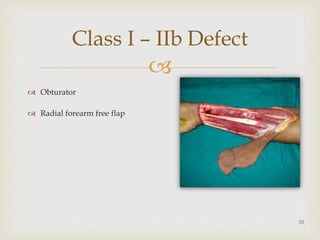
 Obturator
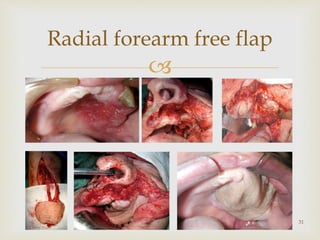
 Radial forearm free flap

Radial forearm free flap
31

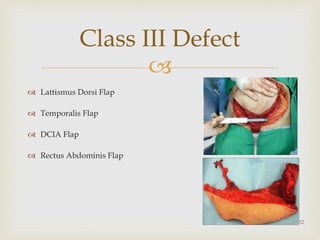
Class III Defect
32
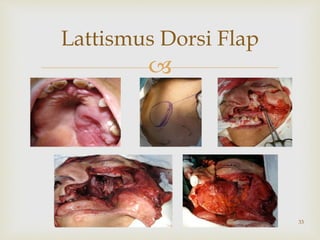
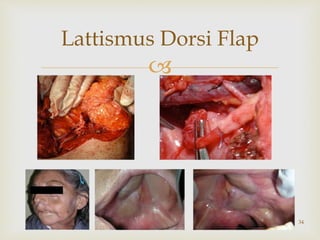
 Lattismus Dorsi Flap
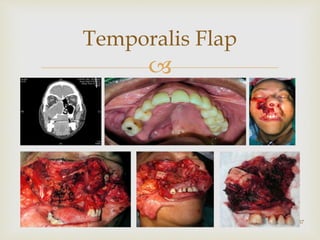
 Temporalis Flap
 DCIA Flap
 Rectus Abdominis Flap

Lattismus Dorsi Flap
33

Lattismus Dorsi Flap
34

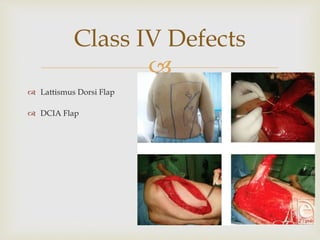
Class IV Defects
35
 Lattismus Dorsi Flap
 DCIA Flap

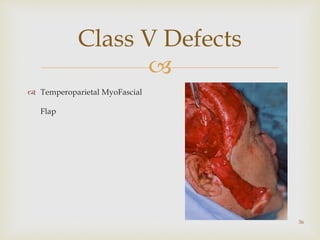
Class V Defects
36
 Temperoparietal MyoFascial
Flap

Temporalis Flap
37

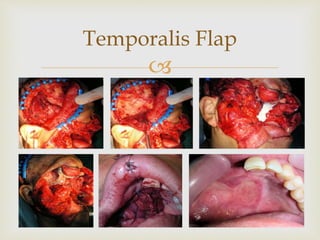
Temporalis Flap
38

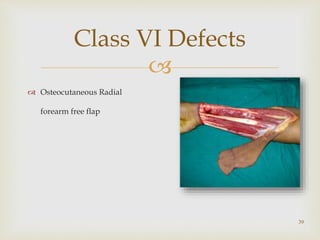
Class VI Defects
39
 Osteocutaneous Radial
forearm free flap
Thank You
40

Maxillectomy & Rehabilitation

  • 1.
  • 2.
      Concept describedby Lazars in 1826.  Syme first performed it in 1828.  Portman described sublabial transoral approach in 1927.  Smith described extended maxillectomy in 1954.  Fairbanks & Barbosa described infratemporal fossa approach for advanced maxillary sinus tumors in 1961.  Midfacial degloving approach was popularized in 1970. History 2
  • 3.
  • 4.
      Malignant tumorsinvolving maxilla – Sq Cell Carcinoma  Benign tumors of maxilla causing extensive bone destruction (fibrous dysplasia)  Extensive fungal / Granulomatous infections (rare)  Malignant tumors of oral cavity with extensive involvement of palate Indications 4
  • 5.
      Lymphoreticular malignancies– Lymphoma and Pediatric Rhabdomyosarcoma  Bilateral tumors with bilateral orbital involvement  Malignant tumors with skull base extension.  Systemic disorders like uncontrolled diabetes / poor cardio respiratory reserve  Poor general condition of the patient  Patient not consenting to undergo the procedure Contraindications 5
  • 6.
     Pre-op Evaluation  NasalEndoscopy & Biopsy  Examination of Cranial Nerve Function.  Examination of oral cavity  CT Scan / MRI  Opthalmological evaluation  Dental evaluation 6
  • 7.
  • 8.
      General anaesthesia Marking incision site  Corneal shield / Temporary tarsoraphy  Infiltration with 1% xylocaine with 1 in 100,000 adrenaline Surgical Steps 8
  • 9.
      Hypotensive Anaesthesia. Transoral Intubation is preferable.  E.T. Tube secured opposite the side of tumor in lower lip.  If Trismus present – Tracheostomy / Trans-nasal fibreoptic intubation. 9 Anaesthetic Considerations
  • 10.
     Incision  Weber Ferguson’sincision is used.  Lateral rhinotomy incision with horizontal infraorbital component and midline lip split.  Extends 1cm lateral to lateral canthus.  3mm below lower Eyelash.  Along nasomaxillary groove.  Curves along alar margin.  Dividing upper lip over ipsilateral philtrum. 10
  • 11.
     11 Incision  Extends roundthe upper gingivobucal sulcus upto maxillary tuberosity.  Medially a midline incision given between canine & lateral incisor extending upto juncn. of hard & soft palate.  The palatal incision should lie 3mm lateral to midline.  Incision carried laterally to join gingivobuccal incision around posterior maxillary tuberosity.
  • 12.
     Flap 12  Cheek flapelevated in subperiosteal plane.  Infraorbital nerve divided.  Flap elevated till zygomatic process.  Inferior and medial periorbita is elevated to expose the floor of the orbit, lacrimal fossa, and lamina papyracea.  Nasolacrimal Duct transected & Lacrimal sac is marsupialized.
  • 13.
     13 Nasolacrimal Duct The medialcanthal ligament The nasolacrimal duct
  • 14.
     Bone cuts 14  Frontalprocess of Maxilla & lacrimal bone.  Floor of orbit  Zygomatic process  Palatal osteotomy  Osteotomy to separate maxillary tuberosity from pterygoid plates.
  • 15.
  • 16.
     Hemostasis 16  Bleeding frommaxillary artery is controlled by ligation  Venous bleeding from pterygoid plexus is controlled with packing.  Use of powered osteotomes results in less bleeding.
  • 17.
     Obturator Prosthesis 17  Itprevents oro-antral & oro-nasal communication.  Designed preoperatively.  Attached to preserved dentition with wires  If obturator is used then the surgical defect is lined by skin graft internally supported with cuticell@.  Disadvantage – • Deficient aesthetic and functional reconstruction • Rhinolalia • Midface retrusion • Inadequate prosthetic rehabilitation • Difficult insertion in patients with trismus
  • 18.
  • 19.
      In earlypostoperative period, frequent oral irrigation is encouraged.  Oronasal irrigations are encouraged after removal of Vaseline gauze.  Jaw stretching exercise is advised to prevent development of trismus.  Once the raw area has healed satisfactory (3–4 weeks), patient may be referred to the prosthodontic department for permanent prosthesis 19 Post op Care
  • 20.
  • 21.
      Bleeding  Midface retrusion  Epiphora  Break down of skin graft  Numbness of cheek area Complications 21
  • 22.
      Commonest site– Maxillary Artery  Breaking maxilla from pterygoid process will cause bleeding from internal maxillary artery. Simple hot packs will help in reducing bleeding during this stage.  Can be minimized by coagulating bleeders.  Angular vessels should be secured properly.  When lip splitting incision is used bleeding from labial vessels is common and should be secured at the earliest Bleeding 22
  • 23.
  • 24.
      Nasolacrimal ductis transected during maxillectomy thus causing epiphora.  Simple transection of nasolacrimal duct rarely causes epiphora unless followed by stricture which usually occurs following radiotherapy  Marsupialization of lacrimal sac.  Insertion of silicone tube after transection of nasolacrimal duct. Epiphora 24
  • 25.
      Caused dueto transection of infraorbial nerve.  Infraorbital nerve can be conserved if not involved by the tumor. Numbness of cheek area 25
  • 26.
  • 27.
     Objectives 27  Closure ofthe surgical wound  Elimination of the maxillary defect  Restoration of Midfacial contour  Support Eyeball  Reconstruction of the palate  Restore normal mastication and deglutition.
  • 28.
     Classification of MaxillaryDefect 28  Vertical I. Maxillectomy not causing an oronasal fistula II. Maxillectomy not involving the orbit III. Maxillectomy involving the orbital adnexa with orbital retention IV. Maxillectomy with orbital enucleation or exenteration V. Orbitomaxillary defect VI. Nasomaxillary defect Horizontal (a) Palatal defect only, not involving the dental alveolus (b) Defect ≤ one half unilateral (c) Defect ≤ one half bilateral or transverse anterior (d) Defect greater than one half maxillectomy
  • 29.
      Obturator  LocalFlap – Bichat Fat pad Palatal mucoperichondrial island flap Submental island Temporalis  Regional Pedicle Flap – Buccinator Flap Temporalis Muscle Flap Temperoparietal Fascia Flap Cervicopectoral Flap  Microvascular Free Flap – Rectus Abdominis Flap Radial Forearm Flap Iliac crest Flap Lattismus dorsi Flap Osteofasciocutaneous Fibula Flap 29 Techniques
  • 30.
     Class I –IIb Defect 30  Obturator  Radial forearm free flap
  • 31.
  • 32.
     Class III Defect 32 Lattismus Dorsi Flap  Temporalis Flap  DCIA Flap  Rectus Abdominis Flap
  • 33.
  • 34.
  • 35.
     Class IV Defects 35 Lattismus Dorsi Flap  DCIA Flap
  • 36.
     Class V Defects 36 Temperoparietal MyoFascial Flap
  • 37.
  • 38.
  • 39.
     Class VI Defects 39 Osteocutaneous Radial forearm free flap
  • 40.