 Tumors arising from or extending into the ITF
from neighboring regions provide a
challenge as to how best to approach the
area
 Tumors within the ITF are rare, making up
less than 1% of head and neck tumors
 The ITF approaches are categorized as
anterior (transfacial, transmaxillary,
transoral, and transpalatal),
 lateral (transzygomatic and lateral
infratemporal), or
 inferior (transmandibular and transcervical)
 The pioneers of the ITF were Conley and
Barbosa
 Barbosa indicated the ITF approach for
advanced tumors into the maxillary sinus. 1960
 n 1969, Terez et al used a craniofacial
approach for tumors invading the pterygoid
fossa but residual tumor could not be avoided.
 In 1976, House and Hitselberger described a
transcochlear approach for tumors that
originated medially to the internal auditory
canal or from the clivus.
 In 1977, Fisch and coworkers reported the
posterolateral ITF approach
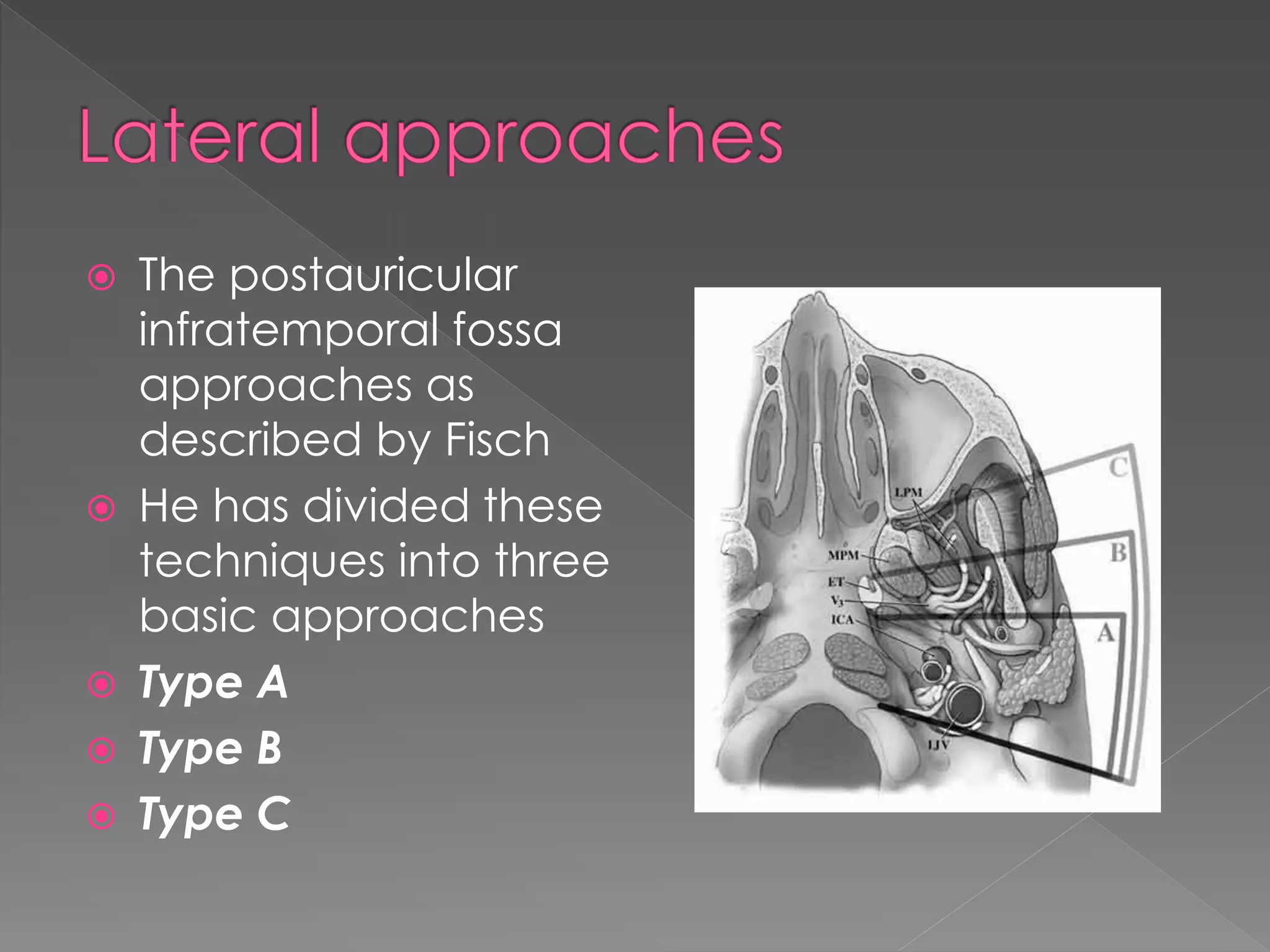
 The postauricular
infratemporal fossa
approaches as
described by Fisch
 He has divided these
techniques into three
basic approaches
 Type A
 Type B
 Type C
 indicated for meningiomas,
cholesteatoma involving the
internal carotid artery and
petrous apex, for
intratemporal neuromas
of cranial nerves IX-XII and
for lesions reaching the skull
base from below (Carotid
artery aneurysms, glomus
vagale tumors etc).
 Incisions and Skin Flaps
 Anteriorly based periosteal
flap elevation.
 the tertiary branches of the
facial nerve are identified
and protected with periosteal
flap.
 Closure of the
External Auditory
Canal
 The cartilaginous
canal skin is everted
and sutured with
absorbable sutures
and reinforced
medially with the
periosteal flap
elevated off the
mastoid cortex
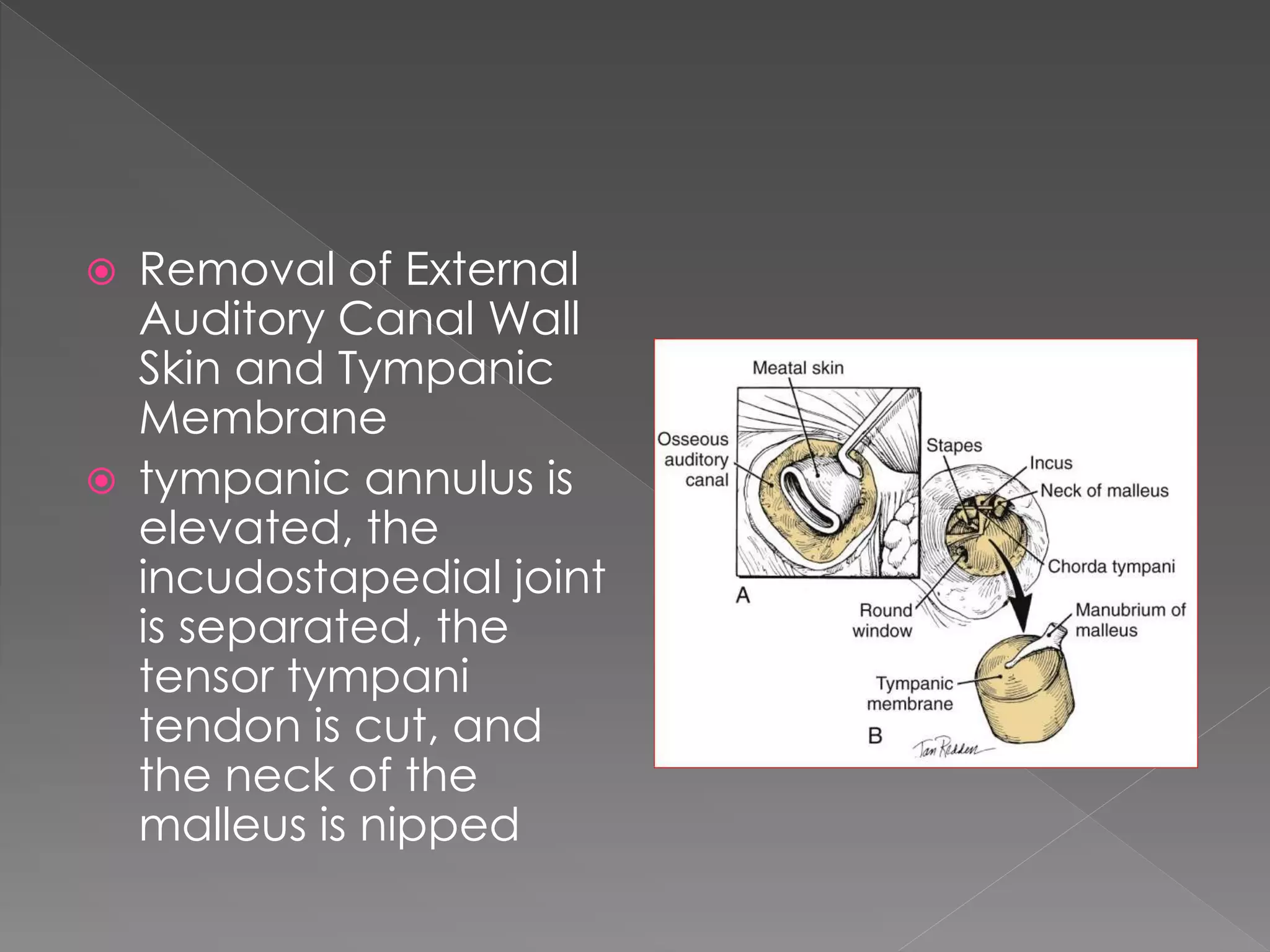
 Removal of External
Auditory Canal Wall
Skin and Tympanic
Membrane
 tympanic annulus is
elevated, the
incudostapedial joint
is separated, the
tensor tympani
tendon is cut, and
the neck of the
malleus is nipped
 Cervical Dissection
 Major structures,
including the
common, external,
and internal carotid
arteries, the internal
jugular vein, and
cranial nerves IX to XII,
are identified
 Division of the posterior
belly of the digastric
 Ligation of the
occipital artery and
ascending pharyngeal
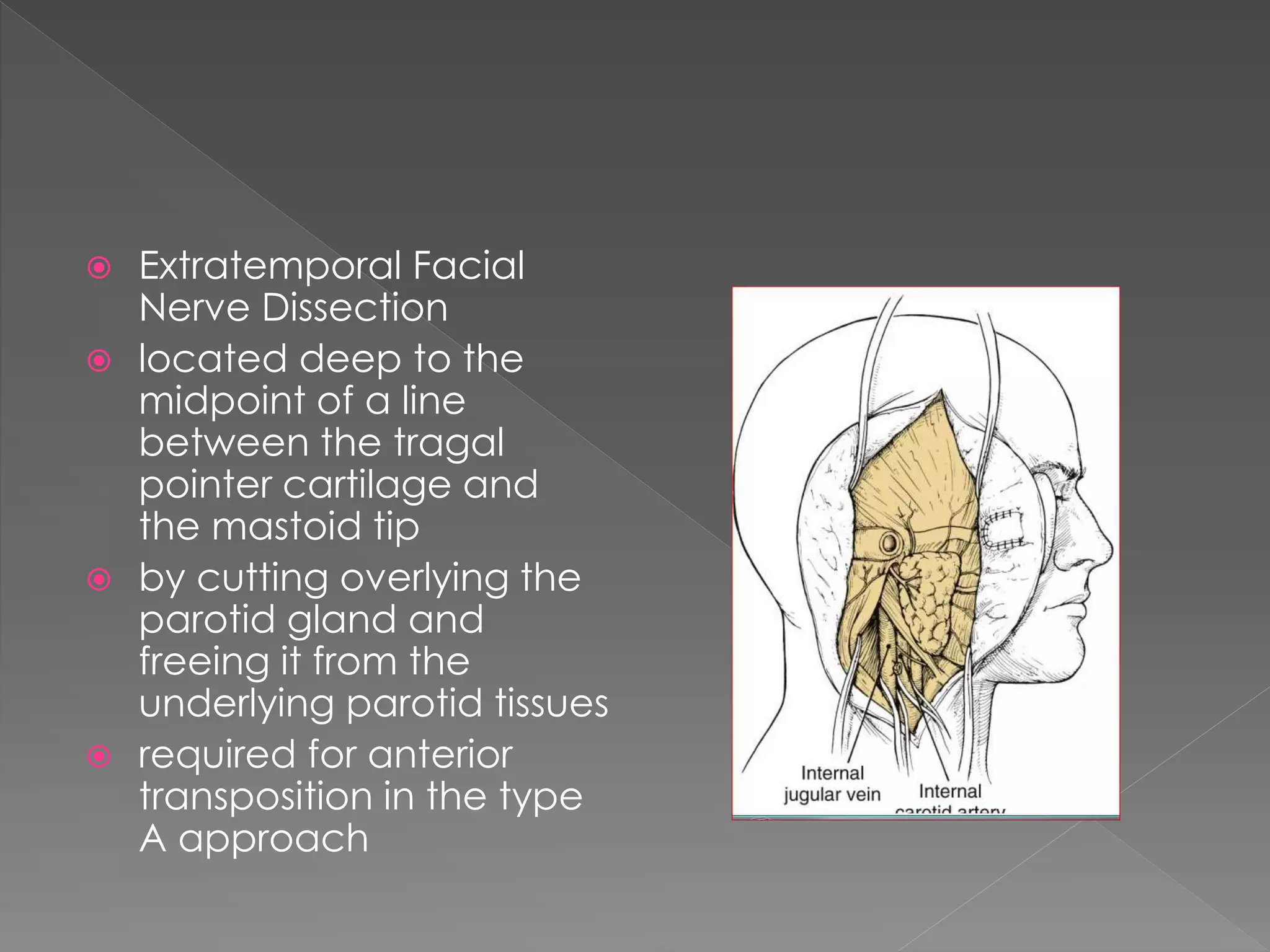
 Extratemporal Facial
Nerve Dissection
 located deep to the
midpoint of a line
between the tragal
pointer cartilage and
the mastoid tip
 by cutting overlying the
parotid gland and
freeing it from the
underlying parotid tissues
 required for anterior
transposition in the type
A approach
 Radical
Mastoidectomy
 removes the air cell
tracts lateral and
adjacent to the otic
capsule
 The stapes
suprastructure is
removed to prevent
inner ear trauma
 The eustachian tube is
obliterated with bone
wax
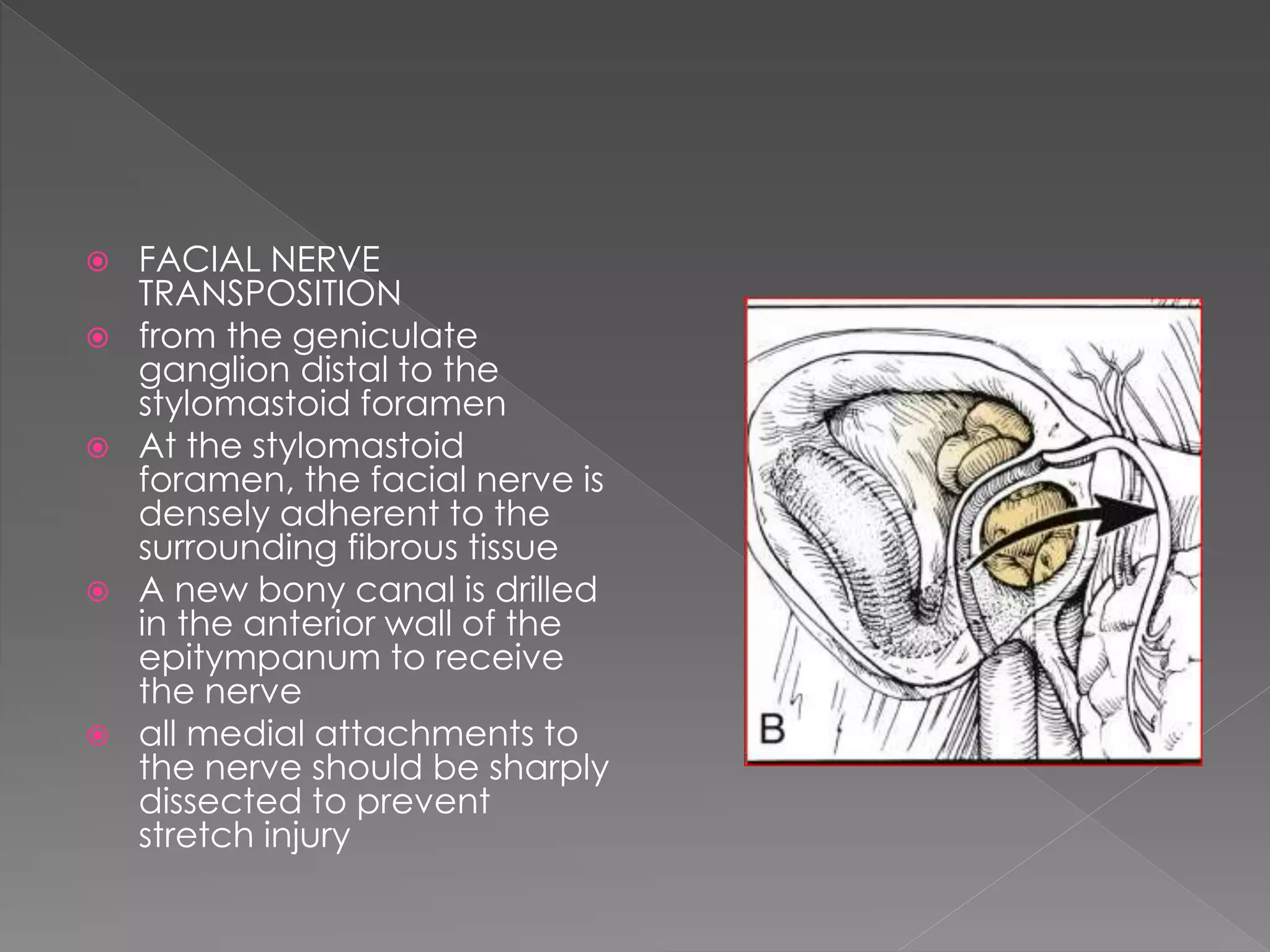
 FACIAL NERVE
TRANSPOSITION
 from the geniculate
ganglion distal to the
stylomastoid foramen
 At the stylomastoid
foramen, the facial nerve is
densely adherent to the
surrounding fibrous tissue
 A new bony canal is drilled
in the anterior wall of the
epitympanum to receive
the nerve
 all medial attachments to
the nerve should be sharply
dissected to prevent
stretch injury
 OCCLUSION OF THE
SIGMOID SINUS
 Bone is removed over
the posterior fossa
dura anterior and
posterior to the
sigmoid sinus to allow
ligation
 Dural vessels are
coagulated
 A small CSF leak may
occur and is easily
controlled with a
sutured muscle plug
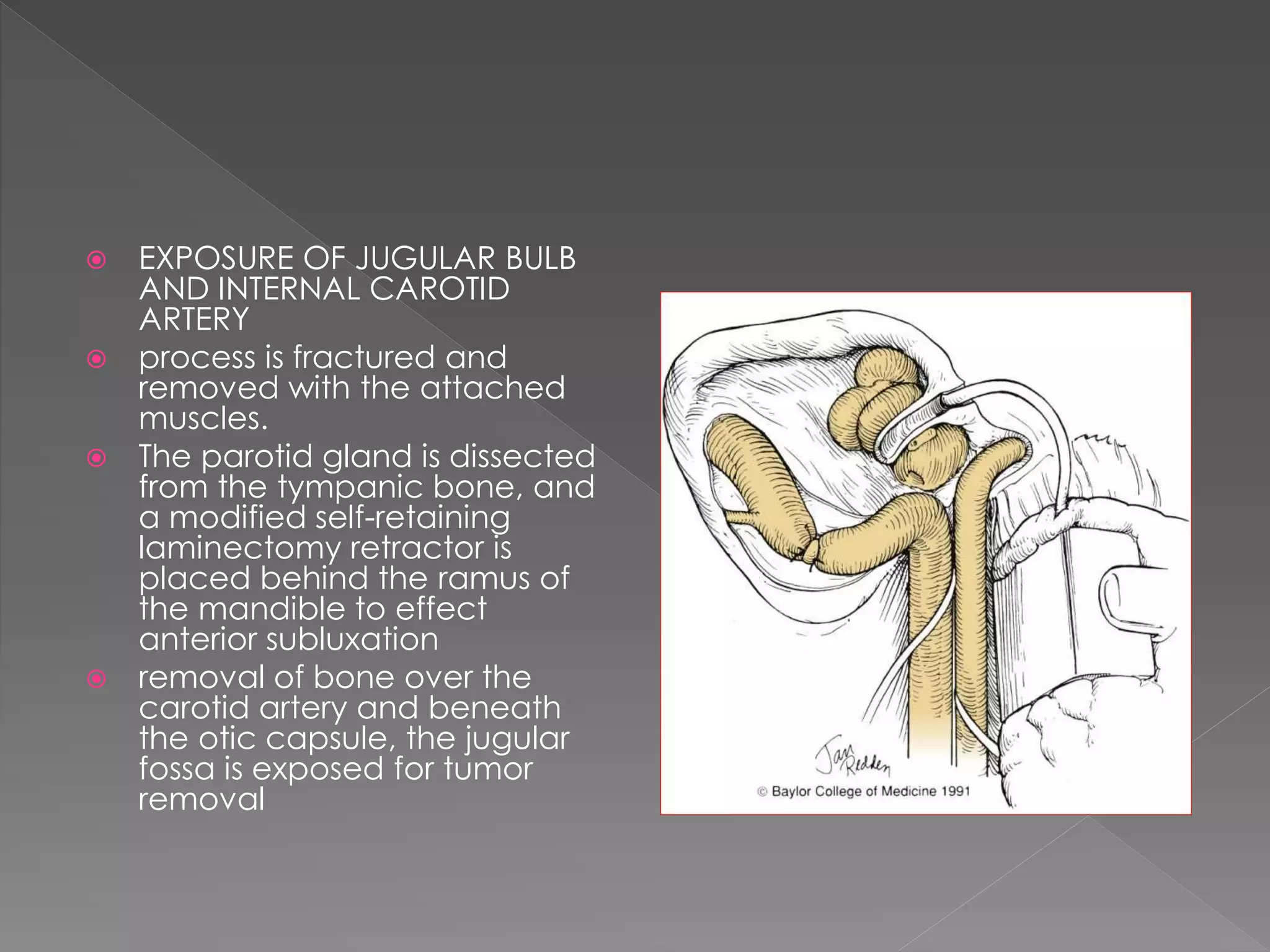
 EXPOSURE OF JUGULAR BULB
AND INTERNAL CAROTID
ARTERY
 process is fractured and
removed with the attached
muscles.
 The parotid gland is dissected
from the tympanic bone, and
a modified self-retaining
laminectomy retractor is
placed behind the ramus of
the mandible to effect
anterior subluxation
 removal of bone over the
carotid artery and beneath
the otic capsule, the jugular
fossa is exposed for tumor
removal
 TUMOR REMOVAL
 The jugular vein is ligated to
prevent tumor and air
embolism. Dissection begins
by freeing the internal carotid
artery and rotating the tumor
posteriorly
 The lateral wall of the sigmoid
sinus is removed along with
intraluminal tumor
 The inferior margin of the
tumor is elevated, and the
extracranial tumor is removed
 Profuse bleeding may occur
from the entrances of the
inferior petrosal sinus into the
jugular bulb.
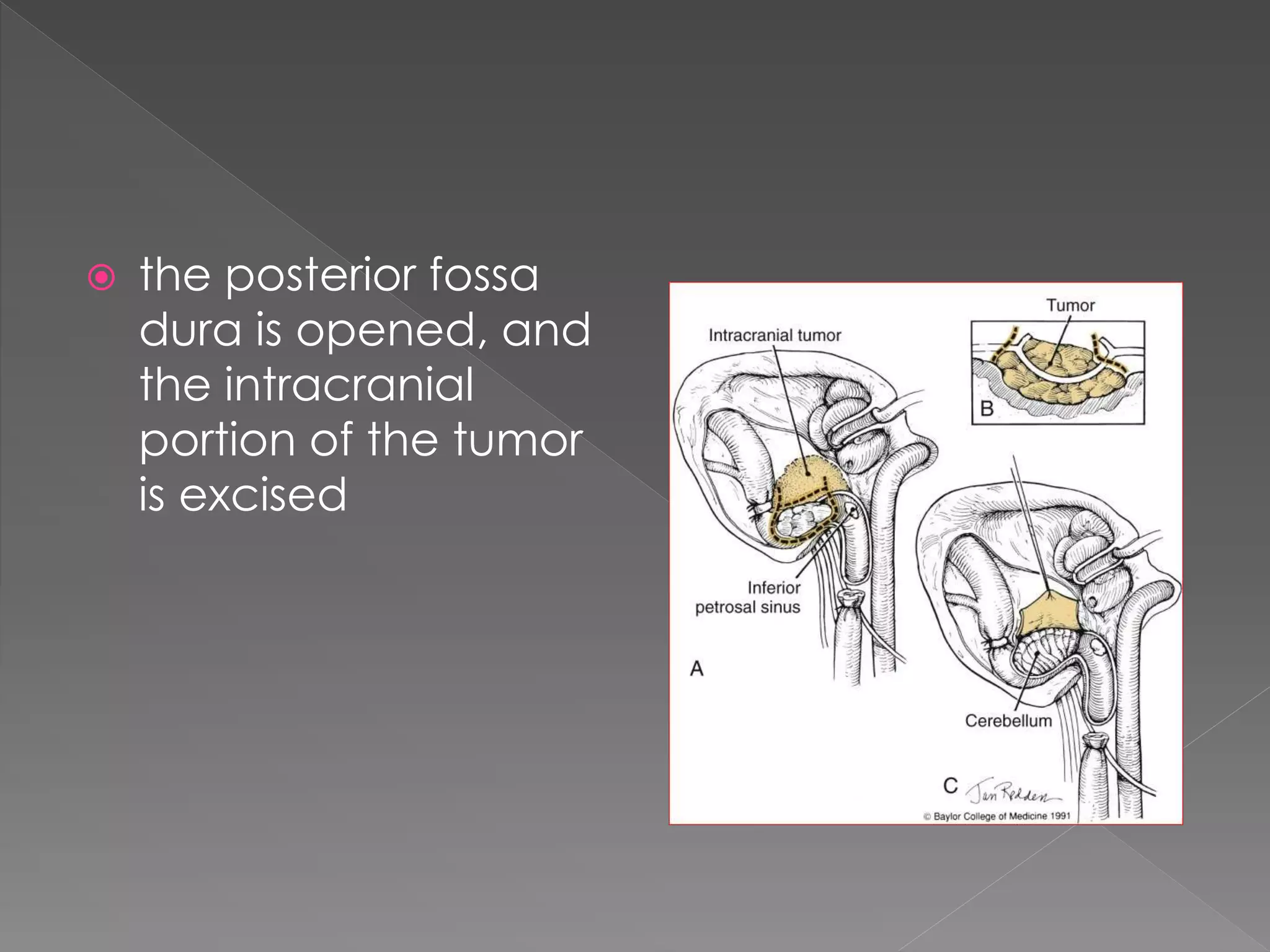
 the posterior fossa
dura is opened, and
the intracranial
portion of the tumor
is excised
 CLOSURE OF WOUND
 Fascia lata provides the best
material for reconstruction,
 lyophilized dura can be used
to seal the defect.
 Abdominal fat is used to
obliterate the dead space of
the temporal bone, and the
temporalis muscle is rotated
inferiorly for reinforcement of
the wound
 The skin is closed routinely,
and a bulky pressure dressing
is applied for a minimum of 5
days to prevent leakage of
CSF
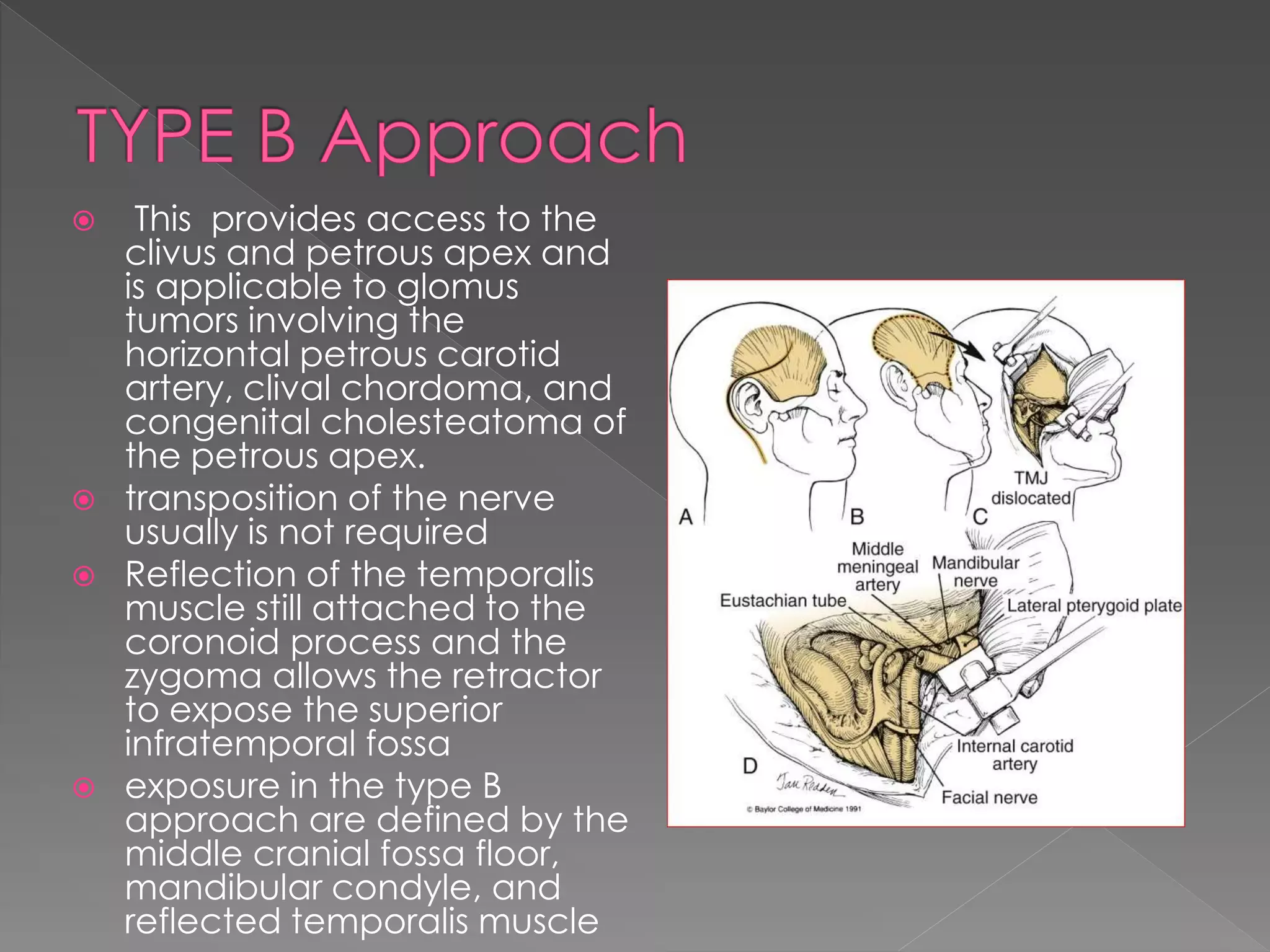
 This provides access to the
clivus and petrous apex and
is applicable to glomus
tumors involving the
horizontal petrous carotid
artery, clival chordoma, and
congenital cholesteatoma of
the petrous apex.
 transposition of the nerve
usually is not required
 Reflection of the temporalis
muscle still attached to the
coronoid process and the
zygoma allows the retractor
to expose the superior
infratemporal fossa
 exposure in the type B
approach are defined by the
middle cranial fossa floor,
mandibular condyle, and
reflected temporalis muscle
 The middle meningeal
artery and V3 branch of the
trigeminal nerve require
bipolar cauterization and
transection
 The carotid artery may be
uncovered from its vertical
segment to its anterior limit
at the foramen lacerum
after separation from the
soft tissues around the
eustachian tube
 Elevation of the carotid
artery permits additional
access to the petrous apex
and clivus.
 Transcochlear approach
to the petrous apex.
 A, Posterior translocation
of the facial nerve.
GSPN, greater superficial
petrosal nerve.
 B, Subtotal
petrosectomy with
removal of the otitic
capsule
 Tumors of the clivus, such
as chordomas, up to the
parasellar area may be
removed through the
type B approach
 Type C Approach
 posterolateral access to
the rostral clivus, cavernous
sinus, sphenoid sinus,
peritubal space,
pterygopalatine fossa, and
nasopharynx
 used primarily for extensive
juvenile nasopharyngeal
angiofibroma and
radiation failure squamous
cell carcinoma.
 The base of the pterygoid
process is removed to
approach the sphenoid
sinus and cavernous sinus
 approach to
nasopharyngeal
exposure.
 Removal of
pterygoid process
and lateral wall of
the nasopharynx
exposing the
opposite torus
tubarius.
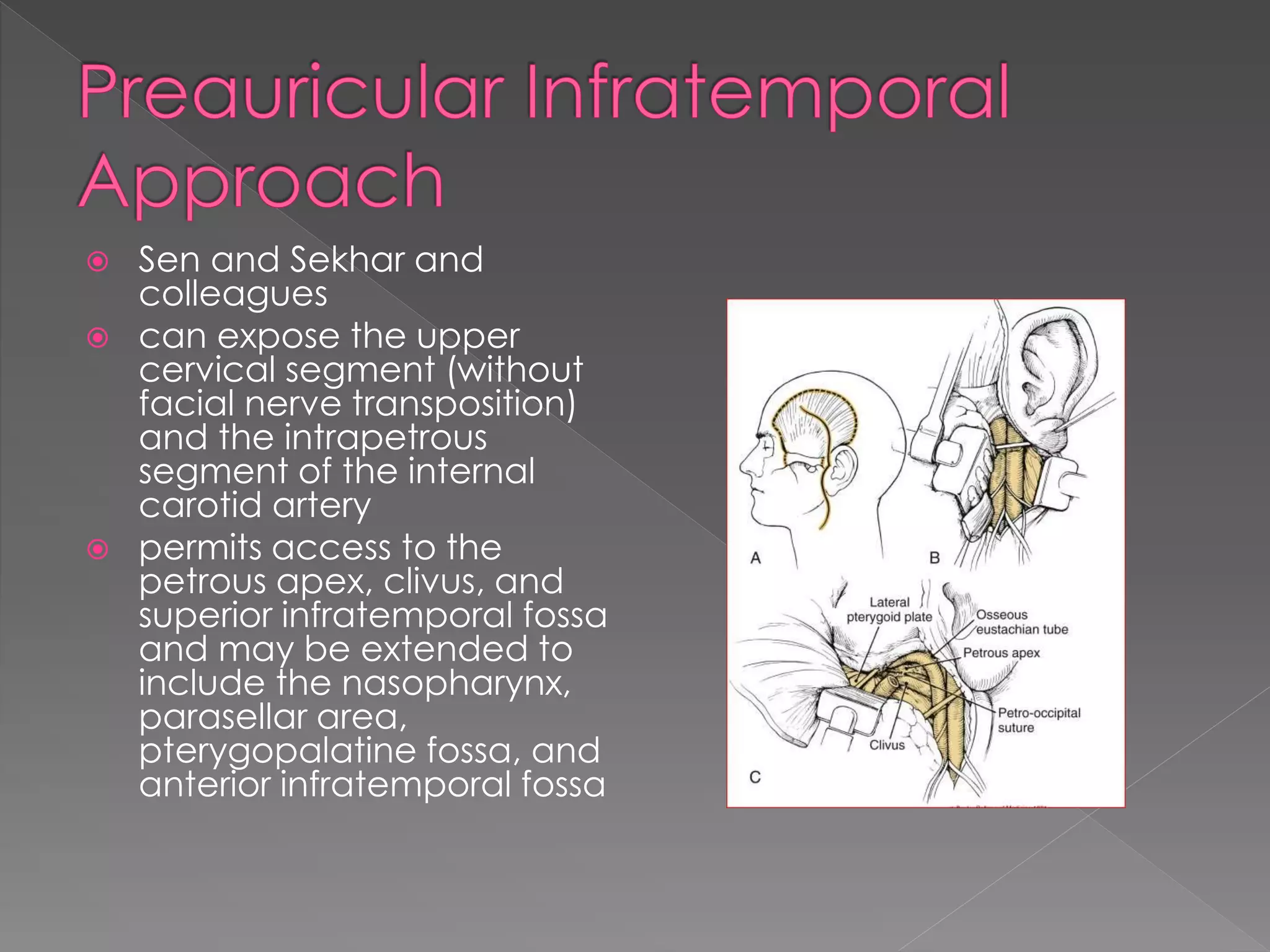
 Sen and Sekhar and
colleagues
 can expose the upper
cervical segment (without
facial nerve transposition)
and the intrapetrous
segment of the internal
carotid artery
 permits access to the
petrous apex, clivus, and
superior infratemporal fossa
and may be extended to
include the nasopharynx,
parasellar area,
pterygopalatine fossa, and
anterior infratemporal fossa
 Advantage of preauricular approach
preserving hearing
 Facial .n need not to b rerouting
 Disadvantage inability to access tumours
extending temporal bone and posterior fossa
 The Fisch C and D approaches both provide
excellent access to structures within the ITF, as
well as the basisphenoid, clivus, and entire
intratemporal course of the internal carotid
artery.
 adverse outcomes include dysfunction of the
facial nerve, conductive hearing loss, and
dental malocclusion.
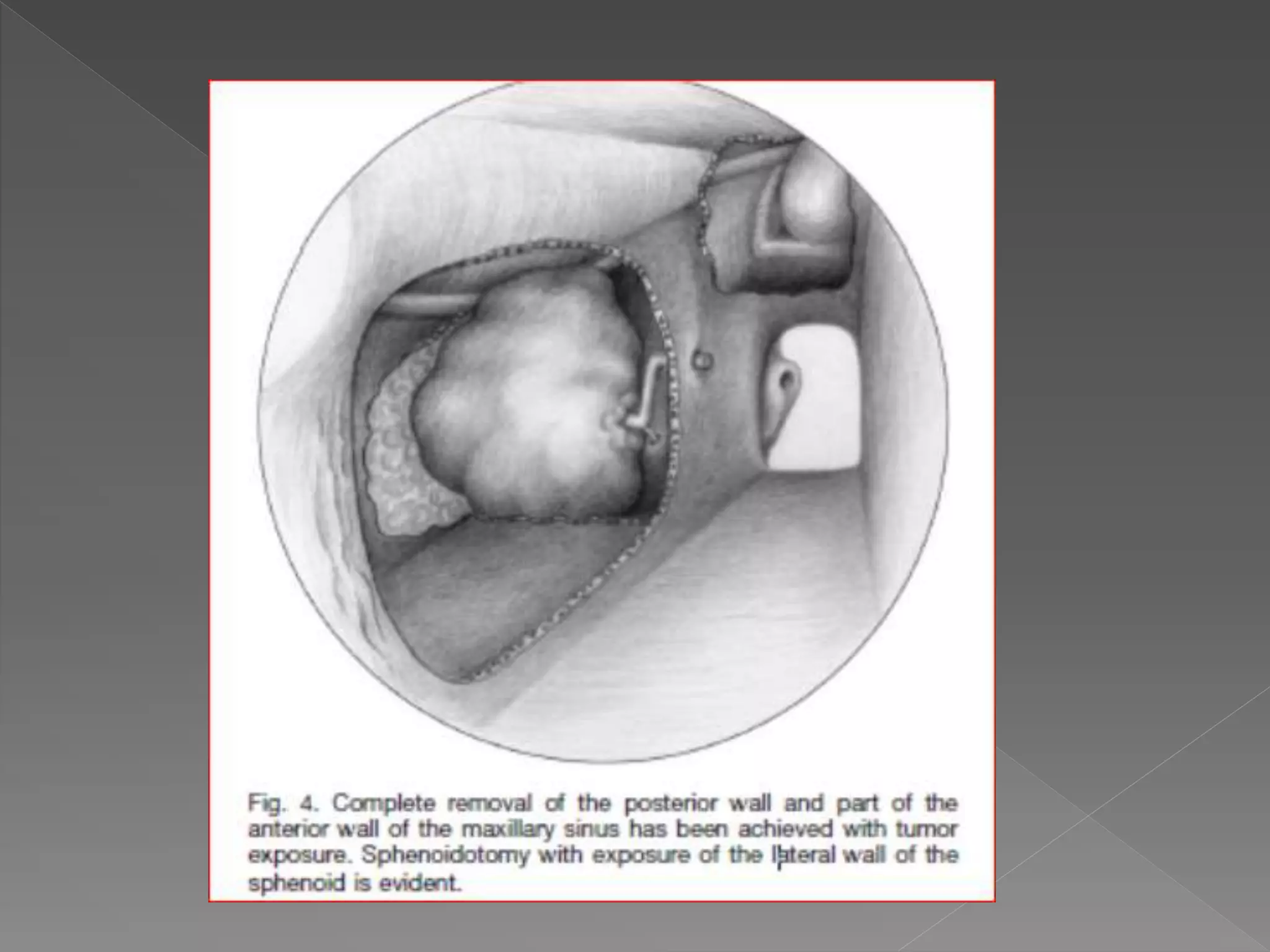
 large middle meatal
antrostomy and
complete
sphenoethmoidecto
my
 endoscopic medial
maxillectomy was
performed.
 The inferior turbinate
was crushed and cut
with a scissors
 A mucosal incision
was made from the
cut inferior turbinate
onto the floor of the
nasal cavity and was
extended posteriorly
to the back of the
inferior turbinate.
 the lower half of the
middle turbinate was
removed to achieve
full visualization of
the nasal
component of the
tumour
 This allows the second
surgeon to keep the
operating field clear of
blood, even if there is
profuse bleeding
present, or to place
traction on the tumor,
allowing the primary
surgeon to dissect
around the tumor,
freeing it from its
attachments in areas
such as the infraorbital
fissure and the lateral
extensions into the ITF
 Lack of formal control of the internal
carotid artery or internal jugular vein.
 this technique is not suitable for tumors
with invasion or encasement of these
structures.
 In addition, if there is tumor extension
through the dura into the middle cranial
fossa or laterally into the masseteric
space and inferiorly into the
parapharyngeal space,
 Several anterior approaches to the
infratemporal fossa
 Transoral, Transantral, Transpalatal,
Transmaxillary, Extended maxillotomy,
Maxillary swing, Transmandibular,
Transzygomatic , Facial translocation,
Transcranial, Combined
 These approaches allow good access to
the anteromedial ITF, nasopharynx ,
basisphenoid, and middle cranial fossa.
 may result in facial deformity, facial and
infraorbital nerve dysfunction, and lacrimal
dysfunction
 The superior gingivolabial sulcus posteriorly is close to
the tuberosity of the maxilla and provides access to
the lower part of the infratemporal fossa.
 An approach through this area does not provide
enough exposure for removal of tumours,
 the view is obstructed by fatty tissue and there is no
vascular control.
 However, the recess provides access for biopsy
purposes especially if the lesion is located low in the
infratemporal fossa.
 Occasionally a benign tumour may be removed
through this approach.
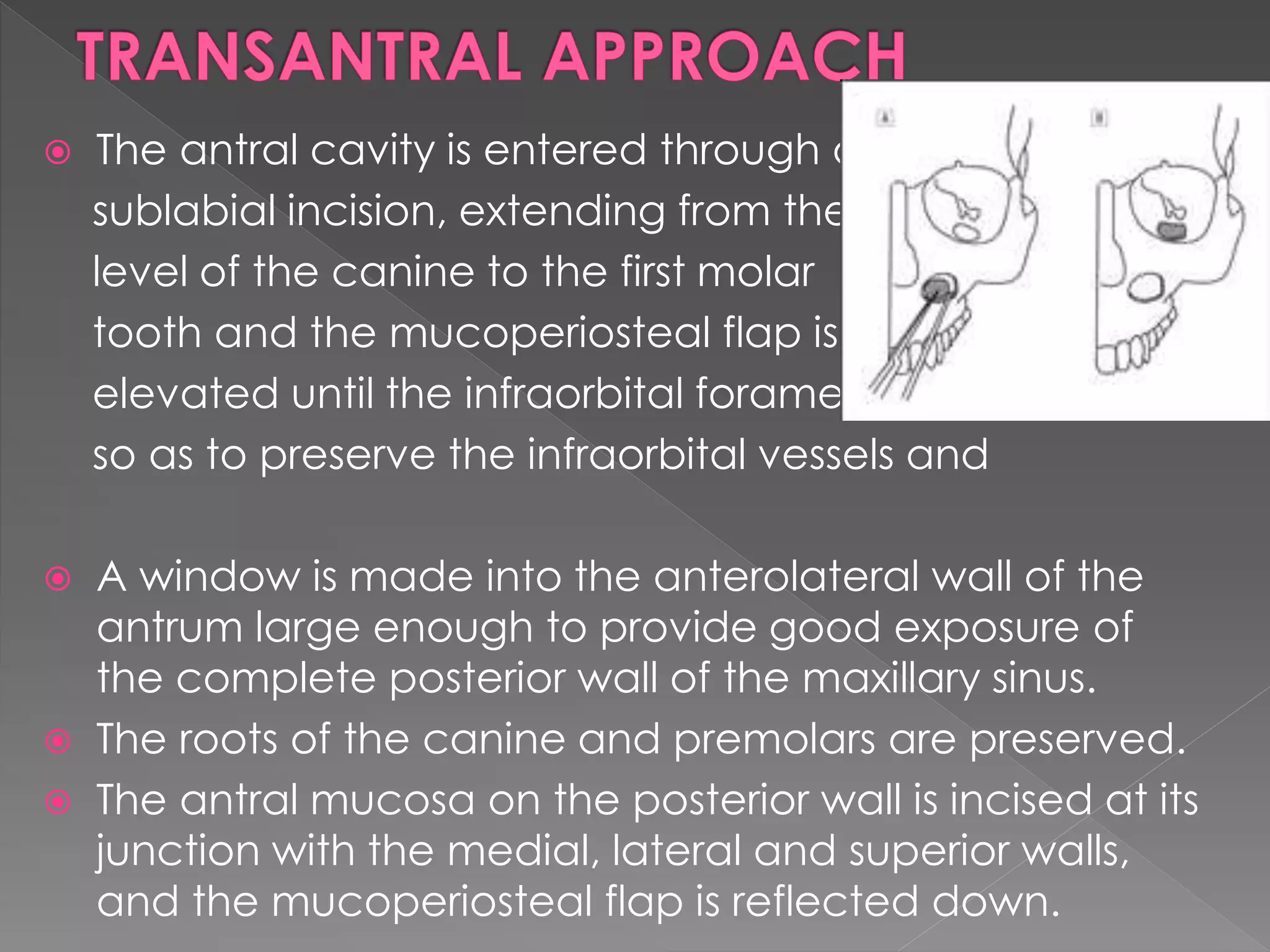
 The antral cavity is entered through a
sublabial incision, extending from the
level of the canine to the first molar
tooth and the mucoperiosteal flap is
elevated until the infraorbital foramen,
so as to preserve the infraorbital vessels and
 A window is made into the anterolateral wall of the
antrum large enough to provide good exposure of
the complete posterior wall of the maxillary sinus.
 The roots of the canine and premolars are preserved.
 The antral mucosa on the posterior wall is incised at its
junction with the medial, lateral and superior walls,
and the mucoperiosteal flap is reflected down.
 The periosteum on the outer surface of
the posterior wall is incised along its
medial, lateral and superior border and
reflected downwards.
 At the end of the procedure the bony
posterior wall and the mucoperiosteal
flap are replaced.
 This approach is not suitable for tumour
excision by itself, but may be combined
with other approaches. It is invariably
employed for the purpose of obtaining a
biopsy.
 The authors Kornfehl et al. have basically described a
transpharyngeal approach via the palate.
 The nasopharynx is reached via an ‘S'-shaped incision
running vertically on the soft palate and on to the anterior
pharyngeal arch towards the side of the lesion.
 The mucosa of the lateral wall of the nasopharynx is
incised vertically, the superior constrictor muscle of the
pharynx is split to enter the most medial part of the
infratemporal fossa.
 Kornfehl et al. employed this approach to extirpate a
cavernous haemangioma close to the lateral pterygoid
muscle which had been shown not to have any feeding
vessels.
 This is not a safe approach for tumour excision.
 The internal carotid artery is close to the pharyngeal wall
and it is not possible to obtain any control on the vessel.
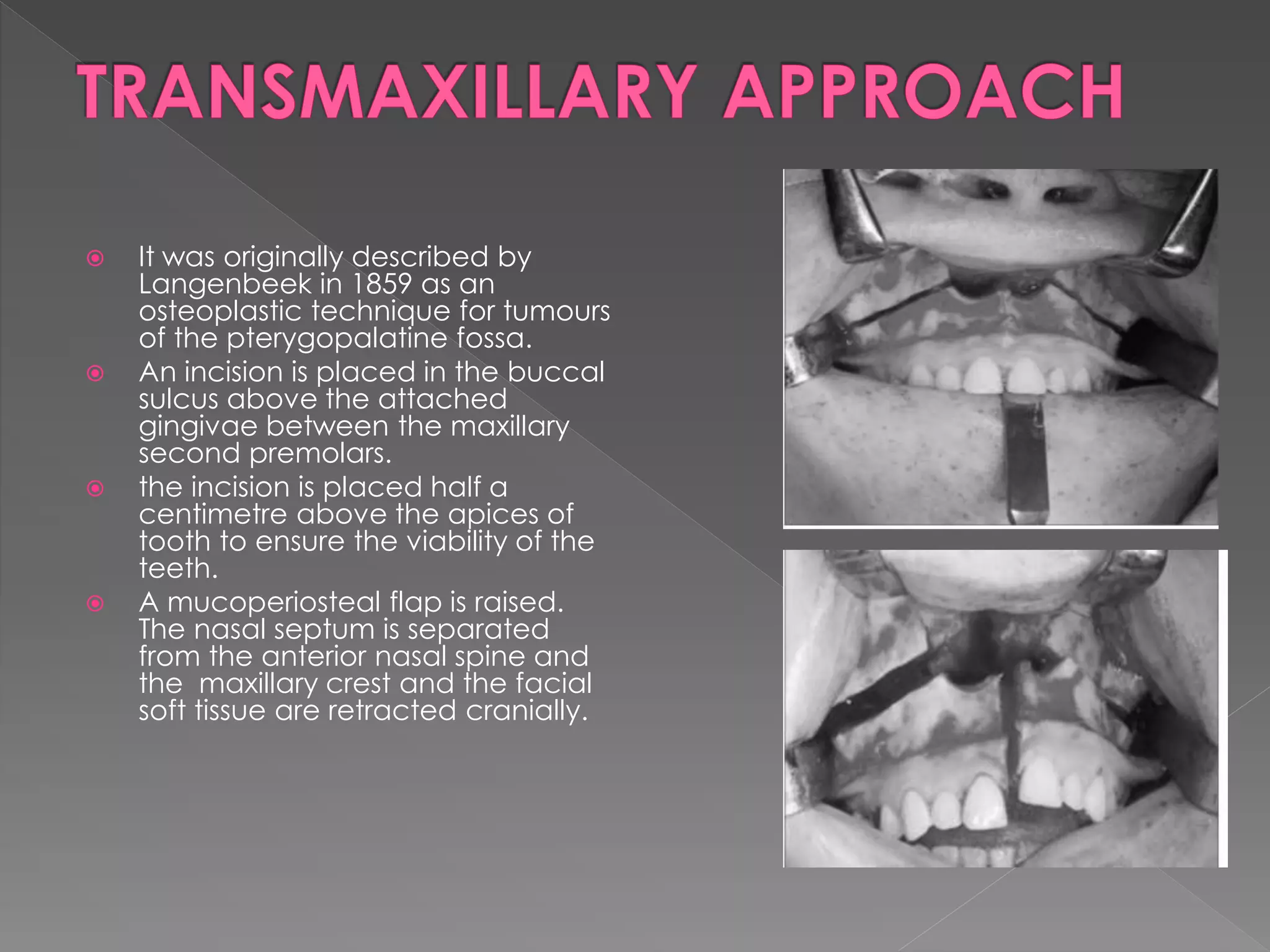
 It was originally described by
Langenbeek in 1859 as an
osteoplastic technique for tumours
of the pterygopalatine fossa.
 An incision is placed in the buccal
sulcus above the attached
gingivae between the maxillary
second premolars.
 the incision is placed half a
centimetre above the apices of
tooth to ensure the viability of the
teeth.
 A mucoperiosteal flap is raised.
The nasal septum is separated
from the anterior nasal spine and
the maxillary crest and the facial
soft tissue are retracted cranially.
 An osteotomy incision is placed, using an
electric burr from one maxillary tuberosity to the
other.
 The incision passes just under the zygomatic
buttress and divides the anterior nasal aperture.
 An osteotomy of the medial wall of the maxilla is
performed through the inferior meatus to the
palatine canal. At this stage the palate and the
inferior portion of the maxilla remain attached
by the pterygomaxillary suture, the thin posterior
wall of the maxillary sinus and the bone forming
the canal of the palatine vessels.
 Using a curved osteotome the maxilla is
separated and disimpacted downwards.
 The buttress of bone anterolaterally and at the
piriform nasal aperture are preserved so that
they can be approximated at closure.
 This is essentially a transantral
approach with an extended
sublabial incision taken from the
midline to the maxillary tuberosity
and carried down to the
periosteum.
 The posterior wall of the maxillary
sinus is widely excised allowing
access to the pterygomaxillary
portion of the tumour.
 The medial wall of the maxillary
sinus and the nasopharynx is
removed. Lateral extension of the
tumour can be exposed by
removing the lateral wall of the
antrum.
 It can also be combined with a
transpalatal approach. It was
described by Krause and Baker
who used it mainly for surgical
treatment of nasopharyngeal
angiofibroma.
 The concept of approaching the retromaxillary area
through a mandibulotomy is not new and has been
advocated by Conley and Barbosa. The infratemporal
fossa communicates inferiorly with the neck.
 If the mandible is laterally retracted and the medial
pterygoid muscle is detached from its mandibular
attachment the infratemporal space can be reached.
 This approach provides good control of the vessels and
nerves and en bloc resection of nasopharynx, posterior
maxilla, infratemporal fossa structures, mandibular ramus
and parotid gland can be performed.
 The procedure has been modified by Attia et al. to
obtain wide field exposure without sacrifice of either
mandibular function or the sensory supply of the face
and oral cavity.
 The mandibular osteotomies are
arranged to spare the inferior alveolar
nerve and vessels and are positioned
under the intercondylar notch above
the opening of the mandibular canal
and just medial to the mental
foramen.
 Detachment of the medial and
lateral pterygoid muscles and the
sphenomandibular ligament allows
the mandibular segment to be
reflected superiorly .
 This provides direct access to the
infratemporal fossa; osteosynthesis of
the mandible and intermaxillary
fixation is performed. The procedure
preserves function, exposure is good
and is cosmetically acceptable.
 Incision – Weber Ferguson incision
without gingivolabial component
 Bilateral tarsorraphy should be
performed
 Inverted “U” shaped incision is
marked out on the hard palate
 After deepening the facial incision
the lacrimal sac should be
skeletonized and sectioned at its
lower end.
 Infra orbital nerve should be
sectioned as it comes out of
infraorbital foramen.
 Periosteum of the inferior orbital wall
should be elevated.
 Osteotomies should be performed on
the frontal process of maxilla and at
the maxillo zygomatic suture.
 The maxillo ethmoidal junction should
be separated using a straight
osteotome.
 The mucoperiosteum over the hard
palate should be elevated based on
the contralateral greater palatine
vessels. The ipsilateral greater palatine
vessels were cauterized and sectioned.
 A straight osteotome should be placed
between the arms of a v shaped notch
located on the anterior nasal spine and
hammered in order to separate the
maxilla down the middle.
 Now the whole maxilla with its
attached cheek tissue can be swung
like a door laterally exposing the whole
of nasopharynx.
 Mass in the naso pharynx can now be
removed under direct vision.
 Maxilla can be repositioned after
surgery and secured in position by using
miniplate and screws.
 Radical excision of tumours and the
relatively limited access obtained by any
single approach have made combined
approaches necessary.
 It offers the patients the maximum
benefit of the technical ‘know-how’ of
the surgical team and the best
opportunity for surgical excision.
Infratemporal fossa approaches

Infratemporal fossa approaches

  • 2.
     Tumors arisingfrom or extending into the ITF from neighboring regions provide a challenge as to how best to approach the area  Tumors within the ITF are rare, making up less than 1% of head and neck tumors  The ITF approaches are categorized as anterior (transfacial, transmaxillary, transoral, and transpalatal),  lateral (transzygomatic and lateral infratemporal), or  inferior (transmandibular and transcervical)
  • 3.
     The pioneersof the ITF were Conley and Barbosa  Barbosa indicated the ITF approach for advanced tumors into the maxillary sinus. 1960  n 1969, Terez et al used a craniofacial approach for tumors invading the pterygoid fossa but residual tumor could not be avoided.  In 1976, House and Hitselberger described a transcochlear approach for tumors that originated medially to the internal auditory canal or from the clivus.  In 1977, Fisch and coworkers reported the posterolateral ITF approach
  • 4.
     The postauricular infratemporalfossa approaches as described by Fisch  He has divided these techniques into three basic approaches  Type A  Type B  Type C
  • 5.
     indicated formeningiomas, cholesteatoma involving the internal carotid artery and petrous apex, for intratemporal neuromas of cranial nerves IX-XII and for lesions reaching the skull base from below (Carotid artery aneurysms, glomus vagale tumors etc).  Incisions and Skin Flaps  Anteriorly based periosteal flap elevation.  the tertiary branches of the facial nerve are identified and protected with periosteal flap.
  • 6.
     Closure ofthe External Auditory Canal  The cartilaginous canal skin is everted and sutured with absorbable sutures and reinforced medially with the periosteal flap elevated off the mastoid cortex
  • 7.
     Removal ofExternal Auditory Canal Wall Skin and Tympanic Membrane  tympanic annulus is elevated, the incudostapedial joint is separated, the tensor tympani tendon is cut, and the neck of the malleus is nipped
  • 8.
     Cervical Dissection Major structures, including the common, external, and internal carotid arteries, the internal jugular vein, and cranial nerves IX to XII, are identified  Division of the posterior belly of the digastric  Ligation of the occipital artery and ascending pharyngeal
  • 9.
     Extratemporal Facial NerveDissection  located deep to the midpoint of a line between the tragal pointer cartilage and the mastoid tip  by cutting overlying the parotid gland and freeing it from the underlying parotid tissues  required for anterior transposition in the type A approach
  • 10.
     Radical Mastoidectomy  removesthe air cell tracts lateral and adjacent to the otic capsule  The stapes suprastructure is removed to prevent inner ear trauma  The eustachian tube is obliterated with bone wax
  • 11.
     FACIAL NERVE TRANSPOSITION from the geniculate ganglion distal to the stylomastoid foramen  At the stylomastoid foramen, the facial nerve is densely adherent to the surrounding fibrous tissue  A new bony canal is drilled in the anterior wall of the epitympanum to receive the nerve  all medial attachments to the nerve should be sharply dissected to prevent stretch injury
  • 12.
     OCCLUSION OFTHE SIGMOID SINUS  Bone is removed over the posterior fossa dura anterior and posterior to the sigmoid sinus to allow ligation  Dural vessels are coagulated  A small CSF leak may occur and is easily controlled with a sutured muscle plug
  • 13.
     EXPOSURE OFJUGULAR BULB AND INTERNAL CAROTID ARTERY  process is fractured and removed with the attached muscles.  The parotid gland is dissected from the tympanic bone, and a modified self-retaining laminectomy retractor is placed behind the ramus of the mandible to effect anterior subluxation  removal of bone over the carotid artery and beneath the otic capsule, the jugular fossa is exposed for tumor removal
  • 14.
     TUMOR REMOVAL The jugular vein is ligated to prevent tumor and air embolism. Dissection begins by freeing the internal carotid artery and rotating the tumor posteriorly  The lateral wall of the sigmoid sinus is removed along with intraluminal tumor  The inferior margin of the tumor is elevated, and the extracranial tumor is removed  Profuse bleeding may occur from the entrances of the inferior petrosal sinus into the jugular bulb.
  • 15.
     the posteriorfossa dura is opened, and the intracranial portion of the tumor is excised
  • 16.
     CLOSURE OFWOUND  Fascia lata provides the best material for reconstruction,  lyophilized dura can be used to seal the defect.  Abdominal fat is used to obliterate the dead space of the temporal bone, and the temporalis muscle is rotated inferiorly for reinforcement of the wound  The skin is closed routinely, and a bulky pressure dressing is applied for a minimum of 5 days to prevent leakage of CSF
  • 17.
     This providesaccess to the clivus and petrous apex and is applicable to glomus tumors involving the horizontal petrous carotid artery, clival chordoma, and congenital cholesteatoma of the petrous apex.  transposition of the nerve usually is not required  Reflection of the temporalis muscle still attached to the coronoid process and the zygoma allows the retractor to expose the superior infratemporal fossa  exposure in the type B approach are defined by the middle cranial fossa floor, mandibular condyle, and reflected temporalis muscle
  • 18.
     The middlemeningeal artery and V3 branch of the trigeminal nerve require bipolar cauterization and transection  The carotid artery may be uncovered from its vertical segment to its anterior limit at the foramen lacerum after separation from the soft tissues around the eustachian tube  Elevation of the carotid artery permits additional access to the petrous apex and clivus.
  • 19.
     Transcochlear approach tothe petrous apex.  A, Posterior translocation of the facial nerve. GSPN, greater superficial petrosal nerve.  B, Subtotal petrosectomy with removal of the otitic capsule  Tumors of the clivus, such as chordomas, up to the parasellar area may be removed through the type B approach
  • 20.
     Type CApproach  posterolateral access to the rostral clivus, cavernous sinus, sphenoid sinus, peritubal space, pterygopalatine fossa, and nasopharynx  used primarily for extensive juvenile nasopharyngeal angiofibroma and radiation failure squamous cell carcinoma.  The base of the pterygoid process is removed to approach the sphenoid sinus and cavernous sinus
  • 21.
     approach to nasopharyngeal exposure. Removal of pterygoid process and lateral wall of the nasopharynx exposing the opposite torus tubarius.
  • 22.
     Sen andSekhar and colleagues  can expose the upper cervical segment (without facial nerve transposition) and the intrapetrous segment of the internal carotid artery  permits access to the petrous apex, clivus, and superior infratemporal fossa and may be extended to include the nasopharynx, parasellar area, pterygopalatine fossa, and anterior infratemporal fossa
  • 23.
     Advantage ofpreauricular approach preserving hearing  Facial .n need not to b rerouting  Disadvantage inability to access tumours extending temporal bone and posterior fossa  The Fisch C and D approaches both provide excellent access to structures within the ITF, as well as the basisphenoid, clivus, and entire intratemporal course of the internal carotid artery.  adverse outcomes include dysfunction of the facial nerve, conductive hearing loss, and dental malocclusion.
  • 25.
     large middlemeatal antrostomy and complete sphenoethmoidecto my  endoscopic medial maxillectomy was performed.  The inferior turbinate was crushed and cut with a scissors
  • 26.
     A mucosalincision was made from the cut inferior turbinate onto the floor of the nasal cavity and was extended posteriorly to the back of the inferior turbinate.
  • 27.
     the lowerhalf of the middle turbinate was removed to achieve full visualization of the nasal component of the tumour
  • 29.
     This allowsthe second surgeon to keep the operating field clear of blood, even if there is profuse bleeding present, or to place traction on the tumor, allowing the primary surgeon to dissect around the tumor, freeing it from its attachments in areas such as the infraorbital fissure and the lateral extensions into the ITF
  • 31.
     Lack offormal control of the internal carotid artery or internal jugular vein.  this technique is not suitable for tumors with invasion or encasement of these structures.  In addition, if there is tumor extension through the dura into the middle cranial fossa or laterally into the masseteric space and inferiorly into the parapharyngeal space,
  • 32.
     Several anteriorapproaches to the infratemporal fossa  Transoral, Transantral, Transpalatal, Transmaxillary, Extended maxillotomy, Maxillary swing, Transmandibular, Transzygomatic , Facial translocation, Transcranial, Combined  These approaches allow good access to the anteromedial ITF, nasopharynx , basisphenoid, and middle cranial fossa.  may result in facial deformity, facial and infraorbital nerve dysfunction, and lacrimal dysfunction
  • 33.
     The superiorgingivolabial sulcus posteriorly is close to the tuberosity of the maxilla and provides access to the lower part of the infratemporal fossa.  An approach through this area does not provide enough exposure for removal of tumours,  the view is obstructed by fatty tissue and there is no vascular control.  However, the recess provides access for biopsy purposes especially if the lesion is located low in the infratemporal fossa.  Occasionally a benign tumour may be removed through this approach.
  • 34.
     The antralcavity is entered through a sublabial incision, extending from the level of the canine to the first molar tooth and the mucoperiosteal flap is elevated until the infraorbital foramen, so as to preserve the infraorbital vessels and  A window is made into the anterolateral wall of the antrum large enough to provide good exposure of the complete posterior wall of the maxillary sinus.  The roots of the canine and premolars are preserved.  The antral mucosa on the posterior wall is incised at its junction with the medial, lateral and superior walls, and the mucoperiosteal flap is reflected down.
  • 35.
     The periosteumon the outer surface of the posterior wall is incised along its medial, lateral and superior border and reflected downwards.  At the end of the procedure the bony posterior wall and the mucoperiosteal flap are replaced.  This approach is not suitable for tumour excision by itself, but may be combined with other approaches. It is invariably employed for the purpose of obtaining a biopsy.
  • 36.
     The authorsKornfehl et al. have basically described a transpharyngeal approach via the palate.  The nasopharynx is reached via an ‘S'-shaped incision running vertically on the soft palate and on to the anterior pharyngeal arch towards the side of the lesion.  The mucosa of the lateral wall of the nasopharynx is incised vertically, the superior constrictor muscle of the pharynx is split to enter the most medial part of the infratemporal fossa.  Kornfehl et al. employed this approach to extirpate a cavernous haemangioma close to the lateral pterygoid muscle which had been shown not to have any feeding vessels.  This is not a safe approach for tumour excision.  The internal carotid artery is close to the pharyngeal wall and it is not possible to obtain any control on the vessel.
  • 37.
     It wasoriginally described by Langenbeek in 1859 as an osteoplastic technique for tumours of the pterygopalatine fossa.  An incision is placed in the buccal sulcus above the attached gingivae between the maxillary second premolars.  the incision is placed half a centimetre above the apices of tooth to ensure the viability of the teeth.  A mucoperiosteal flap is raised. The nasal septum is separated from the anterior nasal spine and the maxillary crest and the facial soft tissue are retracted cranially.
  • 38.
     An osteotomyincision is placed, using an electric burr from one maxillary tuberosity to the other.  The incision passes just under the zygomatic buttress and divides the anterior nasal aperture.  An osteotomy of the medial wall of the maxilla is performed through the inferior meatus to the palatine canal. At this stage the palate and the inferior portion of the maxilla remain attached by the pterygomaxillary suture, the thin posterior wall of the maxillary sinus and the bone forming the canal of the palatine vessels.  Using a curved osteotome the maxilla is separated and disimpacted downwards.  The buttress of bone anterolaterally and at the piriform nasal aperture are preserved so that they can be approximated at closure.
  • 39.
     This isessentially a transantral approach with an extended sublabial incision taken from the midline to the maxillary tuberosity and carried down to the periosteum.  The posterior wall of the maxillary sinus is widely excised allowing access to the pterygomaxillary portion of the tumour.  The medial wall of the maxillary sinus and the nasopharynx is removed. Lateral extension of the tumour can be exposed by removing the lateral wall of the antrum.  It can also be combined with a transpalatal approach. It was described by Krause and Baker who used it mainly for surgical treatment of nasopharyngeal angiofibroma.
  • 40.
     The conceptof approaching the retromaxillary area through a mandibulotomy is not new and has been advocated by Conley and Barbosa. The infratemporal fossa communicates inferiorly with the neck.  If the mandible is laterally retracted and the medial pterygoid muscle is detached from its mandibular attachment the infratemporal space can be reached.  This approach provides good control of the vessels and nerves and en bloc resection of nasopharynx, posterior maxilla, infratemporal fossa structures, mandibular ramus and parotid gland can be performed.  The procedure has been modified by Attia et al. to obtain wide field exposure without sacrifice of either mandibular function or the sensory supply of the face and oral cavity.
  • 41.
     The mandibularosteotomies are arranged to spare the inferior alveolar nerve and vessels and are positioned under the intercondylar notch above the opening of the mandibular canal and just medial to the mental foramen.  Detachment of the medial and lateral pterygoid muscles and the sphenomandibular ligament allows the mandibular segment to be reflected superiorly .  This provides direct access to the infratemporal fossa; osteosynthesis of the mandible and intermaxillary fixation is performed. The procedure preserves function, exposure is good and is cosmetically acceptable.
  • 42.
     Incision –Weber Ferguson incision without gingivolabial component  Bilateral tarsorraphy should be performed  Inverted “U” shaped incision is marked out on the hard palate  After deepening the facial incision the lacrimal sac should be skeletonized and sectioned at its lower end.  Infra orbital nerve should be sectioned as it comes out of infraorbital foramen.  Periosteum of the inferior orbital wall should be elevated.  Osteotomies should be performed on the frontal process of maxilla and at the maxillo zygomatic suture.  The maxillo ethmoidal junction should be separated using a straight osteotome.
  • 43.
     The mucoperiosteumover the hard palate should be elevated based on the contralateral greater palatine vessels. The ipsilateral greater palatine vessels were cauterized and sectioned.  A straight osteotome should be placed between the arms of a v shaped notch located on the anterior nasal spine and hammered in order to separate the maxilla down the middle.  Now the whole maxilla with its attached cheek tissue can be swung like a door laterally exposing the whole of nasopharynx.  Mass in the naso pharynx can now be removed under direct vision.  Maxilla can be repositioned after surgery and secured in position by using miniplate and screws.
  • 44.
     Radical excisionof tumours and the relatively limited access obtained by any single approach have made combined approaches necessary.  It offers the patients the maximum benefit of the technical ‘know-how’ of the surgical team and the best opportunity for surgical excision.

Editor's Notes

  • #5 Type A has anterior transposition of nerve VI1 as its distinguishing feature, without zygomatic displacement Type B has the facial nerve left in situ and the zygoma reflected inferiorly, with the frontal branch of the nerve protected by the temporalis muscle and the bone of the middle fossa removed for exposure of the infratemporal fossa. The mandibular branch of cranial nerve V and the middle meningeal artery are sacrified. Type C is the logical anterior extension of this, with skeletonisation of the maxillary branch of the trigeminal nerve and resection of the pterygoid plates for exposure of the nasopharynx. Type D differs from the other three approaches in that the skin incision is preauricular and can only provide anterior exposure. In it the zygoma is retracted, with the lateral orbital rim and the carotid found and followed as before.
  • #6 Cartilaginous skin elevated uto conchal bowl and suturd with fla elevated poateriorly frm mastoid cortex as water tightsac
  • #9 The greater auricular nerve should be sectioned as distally as possible in the parotid for potential use as an interposition graft if needed Transection of the glossopharyngeal nerve often is necessary to follow the carotid artery into the skull bas
  • #20 the middle fossa may easily be accessed through a temporal craniotomy Exposure of the clivus can be obtained by sharp incision of the fibrous attachments at the petro-occipital fissure. . Removal of the mandibular condyle may give better exposure to the inferior clivus and upper cervical vertebrae
  • #22 uncovers V2 in the foramen rotundum and the inferior orbital fissure The cavernous sinus is exposed by thinning the bone of the middle cranial fossa floor anterior to the V2 stump.
  • #43 The incision line is drawn through the vermillion border, along the filtrum of the lip, extending around the base of the nose (or entering the nostril floor for a better esthetic result) and along the facial nasal groove (In the border of both esthetic units). It then extends infraorbitally 3-4 mm below the cilium to the lateral canthus.