Complications of Stapes
surgery
Dr Safika Zaman
Dept of ENT and HNS
RKMSP,VIMS
Introduction
 Otosclerosis is a disease of altered bone
metabolism, unique to human temporal bone.
 Prevalence of otosclerosis varies amongst races,
more common in Caucasians
 More common in women.
 The operative procedure was divided into
stapedectomy (total footplate removal and
opening all the oval window) and stapedotomy
(small-hole creation on the footplate).
Government
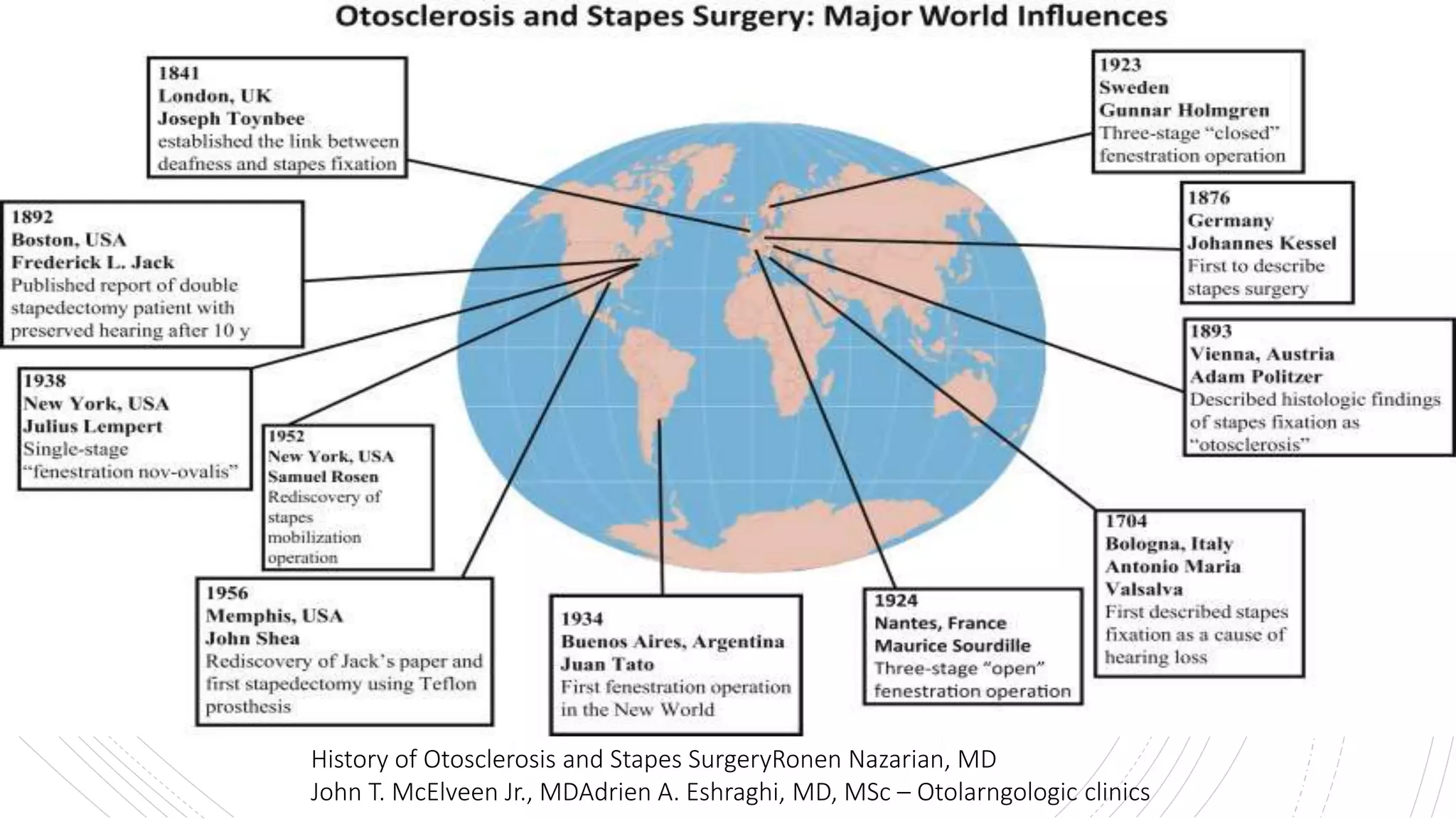
History of Otosclerosis and Stapes SurgeryRonen Nazarian, MD
John T. McElveen Jr., MDAdrien A. Eshraghi, MD, MSc – Otolarngologic clinics
Otosclerosis
 Primarily a disease of the bone that encases the
cochlea and labyrinth.
 Characterized by progressive focal dysplasia
with destruction, remodelling, and finally
sclerosis of the endochondral bone of the
labyrinthine capsule.
 Mostly starts in the anterior part of the oval
window, the so-called fissula ante fenestram
and extends to the annular ligament and stapes.
 Bony ankylosis of the stapes, which results in
increased stiffness of the ossicular chain and
conductive hearing loss
Histopath
appearance
Types of
stapedial
otosclerosis
History
 Insidious onset progressive hearing loss
 Better hearing in noisy environment
 Tinnitus
 Vertigo
 Monotonous well modulated , soft speech
Examination
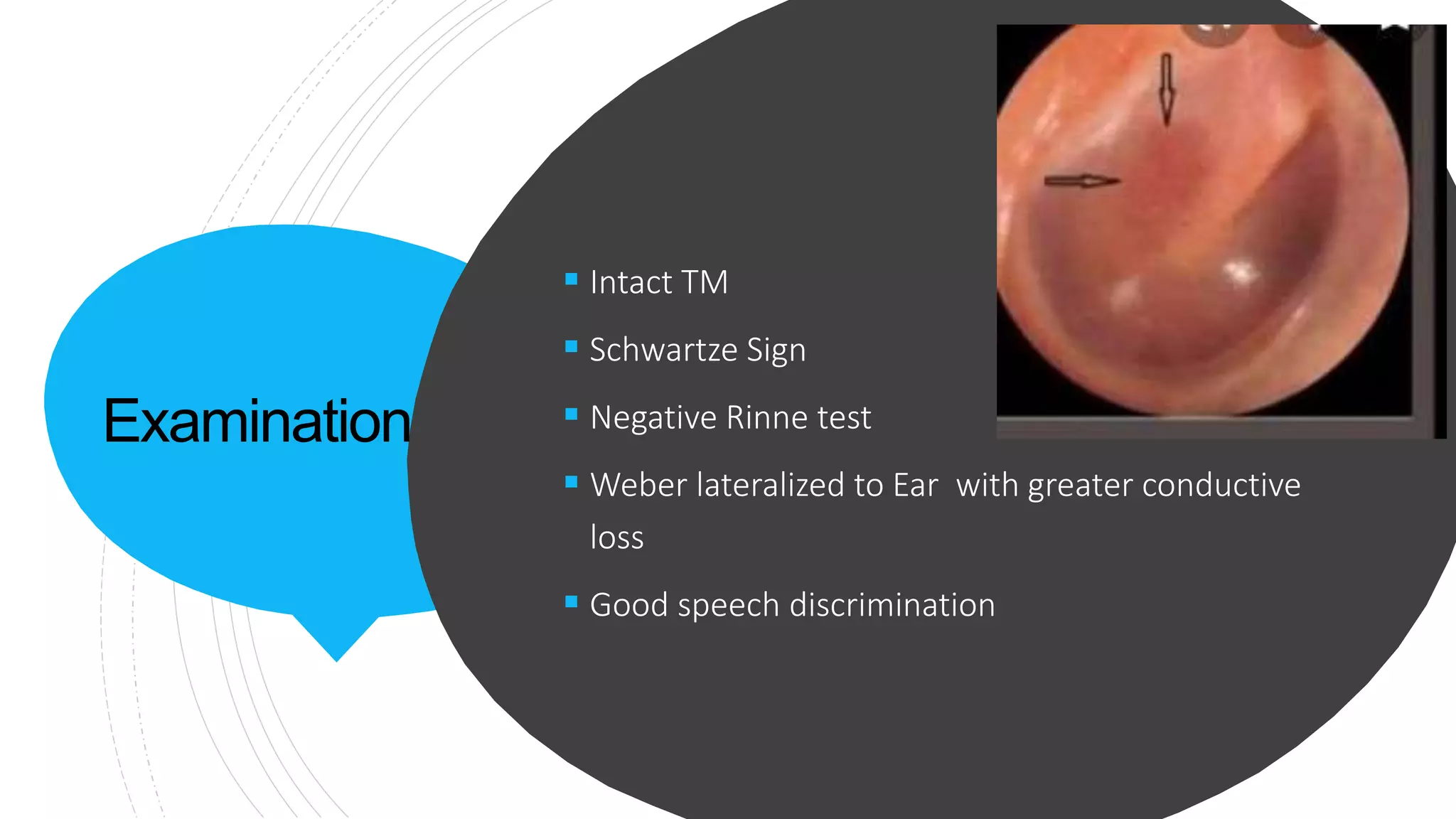
 Intact TM
 Schwartze Sign
 Negative Rinne test
 Weber lateralized to Ear with greater conductive
loss
 Good speech discrimination
Investigations
 Speech audiometry shows a normal increase in
speech discrimination when sound intensity
increases.
 Tympanometry – A type / AS type
 The stapedial reflex is absent
 PTA- conductive or mixed loss
Pure tone
audiometry
Otosclerosis
Th. Somers*, F. Declau**, R. Kuhweide*** and Th.
Robillard****
HRCT
 HRCT is currently the radiologic method of choice in assessing
the labyrinthine windows and otic capsule. On HRCT images,
otosclerotic foci are visualized as hypodense or radiolucent foci
Otosclerosis Temporal Bone PathologyAlicia M. Quesnel,
MDa,b,c,*, Reuven Ishai, MDb,c, Michael J. McKenna, MDa,b
Differentials
 Sequelae of otitis media with intact eardrum:
ossicular chain discontinuity, tympanosclerosis
 Post-traumatic stapes fixation
 Malleus head fixation
 Minor malformations of the middle ear:
monopodic stapes, aplasia of stapes
superstructure
 Abnormal perilymph pressure
 Paget’s disease
 Osteogenesis imperfecta
Treatment
options
 Observation – if hearing loss is less than 30 Db
 Hearing aid – patients with mod CHL , unwilling
to undergo surgery
 Cochlear otosclerosis with progressive
sensorineural hearing loss one may also
consider the use of sodium fluoride, calcium
and vitamin D.
 Surgery- stapedectomy or stapedotomy
 Cochlear implant – in profound HL with
cochlear involvement
Surgery
 Stapes surgery is most appreciated by patients
who experience hearing problems in everyday
life. This is mostly the case when Rinne’s test is
“negative” and air conduction thresholds are at
30 dB HL or worse
 In bilateral cases, the operation should be
carried out on the ear with the highest degree
of hearing loss.
 The worst ear- based on the patient’s
statement and not necessarily on the
audiogram, should be chosen for surgery
Contraindications
 Poor physical health
 Balance problems, such as active
endolymphatic hydrops or a fluctuating hearing
loss
 Pre-existing tympanic membrane perforation
 Active external or middle ear infection
 Inadequate air-bone gap confirmed by an
audiogram and the 512 Hz tuning fork test
 Inner ear malformations as visible on HRCT
Otosclerosis
Th. Somers*, F. Declau**, R. Kuhweide*** and Th.
Robillard****
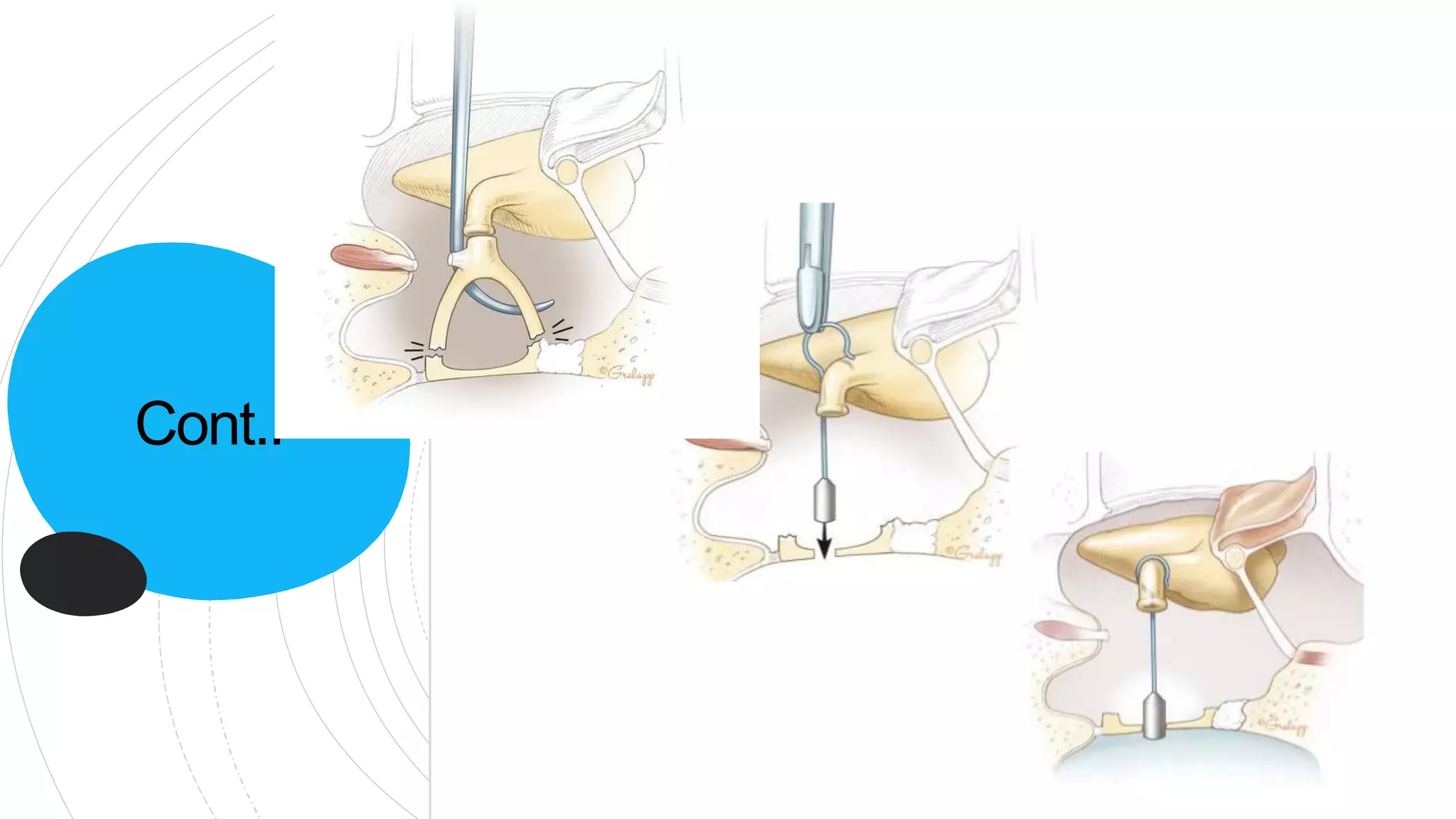
Overview of
surgery
Cont ..
Cont..
Cont..
Complications
 Tears in the tympano-meatal flap
 Subluxation and dislocation of incus
 Overhanging facial nerve
 Obliterative otosclorosis of oval window
 Round window otosclerosis
 Persistent stapedial artery
 Malleus ankyloses
 Perilymph gushers
 Floating or depressed footplate
Intraoperative complications
Surgery of the ear- Shamaugh
Complications
 Chorda tympani dysfunctions
 Otitis media
 Vertigo
 Facial palsy
 SNHL
 CHL
 Reparative granuloma
postoperative complications
Surgery of the ear- Shamaugh
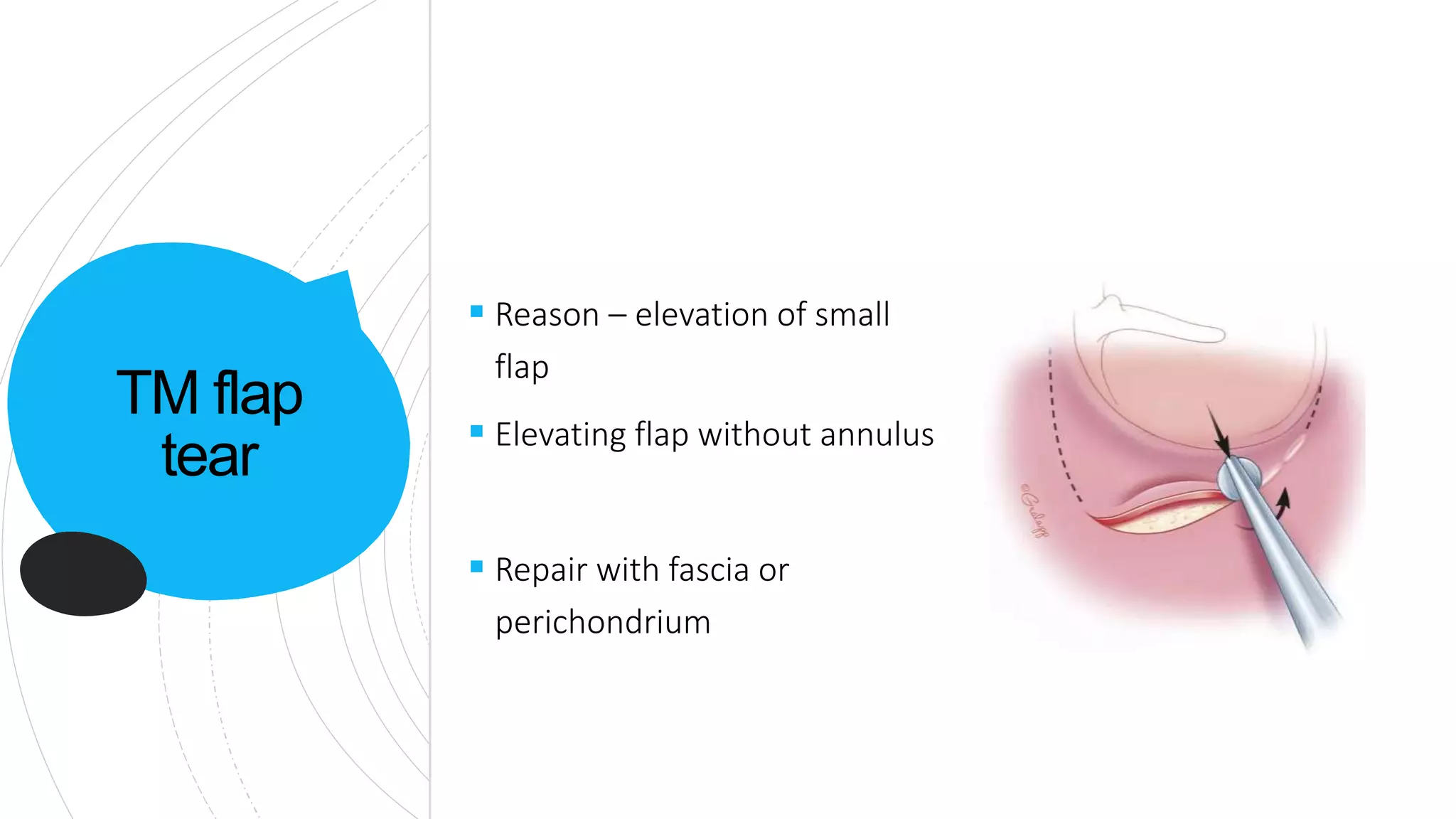
TM flap
tear
 Reason – elevation of small
flap
 Elevating flap without annulus
 Repair with fascia or
perichondrium
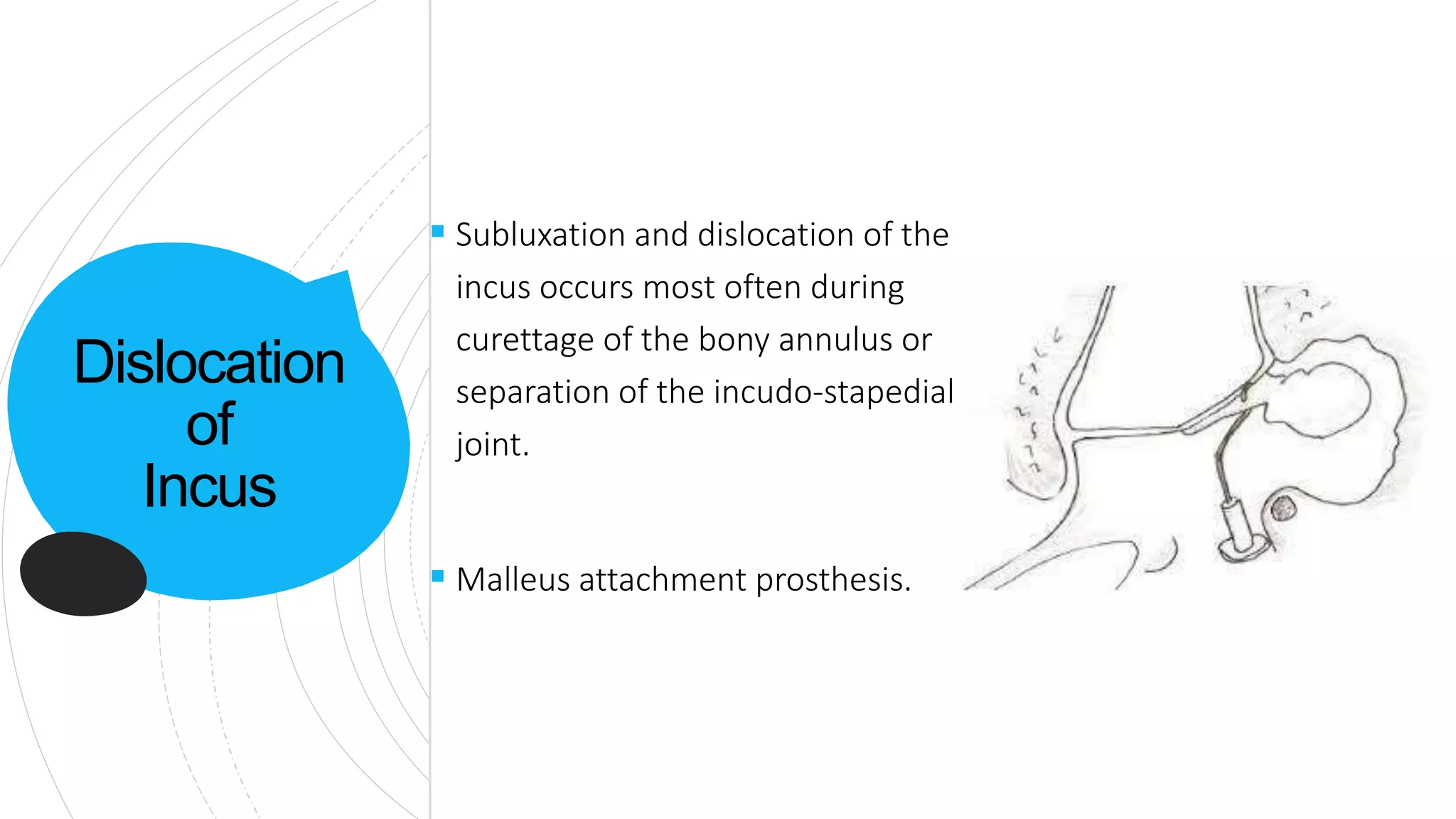
Dislocation
of
Incus
 Subluxation and dislocation of the
incus occurs most often during
curettage of the bony annulus or
separation of the incudo-stapedial
joint.
 Malleus attachment prosthesis.
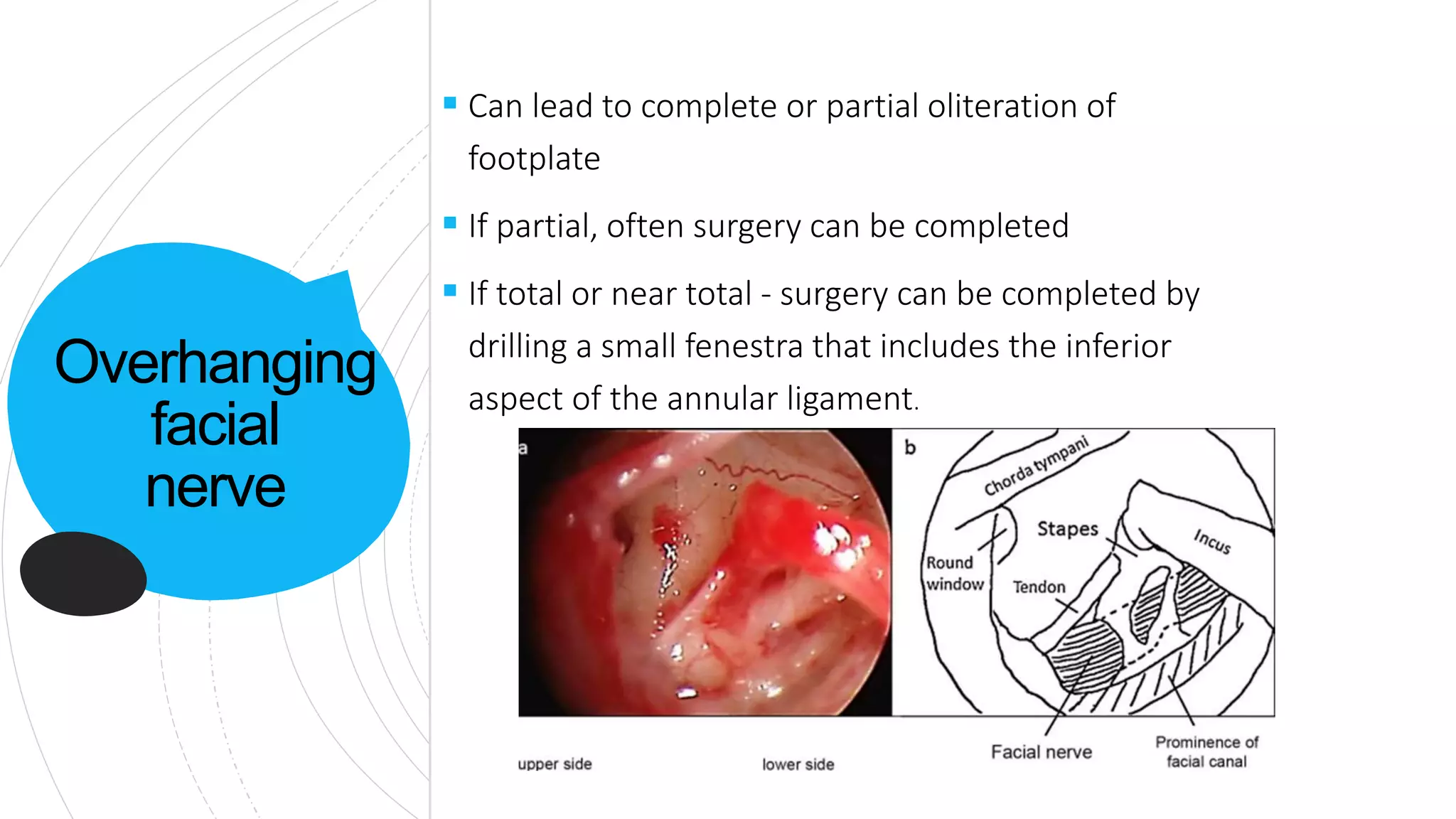
Overhanging
facial
nerve
 Can lead to complete or partial oliteration of
footplate
 If partial, often surgery can be completed
 If total or near total - surgery can be completed by
drilling a small fenestra that includes the inferior
aspect of the annular ligament.
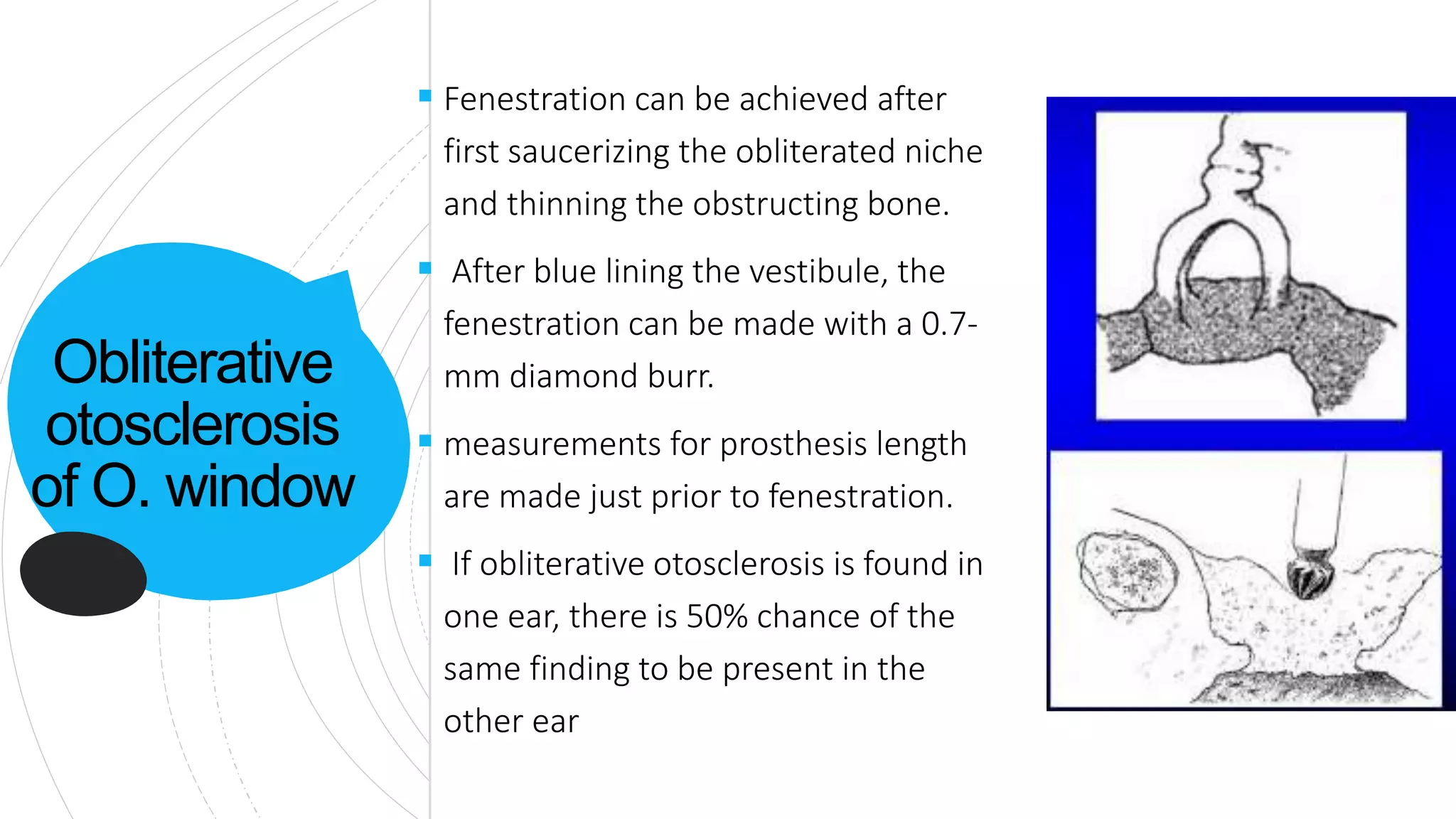
Obliterative
otosclerosis
of O. window
 Fenestration can be achieved after
first saucerizing the obliterated niche
and thinning the obstructing bone.
 After blue lining the vestibule, the
fenestration can be made with a 0.7-
mm diamond burr.
 measurements for prosthesis length
are made just prior to fenestration.
 If obliterative otosclerosis is found in
one ear, there is 50% chance of the
same finding to be present in the
other ear
Round
window
otosclerosis
 Even a minute opening to the round window membrane
can be associated with good hearing.
 if the round window is found to be obliterated, the
procedure should be completed and the finding noted in
the operative note.
 If a residual conductive loss is present following surgery
revision surgery is not recomended as the likely cause is a
obliterated round window
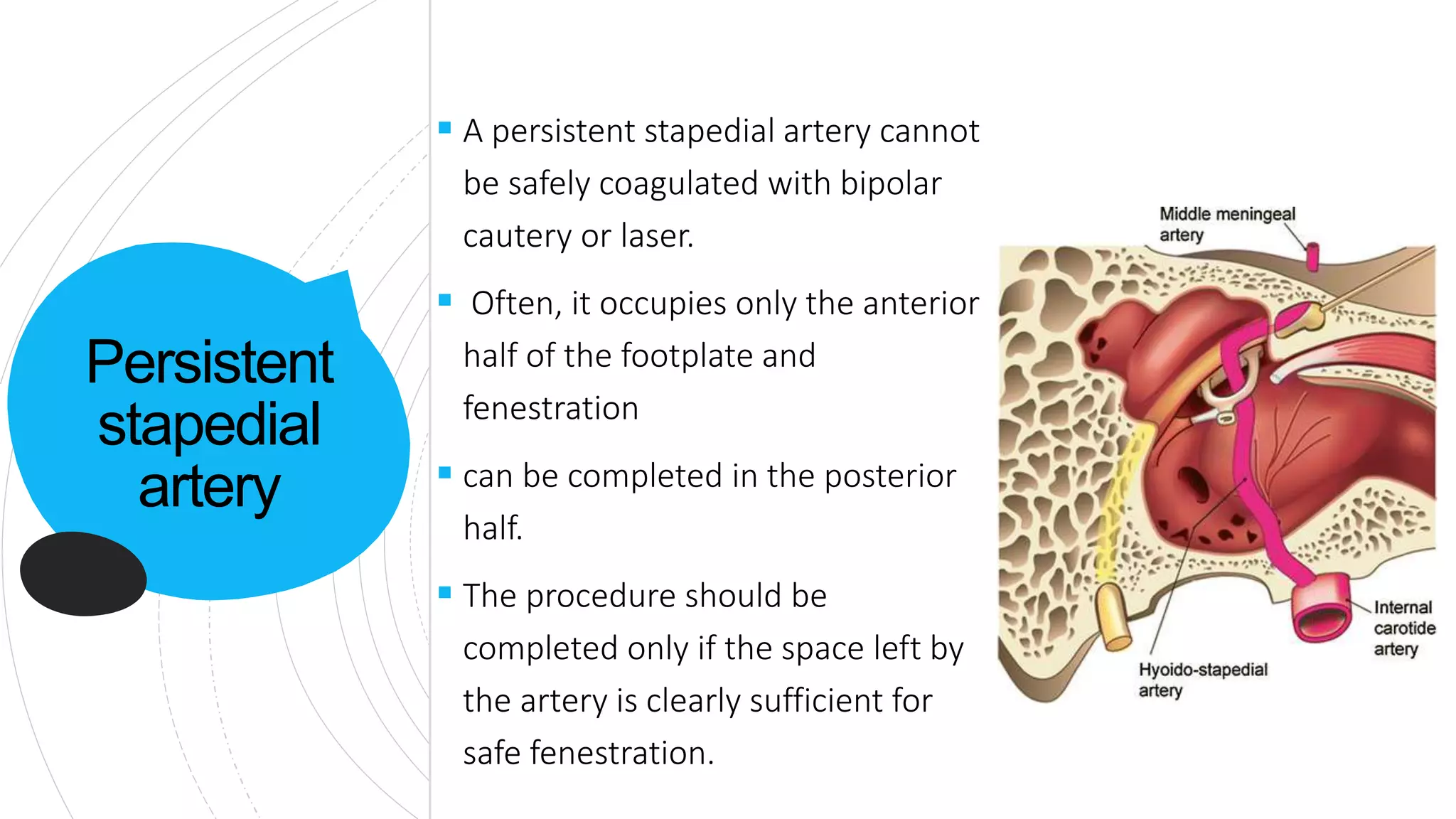
Persistent
stapedial
artery
 A persistent stapedial artery cannot
be safely coagulated with bipolar
cautery or laser.
 Often, it occupies only the anterior
half of the footplate and
fenestration
 can be completed in the posterior
half.
 The procedure should be
completed only if the space left by
the artery is clearly sufficient for
safe fenestration.
Malleus
fixation
 Malleus fixation may result from ossification of the
superior and anterior suspensory ligaments
CSF
Gusher
 Gusher" is a rare phenomenon
that consists in sudden exit of
peri-lymphatic fluid during the
course of the surgery
stapedotomy or stapedectomy
 Etiology is a congenital
malformation that causes
abnormal communication
between the peri-lymphatic
space and the subarachnoid
space.
CSF
Gusher
 1. Elevation of the head
 2. Lumbar spinal drain to remove as much CSF as possible
 3. Small fenestra stapedotomy
 4.Tissue seal over the fenestra is mandatory.
 Some experts recommend that a prosthesis be placed to
keep the seal over the fenestra in place
Management
Floating or
depressed
footplate
 Fenestration can made with a LASER.
 Footplate too thick for the laser to penetrate, a small bur
hole can be created inferior to the annular ligament
 Footplate can be elevated with a small hook.
 Footplate is depressed into the vestibule it should not be
extracted
 Opening should be sealed with a tissue graft, before
placing appropriately sized prosthesis
Facial
palsy
 Temporary paralysis lasts for few hours , often due to local
anaesthesia.
 If paralysis persists more than 3 hour – traumatic injury is
likely.
 Nerve can be injured by -
1. Bone curette or drill during removal of the bony annulus,
2. Fracturing the stapes toward the nerve rather than away
toward the promontory,
3. By injuring an anomalous nerve
Nerve repair to be done in cases of nerve injury
Otitis
media
 Acute otitis media in postoperative period carries risk of
suppurative labyrinthitis and meningitis.
 Treatment – Broad spectrum intravenous antibiotics
 Hospitalization
 Supportive care
Vertigo
 Vertigo during surgery- insult to labyrinth , or result of air
entry in the vestibule. - Resolves within 48 hours.
 Blood causes chemical irritation and resolves in a matter
of days.
 Persistant vertigo is associated with SNHL, can be due to
peri – lymphatic fistula
Chorda
tympani
dysfunction
 Presents with taste disturbance
 Some- time sacrificed during the surgery
 Stretched nerve produce more symptoms than a sacrificed
nerve.
SNHL
 Slight transient depression (<5 dB) in bone conduction
immediately following the procedure is a common
occurrence and attributable to mild serous labyrinthitis.
 Permanent SNHL is attributable to surgical trauma.
 Delayed SNHL should raise the suspicion of a PLP.
 A delayed fluctuating low-frequency loss may indicate
post-traumatic hydrops.
Reparative
granuloma
 Mass of exubareant granulation tissue developing in
reaction to surgery , foreign body or perilymph.
 Presents with signs of labyrinthitis
 Appears after an early period of hearing gain
 Audiometry – mixed hearing loss
 Management – re-exploration and removal of granulation
tissue with prosthesis
CHL
 Malfunctioning prosthesis, eg, one that is too short,
 Unrecognized malleus fixation
 Unrecognized round window obliteration
 Middle ear effusion
 Presence of unrecognized SSCD.
 Revision surgery may be considered after waiting for
several months.
Common causes are
Peri-lymph
Fistula
 Common cause of
sensorineural hearing loss
following stapedectomy.
 Causes are -inadequate
closure of the fenestra in the
footplate by the seal, too long
a prosthesis, or possibly
increased perilymph pressure.
 symptoms are fluctuating
sensorineural hearing loss,
roaring tinnitus, and vertigo
accompanied by fullness in
the ear.
 Otosclerosis Temporal
Bone PathologyAlicia
M. Quesnel,
MDa,b,c,*, Reuven
Ishai, MDb,c, Michael
J. McKenna, MDa,b
Complications
<Name of Song>
Otosclerosis Temporal Bone PathologyAlicia M. Quesnel, MDa,b,c,*, Reuven Ishai,
MDb,c, Michael J. McKenna, MDa,b
Revision
stapes
surgery
 Technically more challenging
 Higher incidence of complications
 Lower success rates
 Often done under general anaesthesia
Revision
stapes
surgery
 Prosthesis dislocation from oval window
 Incus erosion and incus-prosthesis detachment
 Short prosthesis
 Postoperative fibrosis in the middle ear and re-ankyloses
 Peri-lymphatic fistula
 Insufficient fenestra and too tight prosthesis
 Footplate re-sclerosis, incus subluxation, facial nerve
dehiscence and prosthesis friction, reparative granuloma
Yetiser S. Revision surgery for otosclerosis: An overview. World J Otorhinolaryngol 2015; 5(1): 21-29 [DOI:
10.5319/wjo.v5.i1.21]
Common causes
Complications of Stapes surgery.pptx

Complications of Stapes surgery.pptx

  • 1.
    Complications of Stapes surgery DrSafika Zaman Dept of ENT and HNS RKMSP,VIMS
  • 2.
    Introduction  Otosclerosis isa disease of altered bone metabolism, unique to human temporal bone.  Prevalence of otosclerosis varies amongst races, more common in Caucasians  More common in women.  The operative procedure was divided into stapedectomy (total footplate removal and opening all the oval window) and stapedotomy (small-hole creation on the footplate).
  • 3.
    Government History of Otosclerosisand Stapes SurgeryRonen Nazarian, MD John T. McElveen Jr., MDAdrien A. Eshraghi, MD, MSc – Otolarngologic clinics
  • 4.
    Otosclerosis  Primarily adisease of the bone that encases the cochlea and labyrinth.  Characterized by progressive focal dysplasia with destruction, remodelling, and finally sclerosis of the endochondral bone of the labyrinthine capsule.  Mostly starts in the anterior part of the oval window, the so-called fissula ante fenestram and extends to the annular ligament and stapes.  Bony ankylosis of the stapes, which results in increased stiffness of the ossicular chain and conductive hearing loss
  • 5.
  • 6.
  • 7.
    History  Insidious onsetprogressive hearing loss  Better hearing in noisy environment  Tinnitus  Vertigo  Monotonous well modulated , soft speech
  • 8.
    Examination  Intact TM Schwartze Sign  Negative Rinne test  Weber lateralized to Ear with greater conductive loss  Good speech discrimination
  • 9.
    Investigations  Speech audiometryshows a normal increase in speech discrimination when sound intensity increases.  Tympanometry – A type / AS type  The stapedial reflex is absent  PTA- conductive or mixed loss
  • 10.
    Pure tone audiometry Otosclerosis Th. Somers*,F. Declau**, R. Kuhweide*** and Th. Robillard****
  • 11.
    HRCT  HRCT iscurrently the radiologic method of choice in assessing the labyrinthine windows and otic capsule. On HRCT images, otosclerotic foci are visualized as hypodense or radiolucent foci Otosclerosis Temporal Bone PathologyAlicia M. Quesnel, MDa,b,c,*, Reuven Ishai, MDb,c, Michael J. McKenna, MDa,b
  • 12.
    Differentials  Sequelae ofotitis media with intact eardrum: ossicular chain discontinuity, tympanosclerosis  Post-traumatic stapes fixation  Malleus head fixation  Minor malformations of the middle ear: monopodic stapes, aplasia of stapes superstructure  Abnormal perilymph pressure  Paget’s disease  Osteogenesis imperfecta
  • 13.
    Treatment options  Observation –if hearing loss is less than 30 Db  Hearing aid – patients with mod CHL , unwilling to undergo surgery  Cochlear otosclerosis with progressive sensorineural hearing loss one may also consider the use of sodium fluoride, calcium and vitamin D.  Surgery- stapedectomy or stapedotomy  Cochlear implant – in profound HL with cochlear involvement
  • 14.
    Surgery  Stapes surgeryis most appreciated by patients who experience hearing problems in everyday life. This is mostly the case when Rinne’s test is “negative” and air conduction thresholds are at 30 dB HL or worse  In bilateral cases, the operation should be carried out on the ear with the highest degree of hearing loss.  The worst ear- based on the patient’s statement and not necessarily on the audiogram, should be chosen for surgery
  • 15.
    Contraindications  Poor physicalhealth  Balance problems, such as active endolymphatic hydrops or a fluctuating hearing loss  Pre-existing tympanic membrane perforation  Active external or middle ear infection  Inadequate air-bone gap confirmed by an audiogram and the 512 Hz tuning fork test  Inner ear malformations as visible on HRCT Otosclerosis Th. Somers*, F. Declau**, R. Kuhweide*** and Th. Robillard****
  • 16.
  • 17.
  • 18.
  • 19.
  • 20.
    Complications  Tears inthe tympano-meatal flap  Subluxation and dislocation of incus  Overhanging facial nerve  Obliterative otosclorosis of oval window  Round window otosclerosis  Persistent stapedial artery  Malleus ankyloses  Perilymph gushers  Floating or depressed footplate Intraoperative complications Surgery of the ear- Shamaugh
  • 21.
    Complications  Chorda tympanidysfunctions  Otitis media  Vertigo  Facial palsy  SNHL  CHL  Reparative granuloma postoperative complications Surgery of the ear- Shamaugh
  • 22.
    TM flap tear  Reason– elevation of small flap  Elevating flap without annulus  Repair with fascia or perichondrium
  • 23.
    Dislocation of Incus  Subluxation anddislocation of the incus occurs most often during curettage of the bony annulus or separation of the incudo-stapedial joint.  Malleus attachment prosthesis.
  • 24.
    Overhanging facial nerve  Can leadto complete or partial oliteration of footplate  If partial, often surgery can be completed  If total or near total - surgery can be completed by drilling a small fenestra that includes the inferior aspect of the annular ligament.
  • 25.
    Obliterative otosclerosis of O. window Fenestration can be achieved after first saucerizing the obliterated niche and thinning the obstructing bone.  After blue lining the vestibule, the fenestration can be made with a 0.7- mm diamond burr.  measurements for prosthesis length are made just prior to fenestration.  If obliterative otosclerosis is found in one ear, there is 50% chance of the same finding to be present in the other ear
  • 26.
    Round window otosclerosis  Even aminute opening to the round window membrane can be associated with good hearing.  if the round window is found to be obliterated, the procedure should be completed and the finding noted in the operative note.  If a residual conductive loss is present following surgery revision surgery is not recomended as the likely cause is a obliterated round window
  • 27.
    Persistent stapedial artery  A persistentstapedial artery cannot be safely coagulated with bipolar cautery or laser.  Often, it occupies only the anterior half of the footplate and fenestration  can be completed in the posterior half.  The procedure should be completed only if the space left by the artery is clearly sufficient for safe fenestration.
  • 28.
    Malleus fixation  Malleus fixationmay result from ossification of the superior and anterior suspensory ligaments
  • 29.
    CSF Gusher  Gusher" isa rare phenomenon that consists in sudden exit of peri-lymphatic fluid during the course of the surgery stapedotomy or stapedectomy  Etiology is a congenital malformation that causes abnormal communication between the peri-lymphatic space and the subarachnoid space.
  • 30.
    CSF Gusher  1. Elevationof the head  2. Lumbar spinal drain to remove as much CSF as possible  3. Small fenestra stapedotomy  4.Tissue seal over the fenestra is mandatory.  Some experts recommend that a prosthesis be placed to keep the seal over the fenestra in place Management
  • 31.
    Floating or depressed footplate  Fenestrationcan made with a LASER.  Footplate too thick for the laser to penetrate, a small bur hole can be created inferior to the annular ligament  Footplate can be elevated with a small hook.  Footplate is depressed into the vestibule it should not be extracted  Opening should be sealed with a tissue graft, before placing appropriately sized prosthesis
  • 32.
    Facial palsy  Temporary paralysislasts for few hours , often due to local anaesthesia.  If paralysis persists more than 3 hour – traumatic injury is likely.  Nerve can be injured by - 1. Bone curette or drill during removal of the bony annulus, 2. Fracturing the stapes toward the nerve rather than away toward the promontory, 3. By injuring an anomalous nerve Nerve repair to be done in cases of nerve injury
  • 33.
    Otitis media  Acute otitismedia in postoperative period carries risk of suppurative labyrinthitis and meningitis.  Treatment – Broad spectrum intravenous antibiotics  Hospitalization  Supportive care
  • 34.
    Vertigo  Vertigo duringsurgery- insult to labyrinth , or result of air entry in the vestibule. - Resolves within 48 hours.  Blood causes chemical irritation and resolves in a matter of days.  Persistant vertigo is associated with SNHL, can be due to peri – lymphatic fistula
  • 35.
    Chorda tympani dysfunction  Presents withtaste disturbance  Some- time sacrificed during the surgery  Stretched nerve produce more symptoms than a sacrificed nerve.
  • 36.
    SNHL  Slight transientdepression (<5 dB) in bone conduction immediately following the procedure is a common occurrence and attributable to mild serous labyrinthitis.  Permanent SNHL is attributable to surgical trauma.  Delayed SNHL should raise the suspicion of a PLP.  A delayed fluctuating low-frequency loss may indicate post-traumatic hydrops.
  • 37.
    Reparative granuloma  Mass ofexubareant granulation tissue developing in reaction to surgery , foreign body or perilymph.  Presents with signs of labyrinthitis  Appears after an early period of hearing gain  Audiometry – mixed hearing loss  Management – re-exploration and removal of granulation tissue with prosthesis
  • 38.
    CHL  Malfunctioning prosthesis,eg, one that is too short,  Unrecognized malleus fixation  Unrecognized round window obliteration  Middle ear effusion  Presence of unrecognized SSCD.  Revision surgery may be considered after waiting for several months. Common causes are
  • 39.
    Peri-lymph Fistula  Common causeof sensorineural hearing loss following stapedectomy.  Causes are -inadequate closure of the fenestra in the footplate by the seal, too long a prosthesis, or possibly increased perilymph pressure.  symptoms are fluctuating sensorineural hearing loss, roaring tinnitus, and vertigo accompanied by fullness in the ear.
  • 40.
     Otosclerosis Temporal BonePathologyAlicia M. Quesnel, MDa,b,c,*, Reuven Ishai, MDb,c, Michael J. McKenna, MDa,b
  • 41.
    Complications <Name of Song> OtosclerosisTemporal Bone PathologyAlicia M. Quesnel, MDa,b,c,*, Reuven Ishai, MDb,c, Michael J. McKenna, MDa,b
  • 42.
    Revision stapes surgery  Technically morechallenging  Higher incidence of complications  Lower success rates  Often done under general anaesthesia
  • 43.
    Revision stapes surgery  Prosthesis dislocationfrom oval window  Incus erosion and incus-prosthesis detachment  Short prosthesis  Postoperative fibrosis in the middle ear and re-ankyloses  Peri-lymphatic fistula  Insufficient fenestra and too tight prosthesis  Footplate re-sclerosis, incus subluxation, facial nerve dehiscence and prosthesis friction, reparative granuloma Yetiser S. Revision surgery for otosclerosis: An overview. World J Otorhinolaryngol 2015; 5(1): 21-29 [DOI: 10.5319/wjo.v5.i1.21] Common causes

Editor's Notes

  • #2 When listing all project collaborators, either use commas or bullets
  • #4 Use the SmartArt to determine the flow of government/leadership: Who leads the colony (executive)? What is that person/are those people’s duties? Who makes the rules (legislature)? Who ensures the rules are followed (judicial)? Are there any other branches of government? If so, who are they and what is their job? To add more shapes, click on the left shape first, then on SmartArt Tools -> Design -> Add Shape After Do the same for the shape to the right Feel free to rename the branches!
  • #42 What is the name of your colony song? Write lyrics to the song and, if you are feeling creative, use a computer program or instruments to create the music that goes along with it! To insert an audio file, click on Recording -> Audio -> Audio on My PC and choose your file