Definition :
A flap is a unit of tissue that is transferred from
donor site to recipient site while maintaining its own blood
supply.
Term “Flap” :
Originated from the 16th century Dutch word
“FLAPPE” which means “anything that hung broad and
loose, fastened only by one side”.
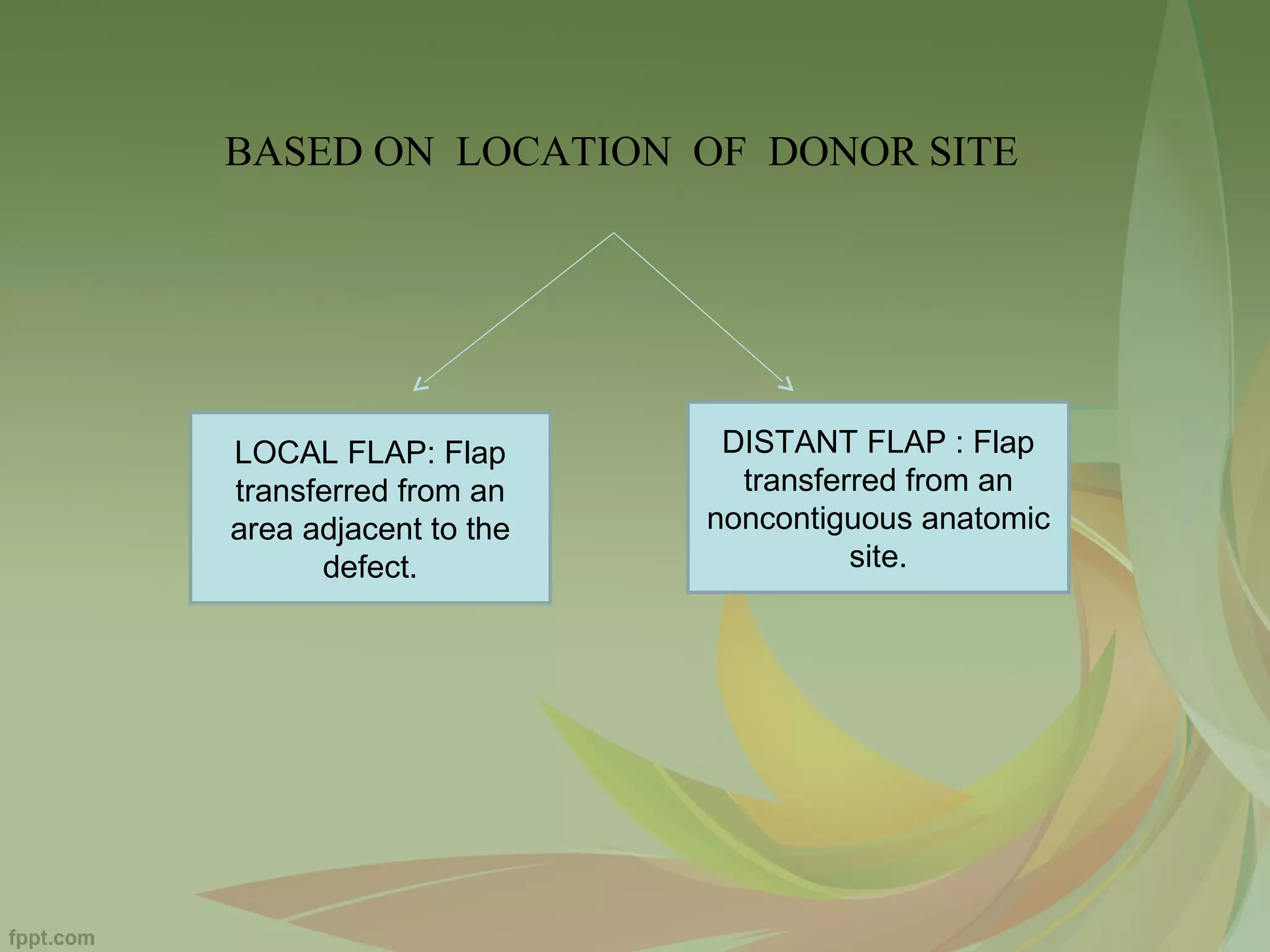
BASED ON LOCATION OF DONOR SITE
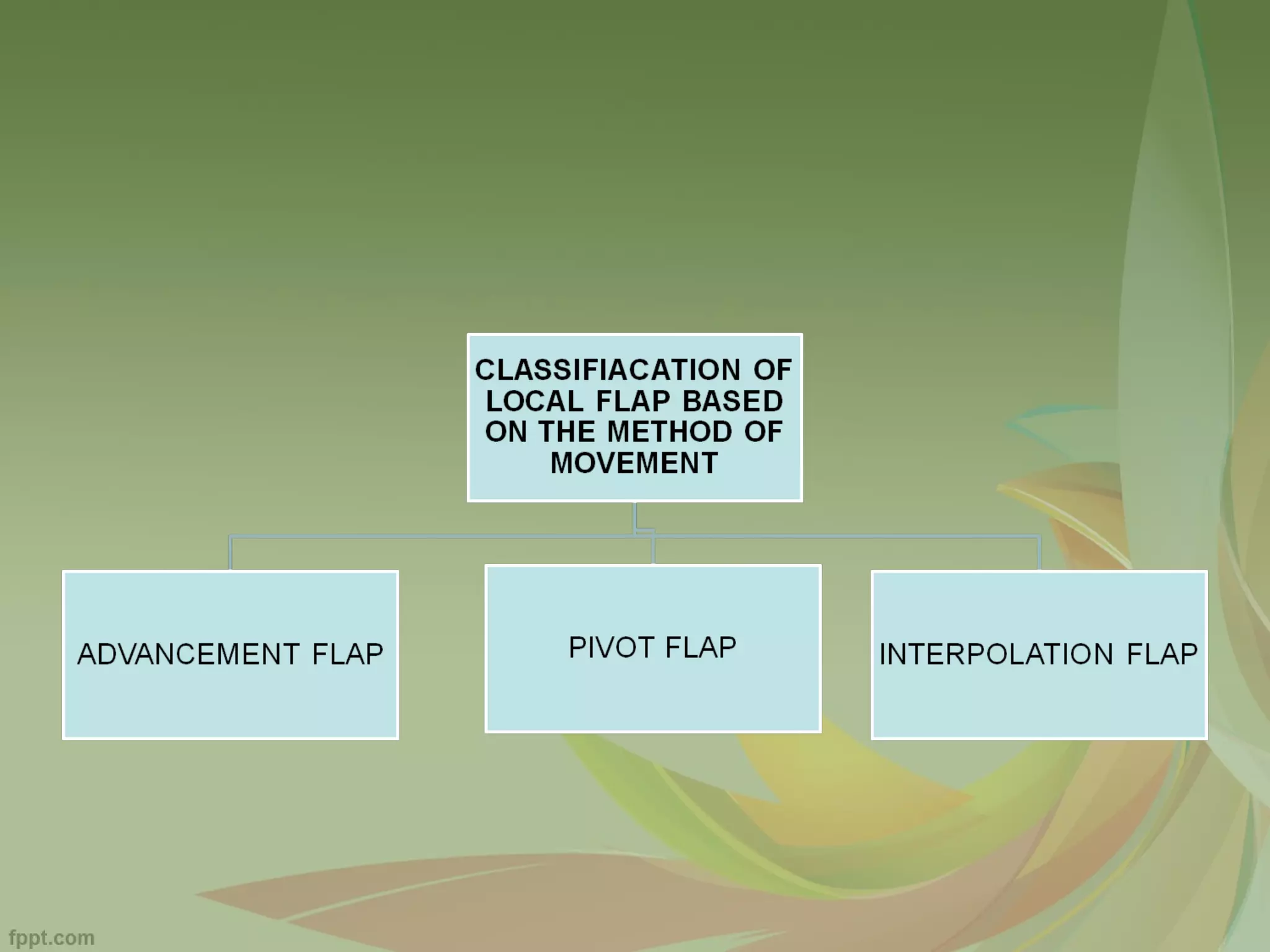
LOCAL FLAP: Flap
transferred from an
area adjacent to the
defect.
DISTANT FLAP : Flap
transferred from an
noncontiguous anatomic
site.
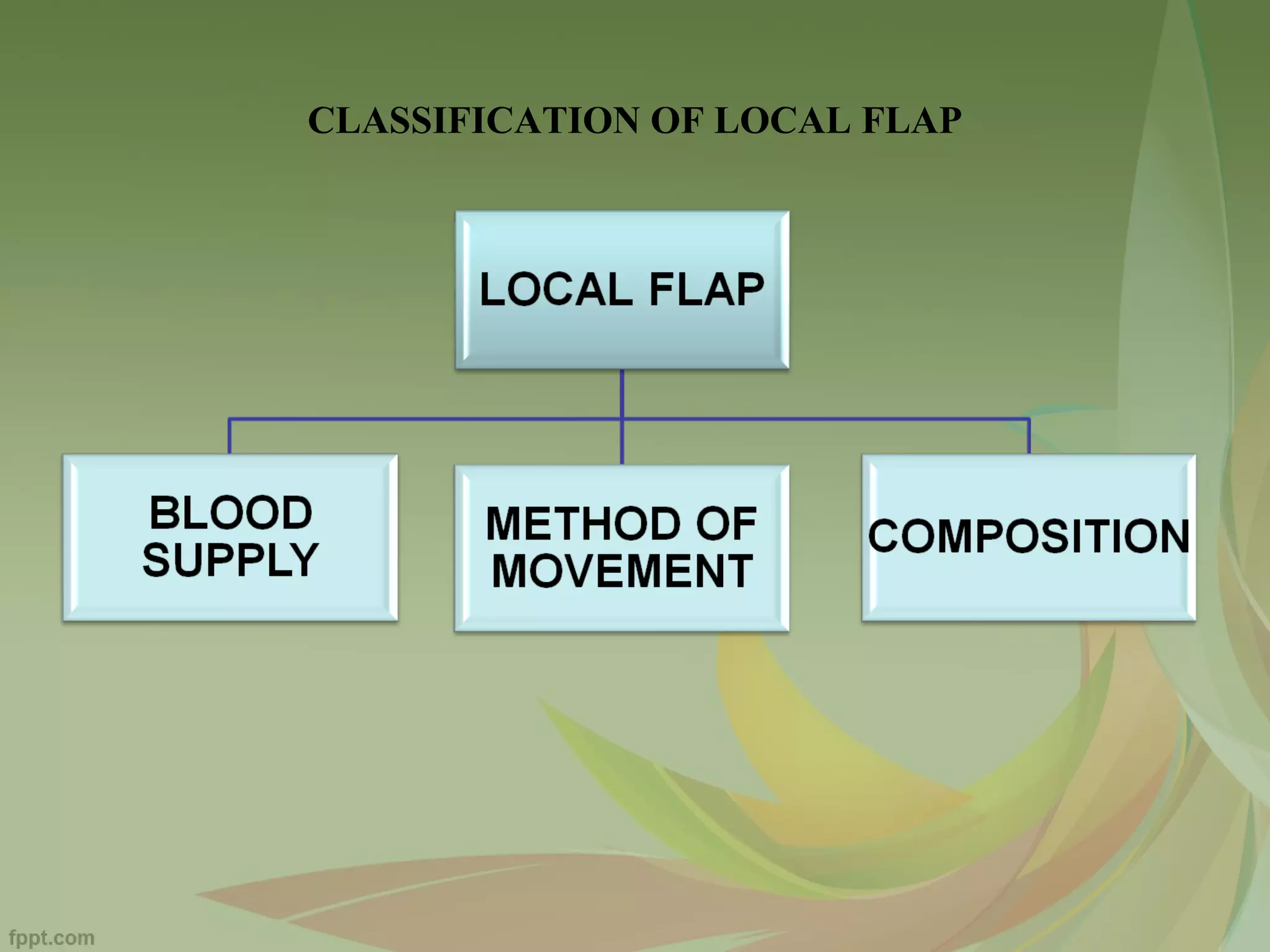
CLASSIFICATION OF LOCAL FLAP
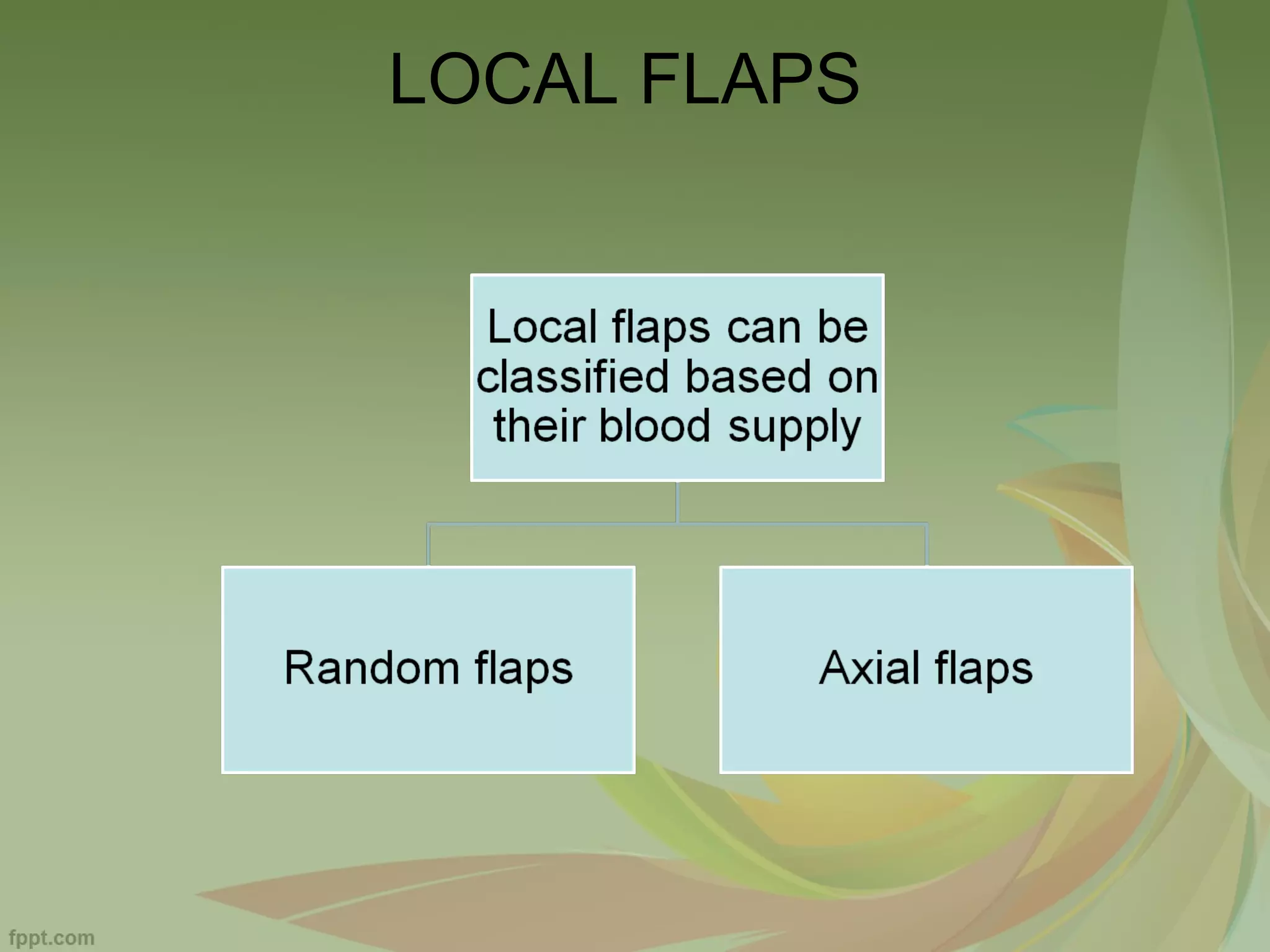
LOCAL FLAPS
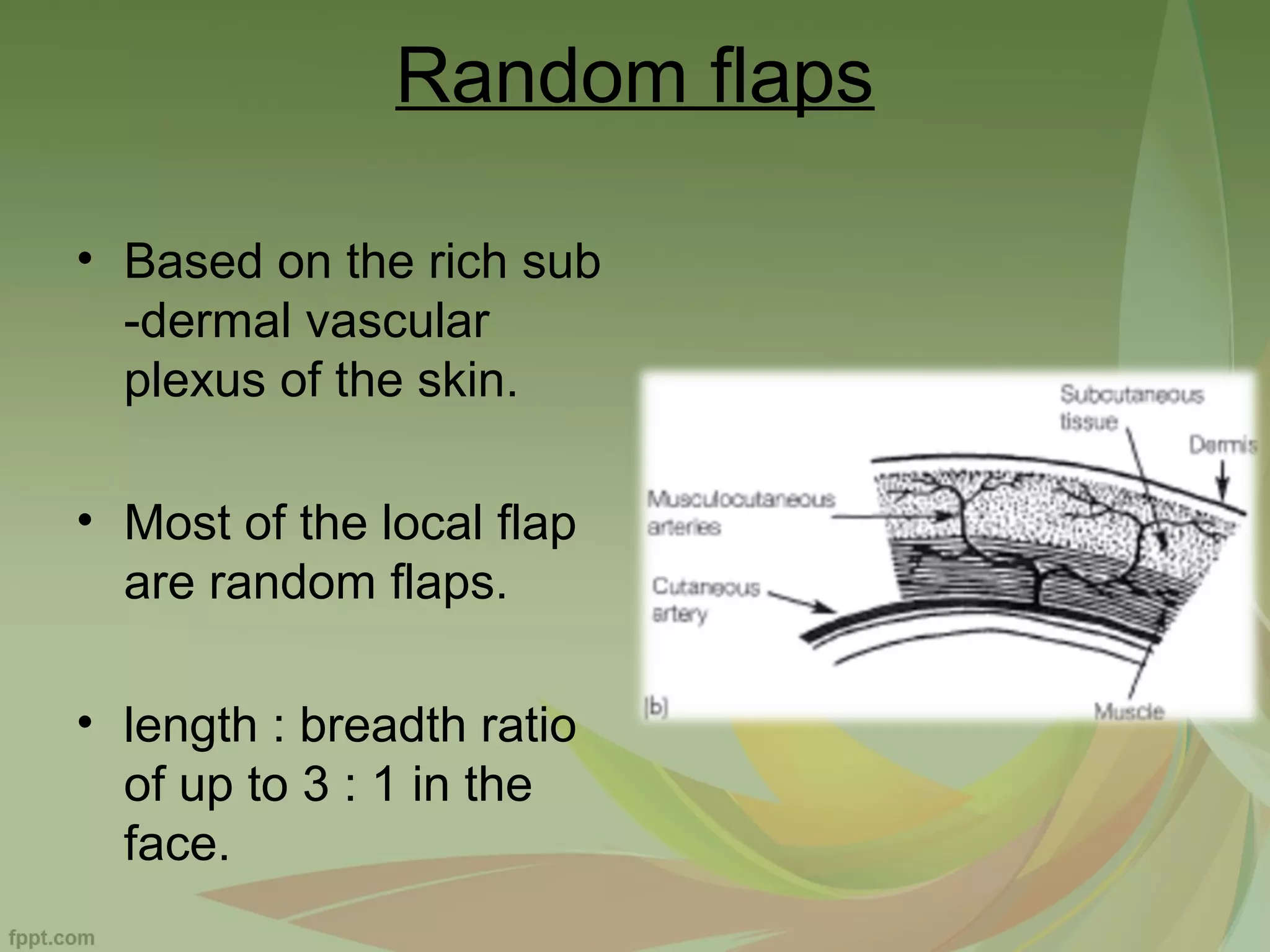
Random flaps
• Based on the rich sub
-dermal vascular
plexus of the skin.
• Most of the local flap
are random flaps.
• length : breadth ratio
of up to 3 : 1 in the
face.
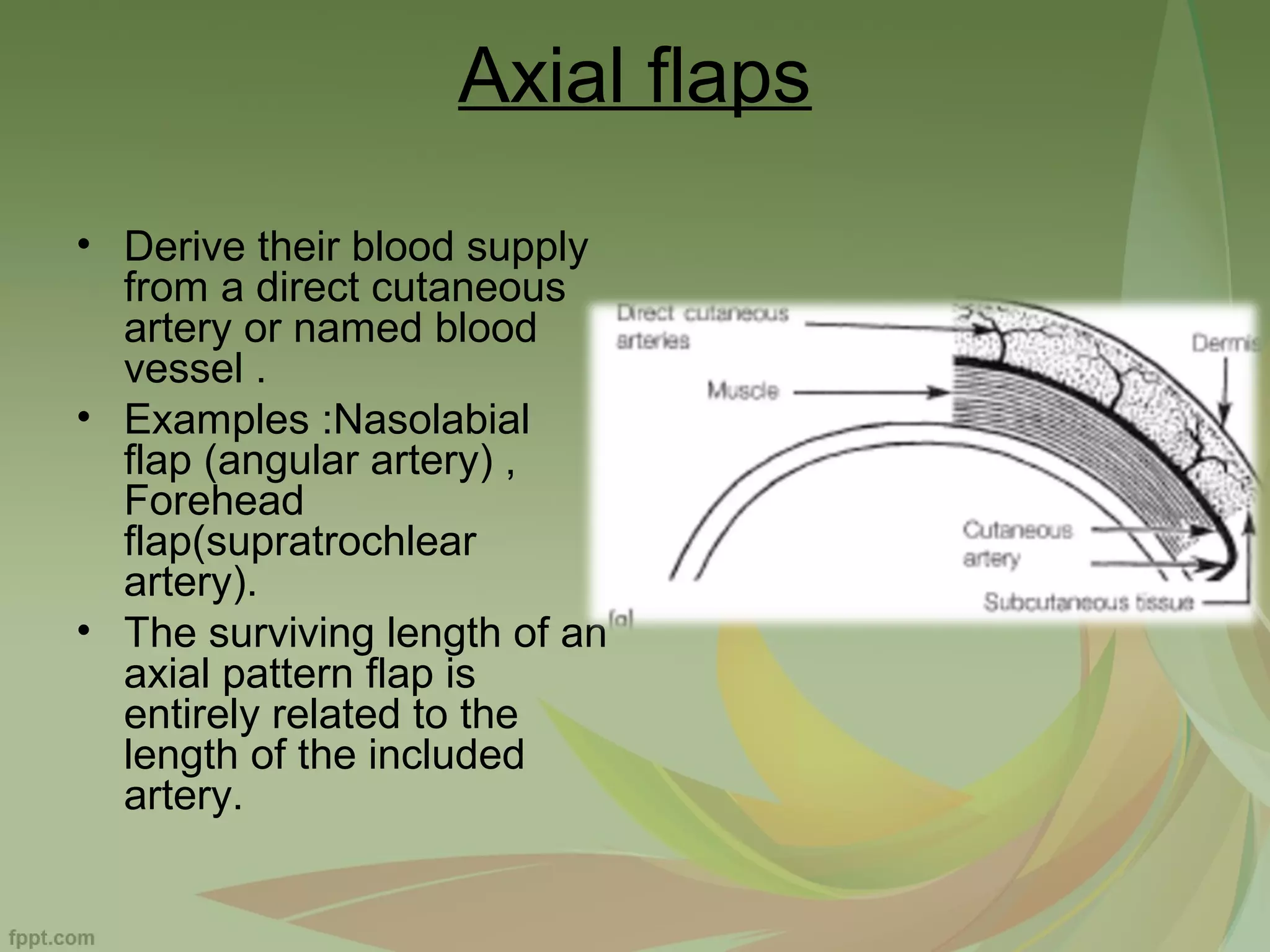
Axial flaps
• Derive their blood supply
from a direct cutaneous
artery or named blood
vessel .
• Examples :Nasolabial
flap (angular artery) ,
Forehead
flap(supratrochlear
artery).
• The surviving length of an
axial pattern flap is
entirely related to the
length of the included
artery.
Type I: one vascular pedicle
Type II: dominant pedicle (s) + minor pedicles
Type III: two dominant pedicles
Type IV: Segmental vascular pedicles
Type V: dominant pedicle + secondary segmental pedicles
Based on vascular pedicle types
In muscles
Mathes and Nahai (1979)
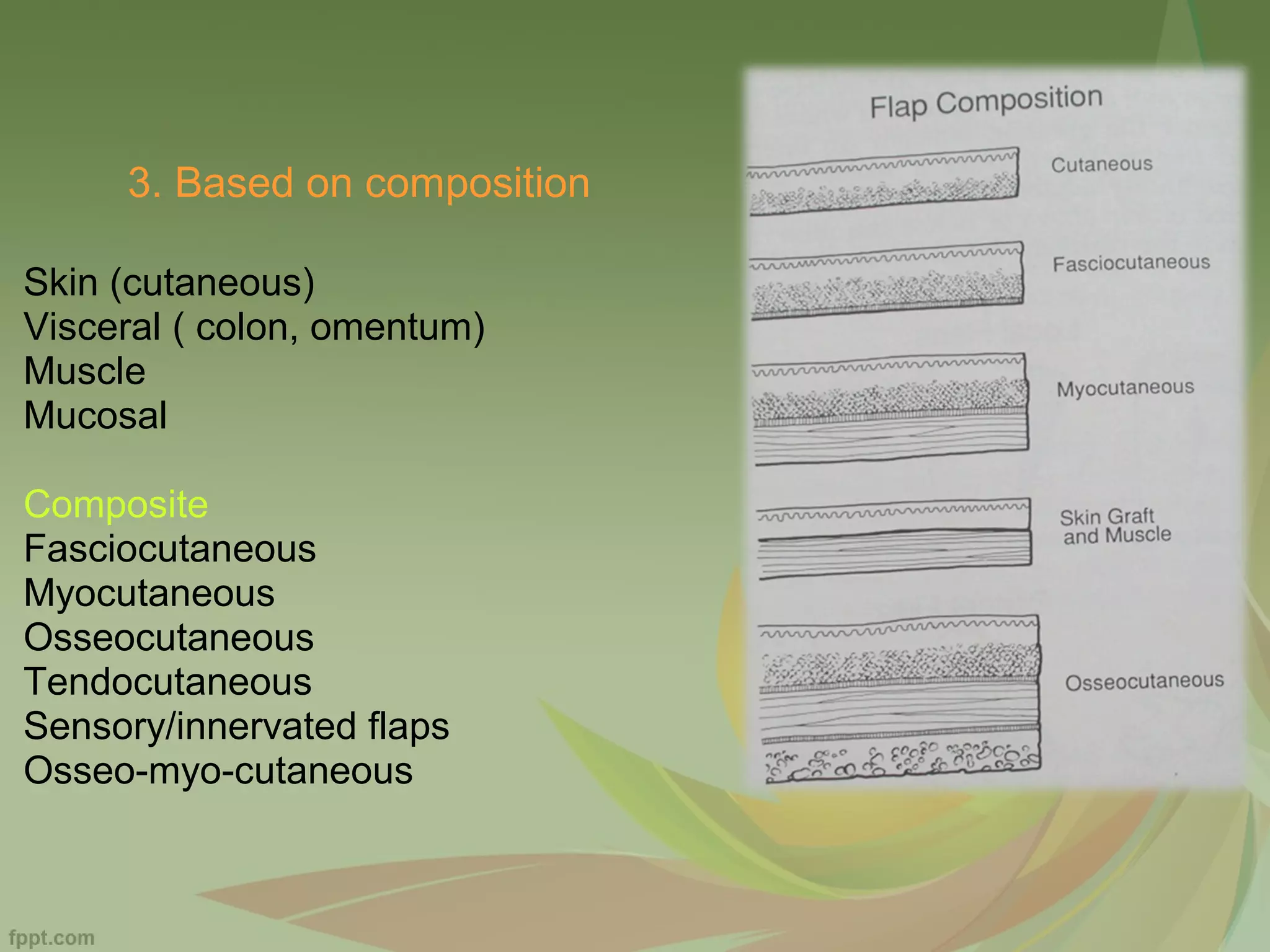
3. Based on composition
Skin (cutaneous)
Visceral ( colon, omentum)
Muscle
Mucosal
Composite
Fasciocutaneous
Myocutaneous
Osseocutaneous
Tendocutaneous
Sensory/innervated flaps
Osseo-myo-cutaneous
Local / Regional flaps – Goals
(Kinnerw & Jeter)
1. Adequate color match
2. Adequate thickness – avoid protrusions or
deficiencies
3. Preservation of clinically perceivable sensory
innervation
4. Sufficient laxity – avoid retraction or deranged
function
5. Resultant suture lines of either primary or
secondary defects are restricted to anatomic units
and fall within natural skin lines.
FLAP MODIFICATION
Modifications and refinements in both technique
and design of flaps have been used for the
optimal result in reconstructive surgery.
Important modifications are :
1. Flap delay.
2. Tissue expansion.
1. DELAY PHENOMENON
It can be defined as “ preliminary surgical
intervention wherein a portion of the
vascular supply to a flap is divided before
definitive elevation and transfer of the
flap”.
2. TISSUE EXPANSION
1957 : Neumann is credited with the first modern report of
this technique.
1976 : Radovan further described the use of this technique
for breast reconstruction.
Advantages :
1. Reconstruction with tissue of a similar colour and
texture to that of the donor defect.
2. Reconstruction with sensate skin containing skin
appendages.
3. Limited donor-site deformity.
Planning and design of local
flap
• Facial defects most common
– Trauma
– Skin malignancies
• Treatment
– secondary healing
– skin graft
– local flaps
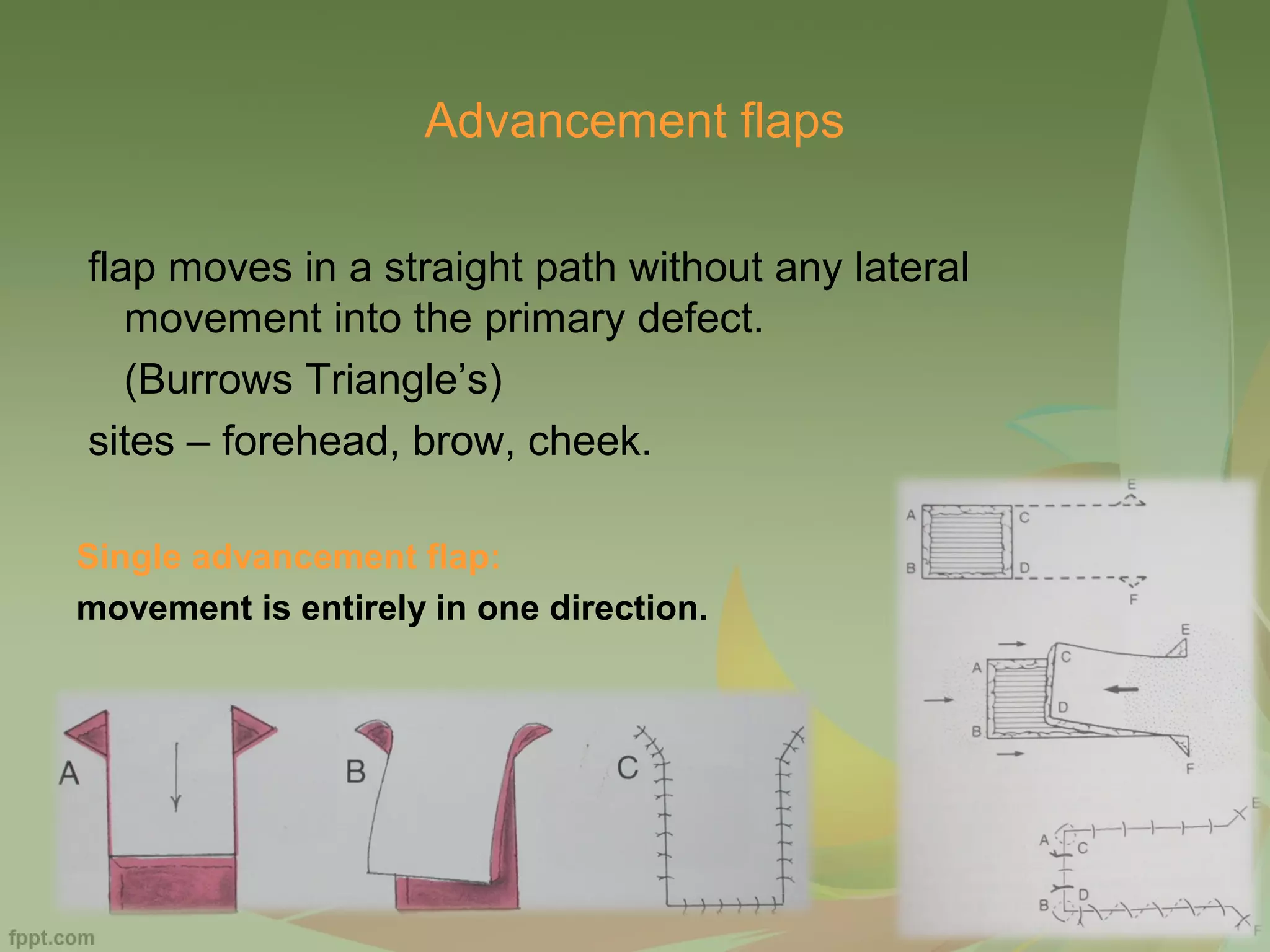
Advancement flaps
flap moves in a straight path without any lateral
movement into the primary defect.
(Burrows Triangle’s)
sites – forehead, brow, cheek.
Single advancement flap:
movement is entirely in one direction.
Advancement Flaps
Burrow’
s
triangle
at the
base of
the flap
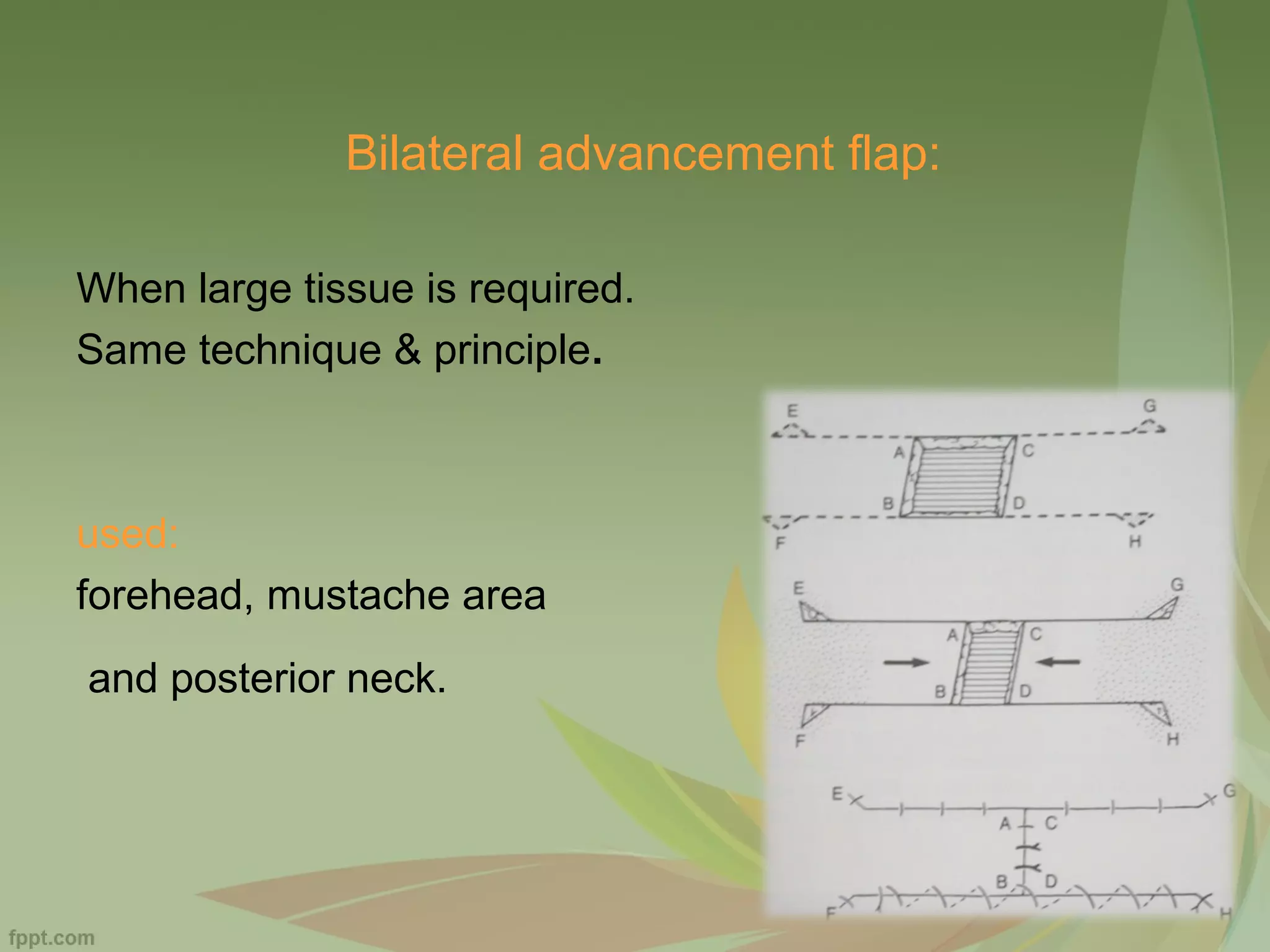
Bilateral advancement flap:
When large tissue is required.
Same technique & principle.
used:
forehead, mustache area
and posterior neck.
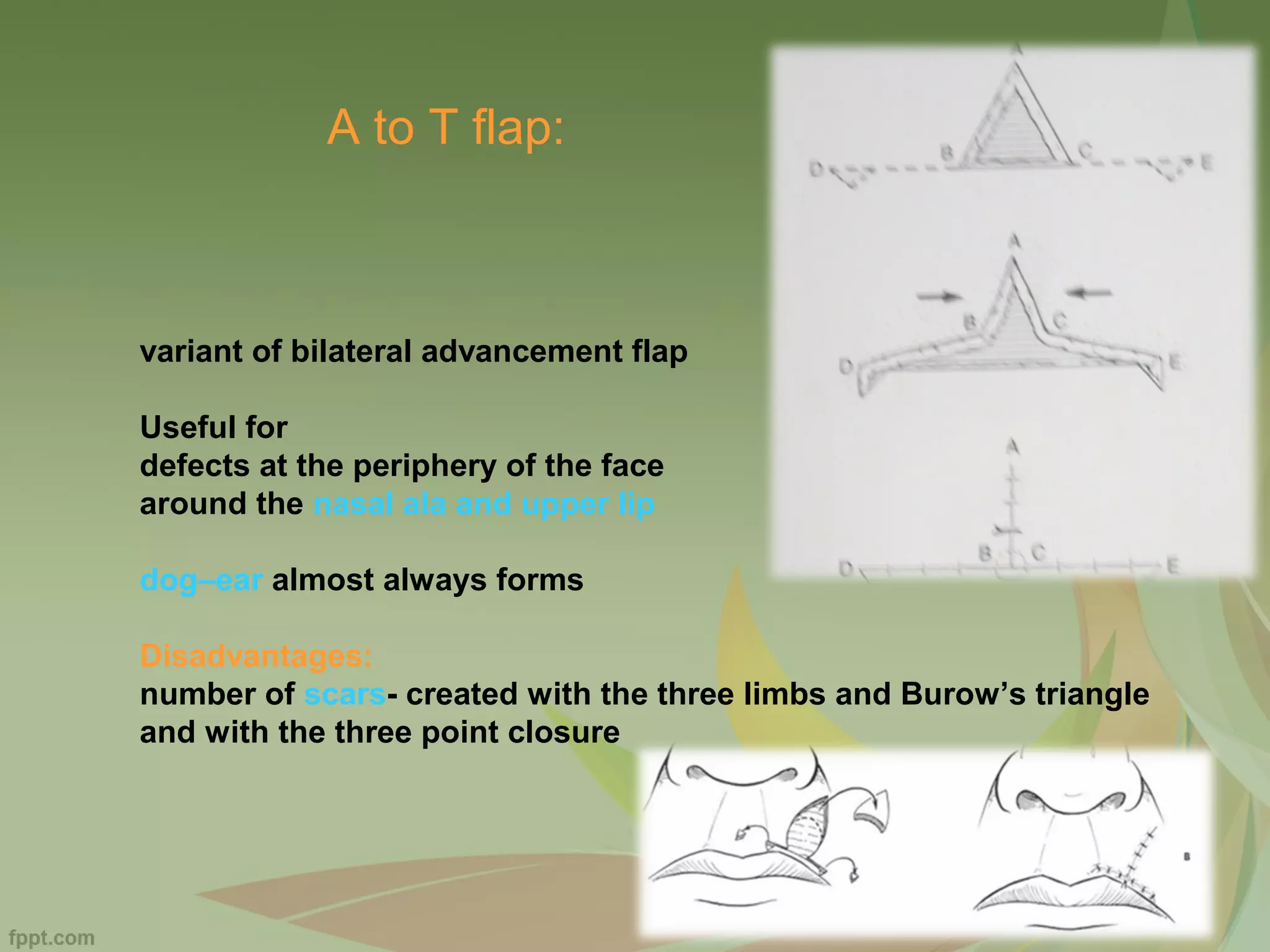
variant of bilateral advancement flap
Useful for
defects at the periphery of the face
around the nasal ala and upper lip
dog–ear almost always forms
Disadvantages:
number of scars- created with the three limbs and Burow’s triangle
and with the three point closure
A to T flap:
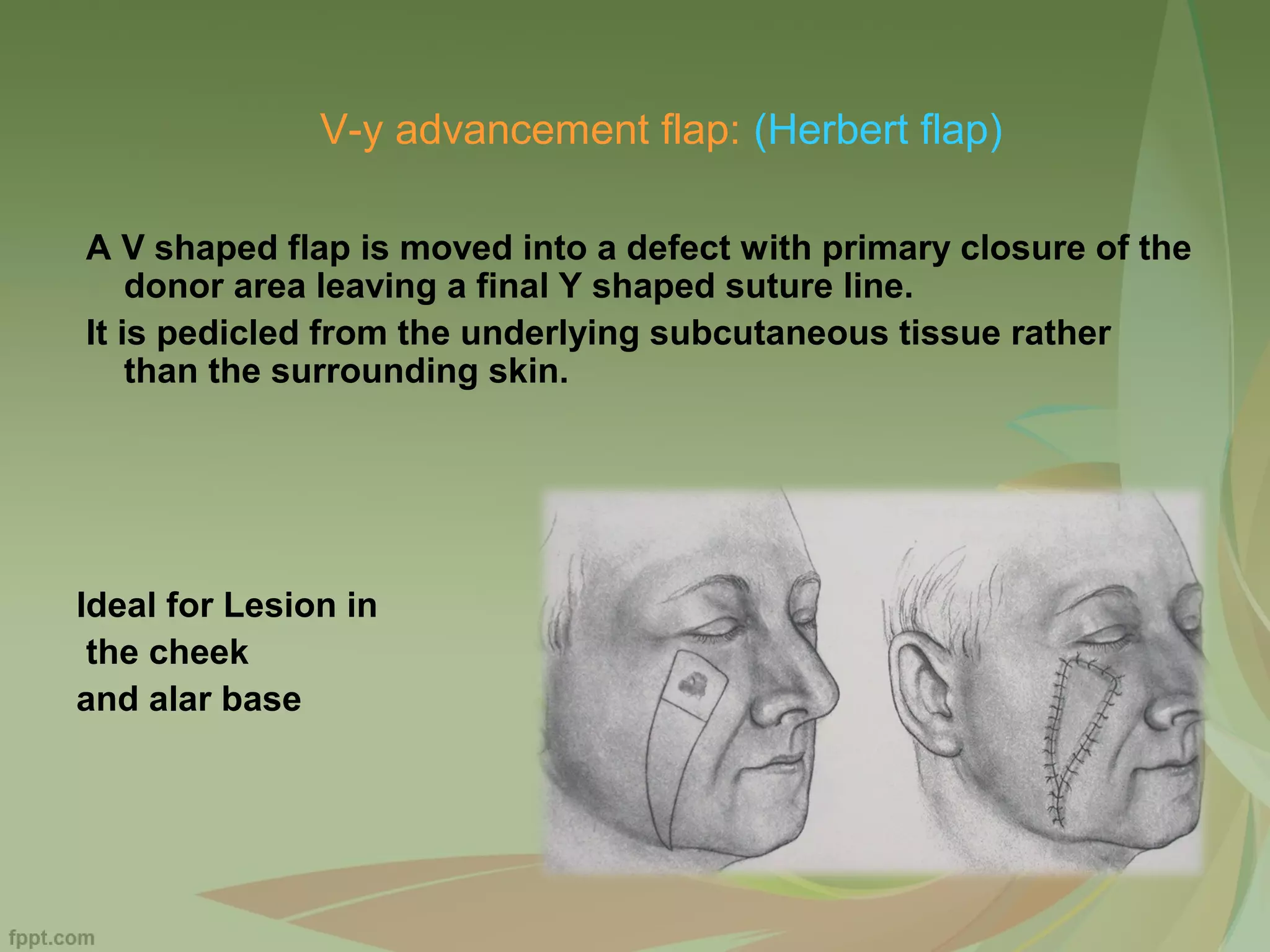
V-y advancement flap: (Herbert flap)
A V shaped flap is moved into a defect with primary closure of the
donor area leaving a final Y shaped suture line.
It is pedicled from the underlying subcutaneous tissue rather
than the surrounding skin.
Ideal for Lesion in
the cheek
and alar base
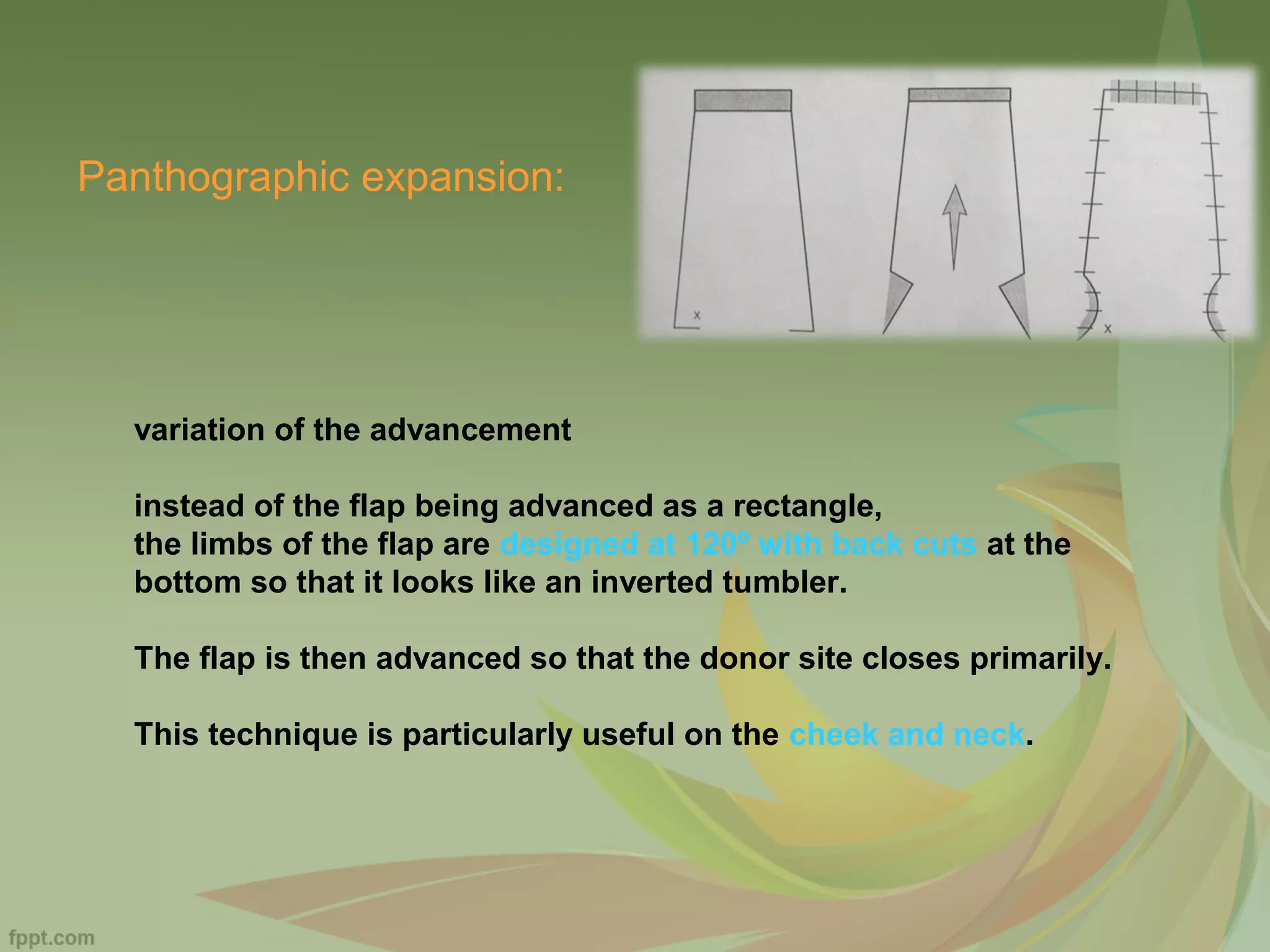
Panthographic expansion:
variation of the advancement
instead of the flap being advanced as a rectangle,
the limbs of the flap are designed at 120º with back cuts at the
bottom so that it looks like an inverted tumbler.
The flap is then advanced so that the donor site closes primarily.
This technique is particularly useful on the cheek and neck.
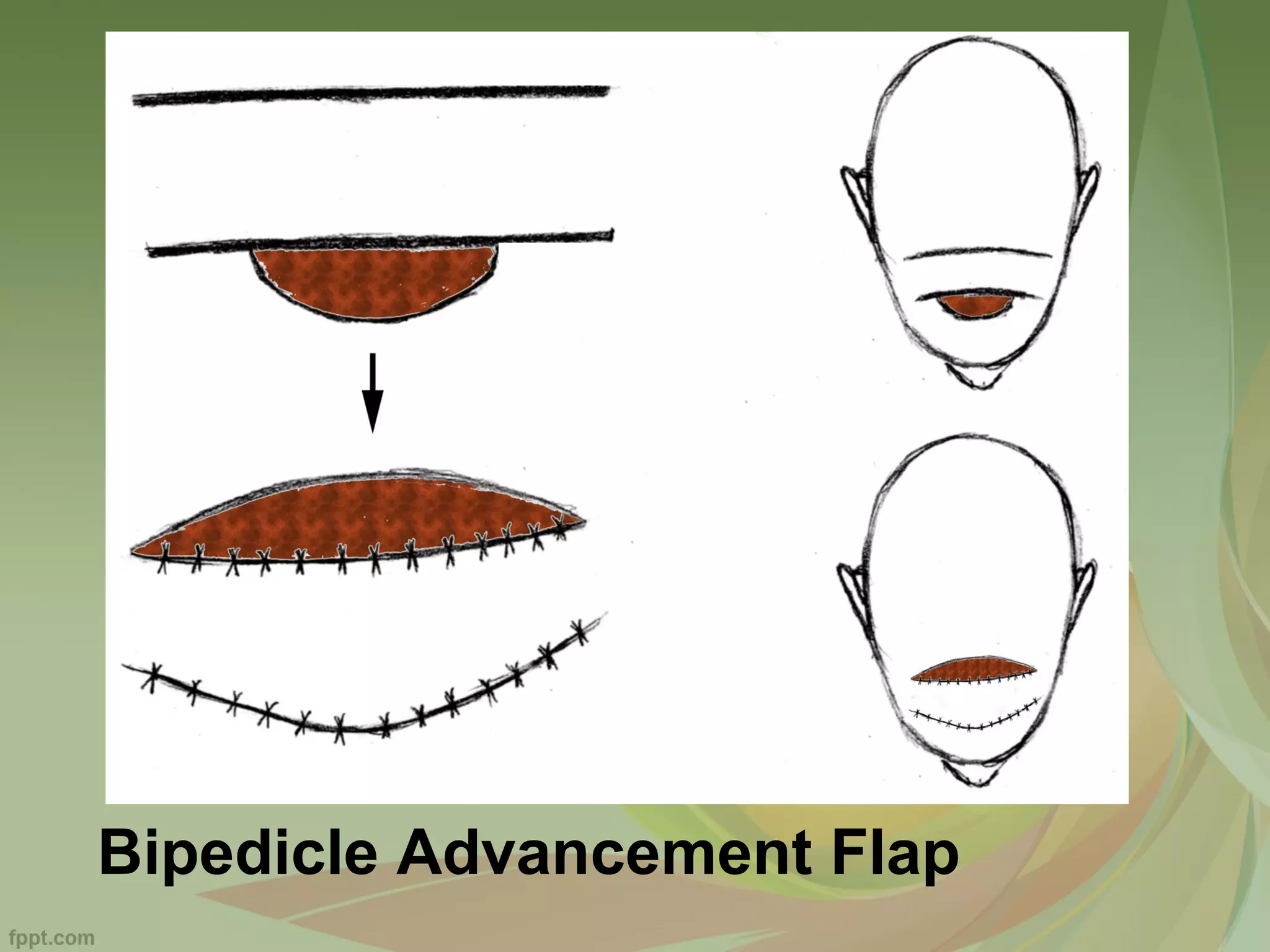
Bipedicle Advancement Flap
Pivot flaps:
Derives its name from the pivot point at the base of the flap
as well as its arc of rotation .
When flap moves laterally into the primary defect - transposition flap
when it is rotated into the defect - rotation flap
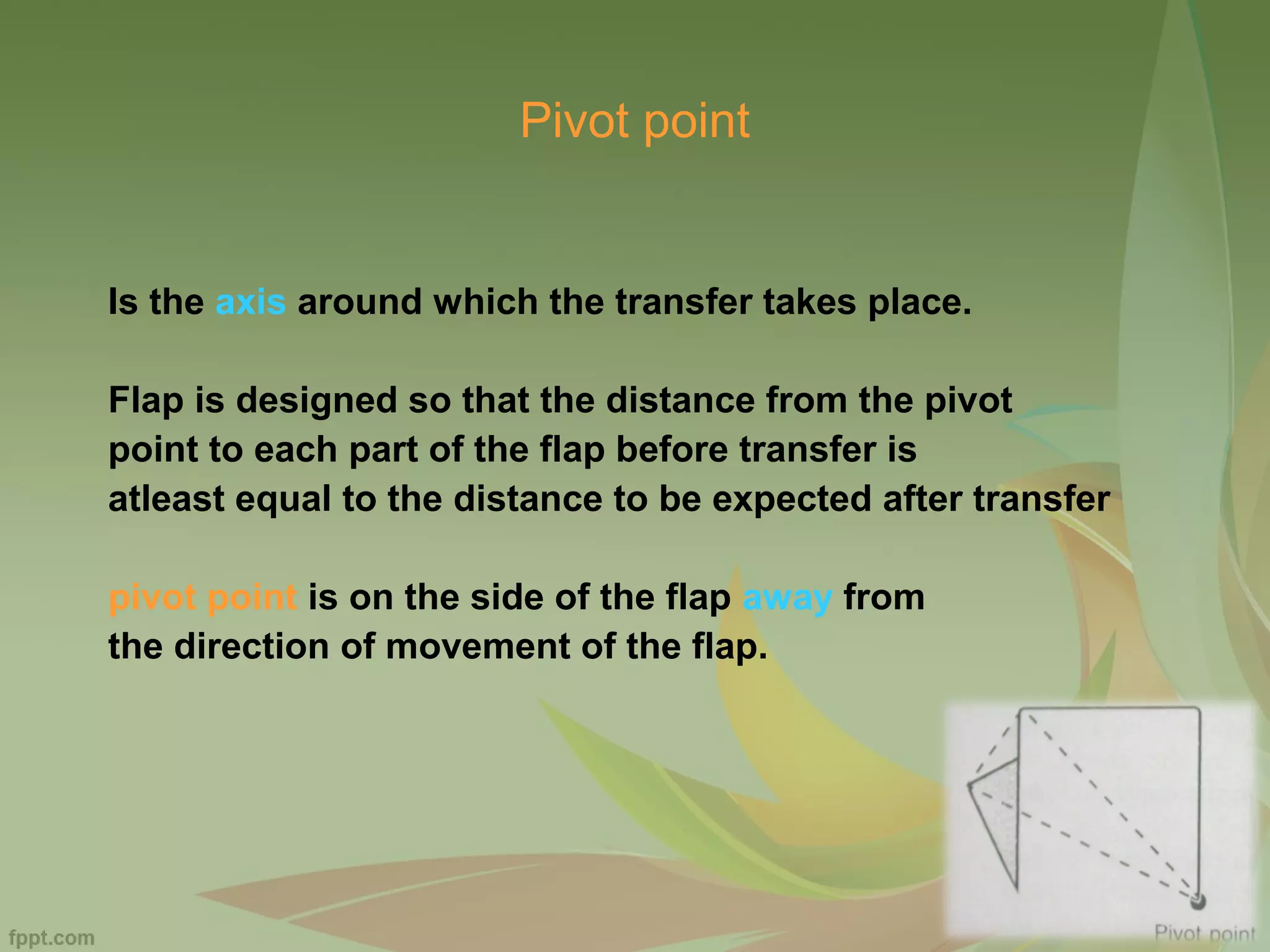
Pivot point
Is the axis around which the transfer takes place.
Flap is designed so that the distance from the pivot
point to each part of the flap before transfer is
atleast equal to the distance to be expected after transfer
pivot point is on the side of the flap away from
the direction of movement of the flap.
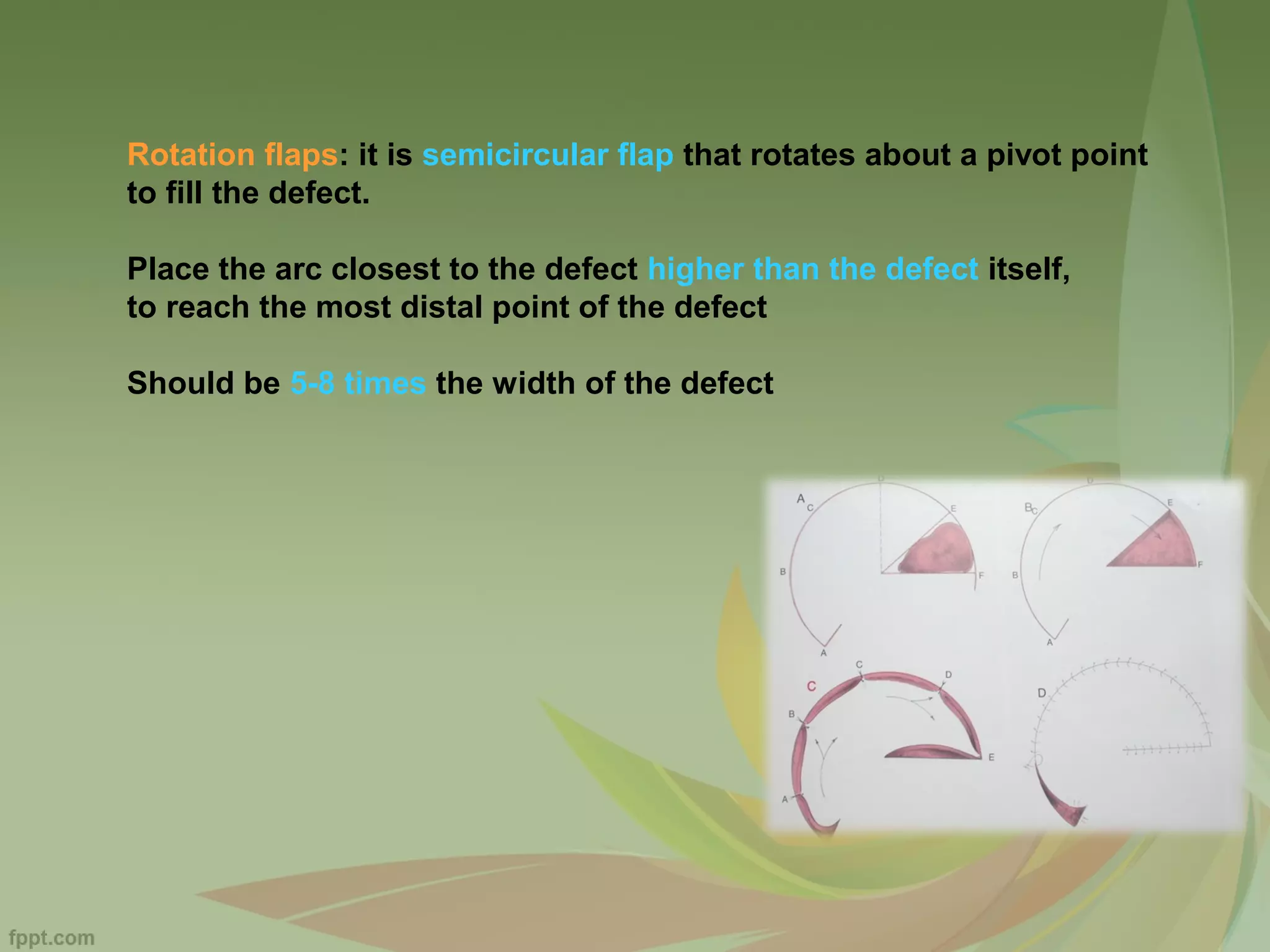
Rotation flaps: it is semicircular flap that rotates about a pivot point
to fill the defect.
Place the arc closest to the defect higher than the defect itself,
to reach the most distal point of the defect
Should be 5-8 times the width of the defect
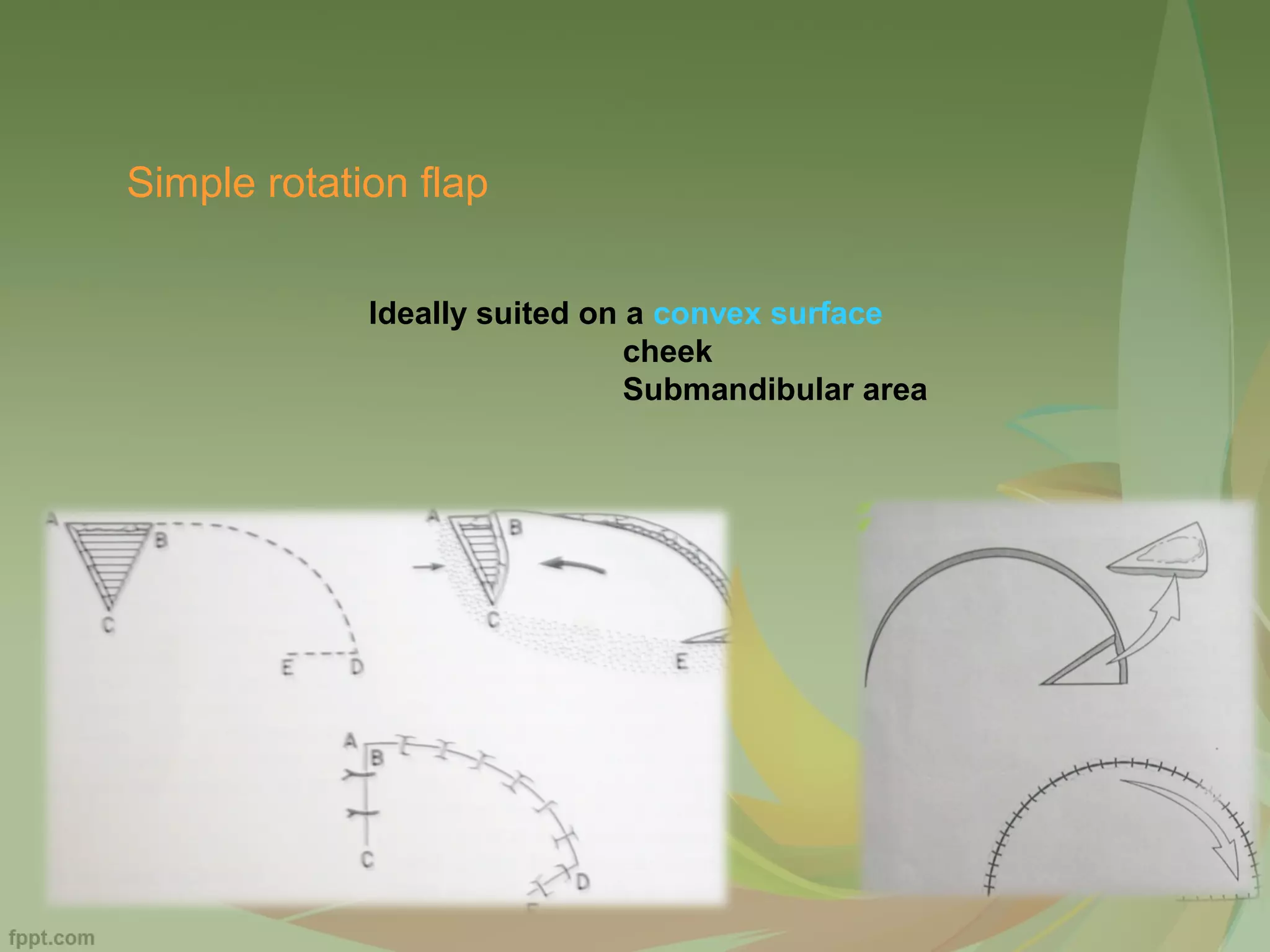
Simple rotation flap
Ideally suited on a convex surface
cheek
Submandibular area
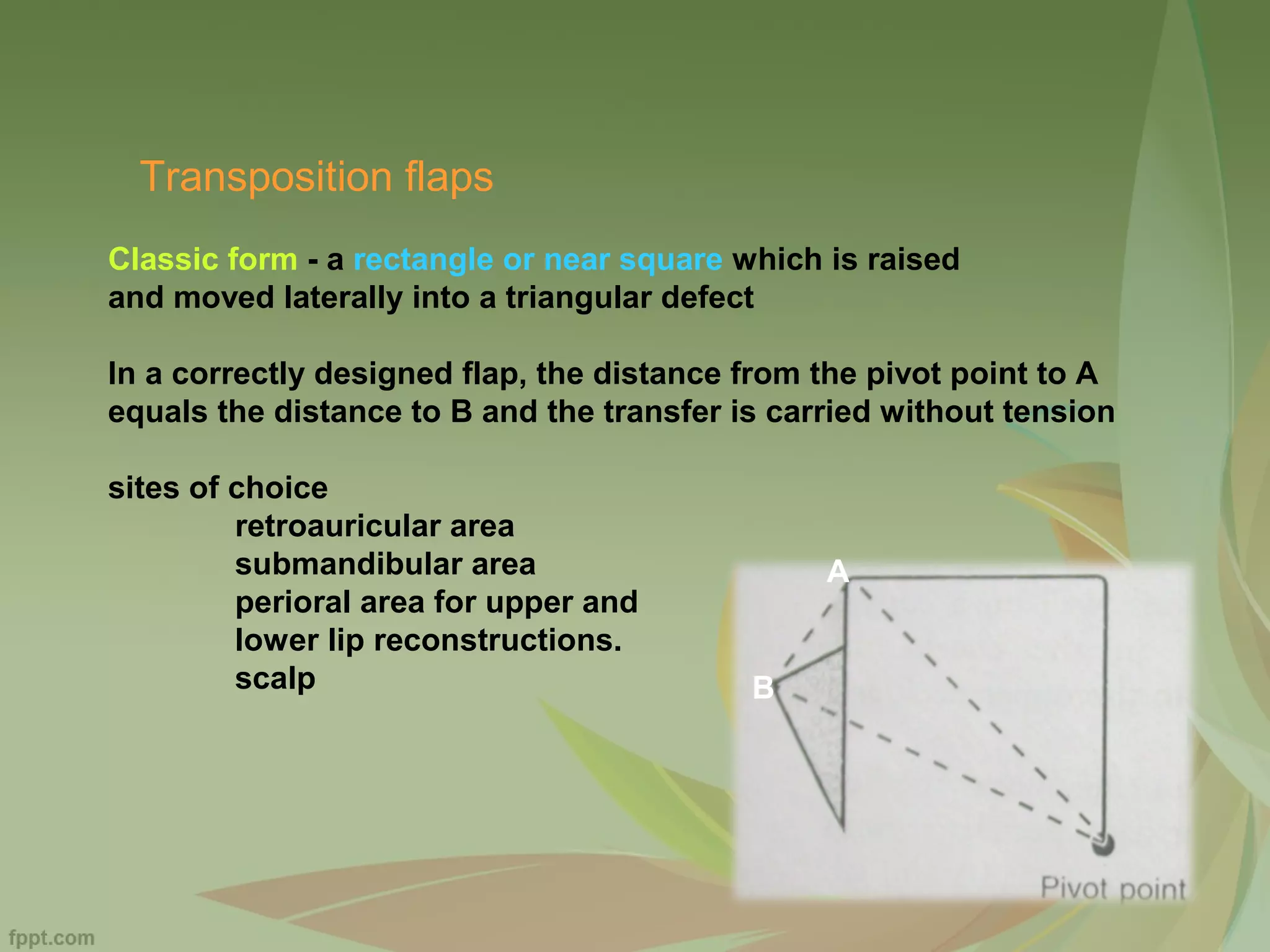
Classic form - a rectangle or near square which is raised
and moved laterally into a triangular defect
In a correctly designed flap, the distance from the pivot point to A
equals the distance to B and the transfer is carried without tension
sites of choice
retroauricular area
submandibular area
perioral area for upper and
lower lip reconstructions.
scalp
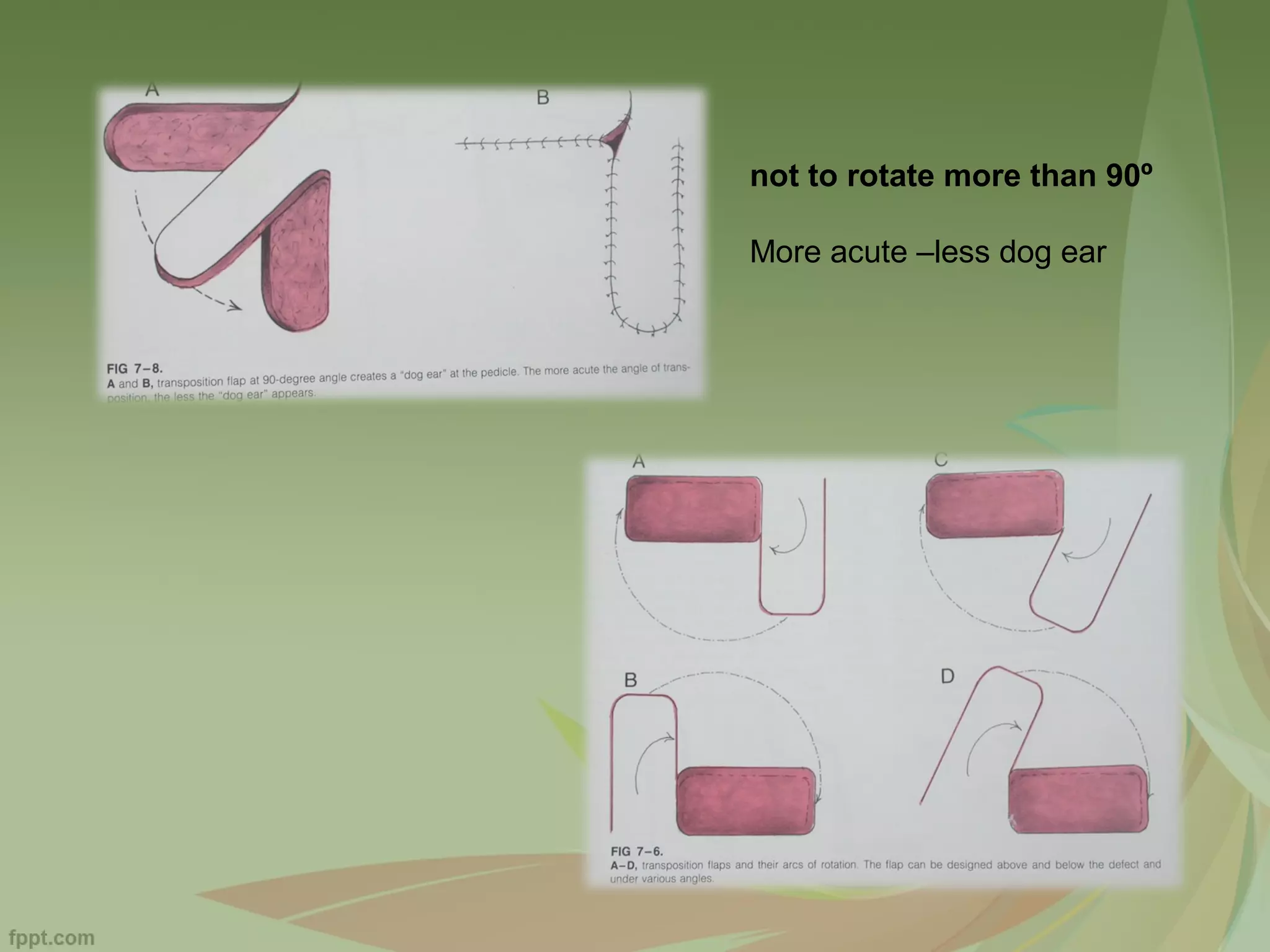
Transposition flaps
A
B
not to rotate more than 90º
More acute –less dog ear
Transposition flap
Limberg’s flap:
combination of flap rotation and
transposition
Disadvantages:
Excess tension
Anatomic landmark displacement because the tissue used to resurface
the rhomboid defect is borrowed from single area.
Rotation pucker at Point C
Best in temple region between the eyebrows and anterior hair line
BD=DE=EF
EF at angle of 60º &
Parallel to one side
Limberg’s flap
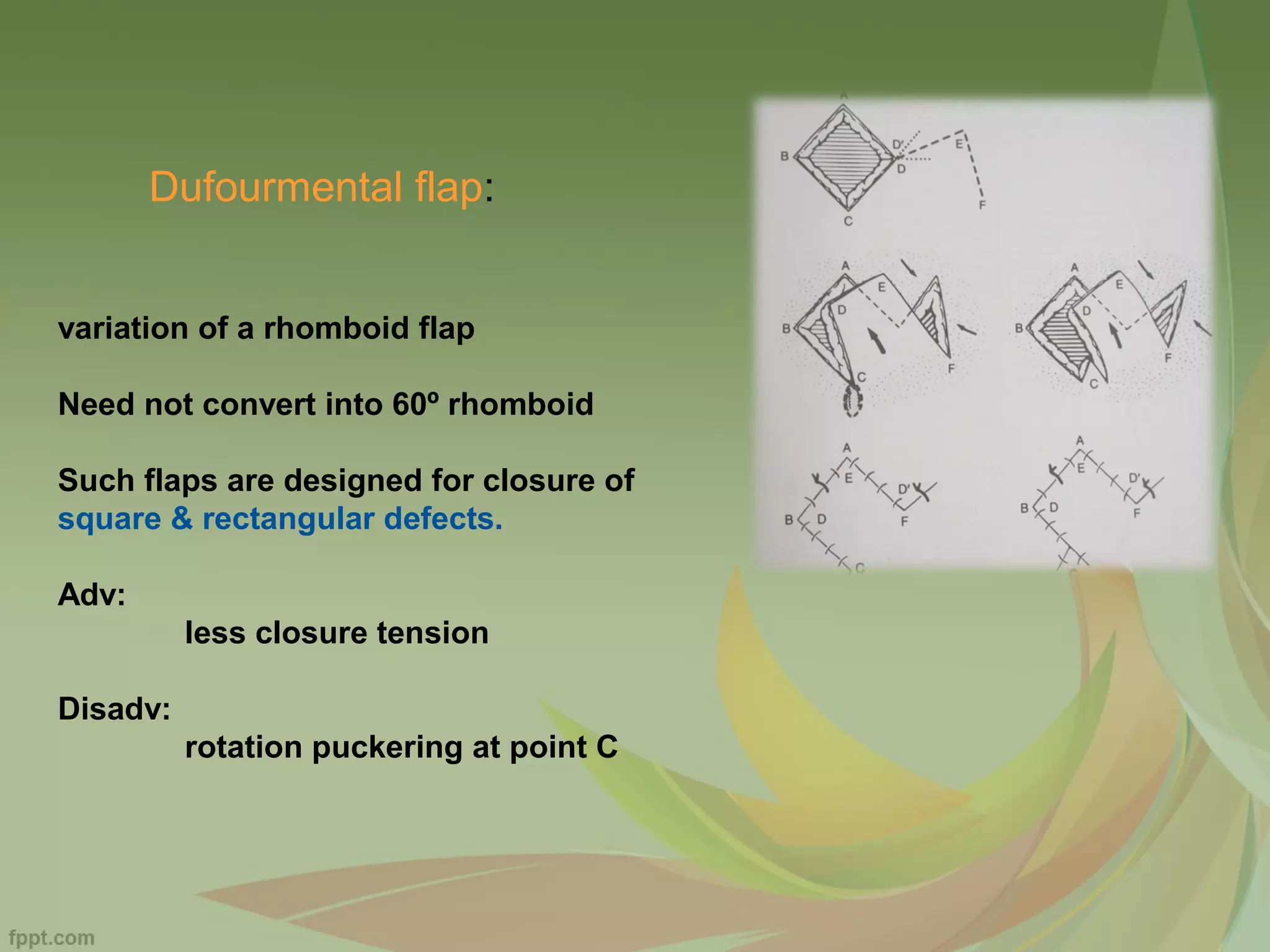
Dufourmental flap:
variation of a rhomboid flap
Need not convert into 60º rhomboid
Such flaps are designed for closure of
square & rectangular defects.
Adv:
less closure tension
Disadv:
rotation puckering at point C
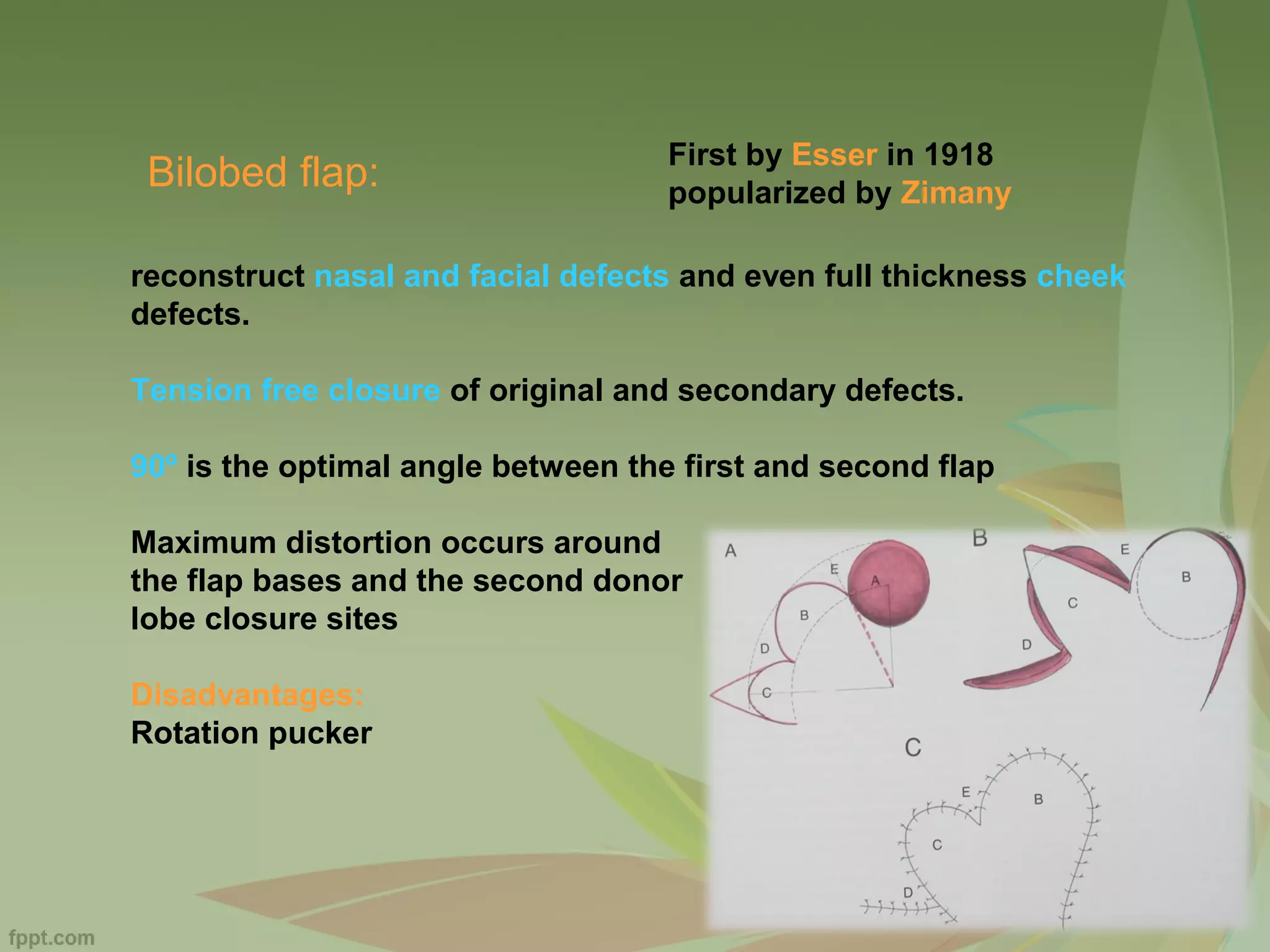
Bilobed flap:
First by Esser in 1918
popularized by Zimany
reconstruct nasal and facial defects and even full thickness cheek
defects.
Tension free closure of original and secondary defects.
90º is the optimal angle between the first and second flap
Maximum distortion occurs around
the flap bases and the second donor
lobe closure sites
Disadvantages:
Rotation pucker
Interpolation flaps:
An interpolation flap is from a nearby, but not immediately
adjacent donor Site and transposed either above or below
the intervening skin to the Recipient defect
Types:
Cutaneous: requires two stage procedure but more reliable
Subcutaneous
Island
Ex: Median forehead flap
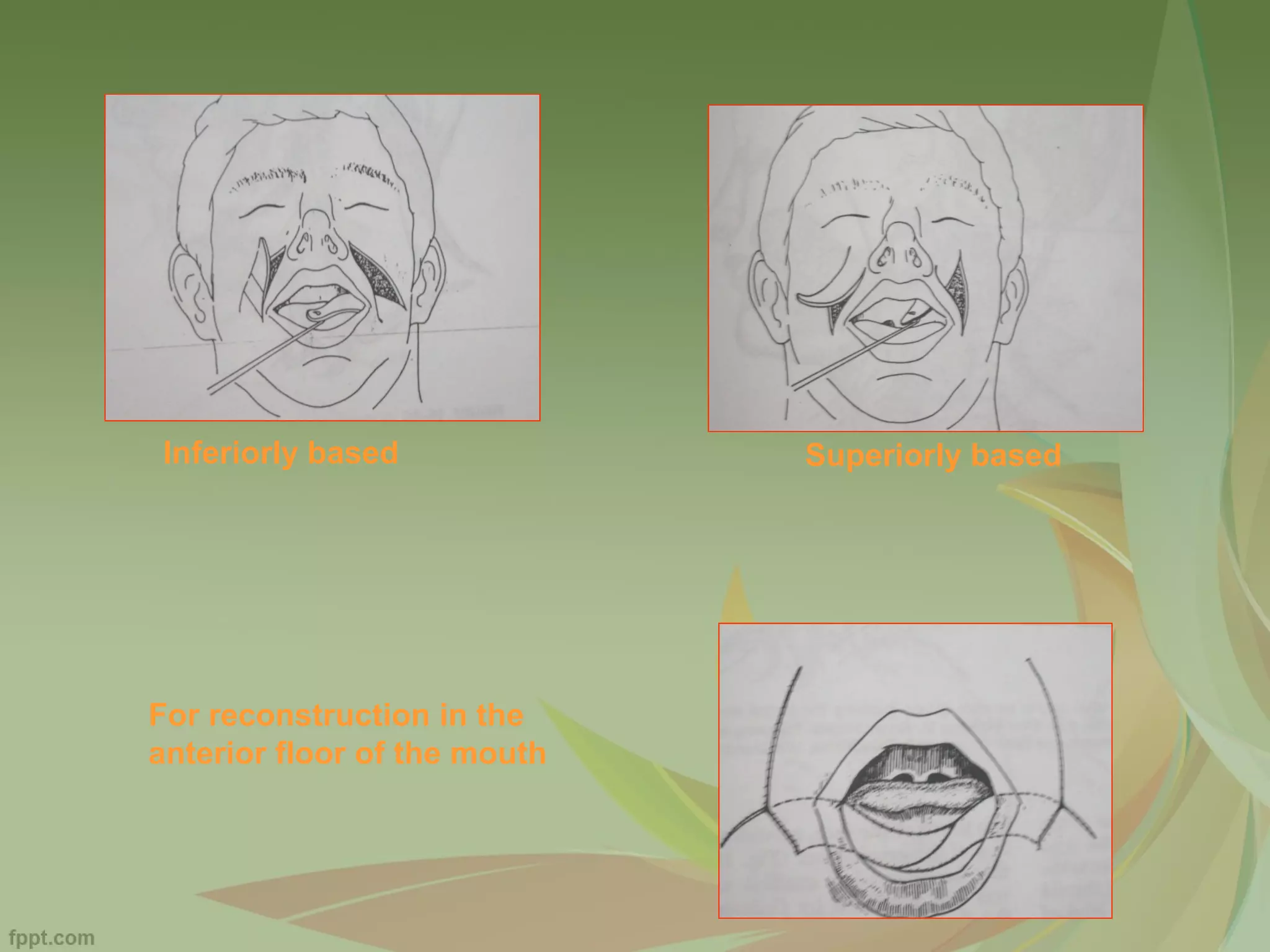
Nasolabial flap
Nasolabial flap:
Sushruta in 600 BC
popularized by Esser and Ganzer
reconstruction of facial skin defects of the upper lip,
nose and cheek following extirpation of skin cancers.
superiorly based nasolabial flap- closure of the oro antral fistulae.
The bilateral inferiorly based nasolabial flap has utility in the reconstruction
of the anterior defects of the floor of the mouth.
Defect in the anterior face, nose and upper lip, floor of the mouth
OAF
Inferiorly based Superiorly based
For reconstruction in the
anterior floor of the mouth
Case photos-Nasolabial flap
Forehead flaps
• The forehead flap is an axial flap used to reconstruct
defects below the level of the eyes.
.
• The most commonly raised forehead flap is the
cutaneous axial median forehead flap, based on the
supratrochlear artery.
• It can be raised and transposed to reconstruct areas
in the upper medial cheek region and the lower half of
the nose and alar rim
• If a radial forearm flap fails in the mouth and an
immediate, reliable 'lifeboat' is required; the forehead
flap may be quickly raised to get the surgeon out of
trouble!
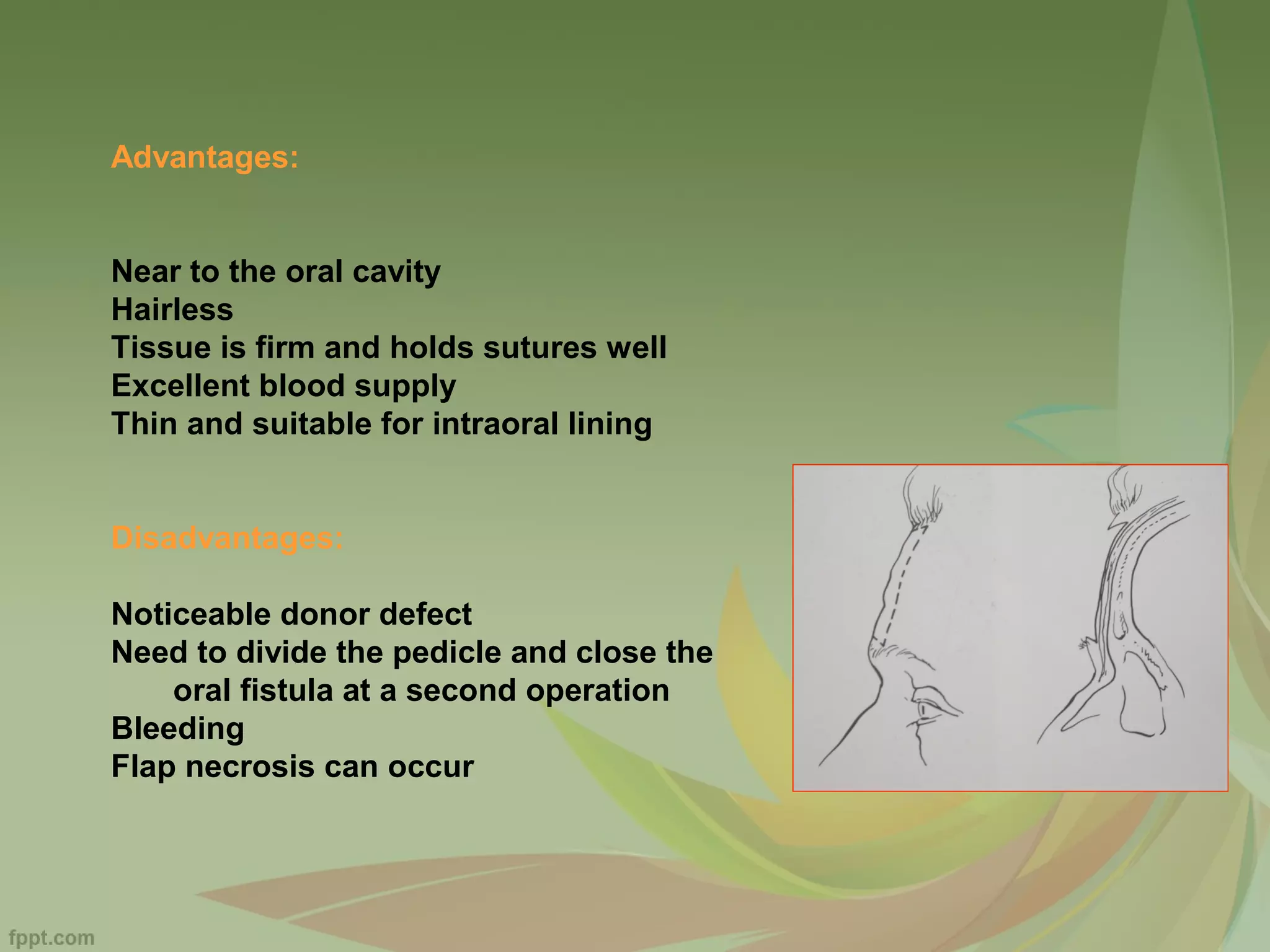
Forehead flap: McGregor.
Blood supply
superficial temporal artery and posterior auricular artery.
Hemiforehead flap or total forehead flap
Advantages:
Near to the oral cavity
Hairless
Tissue is firm and holds sutures well
Excellent blood supply
Thin and suitable for intraoral lining
Disadvantages:
Noticeable donor defect
Need to divide the pedicle and close the
oral fistula at a second operation
Bleeding
Flap necrosis can occur
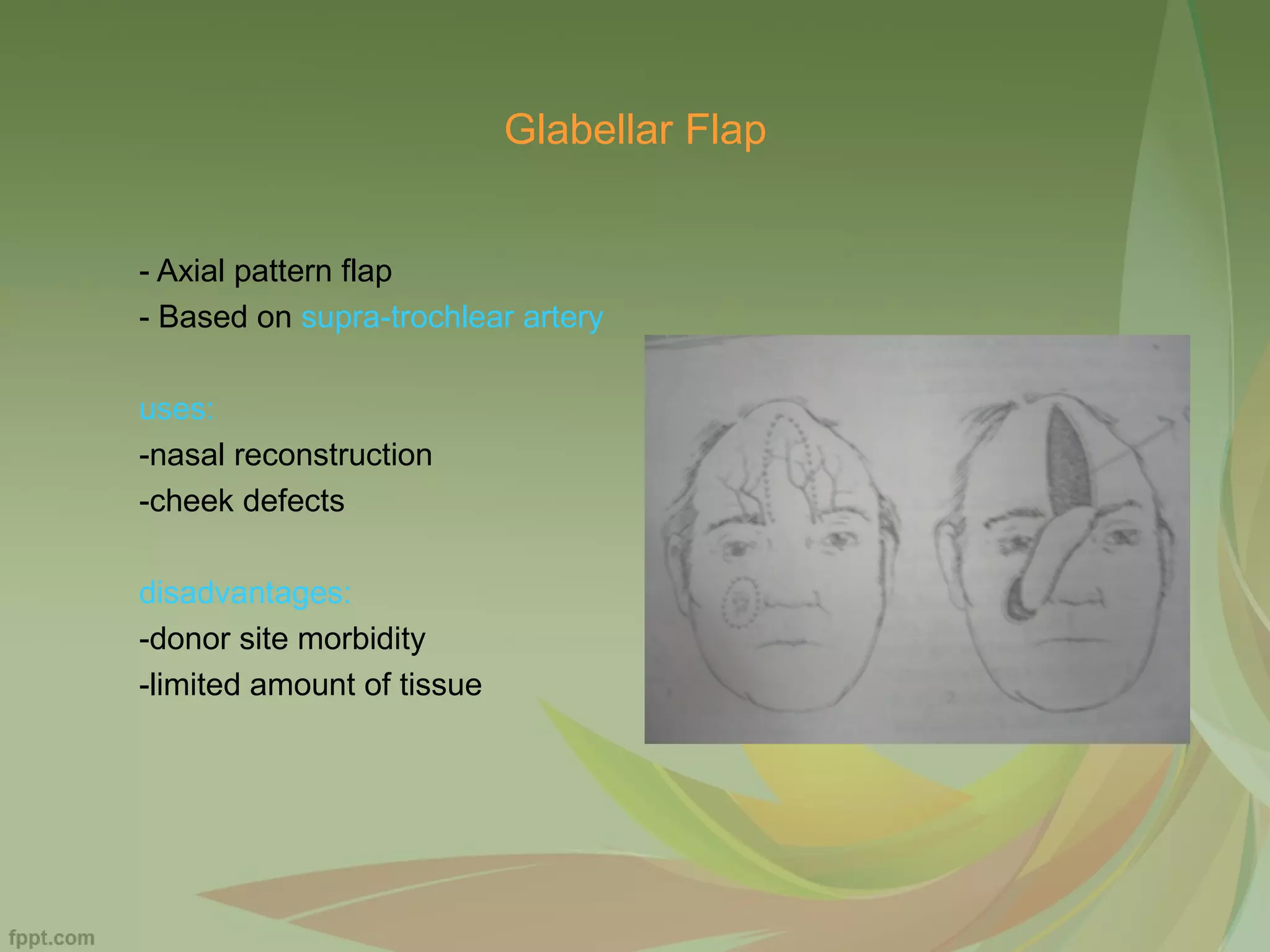
Glabellar Flap
- Axial pattern flap
- Based on supra-trochlear artery
uses:
-nasal reconstruction
-cheek defects
disadvantages:
-donor site morbidity
-limited amount of tissue
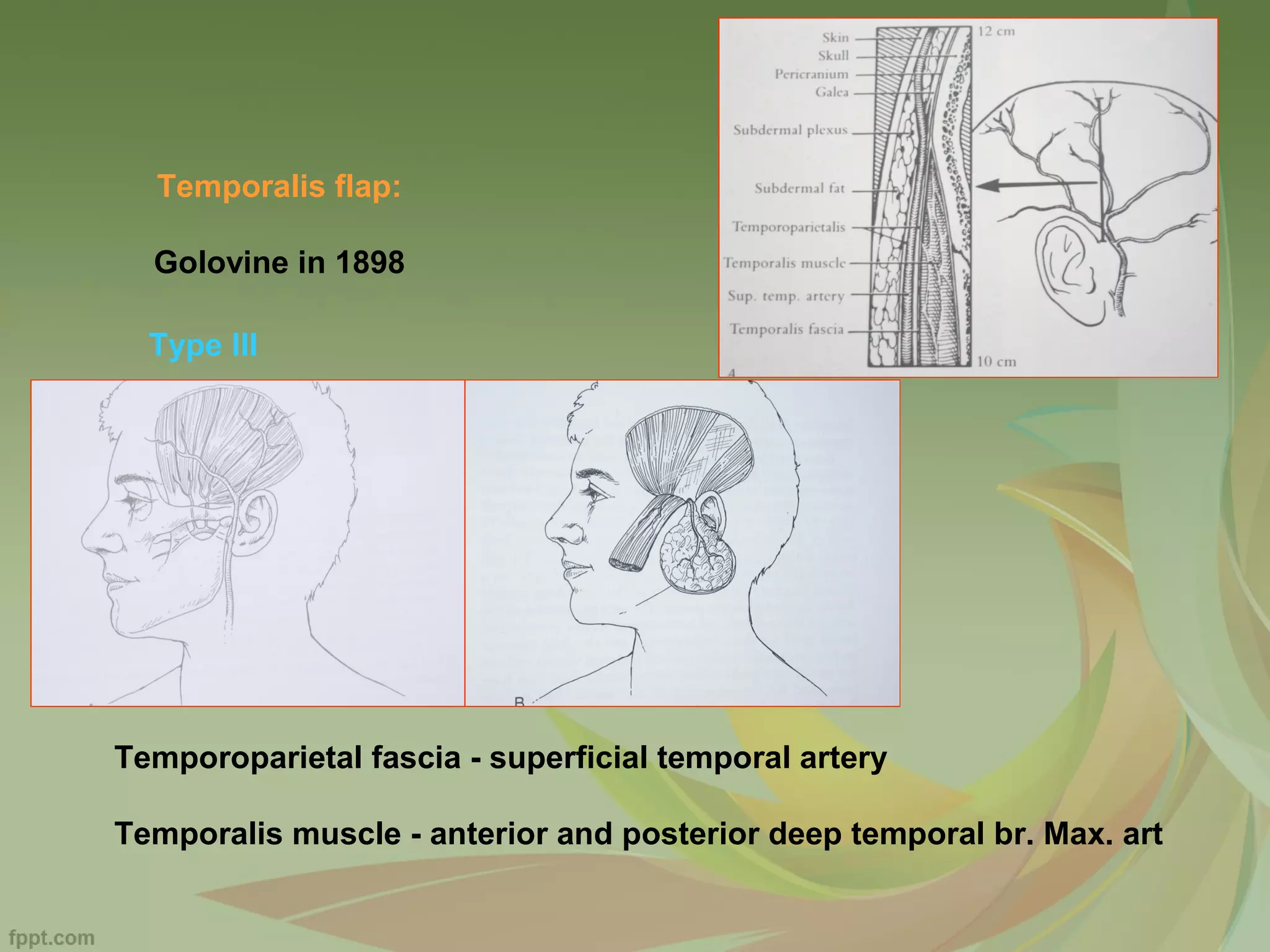
Temporalis flap:
Golovine in 1898
Temporoparietal fascia - superficial temporal artery
Temporalis muscle - anterior and posterior deep temporal br. Max. art
Type III
Uses:
• Useful for obliterating skull base, maxillofacial and
orbital defects.
• It is also used in cranialisation procedure
• Reanimation of the face
• Used to close CSF leaks & dural tears secondary to
trauma & cancer surgeries.
• Used for midface augmentation for hypoplasia
secondary to trauma & congenital anomalies.
Advantages:
• Close to the oral cavity
• Good arc of rotation
• Reliable and well tolerated
• Thin flap
• Problems from the loss of muscle function are
minimal
Disadvantages:
• Cosmetic deformity in donor site
• Traction paresis of Facial nerve
Temporalis flap
•Ideal for Aged patient
•Defects of 4x4 to 6x7 cm.
•based laterally
•It involves lower cheek and upper neck
•useful, well tolerated flap for closing cheek defects with or without an
associated neck dissection.
•maxillary artery, vein and their branches-blood supply
Cervicofacial flap:
Postoperative Care
• Pain reliever
• Wound care
• antibiotic ointment
• Sutures removed at 5-7 days
• Revision if required - 6 months
Complications
• Infection
• Dehiscence
• Vascular insufficiency due to
• Mechanical tension
• Kinking
• compression
• Hematoma/seroma
• Failure/necrosis
PREVENTION OF FLAP NECROSIS
Important steps to prevent necrosis :
1.Avoiding tension by prior establishing pivot point or using
planning in reverse if local flap is jumping over intact skin
.
2. Planning the flap with a margin of reserve is an
additional way in which tension can be avoided.
3.Avoding kinking particularly at the base of the flap.
4.In random flap proper length: breadth ratio should be
PREVENTION OF FLAP NECROSIS
5.In axial flap , length does not extend recognized safe
length.
6.Proper plane for flap elevation for raising flap.
7. No compression at pedicle
8.Using delay principal when it was considered
inadequate .
9.Avoiding infection : prevention of hematoma and
avoidance of raw area .
Local flaps in head & neack reconstruction

Local flaps in head & neack reconstruction

  • 2.
    Definition : A flapis a unit of tissue that is transferred from donor site to recipient site while maintaining its own blood supply. Term “Flap” : Originated from the 16th century Dutch word “FLAPPE” which means “anything that hung broad and loose, fastened only by one side”.
  • 3.
    BASED ON LOCATIONOF DONOR SITE LOCAL FLAP: Flap transferred from an area adjacent to the defect. DISTANT FLAP : Flap transferred from an noncontiguous anatomic site.
  • 5.
  • 6.
  • 7.
    Random flaps • Basedon the rich sub -dermal vascular plexus of the skin. • Most of the local flap are random flaps. • length : breadth ratio of up to 3 : 1 in the face.
  • 8.
    Axial flaps • Derivetheir blood supply from a direct cutaneous artery or named blood vessel . • Examples :Nasolabial flap (angular artery) , Forehead flap(supratrochlear artery). • The surviving length of an axial pattern flap is entirely related to the length of the included artery.
  • 9.
    Type I: onevascular pedicle Type II: dominant pedicle (s) + minor pedicles Type III: two dominant pedicles Type IV: Segmental vascular pedicles Type V: dominant pedicle + secondary segmental pedicles Based on vascular pedicle types In muscles Mathes and Nahai (1979)
  • 11.
    3. Based oncomposition Skin (cutaneous) Visceral ( colon, omentum) Muscle Mucosal Composite Fasciocutaneous Myocutaneous Osseocutaneous Tendocutaneous Sensory/innervated flaps Osseo-myo-cutaneous
  • 12.
    Local / Regionalflaps – Goals (Kinnerw & Jeter) 1. Adequate color match 2. Adequate thickness – avoid protrusions or deficiencies 3. Preservation of clinically perceivable sensory innervation 4. Sufficient laxity – avoid retraction or deranged function 5. Resultant suture lines of either primary or secondary defects are restricted to anatomic units and fall within natural skin lines.
  • 13.
    FLAP MODIFICATION Modifications andrefinements in both technique and design of flaps have been used for the optimal result in reconstructive surgery. Important modifications are : 1. Flap delay. 2. Tissue expansion.
  • 14.
    1. DELAY PHENOMENON Itcan be defined as “ preliminary surgical intervention wherein a portion of the vascular supply to a flap is divided before definitive elevation and transfer of the flap”.
  • 15.
    2. TISSUE EXPANSION 1957: Neumann is credited with the first modern report of this technique. 1976 : Radovan further described the use of this technique for breast reconstruction. Advantages : 1. Reconstruction with tissue of a similar colour and texture to that of the donor defect. 2. Reconstruction with sensate skin containing skin appendages. 3. Limited donor-site deformity.
  • 16.
    Planning and designof local flap • Facial defects most common – Trauma – Skin malignancies • Treatment – secondary healing – skin graft – local flaps
  • 17.
    Advancement flaps flap movesin a straight path without any lateral movement into the primary defect. (Burrows Triangle’s) sites – forehead, brow, cheek. Single advancement flap: movement is entirely in one direction.
  • 18.
  • 20.
    Bilateral advancement flap: Whenlarge tissue is required. Same technique & principle. used: forehead, mustache area and posterior neck.
  • 21.
    variant of bilateraladvancement flap Useful for defects at the periphery of the face around the nasal ala and upper lip dog–ear almost always forms Disadvantages: number of scars- created with the three limbs and Burow’s triangle and with the three point closure A to T flap:
  • 22.
    V-y advancement flap:(Herbert flap) A V shaped flap is moved into a defect with primary closure of the donor area leaving a final Y shaped suture line. It is pedicled from the underlying subcutaneous tissue rather than the surrounding skin. Ideal for Lesion in the cheek and alar base
  • 24.
    Panthographic expansion: variation ofthe advancement instead of the flap being advanced as a rectangle, the limbs of the flap are designed at 120º with back cuts at the bottom so that it looks like an inverted tumbler. The flap is then advanced so that the donor site closes primarily. This technique is particularly useful on the cheek and neck.
  • 25.
  • 26.
    Pivot flaps: Derives itsname from the pivot point at the base of the flap as well as its arc of rotation . When flap moves laterally into the primary defect - transposition flap when it is rotated into the defect - rotation flap
  • 27.
    Pivot point Is theaxis around which the transfer takes place. Flap is designed so that the distance from the pivot point to each part of the flap before transfer is atleast equal to the distance to be expected after transfer pivot point is on the side of the flap away from the direction of movement of the flap.
  • 28.
    Rotation flaps: itis semicircular flap that rotates about a pivot point to fill the defect. Place the arc closest to the defect higher than the defect itself, to reach the most distal point of the defect Should be 5-8 times the width of the defect
  • 29.
    Simple rotation flap Ideallysuited on a convex surface cheek Submandibular area
  • 30.
    Classic form -a rectangle or near square which is raised and moved laterally into a triangular defect In a correctly designed flap, the distance from the pivot point to A equals the distance to B and the transfer is carried without tension sites of choice retroauricular area submandibular area perioral area for upper and lower lip reconstructions. scalp Transposition flaps A B
  • 31.
    not to rotatemore than 90º More acute –less dog ear
  • 32.
  • 33.
    Limberg’s flap: combination offlap rotation and transposition Disadvantages: Excess tension Anatomic landmark displacement because the tissue used to resurface the rhomboid defect is borrowed from single area. Rotation pucker at Point C Best in temple region between the eyebrows and anterior hair line BD=DE=EF EF at angle of 60º & Parallel to one side
  • 34.
  • 36.
    Dufourmental flap: variation ofa rhomboid flap Need not convert into 60º rhomboid Such flaps are designed for closure of square & rectangular defects. Adv: less closure tension Disadv: rotation puckering at point C
  • 37.
    Bilobed flap: First byEsser in 1918 popularized by Zimany reconstruct nasal and facial defects and even full thickness cheek defects. Tension free closure of original and secondary defects. 90º is the optimal angle between the first and second flap Maximum distortion occurs around the flap bases and the second donor lobe closure sites Disadvantages: Rotation pucker
  • 40.
    Interpolation flaps: An interpolationflap is from a nearby, but not immediately adjacent donor Site and transposed either above or below the intervening skin to the Recipient defect Types: Cutaneous: requires two stage procedure but more reliable Subcutaneous Island Ex: Median forehead flap Nasolabial flap
  • 41.
    Nasolabial flap: Sushruta in600 BC popularized by Esser and Ganzer reconstruction of facial skin defects of the upper lip, nose and cheek following extirpation of skin cancers. superiorly based nasolabial flap- closure of the oro antral fistulae. The bilateral inferiorly based nasolabial flap has utility in the reconstruction of the anterior defects of the floor of the mouth. Defect in the anterior face, nose and upper lip, floor of the mouth OAF
  • 42.
    Inferiorly based Superiorlybased For reconstruction in the anterior floor of the mouth
  • 43.
  • 44.
    Forehead flaps • Theforehead flap is an axial flap used to reconstruct defects below the level of the eyes. . • The most commonly raised forehead flap is the cutaneous axial median forehead flap, based on the supratrochlear artery. • It can be raised and transposed to reconstruct areas in the upper medial cheek region and the lower half of the nose and alar rim • If a radial forearm flap fails in the mouth and an immediate, reliable 'lifeboat' is required; the forehead flap may be quickly raised to get the surgeon out of trouble!
  • 45.
    Forehead flap: McGregor. Bloodsupply superficial temporal artery and posterior auricular artery. Hemiforehead flap or total forehead flap
  • 46.
    Advantages: Near to theoral cavity Hairless Tissue is firm and holds sutures well Excellent blood supply Thin and suitable for intraoral lining Disadvantages: Noticeable donor defect Need to divide the pedicle and close the oral fistula at a second operation Bleeding Flap necrosis can occur
  • 47.
    Glabellar Flap - Axialpattern flap - Based on supra-trochlear artery uses: -nasal reconstruction -cheek defects disadvantages: -donor site morbidity -limited amount of tissue
  • 49.
    Temporalis flap: Golovine in1898 Temporoparietal fascia - superficial temporal artery Temporalis muscle - anterior and posterior deep temporal br. Max. art Type III
  • 50.
    Uses: • Useful forobliterating skull base, maxillofacial and orbital defects. • It is also used in cranialisation procedure • Reanimation of the face • Used to close CSF leaks & dural tears secondary to trauma & cancer surgeries. • Used for midface augmentation for hypoplasia secondary to trauma & congenital anomalies.
  • 51.
    Advantages: • Close tothe oral cavity • Good arc of rotation • Reliable and well tolerated • Thin flap • Problems from the loss of muscle function are minimal Disadvantages: • Cosmetic deformity in donor site • Traction paresis of Facial nerve
  • 52.
  • 53.
    •Ideal for Agedpatient •Defects of 4x4 to 6x7 cm. •based laterally •It involves lower cheek and upper neck •useful, well tolerated flap for closing cheek defects with or without an associated neck dissection. •maxillary artery, vein and their branches-blood supply Cervicofacial flap:
  • 54.
    Postoperative Care • Painreliever • Wound care • antibiotic ointment • Sutures removed at 5-7 days • Revision if required - 6 months
  • 55.
    Complications • Infection • Dehiscence •Vascular insufficiency due to • Mechanical tension • Kinking • compression • Hematoma/seroma • Failure/necrosis
  • 56.
    PREVENTION OF FLAPNECROSIS Important steps to prevent necrosis : 1.Avoiding tension by prior establishing pivot point or using planning in reverse if local flap is jumping over intact skin . 2. Planning the flap with a margin of reserve is an additional way in which tension can be avoided. 3.Avoding kinking particularly at the base of the flap. 4.In random flap proper length: breadth ratio should be
  • 57.
    PREVENTION OF FLAPNECROSIS 5.In axial flap , length does not extend recognized safe length. 6.Proper plane for flap elevation for raising flap. 7. No compression at pedicle 8.Using delay principal when it was considered inadequate . 9.Avoiding infection : prevention of hematoma and avoidance of raw area .

Editor's Notes

  • #7 Local flaps can be classified based on their blood supply