 Non Invasive Optical technique
 Real time visualisation
 In situ examination of
Pattern of vascularisation
Cellular architecture of the superficial
layers of the mucosa.
 Hamou, 1979
Cervical & Uterine epithelial cells.
 Andrea et al, 1990
Pathologies of larynx
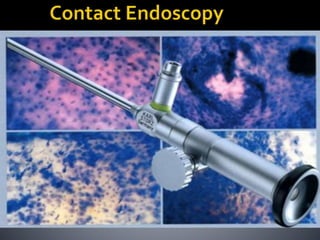
 Magnified images -Hopkins’ rod-lens
endoscope placed on the surface of the dye
stained mucosal tissue.
 Allows assessment of precancerous and
cancerous lesions in vivo
 Has significant potential in the
histopathologic diagnosis of many suspicious
head and neck mucosal lesions without tissue
biopsy.
Karl Storz, Germany
 7215 AA
 7215 BA
 Diameters of scopes- 4mm 5.5 mm
 Length- 23 cm 18 cm
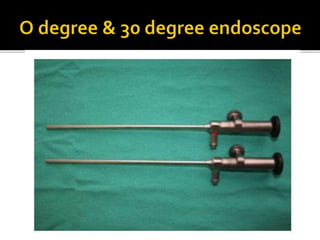
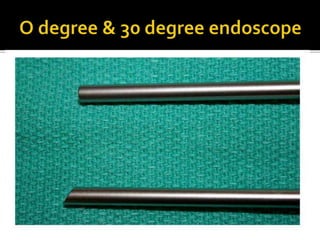
 Straight forward(O degree) & Forward-
Oblique telescopes(30 degree)
 Magnification- 1x 60x & 150x
 High intensity xenon light source
 Real time photographic & video
documentation
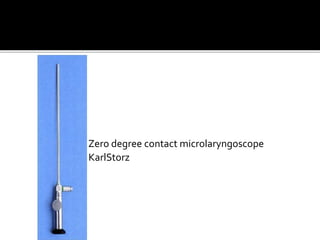
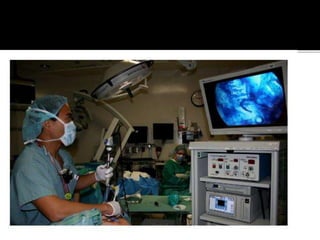
Zero degree contact microlaryngoscope
KarlStorz
 magnifying endoscope 0° placed in contact
against the mucosal surface,
Documented magnified cytological images (at
60x or 150x) are recorded
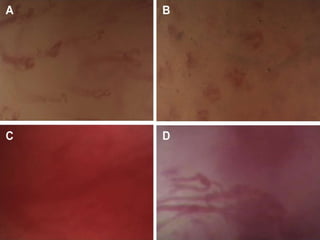
 Vascular patterns were studied without
staining as the stain prevents penetration of
light into submucosal plane where the blood
vessels lie.
 Staining of the superficial cells of the mucosa
with a contrast dye, 1% methylene blue
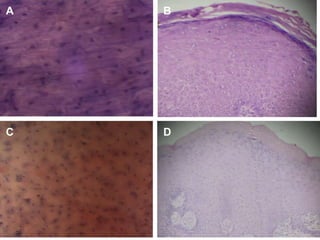
 homogeneousness of distribution of cells
 number of cells per field
 uniformity of nucleus
 staining, hyperchromatism, nuclear cytoplasmic
ratio,
 Nuclear & cellular pleomorphism, prominent
nucleoli, presence of mitotic figures
 pattern of distribution, branching & coiling of
blood vessels.
 rate of flow of RBCs inside the blood vessels seen
on CE of unstained lesion.
 Assess
Vocal cord
Nasal Mucosa
Nasopharynx
Oral Cavity
Oropharynx
Trachea
 For Oral Cavity & other accessible areas
can be used in outpatient dept
 Laryngeal Mucosa
passage of CE through a suspension
laryngoscope under Anaesthesia.
 Done under GA
 Transition from ciliated to squamous
epithelium can be observed.
Abnormality
 Metaplastic substitution of ciliated epithelium
by squamous in chronic smokers,GERD
patients.
 Chronic laryngitis- epithelial cells have larger
nuclei than normal & an increased
nuclear:cytoplasmic ratio.
 Keratosis detected easily- different stages of
keratinization can be seen.
 Leukoplakia- heterogeneity of cell populations
with nuclei of different colour,size & shape.
 Carcinoma- extreme heterogeneity of nuclear
size, shape & staining characteristics.
Enables assessment of transitional zone
between normal & abnormal mucosa
-a better evaluation of early stage disease.
 Laryngeal papillomata assessment &
management- Typical vascular loops in the
core of pappillomata.also koilocytes.
Normal-
 Squamous epithelium-anterior tip & inferior
border of Inferior turbinate, septum & nasal
vestibule.
 Ciliated epithelium- most of nasal cavity.
 Duct orifices of the gland –most prominent at
the anterior end of turbinate.
 Microvascular network
Useful in
Chronic rhinosinusitis
Allergic rhinitis
Nasal polyposis
Mucociliary diseases
 Chronic Rhinitis
Squamous epithelium covers most of inferior &
middle turbinate, anterior septum.
Area of keratosis predominate in the parts
exposed to turbulent air flow.
Overproduction of mucus.
 Allergic Rhintis
Papillae of glands larger than normal.
ciliated epithelium preserved.
 Nasal Polyps
Anterior surface covered by squamous
epithelium while rest ciliated cells.
Can detect metaplastic changes.
 Normal
Oral mucosa morphology varies from site to site
Masticatory mucosa covering hard palate &
gingiva is keratinised epithelium
Transition from keratinised epithelium in lip to
non keratinised epithelium of vestibule.
 Abnormality
Diagnosis of early cancer
Study of tumourmargins
Assessment of response to radiotherapy
& Chemotherapy
 Used in
Long term followup of patients treated for
Nasopharyngeal Carcinoma.
 Normally
Squamous epithelium in central & inferior part
of posterior wall.
Orifices of glandular duct throughout nose.
Abnormality
 Irregular vascular pattern-
atypical vessels,thrombosis,blood cell
aggregates & increased vascular fragility.
 Tissue fragile & bleed easily if probed firmly.
 Malignancy- anisokaryosis,heterochromasia &
hyperchromasia
 Non invasive, simple, quick, repeatable, in
vivo examination of cellular architecture and
vascular pattern of mucosa.
 Large and multiple areas examined quickly & in the
same sitting.
 Avoids tissue damage and changes in cells which
can occur due to biopsy and processing of tissue for
histopathological examination. Suspicious lesions
thus can be followed up serially.
 Can help in deciding precise site for taking biopsy
by identifying areas of cellular atypia which may
improve the yield of biopsy.
 Can help in deciding margins of resection
during tumour removal by differentiating
tumour.
 Results are known immediately.
 Can be employed both in out patient
department and operation theatre.
 Can be combined with other techniques like
autofluorescence (Compact Endoscopy).
 Video and still images can be stored and
reviewed as many time as necessary
 Inability to detect very early dysplasia
 differentiation of 'carcinoma in situ' from
'invasive carcinoma'.
 Accuracy & clinical applicability of contact
endoscopes will continue to improve by
- improvements in optical system, new cell
dyes, markers,fluorescent products,light
sources,image processing & better recording
techniques.
 Enable CE findings to be instrumental in
deciding the treatment modality both pre
operatively as well as during surgery.
 Combination of Autofluorescence & Contact
Endoscopy
 In autofluorescence endoscopy, an emission
spectrum fixed wavelength(375 to 440 nm), &
autofluorescence is measured in green spectrum
between 470 and 800 nm.
 Appearance & degree of autofluorescence depend
on structure of the examined tissue, mainly
content of fluorophores.
 Normal mucosa -bright green autofluorescence
*translucent elastic fibers in the lamina propria.
 Significant decrease in fluorescence intensity - in
areas with dysplastic & cancerous changes
 After visualization of the dysplastic or cancerous
hot spots by autofluorescence, contact endoscopy
was performed.
 Compact endoscopy
- useful method in the detection and
delineation of Precancerous
& Cancerous lesions.
-complementary tool supplementing
Microlaryngoscopy.
Contact and Compact Endoscopy in ENT

Contact and Compact Endoscopy in ENT

  • 3.
     Non InvasiveOptical technique  Real time visualisation  In situ examination of Pattern of vascularisation Cellular architecture of the superficial layers of the mucosa.
  • 4.
     Hamou, 1979 Cervical& Uterine epithelial cells.  Andrea et al, 1990 Pathologies of larynx
  • 5.
     Magnified images-Hopkins’ rod-lens endoscope placed on the surface of the dye stained mucosal tissue.  Allows assessment of precancerous and cancerous lesions in vivo  Has significant potential in the histopathologic diagnosis of many suspicious head and neck mucosal lesions without tissue biopsy.
  • 6.
    Karl Storz, Germany 7215 AA  7215 BA
  • 7.
     Diameters ofscopes- 4mm 5.5 mm  Length- 23 cm 18 cm  Straight forward(O degree) & Forward- Oblique telescopes(30 degree)  Magnification- 1x 60x & 150x  High intensity xenon light source  Real time photographic & video documentation
  • 10.
    Zero degree contactmicrolaryngoscope KarlStorz
  • 11.
     magnifying endoscope0° placed in contact against the mucosal surface, Documented magnified cytological images (at 60x or 150x) are recorded  Vascular patterns were studied without staining as the stain prevents penetration of light into submucosal plane where the blood vessels lie.
  • 12.
     Staining ofthe superficial cells of the mucosa with a contrast dye, 1% methylene blue
  • 14.
     homogeneousness ofdistribution of cells  number of cells per field  uniformity of nucleus  staining, hyperchromatism, nuclear cytoplasmic ratio,  Nuclear & cellular pleomorphism, prominent nucleoli, presence of mitotic figures  pattern of distribution, branching & coiling of blood vessels.  rate of flow of RBCs inside the blood vessels seen on CE of unstained lesion.
  • 15.
     Assess Vocal cord NasalMucosa Nasopharynx Oral Cavity Oropharynx Trachea
  • 16.
     For OralCavity & other accessible areas can be used in outpatient dept  Laryngeal Mucosa passage of CE through a suspension laryngoscope under Anaesthesia.
  • 17.
     Done underGA  Transition from ciliated to squamous epithelium can be observed.
  • 18.
    Abnormality  Metaplastic substitutionof ciliated epithelium by squamous in chronic smokers,GERD patients.  Chronic laryngitis- epithelial cells have larger nuclei than normal & an increased nuclear:cytoplasmic ratio.
  • 19.
     Keratosis detectedeasily- different stages of keratinization can be seen.  Leukoplakia- heterogeneity of cell populations with nuclei of different colour,size & shape.
  • 20.
     Carcinoma- extremeheterogeneity of nuclear size, shape & staining characteristics. Enables assessment of transitional zone between normal & abnormal mucosa -a better evaluation of early stage disease.  Laryngeal papillomata assessment & management- Typical vascular loops in the core of pappillomata.also koilocytes.
  • 24.
    Normal-  Squamous epithelium-anteriortip & inferior border of Inferior turbinate, septum & nasal vestibule.  Ciliated epithelium- most of nasal cavity.  Duct orifices of the gland –most prominent at the anterior end of turbinate.  Microvascular network
  • 25.
    Useful in Chronic rhinosinusitis Allergicrhinitis Nasal polyposis Mucociliary diseases
  • 26.
     Chronic Rhinitis Squamousepithelium covers most of inferior & middle turbinate, anterior septum. Area of keratosis predominate in the parts exposed to turbulent air flow. Overproduction of mucus.
  • 27.
     Allergic Rhintis Papillaeof glands larger than normal. ciliated epithelium preserved.  Nasal Polyps Anterior surface covered by squamous epithelium while rest ciliated cells. Can detect metaplastic changes.
  • 28.
     Normal Oral mucosamorphology varies from site to site Masticatory mucosa covering hard palate & gingiva is keratinised epithelium Transition from keratinised epithelium in lip to non keratinised epithelium of vestibule.
  • 29.
     Abnormality Diagnosis ofearly cancer Study of tumourmargins Assessment of response to radiotherapy & Chemotherapy
  • 32.
     Used in Longterm followup of patients treated for Nasopharyngeal Carcinoma.
  • 33.
     Normally Squamous epitheliumin central & inferior part of posterior wall. Orifices of glandular duct throughout nose.
  • 34.
    Abnormality  Irregular vascularpattern- atypical vessels,thrombosis,blood cell aggregates & increased vascular fragility.  Tissue fragile & bleed easily if probed firmly.  Malignancy- anisokaryosis,heterochromasia & hyperchromasia
  • 35.
     Non invasive,simple, quick, repeatable, in vivo examination of cellular architecture and vascular pattern of mucosa.
  • 36.
     Large andmultiple areas examined quickly & in the same sitting.  Avoids tissue damage and changes in cells which can occur due to biopsy and processing of tissue for histopathological examination. Suspicious lesions thus can be followed up serially.  Can help in deciding precise site for taking biopsy by identifying areas of cellular atypia which may improve the yield of biopsy.
  • 37.
     Can helpin deciding margins of resection during tumour removal by differentiating tumour.  Results are known immediately.  Can be employed both in out patient department and operation theatre.
  • 38.
     Can becombined with other techniques like autofluorescence (Compact Endoscopy).  Video and still images can be stored and reviewed as many time as necessary
  • 39.
     Inability todetect very early dysplasia  differentiation of 'carcinoma in situ' from 'invasive carcinoma'.
  • 40.
     Accuracy &clinical applicability of contact endoscopes will continue to improve by - improvements in optical system, new cell dyes, markers,fluorescent products,light sources,image processing & better recording techniques.  Enable CE findings to be instrumental in deciding the treatment modality both pre operatively as well as during surgery.
  • 41.
     Combination ofAutofluorescence & Contact Endoscopy
  • 42.
     In autofluorescenceendoscopy, an emission spectrum fixed wavelength(375 to 440 nm), & autofluorescence is measured in green spectrum between 470 and 800 nm.  Appearance & degree of autofluorescence depend on structure of the examined tissue, mainly content of fluorophores.
  • 43.
     Normal mucosa-bright green autofluorescence *translucent elastic fibers in the lamina propria.  Significant decrease in fluorescence intensity - in areas with dysplastic & cancerous changes  After visualization of the dysplastic or cancerous hot spots by autofluorescence, contact endoscopy was performed.
  • 45.
     Compact endoscopy -useful method in the detection and delineation of Precancerous & Cancerous lesions. -complementary tool supplementing Microlaryngoscopy.

Editor's Notes

  • #4 Contact Endoscopy is essentially a noninvasive, optical technique of visualisation which helps real time and in situ examination of the pattern of vascularisation as well as cellular architecture of the superficial layers of the mucosa
  • #5 1865 by desormeaux who obtained a direct view of bladder mucosa. CE was originally described and used by Hamou in 1979 as a technique for visualization of cervical and uterine epithelial cells for screening and diagnosis of cervical and uterine pathology  The first reported use of CE in otolaryngology head and neck surgery was by Andrea et al. as a diagnostic tool in the evaluation of various pathologies in the larynx in the 1990s
  • #6 Magnified images are obtained using Hopkins’ rod-lens endoscope placed on the surface of the dye stained mucosal tissue. This technique allows assessment of precancerous and cancerous lesions in vivo and has significant potential in the histopathologic diagnosis of many suspicious head and neck mucosal lesions without tissue biopsy.
  • #8 Current contact microlaryngoscopes come in a variety of lengths, diameters and viewing angles. Straight forward (O°) and Forward-Oblique telescopes (30°) are also available, & all are capable of 1x, 60x, and 150x magnification. These endoscopes require a high intensity xenon light source,& images can be digitally captured for real-time photographic and video documentation
  • #9 After sucking out the secretions and wiping off saliva, a zero degree contact endoscope O degree & 30 degree endoscope
  • #10 Close up view. Top- Zero Degree scope Bottom 30 degree scope
  • #12 documented magnified cytological images (at 60x or 150x) are recorded
  • #13 Thereafter, the lesion was stained by placing cottonoids soaked in 1% Methylene blue against it for five minutes Stained area was then studied by repeating the procedure mentioned above. Cellular architecture was now seen clearly- nuclei appearing as dark blue structures while cytoplasm was light blue
  • #14  Both a cytopathologist and an otolaryngologist can then assess these images, comparable to histology
  • #17 Evaluuation of laryngeal mucosa
  • #19 Smokers Gerd- interferes with normal mucus clearance.
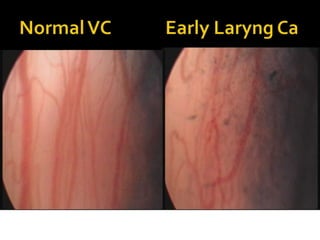
  • #22 1) CE image of blood vessels on normal vocal cords: Blood vessels are parallel to long axis of vocal cord; bifurcations and anastomoses are few 2) blood vessels in early laryngeal cancer: Increased number of blood vessels with increase in bifurcations and anastomoses. Decreased parallelity with long axis of vocal cord is also seen
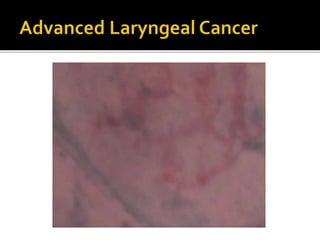
  • #23 CE image of blood vessels in advanced laryngeal cancer: Complete loss of parallelity, extensive anastomoses leading to formation of vascular loops
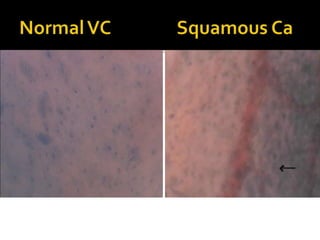
  • #24 normal vocal cord: Homogenous cells with uniform size and shape, N:C ratio uniform & less than 1, nuclei of uniform size & shape, no hyperchromatism or mitotic figures SQ CA: Increased number of cells per field, non homogenous distribution, size & shape of cells, nucleus shape & size varying in the same field, nuclei more darkly stained & larger in size, N:C ratio of more than one (arrow), mitotic figures present
  • #26 Lower 2/3rd pseudostrtfd ciliated columnar. Schneiderian membrne-
  • #32 Vascular patterns seen on CE of unstained lesions. A: Normal blood vessels in cheek. Minimal branching. No coiling or micro haemorrhages.Brisk Flow of RBCs inside the vessels. B: Numerous tufts of vessels seen in lichen planus. C: Numerous dilated blood vessels in erythroplakia D: Blood vessels in malignant lesion showed coiling, micro haemorrhages & increased tortuosity of vessels. Flow of RBCs inside the vessels was sluggish.
  • #33 A: CE image of normal cheek.Note the uniform pattern of cells and nuclei. Uniform Nuclear cytoplasmic ratio & less than one. No mitotic figure. B: Corresponding HPE image.Reactive changes with mild keratinisation is seen. C: CE image of leukoplakia of cheek. Cells uniform with normal N:C ratio. Acellular areas of keratin deposition present. D: Corresponding HPE image Reactive changes with acanthosis, keratinisation and inflammation in submucosa seen. Acanthosis –thickening of skin
  • #36 Anisokaryosis-size of nucleus varies
  • #38 Large and multiple areas examined quickly & in the same sitting as compared to limited areas assessed by biopsy Can help in deciding precise site for taking biopsy by identifying areas of cellular atypia which may improve the yield of biopsy.
  • #39 Can help in deciding margins of resection during tumour removal by differentiating tumour areas from normal mucosa.
  • #41 Early dysplasia first appears in the cells near basement membrane which are not seen on CE as the light as well as dye are unable to penetrate deeper than few superficial layers of the mucosa. invasive carcinoma is differentiated from carcinoma in situ by angioinvasion/neoangiogenesis at the level of basement membrane which may not be picked up by CE
  • #44 Inautofluorescence endoscopy, an emission spectrum is produced with a fixed excitation wavelength(375 to 440 nm), the autofluorescence is measured in the green spectrum between 470 and 800 nm. appearance & degree of autofluorescence depend on the structure of the examined tissue, especially the content of fluorophores, Fluorophores are predominantly proteins, eg, elastin and keratin, as well as NADH.
  • #45 Normal mucosa shows a bright green autofluorescence because of the translucent elastic fibers in the lamina propria. A significant decrease in fluorescence intensity is observed in areas with dysplastic and cancerous changes as a result of changes in tissue structure and metabolism. After visualization of the dysplastic or cancerous hot spots by autofluorescence, contact endoscopy was performed.
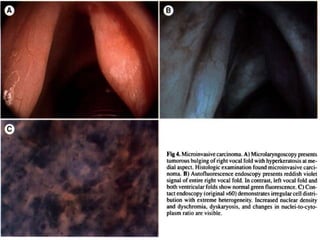
  • #46 Microinvasive carcinoma. A)Microlaryngoscopic view-tumorous bulging of right vocal fold with hyperkeratosis at medial aspect. Histologic examination found microinvasive carcinoma. B) Autofluorescence endoscopy presents reddish violet signal of entire right vocal fold. Left vocal fold & both ventricular folds show normal green fluorescence. C) Contact endoscopy demonstrates irregular cell distribution with extreme heterogeneity. Increased nuclear density & dyschromia. dyskaryosis, & changes in nuclei-to-cytoplasm ratio are visible.
  • #47 Grade I dyslasia Grade II dysplacia