SUBMITTED
BY --
Ashish Pratim
CONTENTS
1. Introduction
2. What are lipids ?
3. Organs involved
4. Types of lipase
5. Emulsifier
6. Digestion in buccal cavity
7. Digestion in stomach
8. Emulsification in intestine(duodenum)
9. Digestion in intestine(duodenum)
10. Absorption
11. Conclusion
12. References
Introduction
Digestion is the break down of large insoluble
food molecules into small water soluble food
molecules so that they can be absorbed into the
watery blood plasma.
Digestion can be divided into two processes
based on how food is broken down :
Mechanical digestion : the physical breakdown
of large food molecules into smaller pieces.
Chemical digestion : the enzymes breaks down
the food into the small molecules .
What are Lipids ?
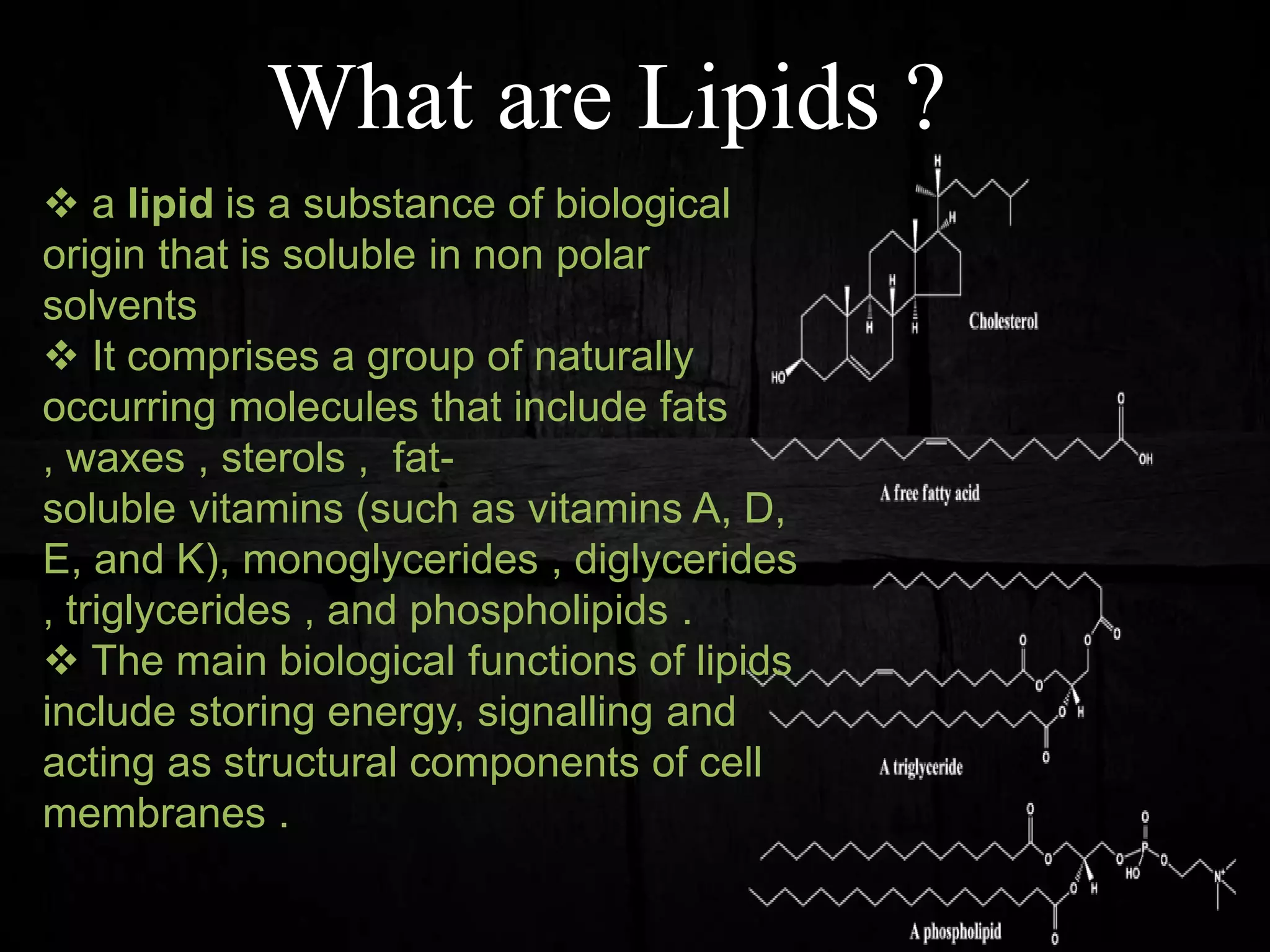
 a lipid is a substance of biological
origin that is soluble in non polar
solvents
 It comprises a group of naturally
occurring molecules that include fats
, waxes , sterols , fat-
soluble vitamins (such as vitamins A, D,
E, and K), monoglycerides , diglycerides
, triglycerides , and phospholipids .
 The main biological functions of lipids
include storing energy, signalling and
acting as structural components of cell
membranes .
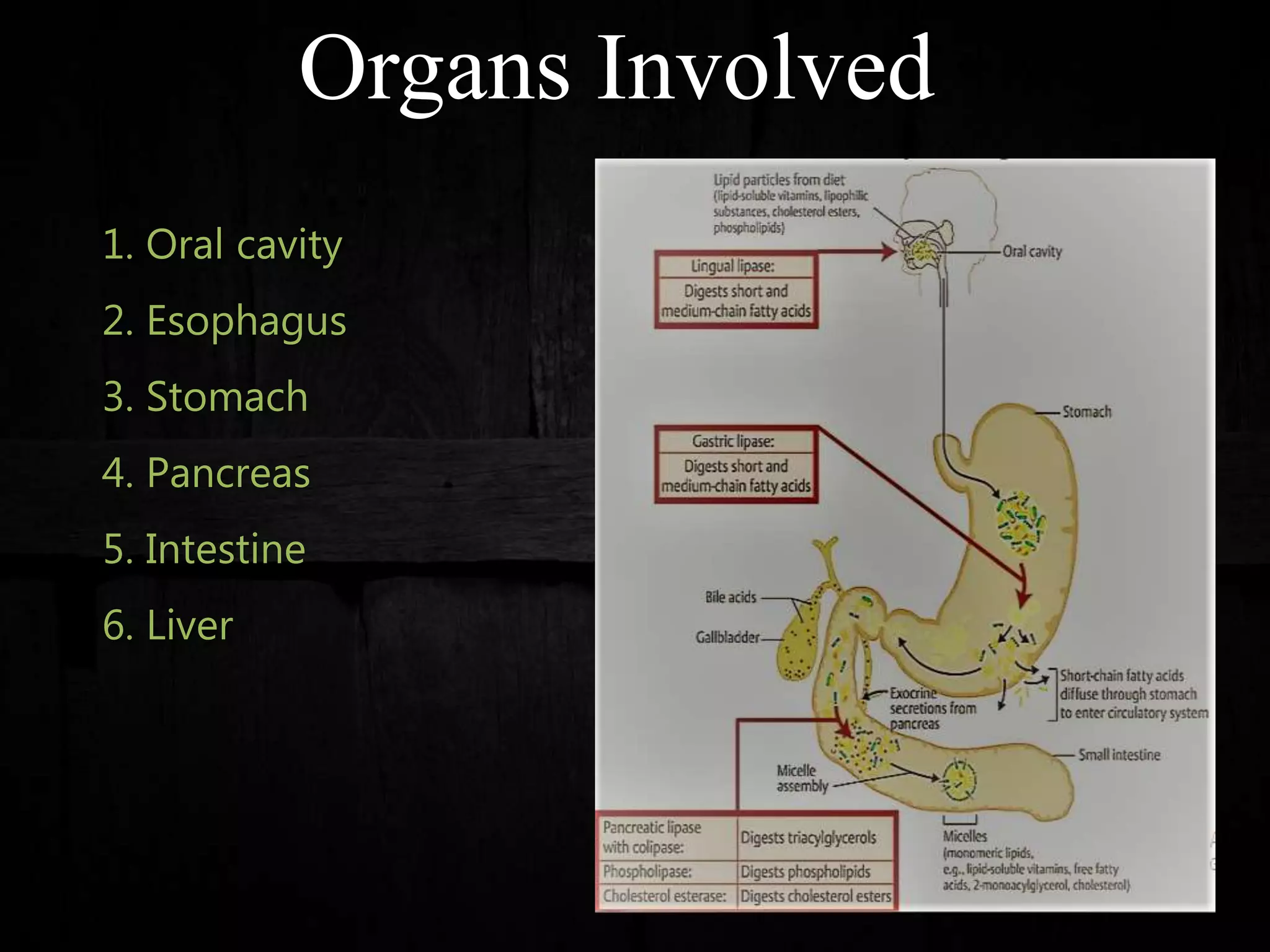
Organs Involved
1. Oral cavity
2. Esophagus
3. Stomach
4. Pancreas
5. Intestine
6. Liver
Types of Lipase
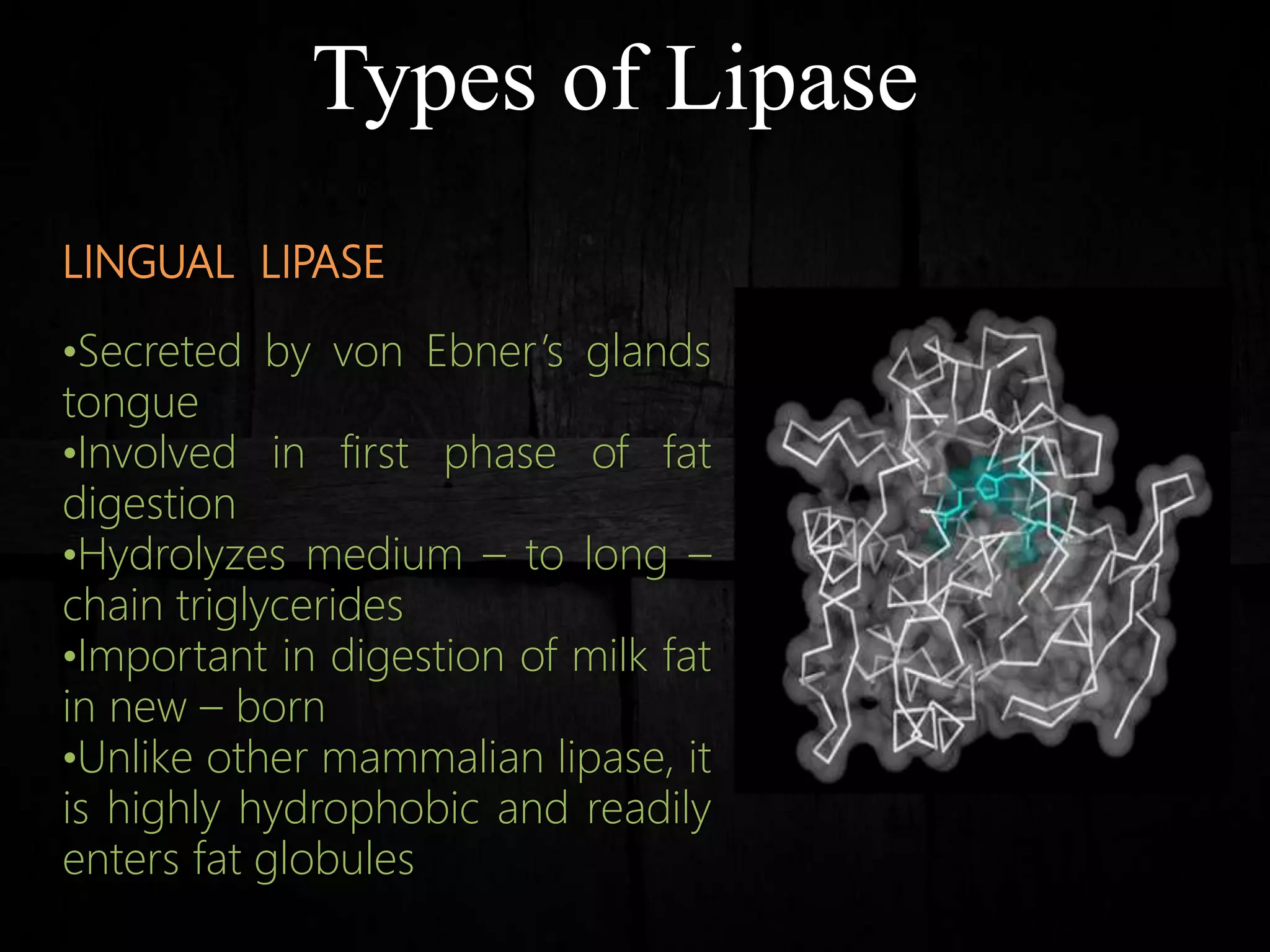
LINGUAL LIPASE
•Secreted by von Ebner’s glands
tongue
•Involved in first phase of fat
digestion
•Hydrolyzes medium – to long –
chain triglycerides
•Important in digestion of milk fat
in new – born
•Unlike other mammalian lipase, it
is highly hydrophobic and readily
enters fat globules
Types of Lipase
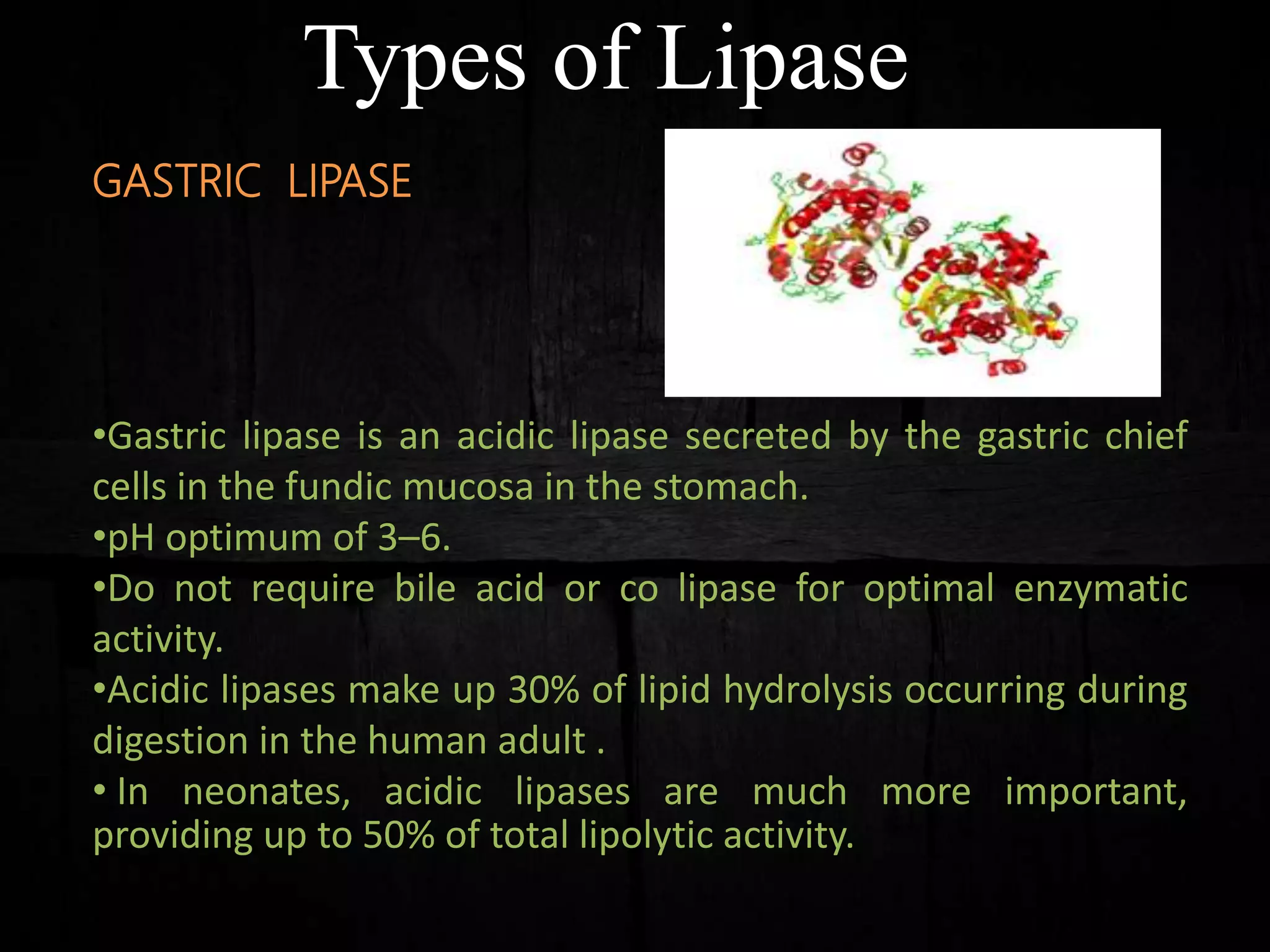
GASTRIC LIPASE
•Gastric lipase is an acidic lipase secreted by the gastric chief
cells in the fundic mucosa in the stomach.
•pH optimum of 3–6.
•Do not require bile acid or co lipase for optimal enzymatic
activity.
•Acidic lipases make up 30% of lipid hydrolysis occurring during
digestion in the human adult .
• In neonates, acidic lipases are much more important,
providing up to 50% of total lipolytic activity.
Types of Lipase
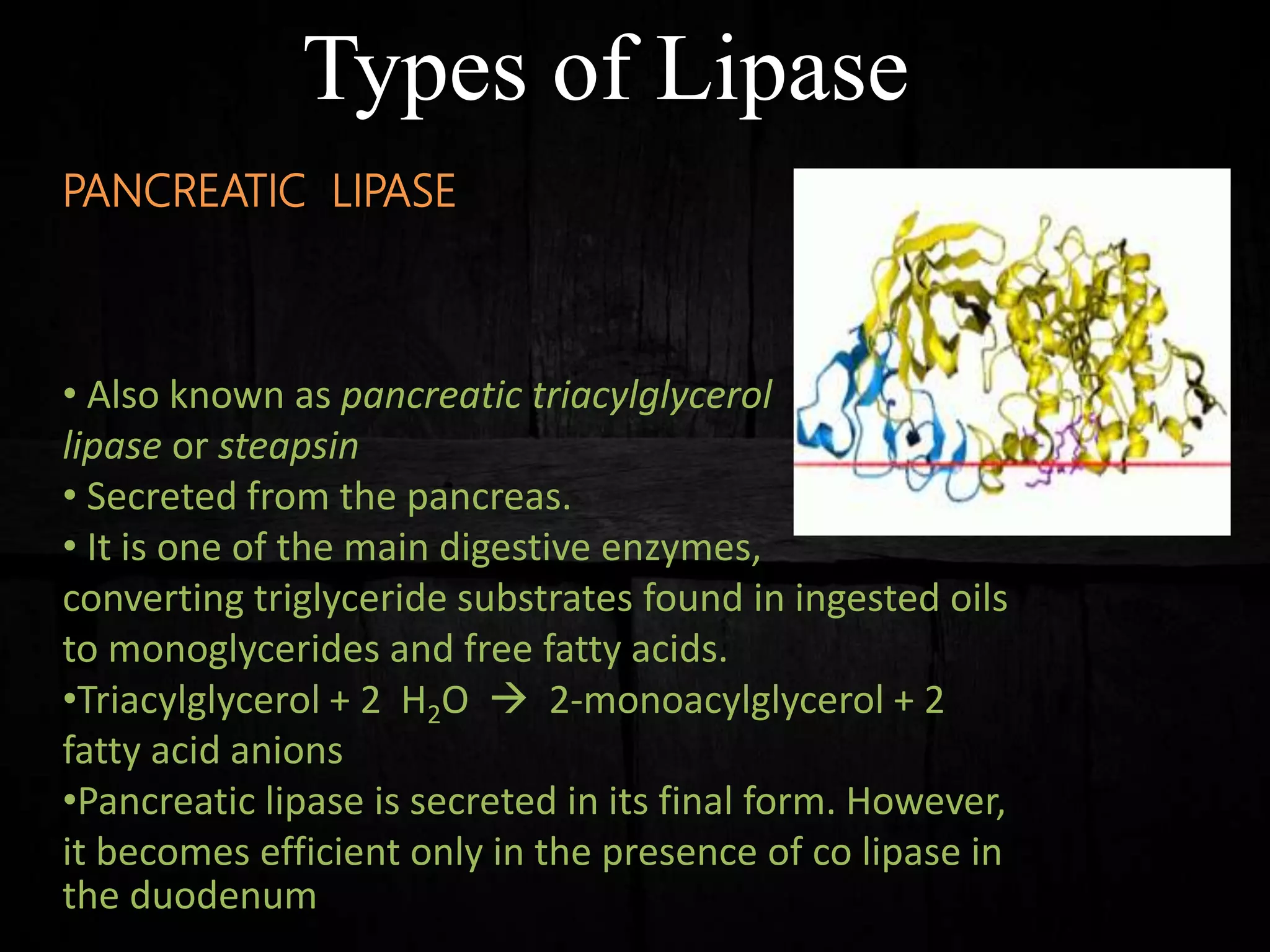
PANCREATIC LIPASE
• Also known as pancreatic triacylglycerol
lipase or steapsin
• Secreted from the pancreas.
• It is one of the main digestive enzymes,
converting triglyceride substrates found in ingested oils
to monoglycerides and free fatty acids.
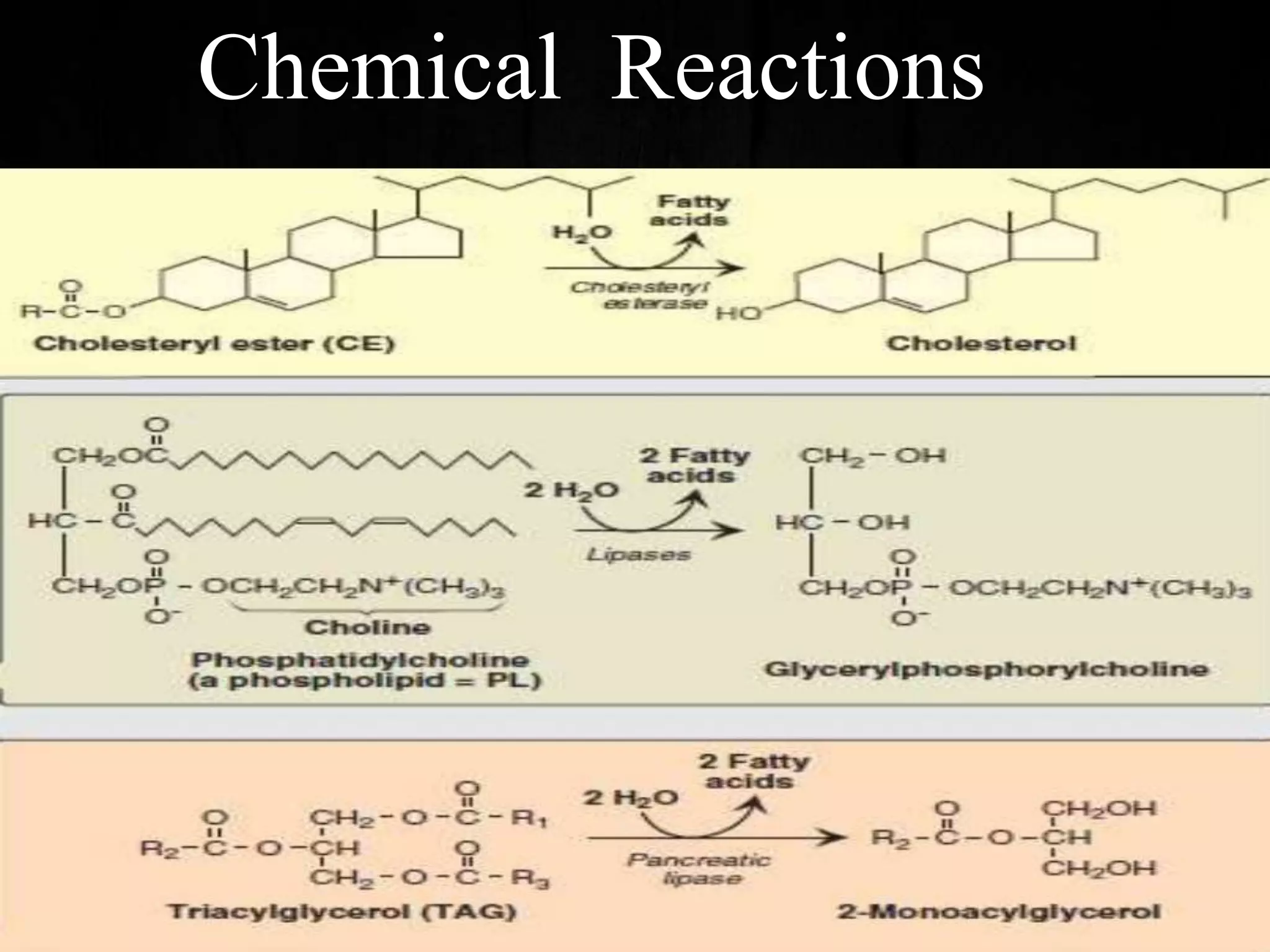
•Triacylglycerol + 2 H2O  2-monoacylglycerol + 2
fatty acid anions
•Pancreatic lipase is secreted in its final form. However,
it becomes efficient only in the presence of co lipase in
the duodenum
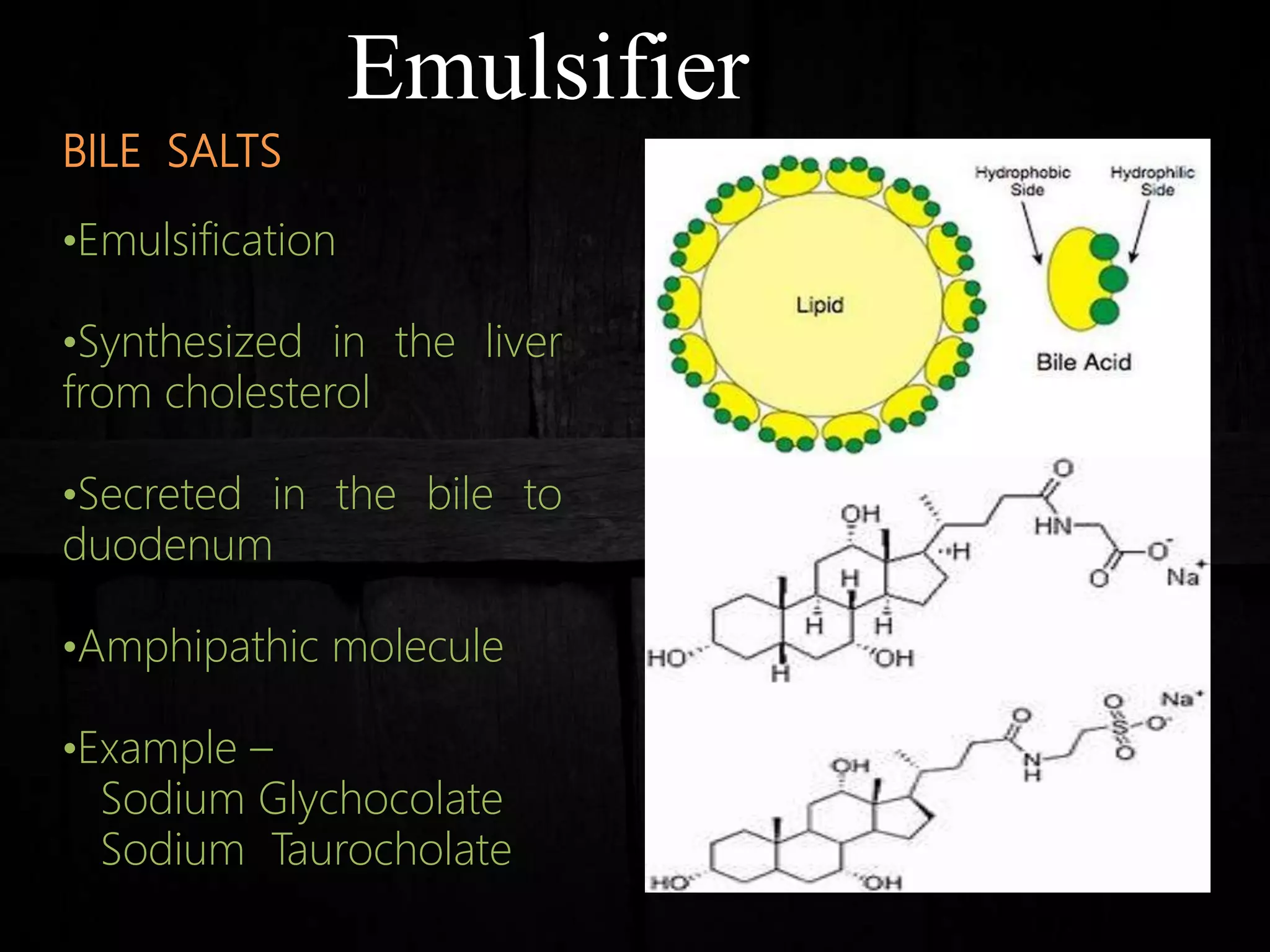
Emulsifier
BILE SALTS
•Emulsification
•Synthesized in the liver
from cholesterol
•Secreted in the bile to
duodenum
•Amphipathic molecule
•Example –
Sodium Glychocolate
Sodium Taurocholate
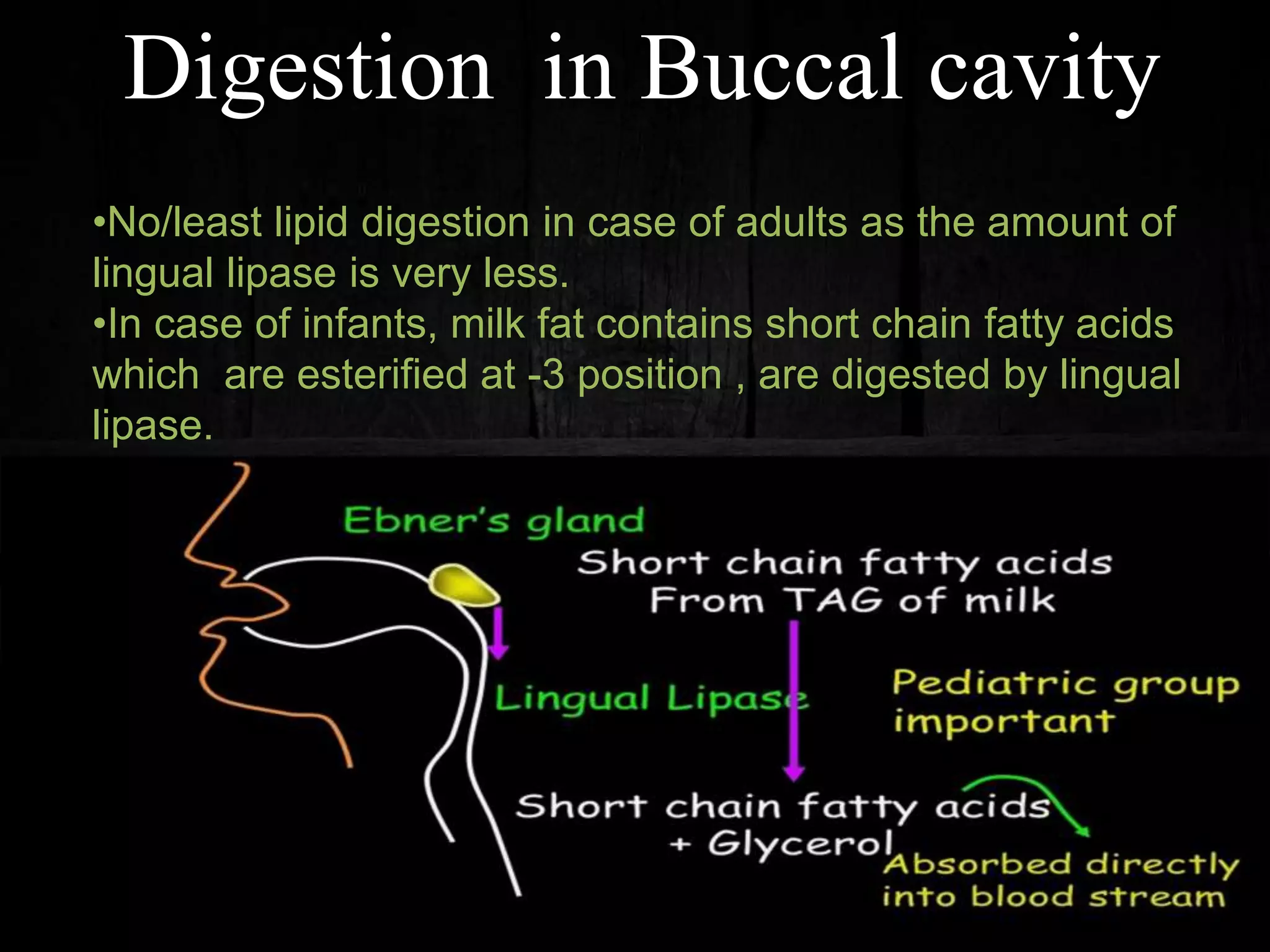
Digestion in Buccal cavity
•No/least lipid digestion in case of adults as the amount of
lingual lipase is very less.
•In case of infants, milk fat contains short chain fatty acids
which are esterified at -3 position , are digested by lingual
lipase.
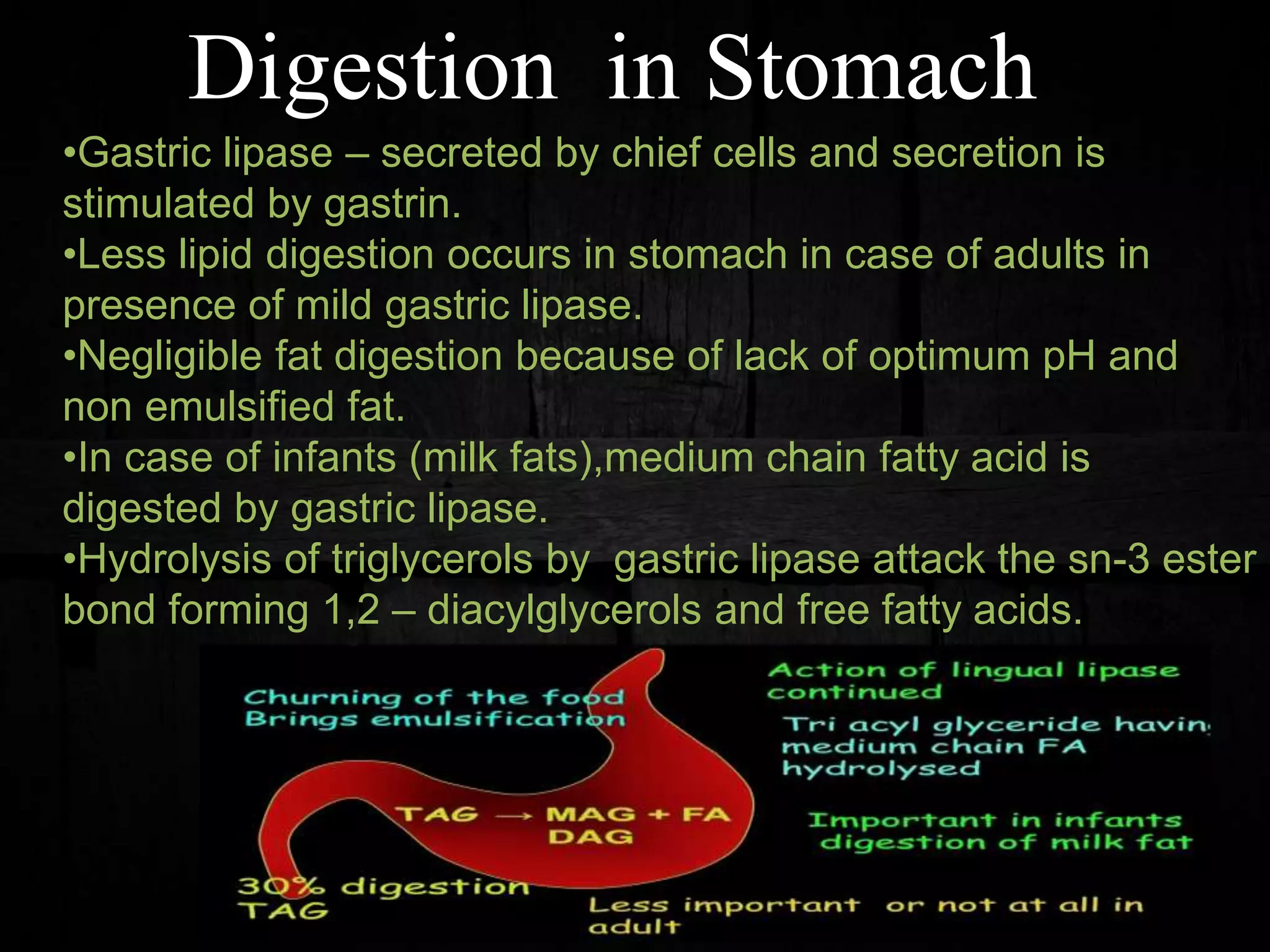
Digestion in Stomach
•Gastric lipase – secreted by chief cells and secretion is
stimulated by gastrin.
•Less lipid digestion occurs in stomach in case of adults in
presence of mild gastric lipase.
•Negligible fat digestion because of lack of optimum pH and
non emulsified fat.
•In case of infants (milk fats),medium chain fatty acid is
digested by gastric lipase.
•Hydrolysis of triglycerols by gastric lipase attack the sn-3 ester
bond forming 1,2 – diacylglycerols and free fatty acids.
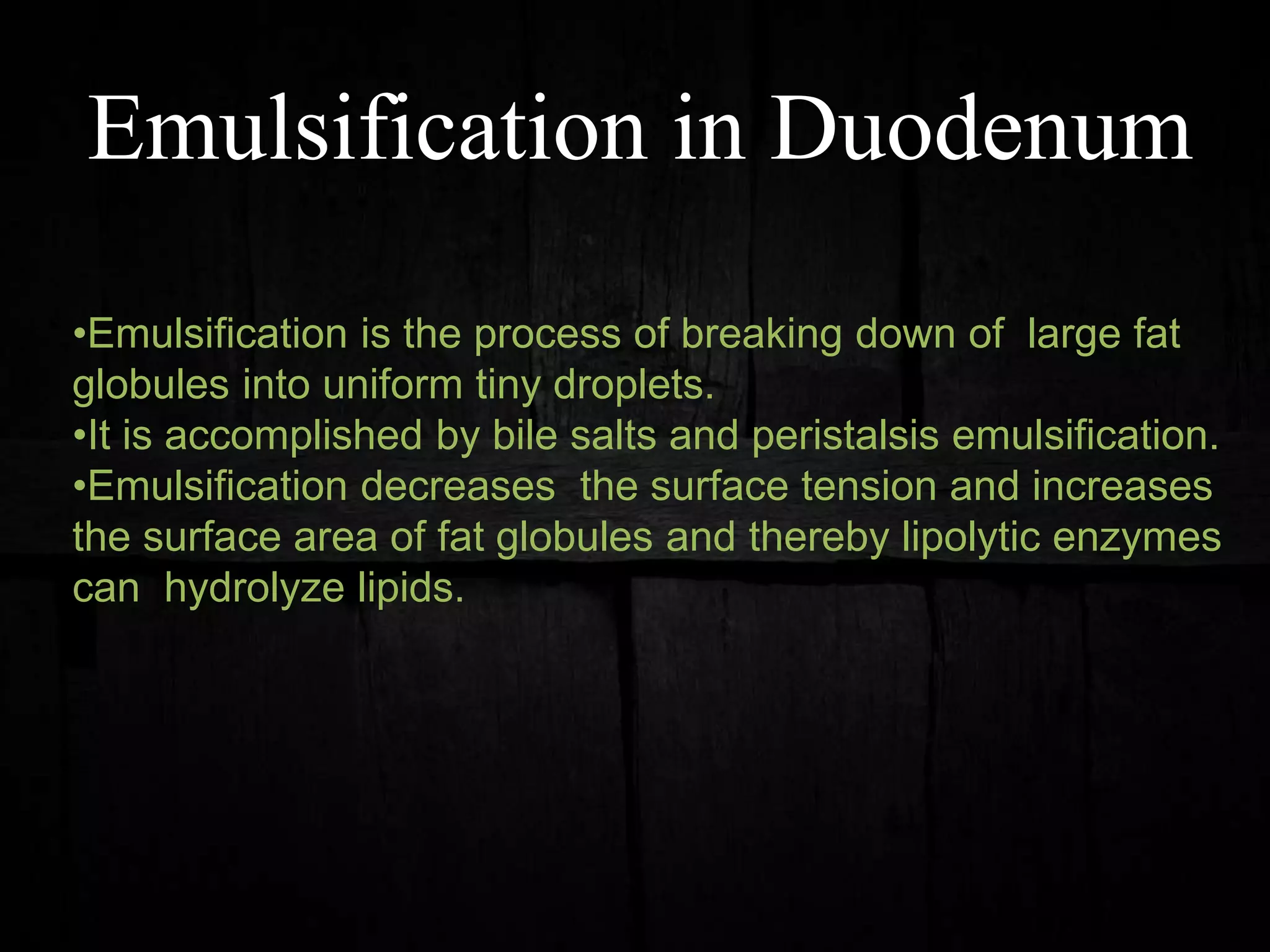
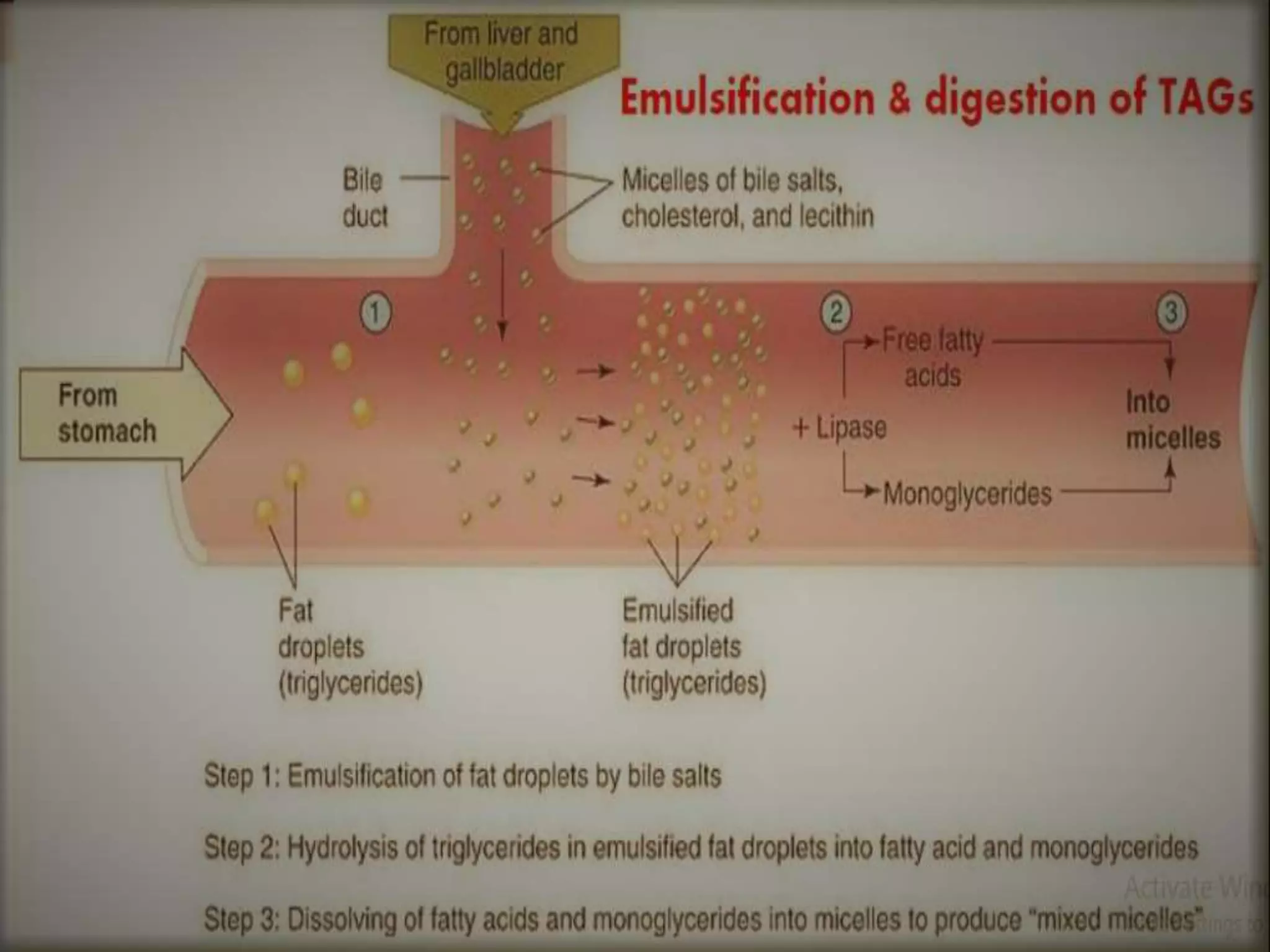
Emulsification in Duodenum
•Emulsification is the process of breaking down of large fat
globules into uniform tiny droplets.
•It is accomplished by bile salts and peristalsis emulsification.
•Emulsification decreases the surface tension and increases
the surface area of fat globules and thereby lipolytic enzymes
can hydrolyze lipids.
Digestion in Duodenum
•Major site of fat digestion
•Effective digestion due to the presence of bile salts
,pancreatic enzymes (pancreatic lipase , cholesteryl esterase)
which are present in the pancreatic juice .
• The pancreatic juice is stimulated by the secretion of
Secretin , Cholecystokinin Pancreozymin (CCK-PZ) , the
gastro intestinal hormones.
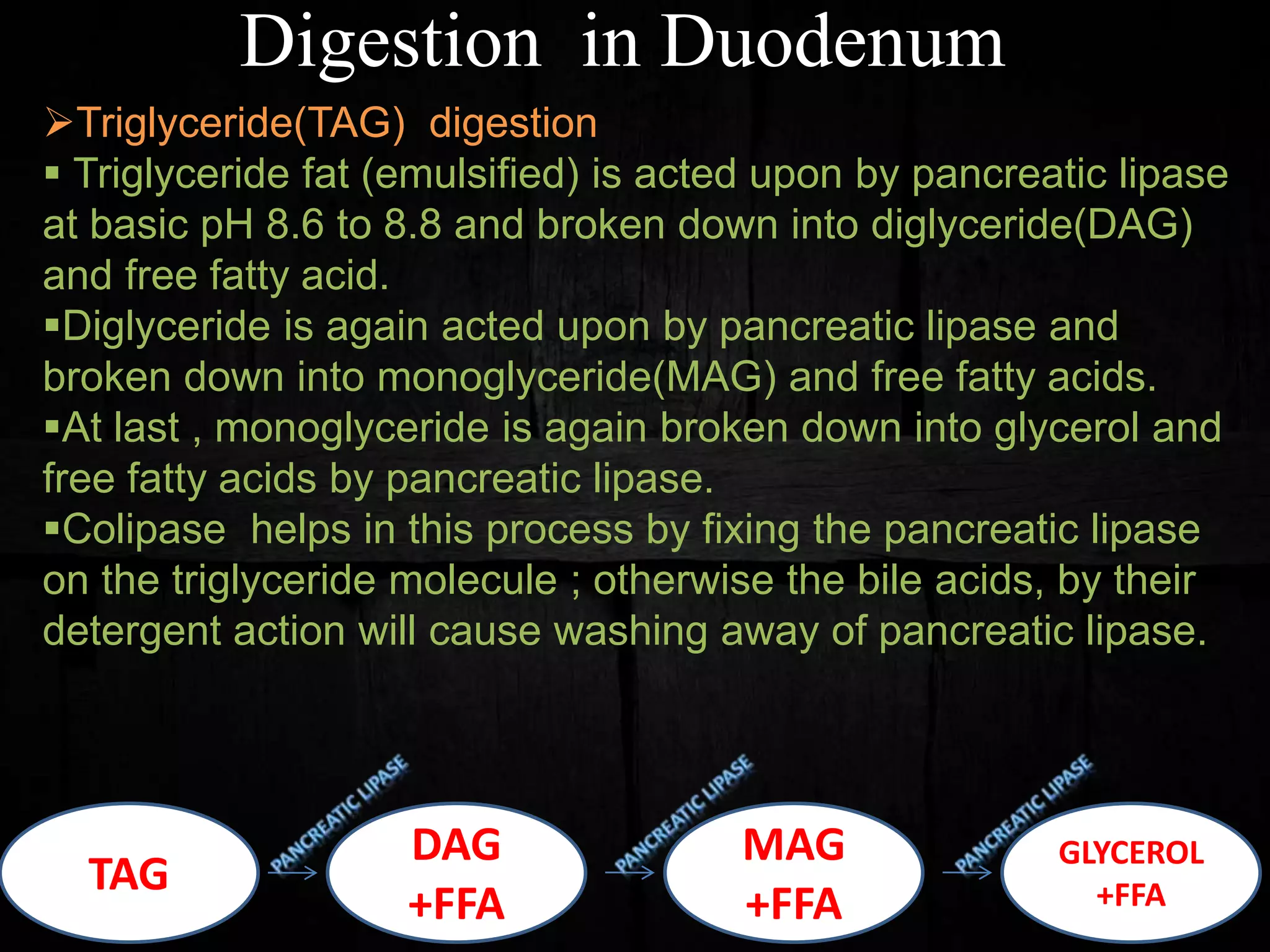
Triglyceride(TAG) digestion
 Triglyceride fat (emulsified) is acted upon by pancreatic lipase
at basic pH 8.6 to 8.8 and broken down into diglyceride(DAG)
and free fatty acid.
Diglyceride is again acted upon by pancreatic lipase and
broken down into monoglyceride(MAG) and free fatty acids.
At last , monoglyceride is again broken down into glycerol and
free fatty acids by pancreatic lipase.
Colipase helps in this process by fixing the pancreatic lipase
on the triglyceride molecule ; otherwise the bile acids, by their
detergent action will cause washing away of pancreatic lipase.
Digestion in Duodenum
TAG
DAG
+FFA
MAG
+FFA
GLYCEROL
+FFA
Digestion in Duodenum
Cholesteryl ester digestion
Cholesteryl ester is acted upon by cholesteryl esterase
,pancreatic hydrolase and broken down into free cholesterol
and a free fatty acid with a molecule of water.
Phospholipid digestion
Phospholipid is acted upon by lipases and broken down into
cholesterol and free fatty acids with two molecules of water.
Chemical Reactions
Absorption of Lipids
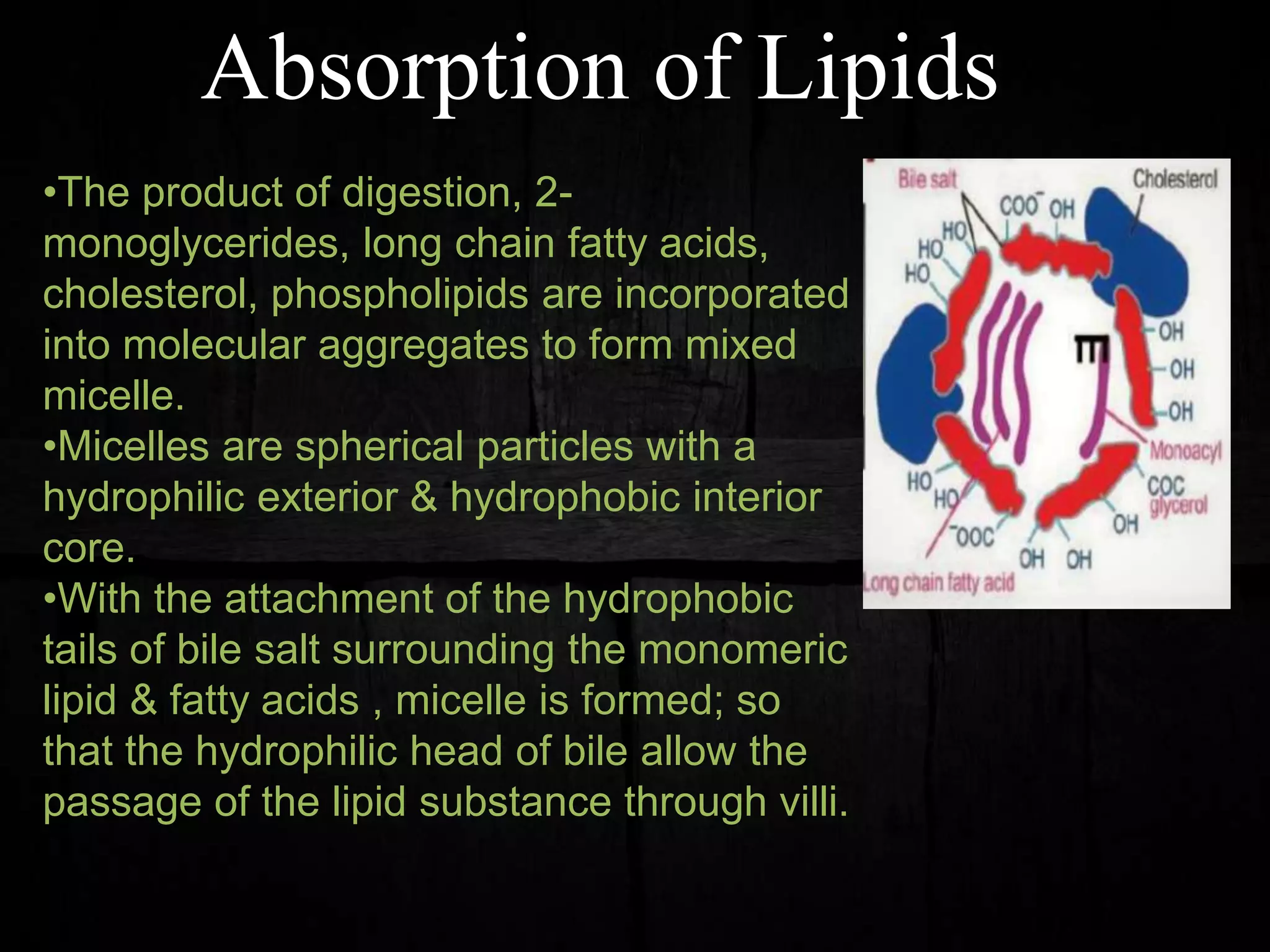
•The product of digestion, 2-
monoglycerides, long chain fatty acids,
cholesterol, phospholipids are incorporated
into molecular aggregates to form mixed
micelle.
•Micelles are spherical particles with a
hydrophilic exterior & hydrophobic interior
core.
•With the attachment of the hydrophobic
tails of bile salt surrounding the monomeric
lipid & fatty acids , micelle is formed; so
that the hydrophilic head of bile allow the
passage of the lipid substance through villi.
Absorption of Lipids
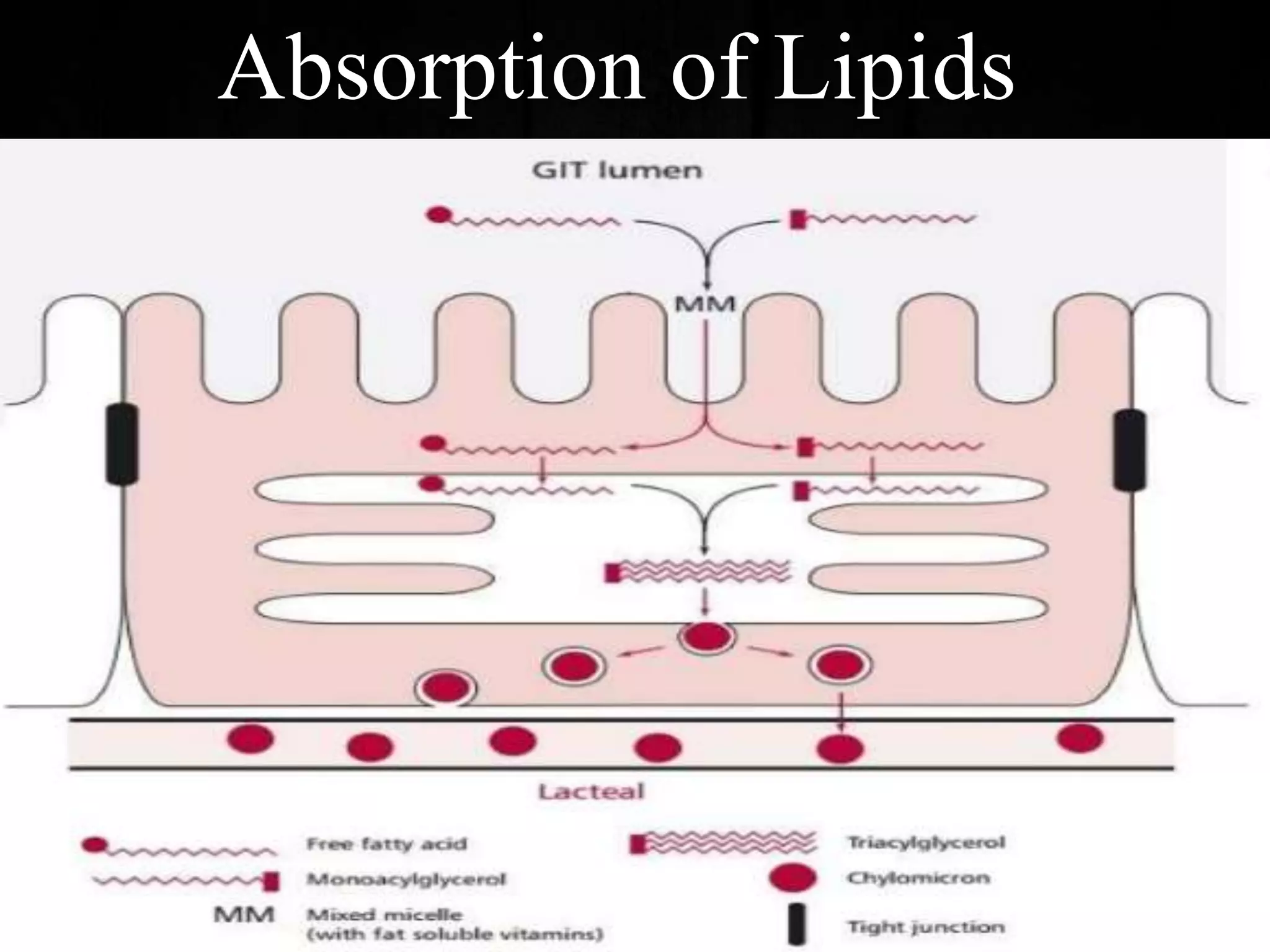
•The micelle is taken in by brush border epithelium by
pinocytosis.
•Inside the cells , the bile salts are removed.
•Medium & short chain fatty acids directly enter portal
circulation and are transported to liver.
•Passing through the Golgi body inside the cell, the long
chain fatty acid molecule get surrounded by protein coat;
structure called chilomicron. MAGs, cholesterol and
phospholipids are bind with it.
•Chilomicron is sent out to sub mucosa by exocytosis.
•Chilomicron is taken by lymphatic vassal (lacteal) from
sub mucosa.
•Lacteals take the chilomicron containing the fatty acid to
the main circulation and finally to liver.
Absorption of Lipids
Conclusion
So to summarize everything,
•Lipid consumption is essential for our daily dietary needs.
•Although break down and mastication of food takes place
in the mouth and first go to the stomach , no real digestion
takes place.
• Real lipid digestion takes place in the duodenum where it
is broken down into small small droplets molecules ,
secondly they are converted into MAG , glycerol and fatty
acid.
•Then get absorbed into the intestinal cells in the form of
mix micelle proceeded by turning into chilomicron and
taken away by lacteleals , which carry lipids to main blood
stream .
References
•Concise MEDICAL PHYSIOLOGY by SUJIT K. CHAUDHURI
(page 354-356)
•Trueman’s Elementary Biology by K.N. Bhatia & M.P. Tyagi
•https://www.youtube.com/watch?v=SyRAzyTk_rk&t=
51s
•https://www.youtube.com/watch?v=Ffe5TpJl-
bg&t=6s
•https://en.wikipedia.org/wiki/Digestion
•https://study.com/academy/lesson/lipids-digestion-
and-absorption.html
•https://www.ncbi.nlm.nih.gov/pubmed/15744090
Thank y u
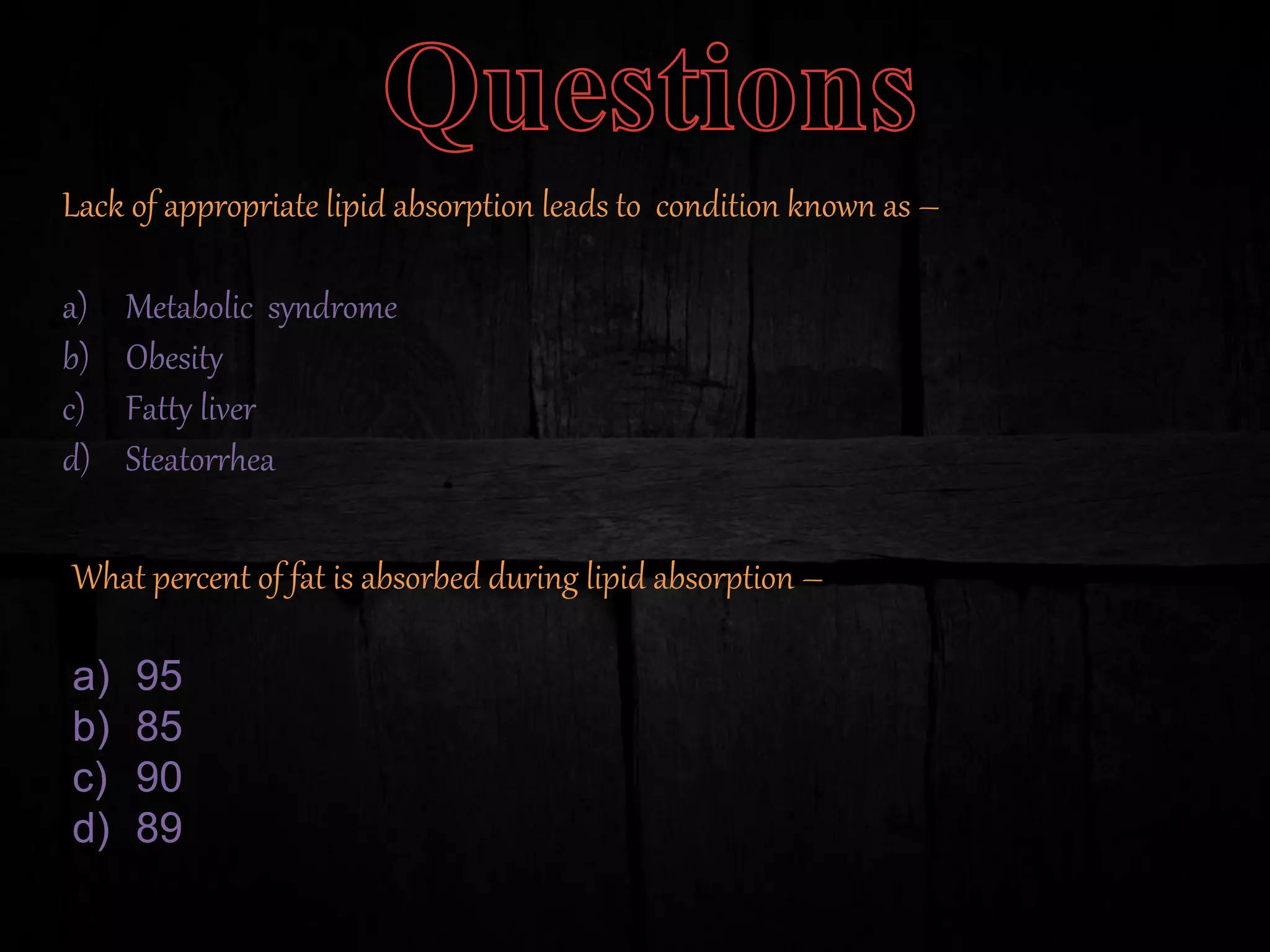
Lack of appropriate lipid absorption leads to condition known as –
a) Metabolic syndrome
b) Obesity
c) Fatty liver
d) Steatorrhea
What percent of fat is absorbed during lipid absorption –
a) 95
b) 85
c) 90
d) 89
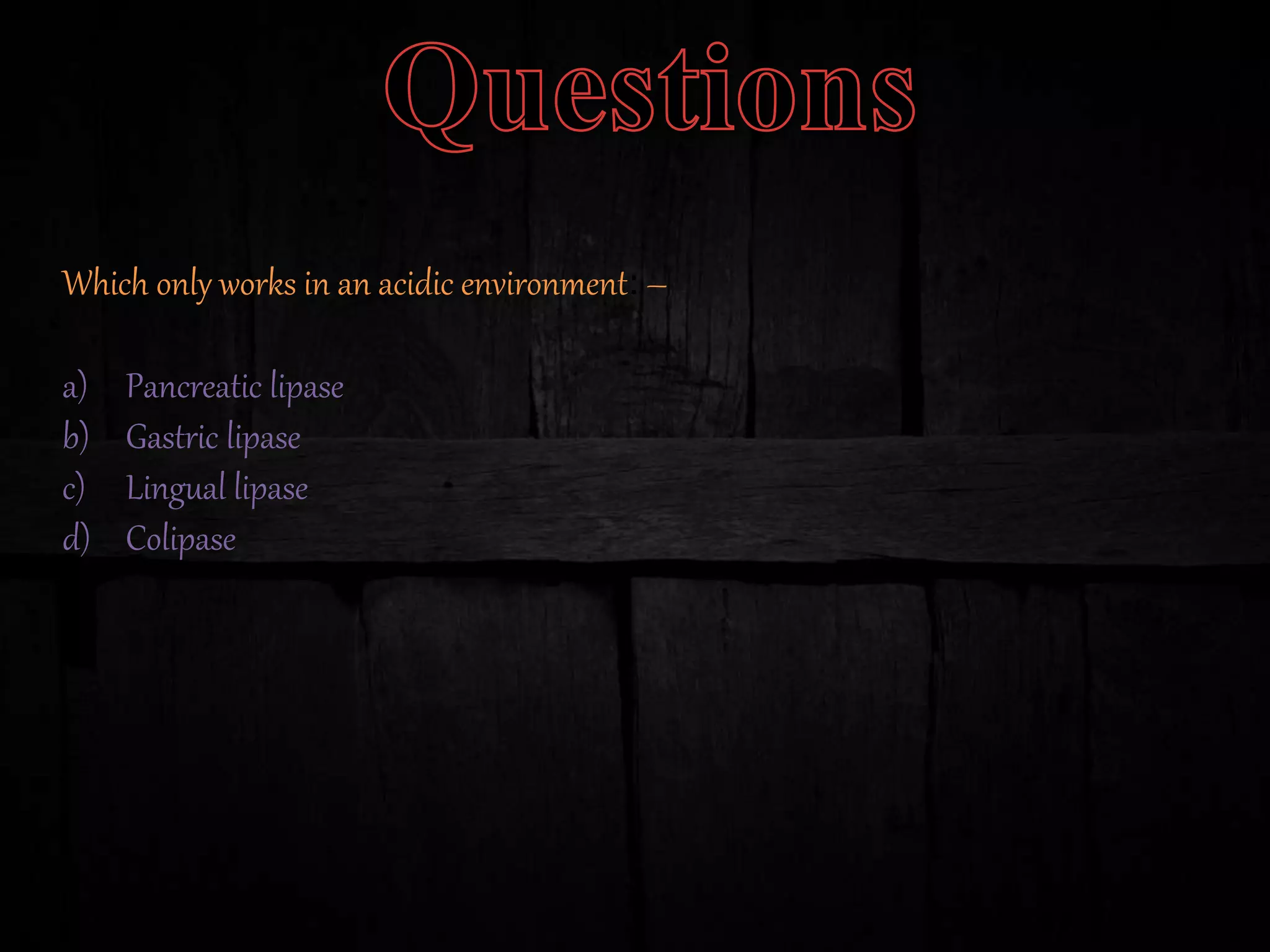
Which only works in an acidic environment: –
a) Pancreatic lipase
b) Gastric lipase
c) Lingual lipase
d) Colipase

Digestion of lipids

  • 1.
  • 2.
    CONTENTS 1. Introduction 2. Whatare lipids ? 3. Organs involved 4. Types of lipase 5. Emulsifier 6. Digestion in buccal cavity 7. Digestion in stomach 8. Emulsification in intestine(duodenum) 9. Digestion in intestine(duodenum) 10. Absorption 11. Conclusion 12. References
  • 3.
    Introduction Digestion is thebreak down of large insoluble food molecules into small water soluble food molecules so that they can be absorbed into the watery blood plasma. Digestion can be divided into two processes based on how food is broken down : Mechanical digestion : the physical breakdown of large food molecules into smaller pieces. Chemical digestion : the enzymes breaks down the food into the small molecules .
  • 4.
    What are Lipids?  a lipid is a substance of biological origin that is soluble in non polar solvents  It comprises a group of naturally occurring molecules that include fats , waxes , sterols , fat- soluble vitamins (such as vitamins A, D, E, and K), monoglycerides , diglycerides , triglycerides , and phospholipids .  The main biological functions of lipids include storing energy, signalling and acting as structural components of cell membranes .
  • 5.
    Organs Involved 1. Oralcavity 2. Esophagus 3. Stomach 4. Pancreas 5. Intestine 6. Liver
  • 6.
    Types of Lipase LINGUALLIPASE •Secreted by von Ebner’s glands tongue •Involved in first phase of fat digestion •Hydrolyzes medium – to long – chain triglycerides •Important in digestion of milk fat in new – born •Unlike other mammalian lipase, it is highly hydrophobic and readily enters fat globules
  • 7.
    Types of Lipase GASTRICLIPASE •Gastric lipase is an acidic lipase secreted by the gastric chief cells in the fundic mucosa in the stomach. •pH optimum of 3–6. •Do not require bile acid or co lipase for optimal enzymatic activity. •Acidic lipases make up 30% of lipid hydrolysis occurring during digestion in the human adult . • In neonates, acidic lipases are much more important, providing up to 50% of total lipolytic activity.
  • 8.
    Types of Lipase PANCREATICLIPASE • Also known as pancreatic triacylglycerol lipase or steapsin • Secreted from the pancreas. • It is one of the main digestive enzymes, converting triglyceride substrates found in ingested oils to monoglycerides and free fatty acids. •Triacylglycerol + 2 H2O  2-monoacylglycerol + 2 fatty acid anions •Pancreatic lipase is secreted in its final form. However, it becomes efficient only in the presence of co lipase in the duodenum
  • 9.
    Emulsifier BILE SALTS •Emulsification •Synthesized inthe liver from cholesterol •Secreted in the bile to duodenum •Amphipathic molecule •Example – Sodium Glychocolate Sodium Taurocholate
  • 10.
    Digestion in Buccalcavity •No/least lipid digestion in case of adults as the amount of lingual lipase is very less. •In case of infants, milk fat contains short chain fatty acids which are esterified at -3 position , are digested by lingual lipase.
  • 11.
    Digestion in Stomach •Gastriclipase – secreted by chief cells and secretion is stimulated by gastrin. •Less lipid digestion occurs in stomach in case of adults in presence of mild gastric lipase. •Negligible fat digestion because of lack of optimum pH and non emulsified fat. •In case of infants (milk fats),medium chain fatty acid is digested by gastric lipase. •Hydrolysis of triglycerols by gastric lipase attack the sn-3 ester bond forming 1,2 – diacylglycerols and free fatty acids.
  • 12.
    Emulsification in Duodenum •Emulsificationis the process of breaking down of large fat globules into uniform tiny droplets. •It is accomplished by bile salts and peristalsis emulsification. •Emulsification decreases the surface tension and increases the surface area of fat globules and thereby lipolytic enzymes can hydrolyze lipids.
  • 13.
    Digestion in Duodenum •Majorsite of fat digestion •Effective digestion due to the presence of bile salts ,pancreatic enzymes (pancreatic lipase , cholesteryl esterase) which are present in the pancreatic juice . • The pancreatic juice is stimulated by the secretion of Secretin , Cholecystokinin Pancreozymin (CCK-PZ) , the gastro intestinal hormones.
  • 14.
    Triglyceride(TAG) digestion  Triglyceridefat (emulsified) is acted upon by pancreatic lipase at basic pH 8.6 to 8.8 and broken down into diglyceride(DAG) and free fatty acid. Diglyceride is again acted upon by pancreatic lipase and broken down into monoglyceride(MAG) and free fatty acids. At last , monoglyceride is again broken down into glycerol and free fatty acids by pancreatic lipase. Colipase helps in this process by fixing the pancreatic lipase on the triglyceride molecule ; otherwise the bile acids, by their detergent action will cause washing away of pancreatic lipase. Digestion in Duodenum TAG DAG +FFA MAG +FFA GLYCEROL +FFA
  • 16.
    Digestion in Duodenum Cholesterylester digestion Cholesteryl ester is acted upon by cholesteryl esterase ,pancreatic hydrolase and broken down into free cholesterol and a free fatty acid with a molecule of water. Phospholipid digestion Phospholipid is acted upon by lipases and broken down into cholesterol and free fatty acids with two molecules of water.
  • 17.
  • 18.
    Absorption of Lipids •Theproduct of digestion, 2- monoglycerides, long chain fatty acids, cholesterol, phospholipids are incorporated into molecular aggregates to form mixed micelle. •Micelles are spherical particles with a hydrophilic exterior & hydrophobic interior core. •With the attachment of the hydrophobic tails of bile salt surrounding the monomeric lipid & fatty acids , micelle is formed; so that the hydrophilic head of bile allow the passage of the lipid substance through villi.
  • 19.
    Absorption of Lipids •Themicelle is taken in by brush border epithelium by pinocytosis. •Inside the cells , the bile salts are removed. •Medium & short chain fatty acids directly enter portal circulation and are transported to liver. •Passing through the Golgi body inside the cell, the long chain fatty acid molecule get surrounded by protein coat; structure called chilomicron. MAGs, cholesterol and phospholipids are bind with it. •Chilomicron is sent out to sub mucosa by exocytosis. •Chilomicron is taken by lymphatic vassal (lacteal) from sub mucosa. •Lacteals take the chilomicron containing the fatty acid to the main circulation and finally to liver.
  • 20.
  • 21.
    Conclusion So to summarizeeverything, •Lipid consumption is essential for our daily dietary needs. •Although break down and mastication of food takes place in the mouth and first go to the stomach , no real digestion takes place. • Real lipid digestion takes place in the duodenum where it is broken down into small small droplets molecules , secondly they are converted into MAG , glycerol and fatty acid. •Then get absorbed into the intestinal cells in the form of mix micelle proceeded by turning into chilomicron and taken away by lacteleals , which carry lipids to main blood stream .
  • 22.
    References •Concise MEDICAL PHYSIOLOGYby SUJIT K. CHAUDHURI (page 354-356) •Trueman’s Elementary Biology by K.N. Bhatia & M.P. Tyagi •https://www.youtube.com/watch?v=SyRAzyTk_rk&t= 51s •https://www.youtube.com/watch?v=Ffe5TpJl- bg&t=6s •https://en.wikipedia.org/wiki/Digestion •https://study.com/academy/lesson/lipids-digestion- and-absorption.html •https://www.ncbi.nlm.nih.gov/pubmed/15744090
  • 23.
  • 24.
    Lack of appropriatelipid absorption leads to condition known as – a) Metabolic syndrome b) Obesity c) Fatty liver d) Steatorrhea What percent of fat is absorbed during lipid absorption – a) 95 b) 85 c) 90 d) 89
  • 25.
    Which only worksin an acidic environment: – a) Pancreatic lipase b) Gastric lipase c) Lingual lipase d) Colipase

Editor's Notes

  • #13 Peristalsis is a series of wave-like muscle contractions that moves food to different processing stations in the digestive tract.